
Integrating CrossCurricular Reading Strategies into High School Curriculum

- Slides: 43
Integrating Cross-Curricular Reading Strategies into High. School Curriculum Hinsdale South High School: Darien, IL Randy Brogan: Reading Specialist/Science Co-Teacher Lisa Elo: English & reading teacher, Rt. I Reading Co-Chair Mike Moretti: Social Studies Teacher Cory Sargent : Science Teacher
Integrating Cross-Curricular Reading Strategies into High. School Curriculum Secondary content-area teachers will introduce, demonstrate, and instruct participants on how research -based reading strategies such as setting a purpose, Gist and QAR (Question, Answer, Response) are utilized across the curriculum to assist in delivering essential content. Participants will leave the workshop with examples, rubrics, and a plan for seamless integration into pre-existing curriculum. This presentation is based upon the experience and content of five years of RTI reading strategy implementation at Hinsdale South High School in Darien, IL.
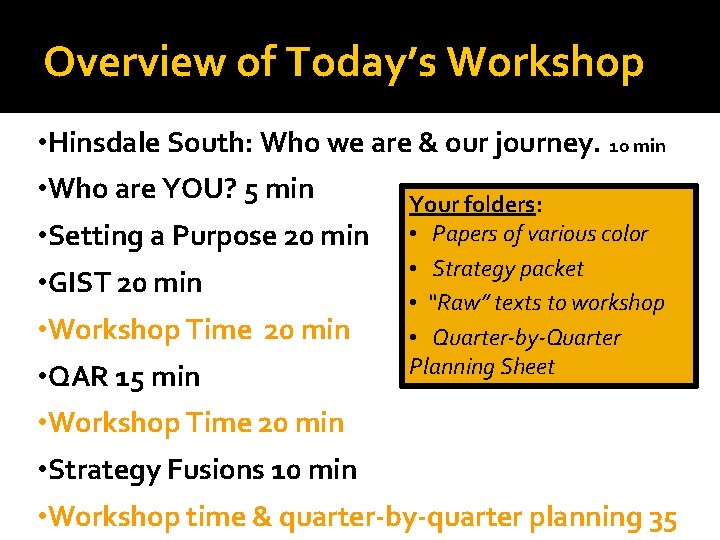
Overview of Today’s Workshop • Hinsdale South: Who we are & our journey. 10 min • Who are YOU? 5 min • Setting a Purpose 20 min • GIST 20 min • Workshop Time 20 min • QAR 15 min Your folders: • Papers of various color • Strategy packet • “Raw” texts to workshop • Quarter-by-Quarter Planning Sheet • Workshop Time 20 min • Strategy Fusions 10 min • Workshop time & quarter-by-quarter planning 35
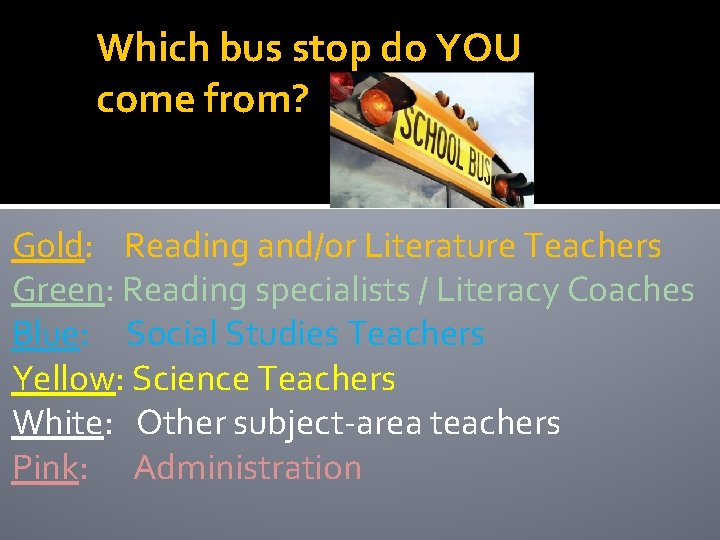
Which bus stop do YOU come from? Gold: Reading and/or Literature Teachers Green: Reading specialists / Literacy Coaches Blue: Social Studies Teachers Yellow: Science Teachers White: Other subject-area teachers Pink: Administration
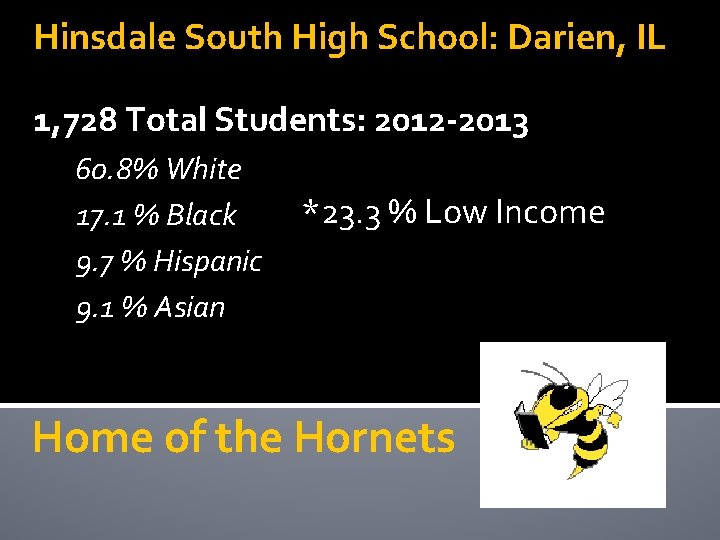
Hinsdale South High School: Darien, IL 1, 728 Total Students: 2012 -2013 60. 8% White 17. 1 % Black 9. 7 % Hispanic 9. 1 % Asian *23. 3 % Low Income Home of the Hornets
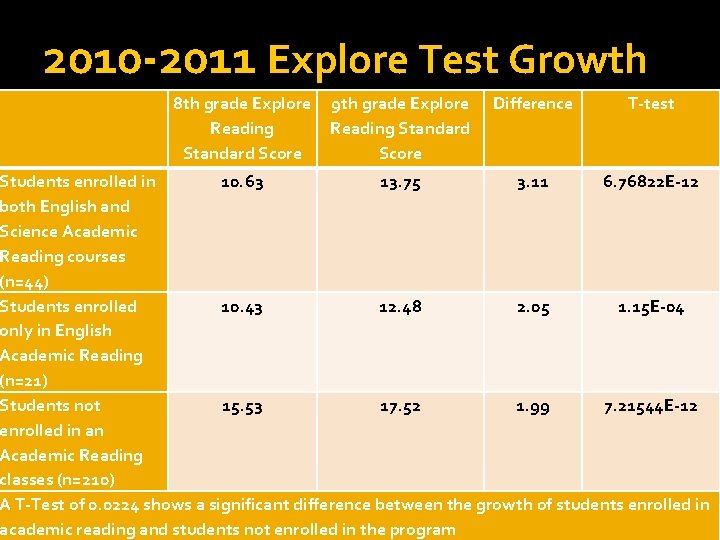
2010 -2011 Explore Test Growth 8 th grade Explore Reading Standard Score 9 th grade Explore Reading Standard Score Difference T-test Students enrolled in 10. 63 13. 75 3. 11 6. 76822 E-12 both English and Science Academic Reading courses (n=44) Students enrolled 10. 43 12. 48 2. 05 1. 15 E-04 only in English Academic Reading (n=21) Students not 15. 53 17. 52 1. 99 7. 21544 E-12 enrolled in an Academic Reading classes (n=210) A T-Test of 0. 0224 shows a significant difference between the growth of students enrolled in academic reading and students not enrolled in the program
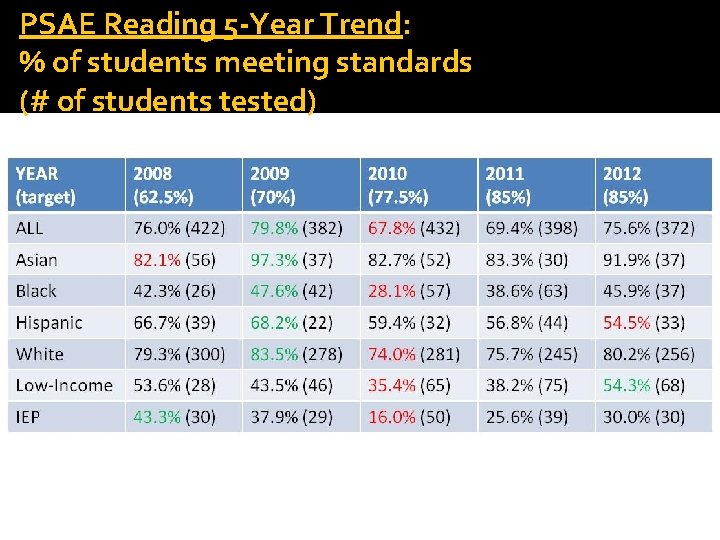
PSAE Reading 5 -Year Trend: % of students meeting standards (# of students tested)
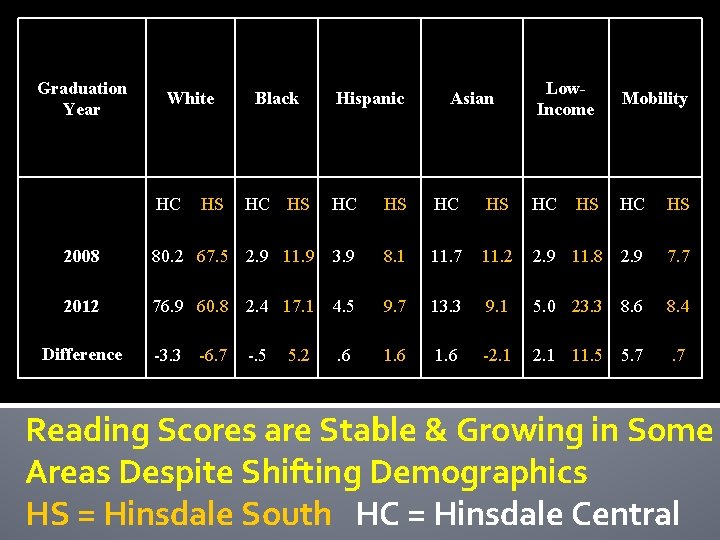
Graduation Year White HC Hispanic Asian Low. Income HC HS HC HC HS 2008 80. 2 67. 5 2. 9 11. 9 3. 9 8. 1 11. 7 11. 2 2. 9 11. 8 2. 9 7. 7 2012 76. 9 60. 8 2. 4 17. 1 4. 5 9. 7 13. 3 9. 1 5. 0 23. 3 8. 6 8. 4 -3. 3 -6. 7 . 6 1. 6 -2. 1 11. 5 5. 7 -. 5 5. 2 HS Mobility HC HS Difference HS Black Reading Scores are Stable & Growing in Some Areas Despite Shifting Demographics HS = Hinsdale South HC = Hinsdale Central
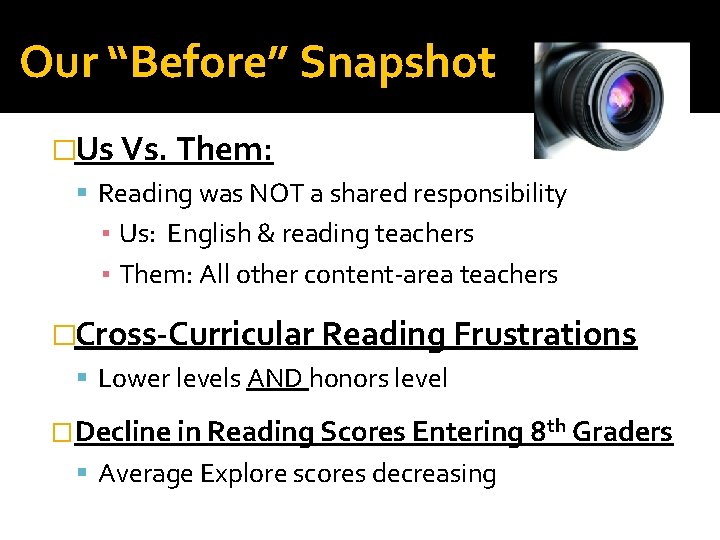
Our “Before” Snapshot �Us Vs. Them: Reading was NOT a shared responsibility ▪ Us: English & reading teachers ▪ Them: All other content-area teachers �Cross-Curricular Reading Frustrations Lower levels AND honors level �Decline in Reading Scores Entering 8 th Graders Average Explore scores decreasing
How Did We Start? � 2007: School & District Improvement Plan (NCLB) � 2008: Rt. I Movement *By 2009, IL requires RTI Plan Reading Subcommittee Math Subcommittee Behavior Subcommittee
Formulated Rt. I Reading Committee �School-wide representation �Reading surveys via “liasons” & compiled concerns �Matched strategies to areas of weakness �Launched strategies by grade level: Freshman: Fall, 2009 Sophomore: Fall, 2010 Junior: Fall, 2013
#1 Concern: Poor Comprehension & Retention �“How much are our students retaining when they read. Simple material at times seems to be a problem, why? ” (Physical Education). �“Students don’t read for comprehension—especially when it comes to inferred meanings—and they struggle with retention of material” (Foreign Language). �“Students do not read for understanding, rather they read to complete an assignment” (Science).
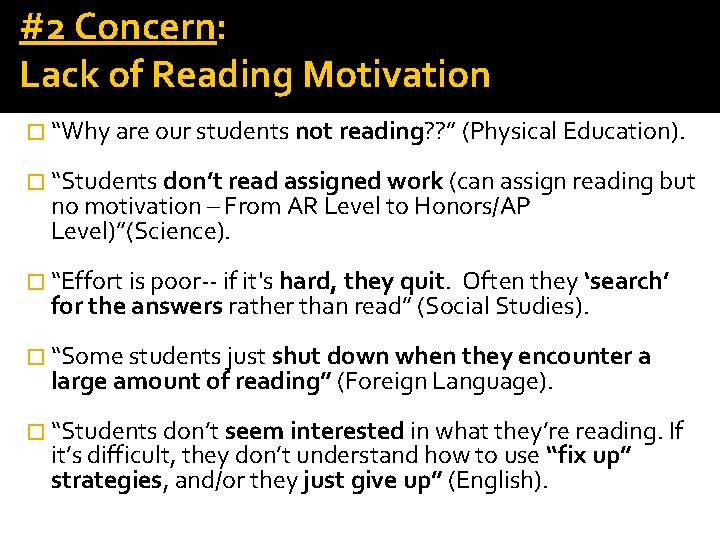
#2 Concern: Lack of Reading Motivation � “Why are our students not reading? ? ” (Physical Education). � “Students don’t read assigned work (can assign reading but no motivation – From AR Level to Honors/AP Level)”(Science). � “Effort is poor-- if it's hard, they quit. Often they ‘search’ for the answers rather than read” (Social Studies). � “Some students just shut down when they encounter a large amount of reading” (Foreign Language). � “Students don’t seem interested in what they’re reading. If it’s difficult, they don’t understand how to use “fix up” strategies, and/or they just give up” (English).
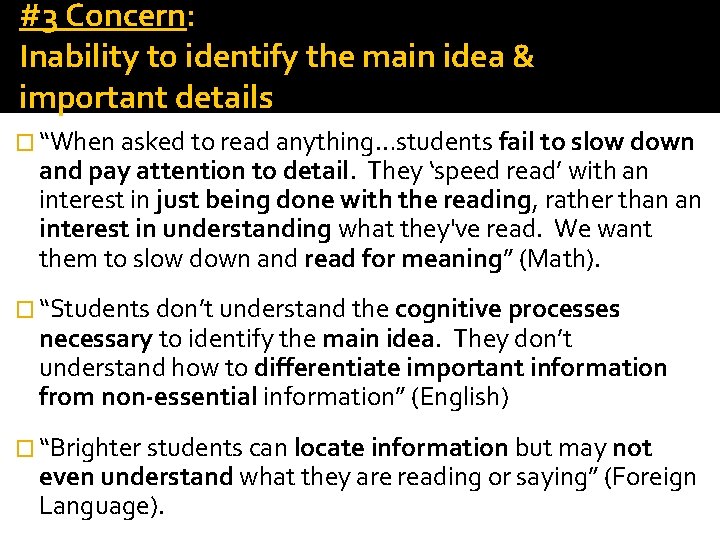
#3 Concern: Inability to identify the main idea & important details � “When asked to read anything…students fail to slow down and pay attention to detail. They ‘speed read’ with an interest in just being done with the reading, rather than an interest in understanding what they've read. We want them to slow down and read for meaning” (Math). � “Students don’t understand the cognitive processes necessary to identify the main idea. They don’t understand how to differentiate important information from non-essential information” (English) � “Brighter students can locate information but may not even understand what they are reading or saying” (Foreign Language).
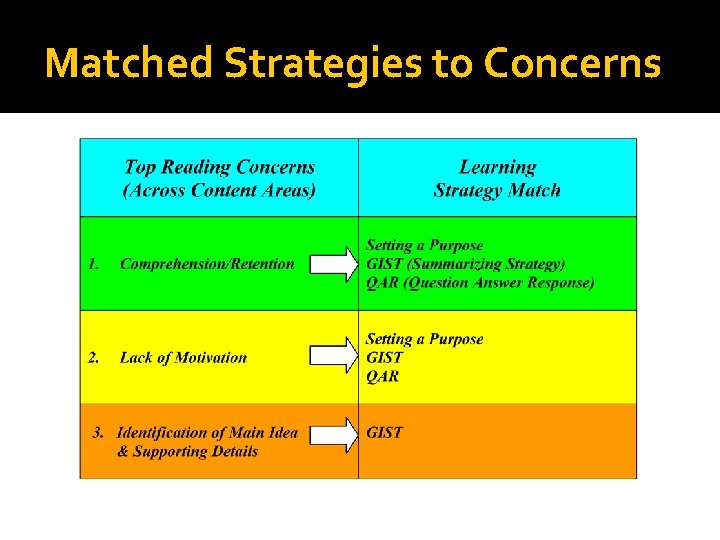
Matched Strategies to Concerns
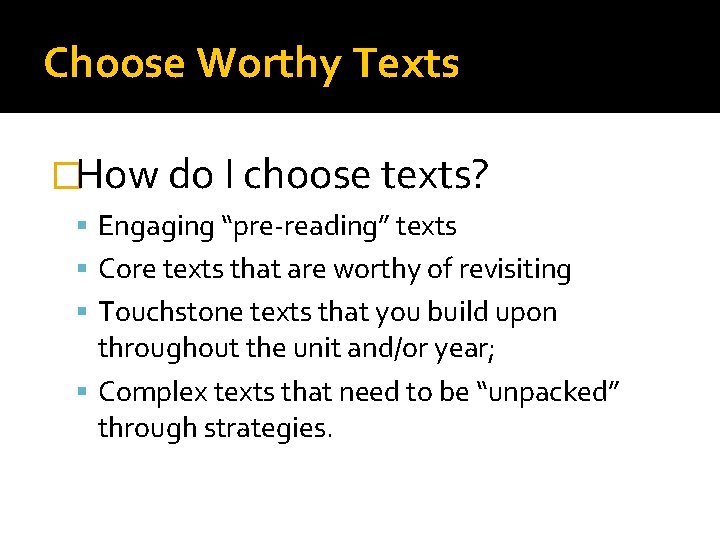
Choose Worthy Texts �How do I choose texts? Engaging “pre-reading” texts Core texts that are worthy of revisiting Touchstone texts that you build upon throughout the unit and/or year; Complex texts that need to be “unpacked” through strategies.
Setting a Purpose: Strategy 1 Increases comprehension, retention, motivation, and the students’ ability to identify the main idea. *Page 2
Setting a Purpose: Providing a Target for Your Students What is setting a purpose? Setting a purpose is simply providing your students a reason for reading. More active and proficient readers are able to set their own purpose; however, it is essential to teach this skill.
Why is setting a purpose so effective? �Setting a purpose is effective because it provides your students a target for reading. Because students have a clear expectation for the reading assignment, this strategy increases motivation, comprehension, and retention. �Students who do not have a purpose for reading often do not focus on the important information in the reading. They are often distracted by trivial, unimportant details instead of the main ideas (the “big picture” essentials) of the reading.
Shopping List: A Purpose If you don’t go to the store with a list, you come home with everything, especially things you don’t need. It could also take you an extremely long time to find everything.
Setting a Purpose: Strategy 1 Non-model & model demonstration. *Page 3 The POWER of setting a purpose!
Purpose Non-Examples: Teacher: Read chapter 2 for homework. Student: Why? Teacher: “Because I said so. ”
Setting a Purpose: * Please see provided handouts for other purpose models.
GIST: Strategy 2 Increases comprehension, retention, motivation, and the students’ ability to identify the main idea. *Pages 5 - 13
What is GIST? �Gist is a strategy that requires students to utilize approximately twenty words to write a summary of the assigned reading. The summary must include the main idea and essential details extracted from the following questions: Who? What? Where? When? Why? How? Note: The student does NOT need to answer all six questions in his/her summary. They are to select the most essential pieces of information to support the main idea.
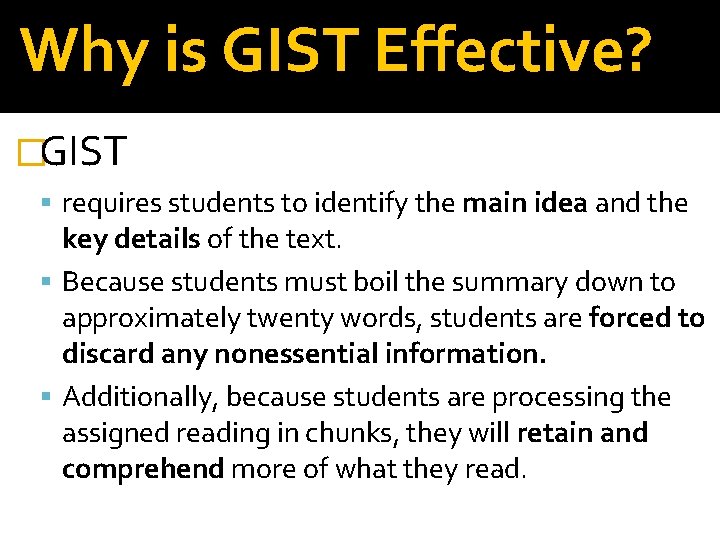
Why is GIST Effective? �GIST requires students to identify the main idea and the key details of the text. Because students must boil the summary down to approximately twenty words, students are forced to discard any nonessential information. Additionally, because students are processing the assigned reading in chunks, they will retain and comprehend more of what they read.
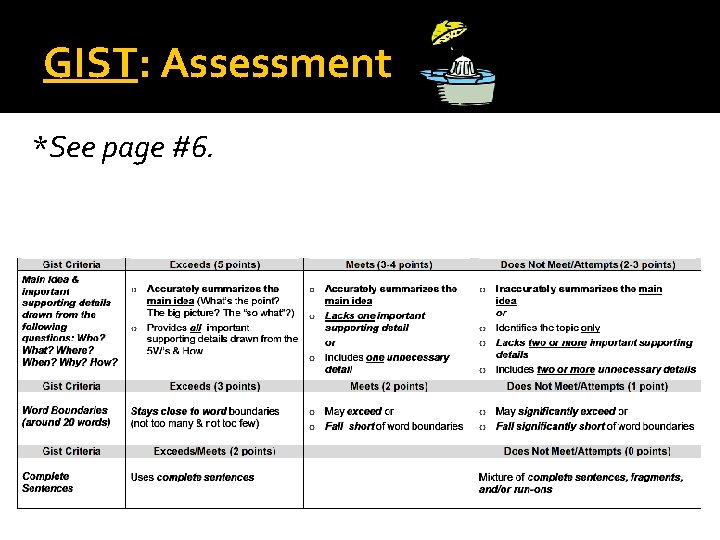
GIST: Assessment *See page #6.
GIST: Strategy 2 Science models! *Page 7
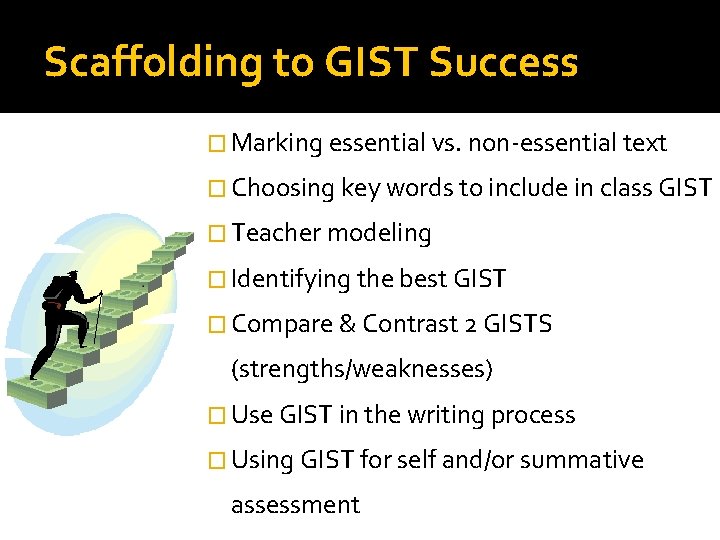
Scaffolding to GIST Success � Marking essential vs. non-essential text � Choosing key words to include in class GIST � Teacher modeling � Identifying the best GIST � Compare & Contrast 2 GISTS (strengths/weaknesses) � Use GIST in the writing process � Using GIST for self and/or summative assessment
GIST: Workshop Time
QAR: Strategy 3 Increases comprehension, retention, motivation, and the students’ ability to identify the central ideas of a text. *Pages 14 - 27
QAR: Strategy 3 Model: Strong Vs. Poor Questions
Scaffolding to QAR Success �Gradual Release of Responsibility Side-by-Side: Poor Questions Vs. HLT Questions QAR question identification with common text �Specific Reading Purpose + QAR Question Assignment – QAR “Stems” Provided �Student Completed Assignment Vs. Teacher-Created Questions
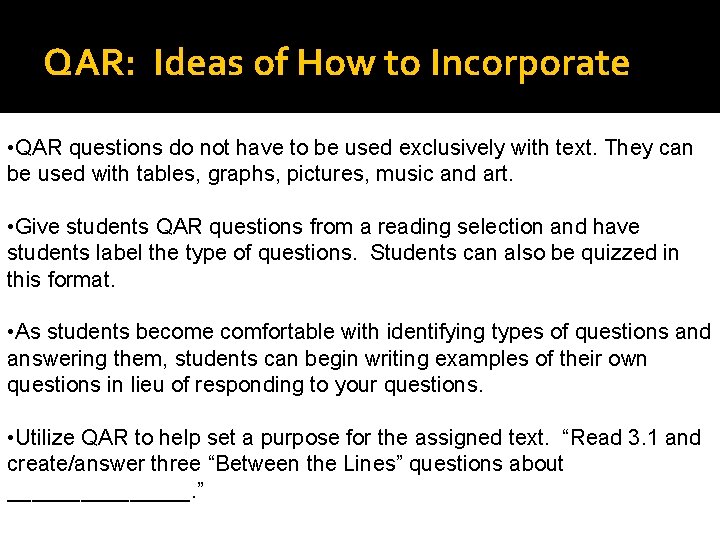
QAR: Ideas of How to Incorporate • QAR questions do not have to be used exclusively with text. They can be used with tables, graphs, pictures, music and art. • Give students QAR questions from a reading selection and have students label the type of questions. Students can also be quizzed in this format. • As students become comfortable with identifying types of questions and answering them, students can begin writing examples of their own questions in lieu of responding to your questions. • Utilize QAR to help set a purpose for the assigned text. “Read 3. 1 and create/answer three “Between the Lines” questions about ________. ”
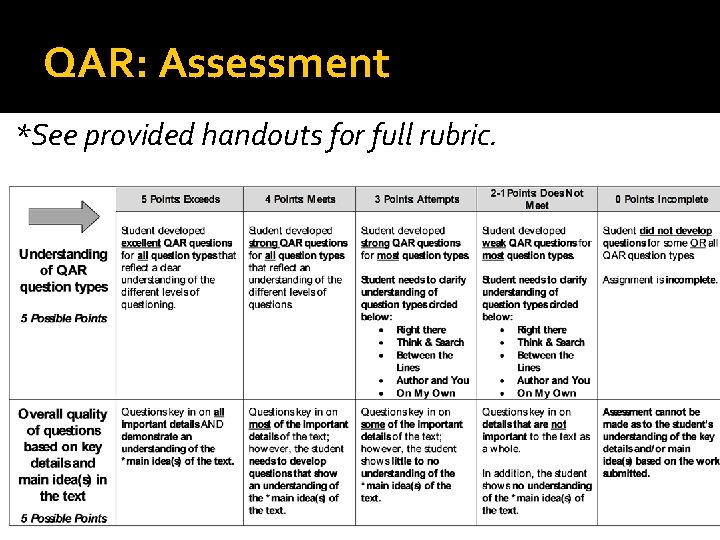
QAR: Assessment *See provided handouts for full rubric.
QAR: Workshop Time
Fusion Strategies: Amplifying the Power of Reading Strategies & Stepping Toward Independence *Pages 28 -36
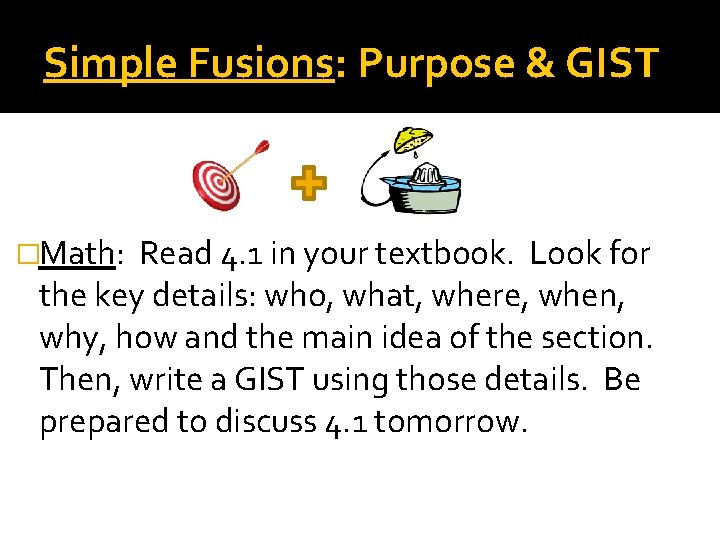
Simple Fusions: Purpose & GIST �Math: Read 4. 1 in your textbook. Look for the key details: who, what, where, when, why, how and the main idea of the section. Then, write a GIST using those details. Be prepared to discuss 4. 1 tomorrow.
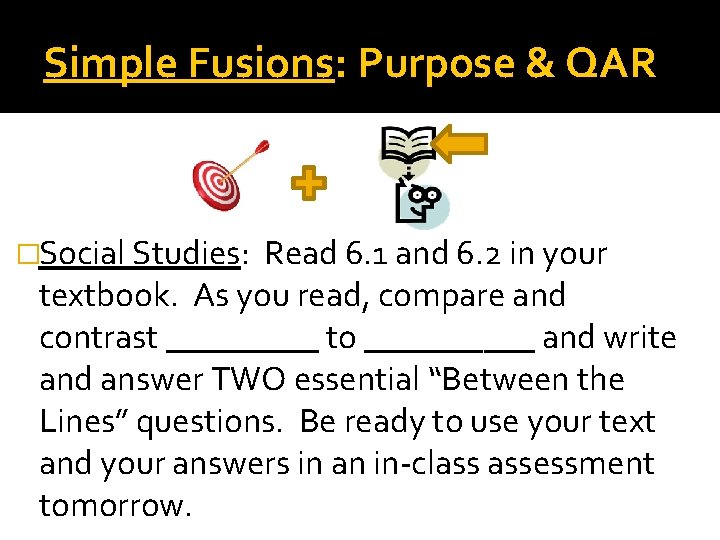
Simple Fusions: Purpose & QAR �Social Studies: Read 6. 1 and 6. 2 in your textbook. As you read, compare and contrast _____ to _____ and write and answer TWO essential “Between the Lines” questions. Be ready to use your text and your answers in an in-class assessment tomorrow.
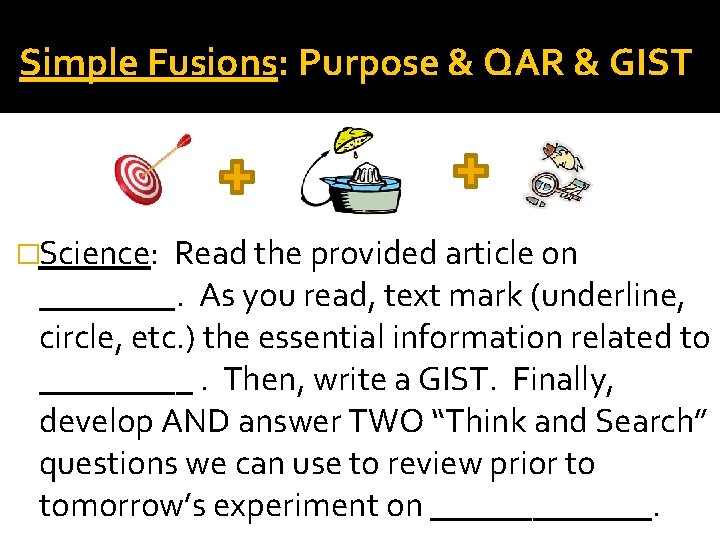
Simple Fusions: Purpose & QAR & GIST �Science: Read the provided article on ____. As you read, text mark (underline, circle, etc. ) the essential information related to _____. Then, write a GIST. Finally, develop AND answer TWO “Think and Search” questions we can use to review prior to tomorrow’s experiment on _______.
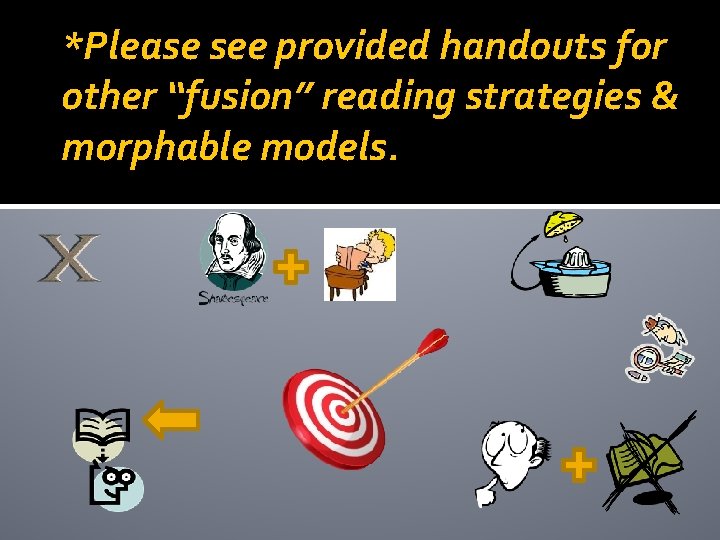
*Please see provided handouts for other “fusion” reading strategies & morphable models.
How will you incorporate these strategies in 2013 -2014? Workshop Time
Created by members of the Literacy Coaching Team (Rt. I Reading) Hinsdale South High School Darien, IL We A. R. E. A Hornet Nation! Accountable, Respectful, Engaged