
Integrating Couples Family Counseling into Individual Counseling David









- Slides: 40
Integrating Couples & Family Counseling into Individual Counseling
David Kaplan ACA Chief Professional Officer dkaplan@counseling. org www. counseling. org/kaplan
Who am I?
Who am I? • Past President of the American Counseling Association (ACA) • Past President of the International Association of Marriage and Family Counselors (IAMFC) • Founding President of New York Association of Marriage and Family Counseling • Book: Family Counseling for all Counselors
Who am I? • A reasonable number of journal articles (and one in the United Airlines in-flight magazine) about family counseling. • Teach coursework in family counseling • 15 years private practice specializing in family work
My goals for today • Get you excited about family work, especially going in and out of individual counseling • Give you ideas to get you started… • And where to go to keep growing
Who are you?
Your Goals for Today?
What are we going to do? • When do I suggest to my client that they involve family members in their counseling? • How do I get family members into my office? • Now that I’ve got the family in my office, what do I do? • Where do I go from here?
The literature supports the use of family work in many areas: • School Problems • Eating disorders • Anxiety disorders • Unipolar and bipolar depression • Physical illnesses
The literature supports the use of family work in many areas including: • OCD • Psychosis • Dissociative Identity Disorder • Traumatic brain injury
Two theories to embrace
Constructivism
The Purr of the Qubit, George Johnson In the latest of a steady stream of small developments, researchers in the Netherlands and Japan reported in the journal Science last week that they had caused an electrical current in a superconducting ring to flow simultaneously clockwise (representing 1) and counterclockwise (0). http: //www. time. com/time/magazine/article/0, 9171, 423540, 00. html
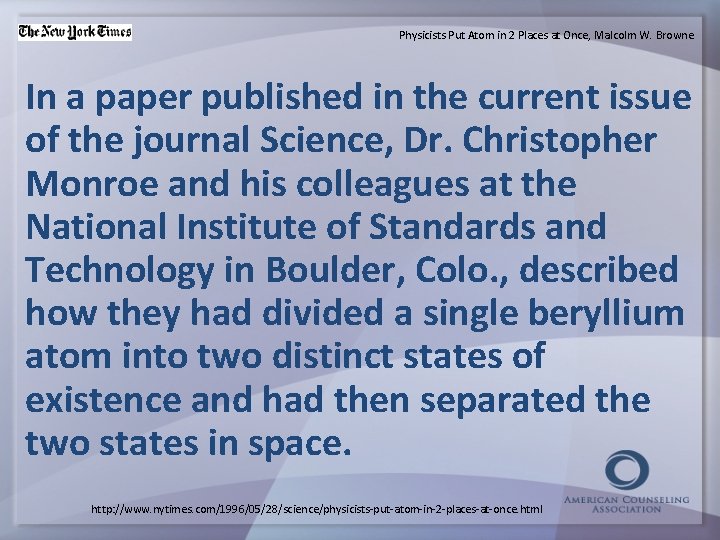
Physicists Put Atom in 2 Places at Once, Malcolm W. Browne In a paper published in the current issue of the journal Science, Dr. Christopher Monroe and his colleagues at the National Institute of Standards and Technology in Boulder, Colo. , described how they had divided a single beryllium atom into two distinct states of existence and had then separated the two states in space. http: //www. nytimes. com/1996/05/28/science/physicists-put-atom-in-2 -places-at-once. html
Annie Hall
Q: I’m going to try to present this with minimal confusion since it has me stumped. I currently do social work in a home health setting working alongside nurses (CAN, LPN, RN), therapists (PT, OT, ST), etc. I began working here after almost a year ago from being laid off from a job of 7 years in a totally different setting (very clinical). With that said, here is the deal. My co-workers and I were discussing school. I shared with them that I was working on my Ph. D and one of them replied, “Well, don’t expect me to call you doctor. ”
I was outdone, all I did was laugh and said, “Don’t worry. I hope not to have to be your doctor. ” So, a few people chimed in saying that unless you earn an MD that’s the only thing that makes you a doctor. That’s when my confusion began! After years of schooling, calling professors “Dr. ”, working alongside psychiatrists, etc. , , have I all this time been mislead? Of course not, but where is thinking from? Anyone ever heard or believe the same way? I feel if you work for your degree, you should be respected as such, but not to recognize is at all is totally ridiculous to me.
A: In order to stay sane on these types of issues, I take a constructivist perspective. There is no “truth” to any of this as the concept of “doctor” (as with any other title) is made up anyway. If some people want to construct their reality that physicians are the only ones entitled to be called Doctor, bless their little hearts. That is their prerogative. I choose to construct a reality that those with Ph. D’s are entitled to be called Doctor because research doctorates were around for centuries before the Ph. D appeared on the scene. Fortunately, there are many whose construct of
So getting back to the sanity part, I have learned that I get to construct my reality and others get to construct their reality. If I want to introduce myself as “Dr. Kaplan, ” that’s okay, and if others want to introduce me as “Mr. Kaplan, ” that’s okay, too. The insanity part will come into play if you try to force your version of reality on someone else and will be amplified if you get into righteous indignation. Thanks for an interesting question and for giving me a chance to stretch my constructivist wings.
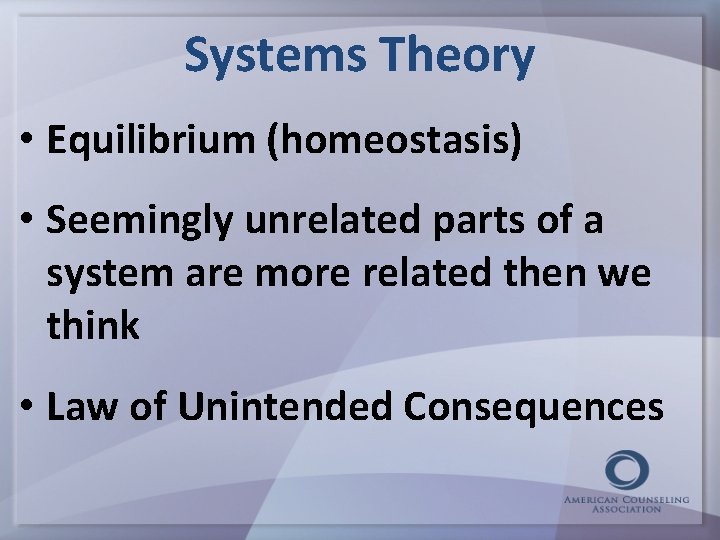
Systems Theory • Equilibrium (homeostasis) • Seemingly unrelated parts of a system are more related then we think • Law of Unintended Consequences
How to deal with LUC
Four key systemic areas that determine if you should involve the family • Communication • Problem Solving • Roles • Boundaries
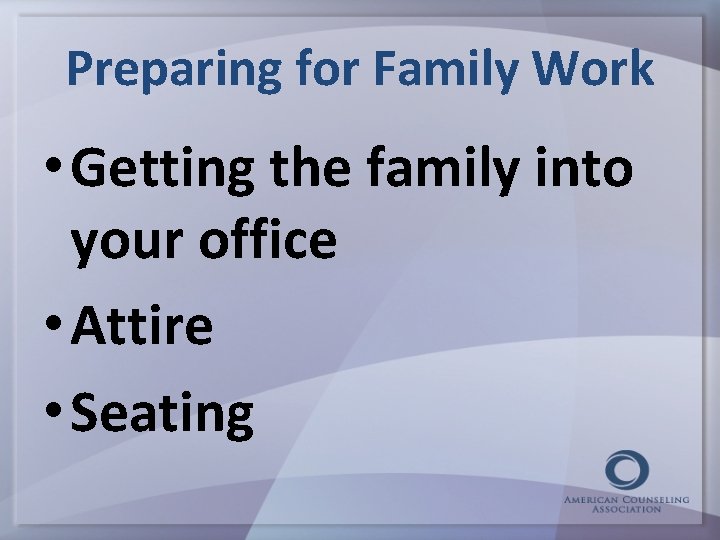
Preparing for Family Work • Getting the family into your office • Attire • Seating
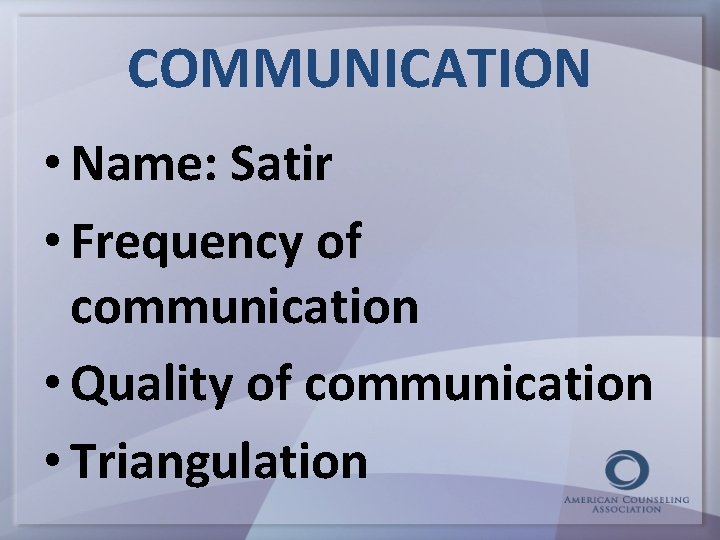
COMMUNICATION • Name: Satir • Frequency of communication • Quality of communication • Triangulation
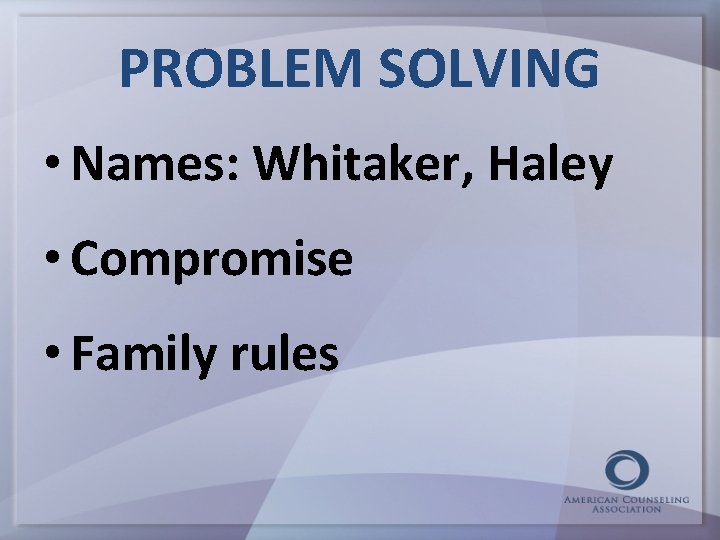
PROBLEM SOLVING • Names: Whitaker, Haley • Compromise • Family rules
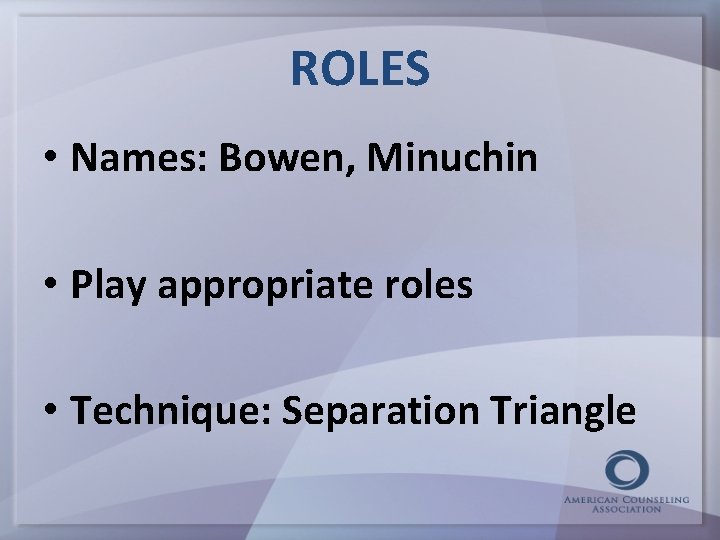
ROLES • Names: Bowen, Minuchin • Play appropriate roles • Technique: Separation Triangle
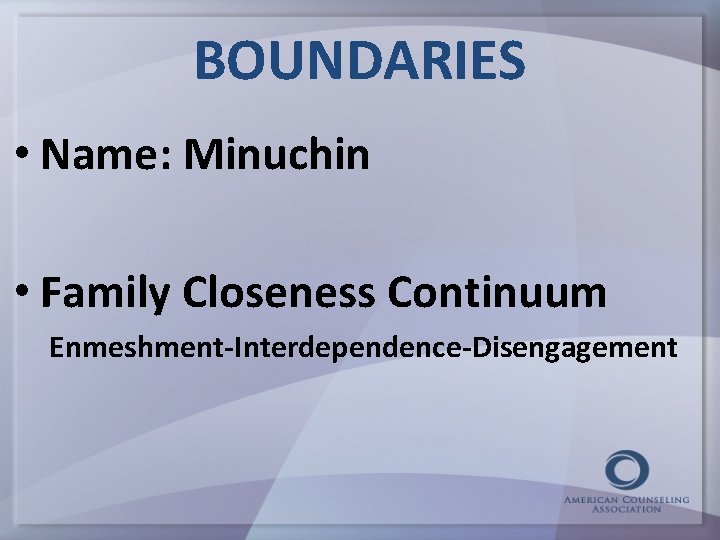
BOUNDARIES • Name: Minuchin • Family Closeness Continuum Enmeshment-Interdependence-Disengagement
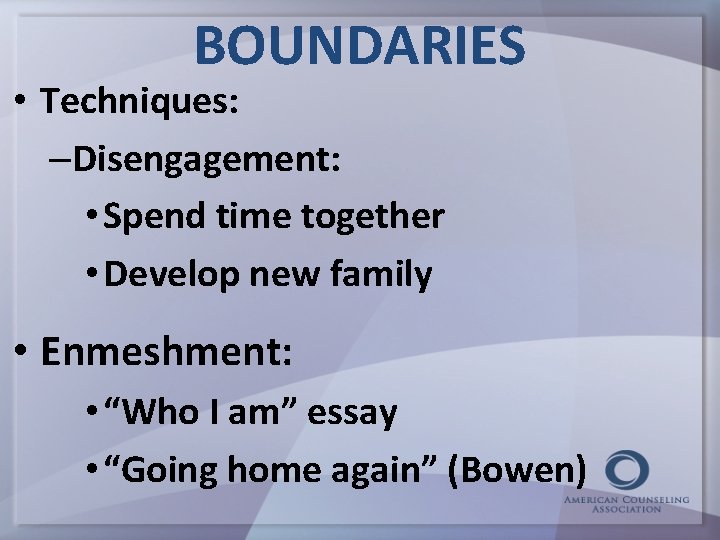
BOUNDARIES • Techniques: –Disengagement: • Spend time together • Develop new family • Enmeshment: • “Who I am” essay • “Going home again” (Bowen)
Where to go from here International Association of Marriage and Family Counselors www. iamfconline. org 31
Annotated References • Napier, A. , & Whitaker, C. (1978). The family crucible. New York: Harper & Row. The Family Crucible is one of my favorite books. If you don’t get excited about systems theory after reading this book, you might want to check your pulse. The Family Crucible includes a thorough list of classic readings.
Annotated References • Minuchin, S. , Rosman, B. L. , & Baker, L. (1978). Psychosomatic families: Anorexia Nervosa in context. Cambridge, MA: Harvard University Press. You get two for the price of one with this book. It provides insight into the importance of understanding and changing family roles and boundaries, as well as the family dynamics of eating disorders.
Annotated References • Satir, V. (1964). Conjoint family therapy. Palo Alto, CA: Science & Behavior Books. Any book by Satir is useful in understanding the importance of communication in families and how to change dysfunctional patterns to functional ones.
Annotated References Haley, J. (1982). Problem solving therapy (2 nd ed. ). San Francisco: Jossey. Bass. This excellent and intriguing book addresses how to use paradoxical interventions to produce a lot of change in a short amount of time. This is probably not the first family systems theory book to read, because paradox is one of the riskiest and most powerful interventions available, and the book might intimidate you if you aren’t familiar with alternative approaches.
Join C&FC Organizations • International Association of Marriage & Family Counselors (IAMFC) www. iamfc. com • American Association for Marriage & Family Therapy www. aamft. org
Get Continuing Education • Ackerman Institute for the Family www. ackerman. org • Philadelphia Child & Family Therapy Training Center www. philafamily. com • Google “family therapy training institute”
Just do it!
Goals for today • Get you excited about family work, especially going in and out of individual counseling • Give you ideas to get you started… • And where to go to keep growing
David Kaplan ACA Chief Professional Officer dkaplan@counseling. org www. counseling. org/kaplan