
Integrating Common Core State Standards CCSS Mathematics and








- Slides: 45
Integrating Common Core State Standards (CCSS) Mathematics and Science
North East Florida Educational Consortium NEFEC Bradford, Columbia, Dixie, Flagler, FSDB, Gilchrist, Hamilton, Lafayette, Levy, Nassau, PK Yonge DRS, Putnam, Suwannee, Union http: //www. nefec. org/ccss/
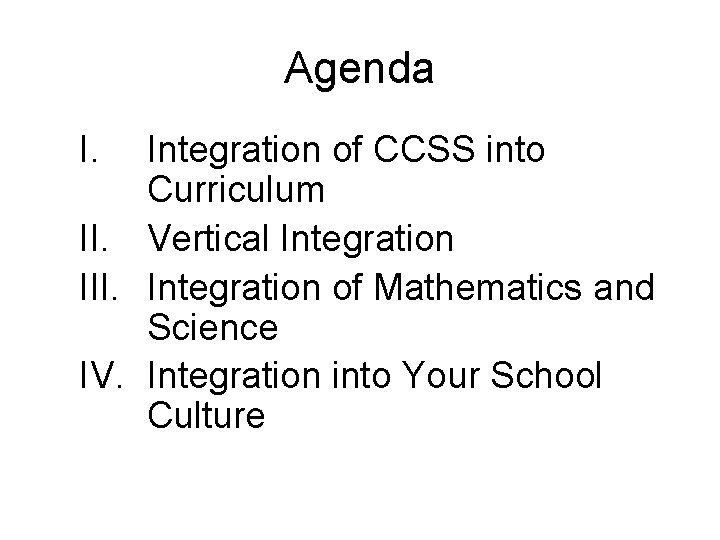
Agenda I. Integration of CCSS into Curriculum II. Vertical Integration III. Integration of Mathematics and Science IV. Integration into Your School Culture
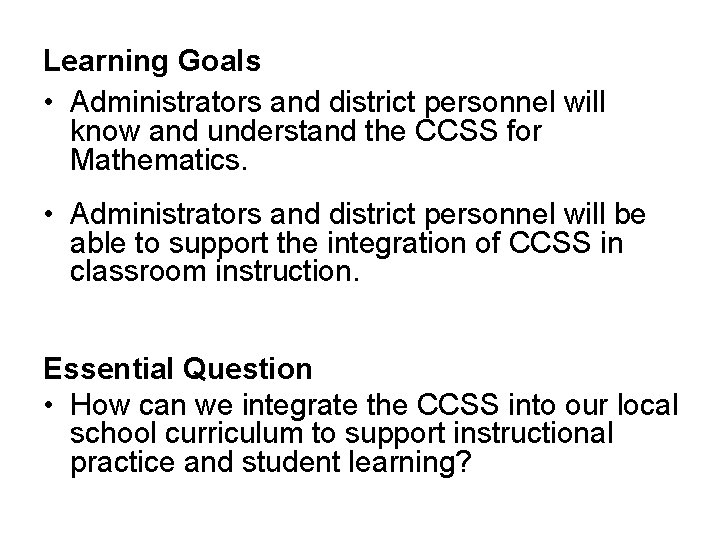
Learning Goals • Administrators and district personnel will know and understand the CCSS for Mathematics. • Administrators and district personnel will be able to support the integration of CCSS in classroom instruction. Essential Question • How can we integrate the CCSS into our local school curriculum to support instructional practice and student learning?
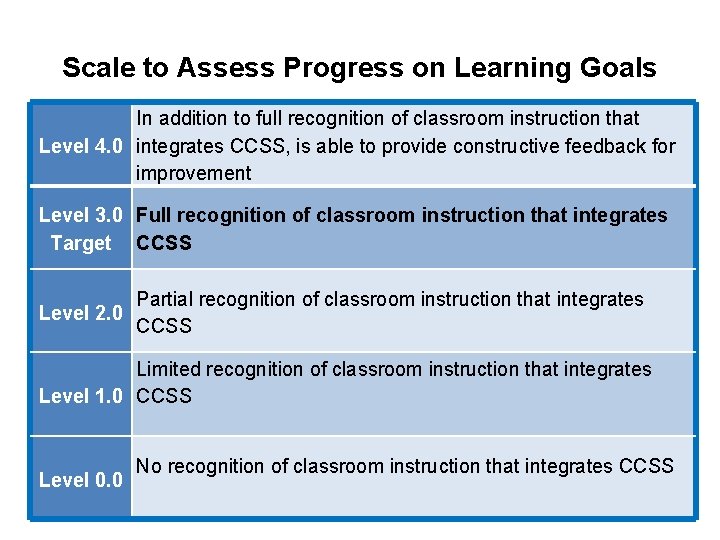
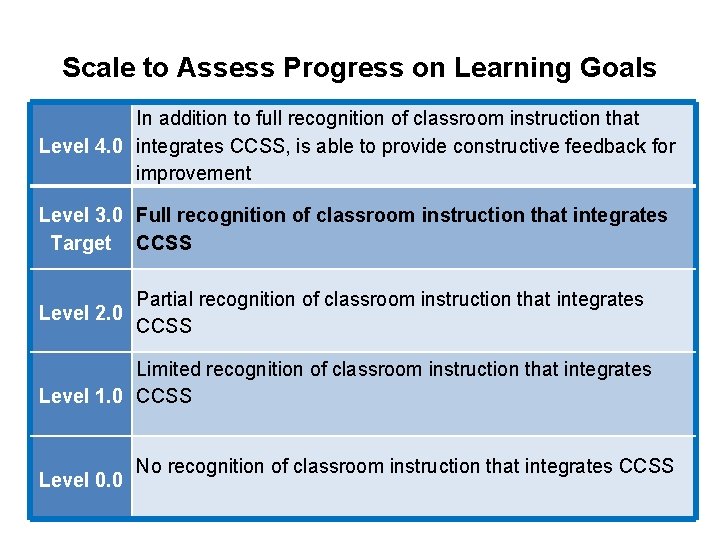
Scale to Assess Progress on Learning Goals In addition to full recognition of classroom instruction that Level 4. 0 integrates CCSS, is able to provide constructive feedback for improvement Level 3. 0 Full recognition of classroom instruction that integrates Target CCSS Level 2. 0 Partial recognition of classroom instruction that integrates CCSS Limited recognition of classroom instruction that integrates Level 1. 0 CCSS Level 0. 0 No recognition of classroom instruction that integrates CCSS
How many examples of integration are found in the following pictures?
I. Integrating into curriculum will not be BUSINESS AS USUAL
Major Changes K-5 : Numeration and operation is intensified and introduced earlier 6 -8 : Ratio and proportion, statistics, rational numbers, and high school Algebra 9 -12: Supports an integrated approach
So What Else Is New? ü Focus on College & Career Pathways ü Emphasis on Mathematical Modeling ü Standards of Mathematical Practice ü Multiple Formats for Testing
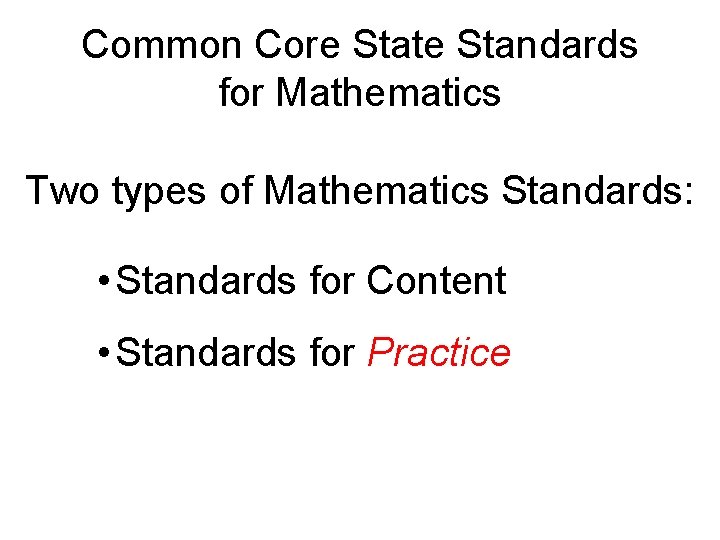
Common Core State Standards for Mathematics Two types of mathematics standards • Standards for Content • Standards for Practice
Math Lesson: Length • Math Lesson Video • Teaching content for deeper understanding Lesson Measurement and Data Mathematics Common Core http: //www. youtube. com/watch? v=rkse 8 sj. MZo&feature=channel&list=UL
Shoulder Talk What is one example of a teacher question that leads to deeper student thinking?
Recapping…. . • More demanding standards • New assessment measuring more complex reasoning • Urgency to address performance gaps
Look Fors in the Classroom • What students are doing, as well as what teacher is doing • Content and tasks • Teaching and learning—including formative assessment • Learning environment
II. Vertical Integration
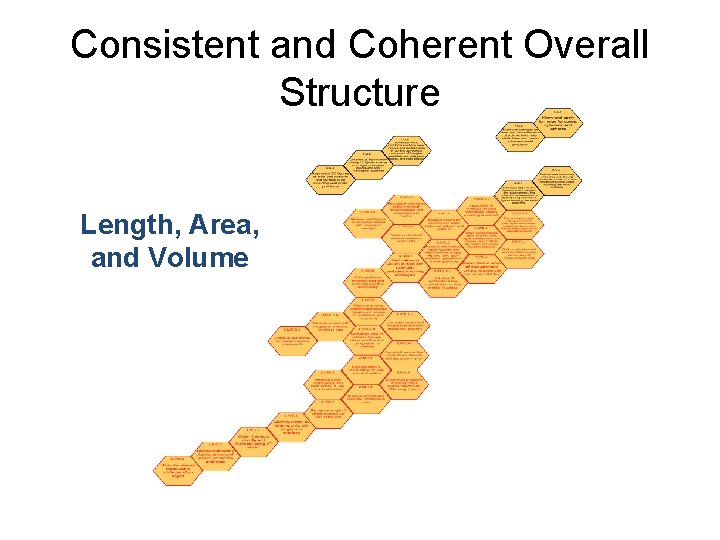
Consistent and Coherent Overall Structure Distinguish: Length, Area, Volume Area and Volume of geometric shapes and solids Area and Perimeter Conversions Length K 1 Grade 2 3 17 4 5 6 7 8
Consistent and Coherent Overall Structure Length, Area, and Volume
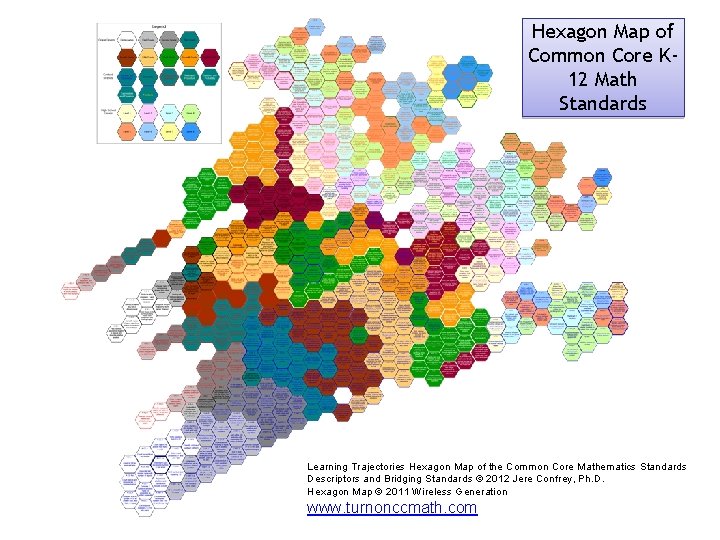
Hexagon Map of Common Core K 12 Math Standards Learning Trajectories Hexagon Map of the Common Core Mathematics Standards Descriptors and Bridging Standards © 2012 Jere Confrey, Ph. D. Hexagon Map © 2011 Wireless Generation www. turnonccmath. com
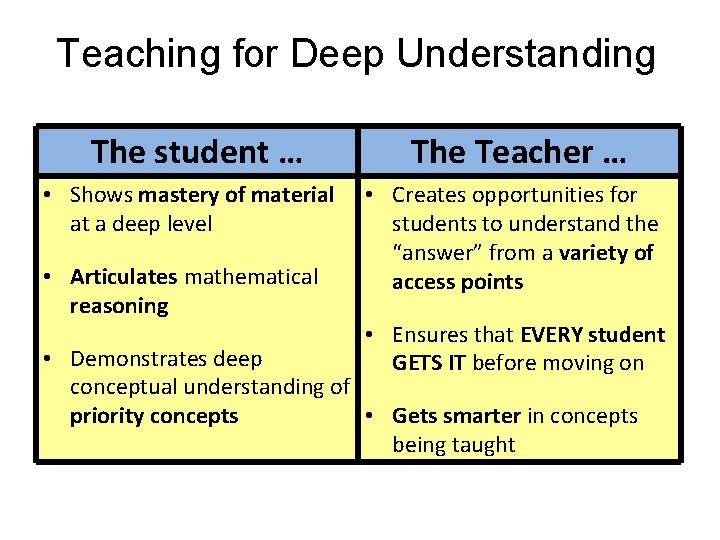
Teaching for Deep Understanding The student … • Shows mastery of material at a deep level • Articulates mathematical reasoning The Teacher … • Creates opportunities for students to understand the “answer” from a variety of access points • Ensures that EVERY student GETS IT before moving on • Demonstrates deep conceptual understanding of priority concepts • Gets smarter in concepts being taught
Shoulder Talk 1. Is there time for vertical planning at your school now? 2. If so, why is it important to continue? 3. If not, what steps will you take to make it happen?
Common Core State Standards for Mathematics Two types of Mathematics Standards: • Standards for Content • Standards for Practice
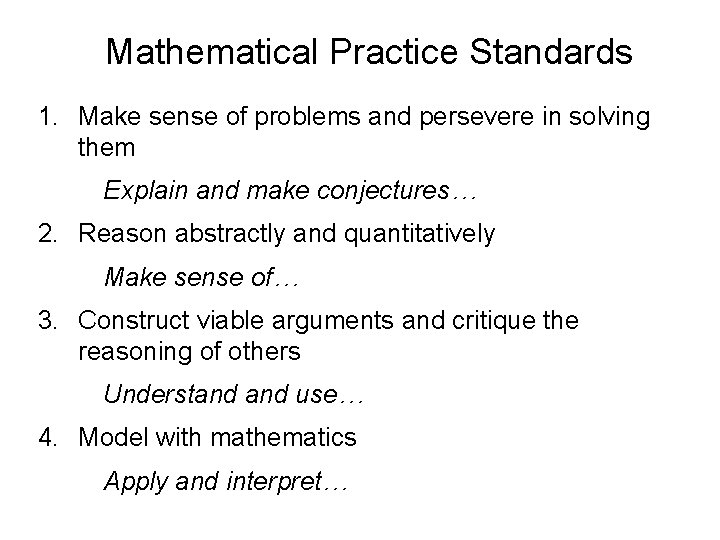
Mathematical Practice Standards 1. Make sense of problems and persevere in solving them Explain and make conjectures… 2. Reason abstractly and quantitatively Make sense of… 3. Construct viable arguments and critique the reasoning of others Understand use… 4. Model with mathematics Apply and interpret…
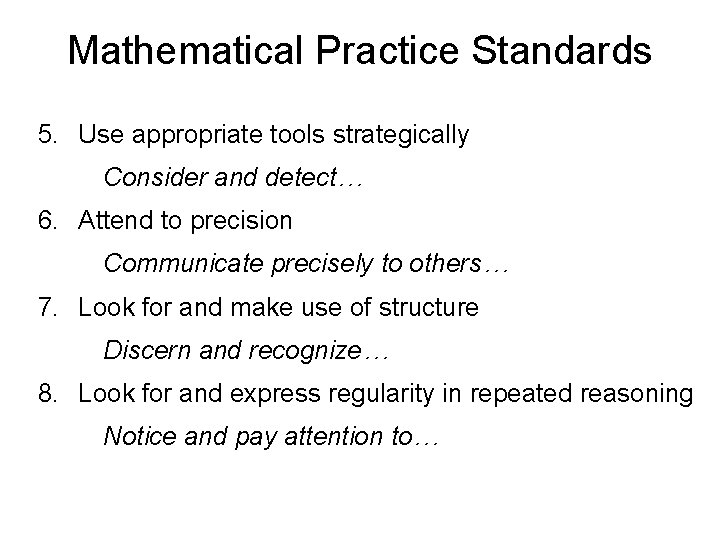
Mathematical Practice Standards 5. Use appropriate tools strategically Consider and detect… 6. Attend to precision Communicate precisely to others… 7. Look for and make use of structure Discern and recognize… 8. Look for and express regularity in repeated reasoning Notice and pay attention to…
As you watch the video, identify which Mathematical Practice Standards are evident.
Looking for Practices • Video to look for Mathematical Practices Common Core State Standards: Middle School http: //www. youtube. com/watch? v=SC 4 OG 1 1 z. OC 8&feature=youtu. be&t=1 m 59 s Includes ELA standards
Shoulder Talk What support will teachers need to integrate the mathematical practice standards into daily work?
Look Fors in the Classroom • Who is doing the mathematical thinking? • What tasks are the students engaged in? • What is the nature of the classroom discourse? –What question is the teacher asking? –What answers are students providing? –What questions are students asking? –Is there opportunity for student-to-student conversations? To what extent are all students engaged in the mathematics learning? Briars April 2012
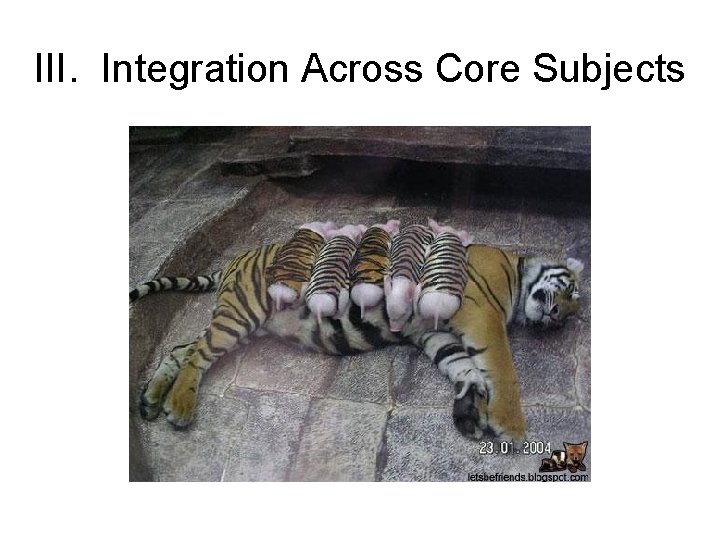
III. Integration Across Core Subjects
As you watch the video, identify the core subjects integrated within the lesson on Density.
• Video of a lesson on Density Demonstrating integration across subjects https: //www. teachingchannel. org/videos/teac hing-density
Shoulder Talk 1. What content was taught? 2. What mathematical practices are evident? 3. How were subject areas integrated?
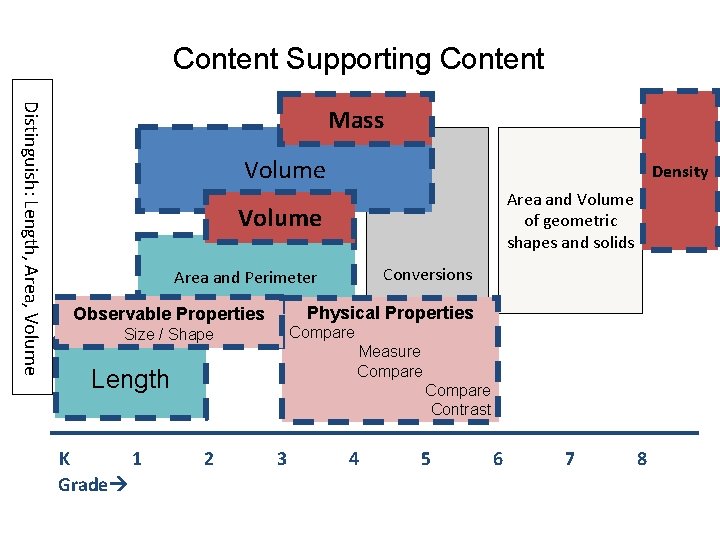
Content Supporting Content Distinguish: Length, Area, Volume Mass Volume Density Area and Volume of geometric shapes and solids Volume Conversions Area and Perimeter Physical Properties Observable Properties Compare Size / Shape Measure Compare Length K 1 Grade Compare Contrast 2 3 4 5 6 7 8
Shoulder Talk What support will teachers need to integrate the CCSS across multiple content areas and the curriculum?
IV. Integration: Is it a part of our School Culture?
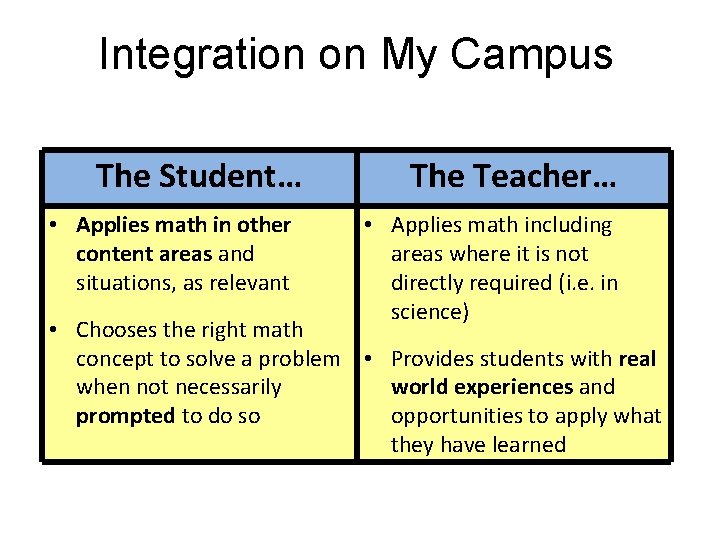
Integration on My Campus The Student… • Applies math in other content areas and situations, as relevant The Teacher… • Applies math including areas where it is not directly required (i. e. in science) • Chooses the right math concept to solve a problem • Provides students with real when not necessarily world experiences and prompted to do so opportunities to apply what they have learned
The Iditarod and Math • Video demonstrating integrating multiple subjects and technology in a real world experience The Iditarod & Math https: //www. teachingchannel. org/videos/tech nology-and-math
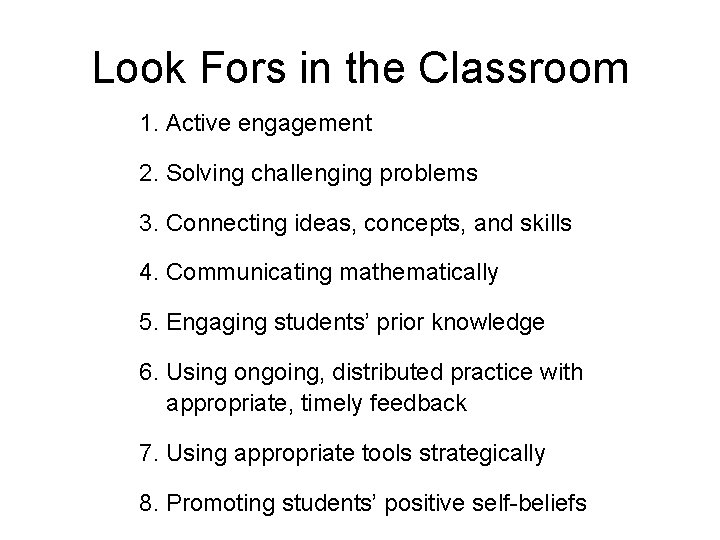
Look Fors in the Classroom 1. Active engagement 2. Solving challenging problems 3. Connecting ideas, concepts, and skills 4. Communicating mathematically 5. Engaging students’ prior knowledge 6. Using ongoing, distributed practice with appropriate, timely feedback 7. Using appropriate tools strategically 8. Promoting students’ positive self-beliefs
Scale to Assess Progress on Learning Goals In addition to full recognition of classroom instruction that Level 4. 0 integrates CCSS, is able to provide constructive feedback for improvement Level 3. 0 Full recognition of classroom instruction that integrates Target CCSS Level 2. 0 Partial recognition of classroom instruction that integrates CCSS Limited recognition of classroom instruction that integrates Level 1. 0 CCSS Level 0. 0 No recognition of classroom instruction that integrates CCSS
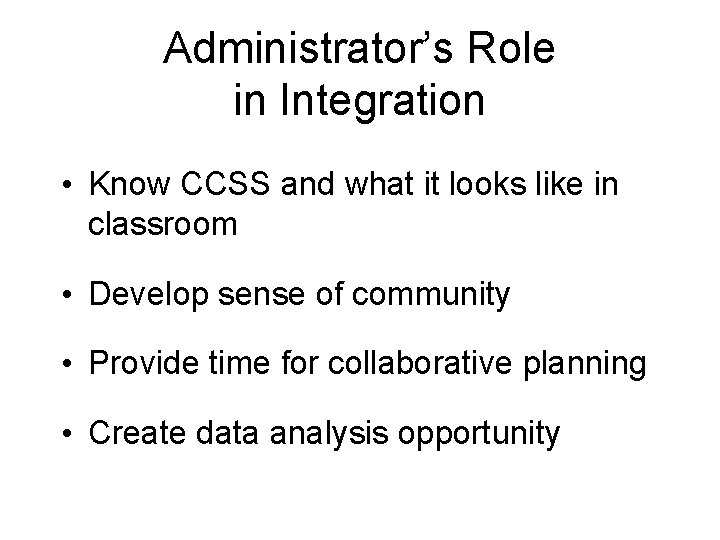
Administrator’s Role in Integration • Know CCSS and what it looks like in classroom • Develop sense of community • Provide time for collaborative planning • Create data analysis opportunity
Shoulder Talk What else can administrators and district personnel do to support integration of CCSS?
COUNTDOWN TO INTEGRATION 45