
Integrating climate change adaptation in disaster risk reduction
- Slides: 30
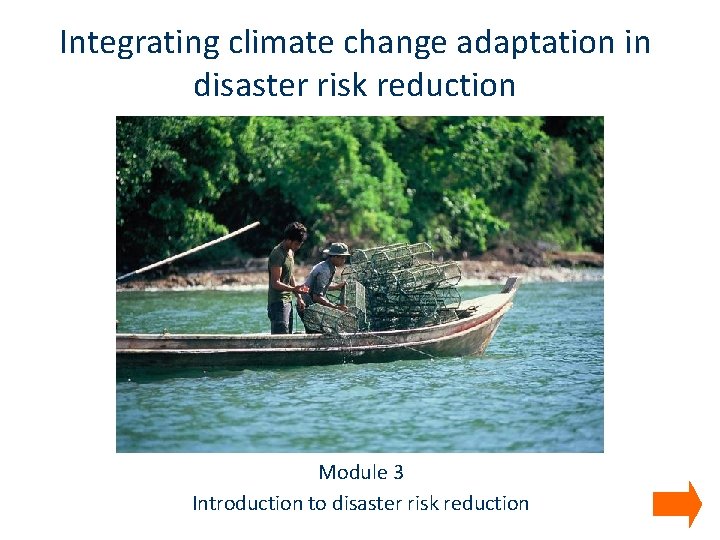
Integrating climate change adaptation in disaster risk reduction Module 3 Introduction to disaster risk reduction
Welcome to e-Learning on integrating climate change adaptation in disaster risk reduction! This module is part of an e-Learning package on integrating climate change adaptation in disaster risk reduction. The package includes five modules: 1. Concepts in disaster risk reduction and climate change adaptation 2. Understanding vulnerability 3. Introduction to disaster risk reduction 4. Introduction to climate change adaptation 5. Guiding principles for integrating adaptation in disaster risk reduction We recommend that you work through the modules in the specified order. To access the other e-Learning modules, please visit the: e-Learning Center - Integrating climate change adaptation in disaster risk reduction NOTE: You will need a user name and password to access the e-Learning Center. If you do not have an account, please contact: Minerva. Support@care. ca
Who are the e-Learning modules for? How were they developed? The e-Learning modules are designed for disaster risk reduction (DRR) practitioners. This includes practitioners within CARE, as well as our civil society and government partner organizations. They were developed by Raks Thai Foundation and CARE, with significant inputs from CARE experts on climate change adaptation and disaster risk reduction, and most importantly from practitioners engaged in DRR initiatives in Country Offices across the Asia Pacific Region, as well as in Raks Thai Foundation. Practitioner perspectives were gathered through two workshops. An initial workshop was conducted to develop the overall framework and brainstorm on key content. In the second workshop, the draft modules were tested and feedback was gathered. The current version reflects inputs from both workshops. The modules reflect CARE’s current thinking on integrating adaptation in DRR initiatives. They should be considered as working versions. Our approach will be tested and refined as we develop more experience in this area. Please send any feedback on these modules to Bruce Ravesloot: ravesloot@careclimatechange. org
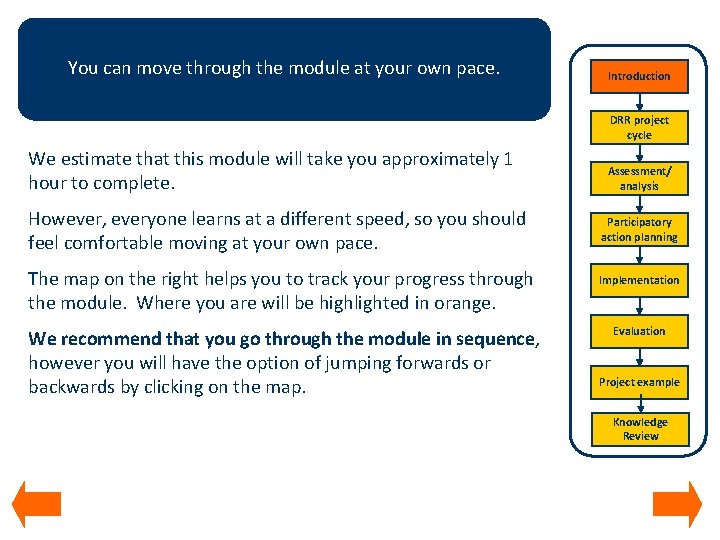
You can move through the module at your own pace. Introduction DRR project cycle We estimate that this module will take you approximately 1 hour to complete. However, everyone learns at a different speed, so you should feel comfortable moving at your own pace. The map on the right helps you to track your progress through the module. Where you are will be highlighted in orange. We recommend that you go through the module in sequence, however you will have the option of jumping forwards or backwards by clicking on the map. Assessment/ analysis Participatory action planning Implementation Evaluation Project example Knowledge Review At any point, you can go back to the previous slide by clicking the back arrow. Use the forward arrow to move through the module.
Throughout the module, you’ll find links to key definitions. This e-Learning module is designed to be as clear and user-friendly as possible. So, as we introduce different concepts, we’ll use simple language and examples to promote understanding. However, we will also provide links to ‘official’ definitions for those who prefer this approach. Any time you see underlined text in the module, you can click to access the official definition. Are you ready? Then let’s get started!
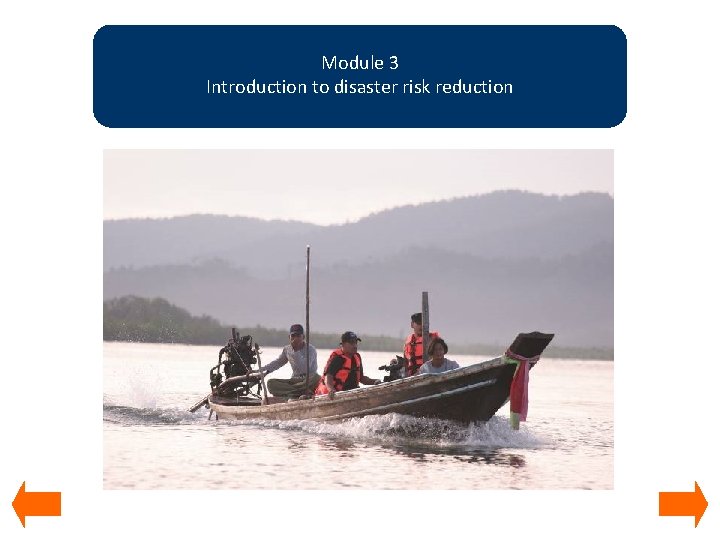
Module 3 Introduction to disaster risk reduction
Modules 1 and 2 focused on building understanding of important concepts for disaster risk reduction. To review from Modules 1 and 2: • Climate change makes disaster risk reduction even more important. • With the exception of geophysical hazards, climate change affects all types of natural hazards. • Vulnerability to climate change and disasters: • Depends on exposure to hazards. • Is determined by human, social, physical, natural, political and financial factors. • Varies within communities and even within households. • More capacity means less vulnerability. Introduction DRR project cycle Assessment/ analysis Participatory action planning Implementation Evaluation Project example Knowledge Review
Let’s start by reminding ourselves what we mean by disaster risk reduction. Disaster risk reduction (DRR) is an approach to reduce disaster risks caused by hazard events. It refers to the practical actions that society, communities or other stakeholders take to reduce the risk of disasters. DRR aims to reduce exposure to hazard events, to reduce vulnerability, and to improve preparedness. Ideally, DRR actions take place within the framework of a disaster risk management (DRM) policy, strategy or plan. Introduction DRR project cycle Assessment/ analysis Participatory action planning Implementation Evaluation Project example Because climate change increases the frequency, severity and intensity of climate-related hazards, it provides a strong imperative for DRR actions. Knowledge Review
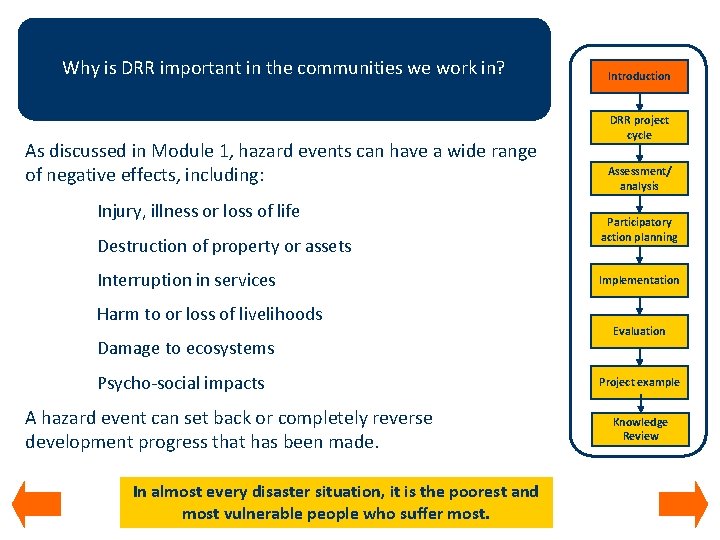
Why is DRR important in the communities we work in? As discussed in Module 1, hazard events can have a wide range of negative effects, including: Injury, illness or loss of life Destruction of property or assets Interruption in services Harm to or loss of livelihoods Damage to ecosystems Psycho-social impacts A hazard event can set back or completely reverse development progress that has been made. In almost every disaster situation, it is the poorest and most vulnerable people who suffer most. Introduction DRR project cycle Assessment/ analysis Participatory action planning Implementation Evaluation Project example Knowledge Review
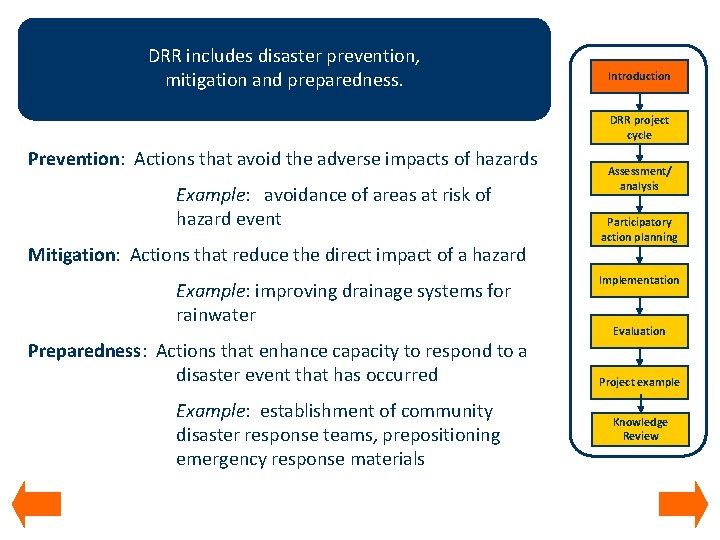
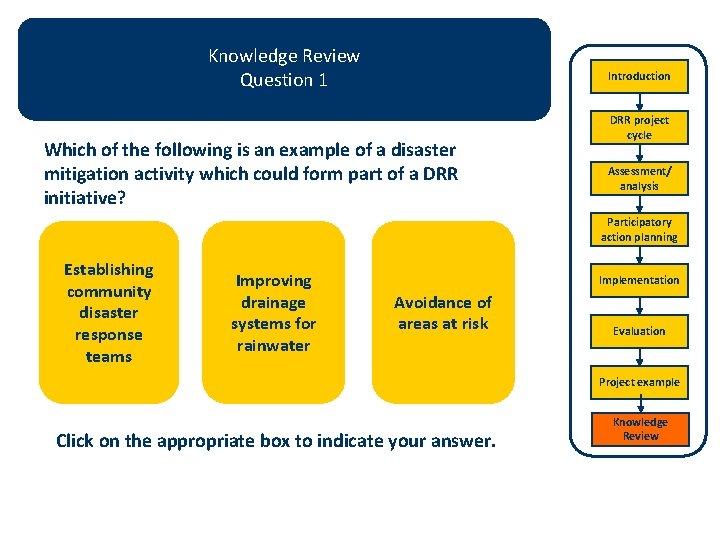
DRR includes disaster prevention, mitigation and preparedness. Introduction DRR project cycle Prevention: Actions that avoid the adverse impacts of hazards Example: avoidance of areas at risk of hazard event Mitigation: Actions that reduce the direct impact of a hazard Example: improving drainage systems for rainwater Preparedness: Actions that enhance capacity to respond to a disaster event that has occurred Example: establishment of community disaster response teams, prepositioning emergency response materials Assessment/ analysis Participatory action planning Implementation Evaluation Project example Knowledge Review
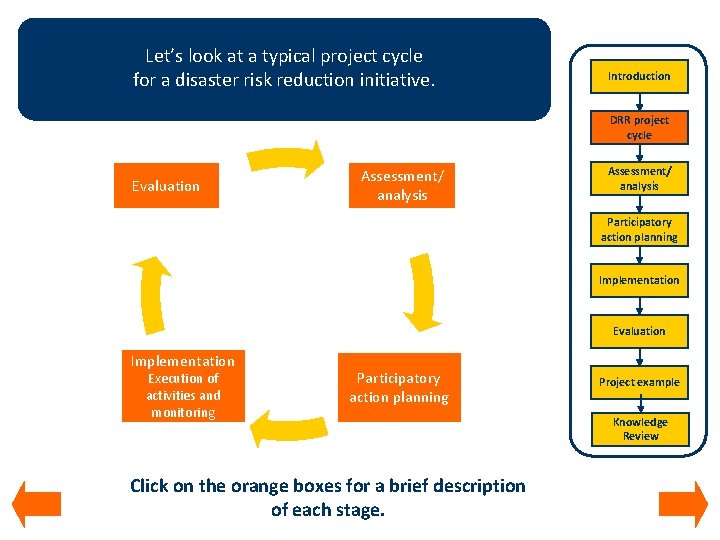
Let’s look at a typical project cycle for a disaster risk reduction initiative. Introduction DRR project cycle Evaluation Assessment/ analysis Participatory action planning Implementation Evaluation Implementation Execution of activities and monitoring Participatory action planning Click on the orange boxes for a brief description of each stage. Project example Knowledge Review
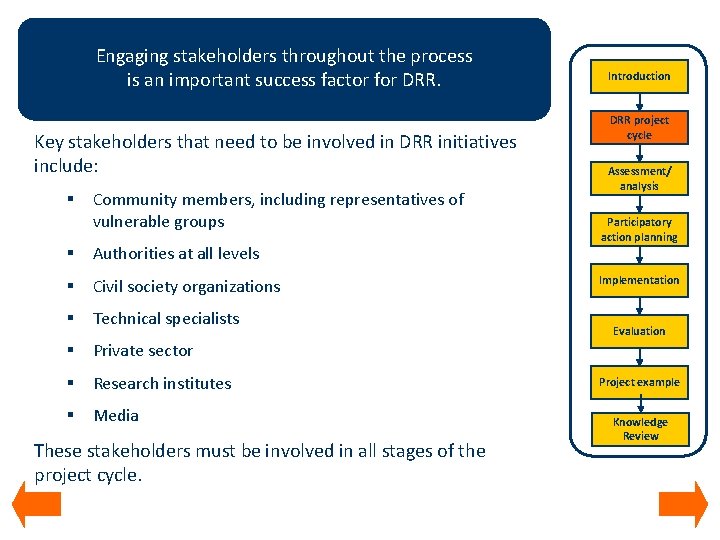
Engaging stakeholders throughout the process is an important success factor for DRR. Key stakeholders that need to be involved in DRR initiatives include: § Community members, including representatives of vulnerable groups § Authorities at all levels § Civil society organizations § Technical specialists § Private sector § Research institutes § Media These stakeholders must be involved in all stages of the project cycle. Introduction DRR project cycle Assessment/ analysis Participatory action planning Implementation Evaluation Project example Knowledge Review
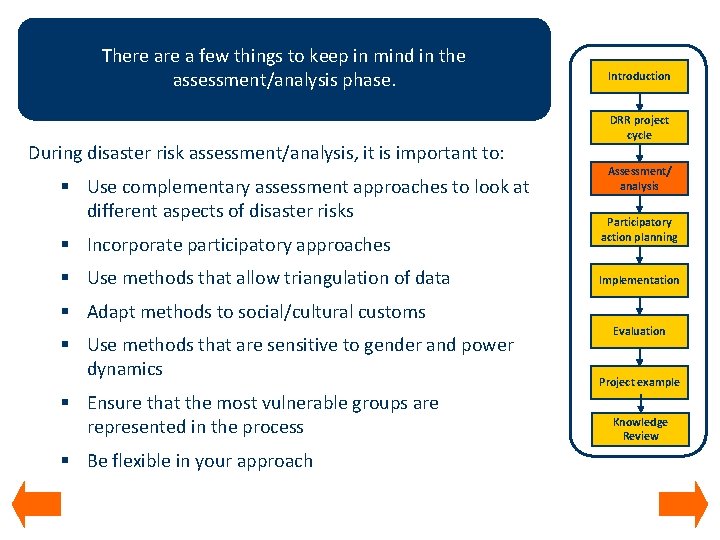
There a few things to keep in mind in the assessment/analysis phase. During disaster risk assessment/analysis, it is important to: § Use complementary assessment approaches to look at different aspects of disaster risks § Incorporate participatory approaches § Use methods that allow triangulation of data Introduction DRR project cycle Assessment/ analysis Participatory action planning Implementation § Adapt methods to social/cultural customs § Use methods that are sensitive to gender and power dynamics § Ensure that the most vulnerable groups are represented in the process § Be flexible in your approach Evaluation Project example Knowledge Review
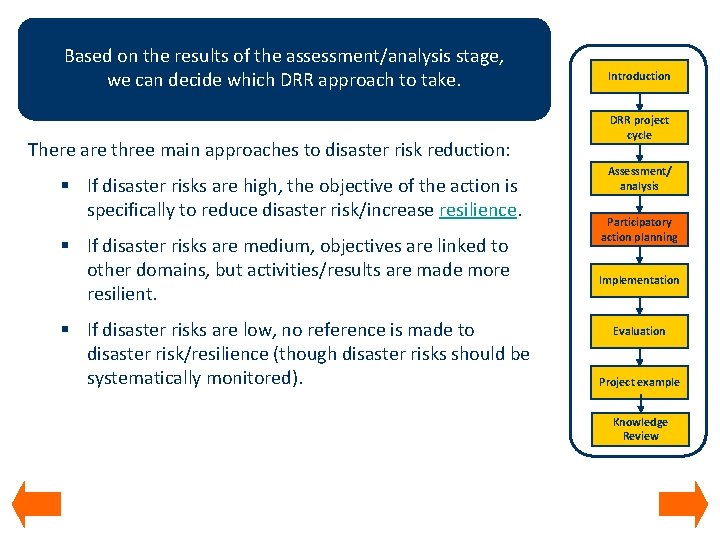
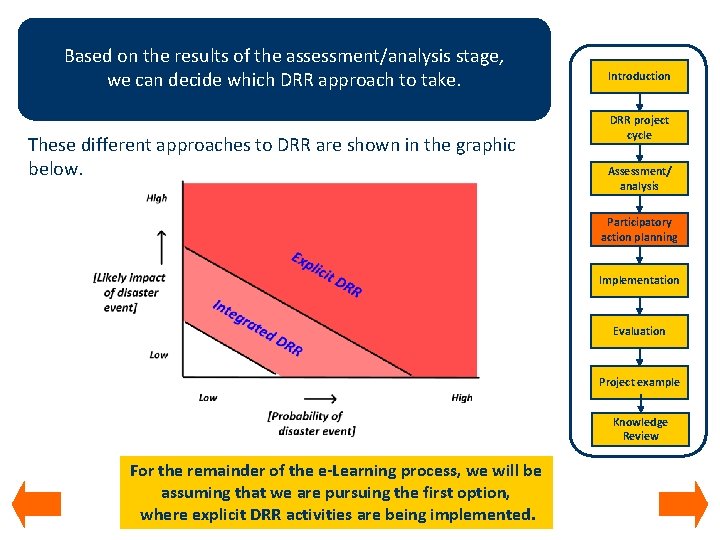
Based on the results of the assessment/analysis stage, we can decide which DRR approach to take. There are three main approaches to disaster risk reduction: § If disaster risks are high, the objective of the action is specifically to reduce disaster risk/increase resilience. § If disaster risks are medium, objectives are linked to other domains, but activities/results are made more resilient. § If disaster risks are low, no reference is made to disaster risk/resilience (though disaster risks should be systematically monitored). Introduction DRR project cycle Assessment/ analysis Participatory action planning Implementation Evaluation Project example Knowledge Review
Based on the results of the assessment/analysis stage, we can decide which DRR approach to take. These different approaches to DRR are shown in the graphic below. Introduction DRR project cycle Assessment/ analysis Participatory action planning Implementation Evaluation Project example Knowledge Review For the remainder of the e-Learning process, we will be assuming that we are pursuing the first option, where explicit DRR activities are being implemented.
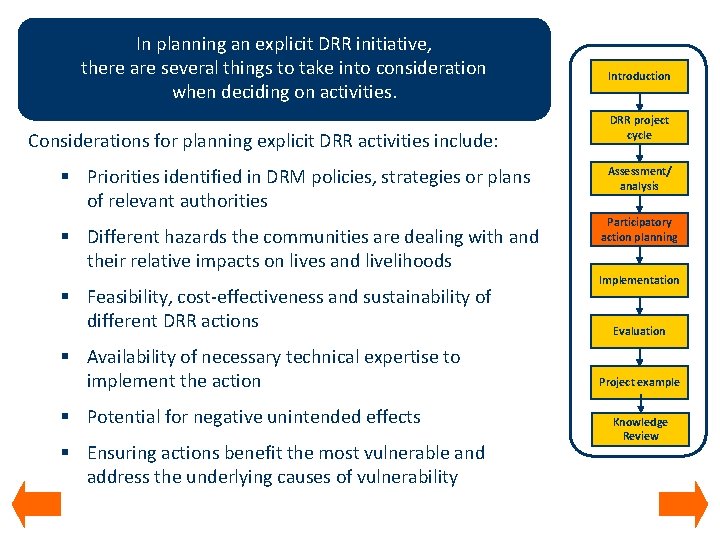
In planning an explicit DRR initiative, there are several things to take into consideration when deciding on activities. Considerations for planning explicit DRR activities include: § Priorities identified in DRM policies, strategies or plans of relevant authorities § Different hazards the communities are dealing with and their relative impacts on lives and livelihoods § Feasibility, cost-effectiveness and sustainability of different DRR actions § Availability of necessary technical expertise to implement the action § Potential for negative unintended effects § Ensuring actions benefit the most vulnerable and address the underlying causes of vulnerability Introduction DRR project cycle Assessment/ analysis Participatory action planning Implementation Evaluation Project example Knowledge Review
Based on the assessment, and taking the above factors into consideration, you may identify a number of different types of DRR activities. For example, to reduce the risk of disaster caused by flooding, activities could include: § Early warning systems § Raising embankments § Improving drainage Introduction DRR project cycle Assessment/ analysis Participatory action planning Implementation § Raising wells § Swimming lessons § Providing boats § Providing safe shelters Evaluation Project example Knowledge Review
Along with actions that explicitly address disaster risks, you may also identify activities that achieve other objectives in addition to reducing disaster risks. Some examples of these types of activities could include: § Sustainable ecosystem management § Diversifying and/or strengthening livelihoods Introduction DRR project cycle Assessment/ analysis Participatory action planning § Strengthening community organization § Strengthening institutional capacity § Building schools that double as shelters for floods or cyclones Implementation Evaluation Project example REFLECTION Consider your own DRR projects. Do they incorporate these types of “dual purpose” activities? Knowledge Review
Once you have identified and prioritized activities, you can move into implementation. This stage involves execution of activities and monitoring. There a couple of key things to keep in mind during the implementation of DRR projects: § Develop activities that meet the project objectives. § Adopt a flexible approach so that you can adjust according to changes in context. This will help to ensure that your DRR initiative is both effective and sustainable. Monitoring is a key tool for achieving this. Introduction DRR project cycle Assessment/ analysis Participatory action planning Implementation Evaluation Project example Knowledge Review
Monitoring in DRR initiatives involves two key aspects. Monitoring of hazards, for example: § Monitoring environmental changes § This monitoring can be linked to early warning systems Monitoring of vulnerability, for example: § Households in unsafe locations § Adherence to building codes § Functioning of local risk management groups § Poverty levels Introduction DRR project cycle Assessment/ analysis Participatory action planning Implementation Evaluation Project example Knowledge Review
Evaluation in DRR initiatives looks at two important dimensions. § Evaluation in DRR initiatives evaluates both the process and the results § Results are evaluated in terms of: - Effectiveness Efficiency Coverage Relevance to local needs and priorities Appropriateness to context Alignment with policies Any unintended impacts Introduction DRR project cycle Assessment/ analysis Participatory action planning Implementation Evaluation Project example Knowledge Review
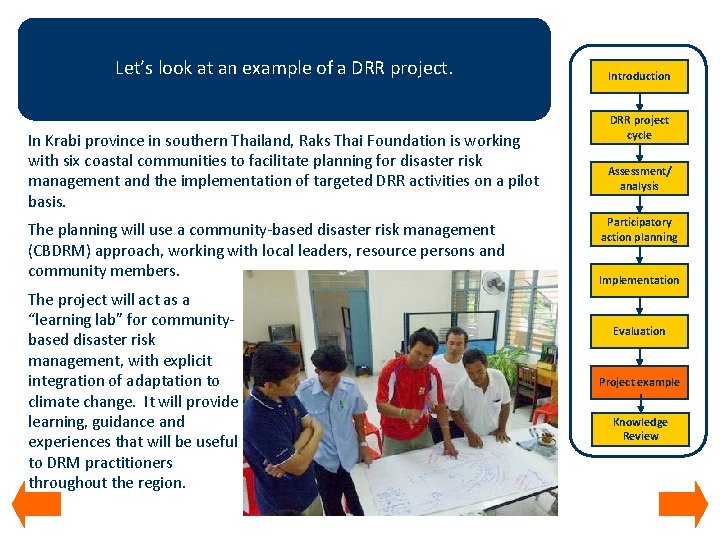
Let’s look at an example of a DRR project. In Krabi province in southern Thailand, Raks Thai Foundation is working with six coastal communities to facilitate planning for disaster risk management and the implementation of targeted DRR activities on a pilot basis. The planning will use a community-based disaster risk management (CBDRM) approach, working with local leaders, resource persons and community members. The project will act as a “learning lab” for communitybased disaster risk management, with explicit integration of adaptation to climate change. It will provide learning, guidance and experiences that will be useful to DRM practitioners throughout the region. Introduction DRR project cycle Assessment/ analysis Participatory action planning Implementation Evaluation Project example Knowledge Review
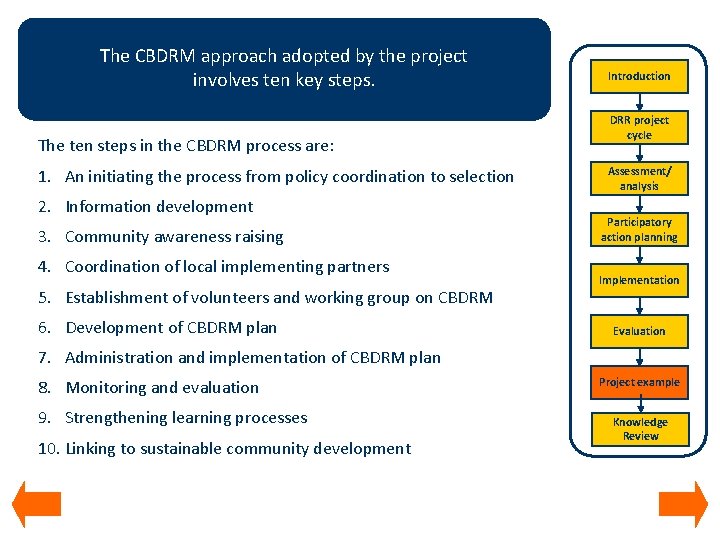
The CBDRM approach adopted by the project involves ten key steps. The ten steps in the CBDRM process are: 1. An initiating the process from policy coordination to selection 2. Information development 3. Community awareness raising 4. Coordination of local implementing partners 5. Establishment of volunteers and working group on CBDRM 6. Development of CBDRM plan Introduction DRR project cycle Assessment/ analysis Participatory action planning Implementation Evaluation 7. Administration and implementation of CBDRM plan 8. Monitoring and evaluation 9. Strengthening learning processes 10. Linking to sustainable community development Project example Knowledge Review
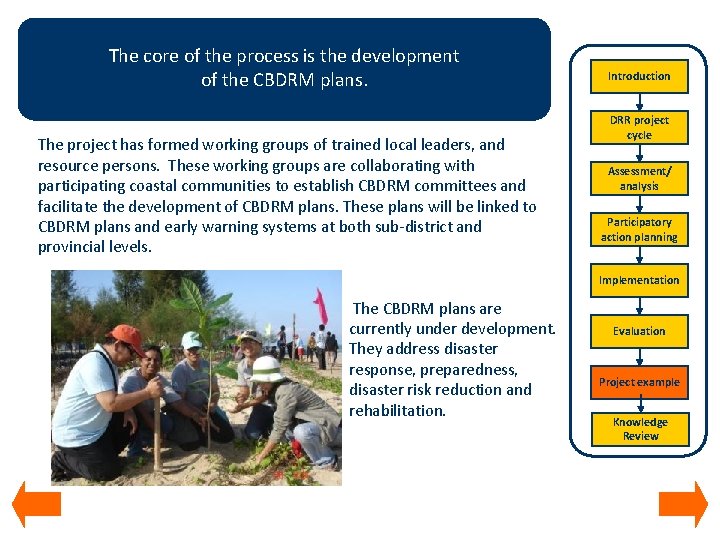
The core of the process is the development of the CBDRM plans. The project has formed working groups of trained local leaders, and resource persons. These working groups are collaborating with participating coastal communities to establish CBDRM committees and facilitate the development of CBDRM plans. These plans will be linked to CBDRM plans and early warning systems at both sub-district and provincial levels. Introduction DRR project cycle Assessment/ analysis Participatory action planning Implementation The CBDRM plans are currently under development. They address disaster response, preparedness, disaster risk reduction and rehabilitation. Evaluation Project example Knowledge Review
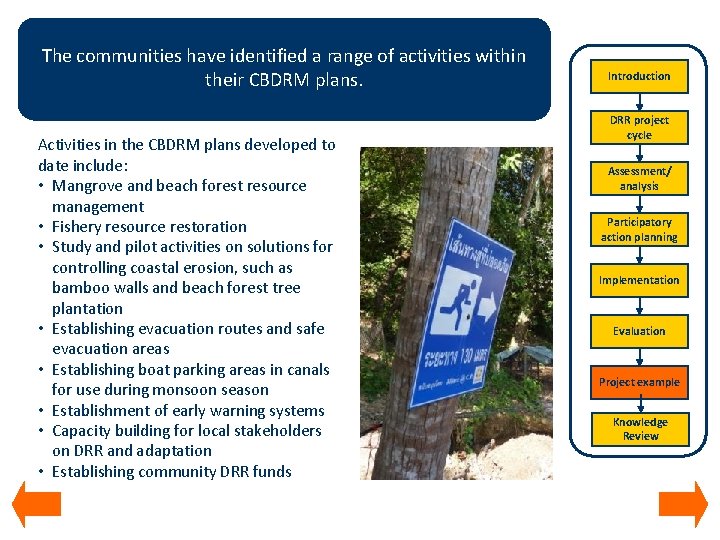
The communities have identified a range of activities within their CBDRM plans. Activities in the CBDRM plans developed to date include: • Mangrove and beach forest resource management • Fishery resource restoration • Study and pilot activities on solutions for controlling coastal erosion, such as bamboo walls and beach forest tree plantation • Establishing evacuation routes and safe evacuation areas • Establishing boat parking areas in canals for use during monsoon season • Establishment of early warning systems • Capacity building for local stakeholders on DRR and adaptation • Establishing community DRR funds Introduction DRR project cycle Assessment/ analysis Participatory action planning Implementation Evaluation Project example Knowledge Review
Let’s review the key learning points for this module. Introduction DRR project cycle • DRR aims to reduce exposure to hazard events, to reduce vulnerability, and to improve preparedness. • The project cycle for DRR consists of four key stages: assessment/analysis; participatory action planning; implementation (execution of activities and monitoring); and evaluation. • Engaging stakeholders is very important throughout the project cycle. • Explicit DRR actions specifically aim to reduce disaster risk/increase resilience. Assessment/ analysis Participatory action planning Implementation Evaluation Project example Knowledge Review
Ready to review your knowledge? Introduction DRR project cycle In this module, we’ve introduced the basics of disaster risk reduction. Next, you’ll have a chance to review your knowledge before moving on to the next module. Ready? If you feel you’re ready for the knowledge review, click on the forward arrow. Not quite there yet? If you’d like to go through any of the concepts again before moving on to the knowledge review, click on the appropriate box in the map. Assessment/ analysis Participatory action planning Implementation Evaluation Project example Knowledge Review
Knowledge Review Question 1 Introduction Which of the following is an example of a disaster mitigation activity which could form part of a DRR initiative? DRR project cycle Assessment/ analysis Participatory action planning Establishing community disaster response teams Improving drainage systems for rainwater Implementation Avoidance of areas at risk Evaluation Project example Click on the appropriate box to indicate your answer. Knowledge Review
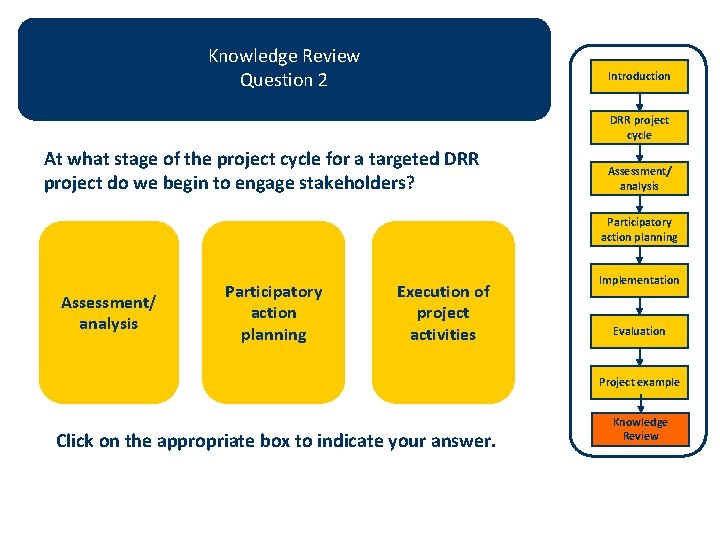
Knowledge Review Question 2 Introduction DRR project cycle At what stage of the project cycle for a targeted DRR project do we begin to engage stakeholders? Assessment/ analysis Participatory action planning Execution of project activities Implementation Evaluation Project example Click on the appropriate box to indicate your answer. Knowledge Review
Congratulations! You’ve completed Module 3. We hope that you have found this to be a useful learning experience. To access the other e-Learning modules, please visit the: e-Learning Center - Integrating climate change adaptation in disaster risk reduction NOTE: You will need a user name and password to access the e. Learning Center. If you do not have an account, please contact: Minerva. Support@care. ca Thank you for your participation! You can exit the module by pressing the Esc key.