
Integrating Career Technical Student Organizations CTSOs into your
- Slides: 42
Integrating Career Technical Student Organizations (CTSOs) into your CTE Classroom Presented By: Sherry D. Davis, Ed. D. , Education Programs Consultant Career Technical Education Administration and Management office Career and College Transition Division CALIFORNIA DEPARTMENT OF EDUCATION Tom Torlakson, State Superintendent of Public Instruction
Every Student Succeeds Act (ESSA) of 2015 ESSA sets a new course for the federal role in public education Ø Requires every state to have a statewide accountability system take effect in 2017– 18 school year Ø Multiple indicators Ø Ø Ø Academic achievement (most weighted indicator) High school graduation rate At least one “valid, reliable, comparable, and Statewide” indicator of school quality (i. e. career and college ready) Ø Meaningful differentiation between schools Ø School supports and interventions CALIFORNIA DEPARTMENT OF EDUCATION Tom Torlakson, State Superintendent of Public Instruction
Every Student Succeeds Act (ESSA) of 2015 ESSA Funding Ø Title I funding formula remains the same Ø Ø Optional 3% set-aside for Direct Student Services (allowable expenditures include academic/CTE coursework Title IV Student Support and Academic Enrichment Grants Ø Ø Well-rounded educational opportunities activities include: Ø Career and college counseling/guidance Ø Community Involvement Effective use of technology Ø Developing strategies for use of digital learning technologies CALIFORNIA DEPARTMENT OF EDUCATION Tom Torlakson, State Superintendent of Public Instruction
Disclaimer • This presentation will work for any of the Career Technical Student Organizations in California: • FBLA • DECA • FHA-HERO (FCCLA) • HOSA • FFA And of course • Skills. USA • My knowledge as a student, teacher, and state officer trainer is why I am using Skills. USA material for this training example.
Career Technical Student Organizations (CTSOs) Why are they part of our (xxx)Class? ?
What is Skills. USA (or other CTSO) Historically – Skills. USA has changed its name a few times • In 1920 s = Future Craftsmen of America (FCA) • 1965 = Evolved to Vocational Industrial Clubs of America (VICA) • 1995 = National Officers voted to change the name to be more reflective of the programs that participate and what students learn: Skills. USA-VICA • 2004 = VICA was dropped from the name to just be: Skills. USA
What is the Purpose of Skills. USA • Unite in a common bond for all CTE pathways that participate: • • • Local (High School) Regionally Statewide Nationally Internationally • Positions in Skills. USA for Students: • • President Vice-President Secretary Treasurer • Parliamentarian • Historian • Reporter *These positions are elected by your peers • Develop Leadership abilities through direct involvement: • Serving as an officer (at any level) • Serving on committees • Participating in chapter meetings • Participate in the Program of Work activities • Direct and Indirect activities
What is the Purpose of Skills. USA • Develop a deep respect for the dignity of work • Assist students in developing realistic career goals • Attain a purposeful life • Create enthusiasm for life long learning • Promote high standards in ethics, workmanship, sportsmanship, academics, and safety • Understand the functions of labor and management • Create a respect, interest, and high regard for CTE pathways and education • Develop patriotism through history, knowledge and practice through democracy skills
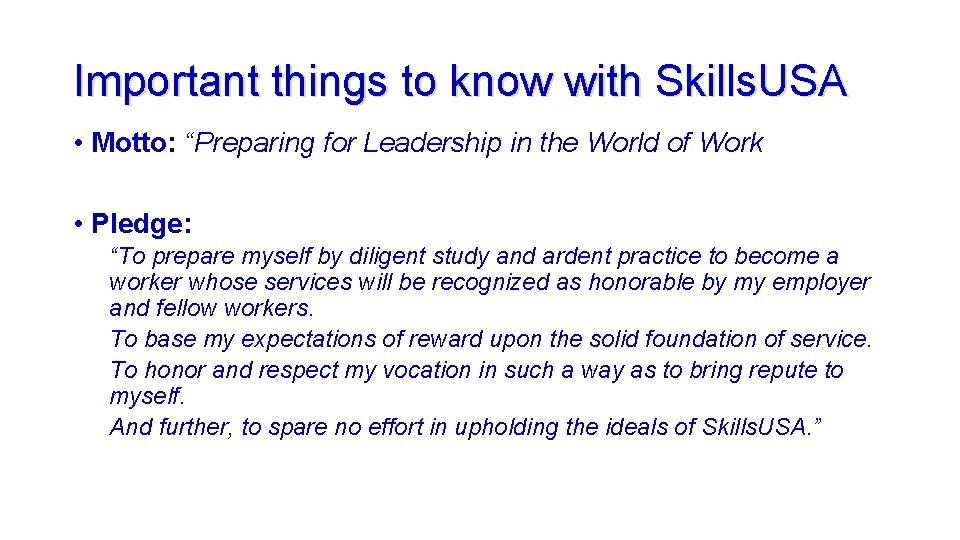
Important things to know with Skills. USA • Motto: “Preparing for Leadership in the World of Work • Pledge: “To prepare myself by diligent study and ardent practice to become a worker whose services will be recognized as honorable by my employer and fellow workers. To base my expectations of reward upon the solid foundation of service. To honor and respect my vocation in such a way as to bring repute to myself. And further, to spare no effort in upholding the ideals of Skills. USA. ”
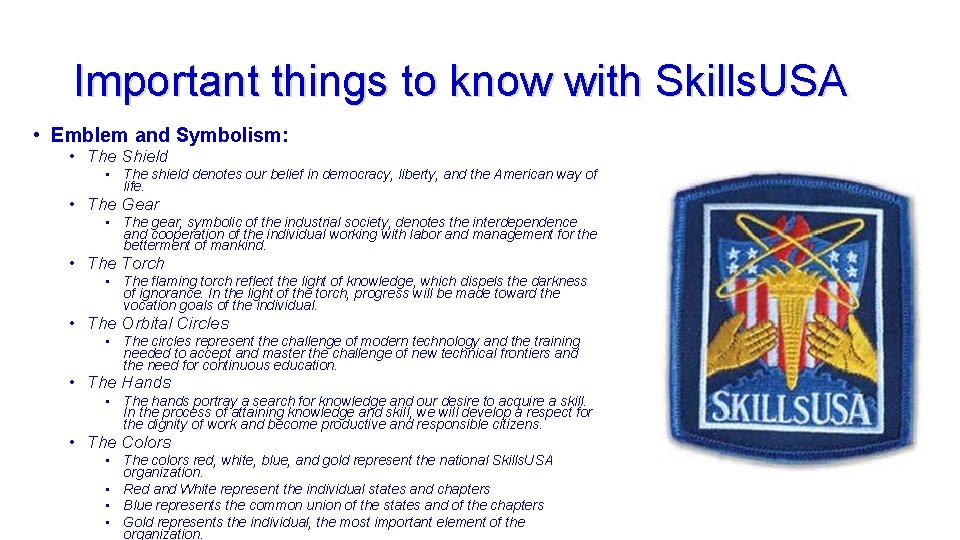
Important things to know with Skills. USA • Emblem and Symbolism: • The Shield • The shield denotes our belief in democracy, liberty, and the American way of life. • The Gear • The gear, symbolic of the industrial society, denotes the interdependence and cooperation of the individual working with labor and management for the betterment of mankind. • The Torch • The flaming torch reflect the light of knowledge, which dispels the darkness of ignorance. In the light of the torch, progress will be made toward the vocation goals of the individual. • The Orbital Circles • The circles represent the challenge of modern technology and the training needed to accept and master the challenge of new technical frontiers and the need for continuous education. • The Hands • The hands portray a search for knowledge and our desire to acquire a skill. In the process of attaining knowledge and skill, we will develop a respect for the dignity of work and become productive and responsible citizens. • The Colors • The colors red, white, blue, and gold represent the national Skills. USA organization. • Red and White represent the individual states and chapters • Blue represents the common union of the states and of the chapters • Gold represents the individual, the most important element of the organization.
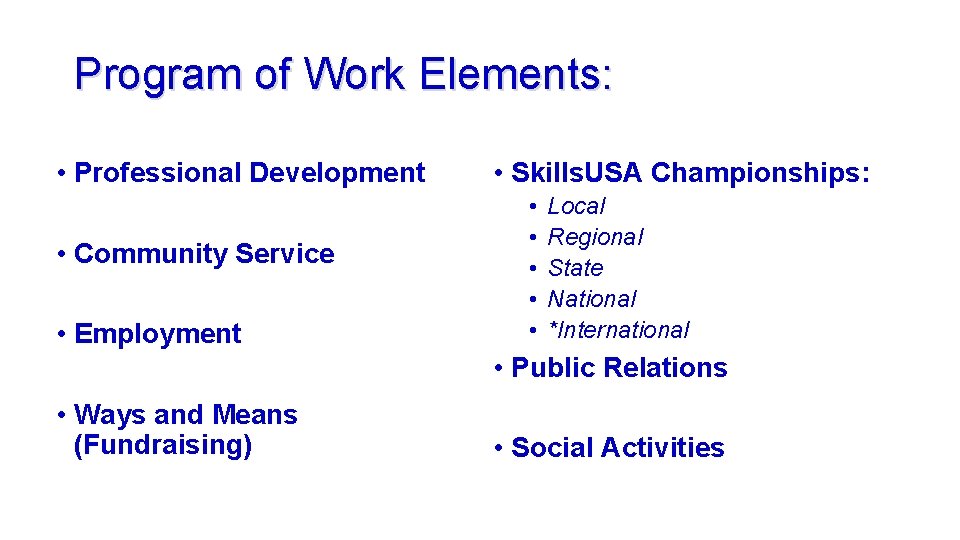
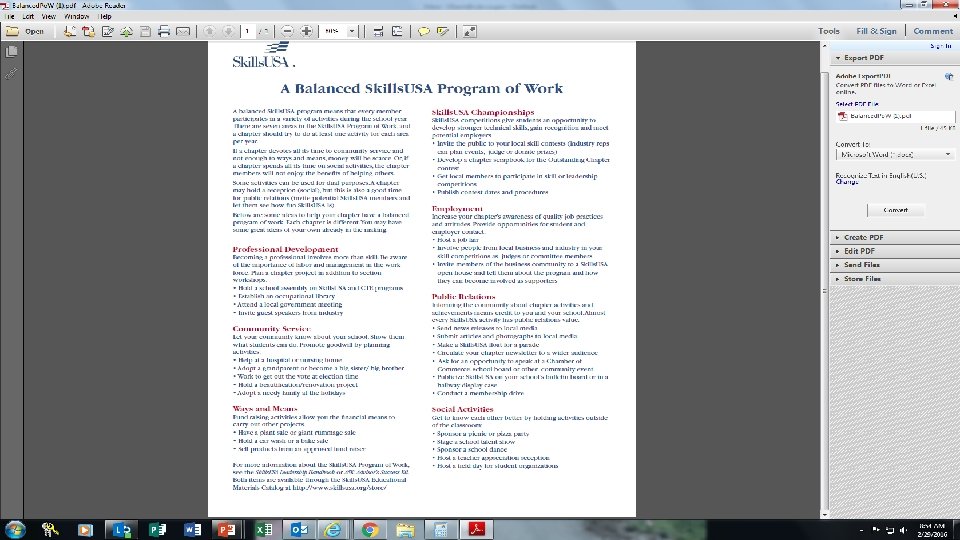
Program of Work Elements: • Professional Development • Community Service • Employment • Skills. USA Championships: • • • Local Regional State National *International • Public Relations • Ways and Means (Fundraising) • Social Activities
Skills. USA Professional Development Program Level 1:
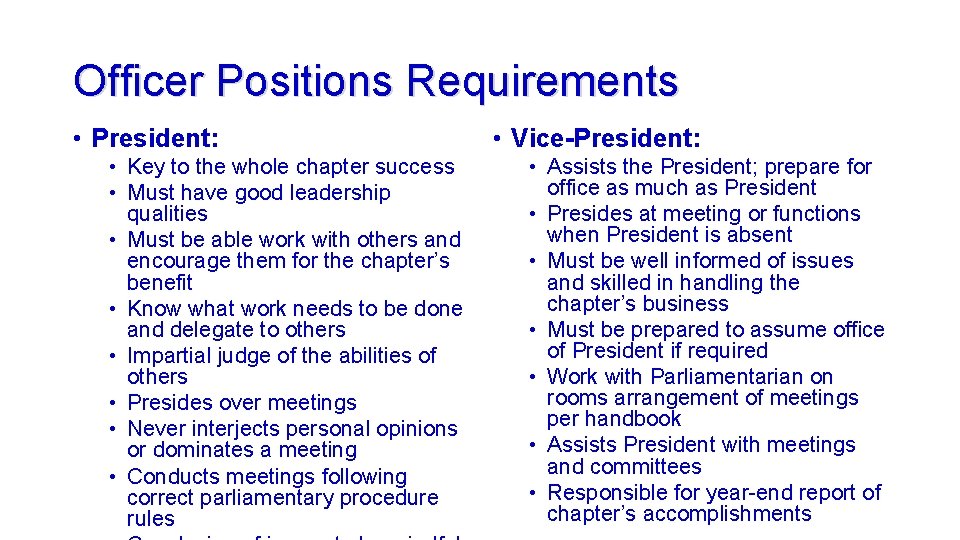
Officer Positions Requirements • President: • Key to the whole chapter success • Must have good leadership qualities • Must be able work with others and encourage them for the chapter’s benefit • Know what work needs to be done and delegate to others • Impartial judge of the abilities of others • Presides over meetings • Never interjects personal opinions or dominates a meeting • Conducts meetings following correct parliamentary procedure rules • Vice-President: • Assists the President; prepare for office as much as President • Presides at meeting or functions when President is absent • Must be well informed of issues and skilled in handling the chapter’s business • Must be prepared to assume office of President if required • Work with Parliamentarian on rooms arrangement of meetings per handbook • Assists President with meetings and committees • Responsible for year-end report of chapter’s accomplishments
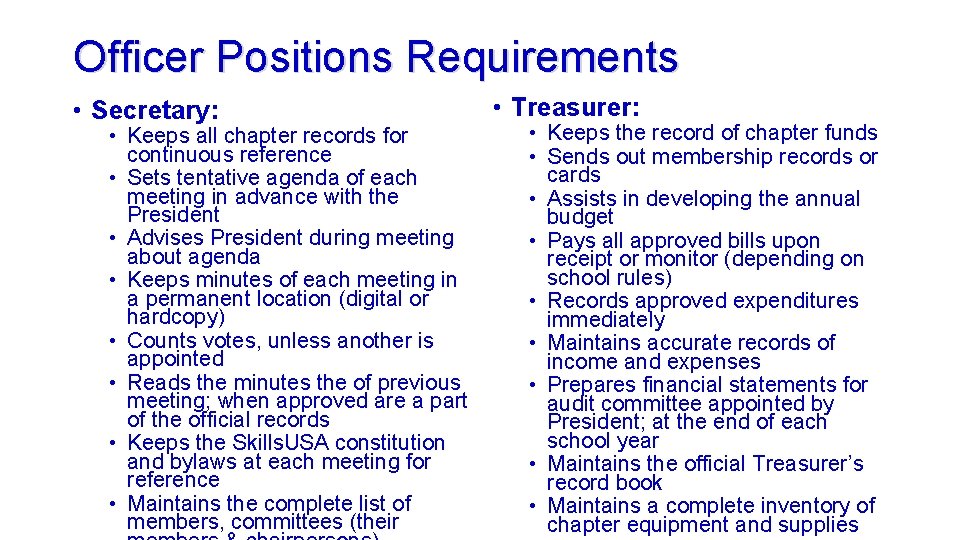
Officer Positions Requirements • Secretary: • Keeps all chapter records for continuous reference • Sets tentative agenda of each meeting in advance with the President • Advises President during meeting about agenda • Keeps minutes of each meeting in a permanent location (digital or hardcopy) • Counts votes, unless another is appointed • Reads the minutes the of previous meeting; when approved are a part of the official records • Keeps the Skills. USA constitution and bylaws at each meeting for reference • Maintains the complete list of members, committees (their • Treasurer: • Keeps the record of chapter funds • Sends out membership records or cards • Assists in developing the annual budget • Pays all approved bills upon receipt or monitor (depending on school rules) • Records approved expenditures immediately • Maintains accurate records of income and expenses • Prepares financial statements for audit committee appointed by President; at the end of each school year • Maintains the official Treasurer’s record book • Maintains a complete inventory of chapter equipment and supplies
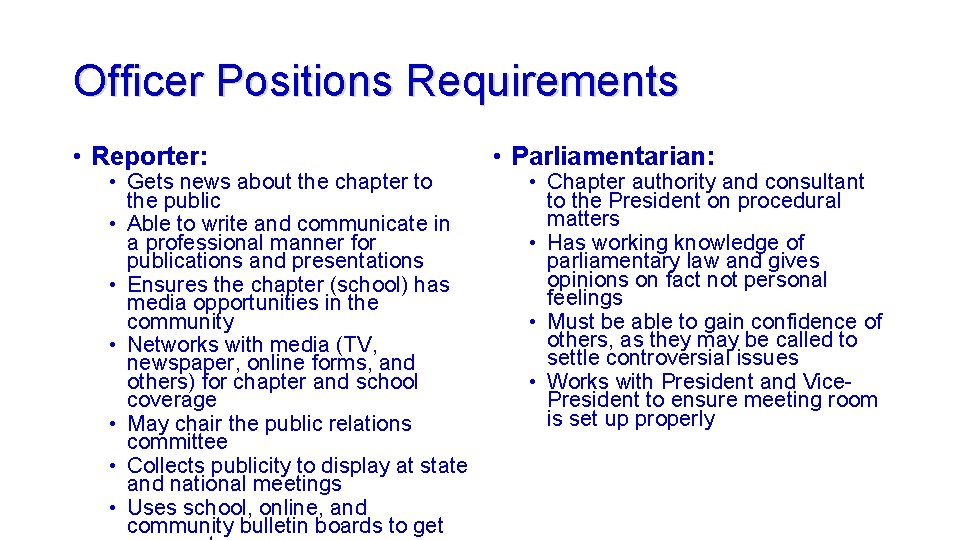
Officer Positions Requirements • Reporter: • Gets news about the chapter to the public • Able to write and communicate in a professional manner for publications and presentations • Ensures the chapter (school) has media opportunities in the community • Networks with media (TV, newspaper, online forms, and others) for chapter and school coverage • May chair the public relations committee • Collects publicity to display at state and national meetings • Uses school, online, and community bulletin boards to get • Parliamentarian: • Chapter authority and consultant to the President on procedural matters • Has working knowledge of parliamentary law and gives opinions on fact not personal feelings • Must be able to gain confidence of others, as they may be called to settle controversial issues • Works with President and Vice. President to ensure meeting room is set up properly
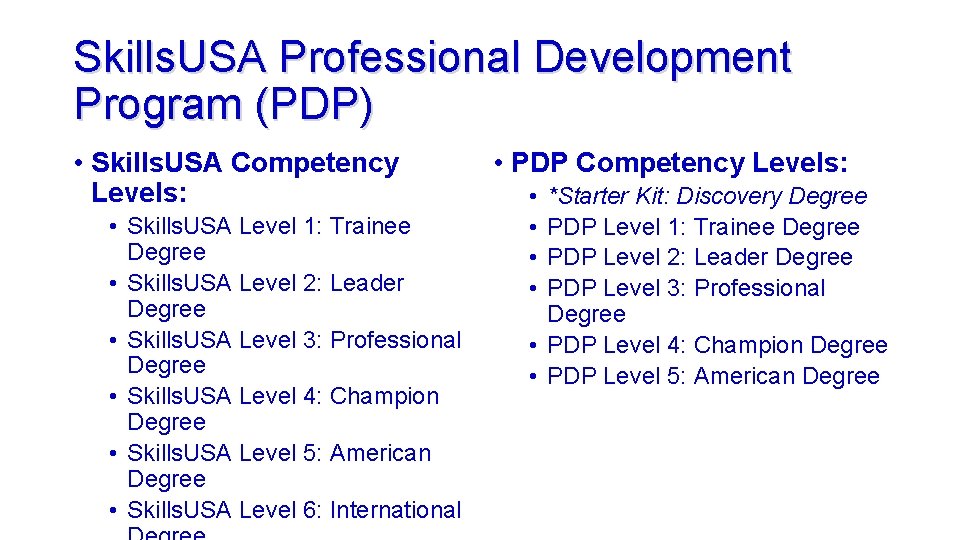
Skills. USA Professional Development Program (PDP) • Skills. USA Competency Levels: • Skills. USA Level 1: Trainee Degree • Skills. USA Level 2: Leader Degree • Skills. USA Level 3: Professional Degree • Skills. USA Level 4: Champion Degree • Skills. USA Level 5: American Degree • Skills. USA Level 6: International • PDP Competency Levels: • • *Starter Kit: Discovery Degree PDP Level 1: Trainee Degree PDP Level 2: Leader Degree PDP Level 3: Professional Degree • PDP Level 4: Champion Degree • PDP Level 5: American Degree
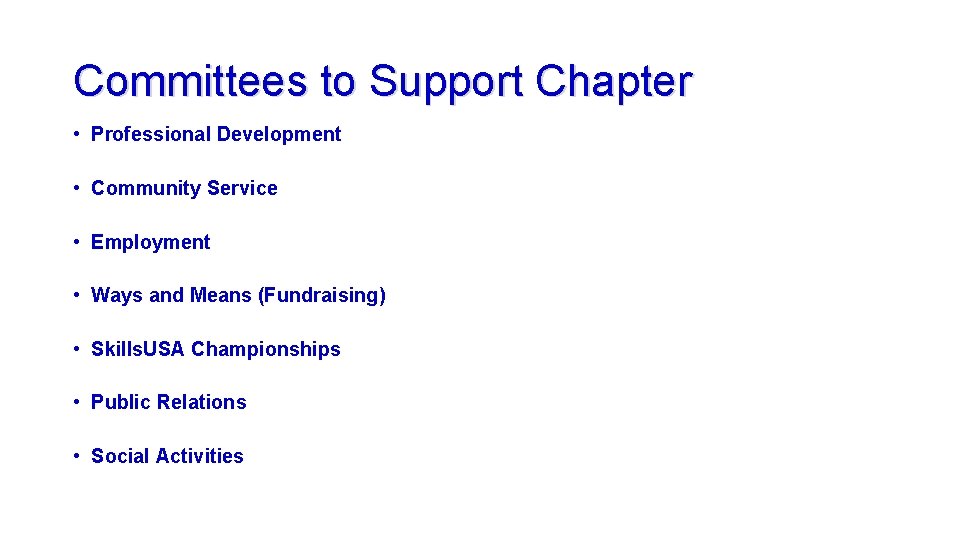
Committees to Support Chapter • Professional Development • Community Service • Employment • Ways and Means (Fundraising) • Skills. USA Championships • Public Relations • Social Activities
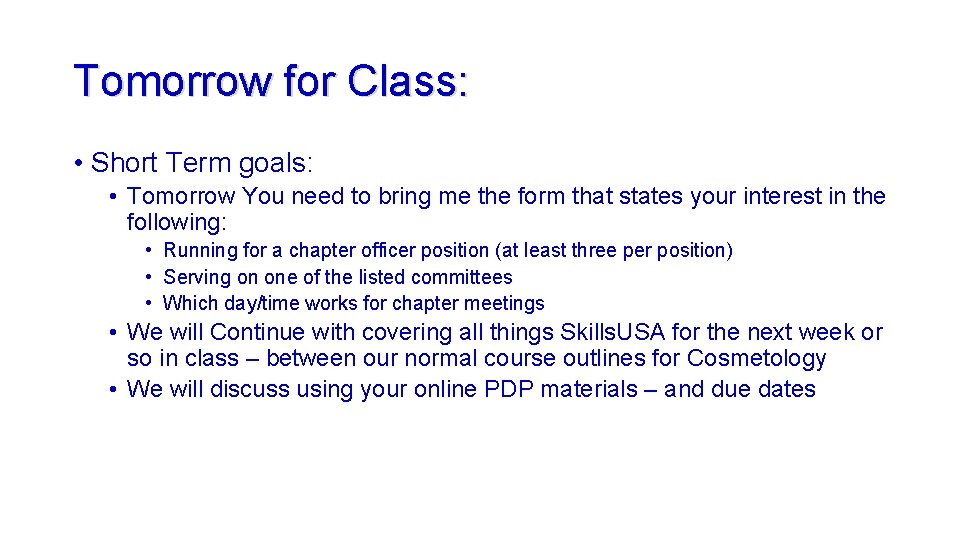
Tomorrow for Class: • Short Term goals: • Tomorrow You need to bring me the form that states your interest in the following: • Running for a chapter officer position (at least three per position) • Serving on one of the listed committees • Which day/time works for chapter meetings • We will Continue with covering all things Skills. USA for the next week or so in class – between our normal course outlines for Cosmetology • We will discuss using your online PDP materials – and due dates
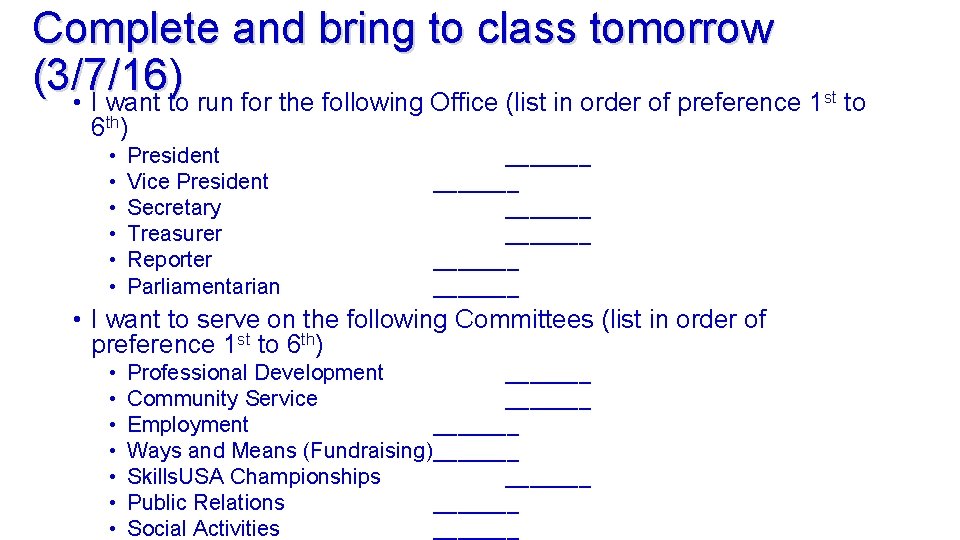
Complete and bring to class tomorrow (3/7/16) • I want to run for the following Office (list in order of preference 1 6 th) • • • President Vice President Secretary Treasurer Reporter Parliamentarian _______ _______ • I want to serve on the following Committees (list in order of preference 1 st to 6 th) • • Professional Development _______ Community Service _______ Employment _______ Ways and Means (Fundraising)_______ Skills. USA Championships _______ Public Relations _______ Social Activities _______ st to
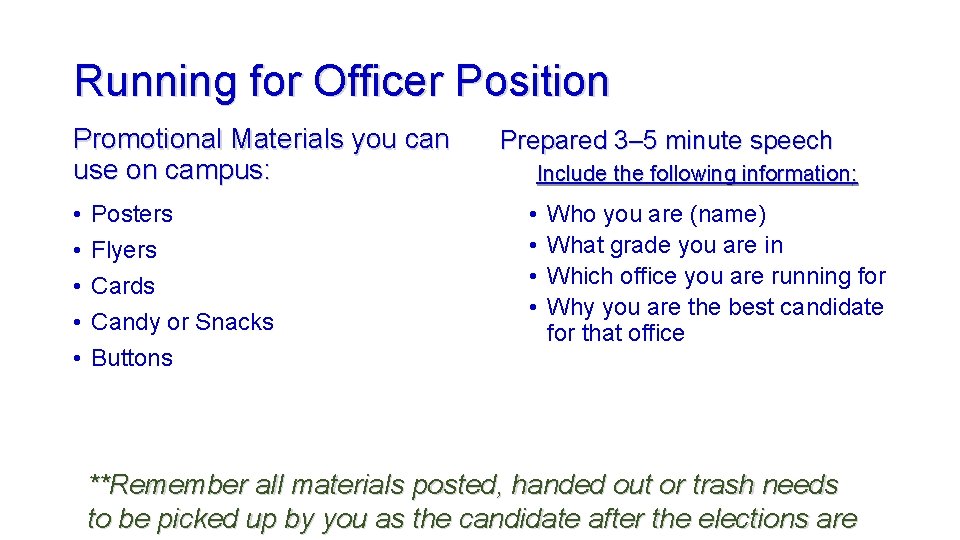
Running for Officer Position Promotional Materials you can use on campus: • • • Posters Flyers Cards Candy or Snacks Buttons Prepared 3– 5 minute speech Include the following information: • • Who you are (name) What grade you are in Which office you are running for Why you are the best candidate for that office **Remember all materials posted, handed out or trash needs to be picked up by you as the candidate after the elections are
Skills. USA Professional Development Program Level 1: • In your Level 1 – PDP online materials complete the following sections • • • S-1. 1 – Establish Short Term Goals S-1. 2 – Demonstrate Knowledge of Skills. USA Motto and current theme S-1. 3 – Demonstrate knowledge of the Skills. USA colors S-1. 4 – Demonstrate knowledge of the Skills. USA creed S-1. 5 – Demonstrate knowledge of the Skills. USA history S-1. 6 – Demonstrate knowledge of the official Skills. USA attire • These need to be complete online by Friday, 3/11/2016 • We will review these in class prior to election of officers = Monday, 3/14/16
Questions that you have about doing CTSOs
Contact Information for CTSOs in California Michelle Mc. Intosh 916 -319 -675 mmcintosh@cde. ca. gov Josiah Mayfield 916 -319 -0486 jmayfield@cde. ca. gov Cindy Beck 916 -319 -0470 cbeck@cde. ca. gov Gary Page 916 -319 -0499 gpage@cde. ca. gov Angie Ford 916 -319 -0448 aford@cde. ca. gov Melissa Webb 916 -319 -0773 mwebb@cde. ca. gov Clay Mitchell 916 -445 -5568 cmitchel@cde. ca. gov
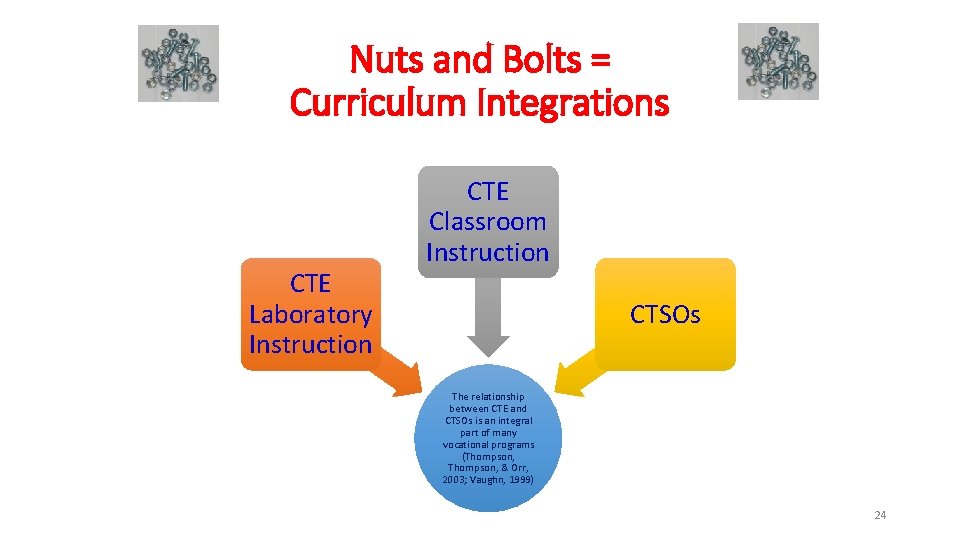
Nuts and Bolts = Curriculum Integrations CTE Laboratory Instruction CTE Classroom Instruction CTSOs The relationship between CTE and CTSOs is an integral part of many vocational programs (Thompson, & Orr, 2003; Vaughn, 1999) 24
Nuts and Bolts = Curriculum Integrations Module Outline: Officers and Elections Overview After completing this module, learners will be able to: a. Explain the process for electing chapter officers b. Describe the duties of each officer c. Locate additional resources about electing and training chapter officers Key Points 1. Electing officers for a Skills. USA chapter is essential for the success of a local organization. a. Officers guide local Skills. USA members. b. The personal growth of student officers contributes exponentially to the growth of the chapter. c. Officers assume a great deal of responsibility, which allows the advisor to be a guide rather than the focal point of the chapter. 25
Nuts and Bolts = Curriculum Integrations 2. The steps to establish a quality chapter officer team are simple! a. Follow a step-by-step process to elect the officers. b. Ensure that all candidates understand the officer roles. c. Provide training for newly elected officers. 3. The officer election process takes preparation, effort and follow-through. a. Form an election committee to design the election process. i. A committee is able to focus on developing an election process that is representative of the entire chapter’s desires. ii. The committee is a group of students who volunteer, apply, or are hand-picked by the advisor to elect the officer team. iii. One committee member serves as a chairperson, and all contribute to determining guidelines and a calendar of events for the election process. iv. Members of the election committee may still run for a chapter office. 4. Determine which offices should be part of the chapter. a. There are six suggested offices; however, local chapters should consider the number that is adequate given the size and scope locally. In some cases that number may be more or less than six. 26
Nuts and Bolts = Curriculum Integrations • b. Items to consider include: üHow many members will be represented? üWill each school program have an officer team, or will there be one officer team for the entire school? üWill the team be representative of all programs? üWhat structure do members desire to have? Is it in line with the chapter constitution and by-laws? Advisor Essentials Training Library Module Outline: Officers and Elections Page 1 27
Nuts and Bolts = Curriculum Integrations Key Points Continued c. All candidates campaign for their desired offices. i. Campaigning provides a great opportunity for leadership and social skill development. ii. Procedures must be fair for all candidates. iii. Establish rules and guidelines that all candidates may follow. This may include implementing a spending limit for campaign materials and/or including speeches as part of the campaign. Additional guidelines may include maintaining a specific GPA or proper behavior in school. d. Hold elections. i. All chapter members are eligible to vote during the elections. ii. The election committee determines the most appropriate balloting procedure. iii. Election should immediately follow the close of the campaign. 28
Nuts and Bolts = Curriculum Integrations e. Install officers. i. After election results are determined, install officers. You may use the long or short version of the installation ceremony listed in the leadership handbook. ii. Choose a time and location appropriate for the members and families who will attend, arrange for public coverage of the event, and ensure that all officers wear official dress to the installation. f. Evaluate the election process. i. Evaluation of all aspects of the election process help to determine what did and did not go well. ii. Make changes for the next year’s election process based on the results of the evaluation. 29
Nuts and Bolts = Curriculum Integrations Once the election procedure has been established, ensure that the candidates fully understand the duties of the office for which they desire to campaign. a. In general, officers should possess the following attributes: i. Professional actions and appearance ii. Proper etiquette iii. The ability to communicate in writing, public speaking, e-mails, conversations, meeting minutes, agendas and listening iv. Parliamentary procedure abilities v. Ability to conduct opening and closing ceremonies 30
Nuts and Bolts = Curriculum Integrations b. President i. Presides over chapter meetings, offering unbiased opinions and judgments ii. Is able to work with others, provide encouragement, offer information and delegate tasks iii. Has a working knowledge about parliamentary procedure c. Vice President i. Is informed well enough to function in the absence of the president ii. Conducts program planning iii. Assists the parliamentarian and president before meetings d. Secretary i. Sets agenda for meetings ii. Keeps all chapter records and meeting minutes; counts votes at meetings iii. Fulfills chapter correspondence Advisor Essentials Training Library Module Outline: Officers and Elections Page 2 31
Nuts and Bolts = Curriculum Integrations Key Points Continued e. Treasurer i. Keeps records of income and expense ii. Provides bills for annual dues and pays approved bills iii. Prepares financial statements f. Reporter i. Establishes and maintains media relations ii. Writes articles and prepares and distributes news releases g. Parliamentarian i. Holds chapter authority and serves as a consultant for procedural matters ii. Has a knowledge of parliamentary law iii. Calls attention to incorrect use of parliamentary procedure 32
Nuts and Bolts = Curriculum Integrations 5. The growth process for officers begins with training. Training ensures officers understand are capable of performing their duties effectively. a. Training chapter officers ensures they are equipped with the skills and knowledge to feel and act confident and responsibly in their many duties. b. Some ideas for training topics include: i. Officer duties ii. Opening and closing ceremonies iii. Parliamentary procedure iv. Skills. USA knowledge v. Professional etiquette and appearance vi. Goal setting vii. Communication skills viii. Basic Skills ix. Team building 33
Nuts and Bolts = Curriculum Integrations 6. Many resources are available to aid in learning about the officer election process. Some primary resources include: a. Skills. USA Leadership Handbook b. Advisor’s Success Kit Chapter 3: Establish a New Skills. USA Chapter c. Advisor’s Success Kit Chapter 6: Elect and Train Skills. USA Leaders and Officers d. Robert’s Rules of Order, Newly Revised e. Parliamentary Procedure at a Glance f. www. skillsusa. org 34
Nuts and Bolts = Curriculum Integrations Review üChapter officer teams are essential to the success of a local chapter. üFollowing a step-by-step procedure will ensure an efficient and effective election process. üSeveral additional resources are available for more information about electing chapter officers. Advisor Essentials Training Library Module Outline: Officers and Elections Page 3 Advisor Essentials Training Library Module Outline: Officers and Elections Page 4 Implement an officer selection and training process and begin growing outstanding leaders in your chapter today! 35
Contact Information: Sherry D. Davis, Ed. D. California Department of Education Programs Consultant – CTEAM Office (Perkins and CTEIG) sdavis@cde. ca. gov 916 -322 -1767 Office 805 -252 -4004 Cell 36
Resources - Links • www. cde. ca. gov • http: //www. cde. ca. gov/ci/ct/pk/ (Perkins web page) • www. cccco. edu • www. skillsusaca. org • http: //www. californiadeca. org/ • http: //ca-fhahero-fccla. org/ • http: //www. cafbla. org/ • http: //www. calaged. org/ • http: //www. cal-hosa. org/ • http: //www. leadershipchallenge. com/home. aspx • www. changingminds. org • www. leadership-central. com • https: //www. stephencovey. com/ • http: //www. ccsse. org/center/ • http: //www. ydae. purdue. edu/lct/hbcu/documents/Student_Involvement_A_Develop mental_Theory_for_HE_Astin. pdf 37
References • ACTE. (2007, August). CTE’s role in secondary-postsecondary transitions. Issue Brief. Alexandria, VA: Retrieved September 19, 2010, from http: //www. acteonline. org/issuebriefs. asp • ACTE. (2007, June). Career and technical education’s role in dropout prevention and recovery. Issue Brief. Alexandria, VA: Retrieved September 18, 2010, from http: //www. acteonline. org/issuebriefs. aspx • ACTE. (2007, March). Position paper: Expanding opportunities postsecondary career and technical education and preparing tomorrow’s workforce. Alexandria, VA: ACTE publication. Retrieved September 19, 2010, from http: //www. acteonline. org/ • ACTE. (2006). Perkins act of 2006: The official guide. ISBN: 100895140128. Alexandria, VA: ACTE publication. • Alfeld, C. , Hansen, D. M. , Aragon, S. R. , Stone III, J. R. (2006). Inside the black box: exploring the value added by career and technical student organizations to students’ high school experience. Career and Technical Education Research. 31(3), p. 121 -155. Retrieved September 19, 2010, from Google Scholar website: http: //scholar. lib. vt. edu/ejournals/CTER/v 31 n 3/alfred. html • Ambrose, W. L. , and Goar, L. G. (2009). Student organization integration: initiatives for positive Youth development – the ultimate leadership experience. Journal of Family Consumer Sciences Education. 27(NTS 5), p. 65 -83. Retrieved September 20, 2010, from http: //www. natefacs. org/JFCSE/v 27 standards 5 Ambrose. pdf • Astin, A. W. (1997). What matters in college? Four critical years revisited. ISBN: 1555424929. San Francisco, CA: Jossey-Bass, Inc. 38
References • Brown, B. L. (2002). CTE student organizations. ERIC Digest #235. EDO-CE-02 -235 Retrieved November 11, 2010, from Google scholar website: http: //calpro-online. org/eric/docs/dig 235. pdf • California Department of Education. (2007). Career Technical Education Model Curriculum Standards. ISBN: 001677. Retrieved September 11, 2010, from http: //www. cde. ca. gov/ci/ct/sf/documents/ctestandards. pdf. Sacramento, CA: CDE Printing Office. • California Department of Education. (2010). Career and technical student organizations. Retrieved September 25, 2010, from California Department of Education Career and technical education website: http: //cte. ed. gov/links/career_and_technical_student_organizations. cfm • Covey, S. R. (2004). The 7 Habits of Highly Effective People. Revised edition. ISBN: 0743272455. New York, NY: Free Press, Inc. • Davis, S. (2012). Career Technical Student Organizations: California Community College Best Kept Secret. (Dissertation). California State University, Northridge. Retrieved December 1, 2012, from: Google Scholar: http: //csun-dspace. calstate. edu/handle/10211. 2/1848 • Derrickson, D. R. (2007). Career technical student organizations: Purpose and possibility. ISBN: 074143066. West Conshohocken, PA: Infinity. • Gordon, H. R. D. (2008). The history and growth of career and technical education in America (3 rd edition). ISBN: 101577665171. Long Grove, IL: Waveland Press, Inc. 39
References • Higher Education Opportunity Act of 2008 (HR 4137). (2008). Retrieved December 20, 2011, from: The Library of Congress: http: //thomas. loc. gov/cgi-bin/query/z? c 110: H. R. 4137. • Johnson, S. (2008). The influence of career technical student organizations on non-traditional and traditional community college students. (Dissertation). University of Southern Mississippi. Hattiesburg, MS. UMI: 3346534. Retrieved September 20, 2010, from Oviatt library Dissertations (Proquest): http: //proquest. umi. com. libproxy. csun. edu/pqdweb? index=0&did=1685695831&Srch. Mode=2&sid=1 &Fmt=6&VInst=PROD&VType=PQD&RQT=309&VName=PQD&TS=1317159059&client. Id=17859 • Krattenmaker, P. , Vaughan, E. , Ramirez, D. , Ochsner, K. , Staley, J. and Raymond, T. (2010). The benefits of implementing CTSOs. Retrieved September 11, 2010, from Google: http: //www. cotsa. cccs. edu/perm. Docs/The. Benefitsof. Implementing. CTSO. pdf • Kuh, G. , Kinzie, J. , Schuh, J. H. , Whitt, E. J. , and Associates. (2010). Student success in college: Creating conditions that matter. ISBN: 9780470599099. San Francisco, CA: Jossey-Bass, Inc • Kuh, G. (2009). The national survey of student engagement: conceptual and empirical foundations. New Directions for Institutional Research. 141(1). pp. 5 -20. Retrieved November 24, 2010, from Oviatt Library http: //library. csun. edu/ • Kuh, G. (2007). The national survey of student engagement: conceptual framework and overview of psychometric properties. Indiana University Center for Postsecondary Research. pp. 1 -26. Retrieved September 20, 2010, from Google Scholar: http: //nsse. indiana. edu/2004_annual_report/pdf/2004_Conceptual_Framework. pdf 40
References • Kuh, G. , Kinzie, J. , Schuh, J. H. , Whitt, E. J. (2005). Assessing conditions to enhance educational effectiveness: The inventory for student engagement and success. ISBN: 9780787982201. San Francisco, CA: Jossey-Bass, Inc. • O’Connell, J. , Woodruff, D. , Schwarzenegger, A. , Board of Governors of the California Community Colleges, CCCO, CDE, et, al. (2008). 2008 -2012 California state plan for career and technical education: a guide for high-quality programs, a bridge to the future. Retrieved September 11, 2010, from West. Ed website: http: //www. schoolsmovingup. net/cs/ctep/print/htdocs/ctep/home. htm • Mac. Gregor, M. G. (2005). Designing student leadership programs: Transforming the leadership potential in youth. 3 rd edition. ISBN: 100967798167. Denver, CO: Youthleadership. com • Mc. Nally, K. and Harvey, M. (2001). Career and Technical Student Organizations: A perfect path to self-determination and successful transition. Preventing School Failure. 45(3). pp. 114 -118. Retrieved September 11, 2010 from Oviatt Library http: //library. csun. edu/ • Scott, J. L. and Sarkees-Wircenski, M. (2004). Overview of career and technical education. (3 rd edition). ISBN: 0826940161. Homewood, IL: American Technical Publishers, Inc. • Skills. USA. (2010). Skills. USA: Champions at work. Retrieved November 2, 2010, from website: www. skillsusa. org • Skills. USA. (2010). Skills. USA Student Leadership Handbook. 24 th edition. ISBN: P 90. Leesburg, VA: Skills. USA • Skills. USA. (2010). Values Proposition Research. Retrieved October, 5, 2011, from website: www. skillsusa. org/directors 41
References • Tinto, V. (1993). Leaving college: Rethinking the causes and cures of student attrition. 2 nd edition. ISBN: 100226804496. Chicago, IL: University of Chicago. • Threeton, M. and Pellock, C. (2010). The relationship between Skills. USA student contest preparation and academics. Journal of Career and Technical Education. 25(2). pp. 94 -108. Retrieved September 20, 2010, from Oviatt Library http: //library. csun. edu/ • Threeton, M. (2007). The Carl D. Perkins Career and Technical Education (CTE) Act of 2006 and the roles and responsibilities of CTE teachers and faculty members. Journal of Industrial Teacher Education. 44(1). pp. 66 -82. Retrieved September 18, 2010, from Oviatt Library http: //library. csun. edu/ • United State Department of Labor. (1999). Secretary’s Commission on Necessary Skills (SCANS) Report. Retrieved November 2, 2010 from http: //wdr. doleta. gov/opr/FULLTEXT/1999_35. pdf • United States Department of Labor. (2010). Occupational Outlook Handbook. ISBN: 9781593577384. Indianapolis, IN: JIST Publishing. • Zirkle, C. and Connors, J. (2003). The Contributions of career and technical student organizations (CTSO) to the development and assessment of workplace skills and knowledge: A literature review. Workforce Education Forum. 30(2). pp. 15 -26. Retrieved September 20, 2010, from Oviatt Library http: //library. csun. edu/ 42