
Integrating Business Analytics into the Business Statistics Course
Integrating Business Analytics into the Business Statistics Course • Robert Andrews, Virginia Commonwealth University • David M. Levine, Baruch College, CUNY • David F. Stephan, Two Bridges Instructional Technology • Kathryn A. Szabat, La Salle University DSI 2012, MSMESB Mini-Conference
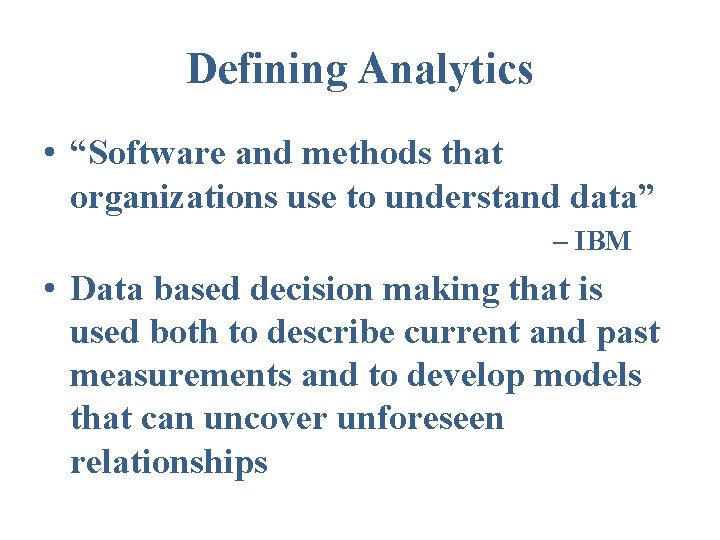
Defining Analytics • “Software and methods that organizations use to understand data” – IBM • Data based decision making that is used both to describe current and past measurements and to develop models that can uncover unforeseen relationships
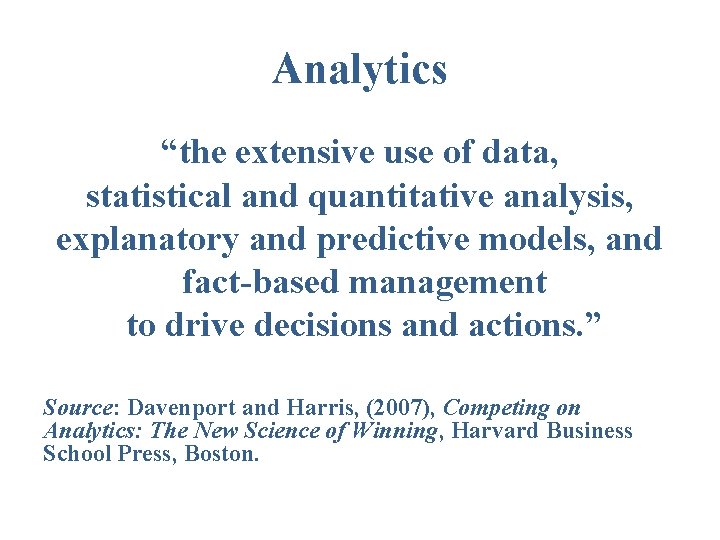
Analytics “the extensive use of data, statistical and quantitative analysis, explanatory and predictive models, and fact-based management to drive decisions and actions. ” Source: Davenport and Harris, (2007), Competing on Analytics: The New Science of Winning, Harvard Business School Press, Boston.
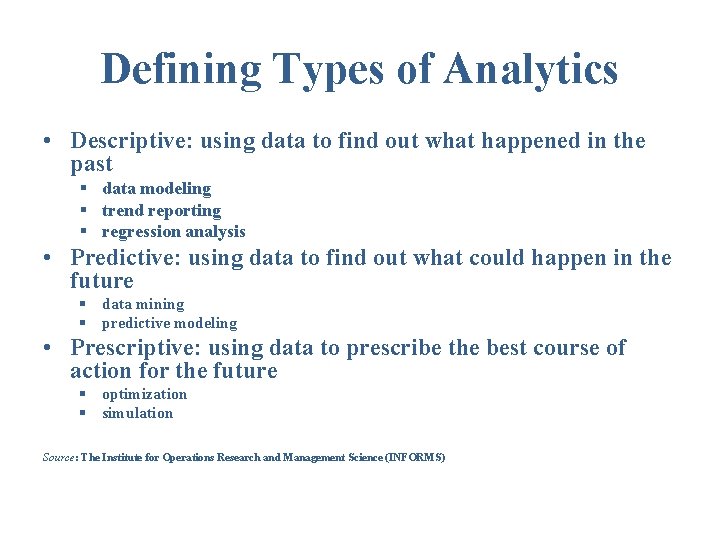
Defining Types of Analytics • Descriptive: using data to find out what happened in the past § data modeling § trend reporting § regression analysis • Predictive: using data to find out what could happen in the future § data mining § predictive modeling • Prescriptive: using data to prescribe the best course of action for the future § optimization § simulation Source: The Institute for Operations Research and Management Science (INFORMS)
Reasons for Integrating Analytics (affective factors) • Helps create the (new) impression that the course will be important to their business education • “I keep saying that the sexy job in the next ten years will be statistician. ”—Hal Varian, Chief Economist, Google as quoted by The New York Times • “Data Scientist: The Sexiest Job of the 21 st Century”—Thomas Davenport and D. J. Patil, Harvard Business Review October 2012
Reasons for Integrating Analytics (professional and career) Information. Week’s 2012 U. S. IT Salary Survey reported that “analyzing data” were critical job skills. § 78. 1% of staff professionals and 76. 9% of management professionals said that analyzing data was critical to their job
How Do We Integrate Analytics? • Would discussing business analytics be § An addition to course? § A replacement for a current topic? § Something introduced in another introductory course? • Would business analytics be § A foundational concept? § A capstone concept? • How would/should business analytics affect course emphasis? § Make it more or less abstract? § Make it more or less focused on specific methods? § Add or subtract individual work?
The Typical Introductory Business Statistics Course • Overview/orientation • Tables and Charts/Descriptive Statistics • Probability and Probability Distributions • Confidence Intervals and Hypothesis Testing • Regression
Issue: Must react to being able to handle much larger amounts of data using new methods and technologies • What about these developments should we include in the introductory course? • With the new additions, what needs to be subtracted from the course? • How can these developments shape entire programs, majors, etc. ?
Integrating DBMS into the Introductory IS Course (circa 1982) Issue: Must react to being able to handle much larger amounts of data using new methods and technologies • What about these developments should we include in the introductory course? • With the new additions, what needs to be subtracted from the course? • How can these developments shape entire programs, majors, etc. ?
Lessons Learned from 1980’s IS Curriculum Discussions • Don’t get focused teaching specific technologies or specific technological solutions • Emphasize “big picture trends, ” conceptual understanding, and effects of possible (disruptive) changes • OK to use smaller-scale or simpler technology to emulate the larger, future more complex things • Problem-solving, problemsolving”
“Problem-solving, problem-solving”
Setting the Foundation for the Business Systems & Analytics Major
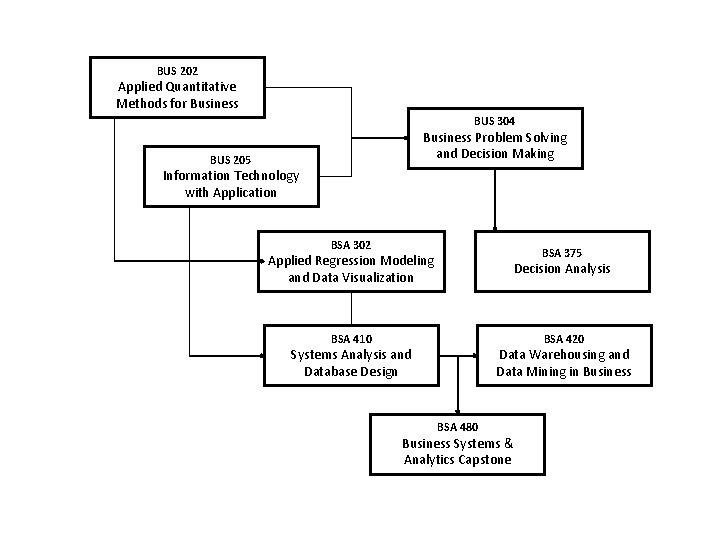
BUS 202 Applied Quantitative Methods for Business BUS 304 Business Problem Solving and Decision Making BUS 205 Information Technology with Application BSA 302 BSA 375 Applied Regression Modeling and Data Visualization Decision Analysis BSA 410 BSA 420 Systems Analysis and Database Design Data Warehousing and Data Mining in Business BSA 480 Business Systems & Analytics Capstone
Business Systems & Analytics The Department: Working Together as a Team Management Information Systems Faculty Statistics Faculty Operations Faculty The Major Re-tooled Management Information Systems major
Departmental Task Review and Improve the Business Core Courses: BUS 202, BUS 205, and BUS 304 with aim to Provide foundation for the BS&A Major/Minor Prepare business students for the workplace
Departmental Task Identified Need: To Integrate Business Analytics into The BUS 202, BUS 205, and BUS 304 Courses
Departmental Task • Coordinated effort to reinforce the understanding of Business Analytics across the courses. • Each course to highlight Business Analytics the first day of class. • Roadmap for tools and techniques learned in each course.
Integrating Business Analytics in the Business Statistics Course • Emphasis on Decision Making and Problem Solving “formulate the problem” • Interpretation and Communication of Statistical Results “someone has to tell the story at the end” • Relevance to Organizational Performance “data-centric organizations ask: what do we know? NOT what do we think? ”
Additions? Statistics as a way of thinking and problem-solving. Use a problem-solving framework such as DCOVA: Define your business objective and the variables for which you want to reach conclusions Collect the data from appropriate sources Organize the data collected Visualize the data by constructing charts Analyze the data to reach conclusions and present those results
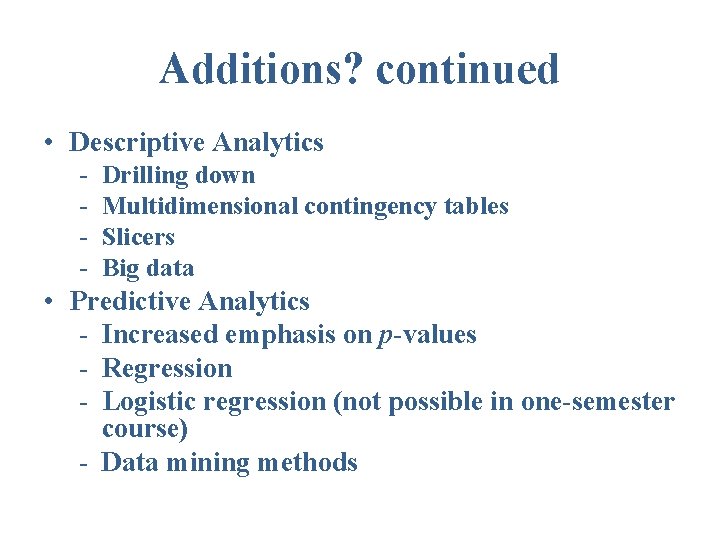
Additions? continued • Descriptive Analytics - Drilling down Multidimensional contingency tables Slicers Big data • Predictive Analytics - Increased emphasis on p-values - Regression - Logistic regression (not possible in one-semester course) - Data mining methods
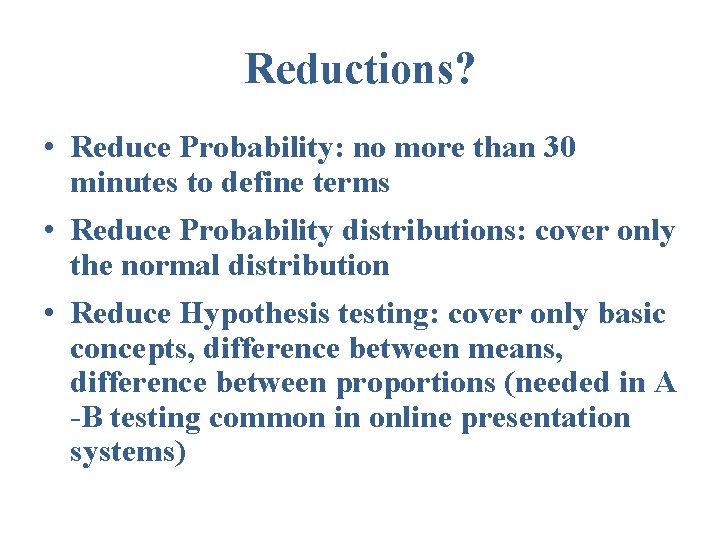
Reductions? • Reduce Probability: no more than 30 minutes to define terms • Reduce Probability distributions: cover only the normal distribution • Reduce Hypothesis testing: cover only basic concepts, difference between means, difference between proportions (needed in A -B testing common in online presentation systems)
- Slides: 22