
Integrating art critical art historical and artmaking practice
- Slides: 24
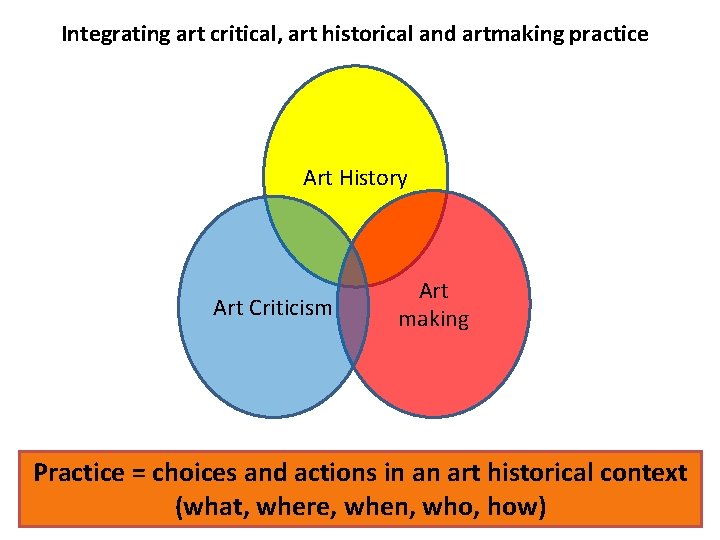
Integrating art critical, art historical and artmaking practice Art History Art Criticism Art making Practice = choices and actions in an art historical context (what, where, when, who, how)
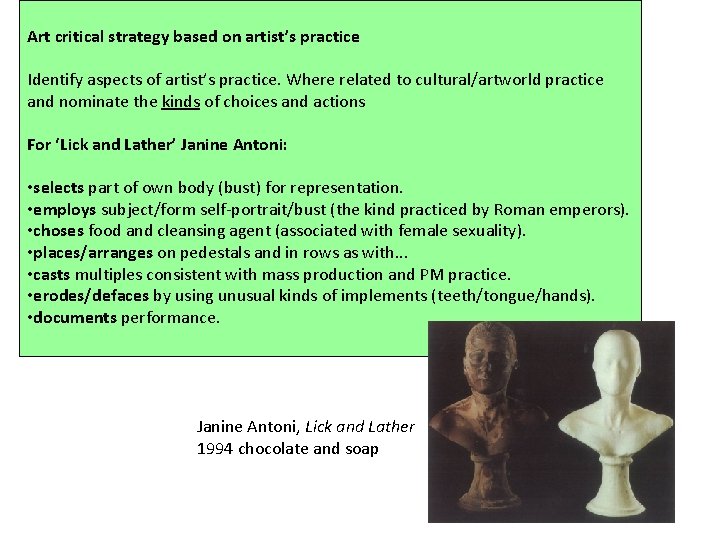
Art critical strategy based on artist’s practice Identify aspects of artist’s practice. Where related to cultural/artworld practice and nominate the kinds of choices and actions For ‘Lick and Lather’ Janine Antoni: • selects part of own body (bust) for representation. • employs subject/form self-portrait/bust (the kind practiced by Roman emperors). • choses food and cleansing agent (associated with female sexuality). • places/arranges on pedestals and in rows as with. . . • casts multiples consistent with mass production and PM practice. • erodes/defaces by using unusual kinds of implements (teeth/tongue/hands). • documents performance. Janine Antoni, Lick and Lather 1994 chocolate and soap
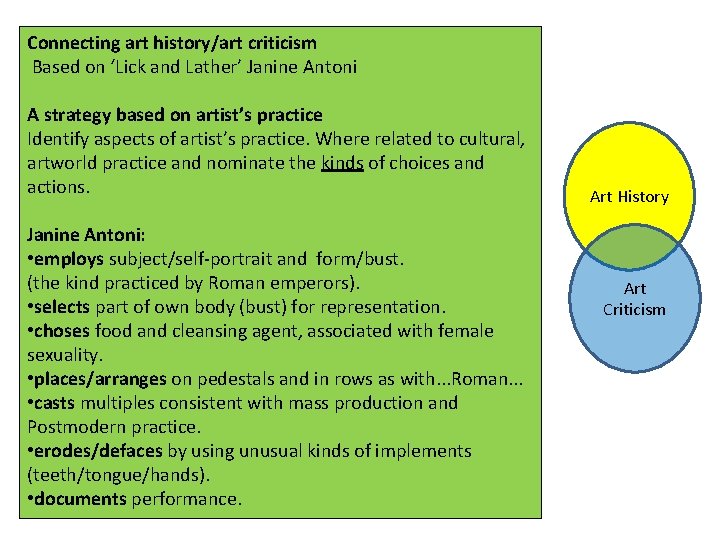
Connecting art history/art criticism Based on ‘Lick and Lather’ Janine Antoni A strategy based on artist’s practice Identify aspects of artist’s practice. Where related to cultural, artworld practice and nominate the kinds of choices and actions. Janine Antoni: • employs subject/self-portrait and form/bust. (the kind practiced by Roman emperors). • selects part of own body (bust) for representation. • choses food and cleansing agent, associated with female sexuality. • places/arranges on pedestals and in rows as with. . . Roman. . . • casts multiples consistent with mass production and Postmodern practice. • erodes/defaces by using unusual kinds of implements (teeth/tongue/hands). • documents performance. Art History Art Criticism
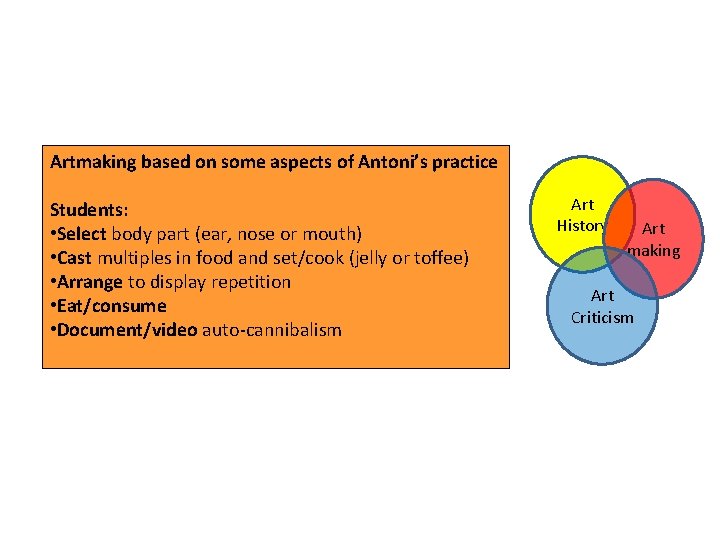
Artmaking based on some aspects of Antoni’s practice Students: • Select body part (ear, nose or mouth) • Cast multiples in food and set/cook (jelly or toffee) • Arrange to display repetition • Eat/consume • Document/video auto-cannibalism Art History Art making Art Criticism
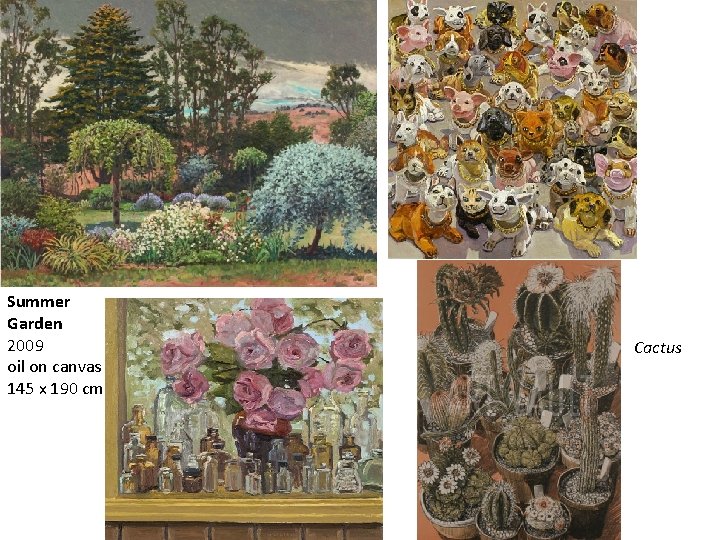
Summer Garden 2009 oil on canvas 145 x 190 cm Cactus
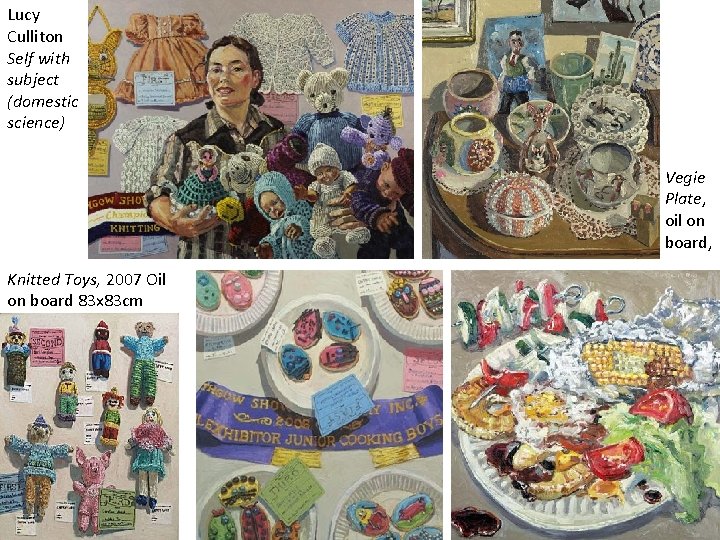
Lucy Culliton Self with subject (domestic science) Vegie Plate, oil on board, Knitted Toys, 2007 Oil on board 83 x 83 cm
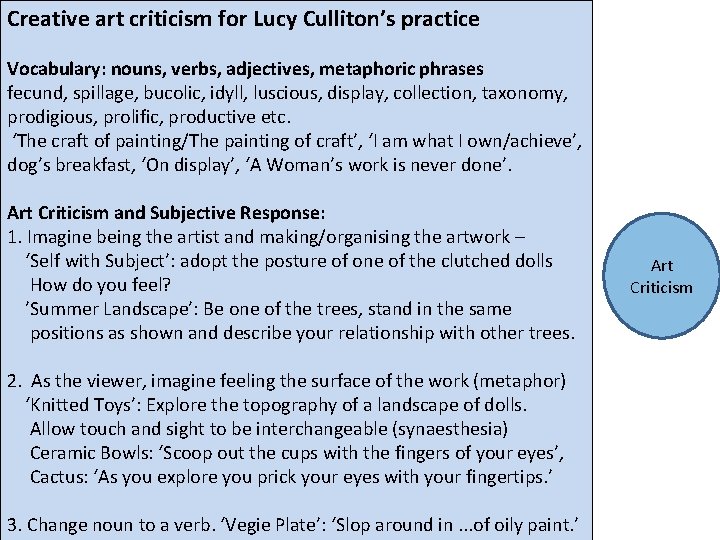
Creative art criticism for Lucy Culliton’s practice Vocabulary: nouns, verbs, adjectives, metaphoric phrases fecund, spillage, bucolic, idyll, luscious, display, collection, taxonomy, prodigious, prolific, productive etc. ‘The craft of painting/The painting of craft’, ‘I am what I own/achieve’, dog’s breakfast, ‘On display’, ‘A Woman’s work is never done’. Art Criticism and Subjective Response: 1. Imagine being the artist and making/organising the artwork – ‘Self with Subject’: adopt the posture of one of the clutched dolls How do you feel? ’Summer Landscape’: Be one of the trees, stand in the same positions as shown and describe your relationship with other trees. 2. As the viewer, imagine feeling the surface of the work (metaphor) ‘Knitted Toys’: Explore the topography of a landscape of dolls. Allow touch and sight to be interchangeable (synaesthesia) Ceramic Bowls: ‘Scoop out the cups with the fingers of your eyes’, Cactus: ‘As you explore you prick your eyes with your fingertips. ’ 3. Change noun to a verb. ‘Vegie Plate’: ‘Slop around in. . . of oily paint. ’ Art Criticism
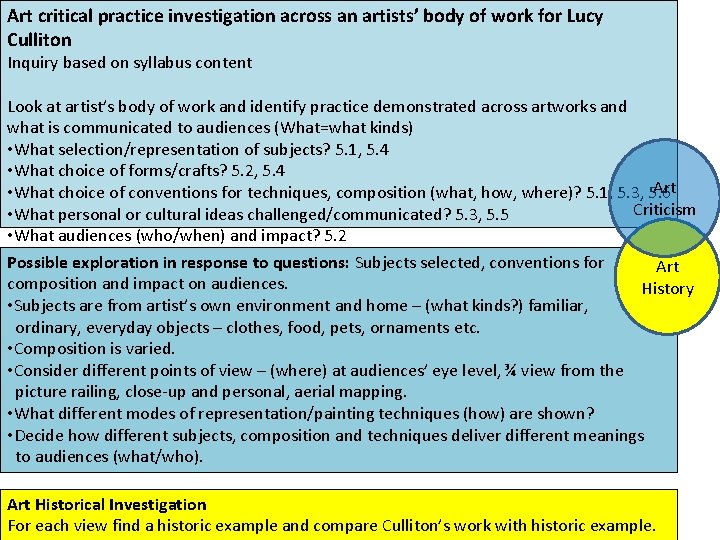
Art critical practice investigation across an artists’ body of work for Lucy Culliton Inquiry based on syllabus content Look at artist’s body of work and identify practice demonstrated across artworks and what is communicated to audiences (What=what kinds) • What selection/representation of subjects? 5. 1, 5. 4 • What choice of forms/crafts? 5. 2, 5. 4 Art • What choice of conventions for techniques, composition (what, how, where)? 5. 1, 5. 3, 5. 6 Criticism • What personal or cultural ideas challenged/communicated? 5. 3, 5. 5 • What audiences (who/when) and impact? 5. 2 Possible exploration in response to questions: Subjects selected, conventions for Art composition and impact on audiences. History • Subjects are from artist’s own environment and home – (what kinds? ) familiar, ordinary, everyday objects – clothes, food, pets, ornaments etc. • Composition is varied. • Consider different points of view – (where) at audiences’ eye level, ¾ view from the picture railing, close-up and personal, aerial mapping. • What different modes of representation/painting techniques (how) are shown? • Decide how different subjects, composition and techniques deliver different meanings to audiences (what/who). Art Historical Investigation For each view find a historic example and compare Culliton’s work with historic example.
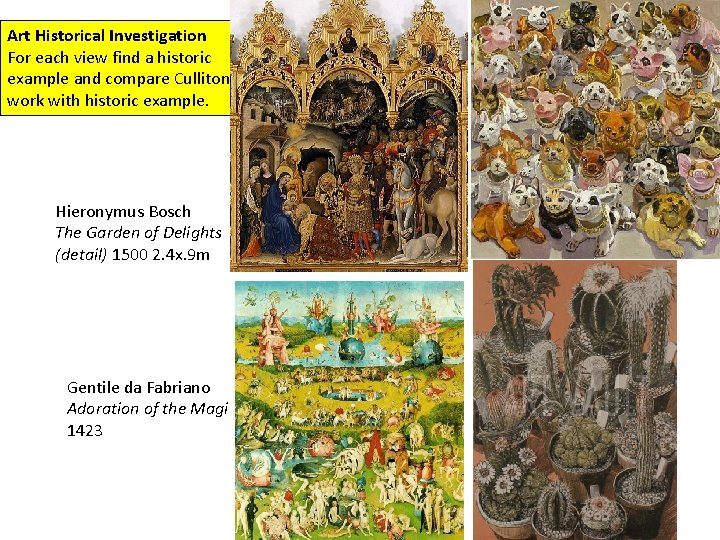
Art Historical Investigation For each view find a historic example and compare Culliton’s work with historic example. Hieronymus Bosch The Garden of Delights (detail) 1500 2. 4 x. 9 m Gentile da Fabriano Adoration of the Magi 1423
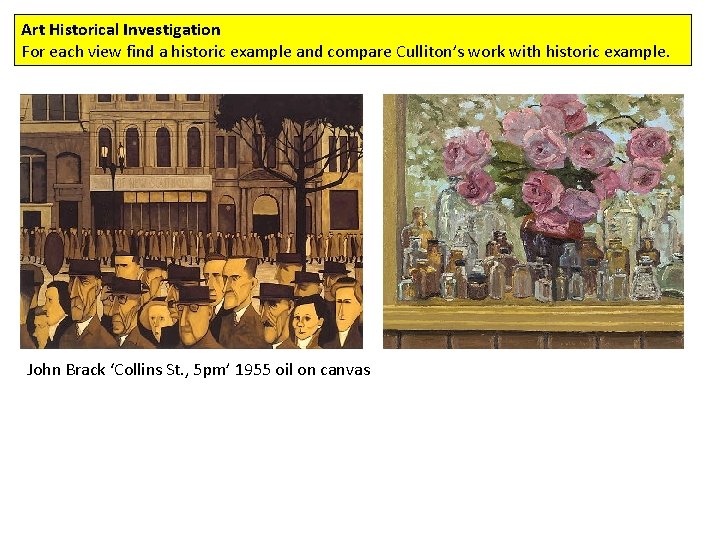
Art Historical Investigation For each view find a historic example and compare Culliton’s work with historic example. John Brack ‘Collins St. , 5 pm’ 1955 oil on canvas
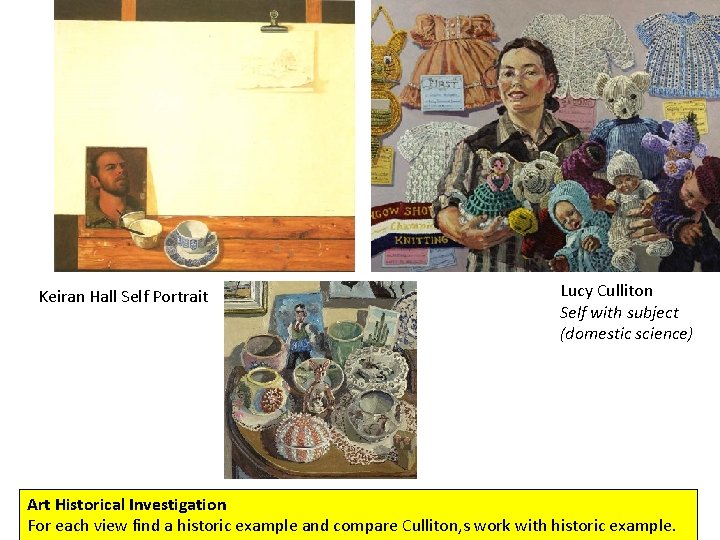
Keiran Hall Self Portrait Lucy Culliton Self with subject (domestic science) Art Historical Investigation For each view find a historic example and compare Culliton, s work with historic example.
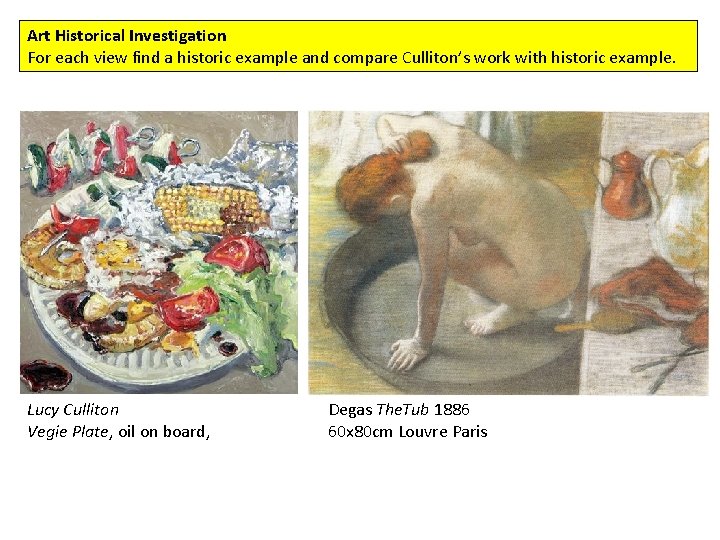
Art Historical Investigation For each view find a historic example and compare Culliton’s work with historic example. Lucy Culliton Vegie Plate, oil on board, Degas The. Tub 1886 60 x 80 cm Louvre Paris
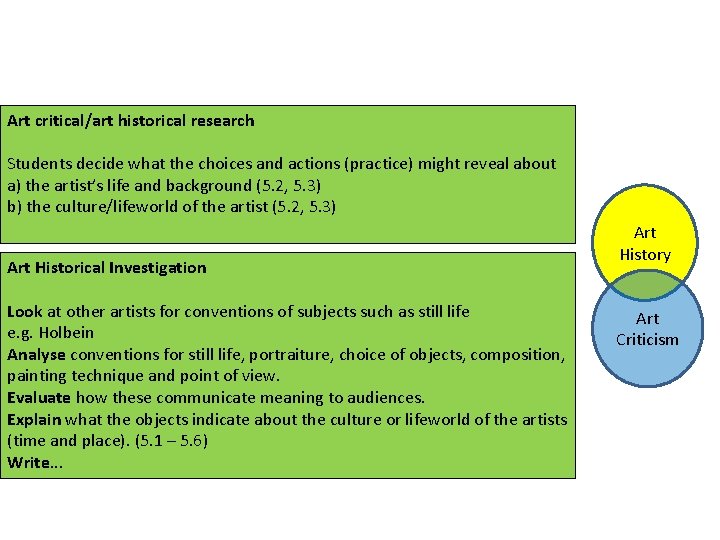
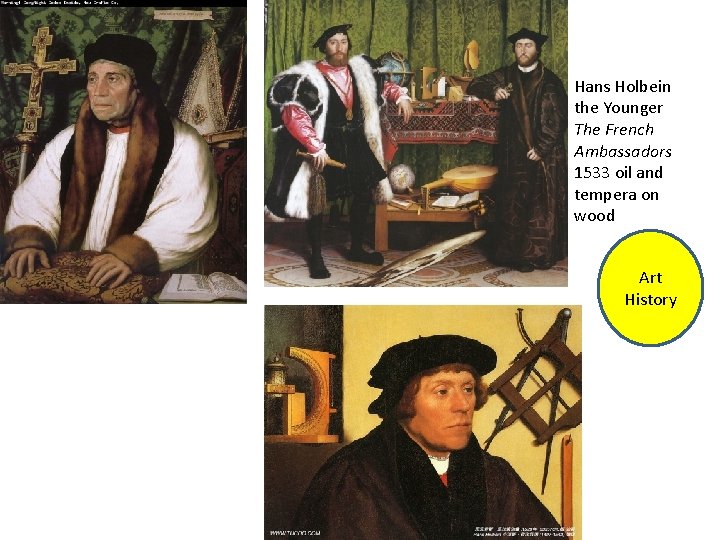
Art critical/art historical research Students decide what the choices and actions (practice) might reveal about a) the artist’s life and background (5. 2, 5. 3) b) the culture/lifeworld of the artist (5. 2, 5. 3) Art Historical Investigation Look at other artists for conventions of subjects such as still life e. g. Holbein Analyse conventions for still life, portraiture, choice of objects, composition, painting technique and point of view. Evaluate how these communicate meaning to audiences. Explain what the objects indicate about the culture or lifeworld of the artists (time and place). (5. 1 – 5. 6) Write. . . Art History Art Criticism
Hans Holbein the Younger The French Ambassadors 1533 oil and tempera on wood Art History
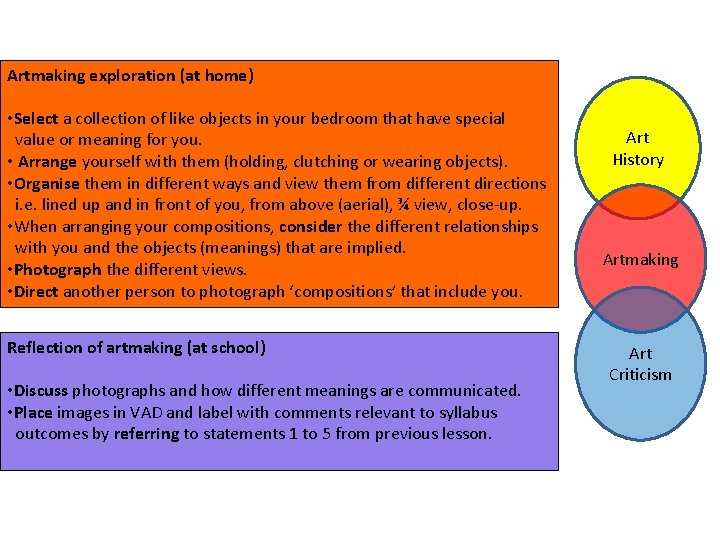
Artmaking exploration (at home) • Select a collection of like objects in your bedroom that have special value or meaning for you. • Arrange yourself with them (holding, clutching or wearing objects). • Organise them in different ways and view them from different directions i. e. lined up and in front of you, from above (aerial), ¾ view, close-up. • When arranging your compositions, consider the different relationships with you and the objects (meanings) that are implied. • Photograph the different views. • Direct another person to photograph ‘compositions’ that include you. Reflection of artmaking (at school) • Discuss photographs and how different meanings are communicated. • Place images in VAD and label with comments relevant to syllabus outcomes by referring to statements 1 to 5 from previous lesson. Art History Artmaking Art Criticism
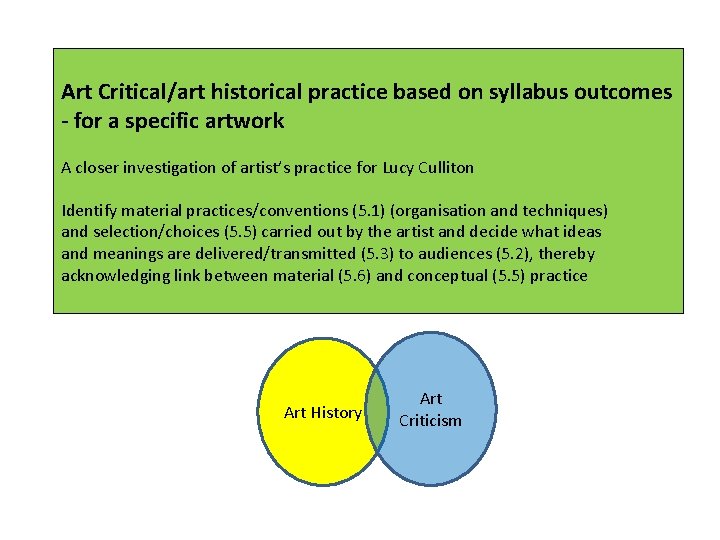
Art Critical/art historical practice based on syllabus outcomes - for a specific artwork A closer investigation of artist’s practice for Lucy Culliton Identify material practices/conventions (5. 1) (organisation and techniques) and selection/choices (5. 5) carried out by the artist and decide what ideas and meanings are delivered/transmitted (5. 3) to audiences (5. 2), thereby acknowledging link between material (5. 6) and conceptual (5. 5) practice Art History Art Criticism
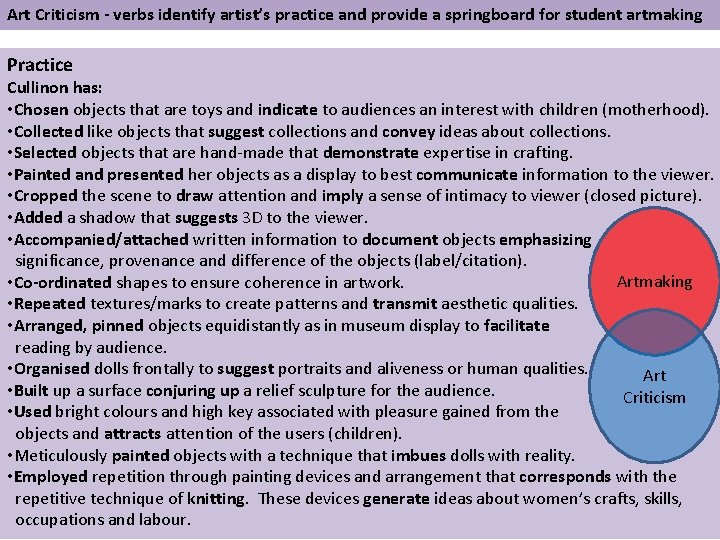
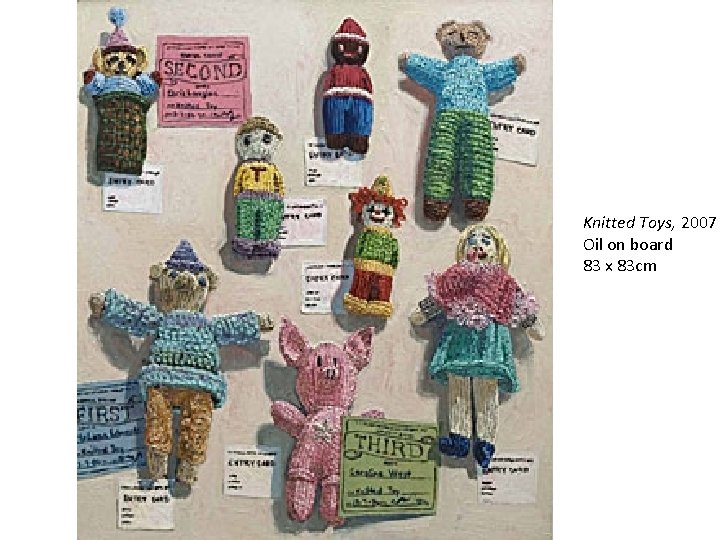
Art Criticism - verbs identify artist’s practice and provide a springboard for student artmaking Practice Cullinon has: • Chosen objects that are toys and indicate to audiences an interest with children (motherhood). • Collected like objects that suggest collections and convey ideas about collections. • Selected objects that are hand-made that demonstrate expertise in crafting. • Painted and presented her objects as a display to best communicate information to the viewer. • Cropped the scene to draw attention and imply a sense of intimacy to viewer (closed picture). • Added a shadow that suggests 3 D to the viewer. • Accompanied/attached written information to document objects emphasizing significance, provenance and difference of the objects (label/citation). Artmaking • Co-ordinated shapes to ensure coherence in artwork. • Repeated textures/marks to create patterns and transmit aesthetic qualities. • Arranged, pinned objects equidistantly as in museum display to facilitate reading by audience. • Organised dolls frontally to suggest portraits and aliveness or human qualities. Art • Built up a surface conjuring up a relief sculpture for the audience. Criticism • Used bright colours and high key associated with pleasure gained from the objects and attracts attention of the users (children). • Meticulously painted objects with a technique that imbues dolls with reality. • Employed repetition through painting devices and arrangement that corresponds with the repetitive technique of knitting. These devices generate ideas about women’s crafts, skills, occupations and labour.
Knitted Toys, 2007 Oil on board 83 x 83 cm
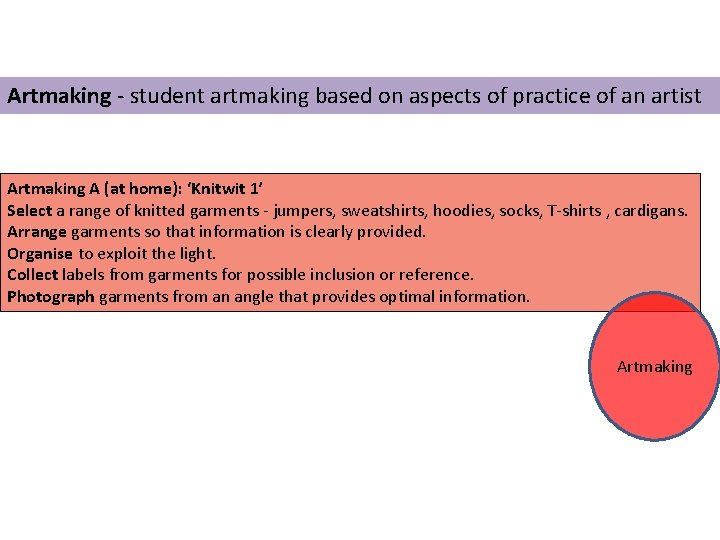
Artmaking - student artmaking based on aspects of practice of an artist Artmaking A (at home): ‘Knitwit 1’ Select a range of knitted garments - jumpers, sweatshirts, hoodies, socks, T-shirts , cardigans. Arrange garments so that information is clearly provided. Organise to exploit the light. Collect labels from garments for possible inclusion or reference. Photograph garments from an angle that provides optimal information. Artmaking
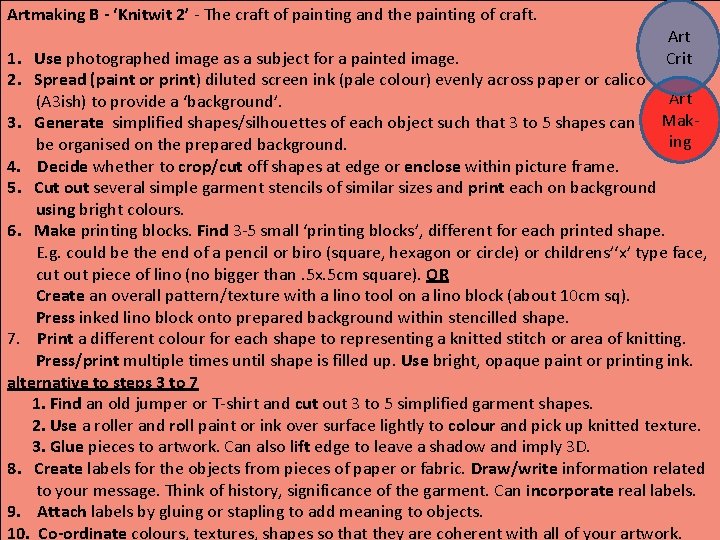
Artmaking B - ‘Knitwit 2’ - The craft of painting and the painting of craft. Art Crit 1. Use photographed image as a subject for a painted image. 2. Spread (paint or print) diluted screen ink (pale colour) evenly across paper or calico Art (A 3 ish) to provide a ‘background’. 3. Generate simplified shapes/silhouettes of each object such that 3 to 5 shapes can Making be organised on the prepared background. 4. Decide whether to crop/cut off shapes at edge or enclose within picture frame. 5. Cut out several simple garment stencils of similar sizes and print each on background using bright colours. 6. Make printing blocks. Find 3 -5 small ‘printing blocks’, different for each printed shape. E. g. could be the end of a pencil or biro (square, hexagon or circle) or childrens’‘x’ type face, cut out piece of lino (no bigger than. 5 x. 5 cm square). OR Create an overall pattern/texture with a lino tool on a lino block (about 10 cm sq). Press inked lino block onto prepared background within stencilled shape. 7. Print a different colour for each shape to representing a knitted stitch or area of knitting. Press/print multiple times until shape is filled up. Use bright, opaque paint or printing ink. alternative to steps 3 to 7 1. Find an old jumper or T-shirt and cut out 3 to 5 simplified garment shapes. 2. Use a roller and roll paint or ink over surface lightly to colour and pick up knitted texture. 3. Glue pieces to artwork. Can also lift edge to leave a shadow and imply 3 D. 8. Create labels for the objects from pieces of paper or fabric. Draw/write information related to your message. Think of history, significance of the garment. Can incorporate real labels. 9. Attach labels by gluing or stapling to add meaning to objects. 10. Co-ordinate colours, textures, shapes so that they are coherent with all of your artwork.
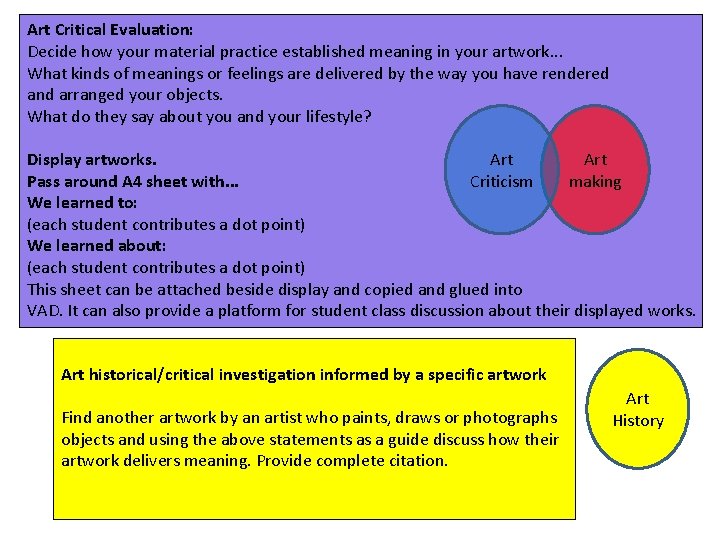
Art Critical Evaluation: Decide how your material practice established meaning in your artwork. . . What kinds of meanings or feelings are delivered by the way you have rendered and arranged your objects. What do they say about you and your lifestyle? Display artworks. Art Pass around A 4 sheet with. . . Criticism making We learned to: (each student contributes a dot point) We learned about: (each student contributes a dot point) This sheet can be attached beside display and copied and glued into VAD. It can also provide a platform for student class discussion about their displayed works. Art historical/critical investigation informed by a specific artwork Find another artwork by an artist who paints, draws or photographs objects and using the above statements as a guide discuss how their artwork delivers meaning. Provide complete citation. Art History
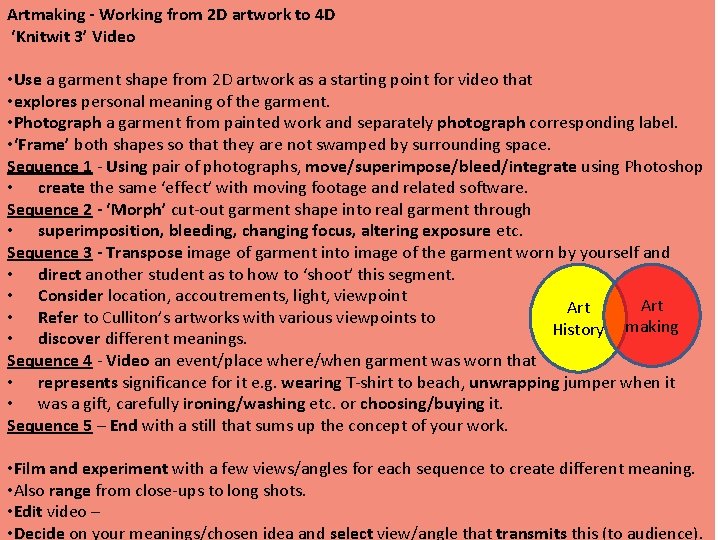
Artmaking - Working from 2 D artwork to 4 D ‘Knitwit 3’ Video • Use a garment shape from 2 D artwork as a starting point for video that • explores personal meaning of the garment. • Photograph a garment from painted work and separately photograph corresponding label. • ‘Frame’ both shapes so that they are not swamped by surrounding space. Sequence 1 - Using pair of photographs, move/superimpose/bleed/integrate using Photoshop • create the same ‘effect’ with moving footage and related software. Sequence 2 - ‘Morph’ cut-out garment shape into real garment through • superimposition, bleeding, changing focus, altering exposure etc. Sequence 3 - Transpose image of garment into image of the garment worn by yourself and • direct another student as to how to ‘shoot’ this segment. • Consider location, accoutrements, light, viewpoint Art • Refer to Culliton’s artworks with various viewpoints to History making • discover different meanings. Sequence 4 - Video an event/place where/when garment was worn that • represents significance for it e. g. wearing T-shirt to beach, unwrapping jumper when it • was a gift, carefully ironing/washing etc. or choosing/buying it. Sequence 5 – End with a still that sums up the concept of your work. • Film and experiment with a few views/angles for each sequence to create different meaning. • Also range from close-ups to long shots. • Edit video – • Decide on your meanings/chosen idea and select view/angle that transmits this (to audience).
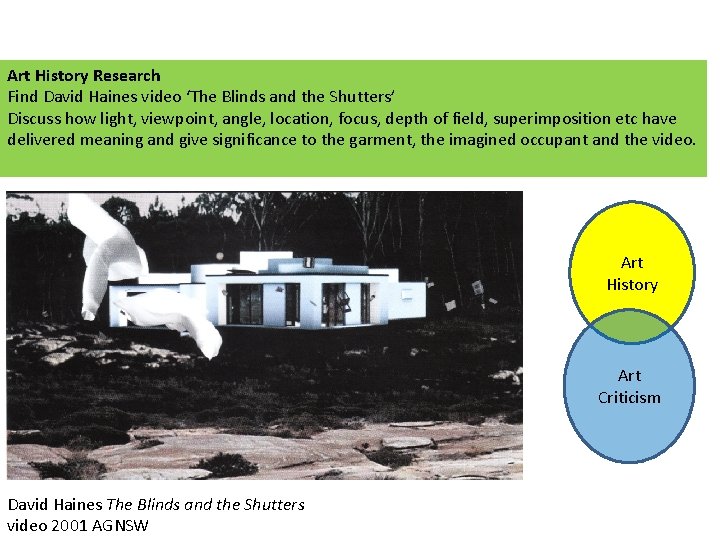
Art History Research Find David Haines video ‘The Blinds and the Shutters’ Discuss how light, viewpoint, angle, location, focus, depth of field, superimposition etc have delivered meaning and give significance to the garment, the imagined occupant and the video. Art History Art Criticism David Haines The Blinds and the Shutters video 2001 AGNSW
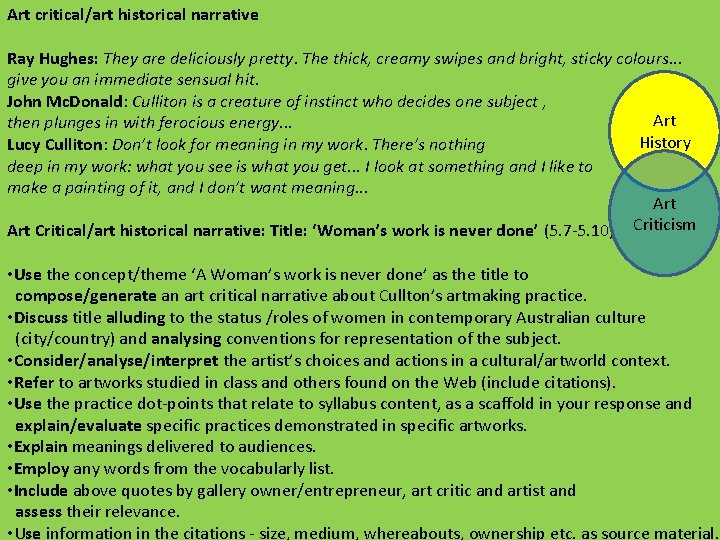
Art critical/art historical narrative Ray Hughes: They are deliciously pretty. The thick, creamy swipes and bright, sticky colours. . . give you an immediate sensual hit. John Mc. Donald: Culliton is a creature of instinct who decides one subject , Art then plunges in with ferocious energy. . . History Lucy Culliton: Don’t look for meaning in my work. There’s nothing deep in my work: what you see is what you get. . . I look at something and I like to make a painting of it, and I don’t want meaning. . . Art Critical/art historical narrative: Title: ‘Woman’s work is never done’ (5. 7 -5. 10) Criticism • Use the concept/theme ‘A Woman’s work is never done’ as the title to compose/generate an art critical narrative about Cullton’s artmaking practice. • Discuss title alluding to the status /roles of women in contemporary Australian culture (city/country) and analysing conventions for representation of the subject. • Consider/analyse/interpret the artist’s choices and actions in a cultural/artworld context. • Refer to artworks studied in class and others found on the Web (include citations). • Use the practice dot-points that relate to syllabus content, as a scaffold in your response and explain/evaluate specific practices demonstrated in specific artworks. • Explain meanings delivered to audiences. • Employ any words from the vocabularly list. • Include above quotes by gallery owner/entrepreneur, art critic and artist and assess their relevance. • Use information in the citations - size, medium, whereabouts, ownership etc. as source material.