
Integrating Architecture Michael van Lent Institute for Creative
- Slides: 15
Integrating Architecture Michael van Lent Institute for Creative Technology University of Southern California
Motivation • Technologies at ICT have been chosen on a project-by-project basis. – Pros • Maximum flexibility for each project • Experience with a wide-range of technologies • Game industry technologies are used more and more – Cons • Inhibits integration of research – with other research groups – with prototype developers – into the Army’s transition pipeline • Increased and duplicated infrastructure effort • No one is using the Army’s simulation systems – don’t include immersive capabilities – significant overhead in familiarization and integration
Solution: The Integrating Architecture • A single technological foundation for ICT – and other research & development groups • Core design principles – Support research in: • • • – – Artificial Intelligence Computer graphics Immersive audio Skeletal and facial animation Immersive training systems Pipeline from research to development to transition Custom-built to researcher’s needs Best-of-class technologies Free or inexpensive research licenses
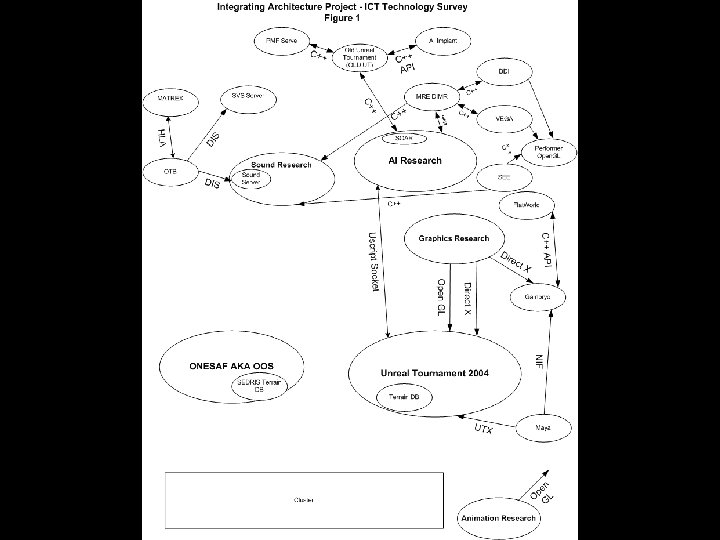
Building the IA • GFY 04 – Phase 1: Investigation • Gather requirements from user community • Survey current ICT technology landscape • Evaluate existing candidate technologies – Phase 2: Design • Create a technical design document • Create a development schedule • Refine the budget – Phase 3: Development • Build part of the Integrating Architecture • Produce a proof-of-concept demonstration • GFY 05 – Phase 4: Continued development • Ready for wide-spread use in October 2005 • GFY 06 and on – Support and Integration Architecture 2. 0
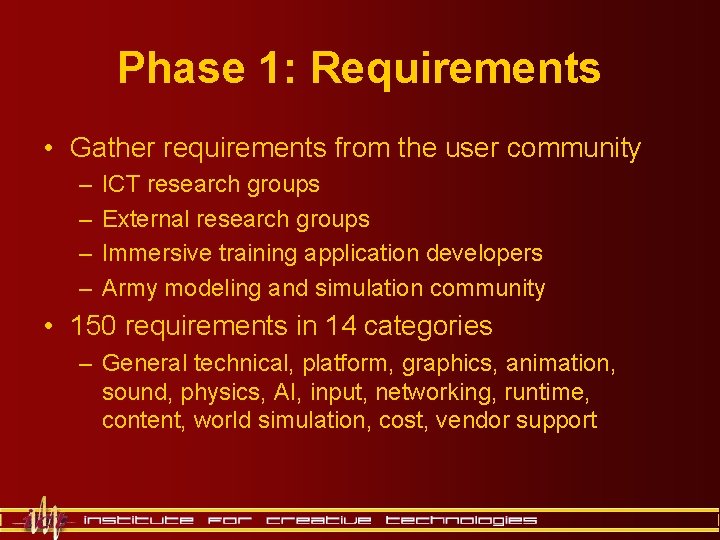
Phase 1: Requirements • Gather requirements from the user community – – ICT research groups External research groups Immersive training application developers Army modeling and simulation community • 150 requirements in 14 categories – General technical, platform, graphics, animation, sound, physics, AI, input, networking, runtime, content, world simulation, cost, vendor support
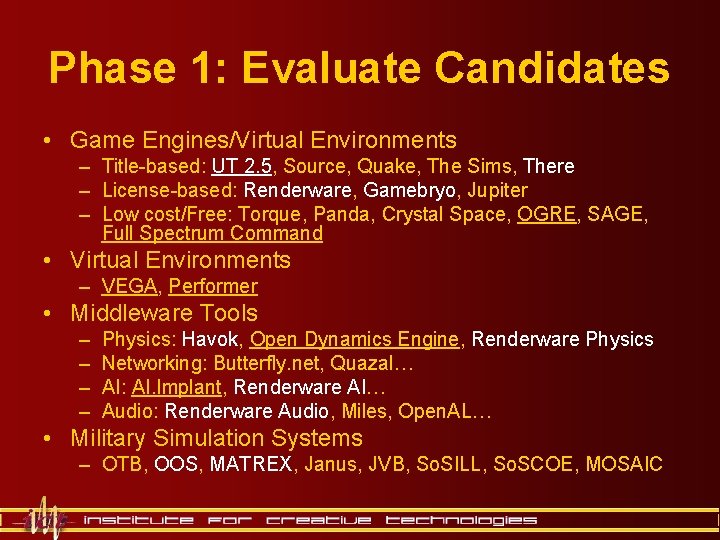
Phase 1: Evaluate Candidates • Game Engines/Virtual Environments – Title-based: UT 2. 5, Source, Quake, The Sims, There – License-based: Renderware, Gamebryo, Jupiter – Low cost/Free: Torque, Panda, Crystal Space, OGRE, SAGE, Full Spectrum Command • Virtual Environments – VEGA, Performer • Middleware Tools – – Physics: Havok, Open Dynamics Engine, Renderware Physics Networking: Butterfly. net, Quazal… AI: AI. Implant, Renderware AI… Audio: Renderware Audio, Miles, Open. AL… • Military Simulation Systems – OTB, OOS, MATREX, Janus, JVB, So. SILL, So. SCOE, MOSAIC
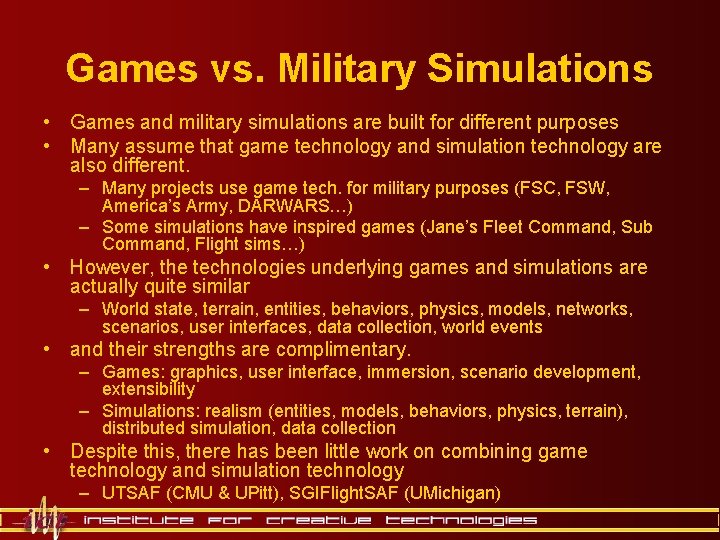
Games vs. Military Simulations • Games and military simulations are built for different purposes • Many assume that game technology and simulation technology are also different. – Many projects use game tech. for military purposes (FSC, FSW, America’s Army, DARWARS…) – Some simulations have inspired games (Jane’s Fleet Command, Sub Command, Flight sims…) • However, the technologies underlying games and simulations are actually quite similar – World state, terrain, entities, behaviors, physics, models, networks, scenarios, user interfaces, data collection, world events • and their strengths are complimentary. – Games: graphics, user interface, immersion, scenario development, extensibility – Simulations: realism (entities, models, behaviors, physics, terrain), distributed simulation, data collection • Despite this, there has been little work on combining game technology and simulation technology – UTSAF (CMU & UPitt), SGIFlight. SAF (UMichigan)
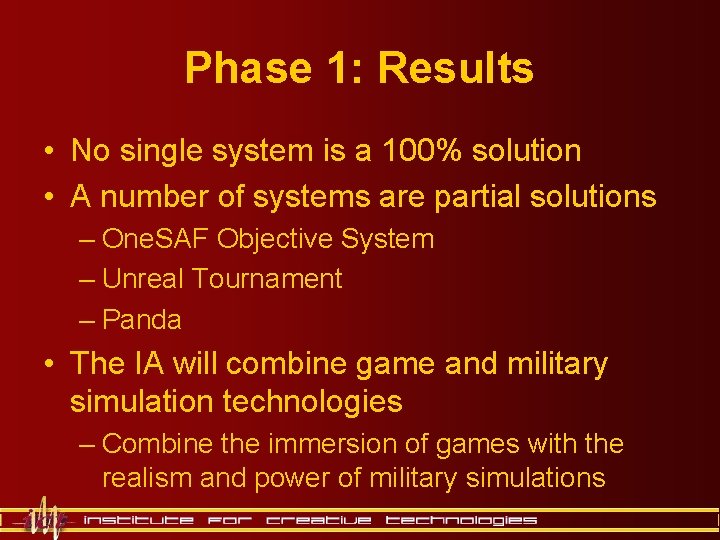
Phase 1: Results • No single system is a 100% solution • A number of systems are partial solutions – One. SAF Objective System – Unreal Tournament – Panda • The IA will combine game and military simulation technologies – Combine the immersion of games with the realism and power of military simulations
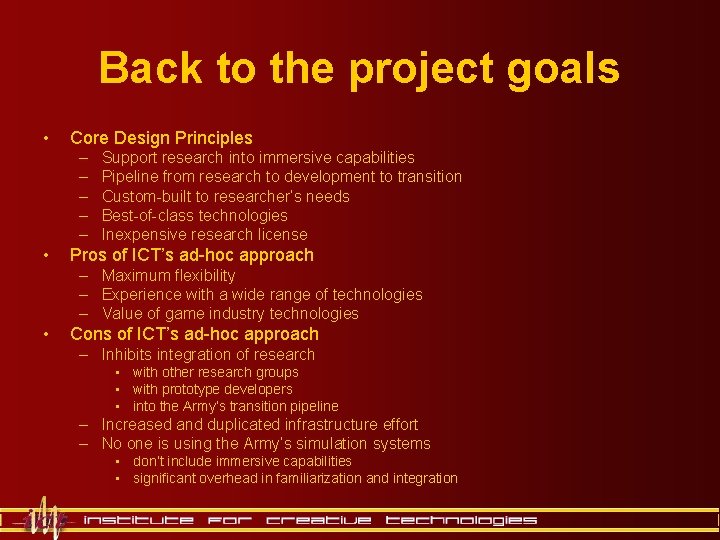
Back to the project goals • Core Design Principles – – – • Support research into immersive capabilities Pipeline from research to development to transition Custom-built to researcher’s needs Best-of-class technologies Inexpensive research license Pros of ICT’s ad-hoc approach – Maximum flexibility – Experience with a wide range of technologies – Value of game industry technologies • Cons of ICT’s ad-hoc approach – Inhibits integration of research • with other research groups • with prototype developers • into the Army’s transition pipeline – Increased and duplicated infrastructure effort – No one is using the Army’s simulation systems • don’t include immersive capabilities • significant overhead in familiarization and integration
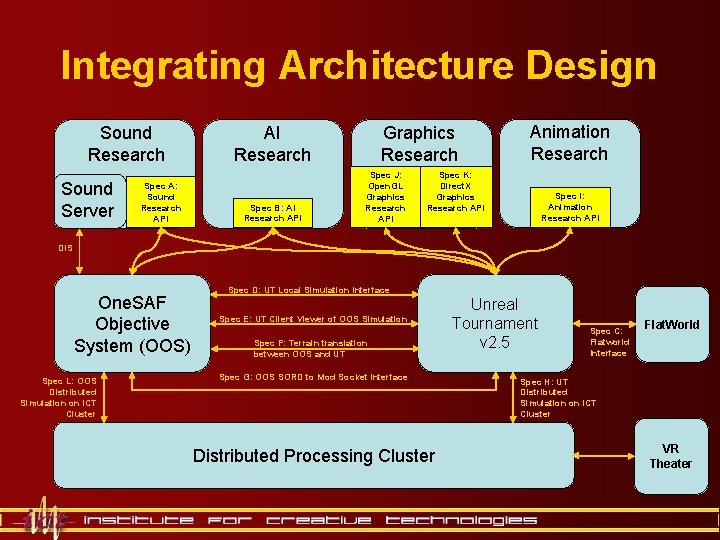
Integrating Architecture Design Sound Research Sound Server Spec A: Sound Research API AI Research Spec B: AI Research API Graphics Research Spec J: Open. GL Graphics Research API Animation Research Spec K: Direct. X Graphics Research API Spec I: Animation Research API DIS One. SAF Objective System (OOS) Spec L: OOS Distributed Simulation on ICT Cluster Spec D: UT Local Simulation Interface Spec E: UT Client Viewer of OOS Simulation Spec F: Terrain translation between OOS and UT Spec G: OOS SORD to Mod Socket Interface Distributed Processing Cluster Unreal Tournament v 2. 5 Spec C: Flatworld Interface Flat. World Spec H: UT Distributed Simulation on ICT Cluster VR Theater
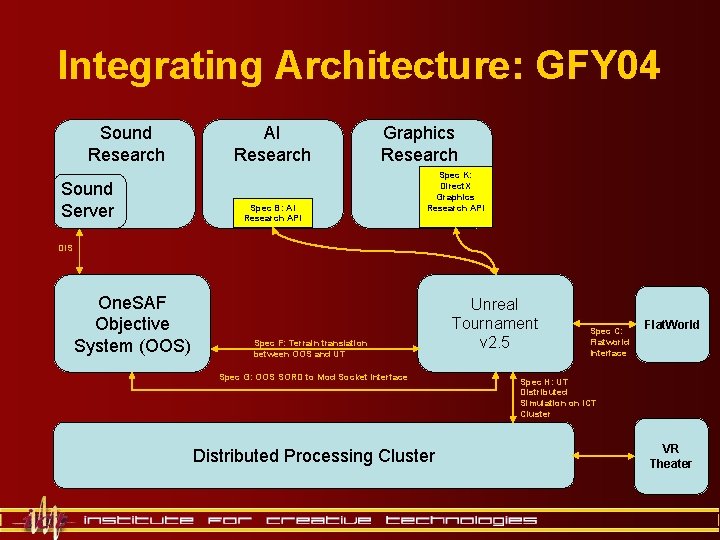
Integrating Architecture: GFY 04 Sound Research Sound Server AI Research Graphics Research Spec B: AI Research API Spec K: Direct. X Graphics Research API DIS One. SAF Objective System (OOS) Spec F: Terrain translation between OOS and UT Spec G: OOS SORD to Mod Socket Interface Distributed Processing Cluster Unreal Tournament v 2. 5 Spec C: Flatworld Interface Flat. World Spec H: UT Distributed Simulation on ICT Cluster VR Theater
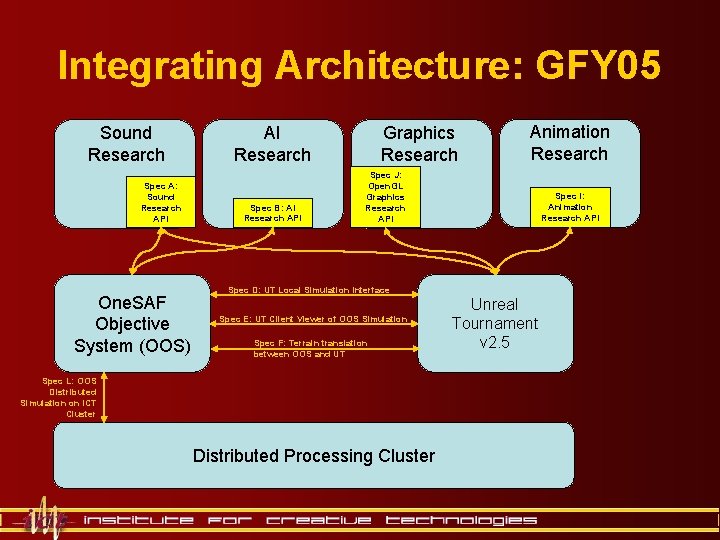
Integrating Architecture: GFY 05 Sound Research Spec A: Sound Research API One. SAF Objective System (OOS) AI Research Spec B: AI Research API Graphics Research Animation Research Spec J: Open. GL Graphics Research API Spec I: Animation Research API Spec D: UT Local Simulation Interface Spec E: UT Client Viewer of OOS Simulation Spec F: Terrain translation between OOS and UT Spec L: OOS Distributed Simulation on ICT Cluster Distributed Processing Cluster Unreal Tournament v 2. 5
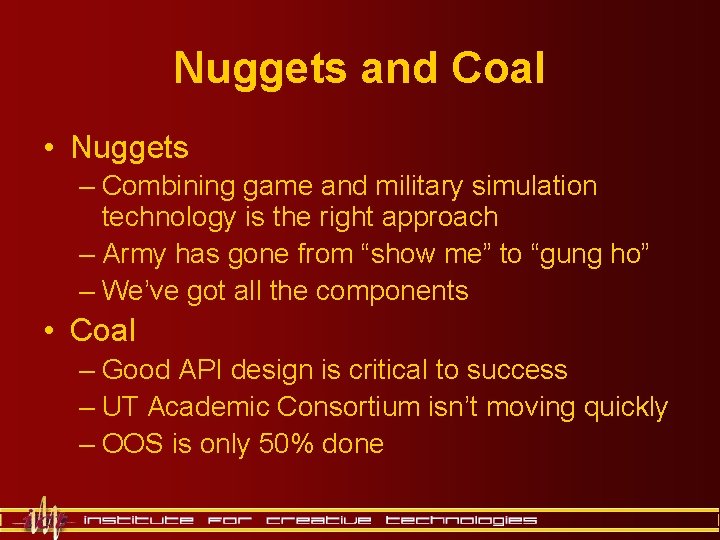
Nuggets and Coal • Nuggets – Combining game and military simulation technology is the right approach – Army has gone from “show me” to “gung ho” – We’ve got all the components • Coal – Good API design is critical to success – UT Academic Consortium isn’t moving quickly – OOS is only 50% done