
Integrated WASH and Community Based Nutrition Programs insights
Integrated WASH and Community Based Nutrition Programs: insights from a fiveyear UNICEF program in Ethiopia Authors: Samuel Godfrey, Jane Bevan, Katherine F. Shields, Argaw Ambelu, Ronna Chan, Georgia Kayser, Jamie Bartram
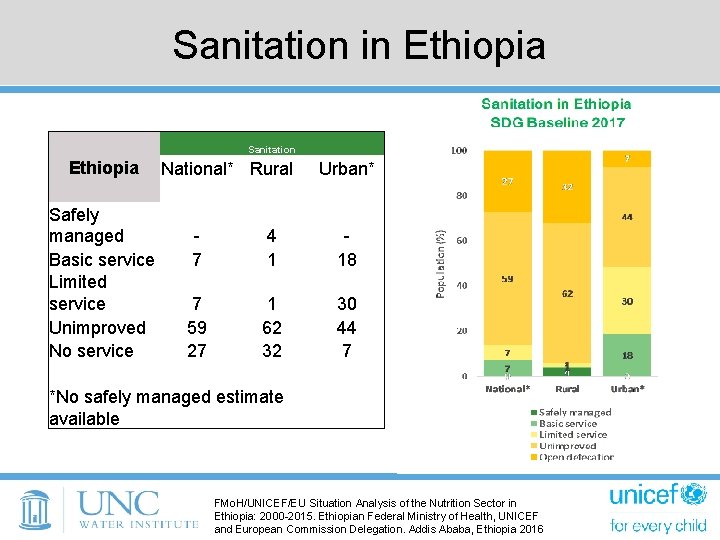
Sanitation in Ethiopia Sanitation Ethiopia Safely managed Basic service Limited service Unimproved No service National* Rural Urban* 7 4 1 18 7 59 27 1 62 32 30 44 7 *No safely managed estimate available FMo. H/UNICEF/EU Situation Analysis of the Nutrition Sector in Ethiopia: 2000 -2015. Ethiopian Federal Ministry of Health, UNICEF and European Commission Delegation. Addis Ababa, Ethiopia 2016
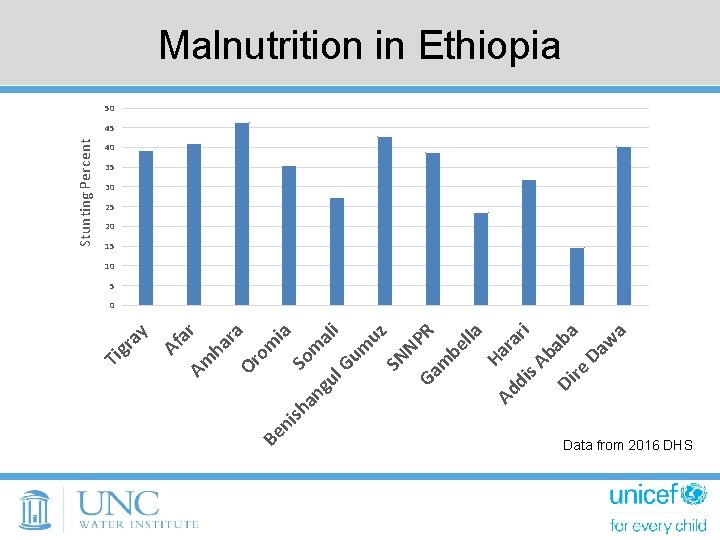
gr ay Af a Am r ha ra Or om Be ia ni sh S an om gu a l G li um uz SN NP Ga R m be lla Ha Ad ra di s A ri ba b Di re a Da w a Ti Stunting Percent Malnutrition in Ethiopia 50 45 40 35 30 25 20 15 10 5 0 Data from 2016 DHS
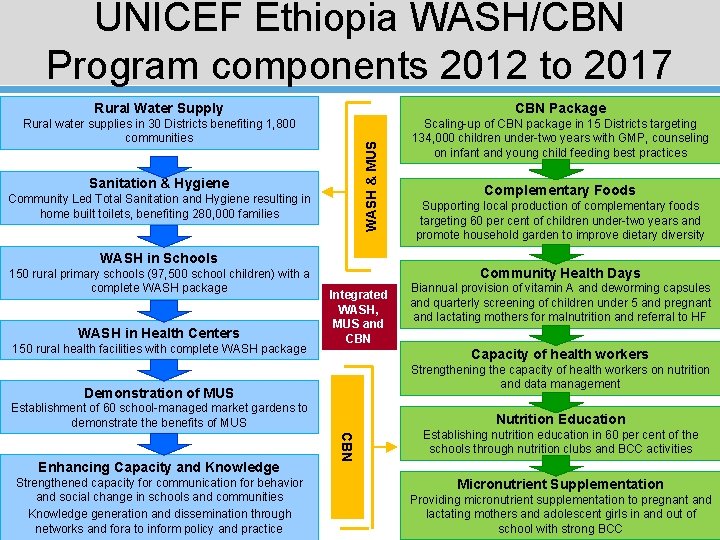
UNICEF Ethiopia WASH/CBN Program components 2012 to 2017 CBN Package Rural water supplies in 30 Districts benefiting 1, 800 communities Scaling-up of CBN package in 15 Districts targeting 134, 000 children under-two years with GMP, counseling on infant and young child feeding best practices WASH & MUS Rural Water Supply Sanitation & Hygiene Community Led Total Sanitation and Hygiene resulting in home built toilets, benefiting 280, 000 families WASH in Schools 150 rural primary schools (97, 500 school children) with a complete WASH package WASH in Health Centers 150 rural health facilities with complete WASH package Integrated WASH, MUS and CBN Biannual provision of vitamin A and deworming capsules and quarterly screening of children under 5 and pregnant and lactating mothers for malnutrition and referral to HF Capacity of health workers Strengthening the capacity of health workers on nutrition and data management Establishment of 60 school-managed market gardens to demonstrate the benefits of MUS Nutrition Education CBN Strengthened capacity for communication for behavior and social change in schools and communities Knowledge generation and dissemination through networks and fora to inform policy and practice Supporting local production of complementary foods targeting 60 per cent of children under-two years and promote household garden to improve dietary diversity Community Health Days Demonstration of MUS Enhancing Capacity and Knowledge Complementary Foods Establishing nutrition education in 60 per cent of the schools through nutrition clubs and BCC activities Micronutrient Supplementation Providing micronutrient supplementation to pregnant and lactating mothers and adolescent girls in and out of school with strong BCC
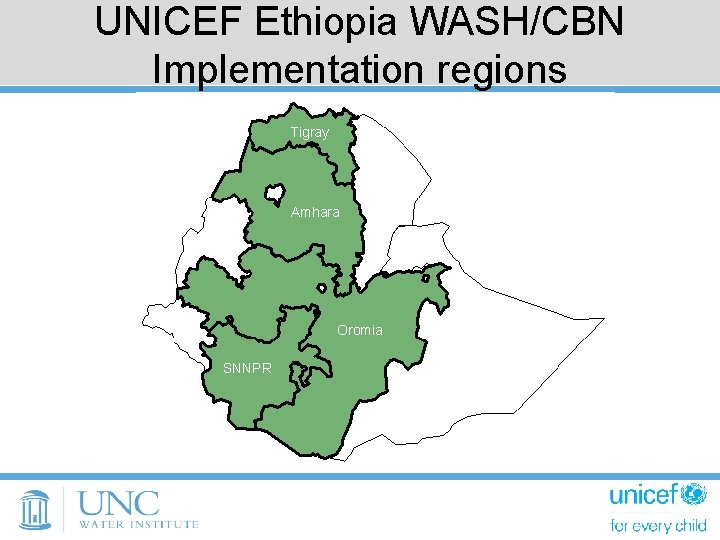
UNICEF Ethiopia WASH/CBN Implementation regions Tigray Amhara Oromia SNNPR
Outcomes of Interest • Stunting – Height for age z-score 2 standard deviations or more below normal. – Baseline: children under the age of five – Midline: children measured at baseline, new children under the age of five • Diarrhea – Self-reported by head of household – Asked for each member of the household – Analyzed for children under the age of five
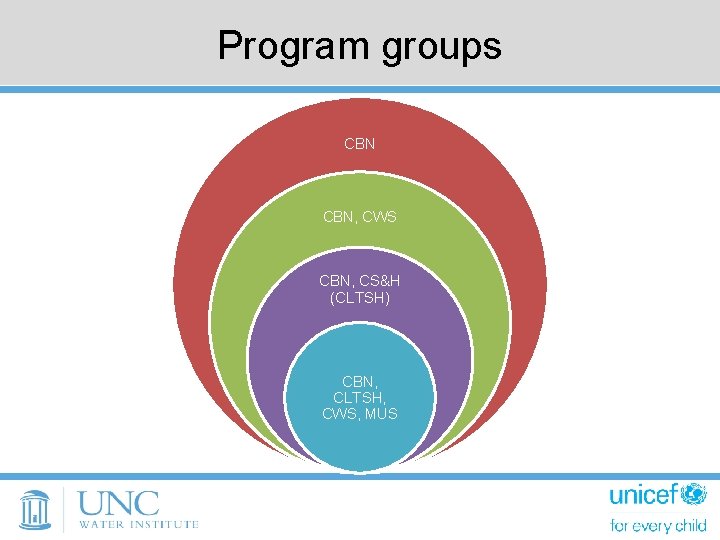
Program groups CBN, CWS CBN, CS&H (CLTSH) CBN, CLTSH, CWS, MUS
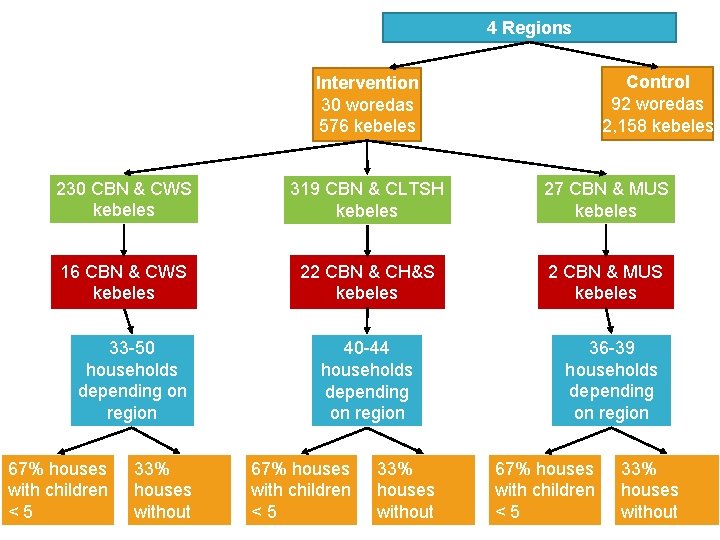
4 Regions Control 92 woredas 2, 158 kebeles Intervention 30 woredas 576 kebeles 230 CBN & CWS kebeles 319 CBN & CLTSH kebeles 27 CBN & MUS kebeles 16 CBN & CWS kebeles 22 CBN & CH&S kebeles 2 CBN & MUS kebeles 33 -50 households depending on region 67% houses with children < 5 33% houses without children 40 -44 households depending on region 67% houses with children < 5 33% houses without children 36 -39 households depending on region 67% houses with children < 5 33% houses without children
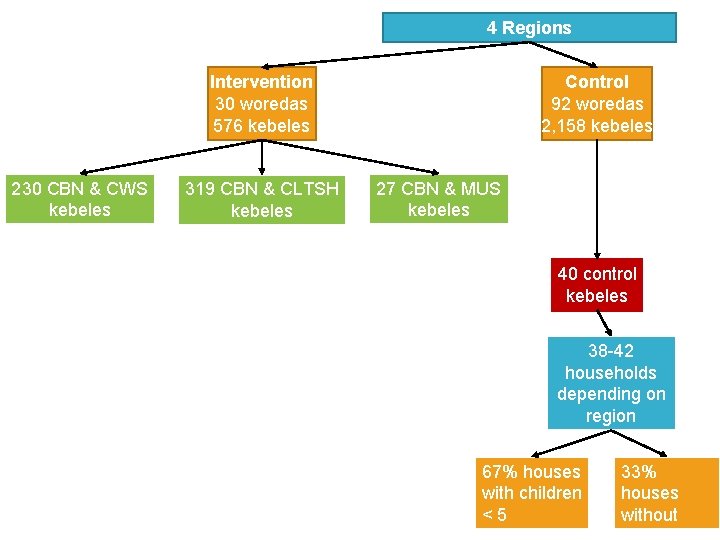
4 Regions Intervention 30 woredas 576 kebeles 230 CBN & CWS kebeles 319 CBN & CLTSH kebeles Control 92 woredas 2, 158 kebeles 27 CBN & MUS kebeles 40 control kebeles 38 -42 households depending on region 67% houses with children < 5 33% houses without
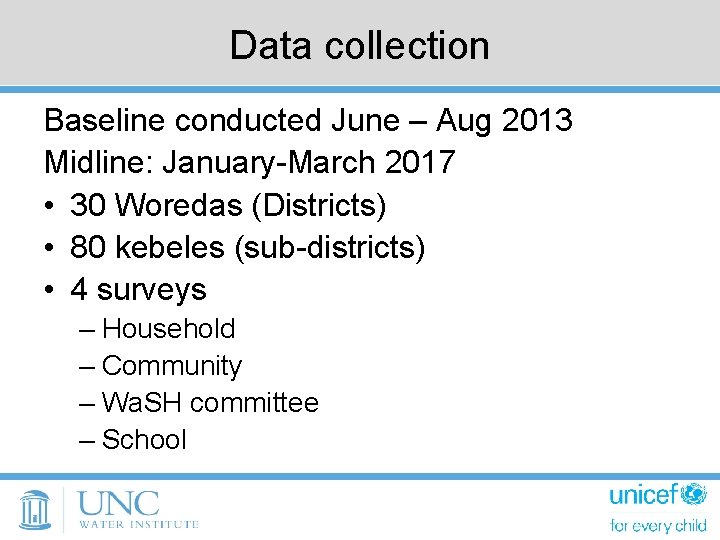
Data collection Baseline conducted June – Aug 2013 Midline: January-March 2017 • 30 Woredas (Districts) • 80 kebeles (sub-districts) • 4 surveys – Household – Community – Wa. SH committee – School
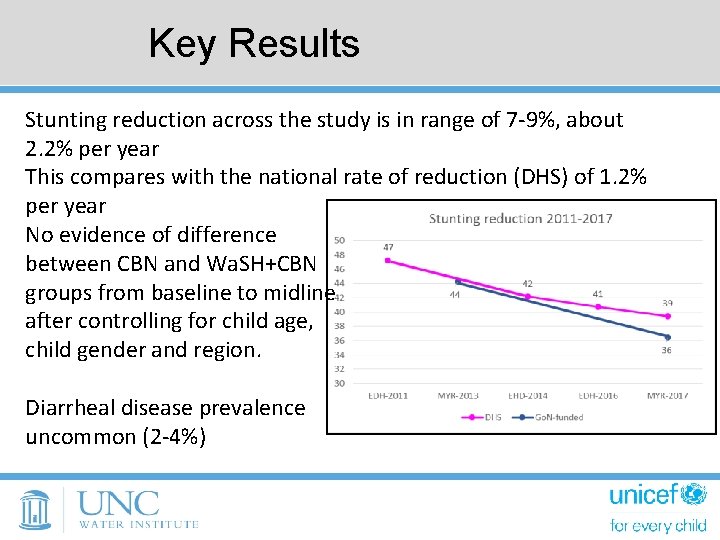
Key Results Stunting reduction across the study is in range of 7 -9%, about 2. 2% per year This compares with the national rate of reduction (DHS) of 1. 2% per year No evidence of difference between CBN and Wa. SH+CBN groups from baseline to midline after controlling for child age, child gender and region. Diarrheal disease prevalence uncommon (2 -4%)
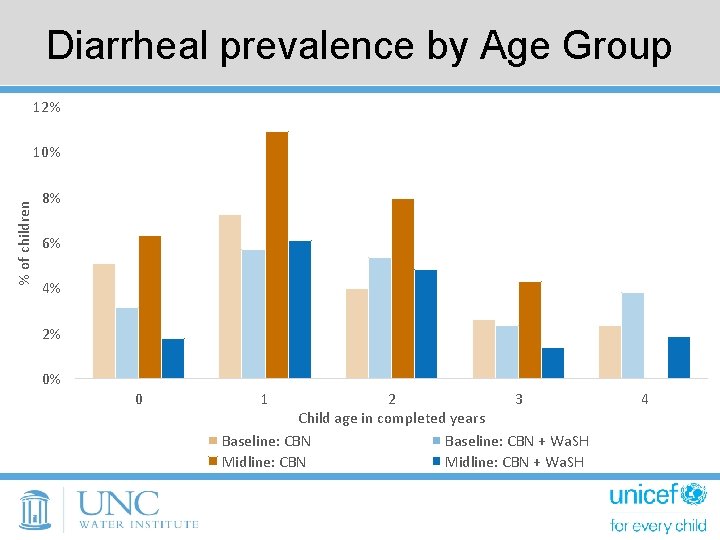
Diarrheal prevalence by Age Group 12% % of children 10% 8% 6% 4% 2% 0% 0 1 2 3 Child age in completed years Baseline: CBN + Wa. SH Midline: CBN + Wa. SH 4
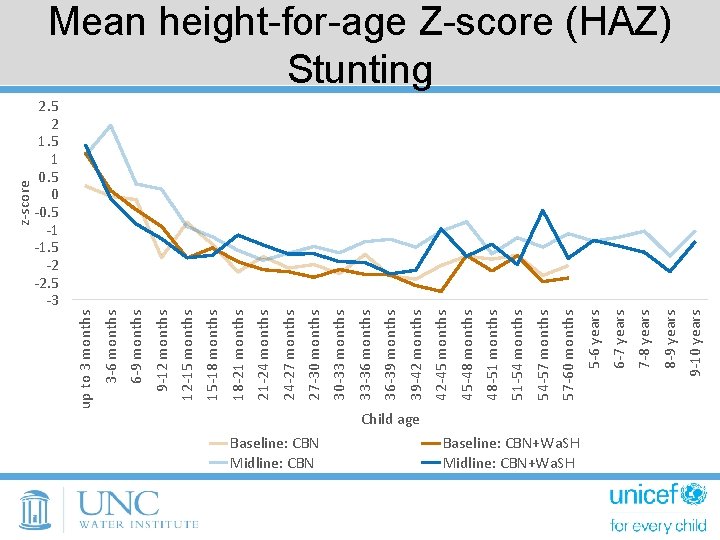
Baseline: CBN Midline: CBN Child age Baseline: CBN+Wa. SH Midline: CBN+Wa. SH 9 -10 years 8 -9 years 7 -8 years 6 -7 years 5 -6 years 57 -60 months 54 -57 months 51 -54 months 48 -51 months 45 -48 months 42 -45 months 39 -42 months 36 -39 months 33 -36 months 30 -33 months 27 -30 months 24 -27 months 21 -24 months 18 -21 months 15 -18 months 12 -15 months 9 -12 months 6 -9 months 3 -6 months up to 3 months z-score Mean height-for-age Z-score (HAZ) Stunting 2. 5 2 1. 5 1 0. 5 0 -0. 5 -1 -1. 5 -2 -2. 5 -3
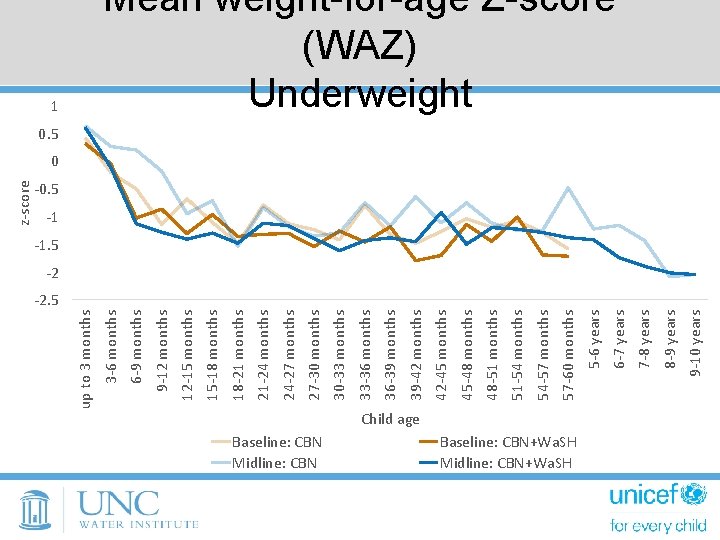
Baseline: CBN Midline: CBN Child age Baseline: CBN+Wa. SH Midline: CBN+Wa. SH 9 -10 years 8 -9 years 7 -8 years 6 -7 years 5 -6 years 57 -60 months 54 -57 months 51 -54 months 48 -51 months 45 -48 months 42 -45 months 39 -42 months 36 -39 months 33 -36 months 30 -33 months 27 -30 months 24 -27 months 21 -24 months 18 -21 months 15 -18 months 12 -15 months 9 -12 months 6 -9 months 3 -6 months up to 3 months z-score 1 Mean weight-for-age Z-score (WAZ) Underweight 0. 5 0 -0. 5 -1 -1. 5 -2 -2. 5
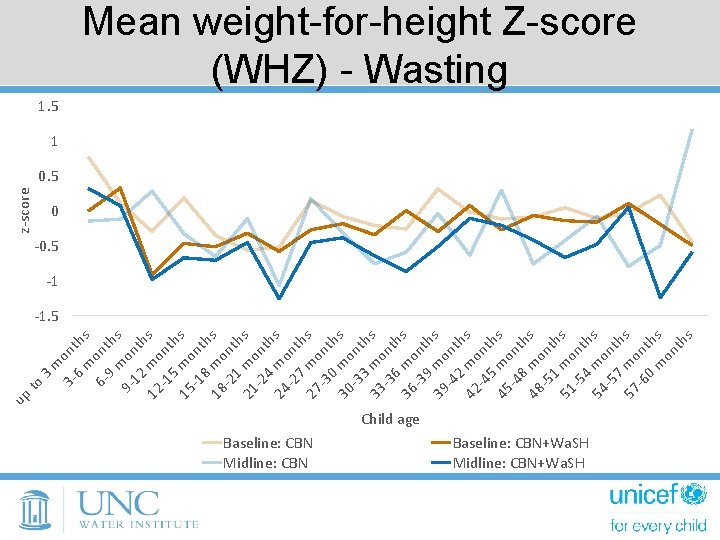
to 3 m 6 3 - on t m hs 6 - ont 9 m hs 9 - on 12 th 12 mo s -1 nt 5 h 15 mo s -1 nt 8 h 18 mo s -2 nt 1 h 21 mo s -2 nt 4 h 24 mo s -2 nt 7 h 27 mo s -3 nt 0 h 30 mo s -3 nt 3 h 33 mo s -3 nt 6 h 36 mo s -3 nt 9 h 39 mo s -4 nt 2 h 42 mo s -4 nt 5 h 45 mo s -4 nt 8 h 48 mo s -5 nt 1 h 51 mo s -5 nt 4 h 54 mo s -5 nt 7 h 57 mo s -6 nt 0 m hs on th s up z-score Mean weight-for-height Z-score (WHZ) - Wasting 1. 5 1 0. 5 0 -0. 5 -1 -1. 5 Child age Baseline: CBN Midline: CBN Baseline: CBN+Wa. SH Midline: CBN+Wa. SH
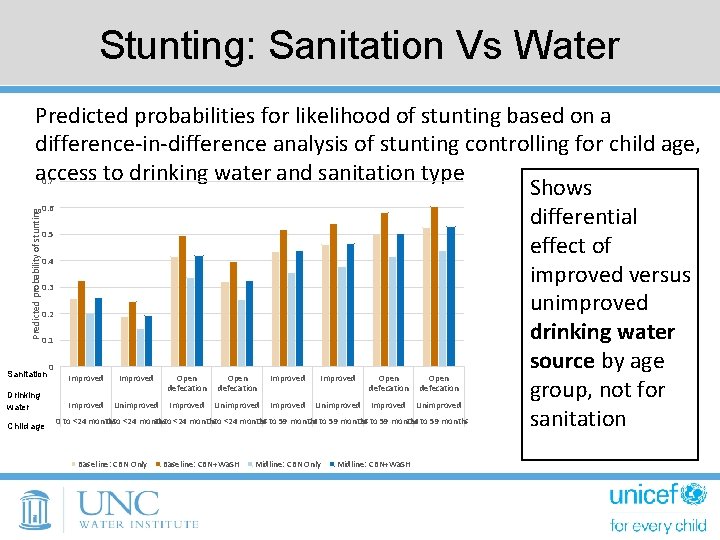
Stunting: Sanitation Vs Water Predicted probabilities for likelihood of stunting based on a difference-in-difference analysis of stunting controlling for child age, access to drinking water and sanitation type Shows differential effect of improved versus unimproved drinking water source by age group, not for sanitation Predicted probability of stunting 0. 7 0. 6 0. 5 0. 4 0. 3 0. 2 0. 1 0 Sanitation Drinking water Child age Improved Open defecation Improved Unimproved 0 to <24 months 24 to 59 months Baseline: CBN Only Baseline: CBN+Wa. SH Midline: CBN Only Midline: CBN+Wa. SH
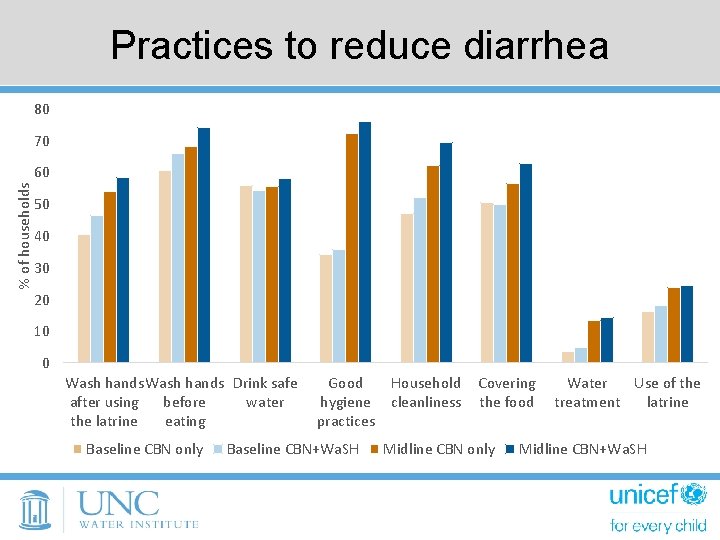
Practices to reduce diarrhea 80 70 % of households 60 50 40 30 20 10 0 Wash hands Drink safe after using before water the latrine eating Baseline CBN only Good Household hygiene cleanliness practices Baseline CBN+Wa. SH Covering the food Midline CBN only Water Use of the treatment latrine Midline CBN+Wa. SH
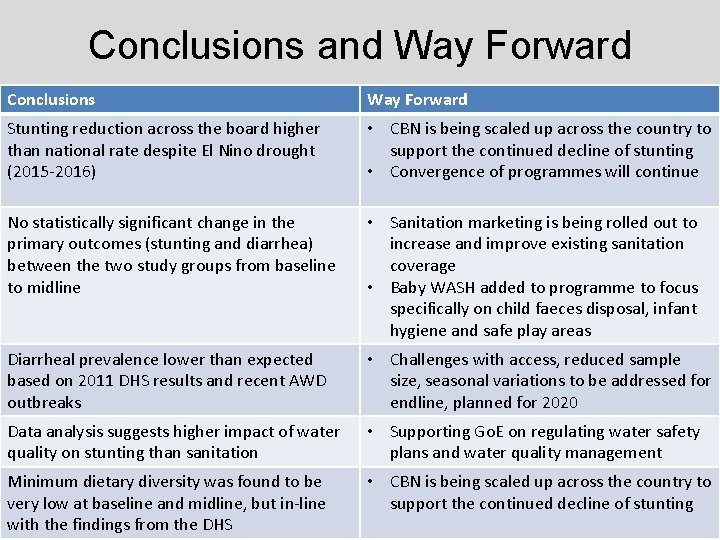
Conclusions and Way Forward Conclusions Way Forward Stunting reduction across the board higher than national rate despite El Nino drought (2015 -2016) • CBN is being scaled up across the country to support the continued decline of stunting • Convergence of programmes will continue No statistically significant change in the primary outcomes (stunting and diarrhea) between the two study groups from baseline to midline • Sanitation marketing is being rolled out to increase and improve existing sanitation coverage • Baby WASH added to programme to focus specifically on child faeces disposal, infant hygiene and safe play areas Diarrheal prevalence lower than expected based on 2011 DHS results and recent AWD outbreaks • Challenges with access, reduced sample size, seasonal variations to be addressed for endline, planned for 2020 Data analysis suggests higher impact of water quality on stunting than sanitation • Supporting Go. E on regulating water safety plans and water quality management Minimum dietary diversity was found to be very low at baseline and midline, but in-line with the findings from the DHS • CBN is being scaled up across the country to support the continued decline of stunting
Acknowledgements and Thanks With support from: Government of Ethiopia Thank you! And National Partners Plan, SNV, IDE, Ripple
- Slides: 19