
Integrated Thematic Adapted from Planning Power Point fromfor
- Slides: 16
Integrated Thematic Adapted from. Planning Power. Point fromfor Dr. Sarah Unit and Lesson Design
What previous experience do you have with Thematic Planning? Have you ever taught using a thematic unit? Have your ever designed a thematic unit? Have you ever learned content through a second language via a thematic unit? If so, how did this work for you?
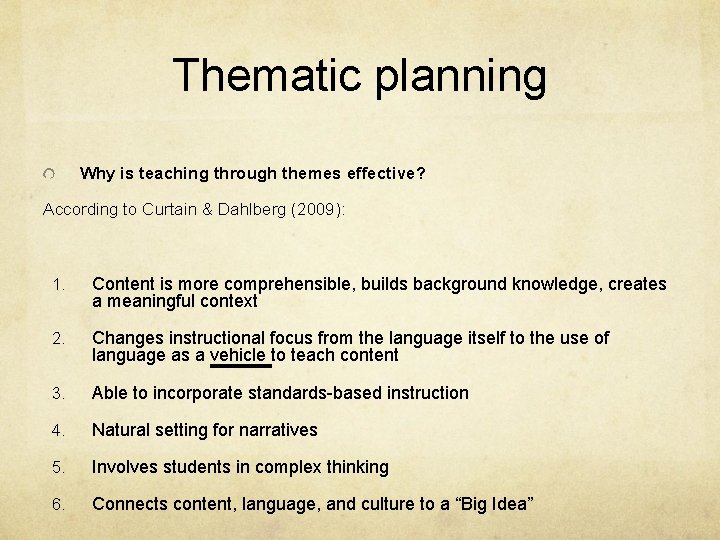
Thematic planning Why is teaching through themes effective? According to Curtain & Dahlberg (2009): 1. Content is more comprehensible, builds background knowledge, creates a meaningful context 2. Changes instructional focus from the language itself to the use of language as a vehicle to teach content 3. Able to incorporate standards-based instruction 4. Natural setting for narratives 5. Involves students in complex thinking 6. Connects content, language, and culture to a “Big Idea”
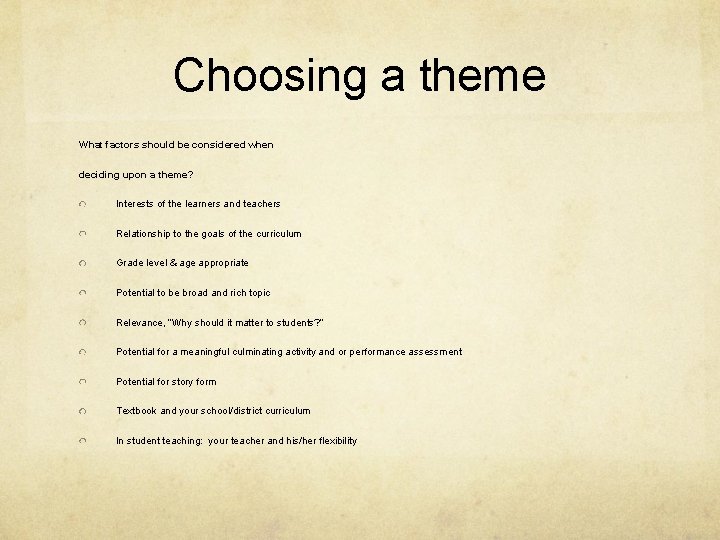
Choosing a theme What factors should be considered when deciding upon a theme? Interests of the learners and teachers Relationship to the goals of the curriculum Grade level & age appropriate Potential to be broad and rich topic Relevance, “Why should it matter to students? ” Potential for a meaningful culminating activity and or performance assessment Potential for story form Textbook and your school/district curriculum In student teaching: your teacher and his/her flexibility
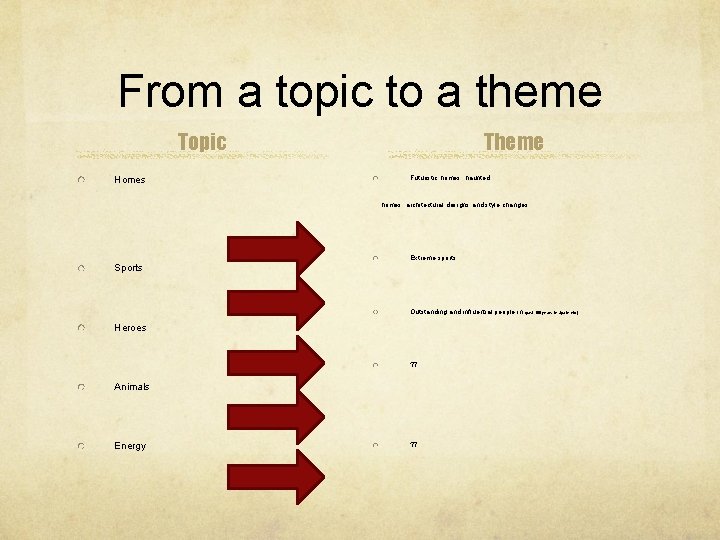
From a topic to a theme Topic Homes Theme Futuristic homes; haunted homes; architectural designs and style changes Extreme sports Sports Outstanding and influential people in (past 100 years, in Spain, etc. ) Heroes ? ? Animals Energy ? ?
Myth or Fact? We can teach any topic we choose. Lessons, units and courses should be designed around the results sought, not necessarily the activities with which we are most comfortable. A common error in activity-oriented experiences is that they engage in hands-on experiences, but neglect being mind-on So, what questions might an educator ask him/herself to ensure that students are engaging in meaningful activities?
What is Understanding by Design? It’s a framework for improving student achievement -- backwards design in curriculum development Emphasizes the teacher’s role in designing effective and thoughtful lessons Answers the question: How will we distinguish merely interesting learning from effective learning? Answers the “Why? ” and “So what? ” questions.
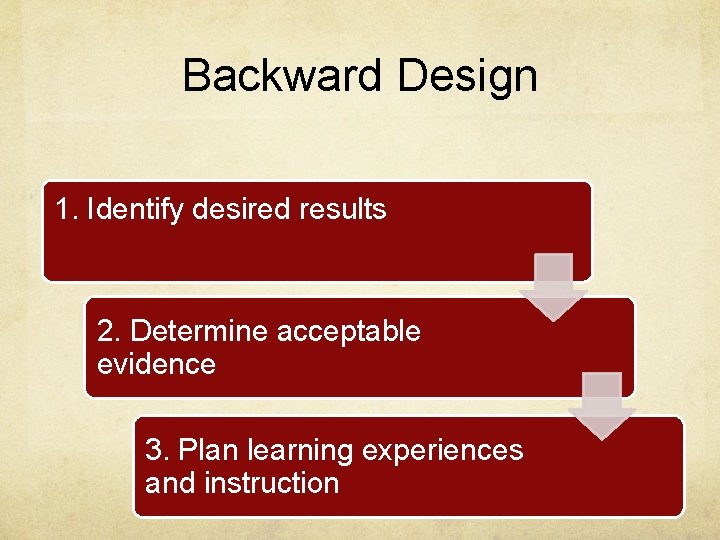
Backward Design 1. Identify desired results 2. Determine acceptable evidence 3. Plan learning experiences and instruction
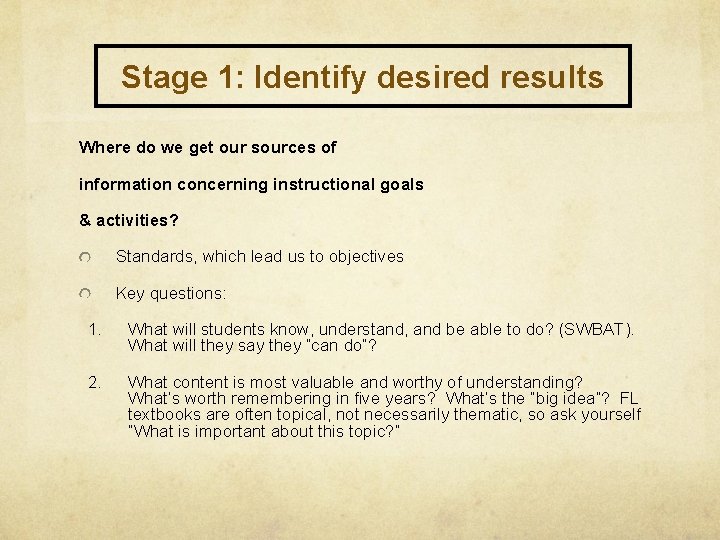
Stage 1: Identify desired results Where do we get our sources of information concerning instructional goals & activities? Standards, which lead us to objectives Key questions: 1. What will students know, understand, and be able to do? (SWBAT). What will they say they “can do”? 2. What content is most valuable and worthy of understanding? What’s worth remembering in five years? What’s the “big idea”? FL textbooks are often topical, not necessarily thematic, so ask yourself “What is important about this topic? ”
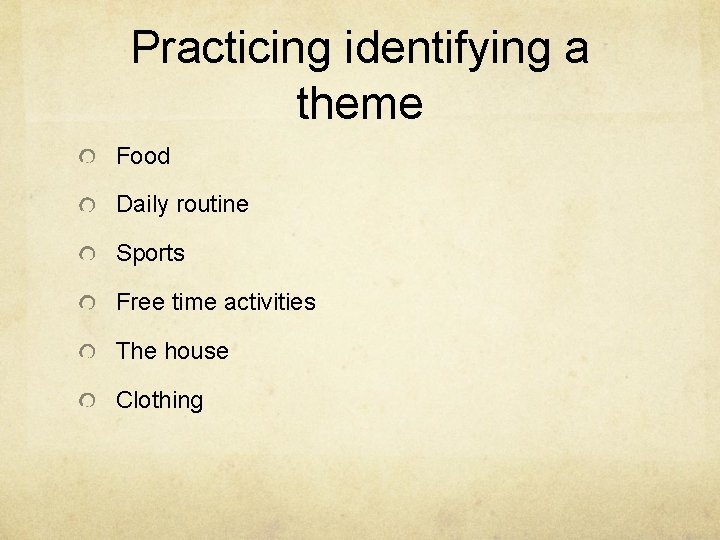
Practicing identifying a theme Food Daily routine Sports Free time activities The house Clothing
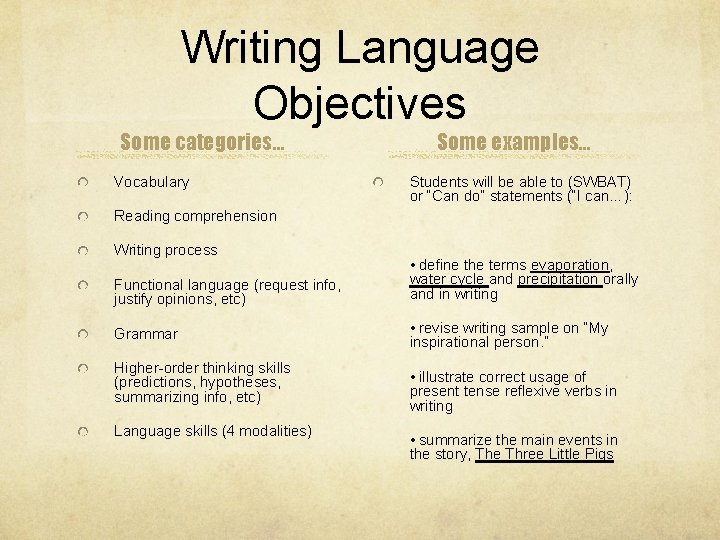
Writing Language Objectives Some categories… Vocabulary Some examples… Students will be able to (SWBAT) or “Can do” statements (“I can…): Reading comprehension Writing process Functional language (request info, justify opinions, etc) Grammar Higher-order thinking skills (predictions, hypotheses, summarizing info, etc) Language skills (4 modalities) • define the terms evaporation, water cycle and precipitation orally and in writing • revise writing sample on “My inspirational person. ” • illustrate correct usage of present tense reflexive verbs in writing • summarize the main events in the story, The Three Little Pigs
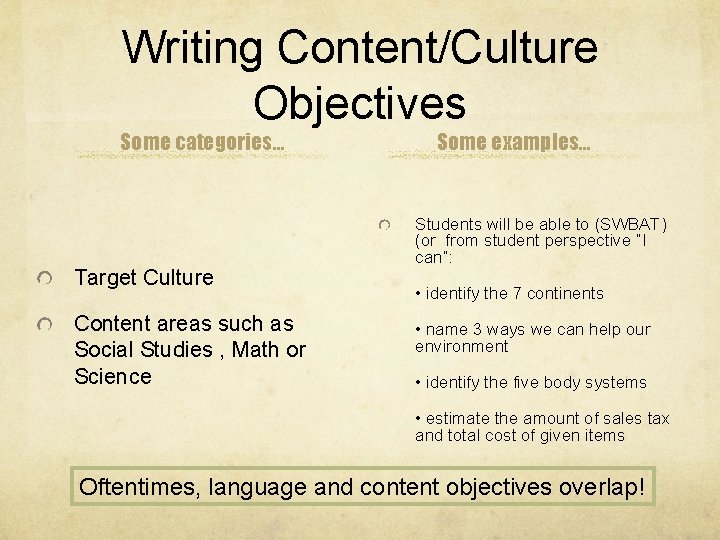
Writing Content/Culture Objectives Some categories… Target Culture Content areas such as Social Studies , Math or Science Some examples… Students will be able to (SWBAT) (or from student perspective “I can”: • identify the 7 continents • name 3 ways we can help our environment • identify the five body systems • estimate the amount of sales tax and total cost of given items Oftentimes, language and content objectives overlap!
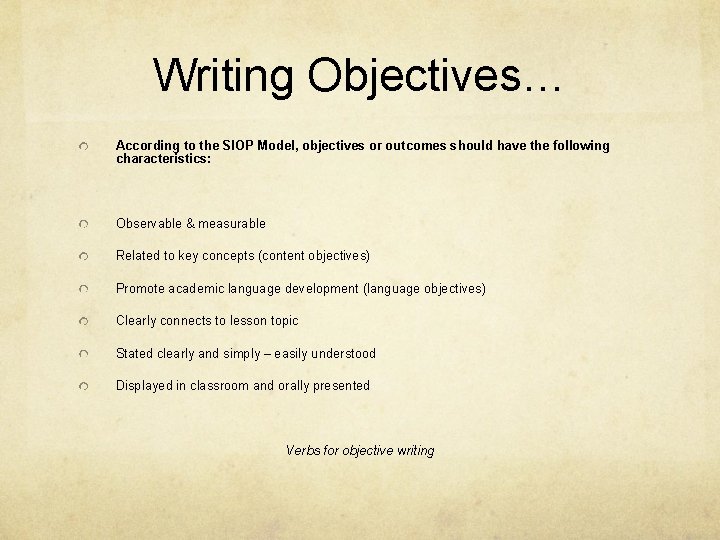
Writing Objectives… According to the SIOP Model, objectives or outcomes should have the following characteristics: Observable & measurable Related to key concepts (content objectives) Promote academic language development (language objectives) Clearly connects to lesson topic Stated clearly and simply – easily understood Displayed in classroom and orally presented Verbs for objective writing
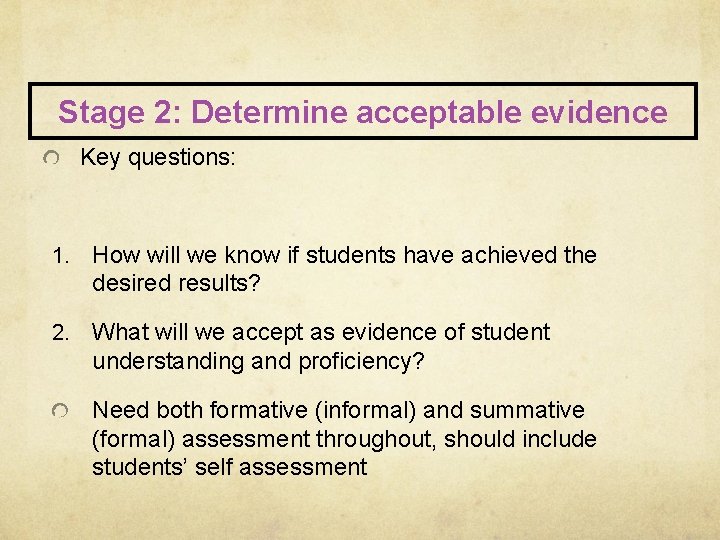
Stage 2: Determine acceptable evidence Key questions: 1. How will we know if students have achieved the desired results? 2. What will we accept as evidence of student understanding and proficiency? Need both formative (informal) and summative (formal) assessment throughout, should include students’ self assessment
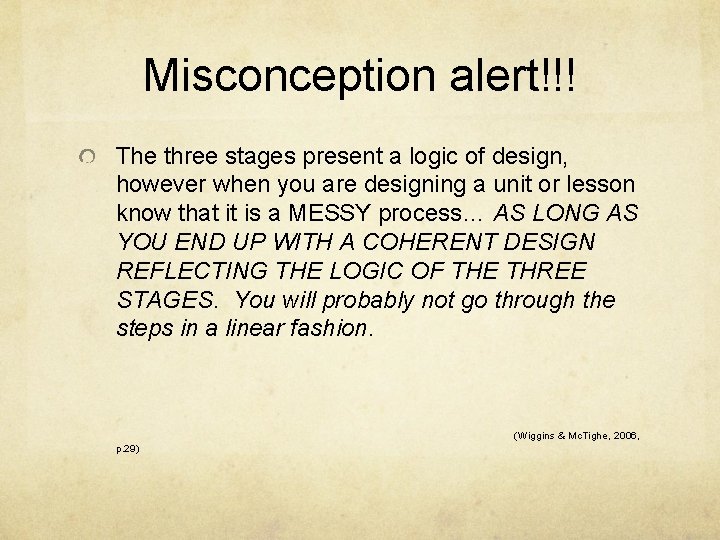
Misconception alert!!! The three stages present a logic of design, however when you are designing a unit or lesson know that it is a MESSY process… AS LONG AS YOU END UP WITH A COHERENT DESIGN REFLECTING THE LOGIC OF THE THREE STAGES. You will probably not go through the steps in a linear fashion. (Wiggins & Mc. Tighe, 2006, p. 29)
Discuss with a partner or in a small group… Brainstorm some thematic ideas you find interesting and would consider exploring with your students?