
Integrated Science I Chapter 14 Waves Unit What

- Slides: 27
Integrated Science I Chapter 14: Waves Unit
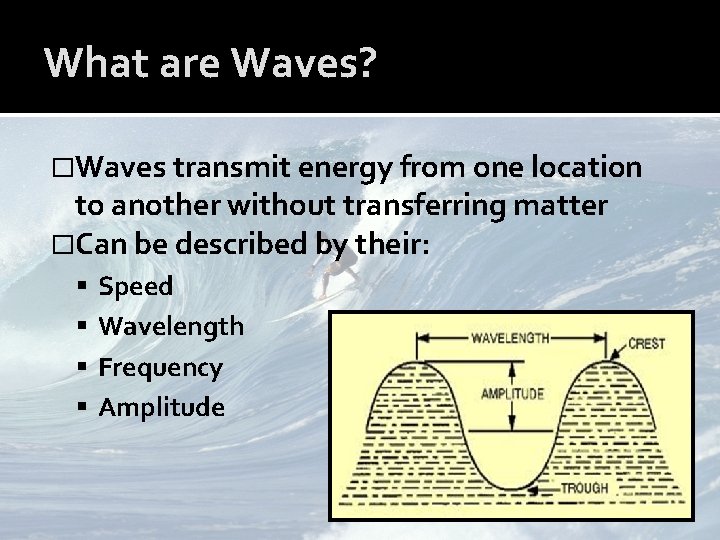
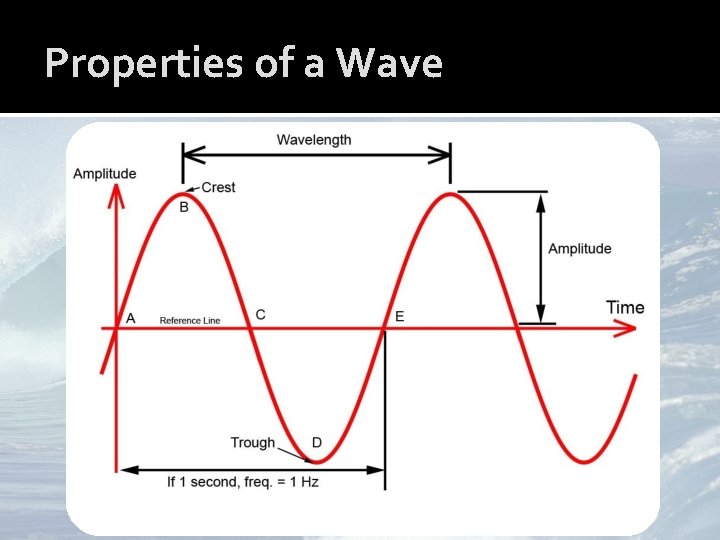
What are Waves? �Waves transmit energy from one location to another without transferring matter �Can be described by their: Speed Wavelength Frequency Amplitude
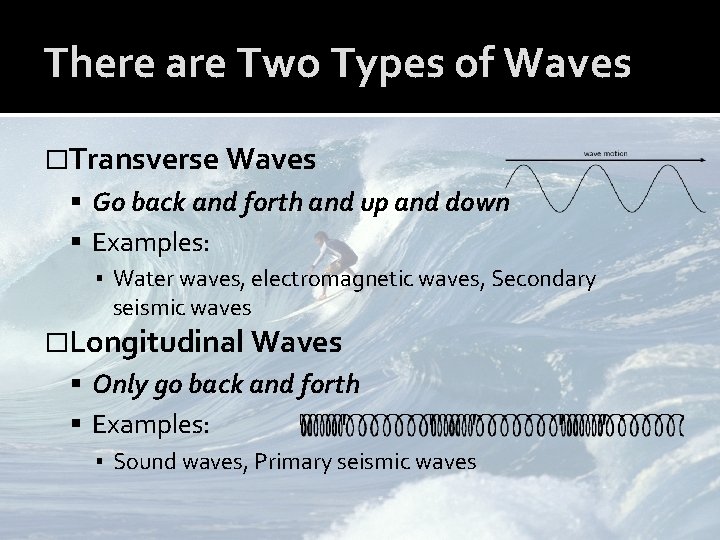
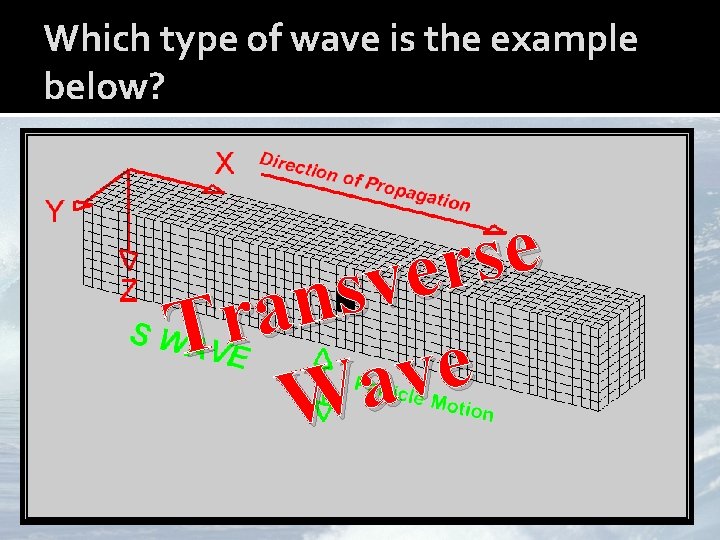
There are Two Types of Waves �Transverse Waves Go back and forth and up and down Examples: ▪ Water waves, electromagnetic waves, Secondary seismic waves �Longitudinal Waves Only go back and forth Examples: ▪ Sound waves, Primary seismic waves
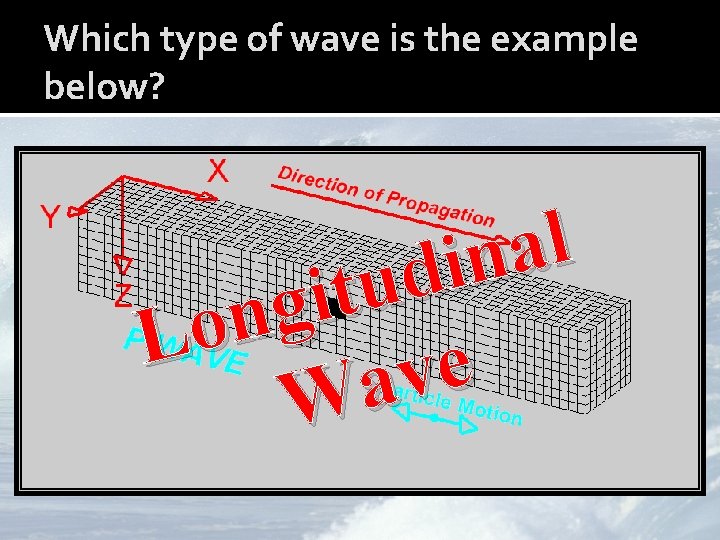
Which type of wave is the example below? l a n i d u t i g n o L e v a W
Which type of wave is the example below? e s r e v s n a Tr e v a W
Properties of a Wave
Wave Behaviors �Reflection A wave bouncing back when it meets a surface or boundary Always at a right angle
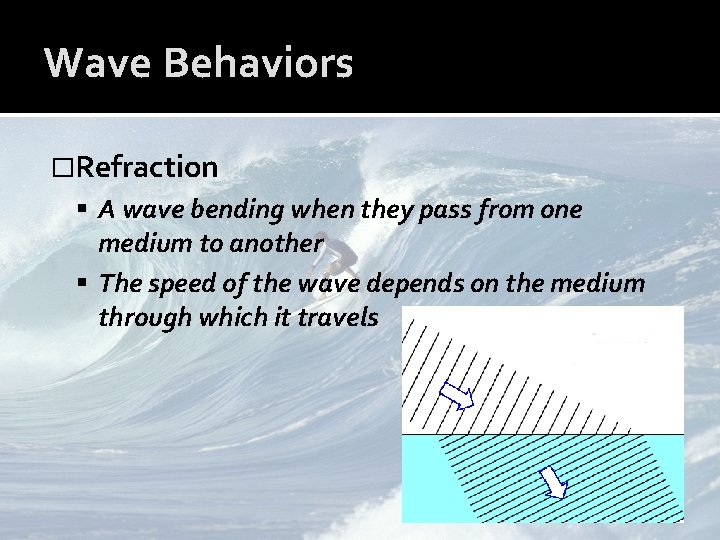
Wave Behaviors �Refraction A wave bending when they pass from one medium to another The speed of the wave depends on the medium through which it travels
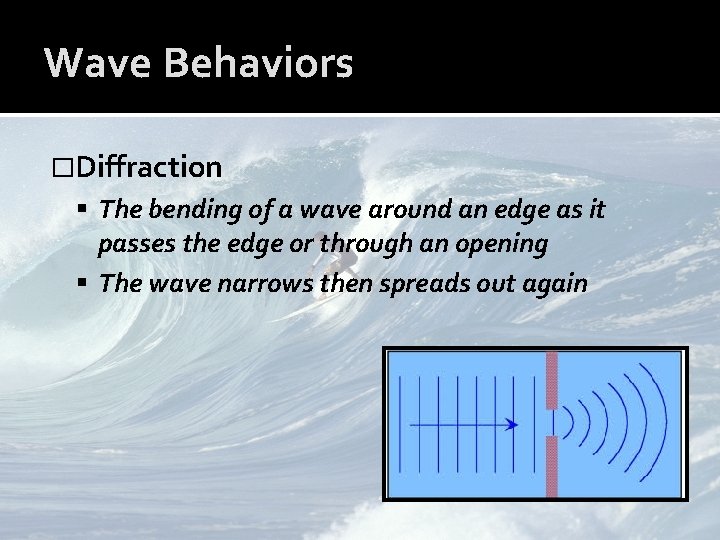
Wave Behaviors �Diffraction The bending of a wave around an edge as it passes the edge or through an opening The wave narrows then spreads out again
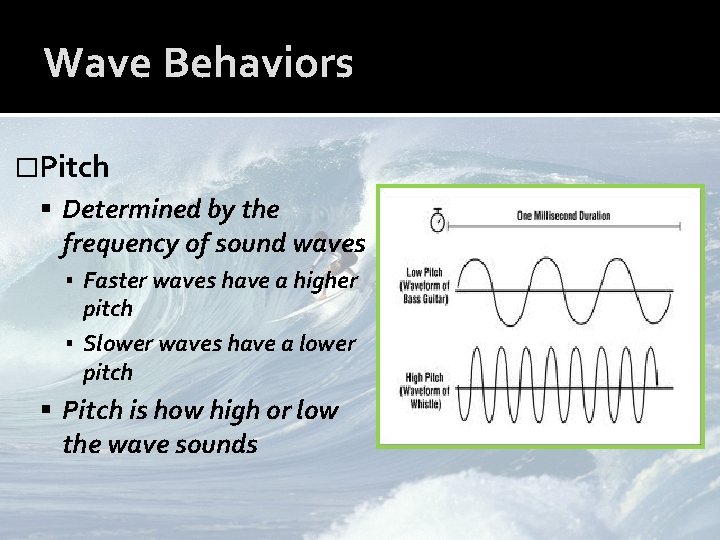
Wave Behaviors �Pitch Determined by the frequency of sound waves ▪ Faster waves have a higher pitch ▪ Slower waves have a lower pitch Pitch is how high or low the wave sounds
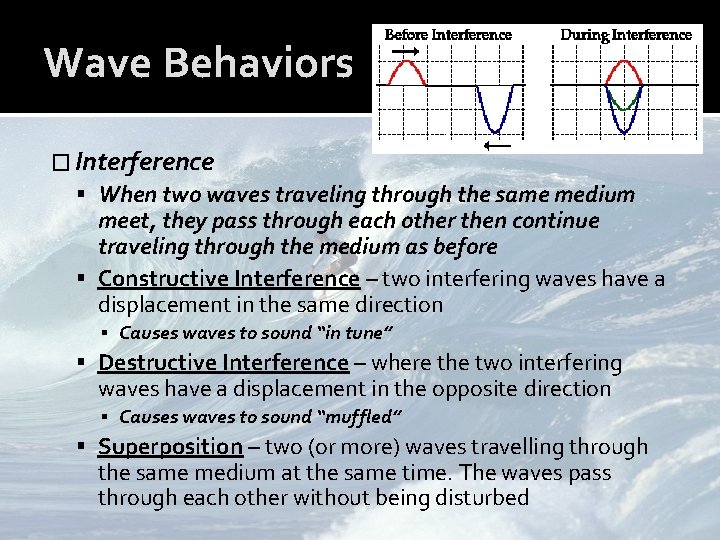
Wave Behaviors � Interference When two waves traveling through the same medium meet, they pass through each other then continue traveling through the medium as before Constructive Interference – two interfering waves have a displacement in the same direction ▪ Causes waves to sound “in tune” Destructive Interference – where the two interfering waves have a displacement in the opposite direction ▪ Causes waves to sound “muffled” Superposition – two (or more) waves travelling through the same medium at the same time. The waves pass through each other without being disturbed
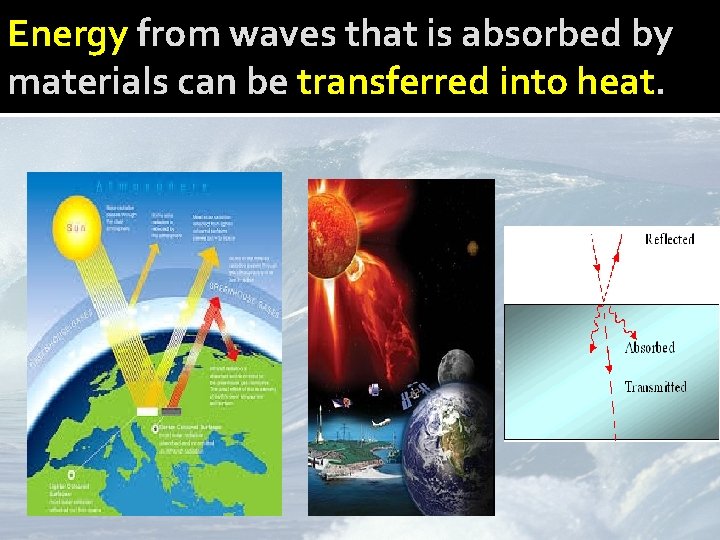
Energy from waves that is absorbed by materials can be transferred into heat.
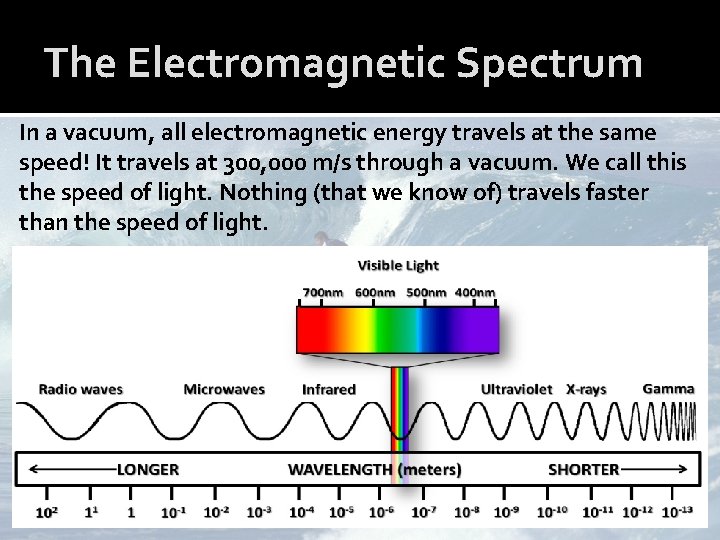
Radiant Energy �Radiant energy travels in waves and does not require a medium �Sources of light energy (e. g. , the sun, a light bulb) radiate energy continually in all directions. �Wide range of frequencies, wavelengths and energies arranged into the electromagnetic spectrum
The Electromagnetic Spectrum In a vacuum, all electromagnetic energy travels at the same speed! It travels at 300, 000 m/s through a vacuum. We call this the speed of light. Nothing (that we know of) travels faster than the speed of light.
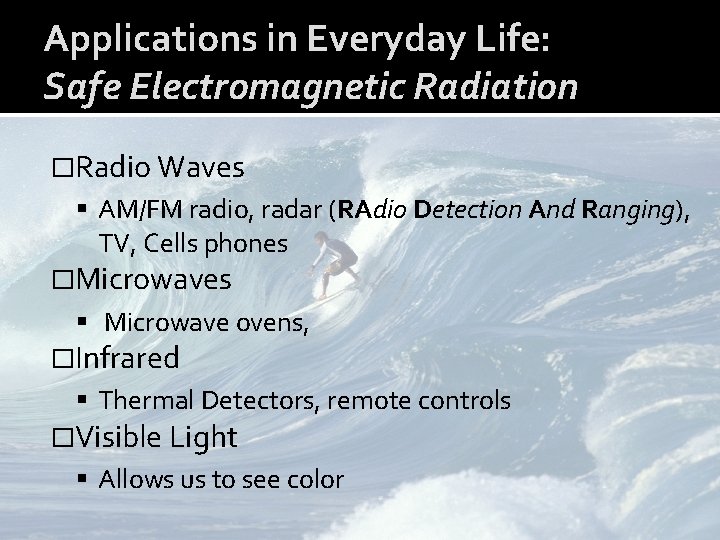
Applications in Everyday Life: Safe Electromagnetic Radiation �Radio Waves AM/FM radio, radar (RAdio Detection And Ranging), TV, Cells phones �Microwaves Microwave ovens, �Infrared Thermal Detectors, remote controls �Visible Light Allows us to see color
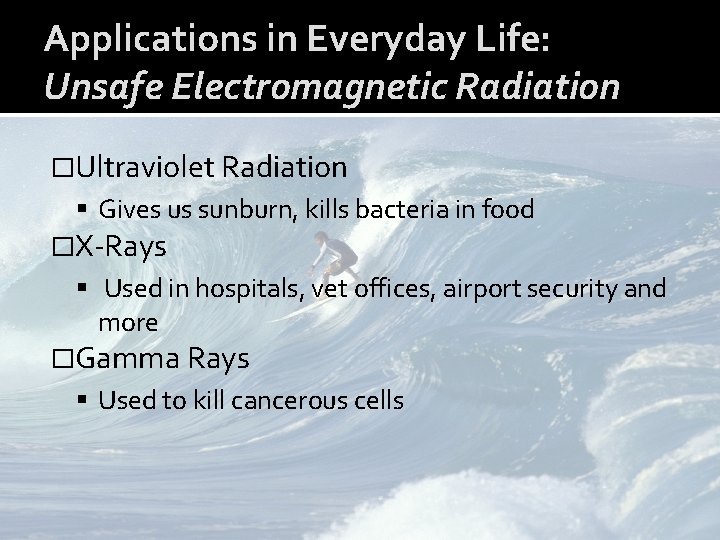
Applications in Everyday Life: Unsafe Electromagnetic Radiation �Ultraviolet Radiation Gives us sunburn, kills bacteria in food �X-Rays Used in hospitals, vet offices, airport security and more �Gamma Rays Used to kill cancerous cells
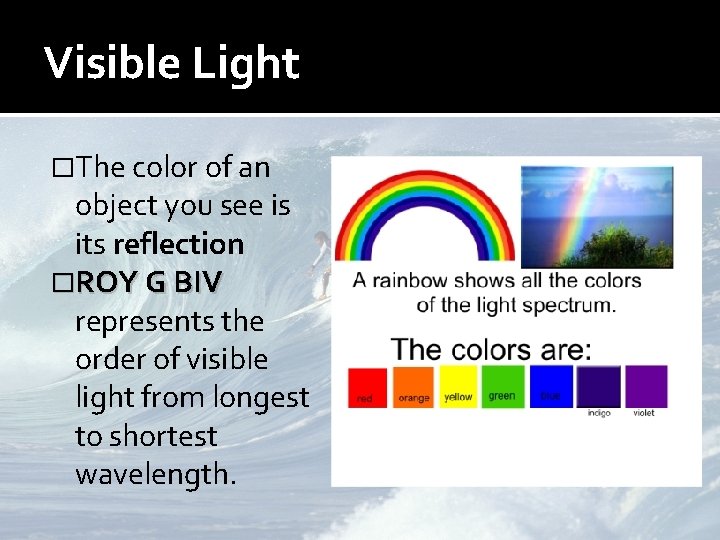
Visible Light �The color of an object you see is its reflection �ROY G BIV represents the order of visible light from longest to shortest wavelength.
Why Some Colors Look Different �Rough objects (wooden bench, plastic, etc. ) Transmit waves in all directions �Smooth objects (metal chair, glossy photo, etc. ) Reflect light with clear images �Opaque objects (paper, an apple, etc. ) Transfer little energy; the energy is absorbed as heat �Transparent objects (air, water, clear glass, etc. ) Transmit most of the energy through the material but smaller amounts of energy may be absorbed or reflected
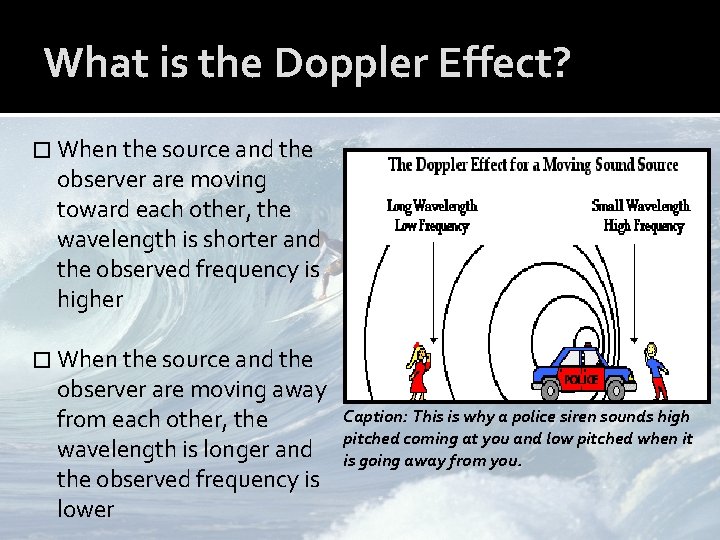
What is the Doppler Effect? � When the source and the observer are moving toward each other, the wavelength is shorter and the observed frequency is higher � When the source and the observer are moving away from each other, the wavelength is longer and the observed frequency is lower Caption: This is why a police siren sounds high pitched coming at you and low pitched when it is going away from you.
Watch this Video! �http: //education- portal. com/academy/lesson/transparent-andopaque-materials-in-electromagneticwaves. html
Answers to your questions! �Q: Why does your hearing get worse when you get older? �A: Age-related hearing loss, or presbycusis, is the slow loss of hearing that occurs as people get older. Tiny hair cells inside your inner ear help you hear. They pick up sound waves and change them into the nerve signals that the brain interprets as sound. Hearing loss occurs when the tiny hair cells are damaged or die. The hair cells do not regrow, so most hearing loss caused by hair cell damage is permanent.
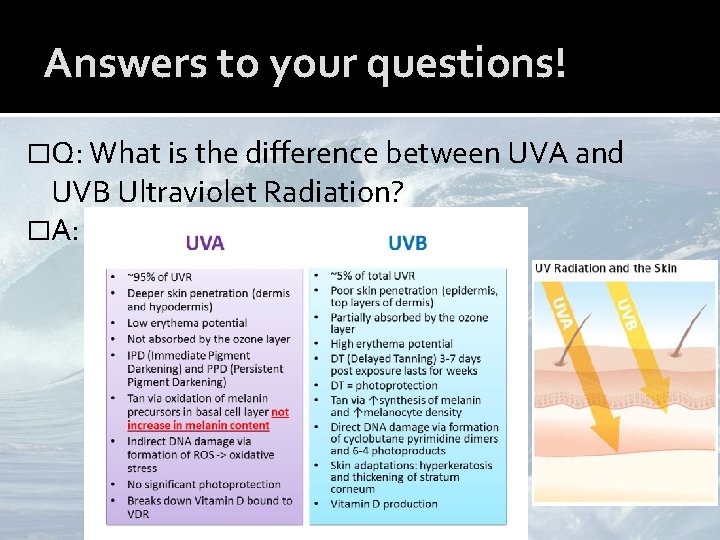
Answers to your questions! �Q: What is the difference between UVA and UVB Ultraviolet Radiation? �A:
Answers to your questions! �Q: What is the fastest wave? What is the most dangerous? �A: All electromagnetic waves travel at the same speed when in a vacuum which is 300, 000 m/s. The most dangerous are gamma rays. �Q: How fast does sound travel? �A: Sound travels at about 350 m/s.
Answers to your questions! �Q: Do waves travel faster through solids, liquids, or gases? �A: It depends on what kind of waves. For example, sound travels fastest in solids because it travels through a medium. Light waves travel fastest in gases or a vacuum because they do not need a medium to travel.
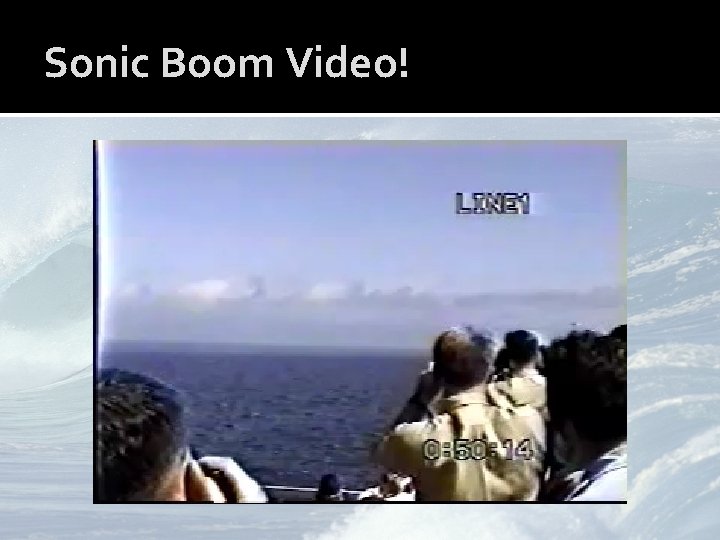
Answers to your questions! �Q: What happens when you break the sound barrier? �A: As the aircraft passes the speed of sound, shock waves form at the front and back of the aircraft. These shock waves are what produces the sonic boom. When they first form, there's a big pressure drop in the air behind them, and this causes any moisture to condense out of the air, producing a white fog. That's what you see as the airplane passes through the sound barrier. Once it is through, the fog goes away again
Sonic Boom Video!
Answers to your questions! �Q: Can you break glass with your voice (sound waves)? �A: Physics suggests that a voice should be able to break glass. Every piece of glass has a natural resonant frequency—the speed at which it will vibrate if bumped or otherwise disturbed by some stimulus, such as a sound wave—as does every other material on Earth