
INTEGRATED SCHOOL HEALTH ISHP PROGRAMME IN THE OSHIKOTO
- Slides: 15
INTEGRATED SCHOOL HEALTH (ISHP) PROGRAMME IN THE OSHIKOTO REGION NEEN CONFERENCE RUNDU HOTEL, KAVANGO EAST 27 – 30 JUNE 2019 ALINA HAMBELELA ANGULA
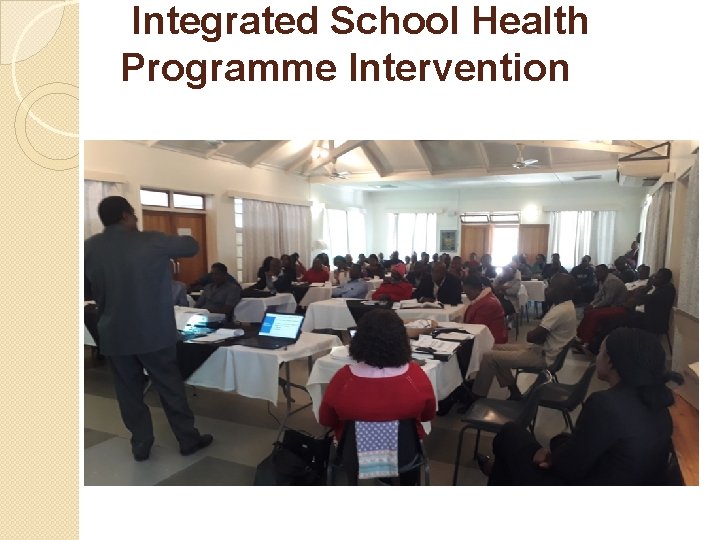
Integrated School Health Programme Intervention
OUTLINE �Background �Purpose �Objectives �Scope �Achievements �Challenges �Recommendations and Way Forward
Background of ISHP �A joint collaboration between Mo. HSS and Mo. EAC �Namibia adopted the WHO’s HPSI �A key strategy to deliver on the Vision 2030 and SDG goals �An ISH Training of Trainers (To. T) Manual was drafted and piloted in October, 2014 �First National training workshop in March, 2015 �National Task Force established to
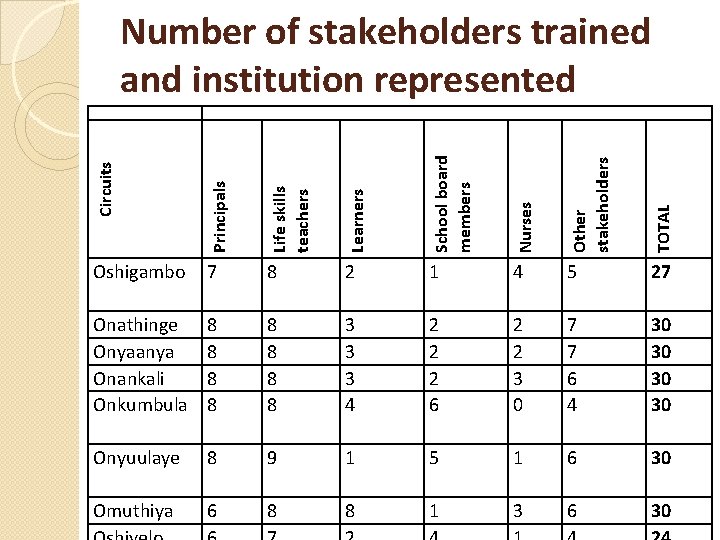
Background of ISHP �Oshikoto Regional Integrated School Health Task Force was trained in 2017 and 2018 �Comprises of Officials from: Mo. HSS, Mo. EAC, Mo. GECW, Mo. AWF, Mo. SYNS, Office of Deputy President: Disability Affairs �Workshop conducted on 18 – 22 June 2018 to all 8 circuits � 232 education stakeholders, including learners were trained
Purpose of ISHP �Help participants understand the components of Comprehensive SHP �Promote provision of food safety and WASH program in school �Provide information on the diverse needs of learners �Have basic understanding about violence against children �Offer guidance as to what support schools need from the community
Objectives of ISHP �Increased knowledge and understanding of the components of Comprehensive SHP �Gained insight into the history and current challenges of school health service in Namibia �Provide information on responsibilities related to WASH �Provide info about various barriers to learning and identify possible interventions �Have basic understanding of the nature and type of child abuse
Scope of the ISHP The programme only focused on 4 crucial modules from the drafted manual. 1. Comprehensive School Health Program 5. Safe Water, Sanitation and Hygiene 6. Learners with Special Needs 7. Violence against Children.
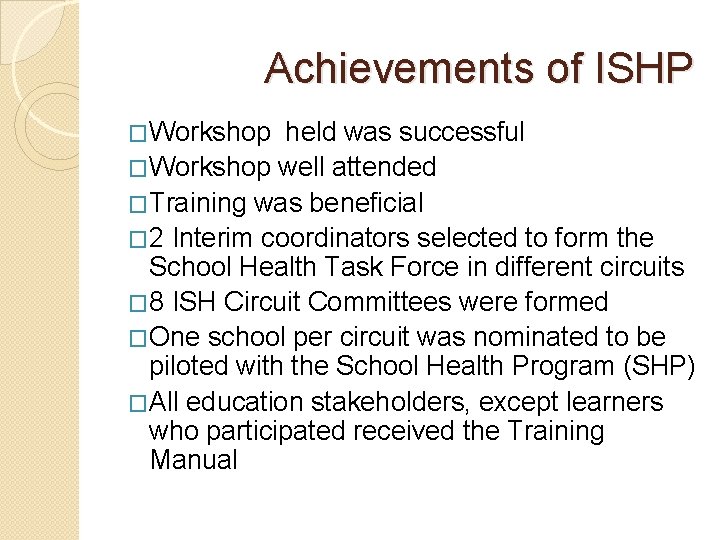
Achievements of ISHP �Workshop held was successful �Workshop well attended �Training was beneficial � 2 Interim coordinators selected to form the School Health Task Force in different circuits � 8 ISH Circuit Committees were formed �One school per circuit was nominated to be piloted with the School Health Program (SHP) �All education stakeholders, except learners who participated received the Training Manual
Life skills teachers Learners School board members Nurses Other stakeholders TOTAL Oshigambo 7 8 2 1 4 5 27 Onathinge Onyaanya Onankali Onkumbula 8 8 8 8 3 3 3 4 2 2 2 6 2 2 3 0 7 7 6 4 30 30 Onyuulaye 8 9 1 5 1 6 30 Omuthiya 6 8 8 1 3 6 30 Circuits Principals Number of stakeholders trained and institution represented
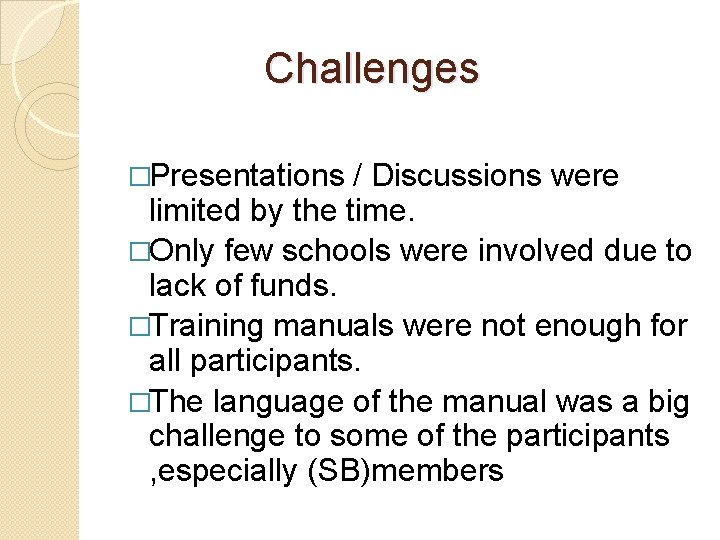
Challenges �Presentations / Discussions were limited by the time. �Only few schools were involved due to lack of funds. �Training manuals were not enough for all participants. �The language of the manual was a big challenge to some of the participants , especially (SB)members
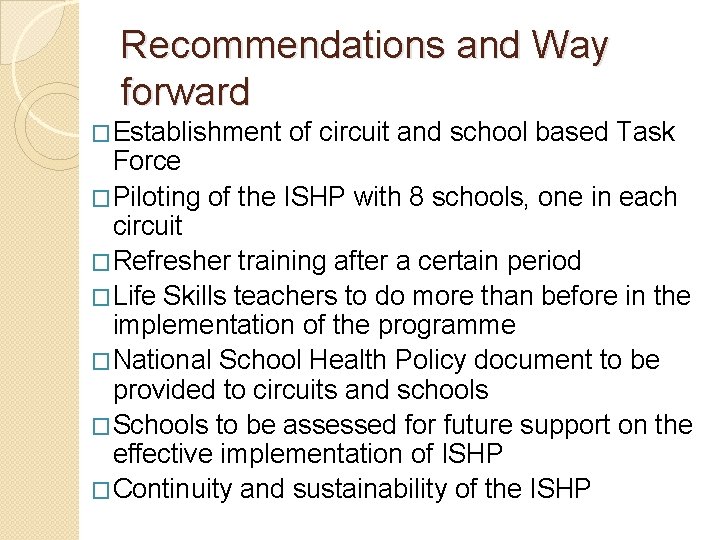
Recommendations and Way forward �Establishment of circuit and school based Task Force �Piloting of the ISHP with 8 schools, one in each circuit �Refresher training after a certain period �Life Skills teachers to do more than before in the implementation of the programme �National School Health Policy document to be provided to circuits and schools �Schools to be assessed for future support on the effective implementation of ISHP �Continuity and sustainability of the ISHP
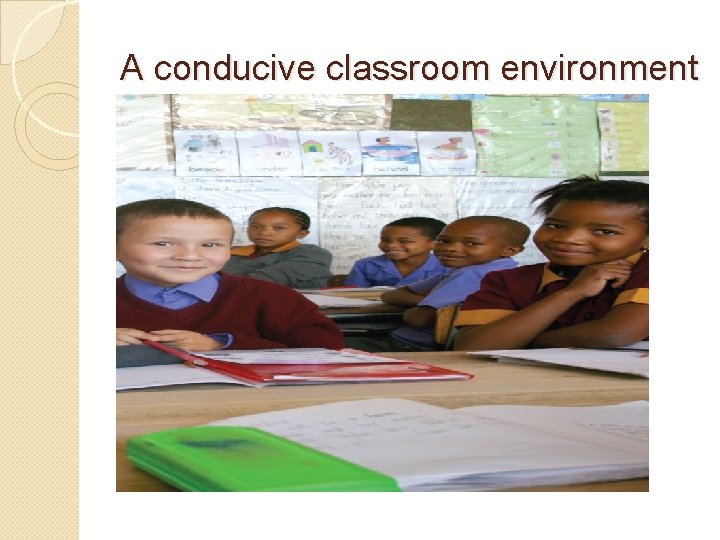
A conducive classroom environment
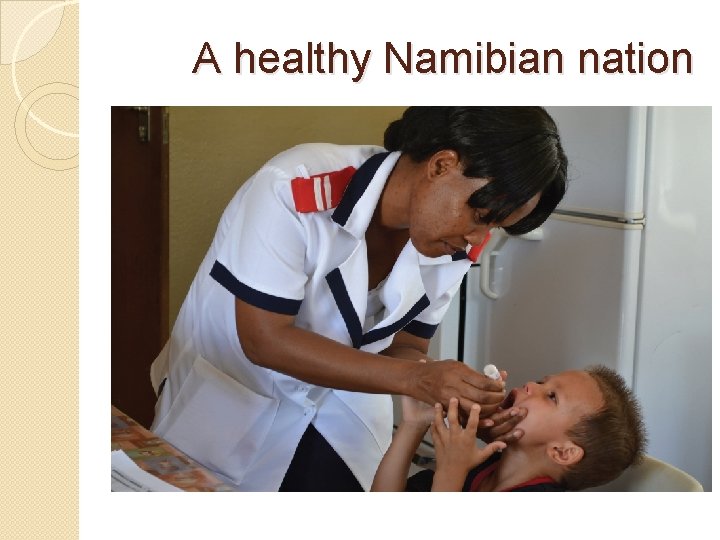
A healthy Namibian nation
THE END THANK YOU