
Integrated Resource Plan 2019 1 PURPOSE OF PRESENTATION


- Slides: 16
Integrated Resource Plan 2019 1
PURPOSE OF PRESENTATION • To share with the committee the details of the approved Integrated Resource Plan 2019. The National Development Plan (NDP) identified the need for South Africa to invest in a strong network of economic infrastructure designed to support the country’s medium and long-term economic and social objectives. ENERGY INFRASTRUCTURE is a critical component that underpins economic activity and growth across the country. It needs to be robust and extensive enough to meet industrial, commercial and household needs. 2
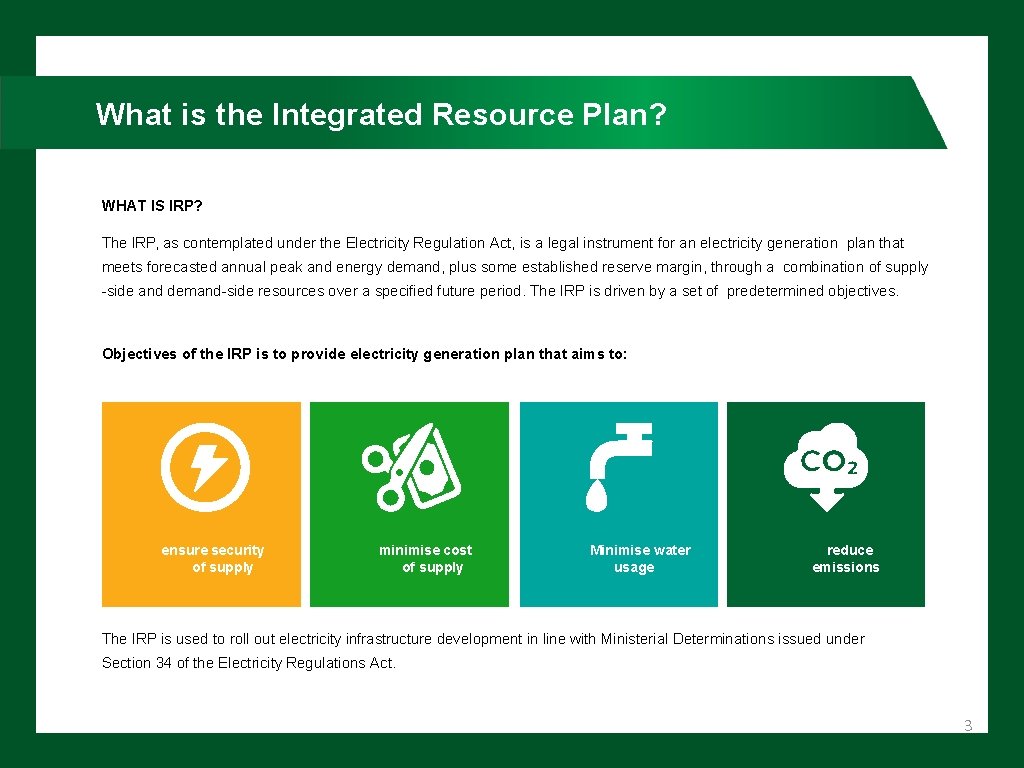
What is the Integrated Resource Plan? WHAT IS IRP? The IRP, as contemplated under the Electricity Regulation Act, is a legal instrument for an electricity generation plan that meets forecasted annual peak and energy demand, plus some established reserve margin, through a combination of supply -side and demand-side resources over a specified future period. The IRP is driven by a set of predetermined objectives. Objectives of the IRP is to provide electricity generation plan that aims to: ensure security of supply minimise cost of supply Minimise water usage reduce emissions The IRP is used to roll out electricity infrastructure development in line with Ministerial Determinations issued under Section 34 of the Electricity Regulations Act. 3
The first IRP for South Africa commonly - referred to as the IRP 2010 - was promulgated in March 2011. The IRP 2010 identified the preferred generation technology mix required to meet expected demand growth up to 2030. The plan was developed taking into account government objectives towards affordable electricity, reduced greenhouse gas (GHG) emissions, reduced water consumption, diversified electricity generation sources, localisation and regional development. It is within this context that our electricity planning philosophy aims to balance supply and demand while minimising the cost of electricity and keeping up with our environmental commitments. • Assumptions made in the IRP 2010 -30 have changed and therefore necessitated an update. 4
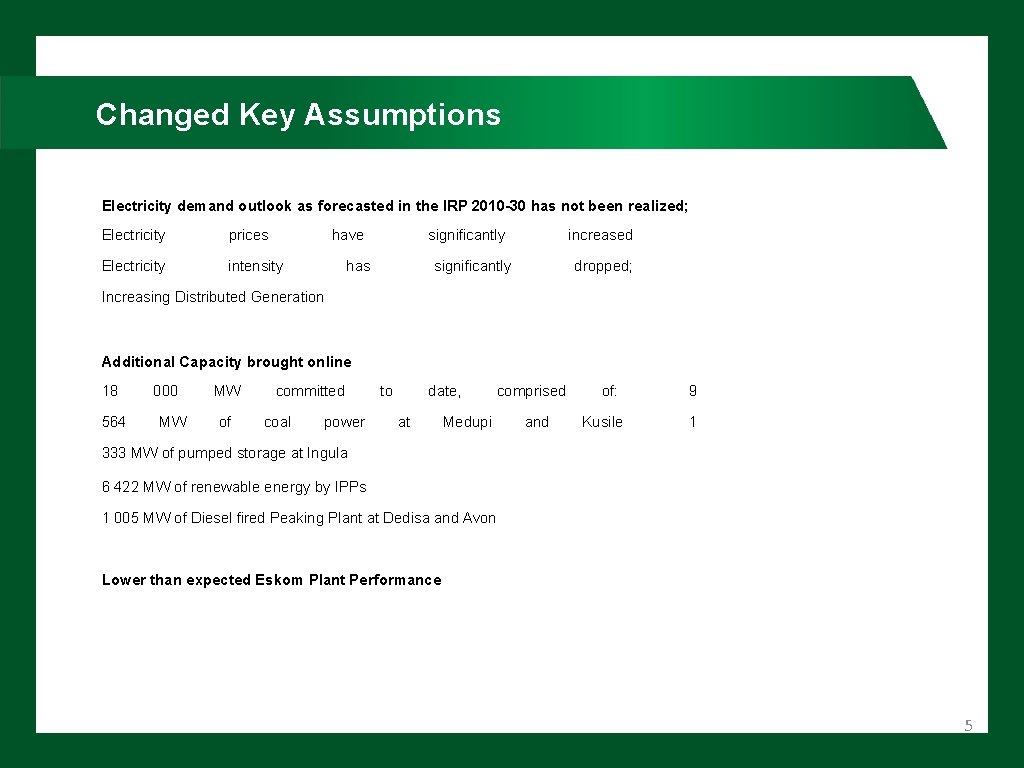
Changed Key Assumptions Electricity demand outlook as forecasted in the IRP 2010 -30 has not been realized; Electricity prices have Electricity intensity significantly has increased significantly dropped; Increasing Distributed Generation Additional Capacity brought online 18 564 000 MW MW of committed coal power to date, at Medupi comprised and of: Kusile 9 1 333 MW of pumped storage at Ingula 6 422 MW of renewable energy by IPPs 1 005 MW of Diesel fired Peaking Plant at Dedisa and Avon Lower than expected Eskom Plant Performance 5
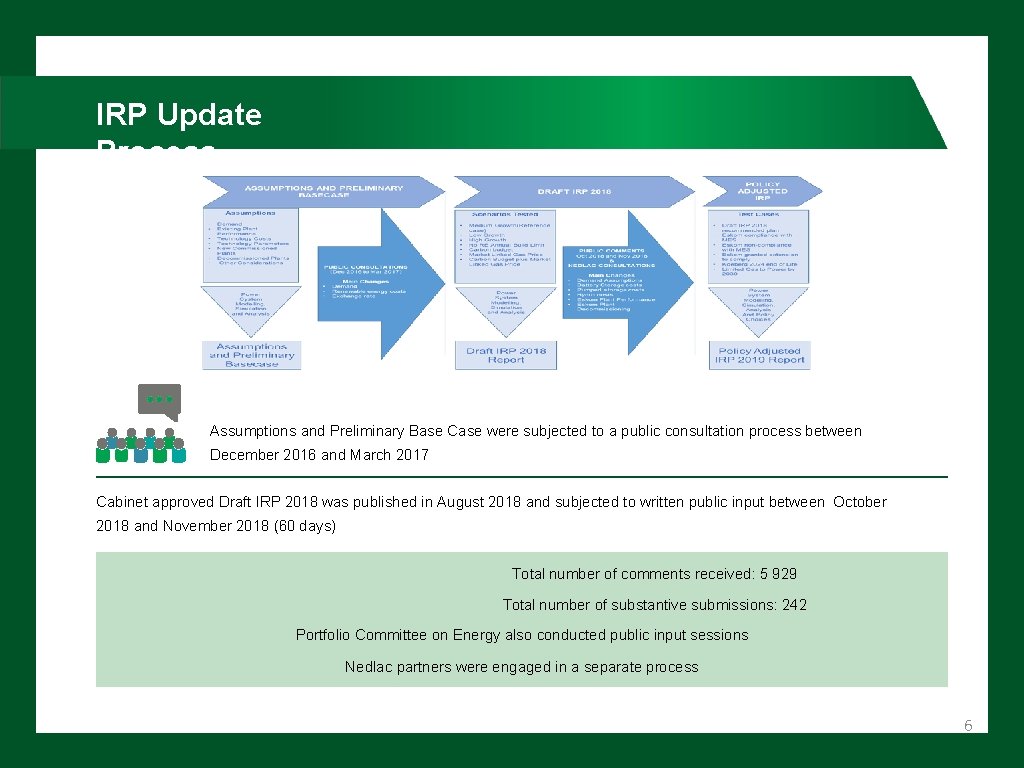
IRP Update Process Assumptions and Preliminary Base Case were subjected to a public consultation process between December 2016 and March 2017 Cabinet approved Draft IRP 2018 was published in August 2018 and subjected to written public input between October 2018 and November 2018 (60 days) Total number of comments received: 5 929 Total number of substantive submissions: 242 Portfolio Committee on Energy also conducted public input sessions Nedlac partners were engaged in a separate process 6
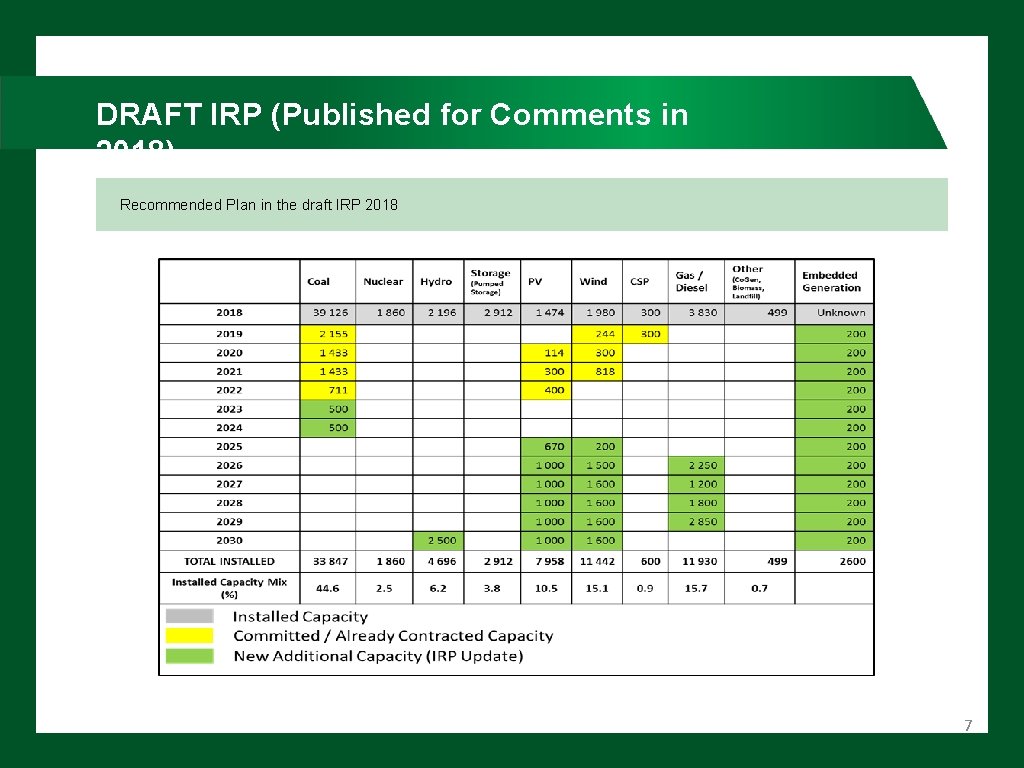
DRAFT IRP (Published for Comments in 2018) Recommended Plan in the draft IRP 2018 7
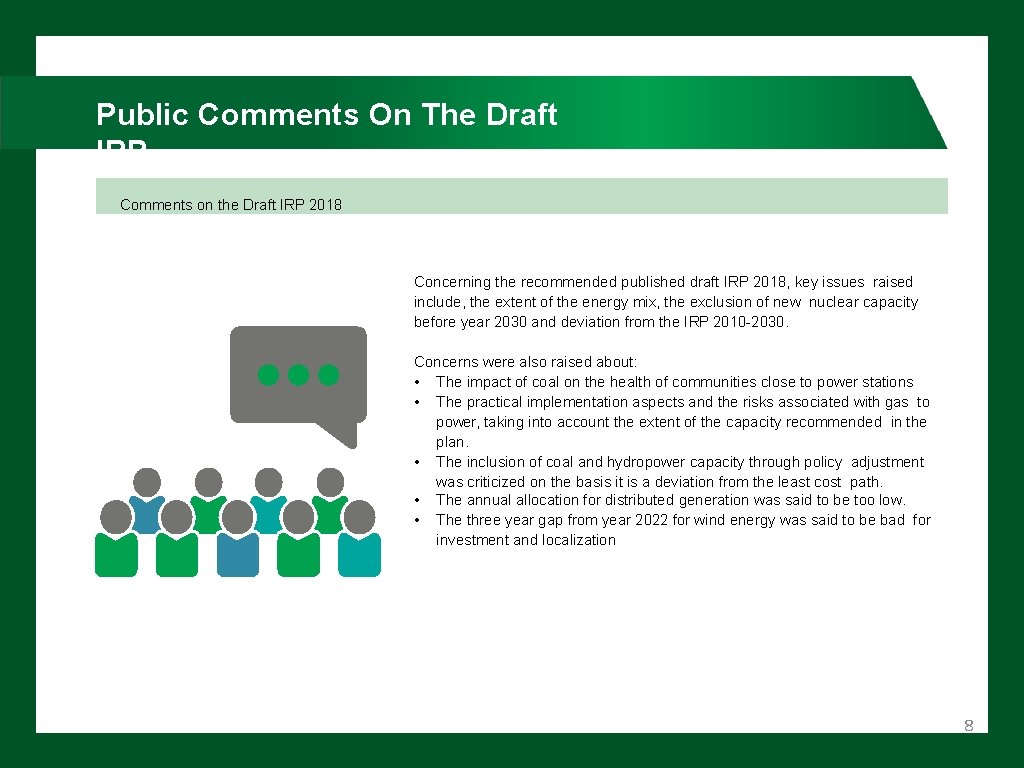
Public Comments On The Draft IRP Comments on the Draft IRP 2018 Concerning the recommended published draft IRP 2018, key issues raised include, the extent of the energy mix, the exclusion of new nuclear capacity before year 2030 and deviation from the IRP 2010 -2030. Concerns were also raised about: • The impact of coal on the health of communities close to power stations • The practical implementation aspects and the risks associated with gas to power, taking into account the extent of the capacity recommended in the plan. • The inclusion of coal and hydropower capacity through policy adjustment was criticized on the basis it is a deviation from the least cost path. • The annual allocation for distributed generation was said to be too low. • The three year gap from year 2022 for wind energy was said to be bad for investment and localization 8
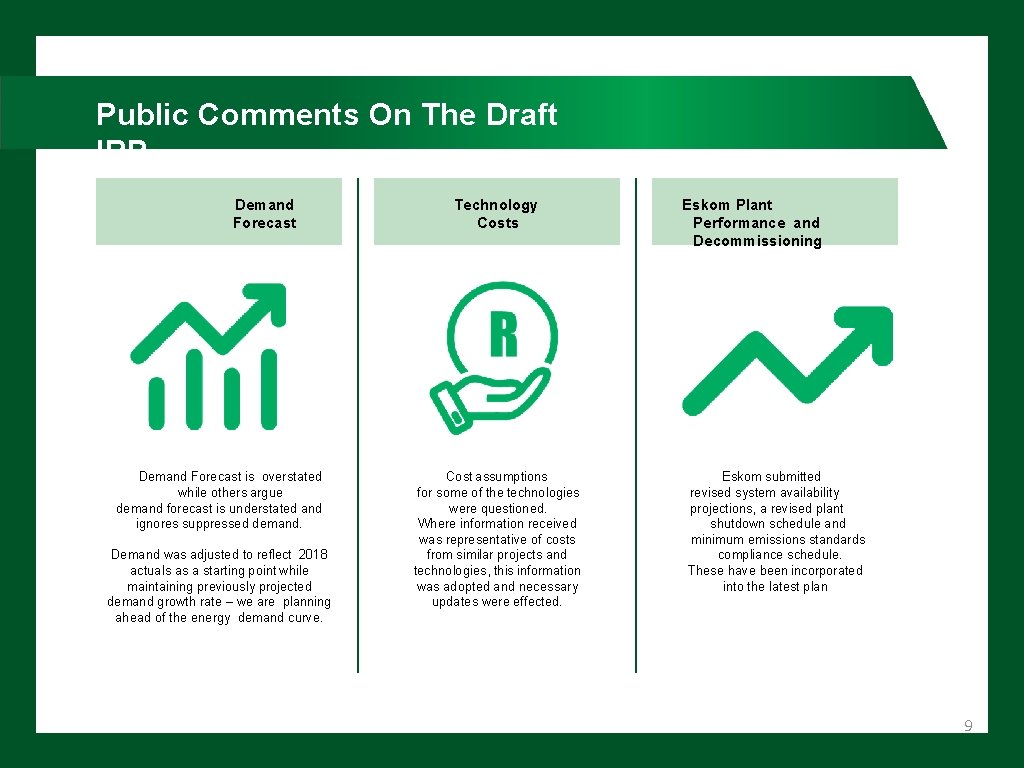
Public Comments On The Draft IRP Demand Forecast is overstated while others argue demand forecast is understated and ignores suppressed demand. Demand was adjusted to reflect 2018 actuals as a starting point while maintaining previously projected demand growth rate – we are planning ahead of the energy demand curve. Technology Costs Cost assumptions for some of the technologies were questioned. Where information received was representative of costs from similar projects and technologies, this information was adopted and necessary updates were effected. Eskom Plant Performance and Decommissioning Eskom submitted revised system availability projections, a revised plant shutdown schedule and minimum emissions standards compliance schedule. These have been incorporated into the latest plan 9
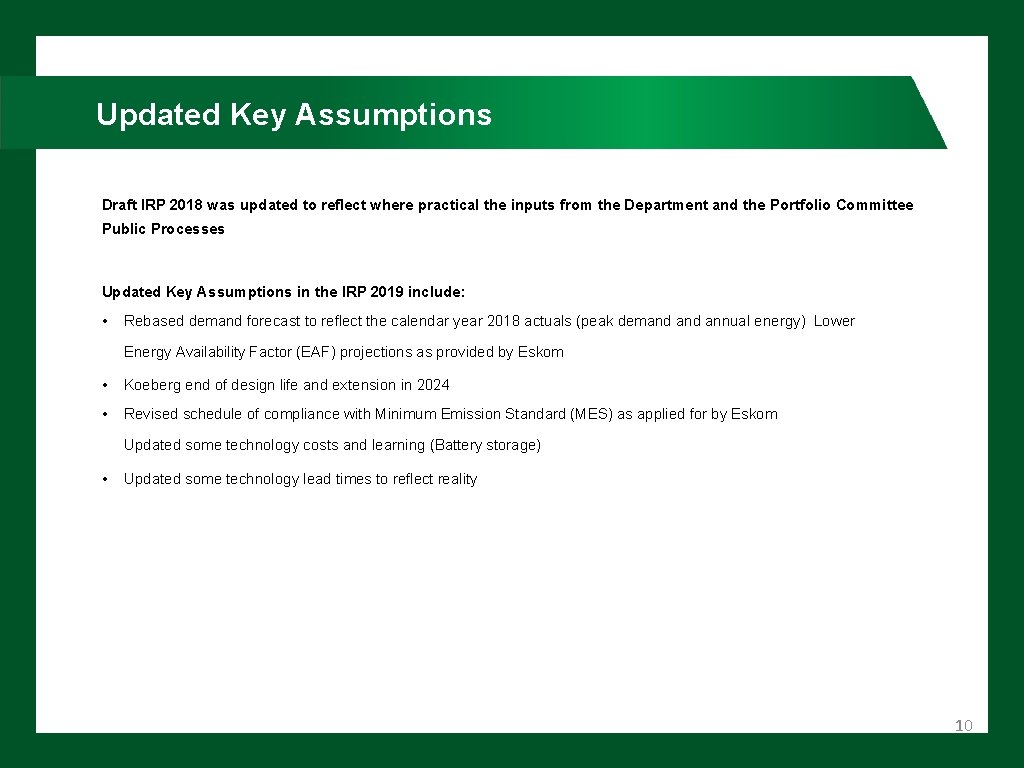
Updated Key Assumptions Draft IRP 2018 was updated to reflect where practical the inputs from the Department and the Portfolio Committee Public Processes Updated Key Assumptions in the IRP 2019 include: • Rebased demand forecast to reflect the calendar year 2018 actuals (peak demand annual energy) Lower Energy Availability Factor (EAF) projections as provided by Eskom • Koeberg end of design life and extension in 2024 • Revised schedule of compliance with Minimum Emission Standard (MES) as applied for by Eskom Updated some technology costs and learning (Battery storage) • Updated some technology lead times to reflect reality 10
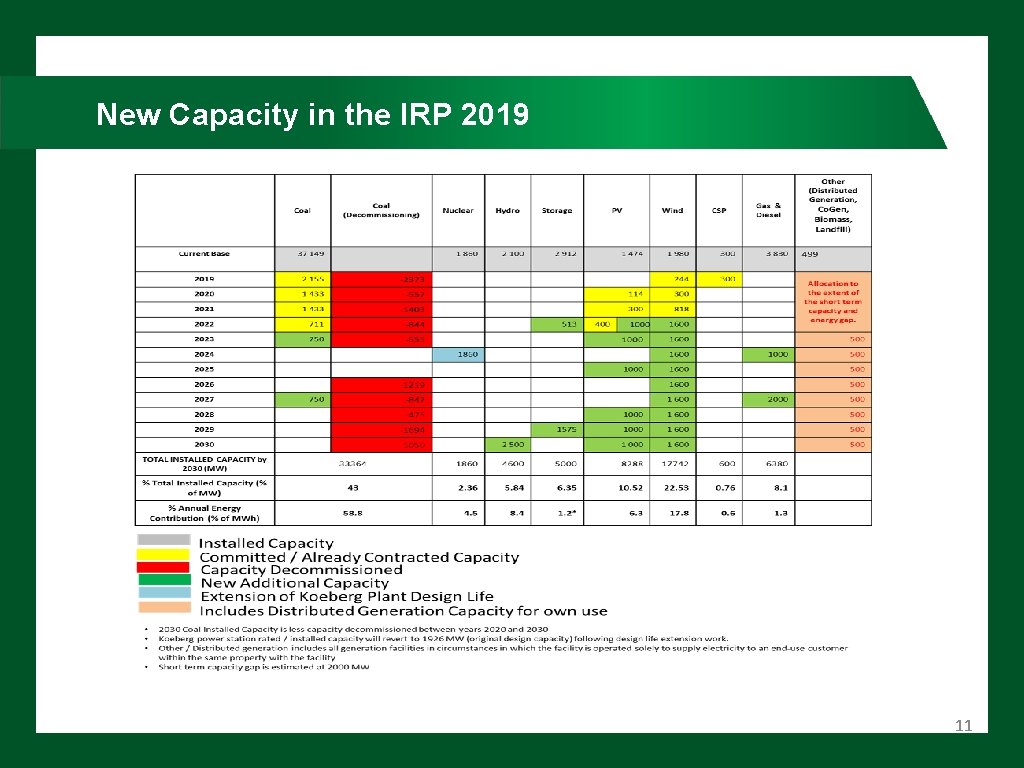
New Capacity in the IRP 2019 11
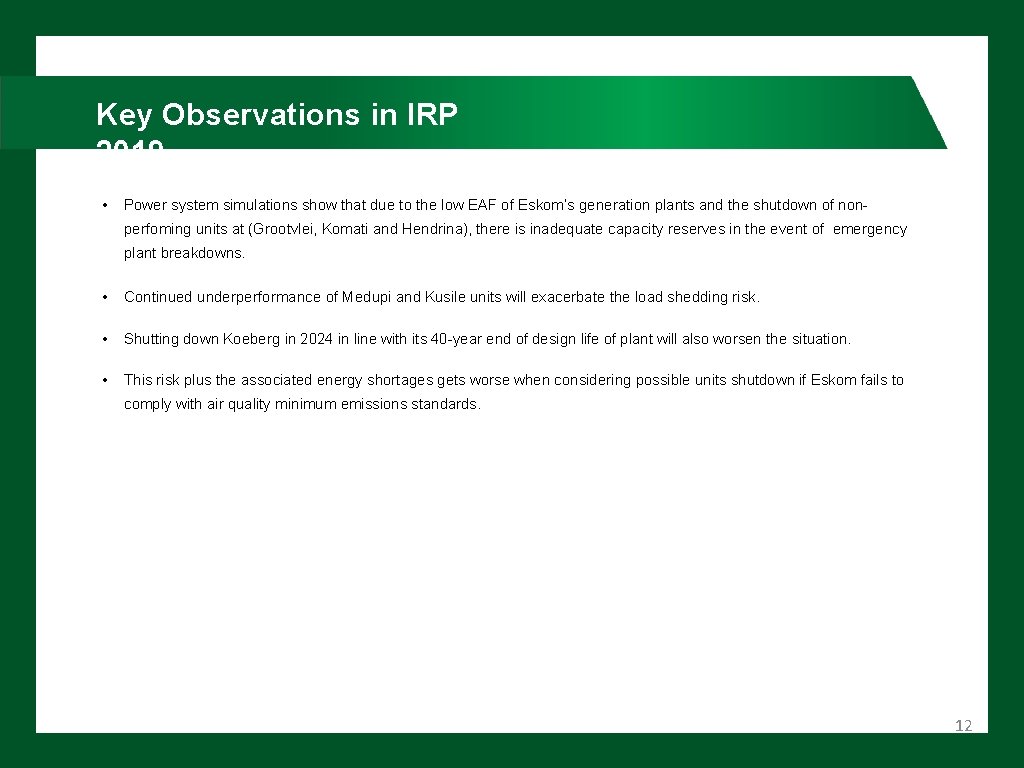
Key Observations in IRP 2019 • Power system simulations show that due to the low EAF of Eskom’s generation plants and the shutdown of nonperfoming units at (Grootvlei, Komati and Hendrina), there is inadequate capacity reserves in the event of emergency plant breakdowns. • Continued underperformance of Medupi and Kusile units will exacerbate the load shedding risk. • Shutting down Koeberg in 2024 in line with its 40 -year end of design life of plant will also worsen the situation. • This risk plus the associated energy shortages gets worse when considering possible units shutdown if Eskom fails to comply with air quality minimum emissions standards. 12
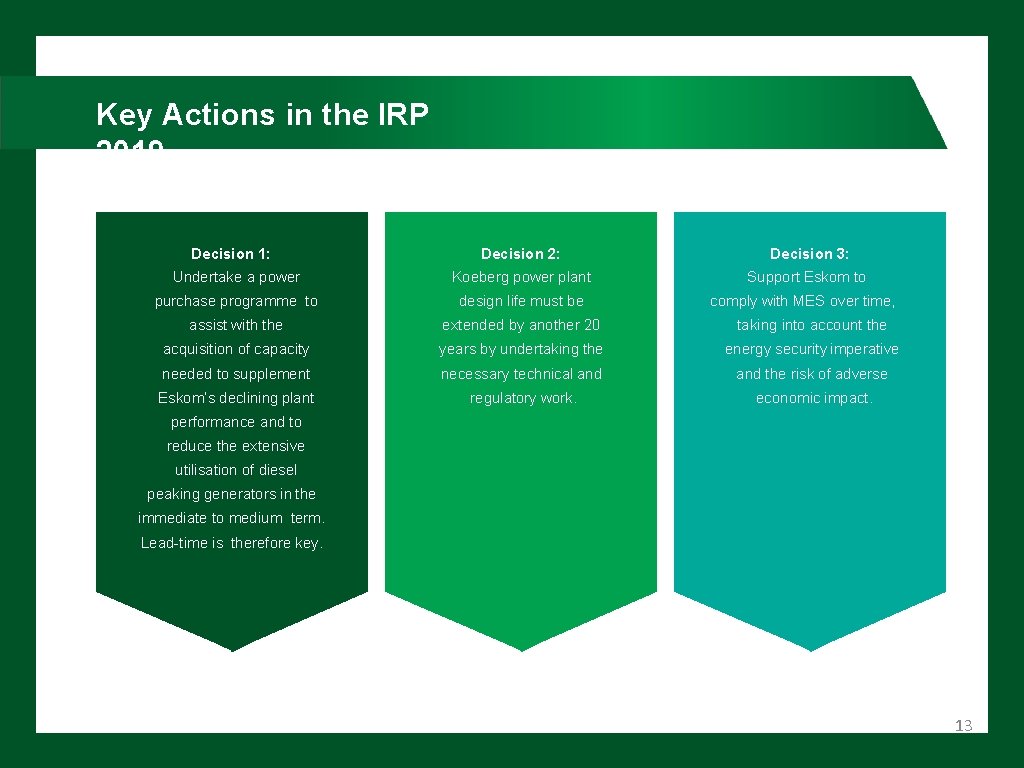
Key Actions in the IRP 2019 Decision 2: Decision 3: Undertake a power Koeberg power plant Support Eskom to purchase programme to design life must be comply with MES over time, assist with the extended by another 20 taking into account the acquisition of capacity years by undertaking the energy security imperative needed to supplement necessary technical and the risk of adverse Eskom’s declining plant regulatory work. economic impact. Decision 1: performance and to reduce the extensive utilisation of diesel peaking generators in the immediate to medium term. Lead-time is therefore key. 13
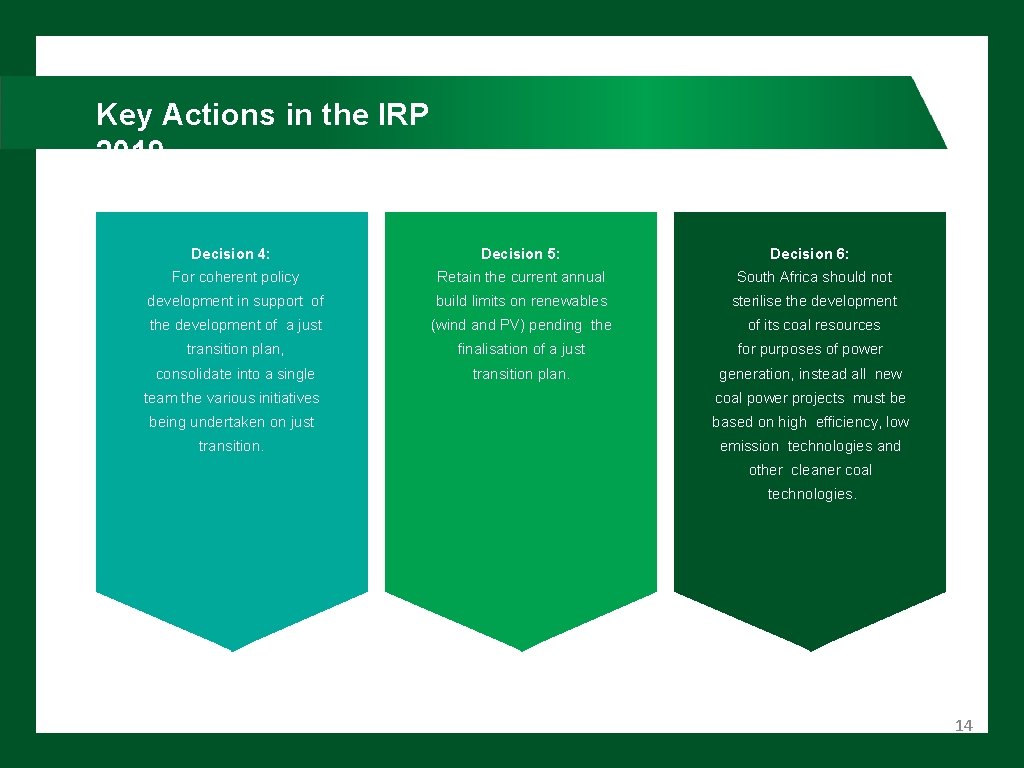
Key Actions in the IRP 2019 Decision 4: Decision 5: Decision 6: For coherent policy Retain the current annual South Africa should not development in support of build limits on renewables sterilise the development of a just (wind and PV) pending the of its coal resources transition plan, finalisation of a just for purposes of power consolidate into a single transition plan. generation, instead all new team the various initiatives coal power projects must be being undertaken on just based on high efficiency, low transition. emission technologies and other cleaner coal technologies. 14
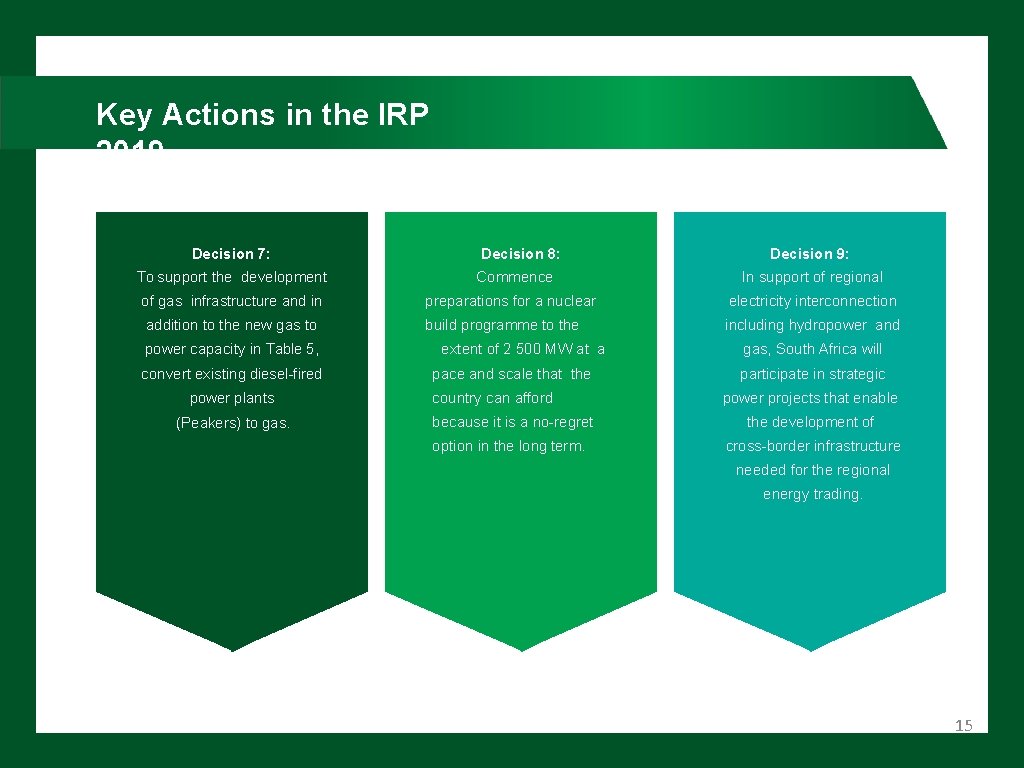
Key Actions in the IRP 2019 Decision 7: Decision 8: Decision 9: To support the development Commence In support of regional of gas infrastructure and in preparations for a nuclear electricity interconnection build programme to the including hydropower and addition to the new gas to power capacity in Table 5, convert existing diesel-fired power plants (Peakers) to gas. extent of 2 500 MW at a pace and scale that the country can afford gas, South Africa will participate in strategic power projects that enable because it is a no-regret the development of option in the long term. cross-border infrastructure needed for the regional energy trading. 15
16