
Integrated Project EIE 360 Dr Daniel Lun Department
- Slides: 36
Integrated Project (EIE 360) Dr Daniel Lun Department of Electronic and Information Engineering Tel: 27666255 Office: DE 637 Email: enpklun@polyu. edu. hk URL: www. eie. polyu. edu. hk/~enpklun/EIE 360. html THE HONG KONG POLYTECHNIC UNIVERSITY Department of Electronic and Information Engineering 1
Lecture 1 Introduction Department of ELECTRONIC AND INFORMATION ENGINEERING 1. Introduction by Dr Daniel Lun 2
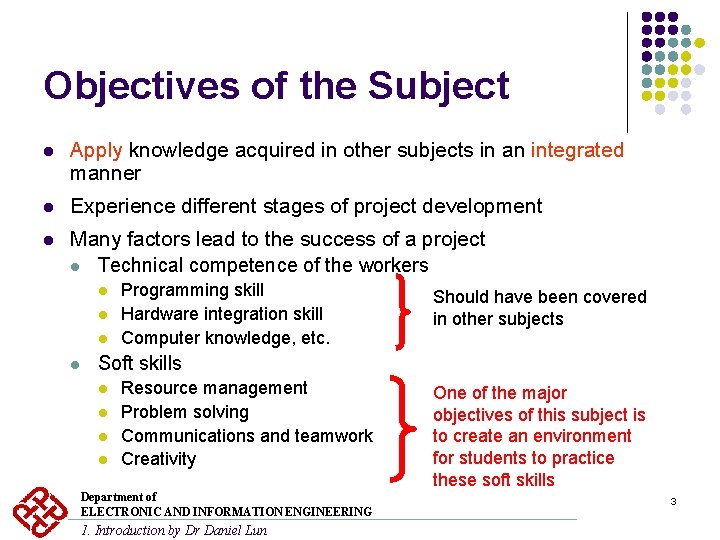
Objectives of the Subject l Apply knowledge acquired in other subjects in an integrated manner l Experience different stages of project development l Many factors lead to the success of a project l Technical competence of the workers l l Programming skill Hardware integration skill Computer knowledge, etc. Should have been covered in other subjects Soft skills l l Resource management Problem solving Communications and teamwork Creativity Department of ELECTRONIC AND INFORMATION ENGINEERING 1. Introduction by Dr Daniel Lun One of the major objectives of this subject is to create an environment for students to practice these soft skills 3
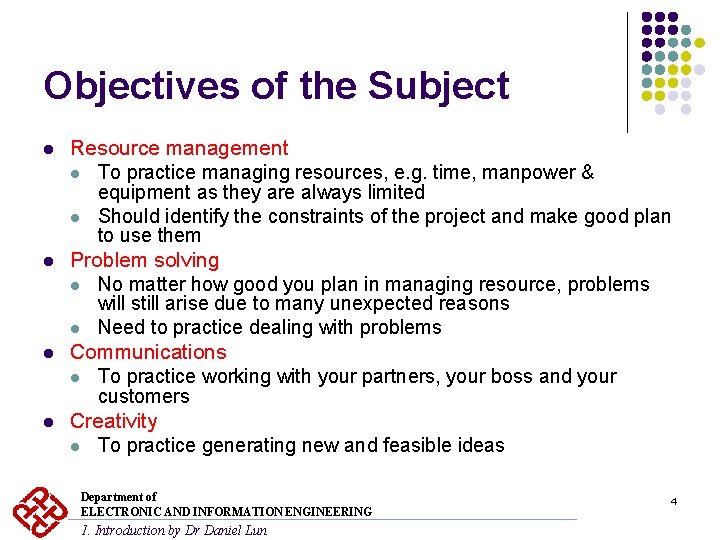
Objectives of the Subject l l Resource management l To practice managing resources, e. g. time, manpower & equipment as they are always limited l Should identify the constraints of the project and make good plan to use them Problem solving l No matter how good you plan in managing resource, problems will still arise due to many unexpected reasons l Need to practice dealing with problems Communications l To practice working with your partners, your boss and your customers Creativity l To practice generating new and feasible ideas Department of ELECTRONIC AND INFORMATION ENGINEERING 1. Introduction by Dr Daniel Lun 4
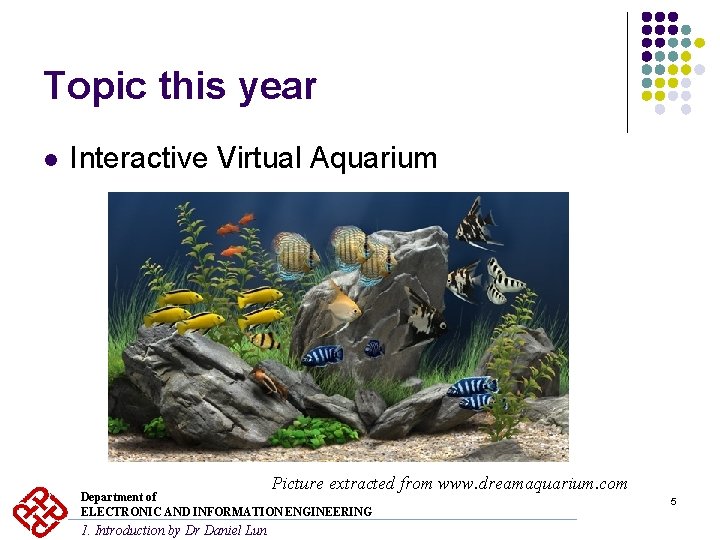
Topic this year l Interactive Virtual Aquarium Picture extracted from www. dreamaquarium. com Department of ELECTRONIC AND INFORMATION ENGINEERING 1. Introduction by Dr Daniel Lun 5
Topic this year (cont) Interactive Virtual Aquarium l ABC Software Company would like to develop a new software called – Interactive Virtual Aquarium l l l Use 3 D graphics to reproduce an aquarium on a computer The swimming fishes and other inhabitants are rendered in real time Although those creatures are not real, they should do everything that real ones do l Pecking at objects in the tank, eating food, chasing each other, swimming amongst the plants, or even fighting with each others! Department of ELECTRONIC AND INFORMATION ENGINEERING 1. Introduction by Dr Daniel Lun 6
Topic this year (cont) My Virtual Aquarium l Different from the current virtual aquarium in the market, ABC Company would like to introduce the following two features: l The growth and behavior of the living creatures in the virtual aquarium should follow a time function (just like tamagotchi!) l l l E. g. the fishes will grow-up, change size and shape, and die as time goes by E. g. the tank will get dirty if not cleaned regularly in time The virtual aquarium will interact with the user based on his/her body motion l Achieve by using a Kinect sensor device – a motion sensing input device created by Microsoft Department of ELECTRONIC AND INFORMATION ENGINEERING 1. Introduction by Dr Daniel Lun 7
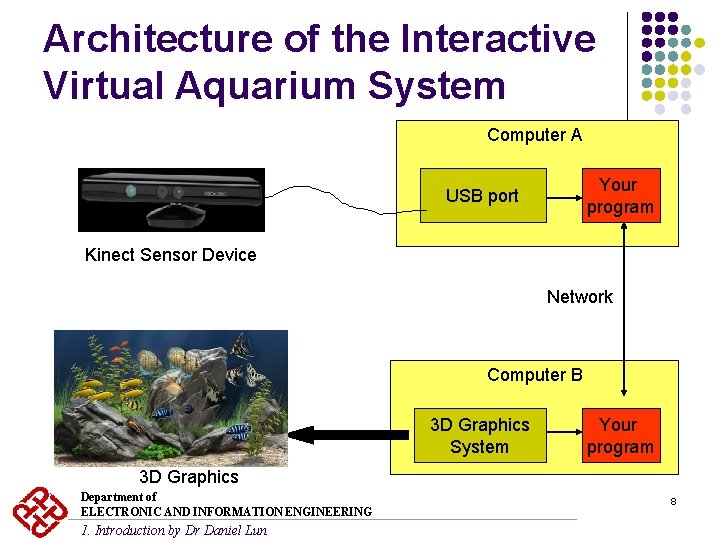
Architecture of the Interactive Virtual Aquarium System Computer A Your program USB port Kinect Sensor Device Network Computer B 3 D Graphics System Your program 3 D Graphics Department of ELECTRONIC AND INFORMATION ENGINEERING 1. Introduction by Dr Daniel Lun 8
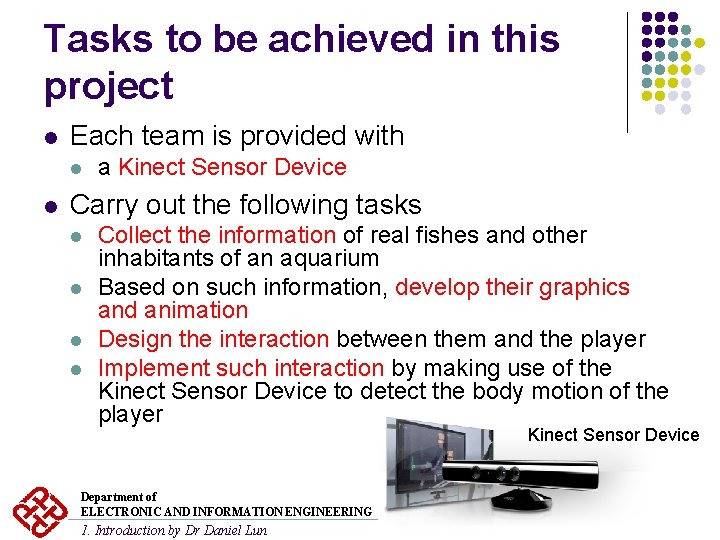
Tasks to be achieved in this project l Each team is provided with l l a Kinect Sensor Device Carry out the following tasks l l Collect the information of real fishes and other inhabitants of an aquarium Based on such information, develop their graphics and animation Design the interaction between them and the player Implement such interaction by making use of the Kinect Sensor Device to detect the body motion of the player Kinect Sensor Device Department of ELECTRONIC AND INFORMATION ENGINEERING 1. Introduction by Dr Daniel Lun
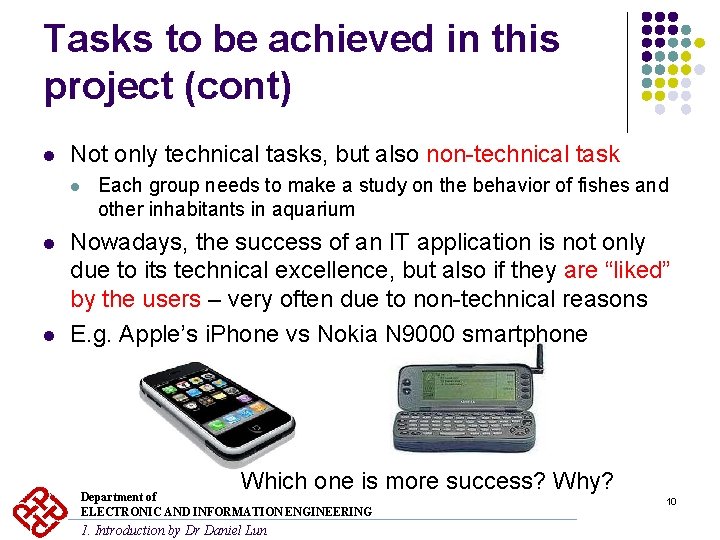
Tasks to be achieved in this project (cont) l Not only technical tasks, but also non-technical task l l l Each group needs to make a study on the behavior of fishes and other inhabitants in aquarium Nowadays, the success of an IT application is not only due to its technical excellence, but also if they are “liked” by the users – very often due to non-technical reasons E. g. Apple’s i. Phone vs Nokia N 9000 smartphone Which one is more success? Why? Department of ELECTRONIC AND INFORMATION ENGINEERING 1. Introduction by Dr Daniel Lun 10
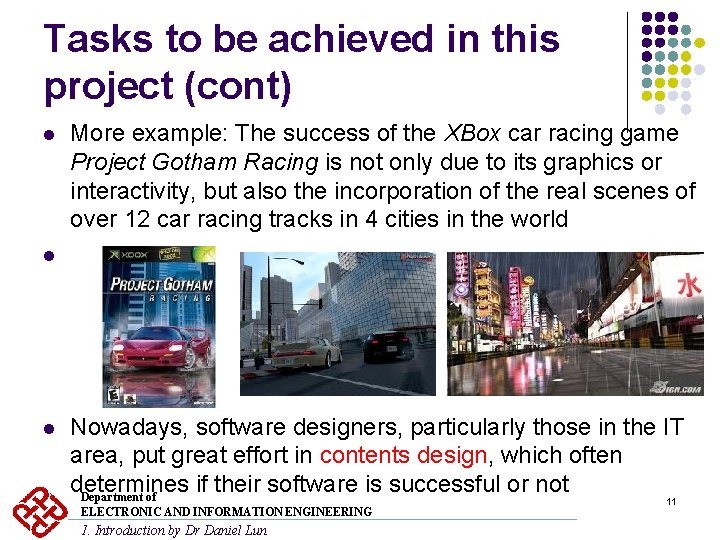
Tasks to be achieved in this project (cont) l More example: The success of the XBox car racing game Project Gotham Racing is not only due to its graphics or interactivity, but also the incorporation of the real scenes of over 12 car racing tracks in 4 cities in the world l l Nowadays, software designers, particularly those in the IT area, put great effort in contents design, which often determines if their software is successful or not Department of ELECTRONIC AND INFORMATION ENGINEERING 1. Introduction by Dr Daniel Lun 11
Things to do in this subject l Learn the features, working principle and implementation methods of different sub-systems required in this project l l l Find a partner to form a group l l Each member will be responsible for one part of the project Work of the members should be combined to form the whole system Make the first demonstration of the design Summarize the experience and design your software l l A series of tutorial and lab exercises will guide you to achieve the minimum of the project requirement Need to make demonstration for each tutorial and submit report for the lab Make a background study of the behavior of fishes and other inhabitants of aquarium Prepare a proposal to indicate your plan of designing the system To record the progress of the project, each student needs to keep a logbook Implement your design and show in the final demonstration l You are also required to make a presentation and a final report to elaborate your work and the result Department of ELECTRONIC AND INFORMATION ENGINEERING 1. Introduction by Dr Daniel Lun 12
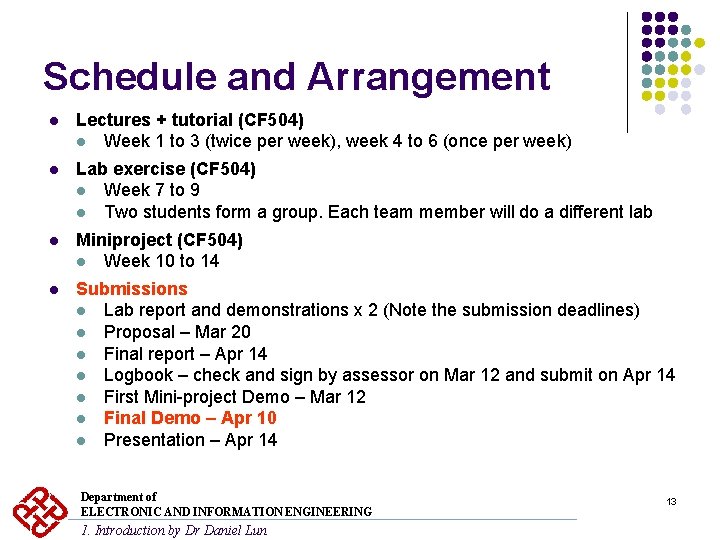
Schedule and Arrangement l Lectures + tutorial (CF 504) l Week 1 to 3 (twice per week), week 4 to 6 (once per week) l Lab exercise (CF 504) l Week 7 to 9 l Two students form a group. Each team member will do a different lab l Miniproject (CF 504) l Week 10 to 14 l Submissions l Lab report and demonstrations x 2 (Note the submission deadlines) l Proposal – Mar 20 l Final report – Apr 14 l Logbook – check and sign by assessor on Mar 12 and submit on Apr 14 l First Mini-project Demo – Mar 12 l Final Demo – Apr 10 l Presentation – Apr 14 Department of ELECTRONIC AND INFORMATION ENGINEERING 1. Introduction by Dr Daniel Lun 13
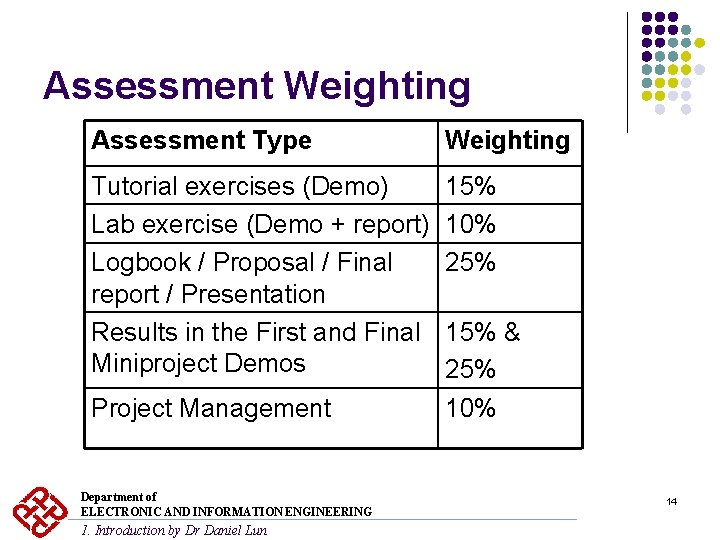
Assessment Weighting Assessment Type Weighting Tutorial exercises (Demo) Lab exercise (Demo + report) Logbook / Proposal / Final report / Presentation Results in the First and Final Miniproject Demos 15% 10% 25% Project Management Department of ELECTRONIC AND INFORMATION ENGINEERING 1. Introduction by Dr Daniel Lun 15% & 25% 10% 14
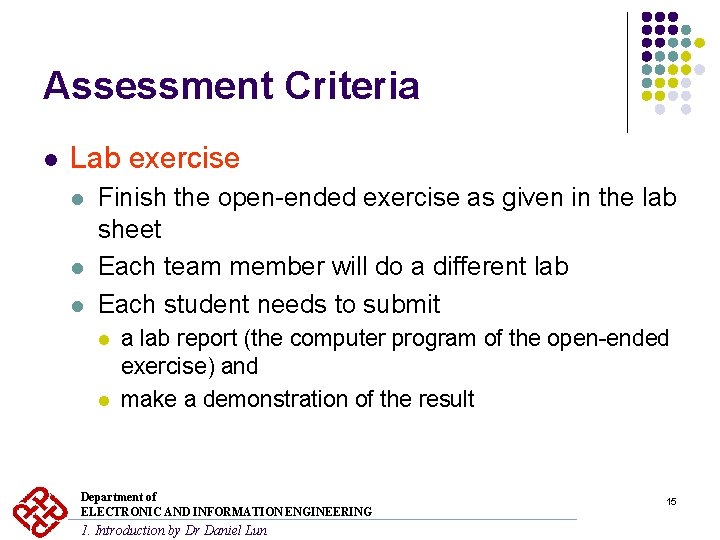
Assessment Criteria l Lab exercise l l l Finish the open-ended exercise as given in the lab sheet Each team member will do a different lab Each student needs to submit l l a lab report (the computer program of the open-ended exercise) and make a demonstration of the result Department of ELECTRONIC AND INFORMATION ENGINEERING 1. Introduction by Dr Daniel Lun 15
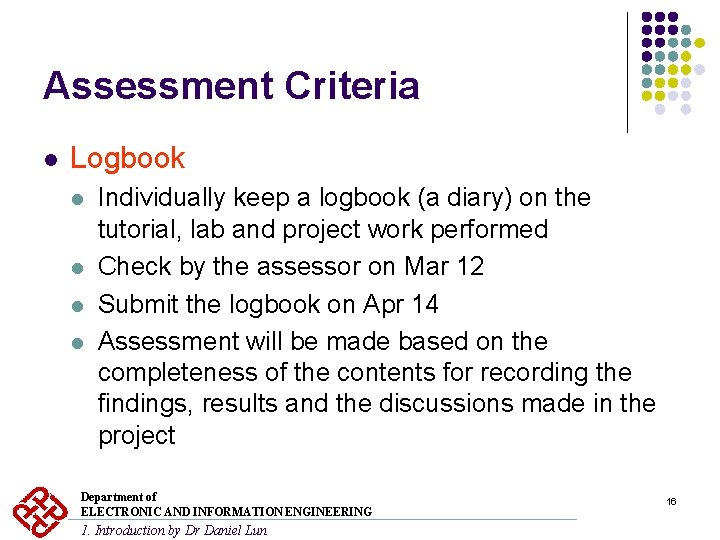
Assessment Criteria l Logbook l l Individually keep a logbook (a diary) on the tutorial, lab and project work performed Check by the assessor on Mar 12 Submit the logbook on Apr 14 Assessment will be made based on the completeness of the contents for recording the findings, results and the discussions made in the project Department of ELECTRONIC AND INFORMATION ENGINEERING 1. Introduction by Dr Daniel Lun 16
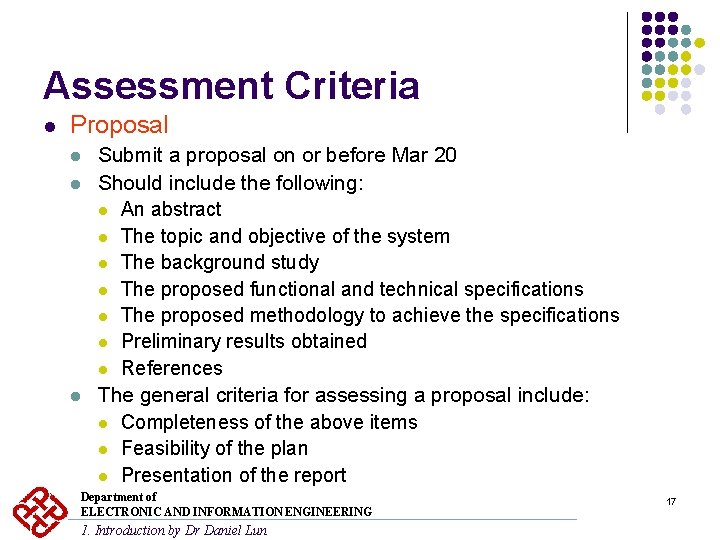
Assessment Criteria l Proposal l Submit a proposal on or before Mar 20 Should include the following: l An abstract l The topic and objective of the system l The background study l The proposed functional and technical specifications l The proposed methodology to achieve the specifications l Preliminary results obtained l References The general criteria for assessing a proposal include: l Completeness of the above items l Feasibility of the plan l Presentation of the report Department of ELECTRONIC AND INFORMATION ENGINEERING 1. Introduction by Dr Daniel Lun 17
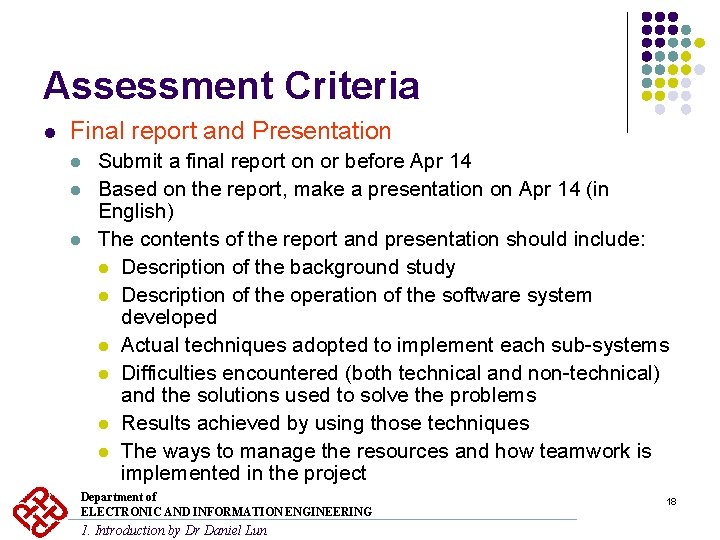
Assessment Criteria l Final report and Presentation l l l Submit a final report on or before Apr 14 Based on the report, make a presentation on Apr 14 (in English) The contents of the report and presentation should include: l Description of the background study l Description of the operation of the software system developed l Actual techniques adopted to implement each sub-systems l Difficulties encountered (both technical and non-technical) and the solutions used to solve the problems l Results achieved by using those techniques l The ways to manage the resources and how teamwork is implemented in the project Department of ELECTRONIC AND INFORMATION ENGINEERING 1. Introduction by Dr Daniel Lun 18
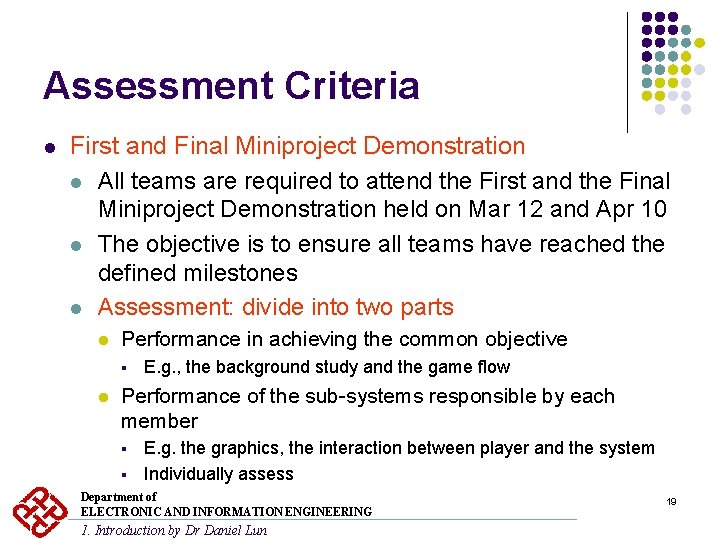
Assessment Criteria l First and Final Miniproject Demonstration l All teams are required to attend the First and the Final Miniproject Demonstration held on Mar 12 and Apr 10 l The objective is to ensure all teams have reached the defined milestones l Assessment: divide into two parts l Performance in achieving the common objective § l E. g. , the background study and the game flow Performance of the sub-systems responsible by each member § § E. g. the graphics, the interaction between player and the system Individually assess Department of ELECTRONIC AND INFORMATION ENGINEERING 1. Introduction by Dr Daniel Lun 19
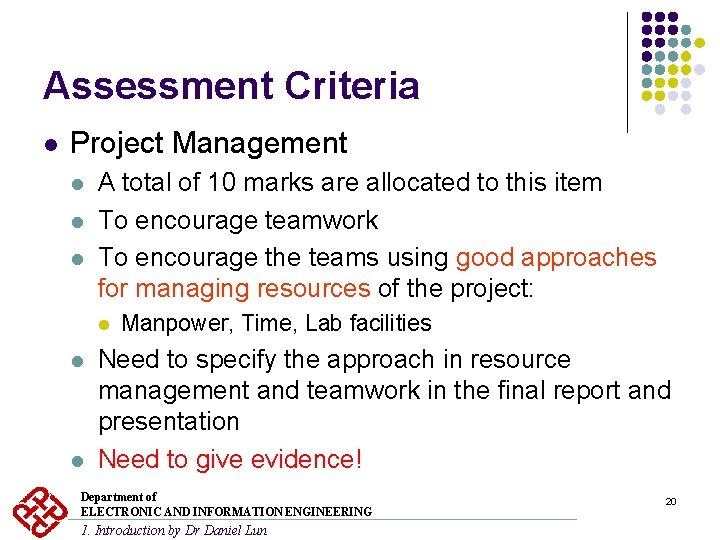
Assessment Criteria l Project Management l l l A total of 10 marks are allocated to this item To encourage teamwork To encourage the teams using good approaches for managing resources of the project: l l l Manpower, Time, Lab facilities Need to specify the approach in resource management and teamwork in the final report and presentation Need to give evidence! Department of ELECTRONIC AND INFORMATION ENGINEERING 1. Introduction by Dr Daniel Lun 20
Project Competition l l l Project development is not the same as doing an assignment, it is open-ended To reward those students who spend great effort in continuously enhancing the result of the project, a project competition will be held along with this subject for them to showcase their achievement Award: l The Best Project Award l l l For the team that gives the best design (graphics and features) Robustness in implementation is another important assessment criterion Cash prizes and certificates will be awarded to the winners of the competition Department of ELECTRONIC AND INFORMATION ENGINEERING 1. Introduction by Dr Daniel Lun 21
Why project management? l l l A project involves the interaction of different parties A project will be successful only if all parties do their job right By having good project management, we can l l Achieve the project goal on time and within the budget Keep your boss and your customers happy Keep the team focus on the goal and work well Everyone shares the load Department of ELECTRONIC AND INFORMATION ENGINEERING 1. Introduction by Dr Daniel Lun 22
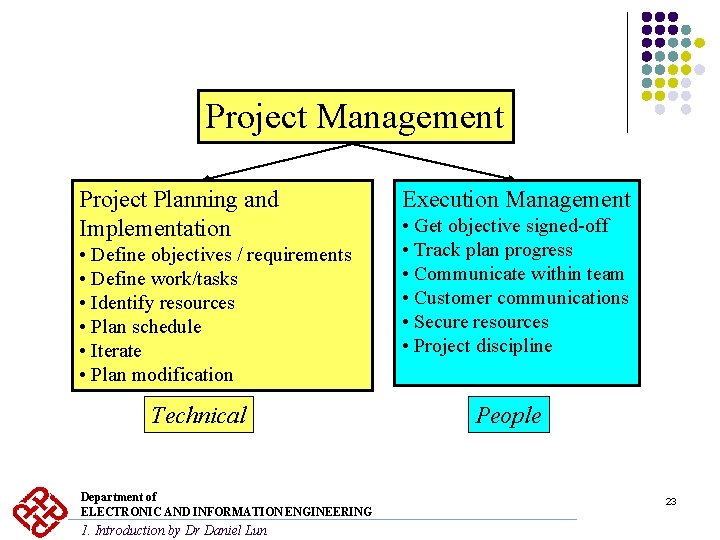
Project Management Project Planning and Implementation • Define objectives / requirements • Define work/tasks • Identify resources • Plan schedule • Iterate • Plan modification Technical Department of ELECTRONIC AND INFORMATION ENGINEERING 1. Introduction by Dr Daniel Lun Execution Management • Get objective signed-off • Track plan progress • Communicate within team • Customer communications • Secure resources • Project discipline People 23
Project Planning l l l The process of project development is full of uncertainties The more uncertainties you have, the less possible that the project can be successful Uncertainties can be reduced by having a good feasibility study before the project l l Background research Understand the resource required and acquired Risk analysis The feasibility study has been prepared for you in the lab exercises Department of ELECTRONIC AND INFORMATION ENGINEERING 1. Introduction by Dr Daniel Lun 24
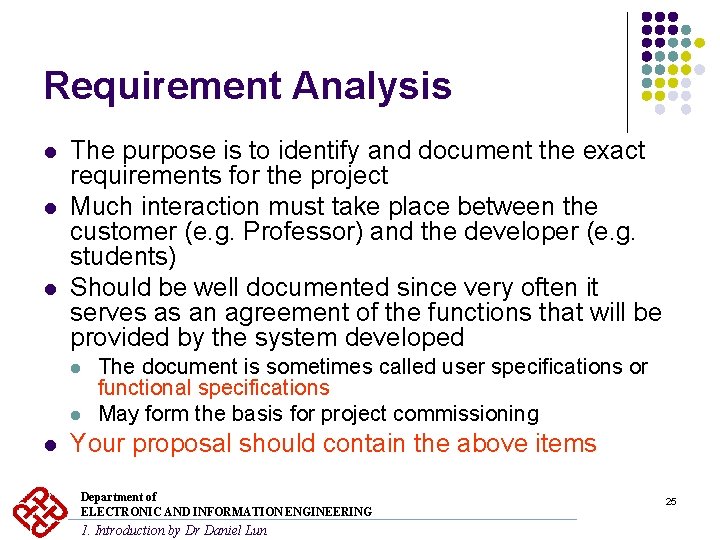
Requirement Analysis l l l The purpose is to identify and document the exact requirements for the project Much interaction must take place between the customer (e. g. Professor) and the developer (e. g. students) Should be well documented since very often it serves as an agreement of the functions that will be provided by the system developed l l l The document is sometimes called user specifications or functional specifications May form the basis for project commissioning Your proposal should contain the above items Department of ELECTRONIC AND INFORMATION ENGINEERING 1. Introduction by Dr Daniel Lun 25
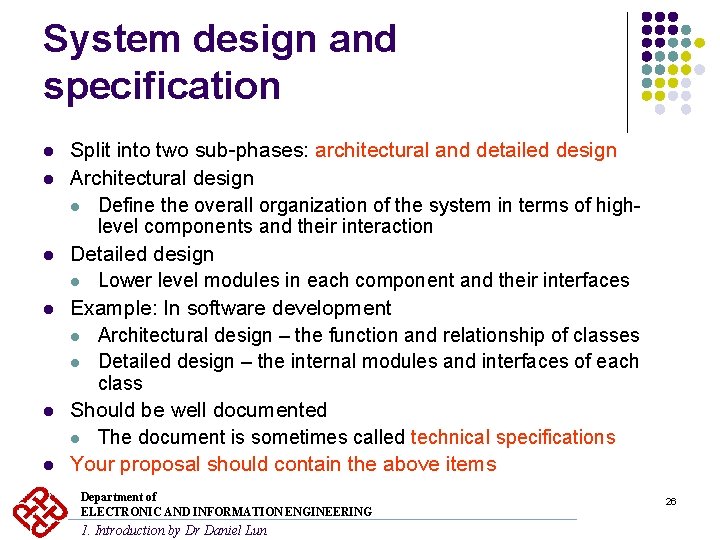
System design and specification l l l Split into two sub-phases: architectural and detailed design Architectural design l Define the overall organization of the system in terms of highlevel components and their interaction Detailed design l Lower level modules in each component and their interfaces Example: In software development l Architectural design – the function and relationship of classes l Detailed design – the internal modules and interfaces of each class Should be well documented l The document is sometimes called technical specifications Your proposal should contain the above items Department of ELECTRONIC AND INFORMATION ENGINEERING 1. Introduction by Dr Daniel Lun 26
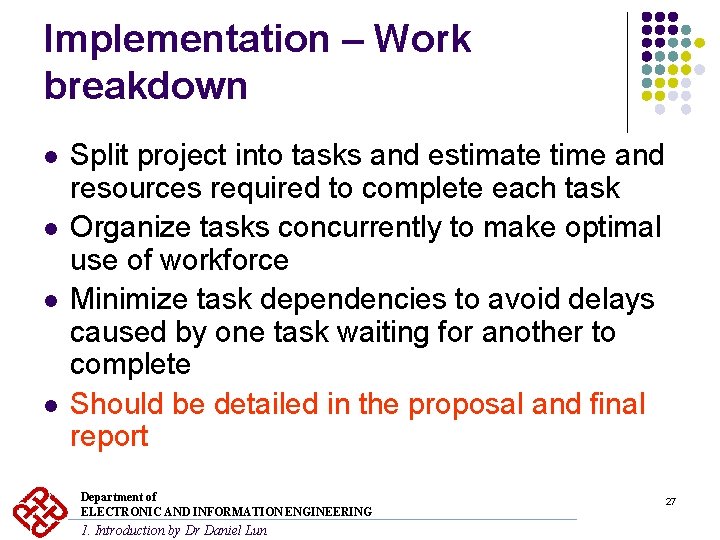
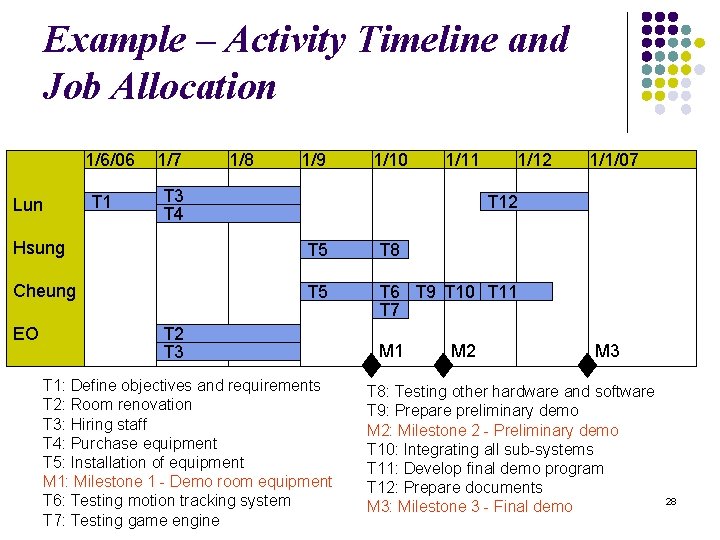
Implementation – Work breakdown l l Split project into tasks and estimate time and resources required to complete each task Organize tasks concurrently to make optimal use of workforce Minimize task dependencies to avoid delays caused by one task waiting for another to complete Should be detailed in the proposal and final report Department of ELECTRONIC AND INFORMATION ENGINEERING 1. Introduction by Dr Daniel Lun 27
Example – Activity Timeline and Job Allocation 1/6/06 Lun T 1 1/7 1/8 1/9 1/10 1/11 T 3 T 4 1/12 T 12 Hsung T 5 T 8 Cheung T 5 T 6 T 9 T 10 T 11 T 7 EO 1/1/07 T 2 T 3 T 1: Define objectives and requirements T 2: Room renovation T 3: Hiring staff T 4: Purchase equipment T 5: Installation of equipment M 1: Milestone 1 - Demo room equipment T 6: Testing motion tracking system T 7: Testing game engine M 1 M 2 M 3 T 8: Testing other hardware and software T 9: Prepare preliminary demo M 2: Milestone 2 - Preliminary demo T 10: Integrating all sub-systems T 11: Develop final demo program T 12: Prepare documents M 3: Milestone 3 - Final demo 28
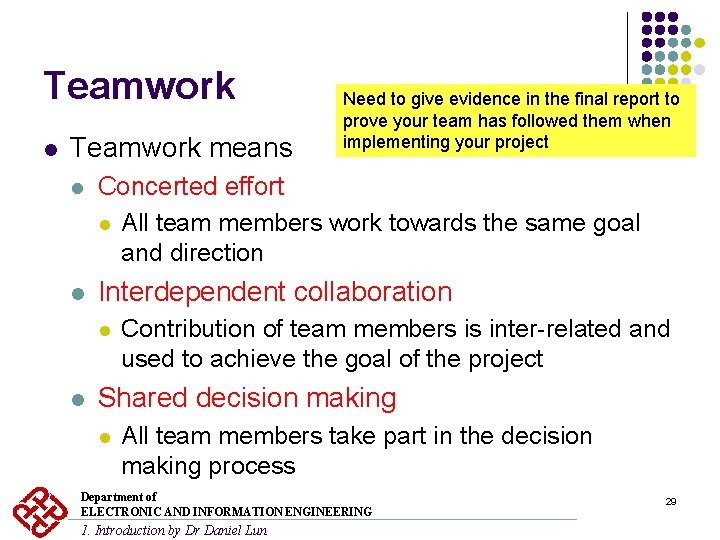
Teamwork l Teamwork means Need to give evidence in the final report to prove your team has followed them when implementing your project l Concerted effort l All team members work towards the same goal and direction l Interdependent collaboration l l Contribution of team members is inter-related and used to achieve the goal of the project Shared decision making l All team members take part in the decision making process Department of ELECTRONIC AND INFORMATION ENGINEERING 1. Introduction by Dr Daniel Lun 29
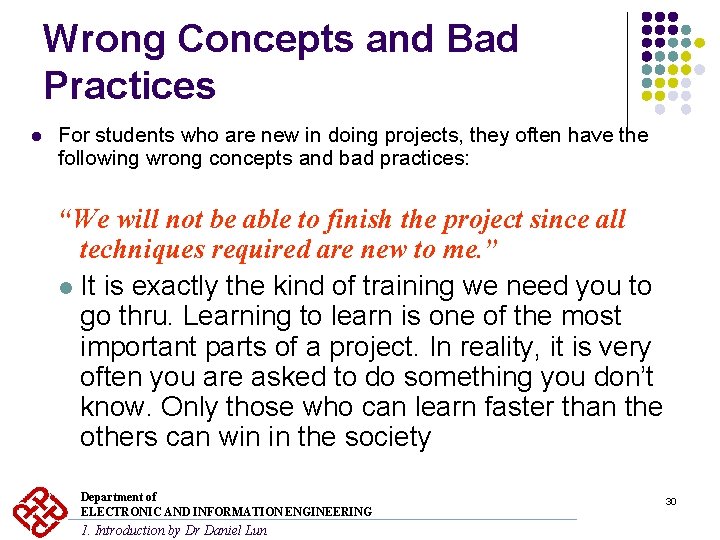
Wrong Concepts and Bad Practices l For students who are new in doing projects, they often have the following wrong concepts and bad practices: “We will not be able to finish the project since all techniques required are new to me. ” l It is exactly the kind of training we need you to go thru. Learning to learn is one of the most important parts of a project. In reality, it is very often you are asked to do something you don’t know. Only those who can learn faster than the others can win in the society Department of ELECTRONIC AND INFORMATION ENGINEERING 1. Introduction by Dr Daniel Lun 30
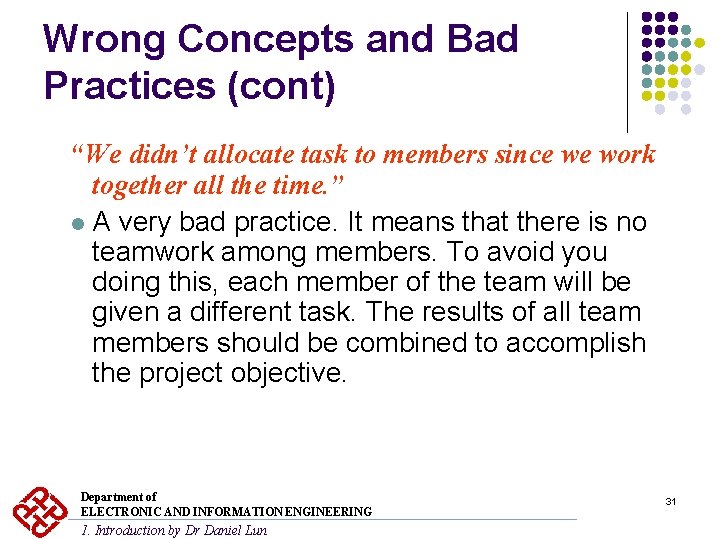
Wrong Concepts and Bad Practices (cont) “We didn’t allocate task to members since we work together all the time. ” l A very bad practice. It means that there is no teamwork among members. To avoid you doing this, each member of the team will be given a different task. The results of all team members should be combined to accomplish the project objective. Department of ELECTRONIC AND INFORMATION ENGINEERING 1. Introduction by Dr Daniel Lun 31
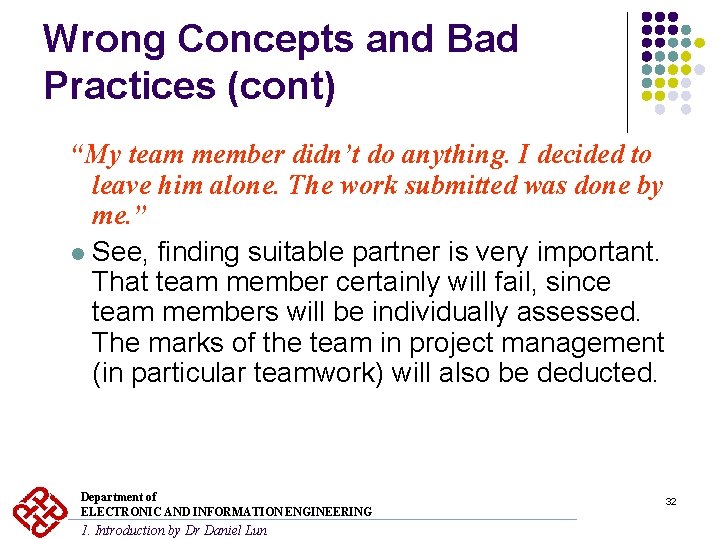
Wrong Concepts and Bad Practices (cont) “My team member didn’t do anything. I decided to leave him alone. The work submitted was done by me. ” l See, finding suitable partner is very important. That team member certainly will fail, since team members will be individually assessed. The marks of the team in project management (in particular teamwork) will also be deducted. Department of ELECTRONIC AND INFORMATION ENGINEERING 1. Introduction by Dr Daniel Lun 32
Wrong Concepts and Bad Practices (cont) “Our team was very busy in many different things so we skipped all the tutorials, lab works and demos. But we managed to use the last few days to finish everything and made a good demo of our game in the Final Demo. ” l Assume that you are doing this project for your customer. If I were the customer of your project, I would never hire your team to do project again! All customers want to see both progress and result. So your marks in project management will be deducted. Department of ELECTRONIC AND INFORMATION ENGINEERING 1. Introduction by Dr Daniel Lun 33
Wrong Concepts and Bad Practices (cont) “Time is limited in doing this project. If I have more time, I can do it much better. ” l It is exactly the objective of the subject to provide training to students on time management. Bear in mind that the subject does not ask you to achieve a perfect result, but a satisfactory result within a time limit. Only those who have good time management skill can get good grade in this subject. Department of ELECTRONIC AND INFORMATION ENGINEERING 1. Introduction by Dr Daniel Lun 34
Some Advices on Problem Solving l People like to solve problem based on its symptom and try to remove the symptom l l l Following the philosophy of western medicine, if you have headache, you will be given a Panadol to remove the headache It works sometimes but not always. Sometimes removing the symptom may just let the real problem (can be big problem) unable to be discovered Have we ever taken time to think of the reason behind the problem and try to really solve it? l l Sometimes you can find out the reason, sometimes you cannot But it is still worth a try Department of ELECTRONIC AND INFORMATION ENGINEERING 1. Introduction by Dr Daniel Lun 35
Some Advices on Problem Solving (cont) l When finding the reasons of a problem, don’t ignore any small abnormality in the course of project development l l Particularly in software development, even a small bug can bite you hardly, and perhaps at the most crucial time! Of course, if there is no hope to solve the problems, looking for tricks to get around them is still a good solution Department of ELECTRONIC AND INFORMATION ENGINEERING 1. Introduction by Dr Daniel Lun 36