
INTEGRATED PEST MANAGEMENT IN FAMILY CHILD CARE HOMES








- Slides: 37
INTEGRATED PEST MANAGEMENT IN FAMILY CHILD CARE HOMES University of California, San Francisco (UCSF) School of Nursing California Childcare Health Program (CCHP) Funded by California Department of Pesticide Regulation (DPR) 1
ICEBREAKER QUESTIONS 1. What’s your name? 2. What’s the pest that bothers you the most? © UCSF CCHP 2016 3. What would you like to learn from today’s workshop? 2
ALLIANCE TEAM PARTNERS Funding for this project has been provided in full or in part through a grant awarded by the California Department of Pesticide Regulation (DPR). The contents of this document do not necessarily reflect the views and policies of DPR nor does mention of trade names or commercial products constitute endorsement or recommendation for use. 3
To reduce the exposure of pesticides for young children in family child care homes. © UCSF CCHP 2016 • Protect children’s health • Protect the health of providers and family members • Protect the environment 4
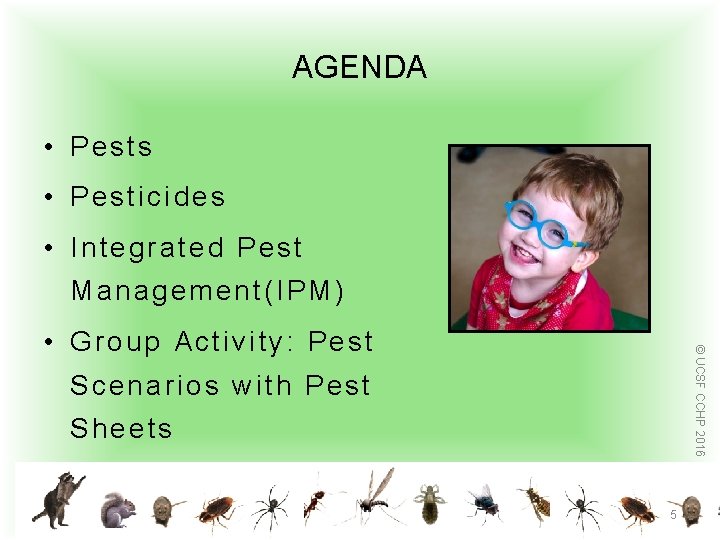
AGENDA • Pests • Pesticides • Integrated Pest Management(IPM) © UCSF CCHP 2016 • Group Activity: Pest Scenarios with Pest Sheets 5
WHAT IS A PEST? © UCSF CCHP 2016 A pest is any living organism that causes damage or discomfort, or transmits or produces disease. 6
WHAT ARE THE MOST COMMON INDOOR PESTS IN CALIFORNIA CHILD CARE CENTERS? 7 © UCSF CCHP 2016 Bradman, A. , Dobson, C. , Leonard, V. & Messenger, B. (2010). Pest Management and Pesticide Use in California Child Care Centers, Center for Children’ s Environmental Health Research, School of Public Health, UC Berkeley at apps. cdpr. ca. gov/schoolipm/childcare/pest_mgt_childcare. pdf.
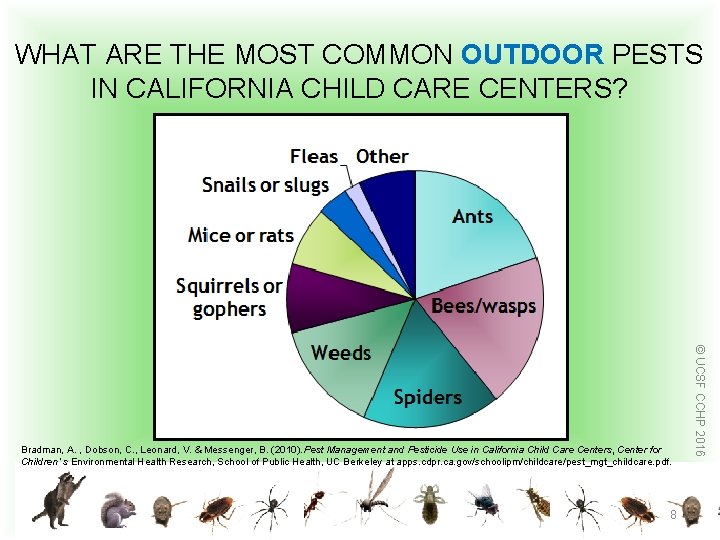
WHAT ARE THE MOST COMMON OUTDOOR PESTS IN CALIFORNIA CHILD CARE CENTERS? 8 © UCSF CCHP 2016 Bradman, A. , Dobson, C. , Leonard, V. & Messenger, B. (2010). Pest Management and Pesticide Use in California Child Care Centers, Center for Children’ s Environmental Health Research, School of Public Health, UC Berkeley at apps. cdpr. ca. gov/schoolipm/childcare/pest_mgt_childcare. pdf.
WHAT PROBLEMS DO PESTS CAUSE? • Health problems • Damage to your home • Discomfort Spread Bacteria © UCSF CCHP 2016 Rats Eat Wires Allergies & Asthma 9
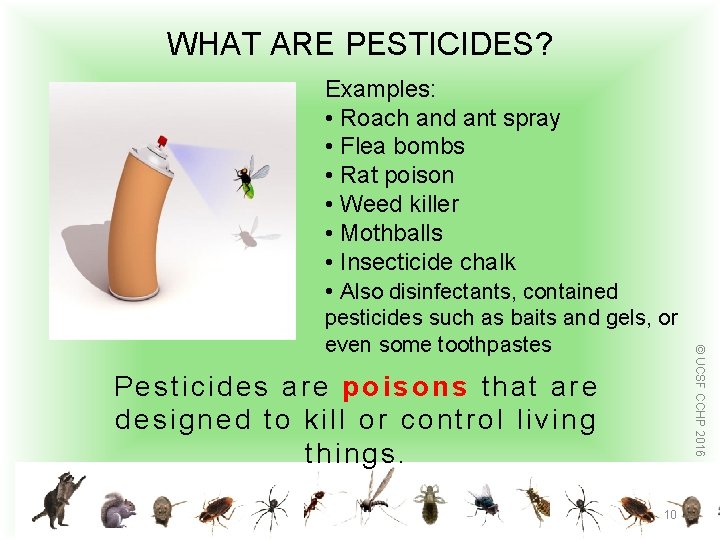
WHAT ARE PESTICIDES? Examples: • Roach and ant spray • Flea bombs • Rat poison • Weed killer • Mothballs • Insecticide chalk • Also disinfectants, contained Pesticides are poisons that are designed to kill or control living things. 10 © UCSF CCHP 2016 pesticides such as baits and gels, or even some toothpastes
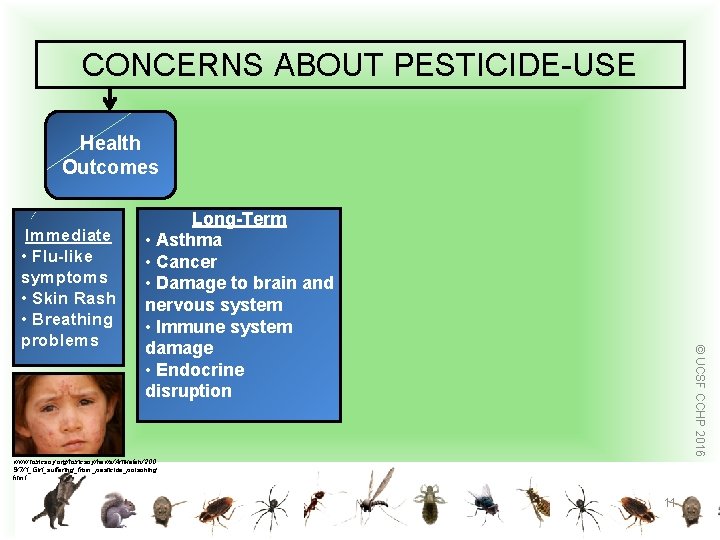
CONCERNS ABOUT PESTICIDE-USE Health Outcomes © UCSF CCHP 2016 Immediate • Flu-like symptoms • Skin Rash • Breathing problems Long-Term • Asthma • Cancer • Damage to brain and nervous system • Immune system damage • Endocrine disruption www. toxicsoy. org/toxicsoy/news/Artikelen/200 9/7/1_Girl_suffering_from_pesticide_poisoning. html 11
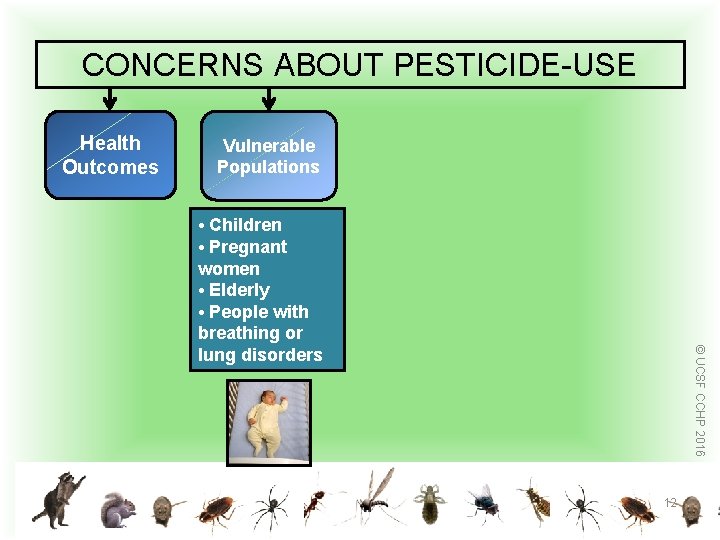
CONCERNS ABOUT PESTICIDE-USE Health Outcomes Vulnerable Populations © UCSF CCHP 2016 • Children • Pregnant women • Elderly • People with breathing or lung disorders 12
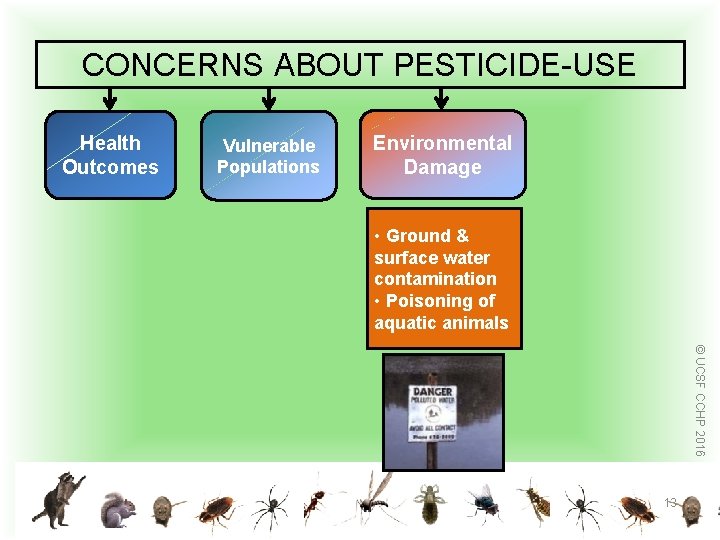
CONCERNS ABOUT PESTICIDE-USE Health Outcomes Vulnerable Populations Environmental Damage • Ground & surface water contamination • Poisoning of aquatic animals © UCSF CCHP 2016 13
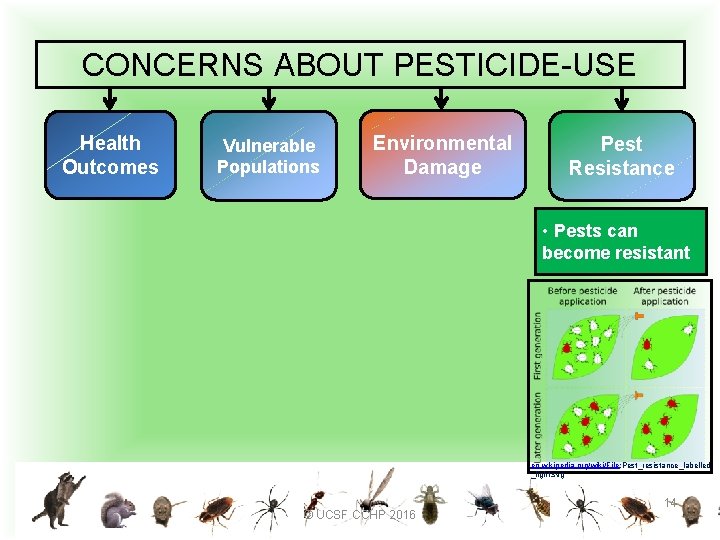
CONCERNS ABOUT PESTICIDE-USE Health Outcomes Vulnerable Populations Environmental Damage Pest Resistance • Pests can become resistant en. wikipedia. org/wiki/File: Pest_resistance_labelled _light. svg © UCSF CCHP 2016 14
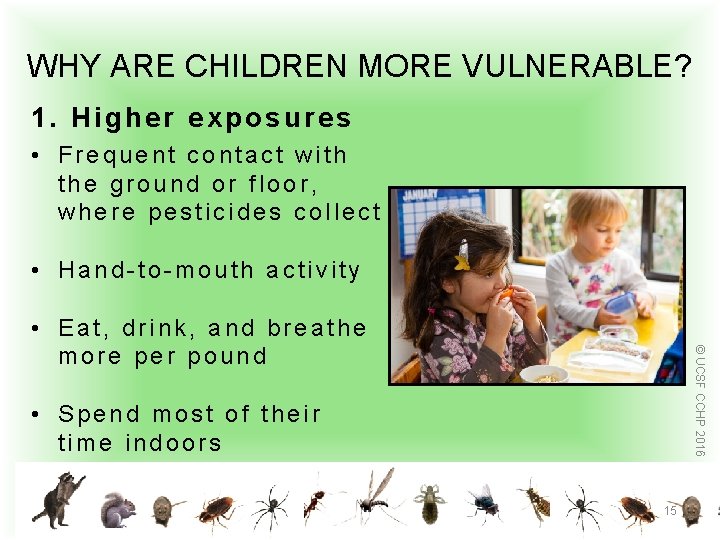
WHY ARE CHILDREN MORE VULNERABLE? 1. Higher exposures • Frequent contact with the ground or floor, where pesticides collect • Hand-to-mouth activity © UCSF CCHP 2016 • Eat, drink, and breathe more per pound • Spend most of their time indoors 15
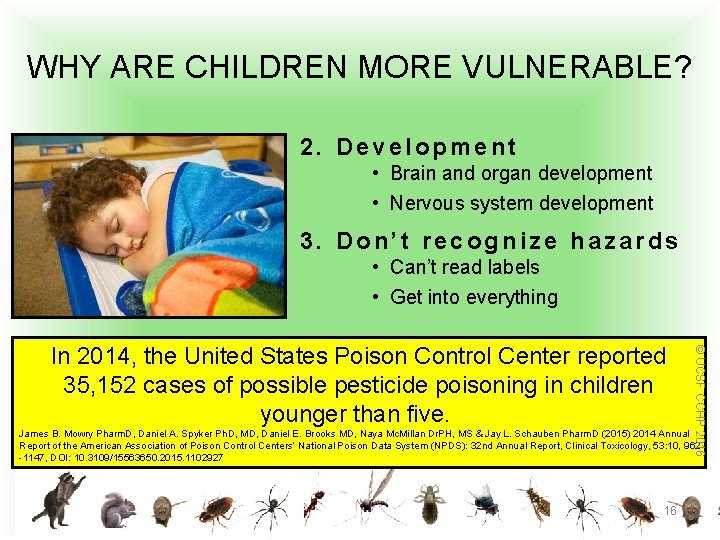
WHY ARE CHILDREN MORE VULNERABLE? 2. Development • Brain and organ development • Nervous system development 3. Don’t recognize hazards • Can’t read labels • Get into everything © UCSF CCHP 2016 In 2014, the United States Poison Control Center reported 35, 152 cases of possible pesticide poisoning in children younger than five. James B. Mowry Pharm. D, Daniel A. Spyker Ph. D, MD, Daniel E. Brooks MD, Naya Mc. Millan Dr. PH, MS & Jay L. Schauben Pharm. D (2015) 2014 Annual Report of the American Association of Poison Control Centers’ National Poison Data System (NPDS): 32 nd Annual Report, Clinical Toxicology, 53: 10, 962 -1147, DOI: 10. 3109/15563650. 2015. 1102927 16
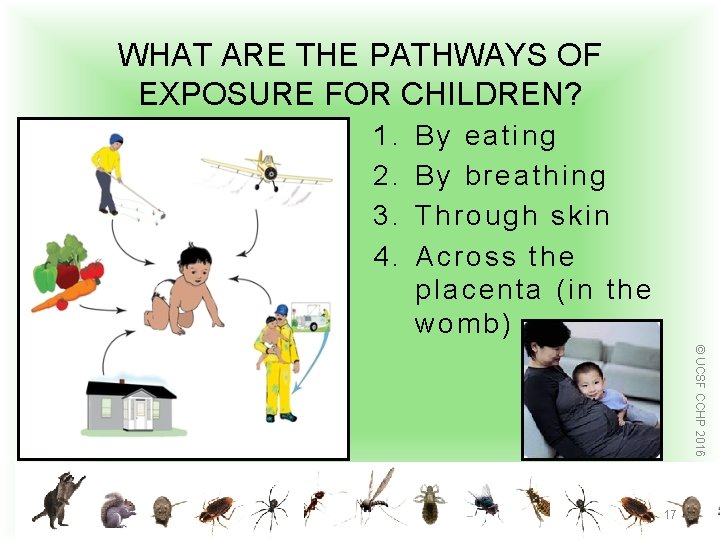
WHAT ARE THE PATHWAYS OF EXPOSURE FOR CHILDREN? 1. 2. 3. 4. By eating By breathing Through skin Across the placenta (in the womb) © UCSF CCHP 2016 17
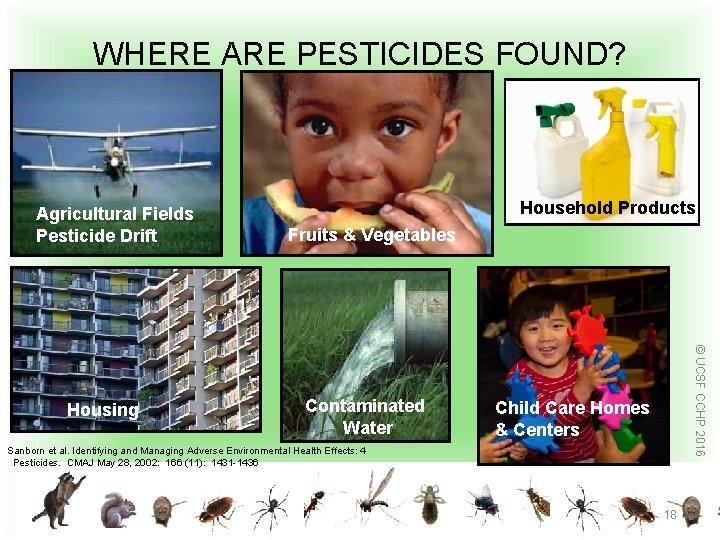
WHERE ARE PESTICIDES FOUND? Agricultural Fields Pesticide Drift Fruits & Vegetables Contaminated Water © UCSF CCHP 2016 Housing Household Products Child Care Homes & Centers Sanborn et al. Identifying and Managing Adverse Environmental Health Effects: 4 Pesticides. CMAJ May 28, 2002: 166 (11): 1431 -1436 18
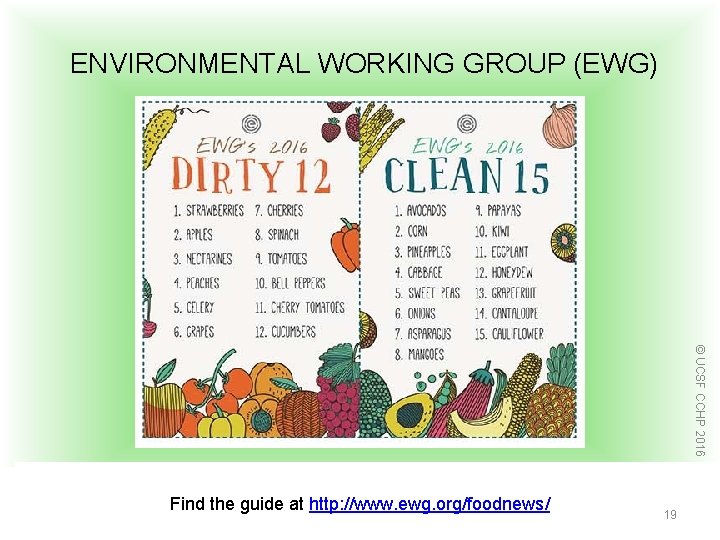
ENVIRONMENTAL WORKING GROUP (EWG) © UCSF CCHP 2016 Find the guide at http: //www. ewg. org/foodnews/ 19
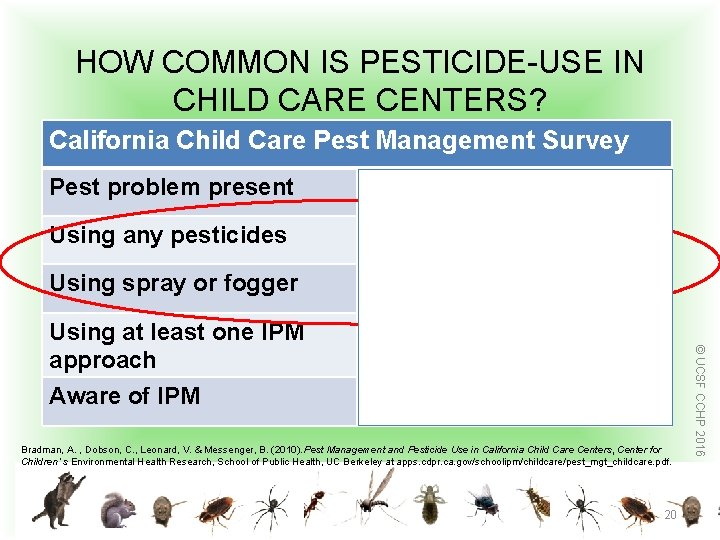
HOW COMMON IS PESTICIDE-USE IN CHILD CARE CENTERS? California Child Care Pest Management Survey 90% Using any pesticides 55% Using spray or fogger 47% Using at least one IPM approach Aware of IPM 65% 25% Bradman, A. , Dobson, C. , Leonard, V. & Messenger, B. (2010). Pest Management and Pesticide Use in California Child Care Centers, Center for Children’ s Environmental Health Research, School of Public Health, UC Berkeley at apps. cdpr. ca. gov/schoolipm/childcare/pest_mgt_childcare. pdf. 20 © UCSF CCHP 2016 Pest problem present
© UCSF CCHP 2016 www. youtube. com/watch? v=w. Eh 2 dl 36 i. ME&index=1&list=PLg. U 4 s. A 8 Hr. Ufrrhe. C 4 r. NNg. B 1 ou 7 Jlnp. Kv. P 21
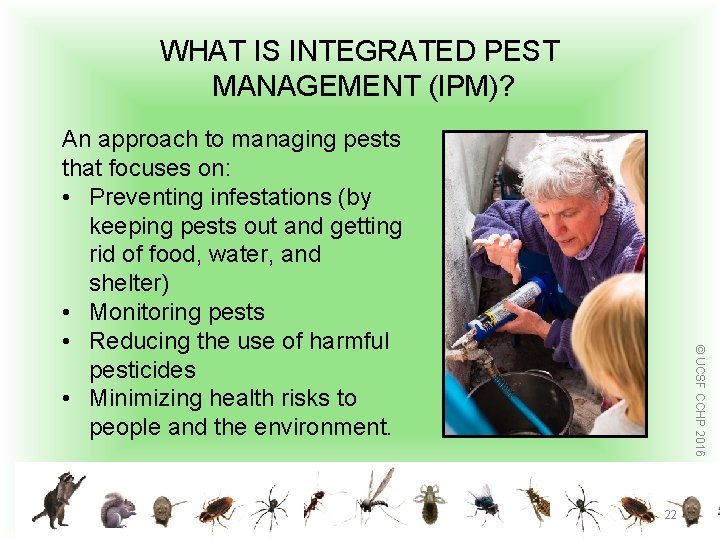
WHAT IS INTEGRATED PEST MANAGEMENT (IPM)? © UCSF CCHP 2016 An approach to managing pests that focuses on: • Preventing infestations (by keeping pests out and getting rid of food, water, and shelter) • Monitoring pests • Reducing the use of harmful pesticides • Minimizing health risks to people and the environment. 22
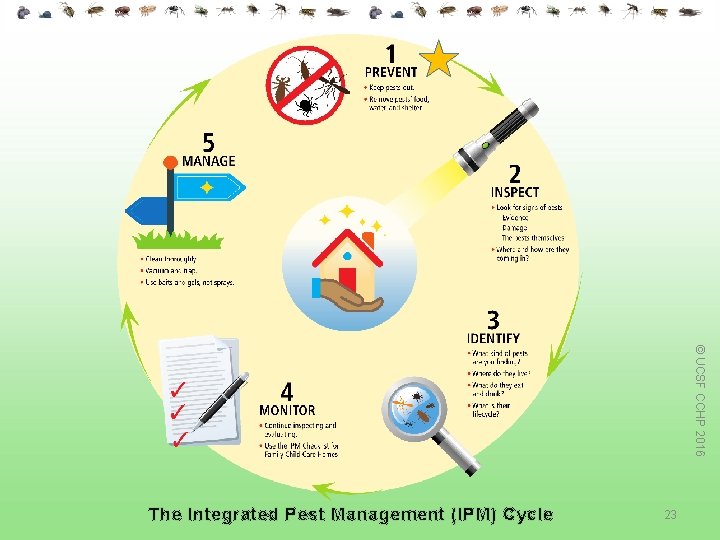
© UCSF CCHP 2016 The Integrated Pest Management (IPM) Cycle 23
PREVENTION: KEEP PESTS OUT Seal or block gaps around doors. Install doorsweeps. © UCSF CCHP 2016 Take home message: Close off entryways so pests can’t get into your home in the first place! Seal gaps around pipes Patch holes in screens 24
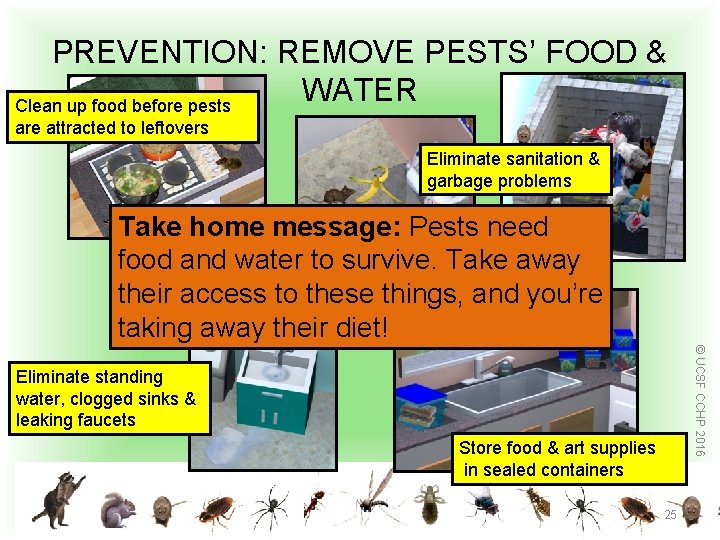
PREVENTION: REMOVE PESTS’ FOOD & WATER Clean up food before pests are attracted to leftovers Eliminate sanitation & garbage problems Take home message: Pests need food and water to survive. Take away their access to these things, and you’re taking away their diet! © UCSF CCHP 2016 Eliminate standing water, clogged sinks & leaking faucets Store food & art supplies in sealed containers 25
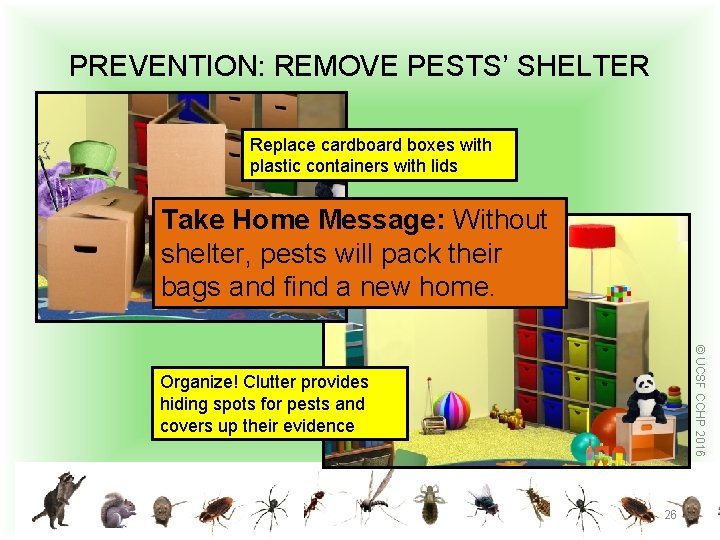
PREVENTION: REMOVE PESTS’ SHELTER Replace cardboard boxes with plastic containers with lids Take Home Message: Without shelter, pests will pack their bags and find a new home. © UCSF CCHP 2016 Organize! Clutter provides hiding spots for pests and covers up their evidence 26
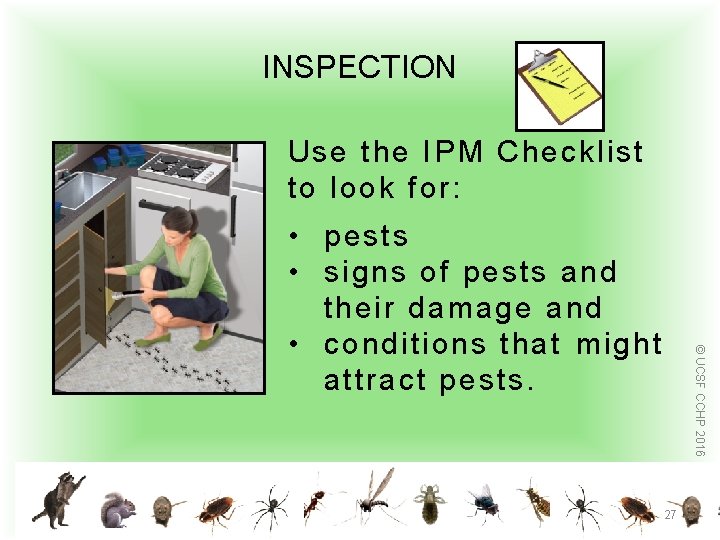
INSPECTION Use the IPM Ch eckli st to loo k f or: © UCSF CCHP 2016 • pests • sign s o f pe sts a n d their damage a nd • condit ions tha t mig h t attra ct pe sts. 27
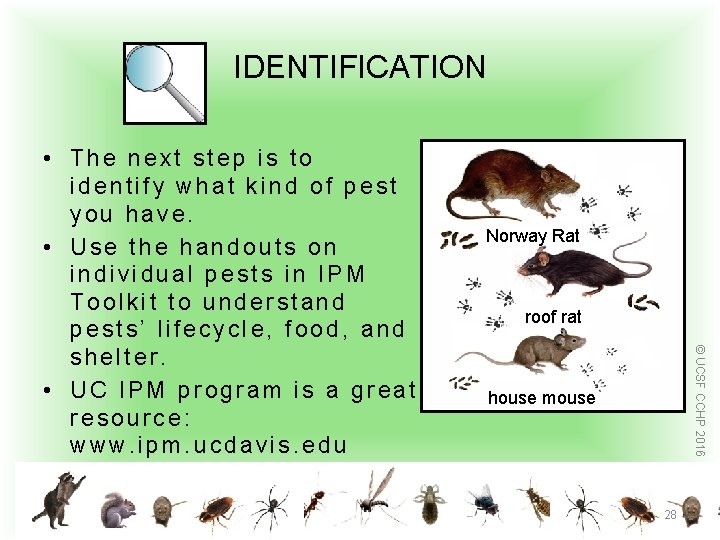
IDENTIFICATION Norway Rat roof rat © UCSF CCHP 2016 • The next step is to identify what kind of pest you have. • Use the handouts on individual pests in IPM Toolkit to understand pests’ lifecycle, food, and shelter. • UC IPM program is a great resource: www. ipm. ucdavis. edu house mouse 28
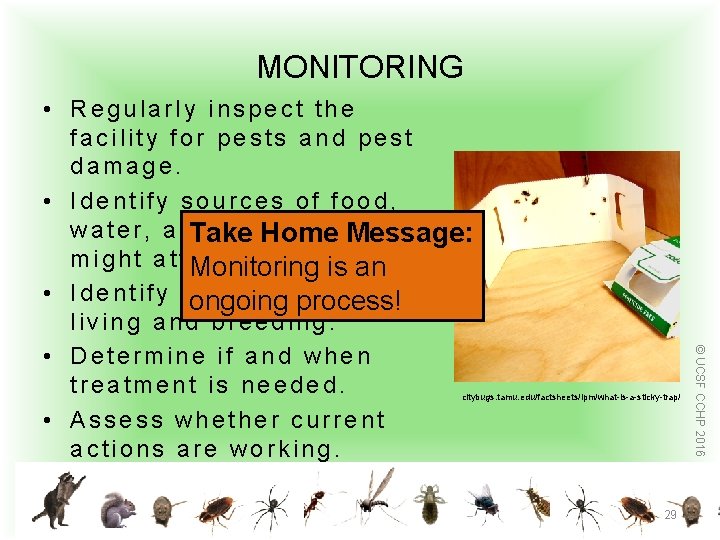
MONITORING citybugs. tamu. edu/factsheets/ipm/what-is-a-sticky-trap/ 29 © UCSF CCHP 2016 • Regularly inspect the facility for pests and pest damage. • Identify sources of food, w a t e r , a n. Take d s h e. Home l t e r t h. Message: at m i g h t a t t Monitoring is an ract pests. • I d e n t i f y wongoing process! here pests are living and breeding. • Determine if and when treatment is needed. • Assess whether current actions are working.
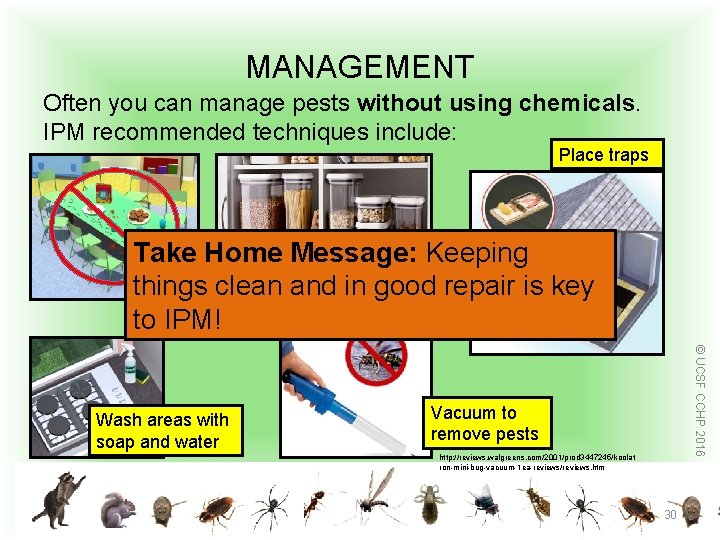
MANAGEMENT Often you can manage pests without using chemicals. IPM recommended techniques include: Place traps Take Home Message: Keeping things clean and in good repair is key Prevention to IPM! © UCSF CCHP 2016 Wash areas with soap and water Vacuum to remove pests http: //reviews. walgreens. com/2001/prod 3447245/koolat ron-mini-bug-vacuum-1 ea-reviews/reviews. htm 30
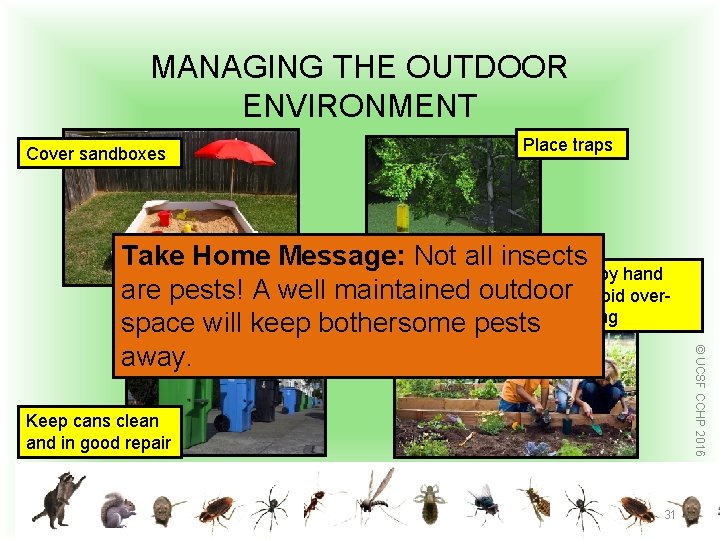
MANAGING THE OUTDOOR ENVIRONMENT Cover sandboxes Place traps Keep cans clean and in good repair 31 © UCSF CCHP 2016 Take Home Message: Not all insects Weed by hand are pests! A well maintained outdoor and avoid overspace will keep bothersome pests fertilizing away.
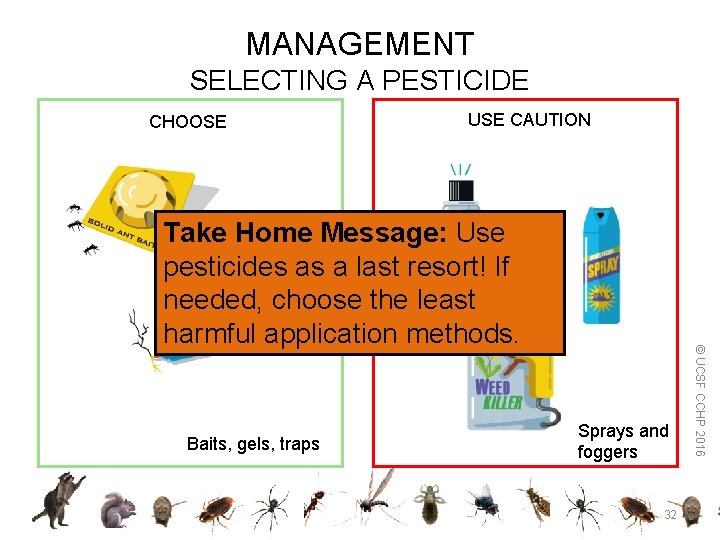
MANAGEMENT SELECTING A PESTICIDE CHOOSE USE CAUTION Baits, gels, traps Sprays and foggers 32 © UCSF CCHP 2016 Take Home Message: Use pesticides as a last resort! If needed, choose the least harmful application methods.
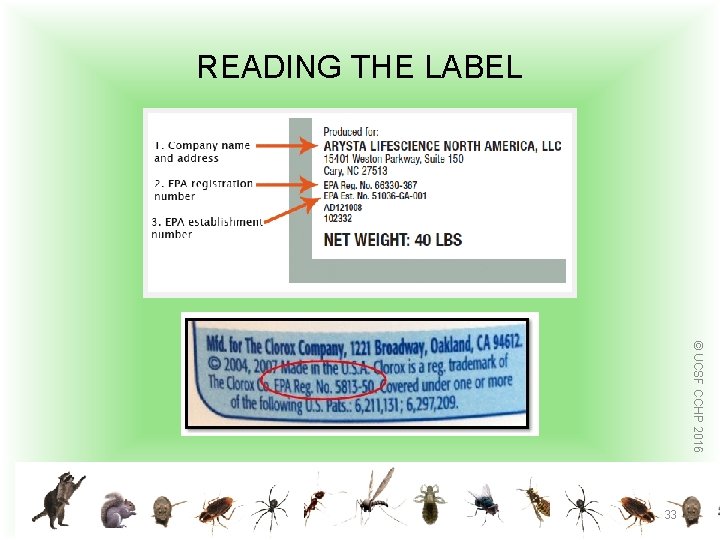
READING THE LABEL © UCSF CCHP 2016 33
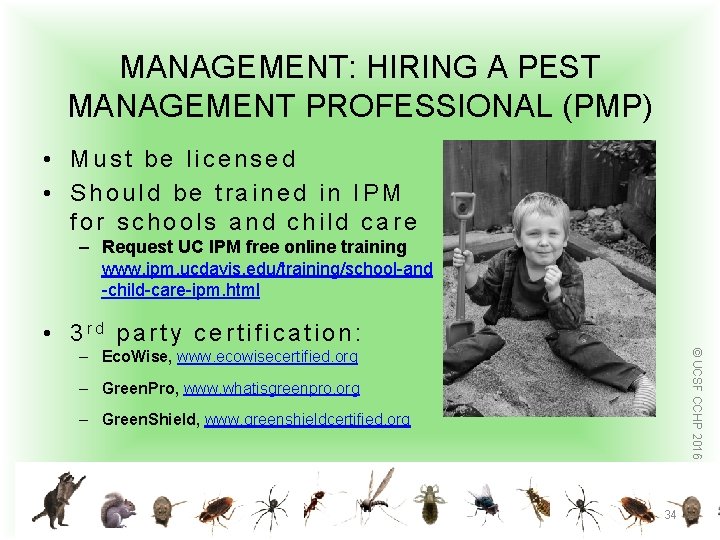
MANAGEMENT: HIRING A PEST MANAGEMENT PROFESSIONAL (PMP) • Must be licensed • Should be trained in IPM for schools and child care – Request UC IPM free online training www. ipm. ucdavis. edu/training/school-and -child-care-ipm. html • 3 rd party certification: © UCSF CCHP 2016 – Eco. Wise, www. ecowisecertified. org – Green. Pro, www. whatisgreenpro. org – Green. Shield, www. greenshieldcertified. org 34
KEY RESOURCES FOR IPM SUPPORT CA Department of Pesticide Regulation(DPR) “Growing Up Green” Child Care IPM: apps. cdpr. ca. gov/schoolipm/ childcare/ – You. Tube Video Series for Child Care Centers www. ipm. ucdavis. edu – Pest Sheets – Free Online Training for PMPs © UCSF CCHP 2016 – Free Online Healthy Schools Act IPM Training Courses UC Statewide Integrated Pest Management Program (UC IPM) 35
SMALL GROUP ACTIVITY Instructions: • Read pest scenario • Using the corresponding pest sheet, list the 5 Steps of IPM for that pest • Report back 5 Steps of IPM: • Prevent • Inspect • Identify • Monitor • Manage
CONTACT INFORMATION cchp. ucsf. edu Your Name Contact Information © UCSF CCHP 2016 UCSF Contact: Kimberly Hazard Project Coordinator, UCSF IPM Project Kimberly. Hazard@ucsf. edu 37