
Integrated optimization of toroidal magnetic fusion power plants
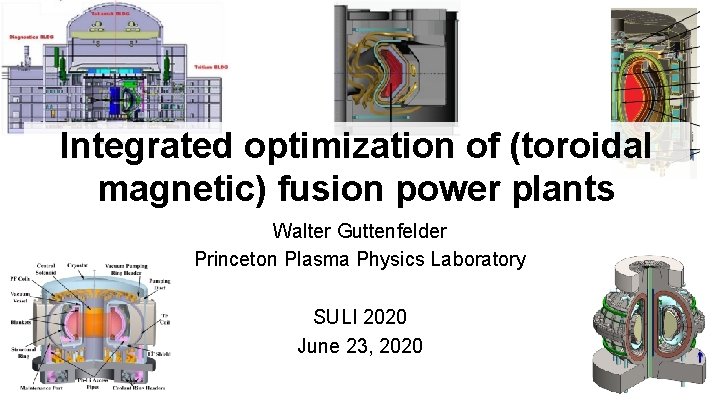
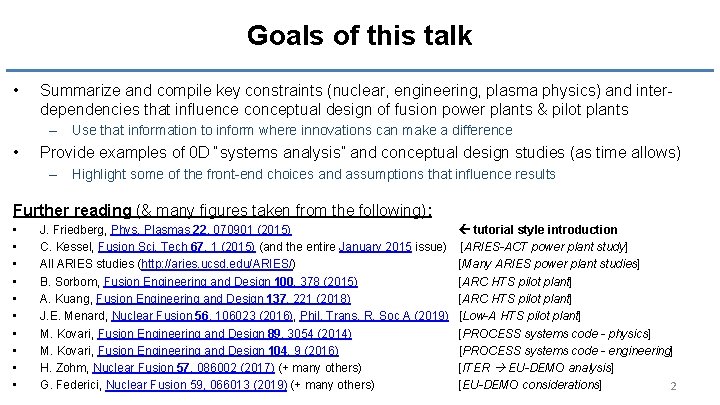
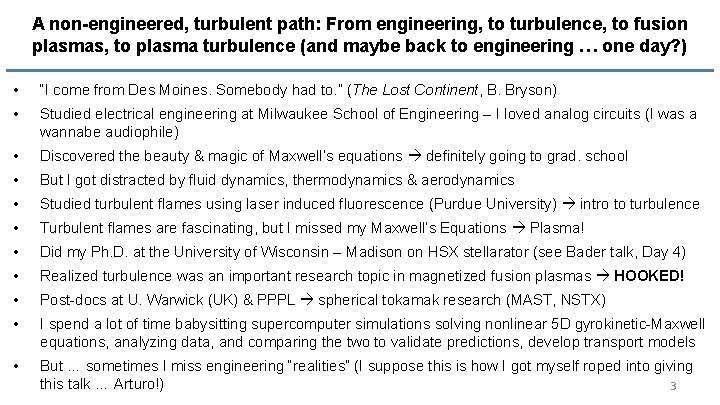
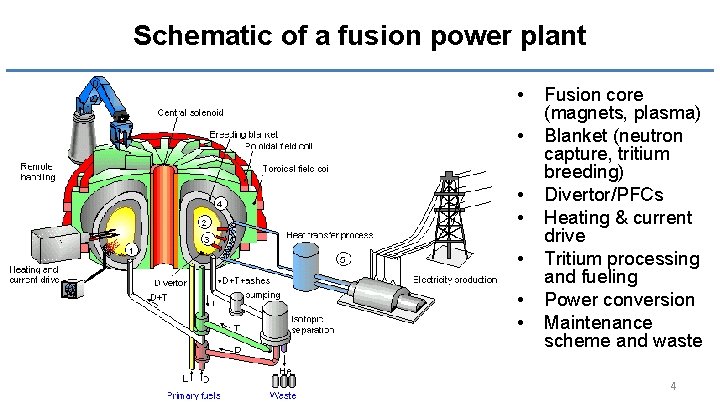
- Slides: 49
Integrated optimization of (toroidal magnetic) fusion power plants Walter Guttenfelder Princeton Plasma Physics Laboratory SULI 2020 June 23, 2020
Goals of this talk • Summarize and compile key constraints (nuclear, engineering, plasma physics) and interdependencies that influence conceptual design of fusion power plants & pilot plants – Use that information to inform where innovations can make a difference • Provide examples of 0 D “systems analysis” and conceptual design studies (as time allows) – Highlight some of the front-end choices and assumptions that influence results Further reading (& many figures taken from the following): • • • J. Friedberg, Phys. Plasmas 22, 070901 (2015) C. Kessel, Fusion Sci. Tech 67, 1 (2015) (and the entire January 2015 issue) All ARIES studies (http: //aries. ucsd. edu/ARIES/) B. Sorbom, Fusion Engineering and Design 100, 378 (2015) A. Kuang, Fusion Engineering and Design 137, 221 (2018) J. E. Menard, Nuclear Fusion 56, 106023 (2016), Phil. Trans. R. Soc A (2019) M. Kovari, Fusion Engineering and Design 89, 3054 (2014) M. Kovari, Fusion Engineering and Design 104, 9 (2016) H. Zohm, Nuclear Fusion 57, 086002 (2017) (+ many others) G. Federici, Nuclear Fusion 59, 066013 (2019) (+ many others) tutorial style introduction [ARIES-ACT power plant study] [Many ARIES power plant studies] [ARC HTS pilot plant] [Low-A HTS pilot plant] [PROCESS systems code - physics] [PROCESS systems code - engineering] [ITER EU-DEMO analysis] [EU-DEMO considerations] 2
A non-engineered, turbulent path: From engineering, to turbulence, to fusion plasmas, to plasma turbulence (and maybe back to engineering … one day? ) • “I come from Des Moines. Somebody had to. ” (The Lost Continent, B. Bryson) • Studied electrical engineering at Milwaukee School of Engineering – I loved analog circuits (I was a wannabe audiophile) • Discovered the beauty & magic of Maxwell’s equations definitely going to grad. school • But I got distracted by fluid dynamics, thermodynamics & aerodynamics • Studied turbulent flames using laser induced fluorescence (Purdue University) intro to turbulence • Turbulent flames are fascinating, but I missed my Maxwell’s Equations Plasma! • Did my Ph. D. at the University of Wisconsin – Madison on HSX stellarator (see Bader talk, Day 4) • Realized turbulence was an important research topic in magnetized fusion plasmas HOOKED! • Post-docs at U. Warwick (UK) & PPPL spherical tokamak research (MAST, NSTX) • I spend a lot of time babysitting supercomputer simulations solving nonlinear 5 D gyrokinetic-Maxwell equations, analyzing data, and comparing the two to validate predictions, develop transport models • But … sometimes I miss engineering “realities” (I suppose this is how I got myself roped into giving this talk … Arturo!) 3
Schematic of a fusion power plant • • Fusion core (magnets, plasma) Blanket (neutron capture, tritium breeding) Divertor/PFCs Heating & current drive Tritium processing and fueling Power conversion Maintenance scheme and waste 4
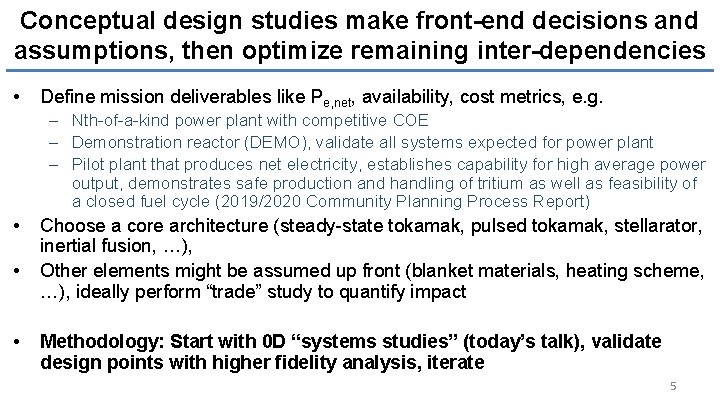
Conceptual design studies make front-end decisions and assumptions, then optimize remaining inter-dependencies • Define mission deliverables like Pe, net, availability, cost metrics, e. g. – Nth-of-a-kind power plant with competitive COE – Demonstration reactor (DEMO), validate all systems expected for power plant – Pilot plant that produces net electricity, establishes capability for high average power output, demonstrates safe production and handling of tritium as well as feasibility of a closed fuel cycle (2019/2020 Community Planning Process Report) • • • Choose a core architecture (steady-state tokamak, pulsed tokamak, stellarator, inertial fusion, …), Other elements might be assumed up front (blanket materials, heating scheme, …), ideally perform “trade” study to quantify impact Methodology: Start with 0 D “systems studies” (today’s talk), validate design points with higher fidelity analysis, iterate 5
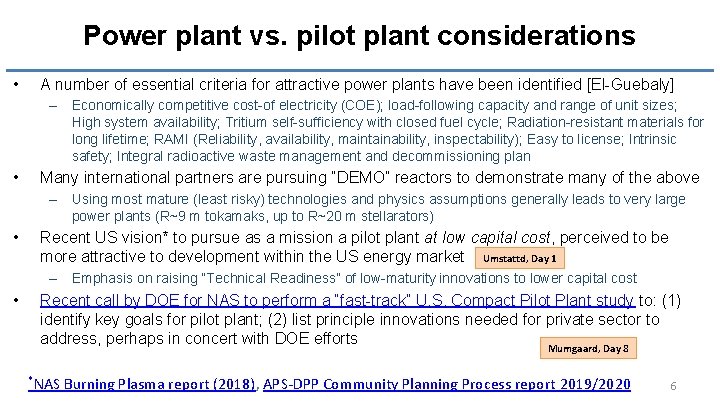
Power plant vs. pilot plant considerations • A number of essential criteria for attractive power plants have been identified [El-Guebaly] – Economically competitive cost-of electricity (COE); load-following capacity and range of unit sizes; High system availability; Tritium self-sufficiency with closed fuel cycle; Radiation-resistant materials for long lifetime; RAMI (Reliability, availability, maintainability, inspectability); Easy to license; Intrinsic safety; Integral radioactive waste management and decommissioning plan • Many international partners are pursuing “DEMO” reactors to demonstrate many of the above – Using most mature (least risky) technologies and physics assumptions generally leads to very large power plants (R~9 m tokamaks, up to R~20 m stellarators) • Recent US vision* to pursue as a mission a pilot plant at low capital cost, perceived to be more attractive to development within the US energy market Umstattd, Day 1 – Emphasis on raising “Technical Readiness” of low-maturity innovations to lower capital cost • Recent call by DOE for NAS to perform a “fast-track” U. S. Compact Pilot Plant study to: (1) identify key goals for pilot plant; (2) list principle innovations needed for private sector to address, perhaps in concert with DOE efforts Mumgaard, Day 8 *NAS Burning Plasma report (2018), APS-DPP Community Planning Process report 2019/2020 6
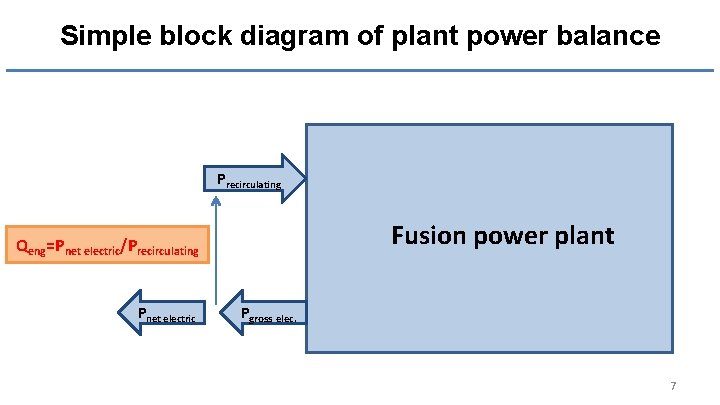
Simple block diagram of plant power balance Precirculating Fusion power plant Qeng=Pnet electric/Precirculating Pnet electric Pgross elec. 7
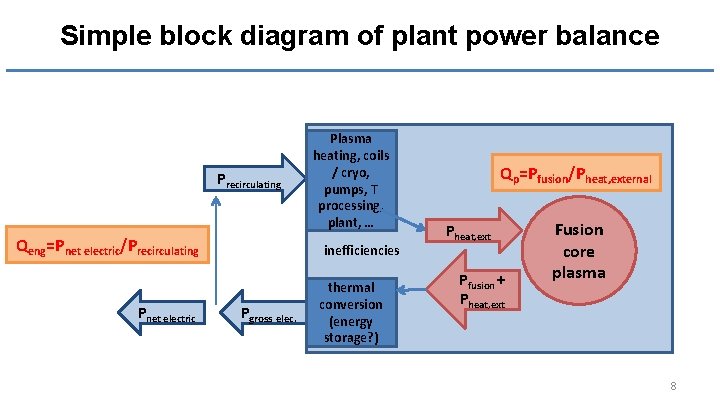
Simple block diagram of plant power balance Precirculating Qeng=Pnet electric/Precirculating Pnet electric Plasma heating, coils / cryo, pumps, T processing, plant, … inefficiencies Pgross elec. thermal conversion (energy storage? ) Qp=Pfusion/Pheat, external Pheat, ext Pfusion + Pheat, ext Fusion core plasma 8
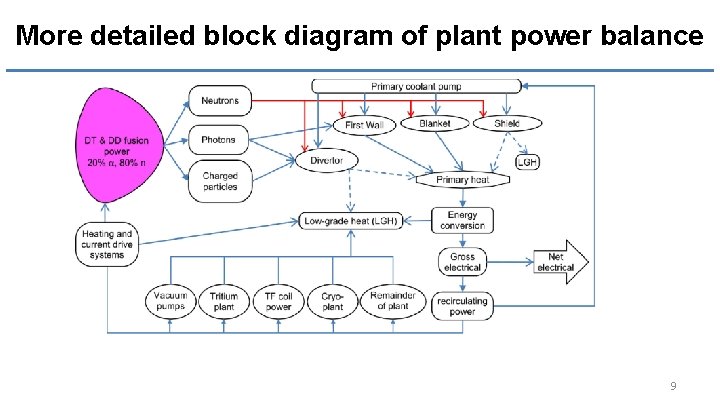
More detailed block diagram of plant power balance 9
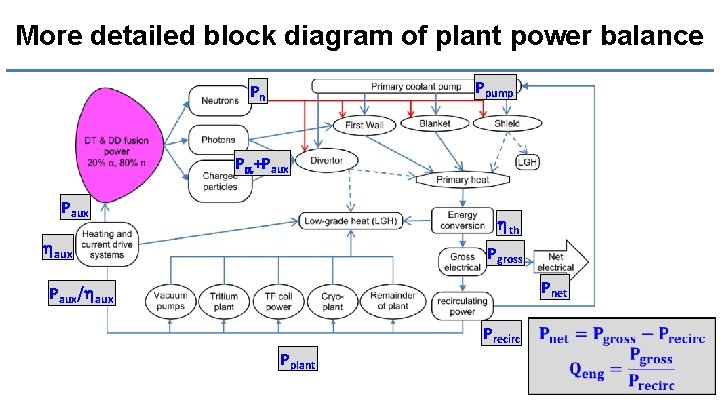
More detailed block diagram of plant power balance Ppump Pn Pa+Paux hth haux Pgross Pnet Paux/haux Precirc Pplant 10
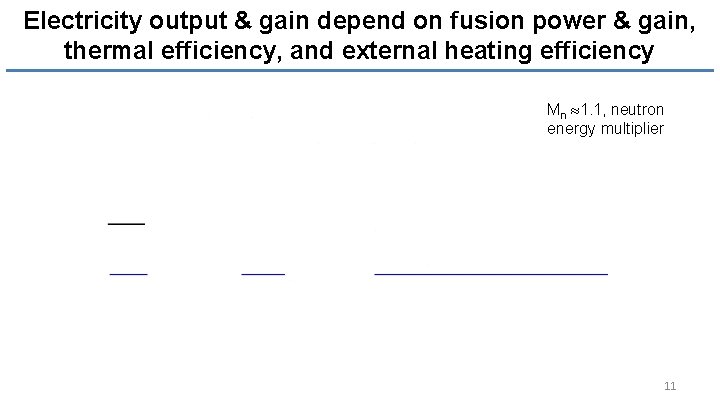
Electricity output & gain depend on fusion power & gain, thermal efficiency, and external heating efficiency Mn 1. 1, neutron energy multiplier 11
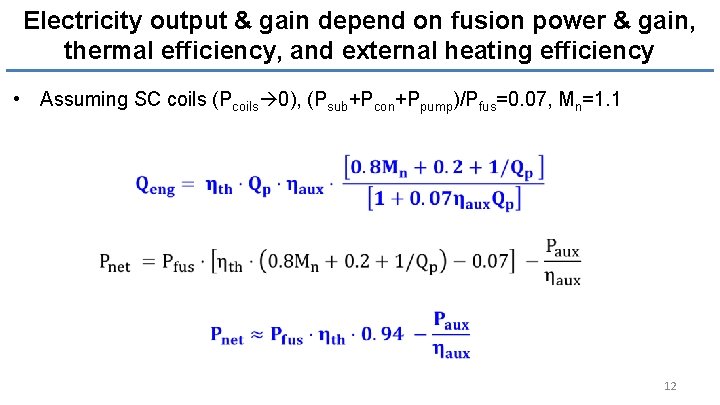
Electricity output & gain depend on fusion power & gain, thermal efficiency, and external heating efficiency • Assuming SC coils (Pcoils 0), (Psub+Pcon+Ppump)/Pfus=0. 07, Mn=1. 1 12
Cost-of-electricity (COE) and capital cost are also of great interest • Not considering cost metrics here (quantitatively) • There have been multiple attempts to quantify Nth-of-a-kind power plant COE, depending on: – – – Capital cost (generally expect $$$ ~ volume or mass) + “learning curve” Construction, licensing and operating costs Availability Waste disposal Contingency • Capital cost & development costs driven by risks & unknowns, complexity, engineering, design, prototyping hard to quantify 13
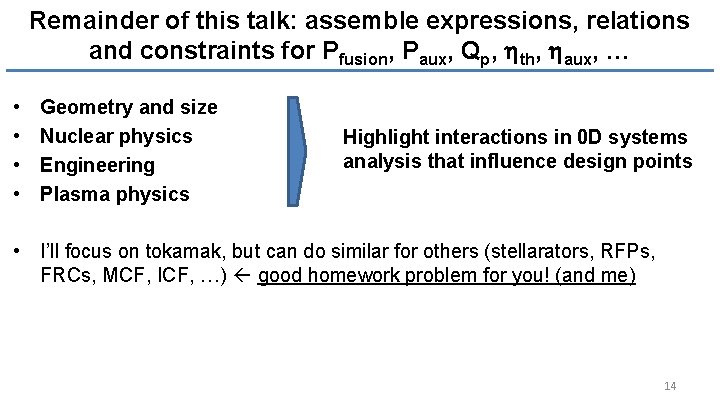
Remainder of this talk: assemble expressions, relations and constraints for Pfusion, Paux, Qp, hth, haux, … • • Geometry and size Nuclear physics Engineering Plasma physics Highlight interactions in 0 D systems analysis that influence design points • I’ll focus on tokamak, but can do similar for others (stellarators, RFPs, FRCs, MCF, ICF, …) good homework problem for you! (and me) 14
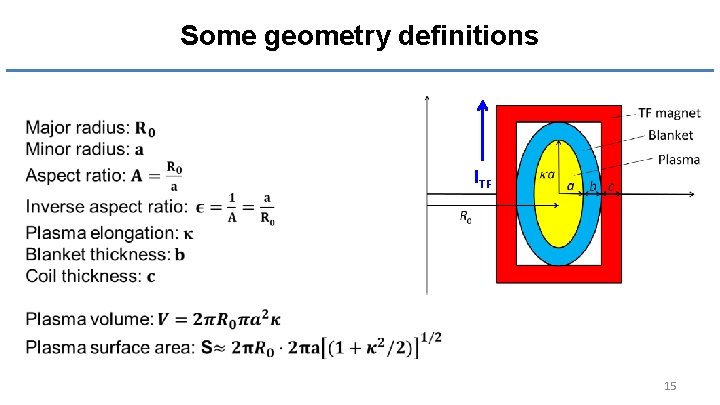
Some geometry definitions ITF 15
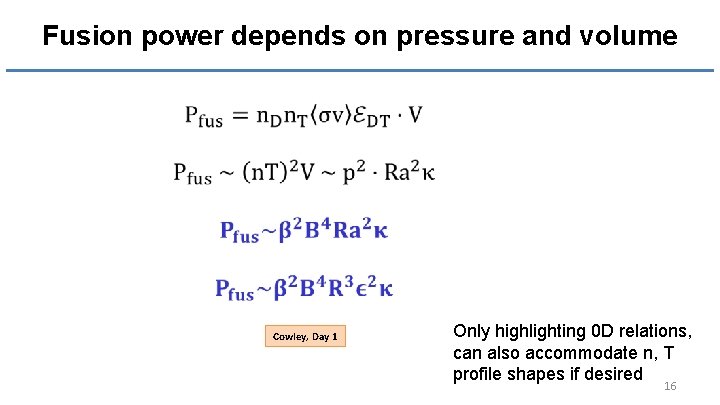
Fusion power depends on pressure and volume Cowley, Day 1 Only highlighting 0 D relations, can also accommodate n, T profile shapes if desired 16
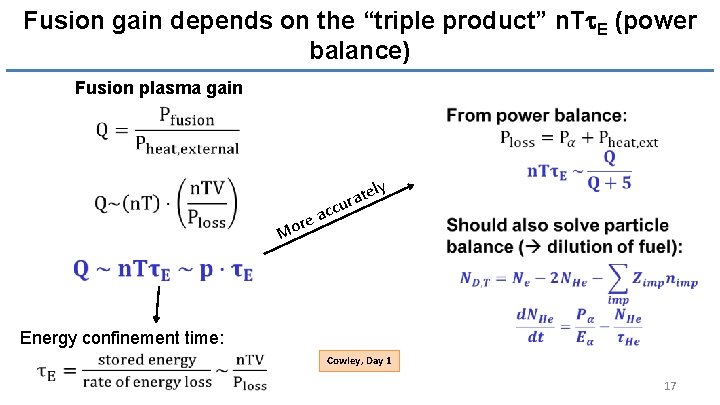
Fusion gain depends on the “triple product” n. Tt. E (power balance) Fusion plasma gain tely a r cu ac e r o M Energy confinement time: Cowley, Day 1 17
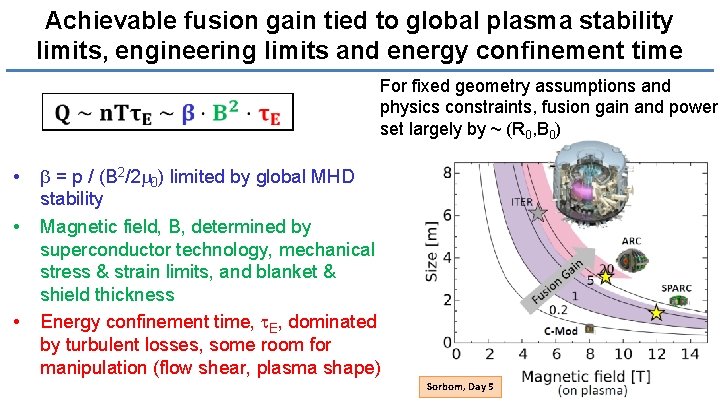
Achievable fusion gain tied to global plasma stability limits, engineering limits and energy confinement time For fixed geometry assumptions and physics constraints, fusion gain and power set largely by ~ (R 0, B 0) • • • b = p / (B 2/2 m 0) limited by global MHD stability Magnetic field, B, determined by superconductor technology, mechanical stress & strain limits, and blanket & shield thickness Energy confinement time, t. E, dominated by turbulent losses, some room for manipulation (flow shear, plasma shape) Sorbom, Day 5 18
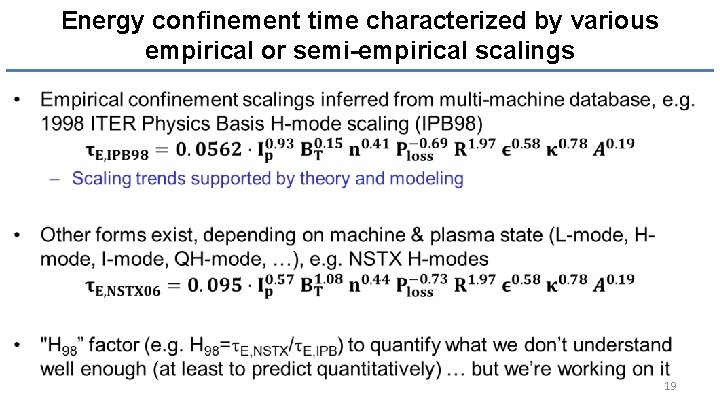
Energy confinement time characterized by various empirical or semi-empirical scalings • 19
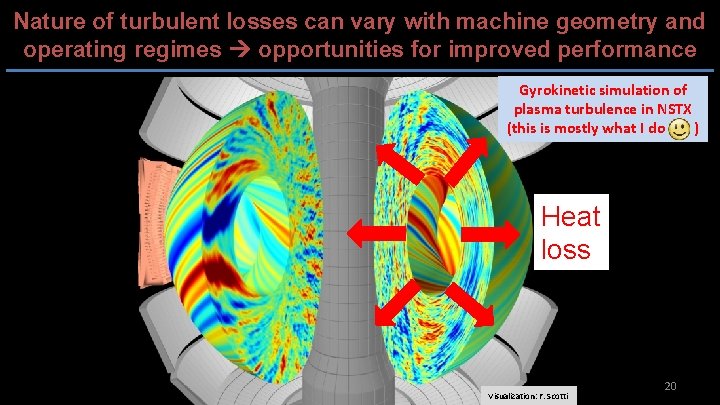
Nature of turbulent losses can vary with machine geometry and operating regimes opportunities for improved performance Gyrokinetic simulation of plasma turbulence in NSTX (this is mostly what I do ) Heat loss Visualization: F. Scotti 20
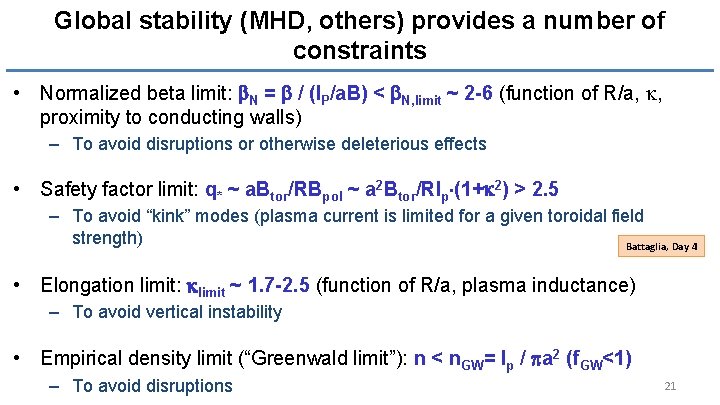
Global stability (MHD, others) provides a number of constraints • Normalized beta limit: b. N = b / (IP/a. B) < b. N, limit ~ 2 -6 (function of R/a, k, proximity to conducting walls) – To avoid disruptions or otherwise deleterious effects • Safety factor limit: q* ~ a. Btor/RBpol ~ a 2 Btor/RIp (1+k 2) > 2. 5 – To avoid “kink” modes (plasma current is limited for a given toroidal field strength) Battaglia, Day 4 • Elongation limit: klimit ~ 1. 7 -2. 5 (function of R/a, plasma inductance) – To avoid vertical instability • Empirical density limit (“Greenwald limit”): n < n. GW= Ip / pa 2 (f. GW<1) – To avoid disruptions 21
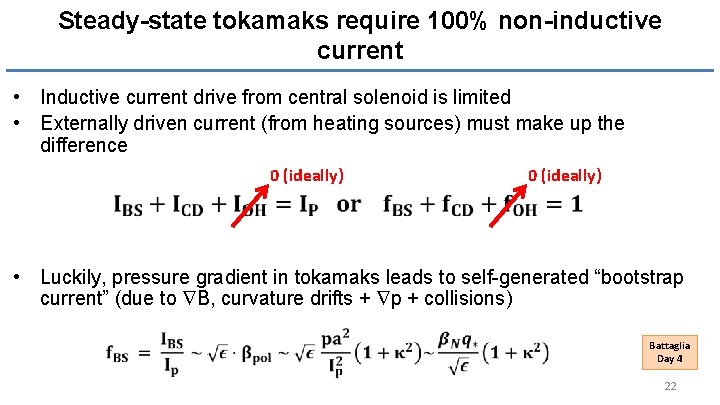
Steady-state tokamaks require 100% non-inductive current • Inductive current drive from central solenoid is limited • Externally driven current (from heating sources) must make up the difference 0 (ideally) • Luckily, pressure gradient in tokamaks leads to self-generated “bootstrap current” (due to B, curvature drifts + p + collisions) Battaglia Day 4 22
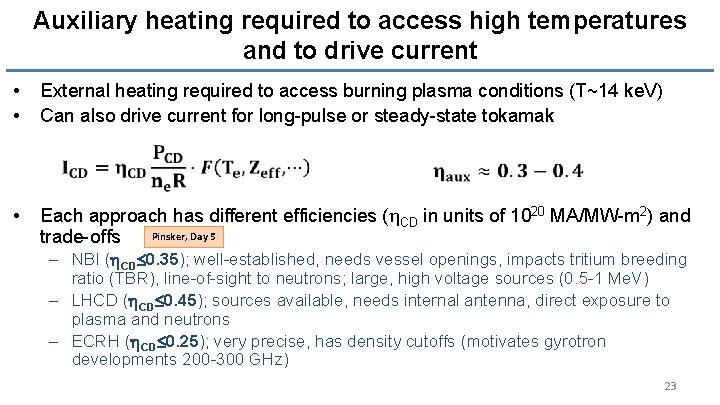
Auxiliary heating required to access high temperatures and to drive current • • External heating required to access burning plasma conditions (T~14 ke. V) Can also drive current for long-pulse or steady-state tokamak • Each approach has different efficiencies (h. CD in units of 1020 MA/MW-m 2) and Pinsker, Day 5 trade-offs – NBI (h. CD 0. 35); well-established, needs vessel openings, impacts tritium breeding ratio (TBR), line-of-sight to neutrons; large, high voltage sources (0. 5 -1 Me. V) – LHCD (h. CD 0. 45); sources available, needs internal antenna, direct exposure to plasma and neutrons – ECRH (h. CD 0. 25); very precise, has density cutoffs (motivates gyrotron developments 200 -300 GHz) 23
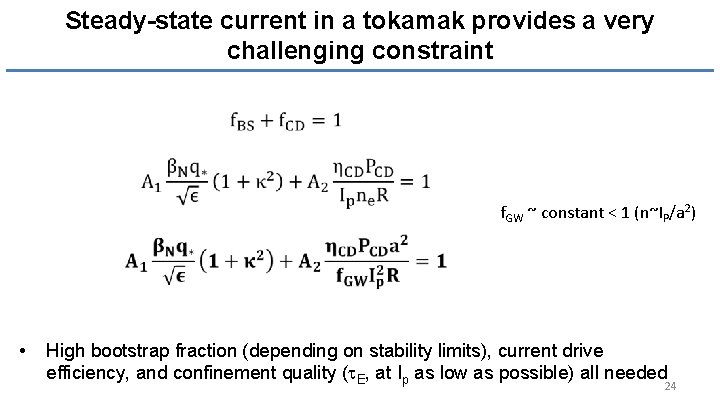
Steady-state current in a tokamak provides a very challenging constraint f. GW ~ constant < 1 (n~IP/a 2) • High bootstrap fraction (depending on stability limits), current drive efficiency, and confinement quality (t. E, at Ip as low as possible) all needed 24
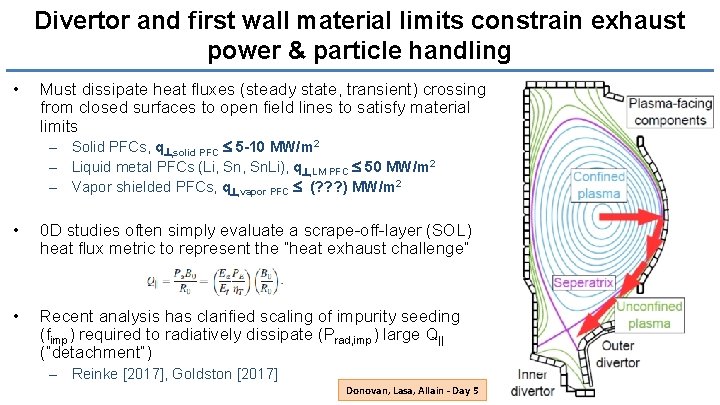
Divertor and first wall material limits constrain exhaust power & particle handling • Must dissipate heat fluxes (steady state, transient) crossing from closed surfaces to open field lines to satisfy material limits – Solid PFCs, q , solid PFC 5 -10 MW/m 2 – Liquid metal PFCs (Li, Sn. Li), q , LM PFC 50 MW/m 2 – Vapor shielded PFCs, q , vapor PFC (? ? ? ) MW/m 2 • 0 D studies often simply evaluate a scrape-off-layer (SOL) heat flux metric to represent the “heat exhaust challenge” • Recent analysis has clarified scaling of impurity seeding (fimp) required to radiatively dissipate (Prad, imp) large Q|| (“detachment”) – Reinke [2017], Goldston [2017] Donovan, Lasa, Allain - Day 5 25
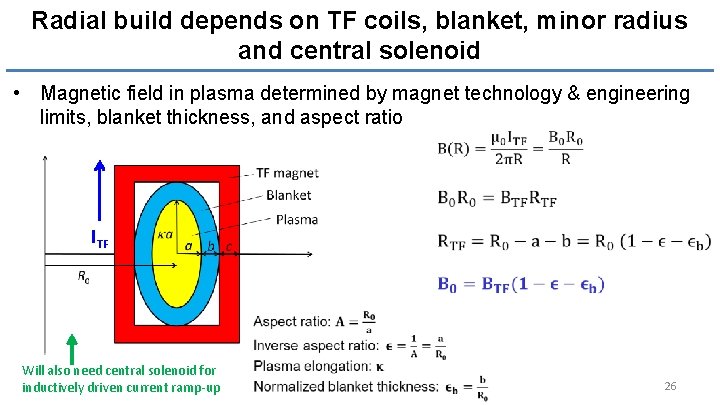
Radial build depends on TF coils, blanket, minor radius and central solenoid • Magnetic field in plasma determined by magnet technology & engineering limits, blanket thickness, and aspect ratio ITF Will also need central solenoid for inductively driven current ramp-up 26
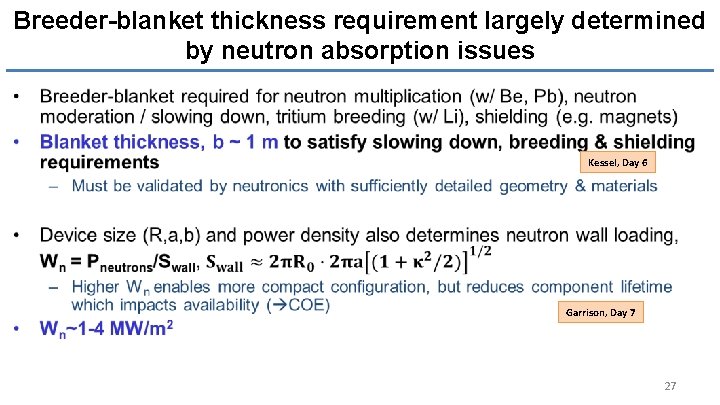
Breeder-blanket thickness requirement largely determined by neutron absorption issues • Kessel, Day 6 Garrison, Day 7 27
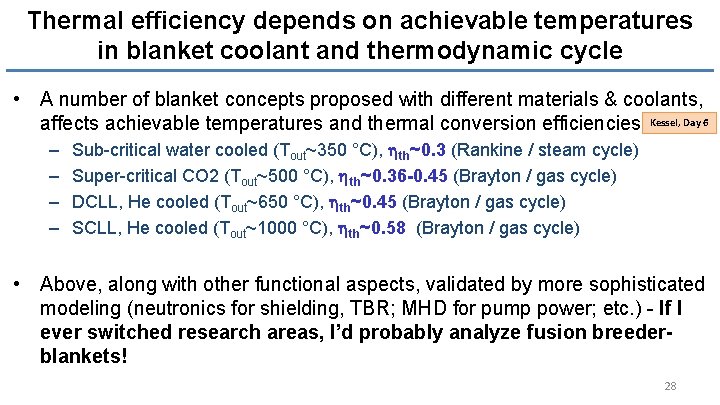
Thermal efficiency depends on achievable temperatures in blanket coolant and thermodynamic cycle • A number of blanket concepts proposed with different materials & coolants, affects achievable temperatures and thermal conversion efficiencies Kessel, Day 6 – – Sub-critical water cooled (Tout~350 °C), hth~0. 3 (Rankine / steam cycle) Super-critical CO 2 (Tout~500 °C), hth~0. 36 -0. 45 (Brayton / gas cycle) DCLL, He cooled (Tout~650 °C), hth~0. 45 (Brayton / gas cycle) SCLL, He cooled (Tout~1000 °C), hth~0. 58 (Brayton / gas cycle) • Above, along with other functional aspects, validated by more sophisticated modeling (neutronics for shielding, TBR; MHD for pump power; etc. ) - If I ever switched research areas, I’d probably analyze fusion breederblankets! 28
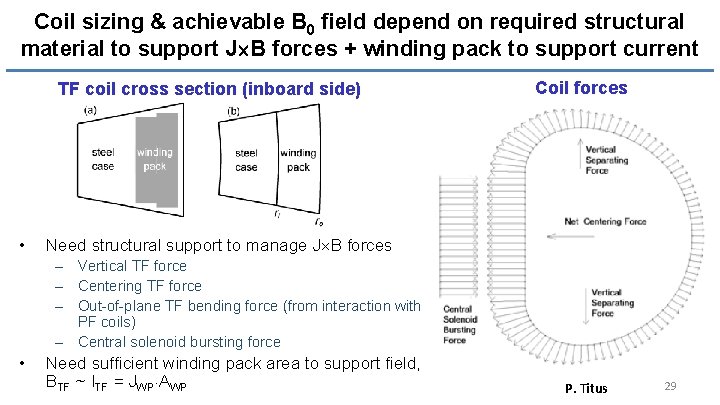
Coil sizing & achievable B 0 field depend on required structural material to support J B forces + winding pack to support current TF coil cross section (inboard side) • Coil forces Need structural support to manage J B forces – Vertical TF force – Centering TF force – Out-of-plane TF bending force (from interaction with PF coils) – Central solenoid bursting force • Need sufficient winding pack area to support field, BTF ~ ITF = JWP AWP P. Titus 29
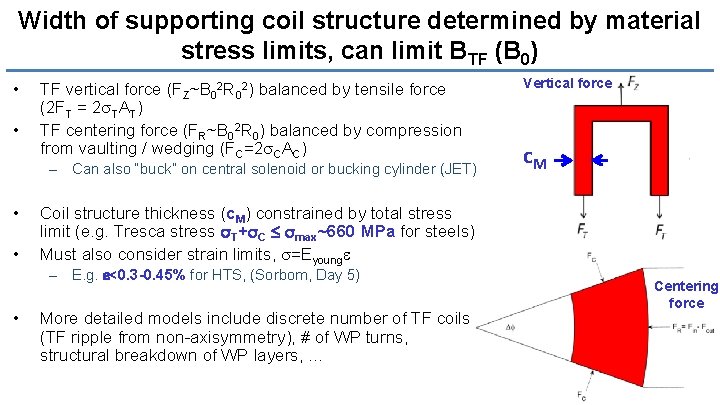
Width of supporting coil structure determined by material stress limits, can limit BTF (B 0) • • TF vertical force (FZ~B 02 R 02) balanced by tensile force (2 FT = 2 s. TAT) TF centering force (FR~B 02 R 0) balanced by compression from vaulting / wedging (FC=2 s. CAC) – Can also “buck” on central solenoid or bucking cylinder (JET) • • c. M Coil structure thickness (c. M) constrained by total stress limit (e. g. Tresca stress s. T+s. C smax~660 MPa for steels) Must also consider strain limits, s=Eyounge – E. g. e<0. 3 -0. 45% for HTS, (Sorbom, Day 5) • Vertical force More detailed models include discrete number of TF coils (TF ripple from non-axisymmetry), # of WP turns, structural breakdown of WP layers, … Centering force 30
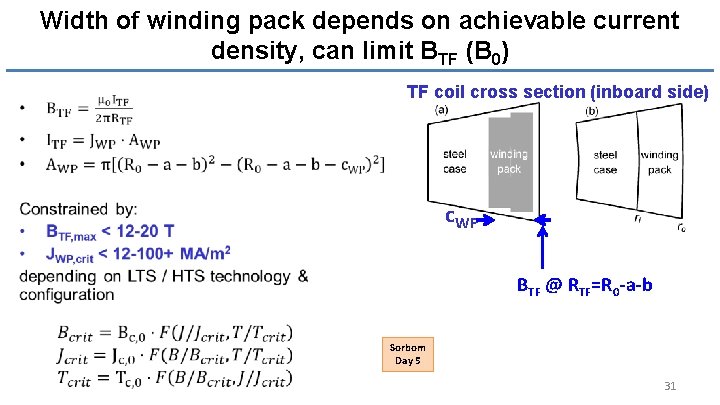
Width of winding pack depends on achievable current density, can limit BTF (B 0) • TF coil cross section (inboard side) c. WP BTF @ RTF=R 0 -a-b Sorbom Day 5 31
Let’s put it all together to identify integrated selfconsistent solutions • Choose targets and constraints • Solve remaining equations • Test sensitivity of solution to parameter variations • First consider power plant (Pe, net=1000 MWe) • Then pilot plant (Pe, net ~ 100 -200 MWe) 32
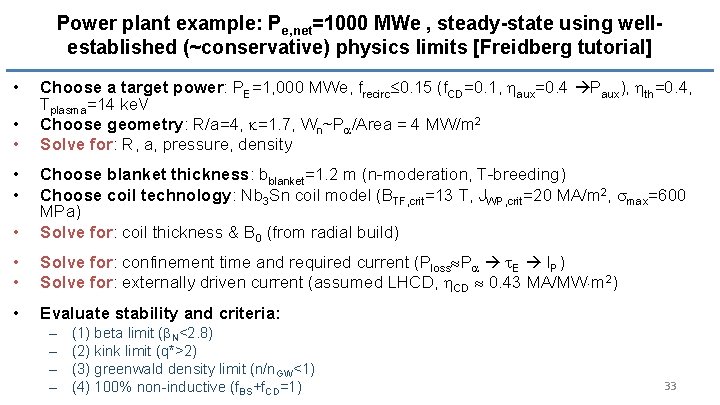
Power plant example: Pe, net=1000 MWe , steady-state using wellestablished (~conservative) physics limits [Freidberg tutorial] • • • Choose a target power: PE=1, 000 MWe, frecirc 0. 15 (f. CD=0. 1, haux=0. 4 Paux), hth=0. 4, Tplasma=14 ke. V Choose geometry: R/a=4, k=1. 7, Wn~Pa/Area = 4 MW/m 2 Solve for: R, a, pressure, density • Choose blanket thickness: bblanket=1. 2 m (n-moderation, T-breeding) Choose coil technology: Nb 3 Sn coil model (BTF, crit=13 T, JWP, crit=20 MA/m 2, smax=600 MPa) Solve for: coil thickness & B 0 (from radial build) • • Solve for: confinement time and required current (Ploss Pa t. E IP) Solve for: externally driven current (assumed LHCD, h. CD 0. 43 MA/MW m 2) • Evaluate stability and criteria: – – (1) beta limit (b. N<2. 8) (2) kink limit (q*>2) (3) greenwald density limit (n/n. GW<1) (4) 100% non-inductive (f. BS+f. CD=1) 33
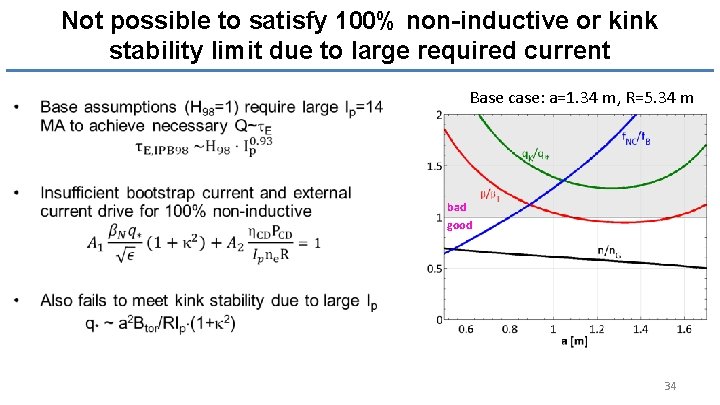
Not possible to satisfy 100% non-inductive or kink stability limit due to large required current • Base case: a=1. 34 m, R=5. 34 m bad good 34
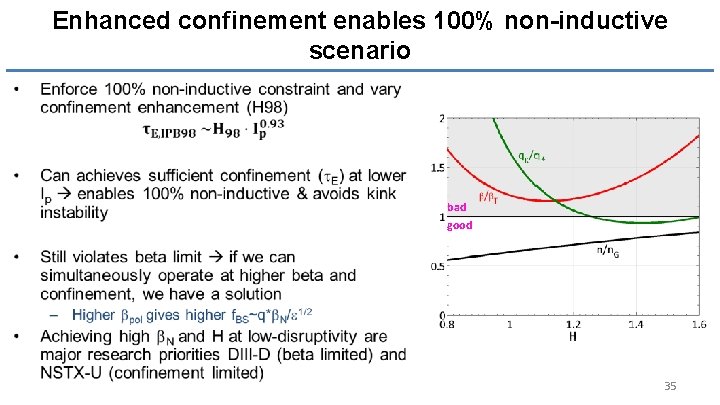
Enhanced confinement enables 100% non-inductive scenario • bad good 35
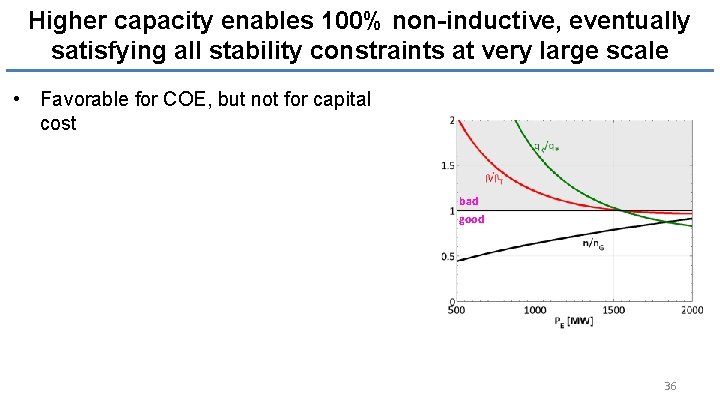
Higher capacity enables 100% non-inductive, eventually satisfying all stability constraints at very large scale • Favorable for COE, but not for capital cost bad good 36
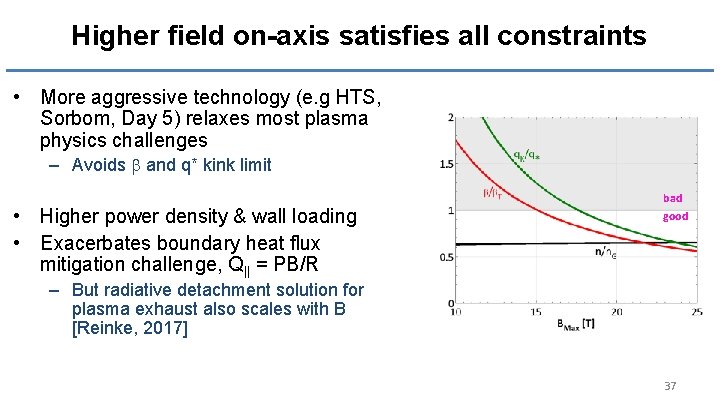
Higher field on-axis satisfies all constraints • More aggressive technology (e. g HTS, Sorbom, Day 5) relaxes most plasma physics challenges – Avoids b and q* kink limit • Higher power density & wall loading • Exacerbates boundary heat flux mitigation challenge, Q|| = PB/R bad good – But radiative detachment solution for plasma exhaust also scales with B [Reinke, 2017] 37
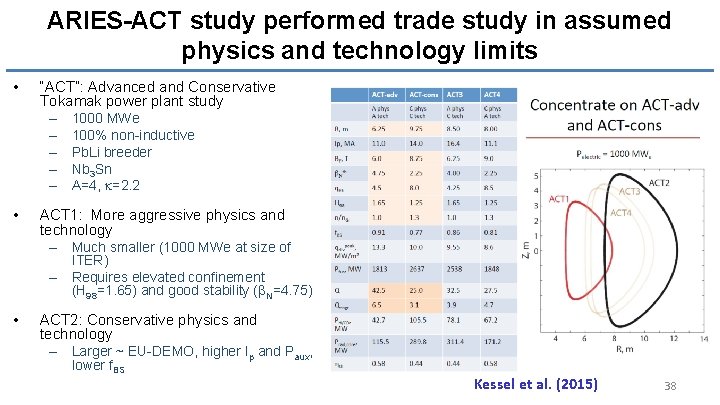
ARIES-ACT study performed trade study in assumed physics and technology limits • “ACT”: Advanced and Conservative Tokamak power plant study – 1000 MWe – 100% non-inductive – Pb. Li breeder – Nb 3 Sn – A=4, k=2. 2 • ACT 1: More aggressive physics and technology – Much smaller (1000 MWe at size of – • ITER) Requires elevated confinement (H 98=1. 65) and good stability (b. N=4. 75) ACT 2: Conservative physics and technology – Larger ~ EU-DEMO, higher Ip and Paux, lower f. BS Kessel et al. (2015) 38
More recent focus to target pilot plant parameters • Lower capacity, Pnet~100 -200 MWe (COE not the immediate concern) – Don’t need to demonstrate 100% of all “essential criteria”, as long as solutions perceived to scale • Target aggressive technology and physics to push for pilot plant at low capital cost (e. g. compact tokamaks, stellarators) 39
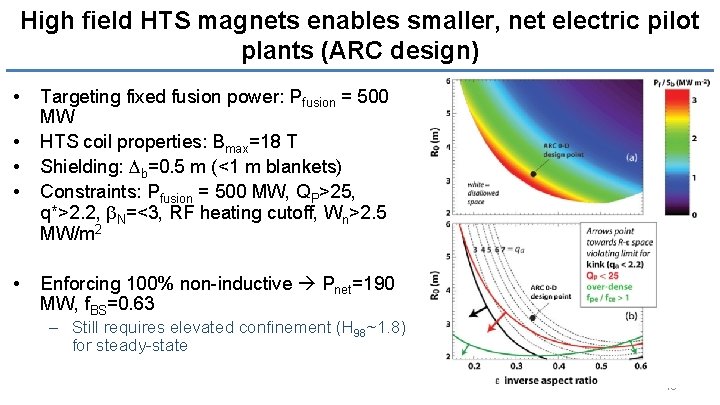
High field HTS magnets enables smaller, net electric pilot plants (ARC design) • • • Targeting fixed fusion power: Pfusion = 500 MW HTS coil properties: Bmax=18 T Shielding: Db=0. 5 m (<1 m blankets) Constraints: Pfusion = 500 MW, QP>25, q*>2. 2, b. N=<3, RF heating cutoff, Wn>2. 5 MW/m 2 Enforcing 100% non-inductive Pnet=190 MW, f. BS=0. 63 – Still requires elevated confinement (H 98~1. 8) for steady-state 40
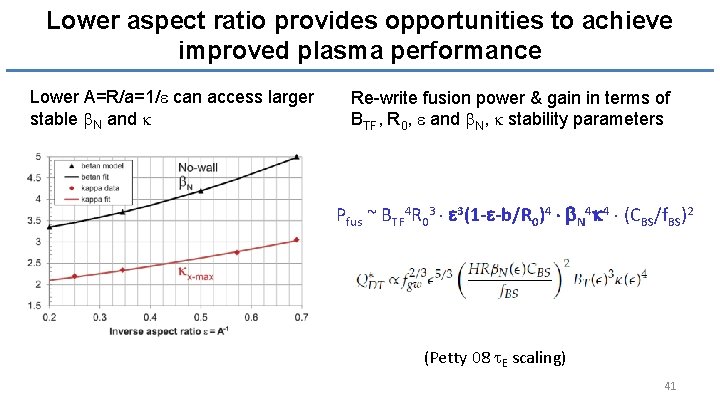
Lower aspect ratio provides opportunities to achieve improved plasma performance Lower A=R/a=1/e can access larger stable b. N and k Re-write fusion power & gain in terms of BTF, R 0, e and b. N, k stability parameters Pfus ~ BTF 4 R 03 e 3(1 -e-b/R 0)4 b. N 4 k 4 (CBS/f. BS)2 (Petty 08 t. E scaling) 41
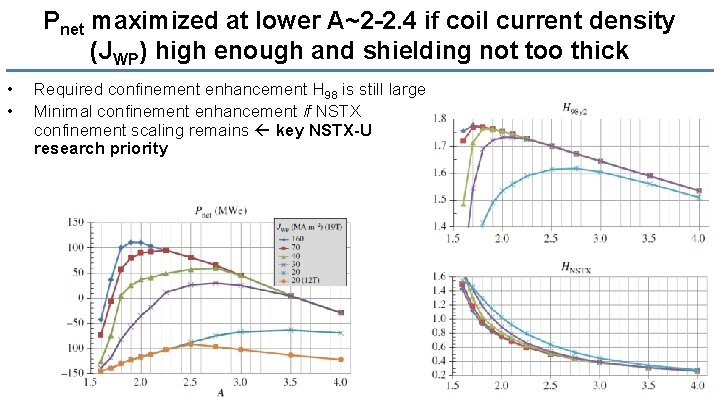
Pnet maximized at lower A~2 -2. 4 if coil current density (JWP) high enough and shielding not too thick • • Required confinement enhancement H 98 is still large Minimal confinement enhancement if NSTX confinement scaling remains key NSTX-U research priority 42
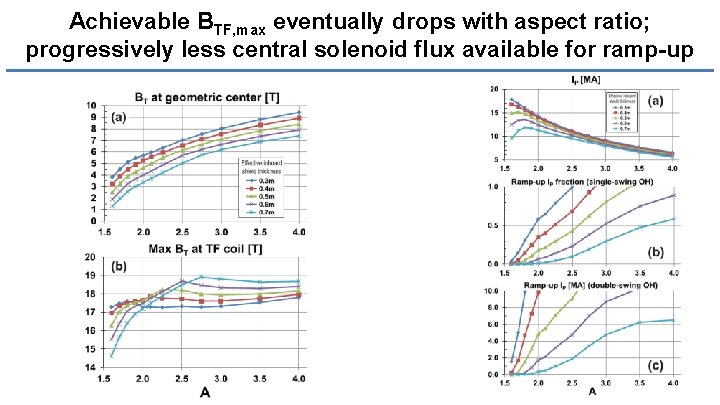
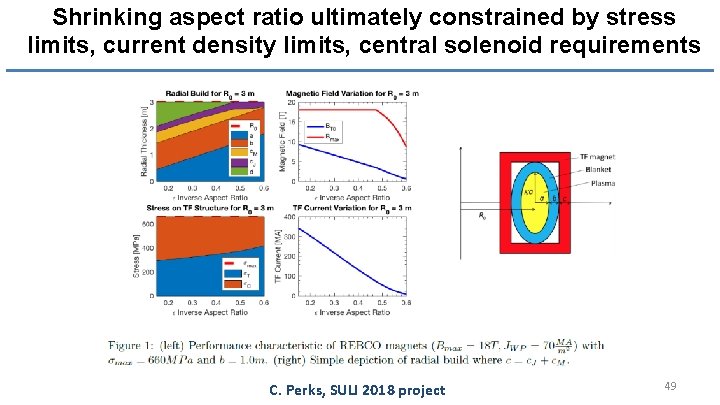
Achievable BTF, max eventually drops with aspect ratio; progressively less central solenoid flux available for ramp-up 43
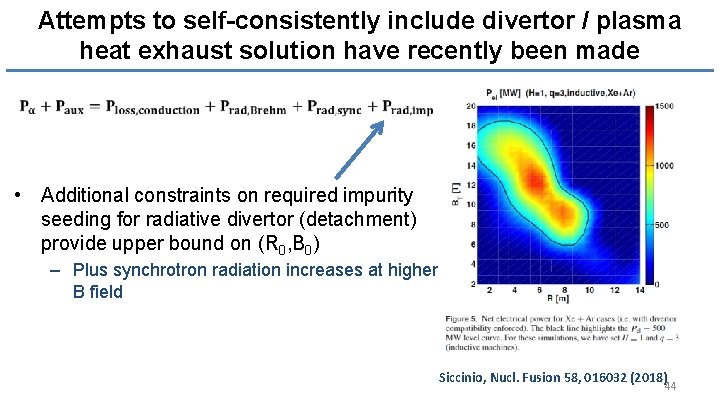
Attempts to self-consistently include divertor / plasma heat exhaust solution have recently been made • Additional constraints on required impurity seeding for radiative divertor (detachment) provide upper bound on (R 0, B 0) – Plus synchrotron radiation increases at higher B field Siccinio, Nucl. Fusion 58, 016032 (2018) 44
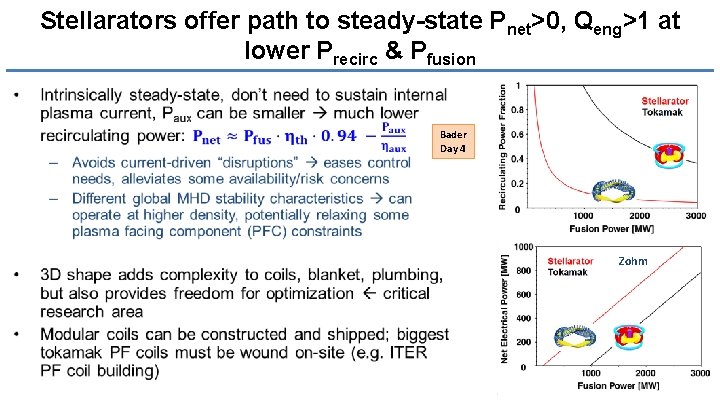
Stellarators offer path to steady-state Pnet>0, Qeng>1 at lower Precirc & Pfusion • Bader Day 4 Zohm 45
Summary • Conceptual power/pilot plant design studies must consider self-consistent integrated solution including nuclear, engineering and plasma physics constraints – Neutron absorption, blanket concepts, superconductor technology, current drive efficiencies, confinement, stability limits, … • Studies have been performed highlighting key sensitivities that influence performance motivates critical, innovative research in US & worldwide fusion programs 46
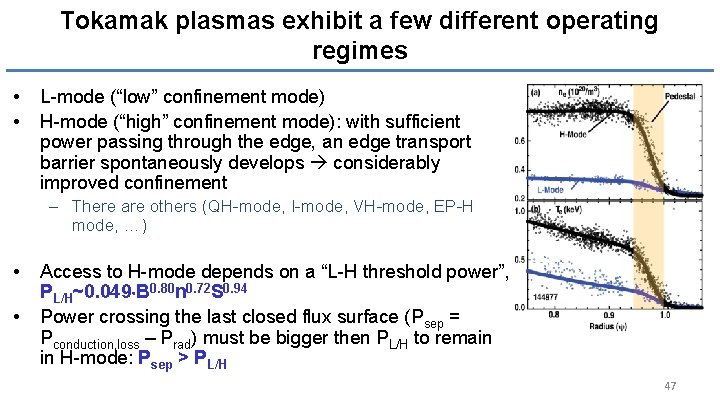
Tokamak plasmas exhibit a few different operating regimes • • L-mode (“low” confinement mode) H-mode (“high” confinement mode): with sufficient power passing through the edge, an edge transport barrier spontaneously develops considerably improved confinement – There are others (QH-mode, I-mode, VH-mode, EP-H mode, …) • • Access to H-mode depends on a “L-H threshold power”, PL/H~0. 049 B 0. 80 n 0. 72 S 0. 94 Power crossing the last closed flux surface (Psep = Pconduction, loss – Prad) must be bigger then PL/H to remain in H-mode: Psep > PL/H 47
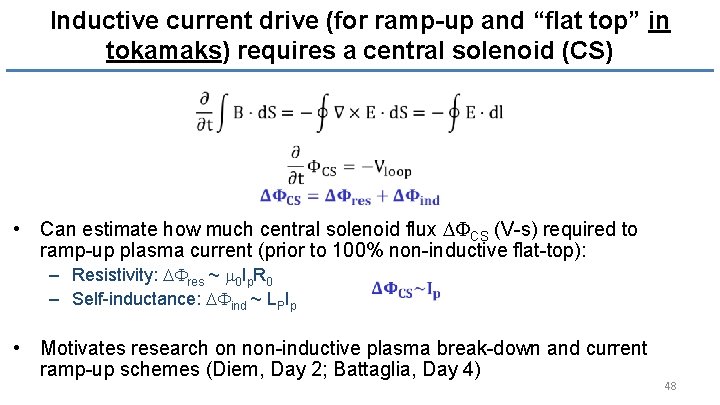
Inductive current drive (for ramp-up and “flat top” in tokamaks) requires a central solenoid (CS) • Can estimate how much central solenoid flux D CS (V-s) required to ramp-up plasma current (prior to 100% non-inductive flat-top): – Resistivity: D res ~ m 0 Ip. R 0 – Self-inductance: D ind ~ LPIp • Motivates research on non-inductive plasma break-down and current ramp-up schemes (Diem, Day 2; Battaglia, Day 4) 48
Shrinking aspect ratio ultimately constrained by stress limits, current density limits, central solenoid requirements C. Perks, SULI 2018 project 49