
Integrated Optimization and Control of a Hybrid Gas

Integrated Optimization and Control of a Hybrid Gas Turbine/s. CO 2 Power System
Background and overview • FOA objective: Develop modular turbine-based hybrid heat engines for FE applications that: • • Integrate with modular gasifiers Promote the clean and efficient use of stranded fuel assets Help to better manage grid demand response for load-following Improve the efficiency and environmental performance of natural gas compression stations • Echogen project – Hybrid Gas Turbine/s. CO 2 Power Cycle • Leverages Echogen commercial s. CO 2 power cycle development • Allows for tighter integration and optimization of gas turbine and s. CO 2 bottoming cycles for steady-state and transient operations • Goals: • • 2 Better overall cycle efficiency than standalone optimization Improved transient performance to achieve faster demand response of combined system
Team • Echogen Power Systems (EPS) • Prime recipient • GTs. CO 2 design • Power cycle modeling and simulation • Siemens Finspa ng • Gas turbine (SGT-750) transient model and control simulation • Siemens PTI • Grid simulation 3
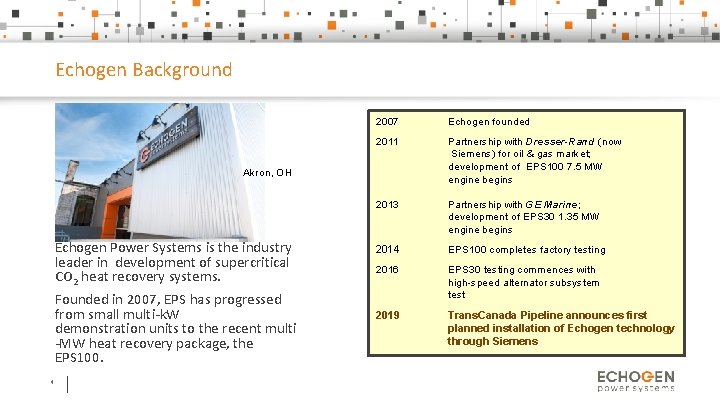
Echogen Background 2007 Echogen founded 2011 Partnership with Dresser-Rand (now Siemens) for oil & gas market; development of EPS 100 7. 5 MW engine begins 2013 Partnership with GE Marine; development of EPS 30 1. 35 MW engine begins 2014 EPS 100 completes factory testing 2016 EPS 30 testing commences with high-speed alternator subsystem test 2019 Trans. Canada Pipeline announces first planned installation of Echogen technology through Siemens Akron, OH Echogen Power Systems is the industry leader in development of supercritical CO 2 heat recovery systems. Founded in 2007, EPS has progressed from small multi-k. W demonstration units to the recent multi -MW heat recovery package, the EPS 100. 4
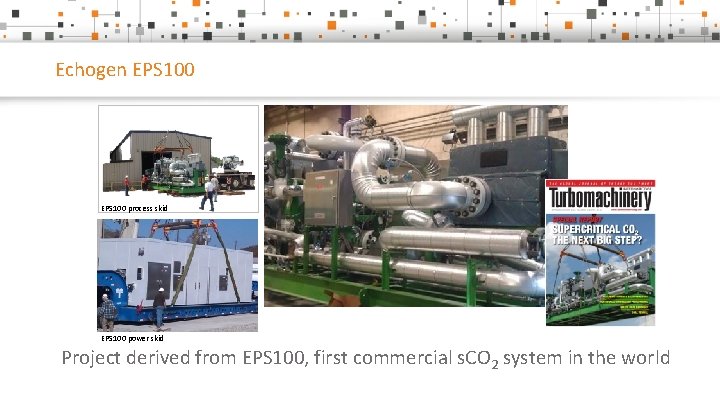
Echogen EPS 100 process skid EPS 100 power skid Project derived from EPS 100, first commercial s. CO 2 system in the world
Heat recovery cycle – current project • Cycle designed for waste heat recovery • Reduces exhaust temperature to ~100°C • Flexible, allows for integration of multiple heat sources at different temperatures • Variable-speed compressor driven off power turbine 6 6
s. CO 2 model in GT-SUITE • Similar architecture to EPS 100 • Exception is compressor speed control with variableratio gearbox on common power turbine shaft • Includes air cooling, active inventory control • Control system in Simulink block 7
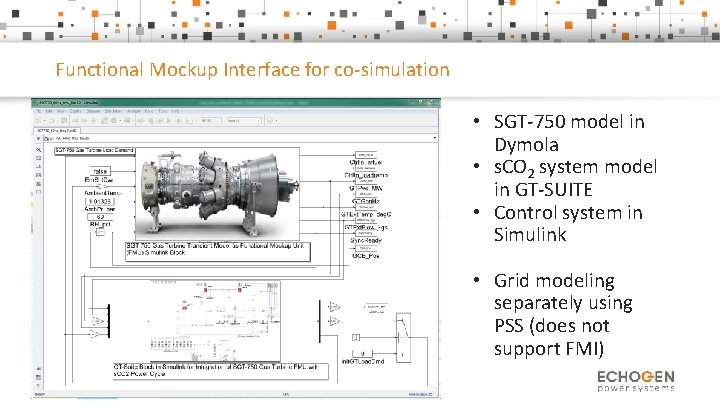
Functional Mockup Interface for co-simulation • SGT-750 model in Dymola • s. CO 2 system model in GT-SUITE • Control system in Simulink • Grid modeling separately using PSS (does not support FMI) 8
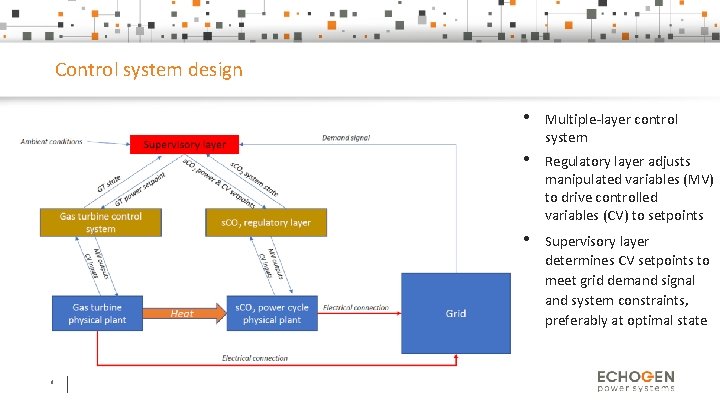
Control system design 9 • Multiple-layer control system • Regulatory layer adjusts manipulated variables (MV) to drive controlled variables (CV) to setpoints • Supervisory layer determines CV setpoints to meet grid demand signal and system constraints, preferably at optimal state
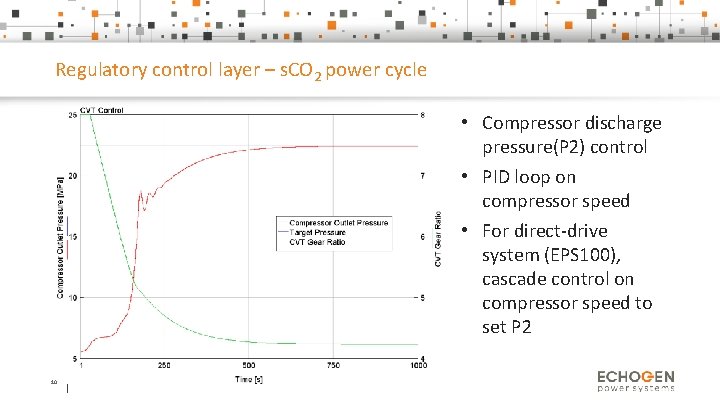
Regulatory control layer – s. CO 2 power cycle • Compressor discharge pressure(P 2) control • PID loop on compressor speed • For direct-drive system (EPS 100), cascade control on compressor speed to set P 2 10
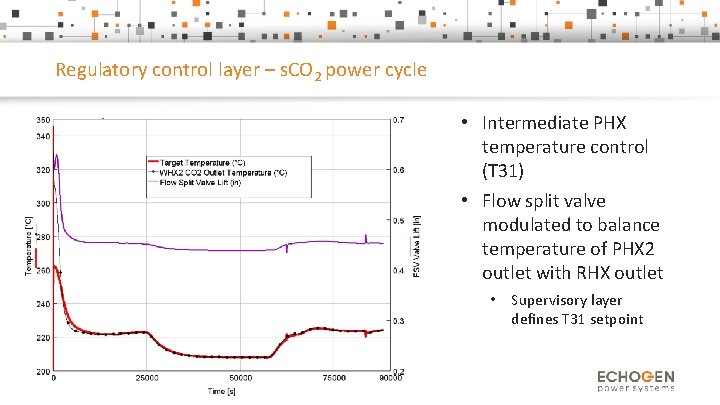
Regulatory control layer – s. CO 2 power cycle • Intermediate PHX temperature control (T 31) • Flow split valve modulated to balance temperature of PHX 2 outlet with RHX outlet • Supervisory layer defines T 31 setpoint 11
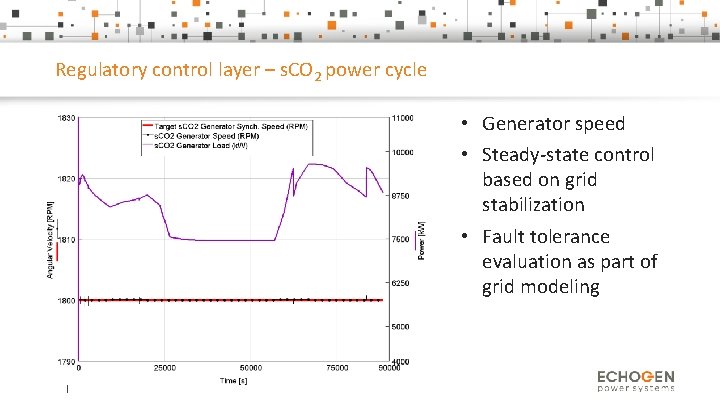
Regulatory control layer – s. CO 2 power cycle • Generator speed • Steady-state control based on grid stabilization • Fault tolerance evaluation as part of grid modeling 12
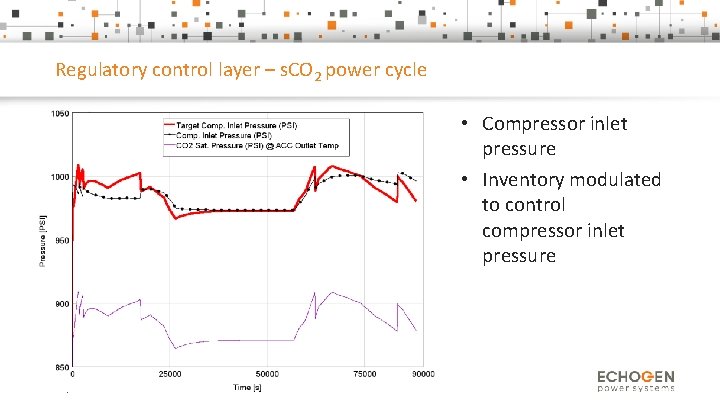
Regulatory control layer – s. CO 2 power cycle • Compressor inlet pressure • Inventory modulated to control compressor inlet pressure 13
Microgrid description • Microgrid model with peak demand of 60 MW (winter) and min demand of 28 MW (summer) • Typical seasonal and diurnal demand curves created based on Siemens PTI experience • Generation assets: • SGT-750: 33 MW (summer) - 45 MW (winter). Minimum output = 20 MW (emissions limit) • s. CO 2 system: 8. 5 – 13 MW • PV generation: 24 MW max • Battery system: 9. 6 MW 14
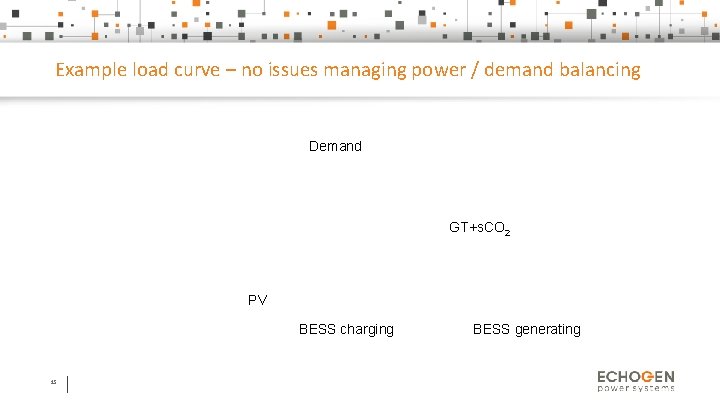
Example load curve – no issues managing power / demand balancing Demand GT+s. CO 2 PV BESS charging 15 BESS generating
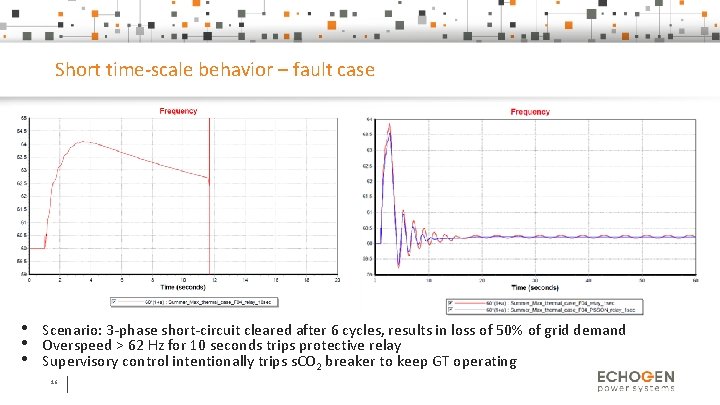
Short time-scale behavior – fault case • • • Scenario: 3 -phase short-circuit cleared after 6 cycles, results in loss of 50% of grid demand Overspeed > 62 Hz for 10 seconds trips protective relay Supervisory control intentionally trips s. CO 2 breaker to keep GT operating 16
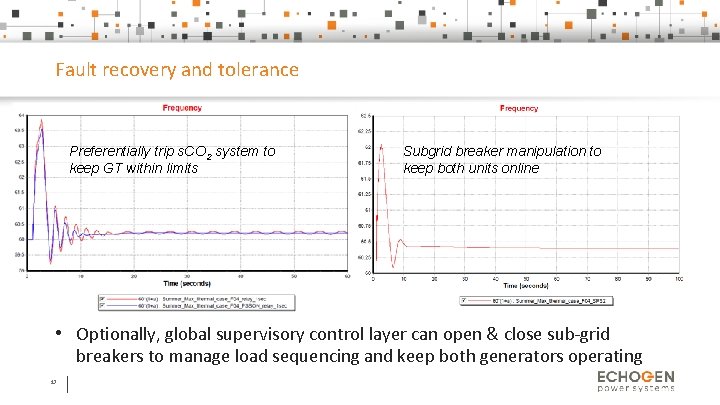
Fault recovery and tolerance Preferentially trip s. CO 2 system to keep GT within limits Subgrid breaker manipulation to keep both units online • Optionally, global supervisory control layer can open & close sub-grid breakers to manage load sequencing and keep both generators operating 17
Summary & next steps • s. CO 2 control system simulation successfully reproduces behavior of EPS 100 in test cell • Co-simulation allows for independent simultaneous simulation in different codes • Grid model shows limitations in responsiveness of s. CO 2 system limit fault tolerance of microgrid • Exploring use of model predictive control (MPC) for regulatory control later responsiveness improvements 18
The Fine Print This material is based upon work supported by the Department of Energy under Award Number(s) DEFE 0031621. This report was prepared as an account of work sponsored by an agency of the United States Government. Neither the United States Government nor any agency thereof, nor any of their employees, makes any warranty, express or implied, or assumes any legal liability or responsibility for the accuracy, completeness, or usefulness of any information, apparatus, product, or process disclosed, or represents that its use would not infringe privately owned rights. Reference herein to any specific commercial product, process, or service by trade name, trademark, manufacturer, or otherwise does not necessarily constitute or imply its endorsement, recommendation, or favoring by the United States Government or any agency thereof. The views and opinions of authors expressed herein do not necessarily state or reflect those of the United States Government or any agency thereof. 19
- Slides: 19