
Integrated Modeling of HighTemperature GateBias HTGB Reliability Degradation
Integrated Modeling of High-Temperature Gate-Bias (HTGB) Reliability Degradation in 4 H-Si. C Power MOSFETs Dev Ettisserry ECE Department UMD College Park Advisor: Prof. Neil Goldsman 10 th ARL Workshop on Si. C Electronics 08/13/2015 UMD College Park D. P. Ettisserry, N. Goldsman
Overview • Introduction • Reliability issues in 4 H-Si. C MOSFETs (Problem statements). • Integrated Modeling Approach • Density Functional Theory plus related modeling tools. • High-temperature reliability modeling. • NO passivation and device reliability. • Summary D. P. Ettisserry, N. Goldsman
![Problem statements Critical reliability concern – High-temperature Vth instability* Room-Temperature ΔVth [1] High-Temperature ΔVth](http://slidetodoc.com/presentation_image_h/0c506899783c1c5cccf0e2b23e41799c/image-3.jpg "Problem statements Critical reliability concern – High-temperature Vth instability* Room-Temperature ΔVth [1] High-Temperature ΔVth")
Problem statements Critical reliability concern – High-temperature Vth instability* Room-Temperature ΔVth [1] High-Temperature ΔVth [2] Development of Passivation processes • After identifying the root-causes of reliability degradation, how can we alter device processing to mitigate them? ? ? • D. P. Ettisserry, N. Goldsman Effect of commonly used NO passivation. * Measurements by our collaborators at U. S. Army Research Lab, Adelphi, MD. [1] A. J. Lelis et. al, IEEE T-ED, 55, no. 8, 1835, 2008. [2] A. J. Lelis et. al, IEEE T-ED, 62, no. 2, 316, 2015.
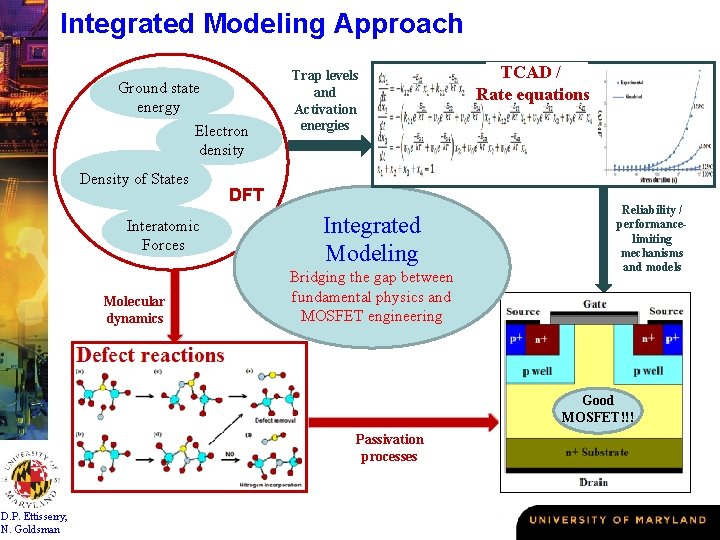
Integrated Modeling Approach Ground state energy Electron density Density of States Interatomic Forces Molecular dynamics Trap levels and Activation energies DFT Integrated Modeling Bridging the gap between fundamental physics and MOSFET engineering TCAD / Rate equations Reliability / performancelimiting mechanisms and models Good MOSFET!!! Passivation processes D. P. Ettisserry, N. Goldsman

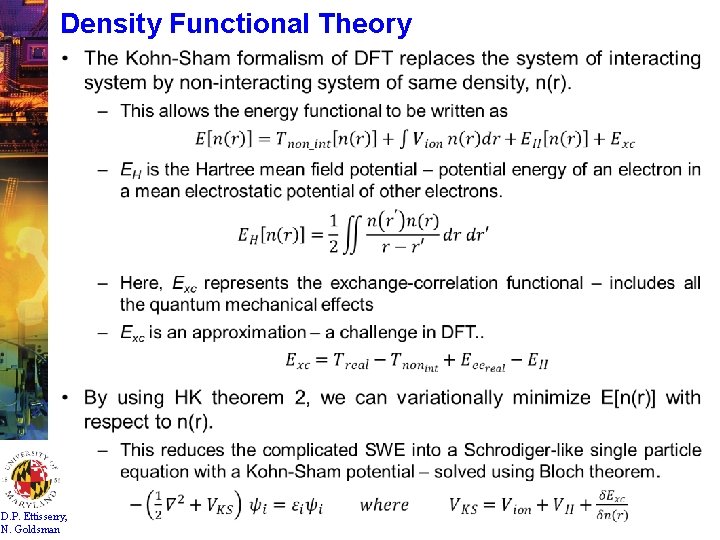
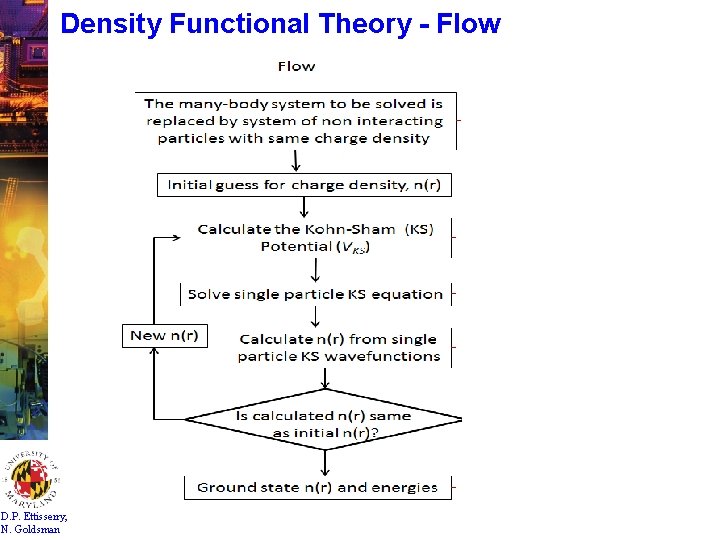
Density Functional Theory • Schrodinger wave equation that accounts for all the electrons and nuclei in the system and their interactions. Total wavefunction • The kinetic and potential energies are altered by quantum effects like Pauli’s exclusion – not quantifiable. • DFT provides a tractable accurate solution for the ground state eigenvalues (energy) and electron density. – Replaces the complicated interacting system Hamiltonian by a sum of noninteracting Hamiltonians. – Uses electron density (one function in space) as the fundamental property instead of ψtot. D. P. Ettisserry, N. Goldsman
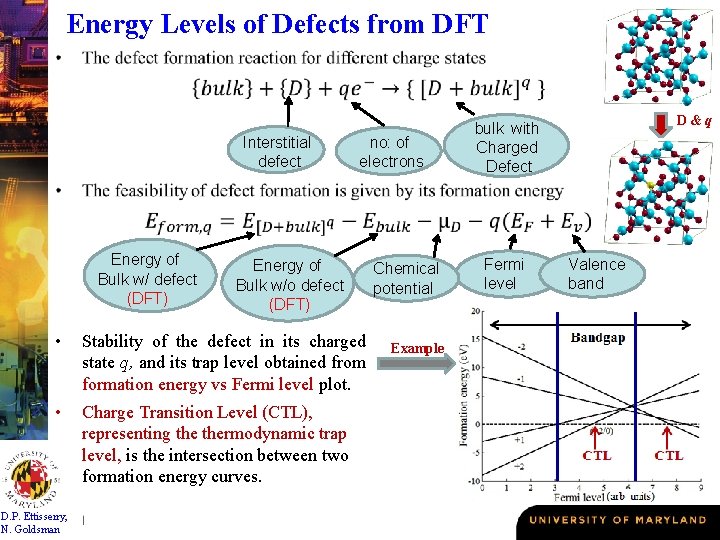
Energy Levels of Defects from DFT Interstitial defect no: of electrons D&q bulk with Charged Defect Energy of Bulk w/ defect (DFT) Energy of Bulk w/o defect (DFT) • Stability of the defect in its charged state q, and its trap level obtained from formation energy vs Fermi level plot. • Charge Transition Level (CTL), representing thermodynamic trap level, is the intersection between two formation energy curves. D. P. Ettisserry, N. Goldsman Chemical potential Example Fermi level Valence band

High-temperature reliability modeling of 4 H-Si. C MOSFETs • Amorphous Si. O 2 model generation • Role of oxide defects in reliability degradation. • Transient modeling of high-temperature Vth instability. [1] D. P. Ettisserry, N. Goldsman, A. Akturk, and A. J. Lelis, “Negative bias-and-Temperature-assisted activation of oxygenvacancy hole traps in 4 H-Si. C MOSFETs, ” accepted for publication by the Journal of Applied Physics. [2] D. P. Ettisserry et. al. , “Modeling of oxygen-vacancy hole trap activation in 4 H-Si. C MOSFETs using Density Functional Theory and Rate Equation Analysis, ” accepted for oral presentation at the Intl. Conference on Simulation of Semiconductor Processes and Devices (SISPAD), 2015. D. P. Ettisserry, N. Goldsman
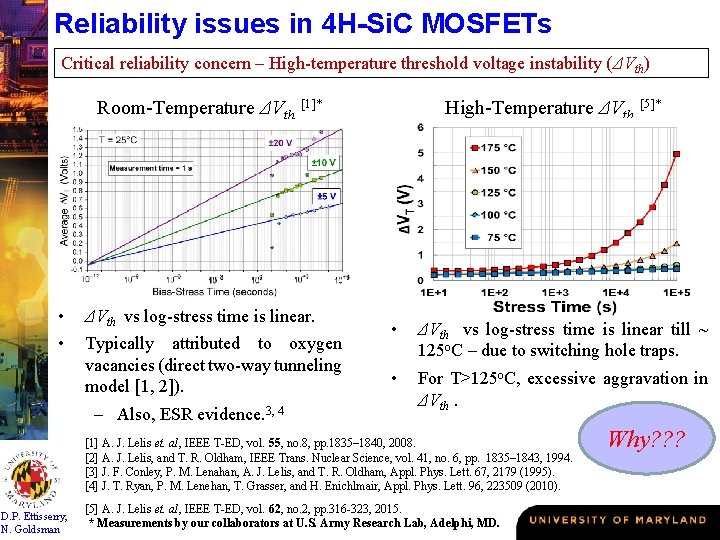
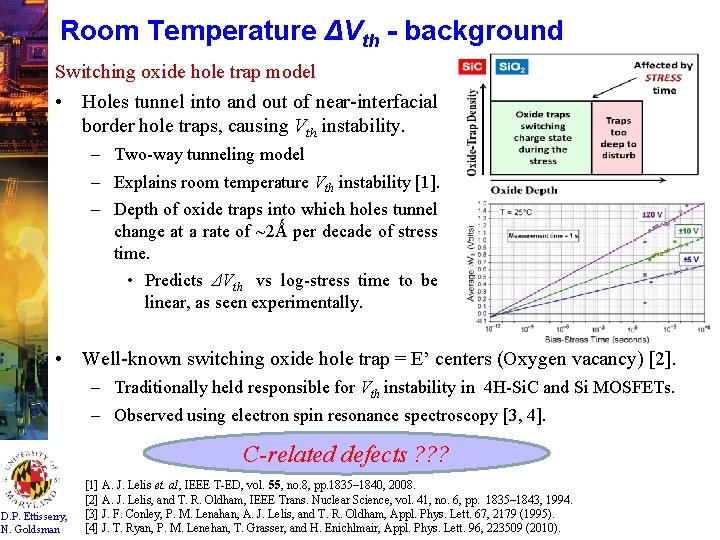
Reliability issues in 4 H-Si. C MOSFETs Critical reliability concern – High-temperature threshold voltage instability (ΔVth) Room-Temperature ΔVth • • ΔVth vs log-stress time is linear. Typically attributed to oxygen vacancies (direct two-way tunneling model [1, 2]). – Also, ESR evidence. 3, 4 High-Temperature ΔVth [1]* • ΔVth vs log-stress time is linear till ~ 125 o. C – due to switching hole traps. • For T>125 o. C, excessive aggravation in ΔVth. [1] A. J. Lelis et. al, IEEE T-ED, vol. 55, no. 8, pp. 1835– 1840, 2008. [2] A. J. Lelis, and T. R. Oldham, IEEE Trans. Nuclear Science, vol. 41, no. 6, pp. 1835– 1843, 1994. [3] J. F. Conley, P. M. Lenahan, A. J. Lelis, and T. R. Oldham, Appl. Phys. Lett. 67, 2179 (1995). [4] J. T. Ryan, P. M. Lenehan, T. Grasser, and H. Enichlmair, Appl. Phys. Lett. 96, 223509 (2010). D. P. Ettisserry, N. Goldsman [5]* [5] A. J. Lelis et. al, IEEE T-ED, vol. 62, no. 2, pp. 316 -323, 2015. * Measurements by our collaborators at U. S. Army Research Lab, Adelphi, MD. Why? ? ?
Amorphous Si. O 2 model generation Method 1 – Sequential Back-bond Break (SBB Method) • New method – Exploits the periodicity of supercell models, inherent in DFT. • Represents bond-switched regions of oxide (high-amorphousness). Method 2 – Quantum molecular dynamics • Represents non-bond-switched regions of oxide (low-amorphousness). D. P. Ettisserry, N. Goldsman

Amorphous Si. O 2 model – structural properties • • Bond angle and bond length distributions agree well with other models generated using molecular dynamics [1]. Pair correlation functions agree well with experimental reports [2]. Further work with larger models will be helpful to confirm the results. [1] F. Devynck et. al. , Phys. Rev. B 76, 075351 (2007). [2] A. C. Wright. , J. Non Crys. Solids, 179, 84 -115 (1993). D. P. Ettisserry, N. Goldsman
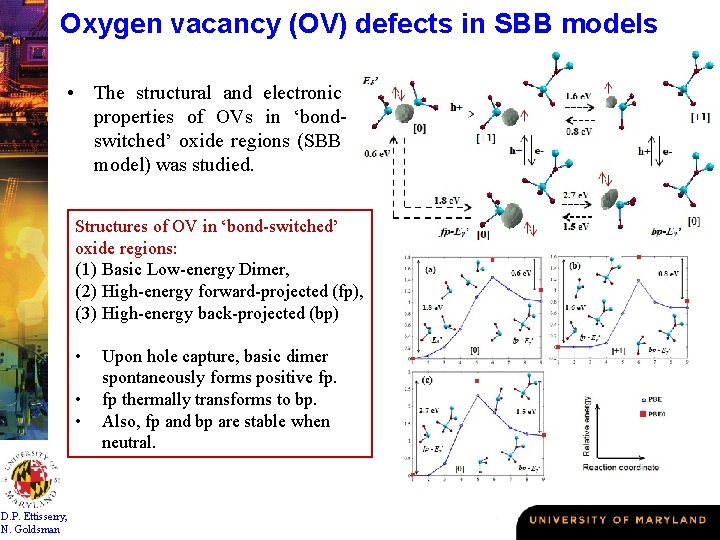
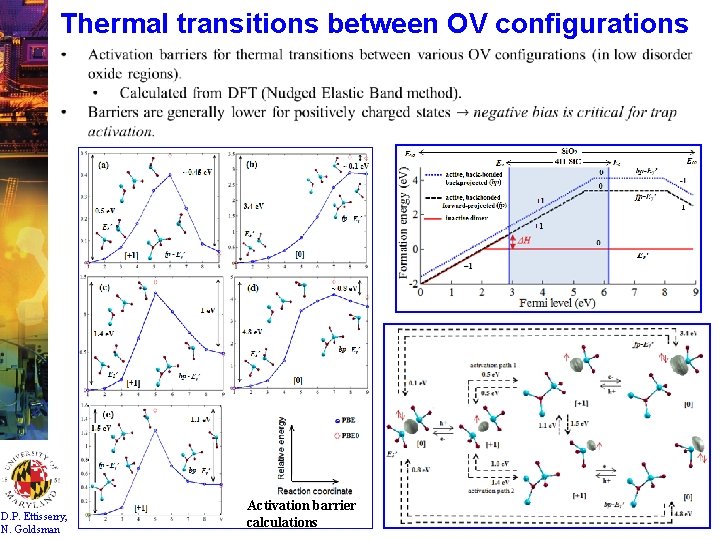
Oxygen vacancy (OV) defects in SBB models • The structural and electronic properties of OVs in ‘bondswitched’ oxide regions (SBB model) was studied. Structures of OV in ‘bond-switched’ oxide regions: (1) Basic Low-energy Dimer, (2) High-energy forward-projected (fp), (3) High-energy back-projected (bp) • • • D. P. Ettisserry, N. Goldsman Upon hole capture, basic dimer spontaneously forms positive fp. fp thermally transforms to bp. Also, fp and bp are stable when neutral.
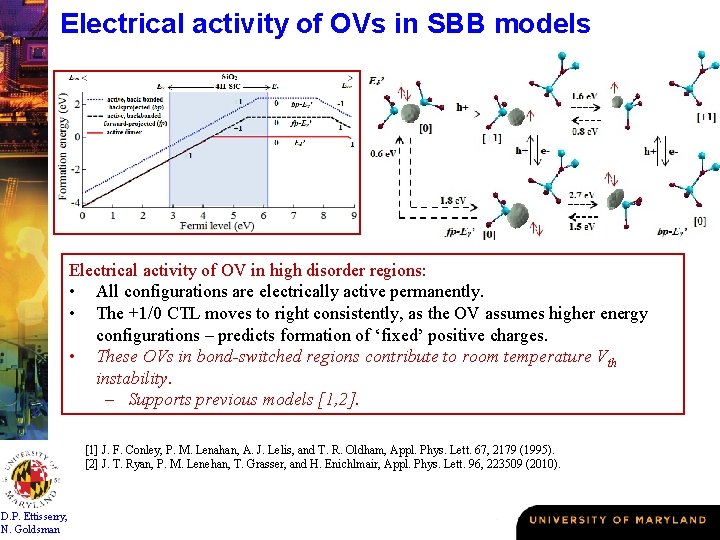
Electrical activity of OVs in SBB models Electrical activity of OV in high disorder regions: • All configurations are electrically active permanently. • The +1/0 CTL moves to right consistently, as the OV assumes higher energy configurations – predicts formation of ‘fixed’ positive charges. • These OVs in bond-switched regions contribute to room temperature Vth instability. – Supports previous models [1, 2]. [1] J. F. Conley, P. M. Lenahan, A. J. Lelis, and T. R. Oldham, Appl. Phys. Lett. 67, 2179 (1995). [2] J. T. Ryan, P. M. Lenehan, T. Grasser, and H. Enichlmair, Appl. Phys. Lett. 96, 223509 (2010). D. P. Ettisserry, N. Goldsman
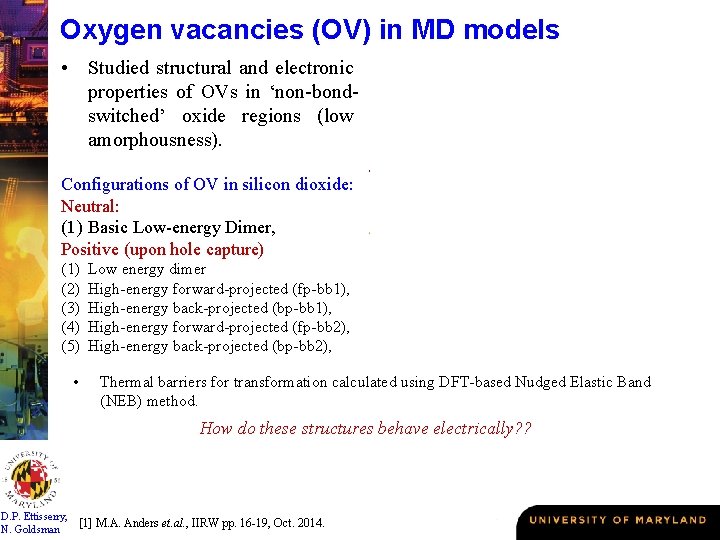
Oxygen vacancies (OV) in MD models • Studied structural and electronic properties of OVs in ‘non-bondswitched’ oxide regions (low amorphousness). Configurations of OV in silicon dioxide: Neutral: (1) Basic Low-energy Dimer, Positive (upon hole capture) (1) (2) (3) (4) (5) • Low energy dimer High-energy forward-projected (fp-bb 1), High-energy back-projected (bp-bb 1), High-energy forward-projected (fp-bb 2), High-energy back-projected (bp-bb 2), Thermal barriers for transformation calculated using DFT-based Nudged Elastic Band (NEB) method. How do these structures behave electrically? ? D. P. Ettisserry, N. Goldsman [1] M. A. Anders et. al. , IIRW pp. 16 -19, Oct. 2014.
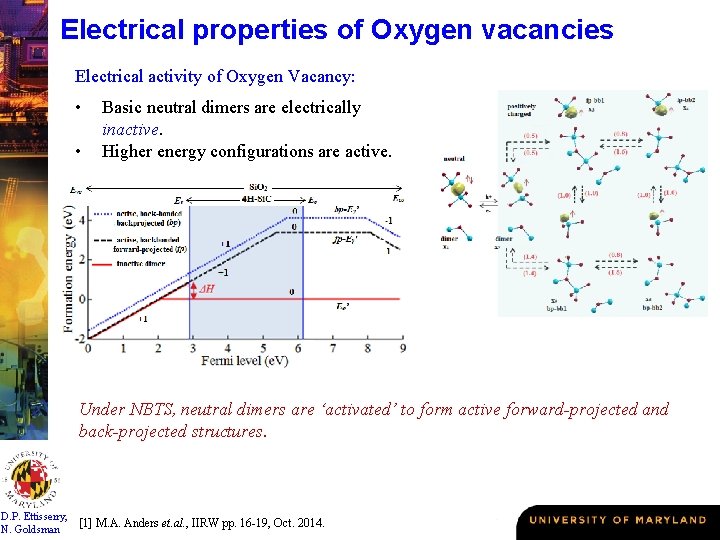
Electrical properties of Oxygen vacancies Electrical activity of Oxygen Vacancy: • • Basic neutral dimers are electrically inactive. Higher energy configurations are active. Under NBTS, neutral dimers are ‘activated’ to form active forward-projected and back-projected structures. D. P. Ettisserry, N. Goldsman [1] M. A. Anders et. al. , IIRW pp. 16 -19, Oct. 2014.
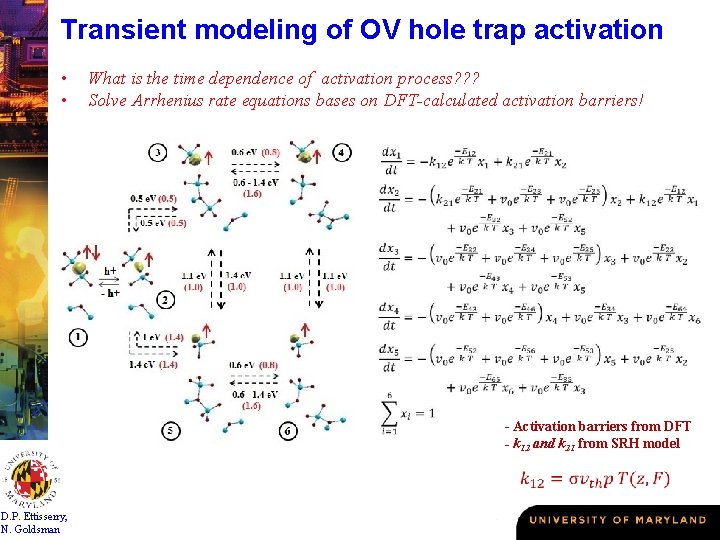
Transient modeling of OV hole trap activation • • What is the time dependence of activation process? ? ? Solve Arrhenius rate equations bases on DFT-calculated activation barriers! - Activation barriers from DFT - k 12 and k 21 from SRH model D. P. Ettisserry, N. Goldsman
![Transient modeling of OV hole trap activation [1] A. J. Lelis et. al, IEEE](http://slidetodoc.com/presentation_image_h/0c506899783c1c5cccf0e2b23e41799c/image-16.jpg "Transient modeling of OV hole trap activation [1] A. J. Lelis et. al, IEEE")
Transient modeling of OV hole trap activation [1] A. J. Lelis et. al, IEEE T-ED, vol. 62, no. 2, pp. 316 -323, 2015. D. P. Ettisserry, N. Goldsman [2] M. A. Anders et. al. , IIRW pp. 16 -19, Oct. 2014.
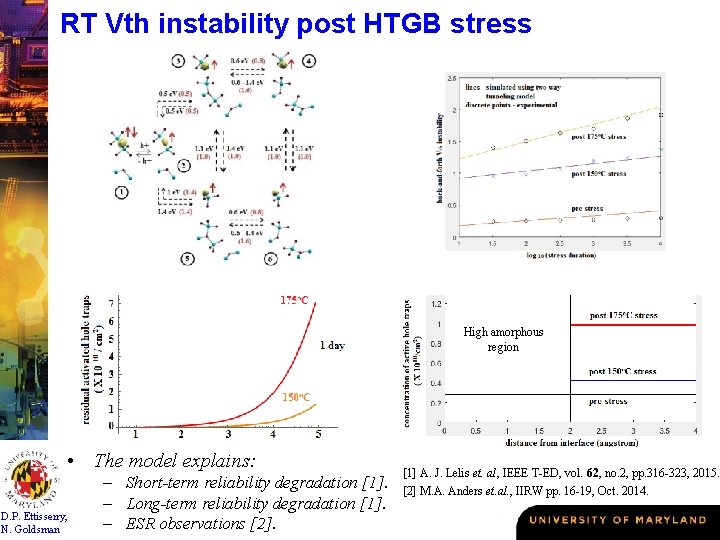
RT Vth instability post HTGB stress High amorphous region • The model explains: D. P. Ettisserry, N. Goldsman – Short-term reliability degradation [1]. – Long-term reliability degradation [1]. – ESR observations [2]. [1] A. J. Lelis et. al, IEEE T-ED, vol. 62, no. 2, pp. 316 -323, 2015. [2] M. A. Anders et. al. , IIRW pp. 16 -19, Oct. 2014.
![NO Passivation of E’ centers [1] D. P. Ettisserry et. al. , “Mechanisms of](http://slidetodoc.com/presentation_image_h/0c506899783c1c5cccf0e2b23e41799c/image-18.jpg "NO Passivation of E’ centers [1] D. P. Ettisserry et. al. , “Mechanisms of")
NO Passivation of E’ centers [1] D. P. Ettisserry et. al. , “Mechanisms of Nitrogen incorporation at 4 H-Si. C/Si. O 2 interface during Nitric Oxide passivation – A first principles study, ” accepted for oral presentation at the Intl. Conference on Silicon Carbide and Related Materials (ICSCRM), 2015. D. P. Ettisserry, N. Goldsman
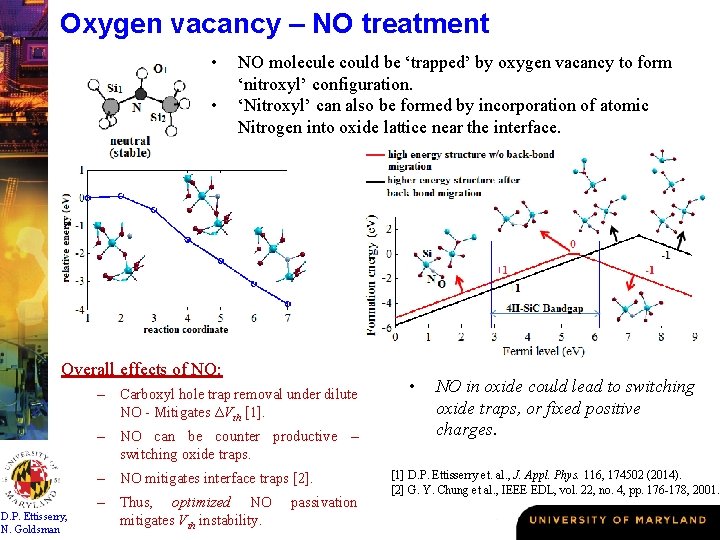
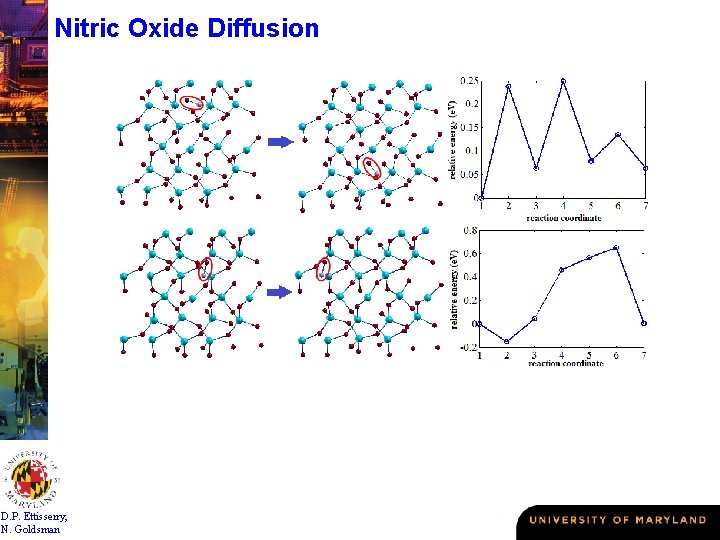
Oxygen vacancy – NO treatment • • NO molecule could be ‘trapped’ by oxygen vacancy to form ‘nitroxyl’ configuration. ‘Nitroxyl’ can also be formed by incorporation of atomic Nitrogen into oxide lattice near the interface. Overall effects of NO: – Carboxyl hole trap removal under dilute NO - Mitigates ΔVth [1]. – NO can be counter productive – switching oxide traps. – NO mitigates interface traps [2]. D. P. Ettisserry, N. Goldsman – Thus, optimized NO mitigates Vth instability. passivation • NO in oxide could lead to switching oxide traps, or fixed positive charges. [1] D. P. Ettisserry et. al. , J. Appl. Phys. 116, 174502 (2014). [2] G. Y. Chung et al. , IEEE EDL, vol. 22, no. 4, pp. 176 -178, 2001.
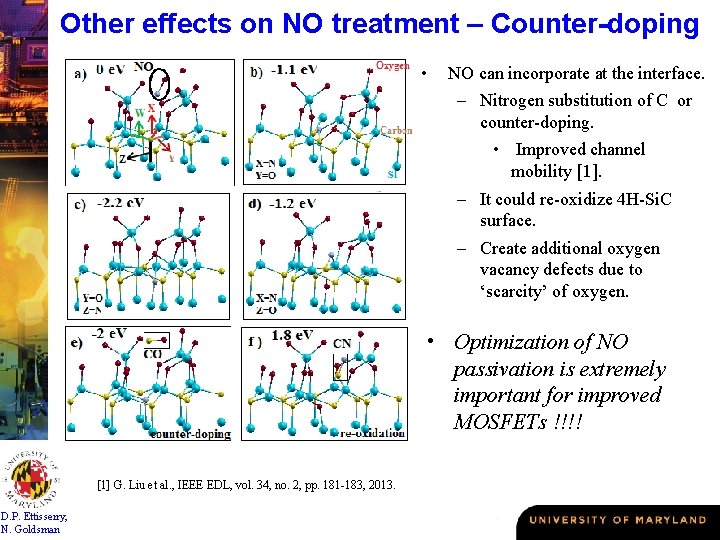
Other effects on NO treatment – Counter-doping • NO can incorporate at the interface. – Nitrogen substitution of C or counter-doping. • Improved channel mobility [1]. – It could re-oxidize 4 H-Si. C surface. – Create additional oxygen vacancy defects due to ‘scarcity’ of oxygen. • Optimization of NO passivation is extremely important for improved MOSFETs !!!! [1] G. Liu et al. , IEEE EDL, vol. 34, no. 2, pp. 181 -183, 2013. D. P. Ettisserry, N. Goldsman
Overall summary • • • D. P. Ettisserry, N. Goldsman Unified Density functional theory with device modeling techniques. – Can solve practical problems encountered by semiconductor device physicists and process engineers. • Reliability and mobility models in semiconductor devices. High Temperature ΔVth in 4 H-Si. C MOSFETs. – Due to the activation of electrically ‘inactive’ oxygen vacancies to form switching oxide hole traps over time. – Long term reliability degradation is due to residual activated hole trap centers. Passivation effects using molecular dynamics – Nitric Oxide • Controlled NO could be effective, Excess NO can have adverse effects. • Counter-doping during NO passivation is energetically feasible.

Thank you, Questions? D. P. Ettisserry, N. Goldsman
Additional defects involved in hole trapping • Role of carbon-related defects • Stability-providing bonding mechanisms D. P. Ettisserry, N. Goldsman

Single carbon interstitial in Si. O 2 – DFT Based Molecular Dynamics simulation • Atomic carbon has been suggested to be emitted into the oxide during 4 H-Si. C oxidation [1]. • Our DFT based molecular dynamics simulation of atomic carbon in Si. O 2 resulted in the rapid formation of Si-O-C-Si bridges. C interstitial Si-O-C-Si bridge Yellow – C Blue - Si Red - O initial final • The existence of carbon-containing interlayers has been observed in TEM measurements [2]. [1] Y. Hijikata, H. Yaguchi, and S. Yoshida, Applied Physics Express 2, 021203 (2009). [2] T. Zheleva, A. Lelis, G. Duscher, F. Liu, I. Levin, and M. Das, Appl. Phys. Lett. 93, 022108 (2008). D. P. Ettisserry, N. Goldsman

Formation of carboxyl defect from Si-O-C-Si bridges in Si. O 2 • Carboxyl defect, Si-[C=O]-Si, are more stable than Si-O-C-Si defect – based on simple octet rule. • Simple bond energy based calculations indicated ~3. 2 e. V energy release. • The kinetics of conversion of Si-O-C-Si bridge to carboxyl configuration was studied using nudged-elastic band method. • Exothermic reaction, energy released = ~2 e. V • Activation barrier = 0. 5 e. V Carboxyl: Likely Defect !! D. P. Ettisserry, N. Goldsman
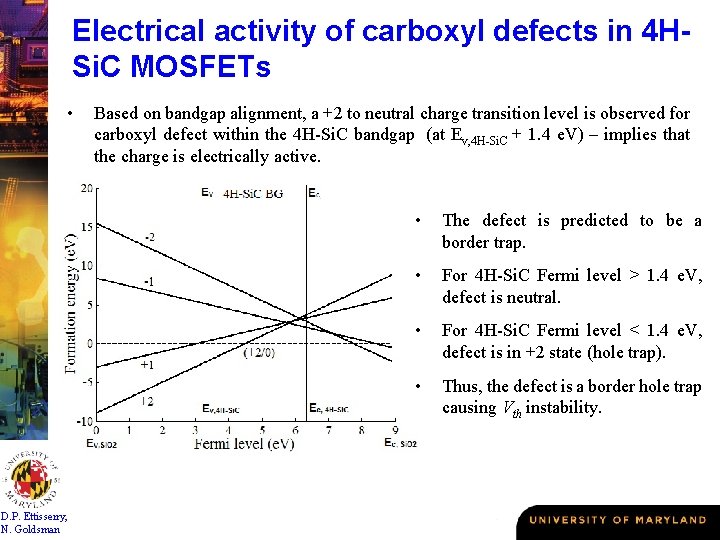
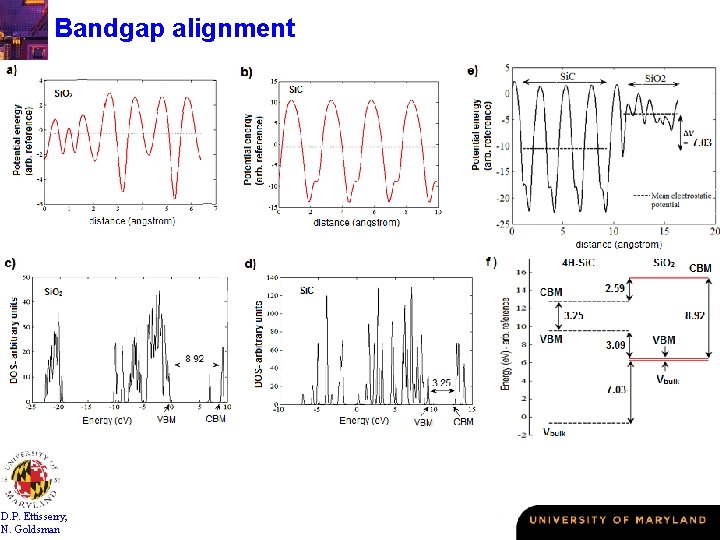
Electrical activity of carboxyl defects in 4 HSi. C MOSFETs • D. P. Ettisserry, N. Goldsman Based on bandgap alignment, a +2 to neutral charge transition level is observed for carboxyl defect within the 4 H-Si. C bandgap (at Ev, 4 H-Si. C + 1. 4 e. V) – implies that the charge is electrically active. • The defect is predicted to be a border trap. • For 4 H-Si. C Fermi level > 1. 4 e. V, defect is neutral. • For 4 H-Si. C Fermi level < 1. 4 e. V, defect is in +2 state (hole trap). • Thus, the defect is a border hole trap causing Vth instability.
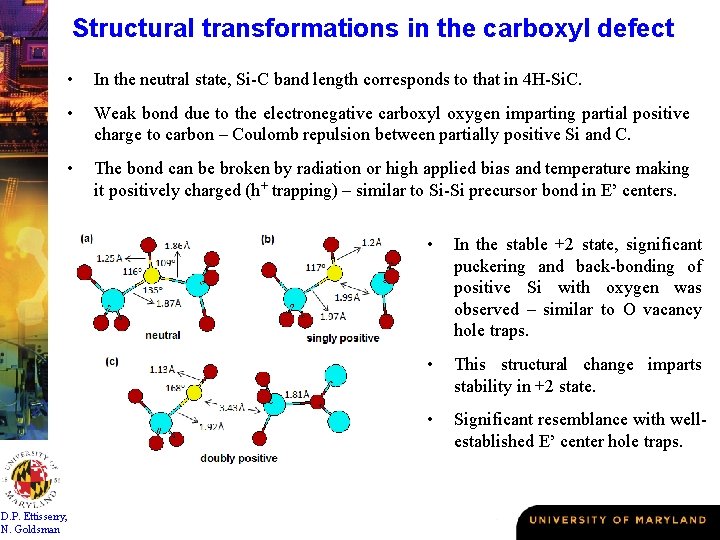
Structural transformations in the carboxyl defect • In the neutral state, Si-C band length corresponds to that in 4 H-Si. C. • Weak bond due to the electronegative carboxyl oxygen imparting partial positive charge to carbon – Coulomb repulsion between partially positive Si and C. • The bond can be broken by radiation or high applied bias and temperature making it positively charged (h+ trapping) – similar to Si-Si precursor bond in E’ centers. D. P. Ettisserry, N. Goldsman • In the stable +2 state, significant puckering and back-bonding of positive Si with oxygen was observed – similar to O vacancy hole traps. • This structural change imparts stability in +2 state. • Significant resemblance with wellestablished E’ center hole traps.
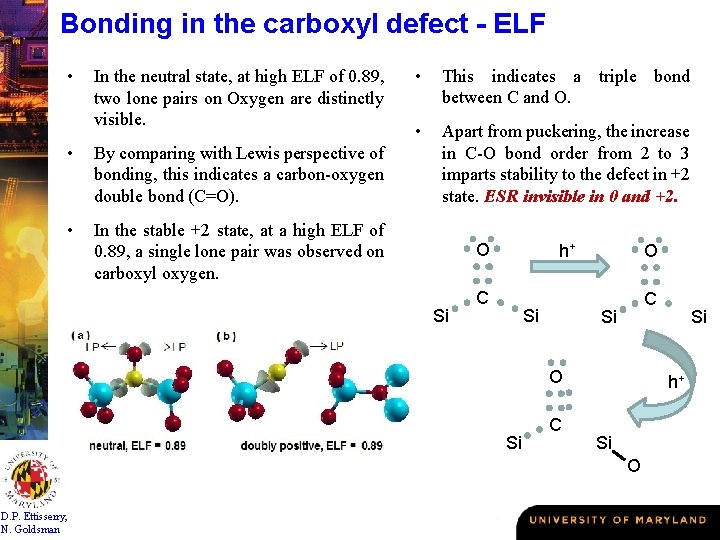
Bonding in the carboxyl defect - ELF • In the neutral state, at high ELF of 0. 89, two lone pairs on Oxygen are distinctly visible. • By comparing with Lewis perspective of bonding, this indicates a carbon-oxygen double bond (C=O). • In the stable +2 state, at a high ELF of 0. 89, a single lone pair was observed on carboxyl oxygen. • This indicates a triple bond between C and O. • Apart from puckering, the increase in C-O bond order from 2 to 3 imparts stability to the defect in +2 state. ESR invisible in 0 and +2. O Si h+ C Si O Si C h+ Si O D. P. Ettisserry, N. Goldsman Si
• Mobility degradation in 4 H-Si. C MOSFETs • Drift Diffusion simulation of 4 H-Si. C MOSFET. • Algorithm for trap characterization. D. P. Ettisserry, N. Goldsman
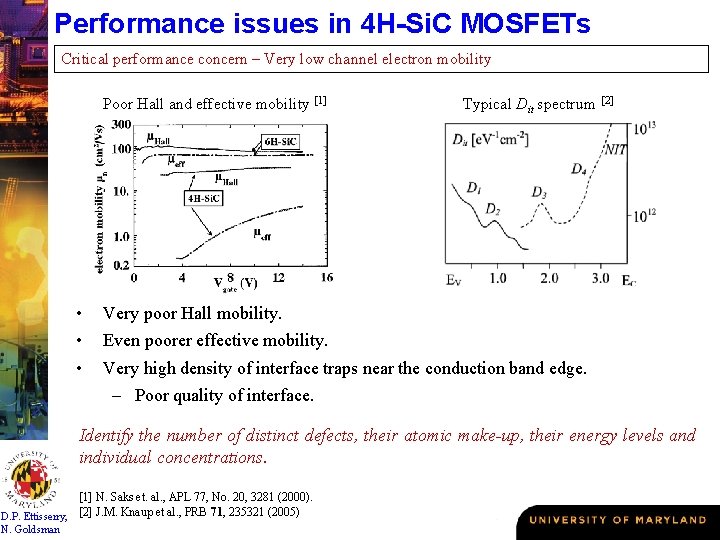
Performance issues in 4 H-Si. C MOSFETs Critical performance concern – Very low channel electron mobility Poor Hall and effective mobility [1] • • • Typical Dit spectrum [2] Very poor Hall mobility. Even poorer effective mobility. Very high density of interface traps near the conduction band edge. – Poor quality of interface. Identify the number of distinct defects, their atomic make-up, their energy levels and individual concentrations. [1] N. Saks et. al. , APL 77, No. 20, 3281 (2000). D. P. Ettisserry, [2] J. M. Knaup et al. , PRB 71, 235321 (2005) N. Goldsman
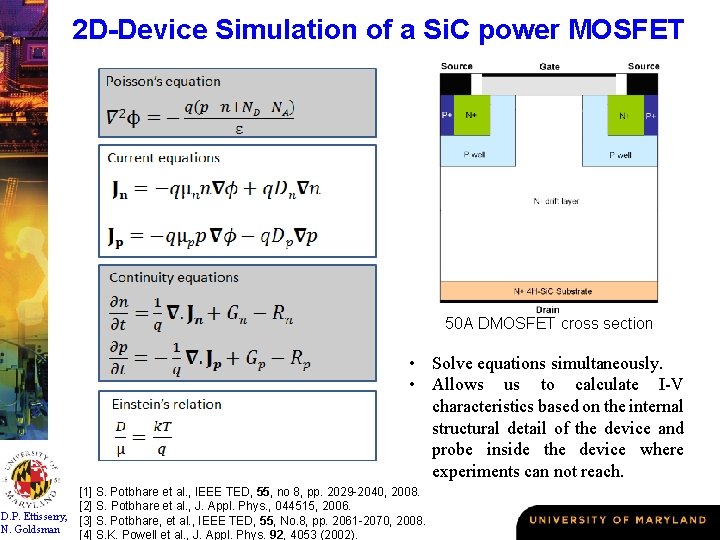
2 D-Device Simulation of a Si. C power MOSFET 50 A DMOSFET cross section • Solve equations simultaneously. • Allows us to calculate I-V characteristics based on the internal structural detail of the device and probe inside the device where experiments can not reach. [1] S. Potbhare et al. , IEEE TED, 55, no 8, pp. 2029 -2040, 2008. [2] S. Potbhare et al. , J. Appl. Phys. , 044515, 2006. D. P. Ettisserry, [3] S. Potbhare, et al. , IEEE TED, 55, No. 8, pp. 2061 -2070, 2008. N. Goldsman [4] S. K. Powell et al. , J. Appl. Phys. 92, 4053 (2002).

Experimentally Verified Mobility Models Bulk Mobility Bulk Phonons and Impurity Scattering Surface Phonon Mobility Doping Coulomb Scattering Mobility Surface Roughness Mobility Step Height Trapped Charge Correlation Length High Field Mobility Saturation Velocity D. P. Ettisserry, N. Goldsman
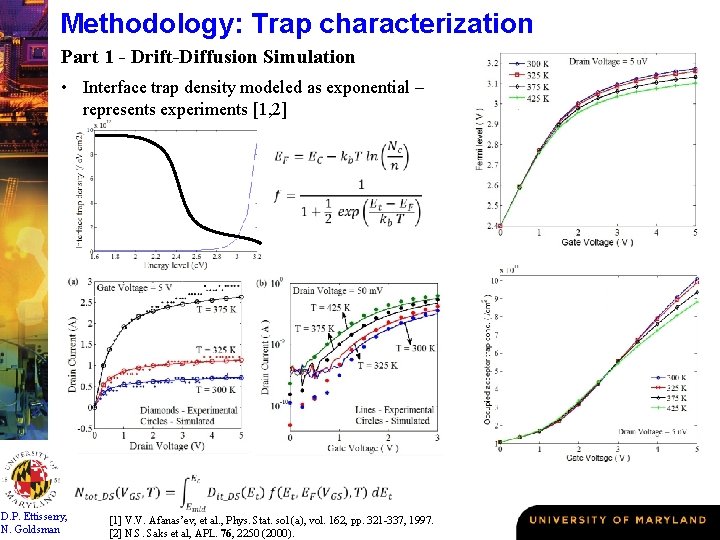
Methodology: Trap characterization Part 1 - Drift-Diffusion Simulation • Interface trap density modeled as exponential – represents experiments [1, 2] D. P. Ettisserry, N. Goldsman [1] V. V. Afanas’ev, et al. , Phys. Stat. sol (a), vol. 162, pp. 321 -337, 1997. [2] N. S. Saks et al, APL. 76, 2250 (2000).
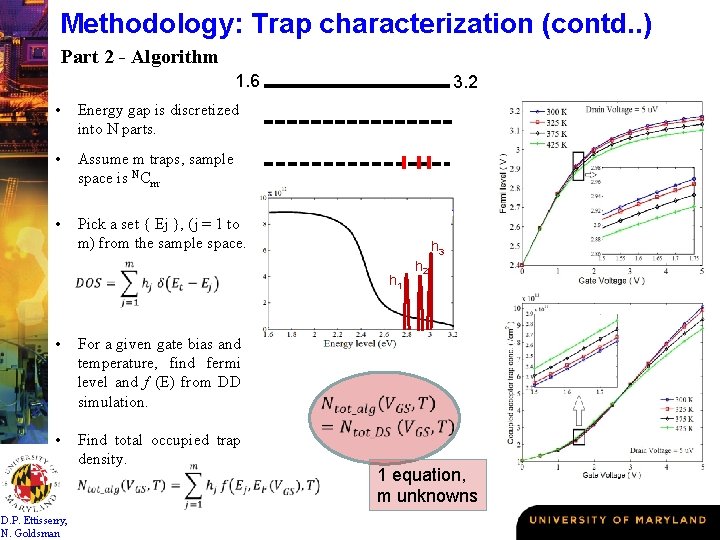
Methodology: Trap characterization (contd. . ) Part 2 - Algorithm 1. 6 • Energy gap is discretized into N parts. • Assume m traps, sample space is NCm. • Pick a set { Ej }, (j = 1 to m) from the sample space. 3. 2 h 3 h 1 • • For a given gate bias and temperature, find fermi level and f (E) from DD simulation. Find total occupied trap density. D. P. Ettisserry, N. Goldsman h 2 1 equation, m unknowns
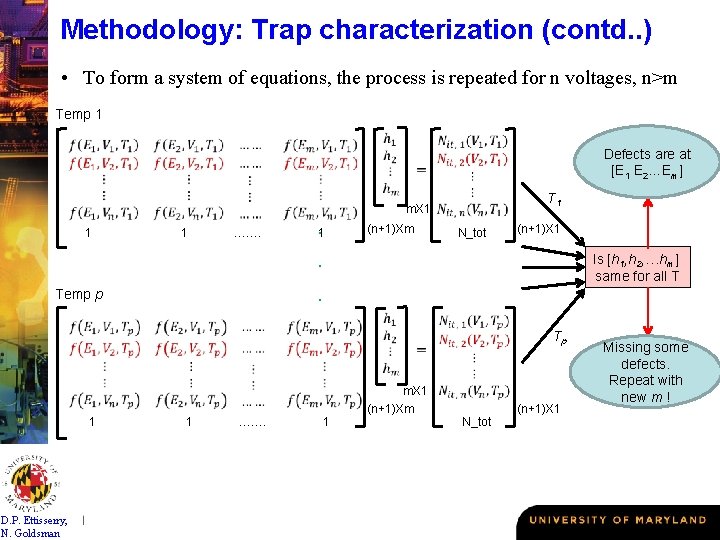
Methodology: Trap characterization (contd. . ) • To form a system of equations, the process is repeated for n voltages, n>m Temp 1 Defects are at [E 1 E 2…Em] T 1 m. X 1 . . . (n+1)Xm 1 1 ……. 1 N_tot Temp p (n+1)X 1 Is [h 1, h 2, …hm] same for all T Tp m. X 1 (n+1)Xm 1 1 ……. 1 N_tot D. P. Ettisserry, N. Goldsman (n+1)X 1 Missing some defects. Repeat with new m !
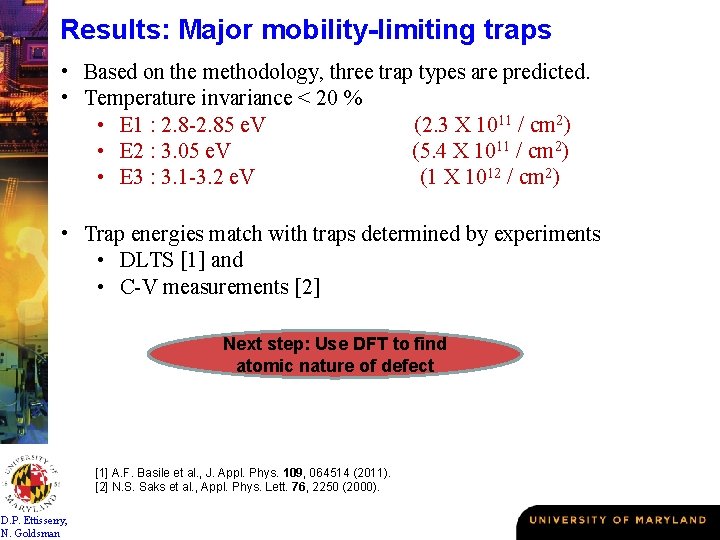
Results: Major mobility-limiting traps • Based on the methodology, three trap types are predicted. • Temperature invariance < 20 % • E 1 : 2. 8 -2. 85 e. V (2. 3 X 10¹¹ / cm 2) • E 2 : 3. 05 e. V (5. 4 X 10¹¹ / cm 2) • E 3 : 3. 1 -3. 2 e. V (1 X 10¹² / cm 2) • Trap energies match with traps determined by experiments • DLTS [1] and • C-V measurements [2] Next step: Use DFT to find atomic nature of defect [1] A. F. Basile et al. , J. Appl. Phys. 109, 064514 (2011). [2] N. S. Saks et al. , Appl. Phys. Lett. 76, 2250 (2000). D. P. Ettisserry, N. Goldsman
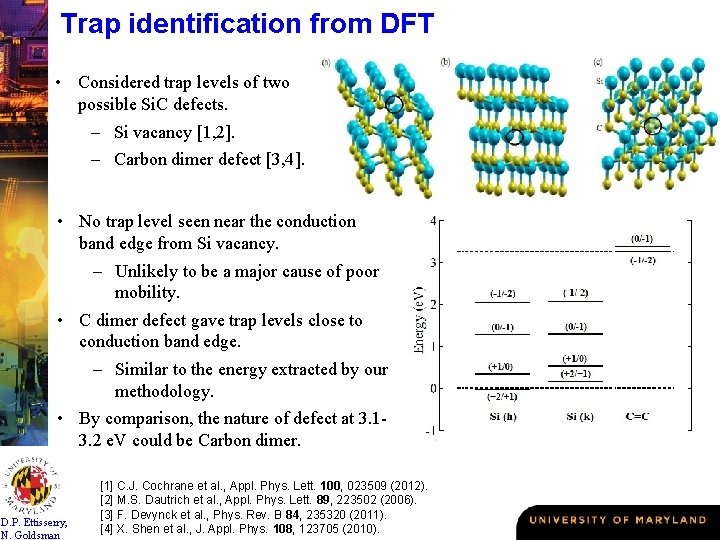
Trap identification from DFT • Considered trap levels of two possible Si. C defects. – Si vacancy [1, 2]. – Carbon dimer defect [3, 4]. • No trap level seen near the conduction band edge from Si vacancy. – Unlikely to be a major cause of poor mobility. • C dimer defect gave trap levels close to conduction band edge. – Similar to the energy extracted by our methodology. • By comparison, the nature of defect at 3. 13. 2 e. V could be Carbon dimer. D. P. Ettisserry, N. Goldsman [1] C. J. Cochrane et al. , Appl. Phys. Lett. 100, 023509 (2012). [2] M. S. Dautrich et al. , Appl. Phys. Lett. 89, 223502 (2006). [3] F. Devynck et al. , Phys. Rev. B 84, 235320 (2011). [4] X. Shen et al. , J. Appl. Phys. 108, 123705 (2010).
Overall summary • Unified Density functional theory with device modeling techniques. – Can solve practical problems encountered by semiconductor device physicists and process engineers. • Reliability and mobility models in semiconductor devices. • Proposed a methodology that combines drift-diffusion simulation and density functional theory to predict: – The existence of three types of mobility reducing defect in Si. C/Si. O 2 interface. – High density of interface trapping likely from Carbon dimer defects in Si. C side of the interface. D. P. Ettisserry, N. Goldsman

Thank you, Questions? D. P. Ettisserry, N. Goldsman
Backup slides
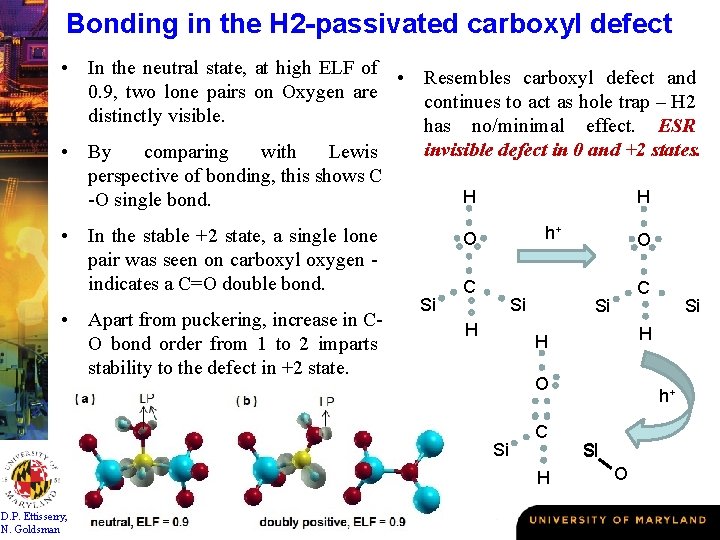
Bonding in the H 2 -passivated carboxyl defect • In the neutral state, at high ELF of • Resembles carboxyl defect and 0. 9, two lone pairs on Oxygen are continues to act as hole trap – H 2 distinctly visible. has no/minimal effect. ESR invisible defect in 0 and +2 states. • By comparing with Lewis perspective of bonding, this shows C H H -O single bond. • In the stable +2 state, a single lone pair was seen on carboxyl oxygen indicates a C=O double bond. • Apart from puckering, increase in CO bond order from 1 to 2 imparts stability to the defect in +2 state. h+ O Si C Si H C Si O C H Si H H Si D. P. Ettisserry, N. Goldsman O h+ Si O
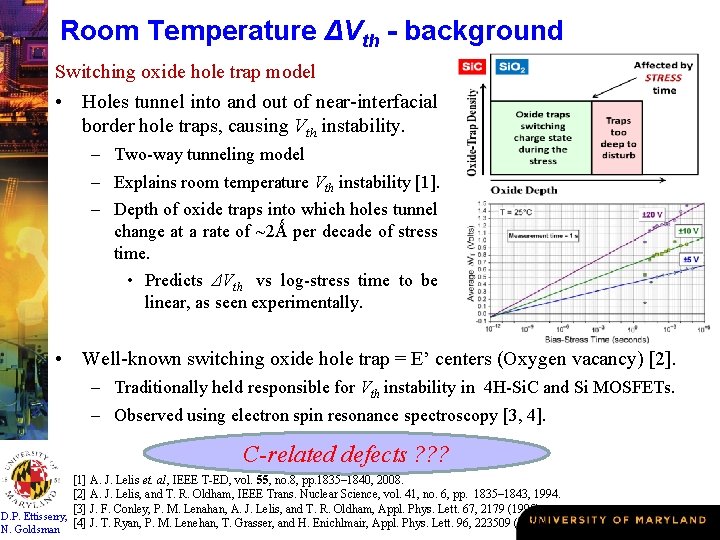
Room Temperature ΔVth - background Switching oxide hole trap model • Holes tunnel into and out of near-interfacial border hole traps, causing Vth instability. – Two-way tunneling model – Explains room temperature Vth instability [1]. – Depth of oxide traps into which holes tunnel change at a rate of ~2Ǻ per decade of stress time. • Predicts ΔVth vs log-stress time to be linear, as seen experimentally. • Well-known switching oxide hole trap = E’ centers (Oxygen vacancy) [2]. – Traditionally held responsible for Vth instability in 4 H-Si. C and Si MOSFETs. – Observed using electron spin resonance spectroscopy [3, 4]. C-related defects ? ? ? [1] A. J. Lelis et. al, IEEE T-ED, vol. 55, no. 8, pp. 1835– 1840, 2008. [2] A. J. Lelis, and T. R. Oldham, IEEE Trans. Nuclear Science, vol. 41, no. 6, pp. 1835– 1843, 1994. [3] J. F. Conley, P. M. Lenahan, A. J. Lelis, and T. R. Oldham, Appl. Phys. Lett. 67, 2179 (1995). D. P. Ettisserry, [4] J. T. Ryan, P. M. Lenehan, T. Grasser, and H. Enichlmair, Appl. Phys. Lett. 96, 223509 (2010). N. Goldsman
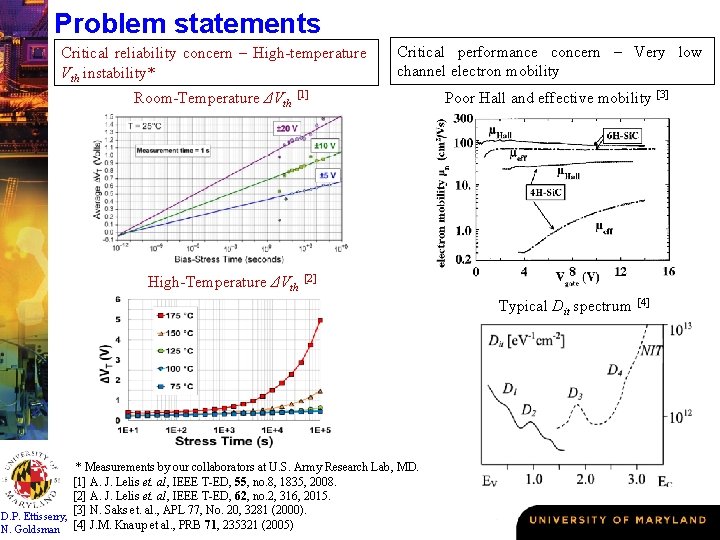
Problem statements Critical reliability concern – High-temperature Vth instability* Room-Temperature ΔVth Critical performance concern – Very low channel electron mobility [1] High-Temperature ΔVth Poor Hall and effective mobility [3] [2] Typical Dit spectrum * Measurements by our collaborators at U. S. Army Research Lab, MD. [1] A. J. Lelis et. al, IEEE T-ED, 55, no. 8, 1835, 2008. [2] A. J. Lelis et. al, IEEE T-ED, 62, no. 2, 316, 2015. [3] N. Saks et. al. , APL 77, No. 20, 3281 (2000). D. P. Ettisserry, N. Goldsman [4] J. M. Knaup et al. , PRB 71, 235321 (2005) [4]
Nitric Oxide Diffusion D. P. Ettisserry, N. Goldsman
Bandgap alignment D. P. Ettisserry, N. Goldsman
Thermal transitions between OV configurations D. P. Ettisserry, N. Goldsman Activation barrier calculations
Room Temperature ΔVth - background Switching oxide hole trap model • Holes tunnel into and out of near-interfacial border hole traps, causing Vth instability. – Two-way tunneling model – Explains room temperature Vth instability [1]. – Depth of oxide traps into which holes tunnel change at a rate of ~2Ǻ per decade of stress time. • Predicts ΔVth vs log-stress time to be linear, as seen experimentally. • Well-known switching oxide hole trap = E’ centers (Oxygen vacancy) [2]. – Traditionally held responsible for Vth instability in 4 H-Si. C and Si MOSFETs. – Observed using electron spin resonance spectroscopy [3, 4]. C-related defects ? ? ? D. P. Ettisserry, N. Goldsman [1] A. J. Lelis et. al, IEEE T-ED, vol. 55, no. 8, pp. 1835– 1840, 2008. [2] A. J. Lelis, and T. R. Oldham, IEEE Trans. Nuclear Science, vol. 41, no. 6, pp. 1835– 1843, 1994. [3] J. F. Conley, P. M. Lenahan, A. J. Lelis, and T. R. Oldham, Appl. Phys. Lett. 67, 2179 (1995). [4] J. T. Ryan, P. M. Lenehan, T. Grasser, and H. Enichlmair, Appl. Phys. Lett. 96, 223509 (2010).
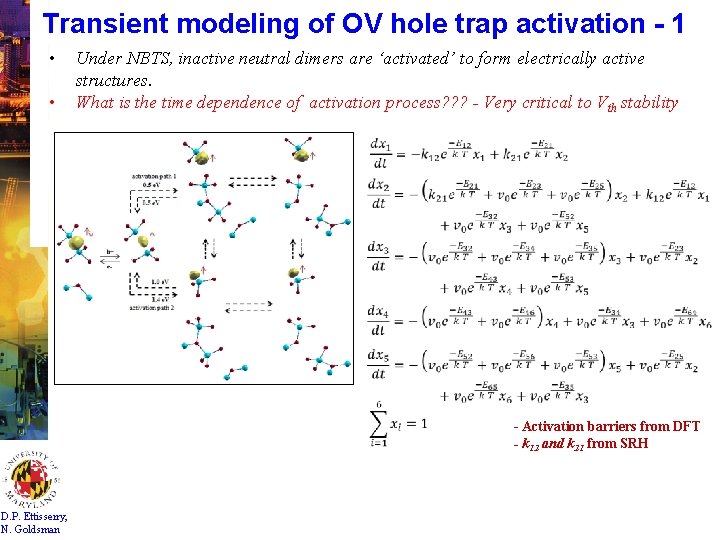
Transient modeling of OV hole trap activation - 1 • • Under NBTS, inactive neutral dimers are ‘activated’ to form electrically active structures. What is the time dependence of activation process? ? ? - Very critical to Vth stability D. P. Ettisserry, N. Goldsman - Activation barriers from DFT - k 12 and k 21 from SRH
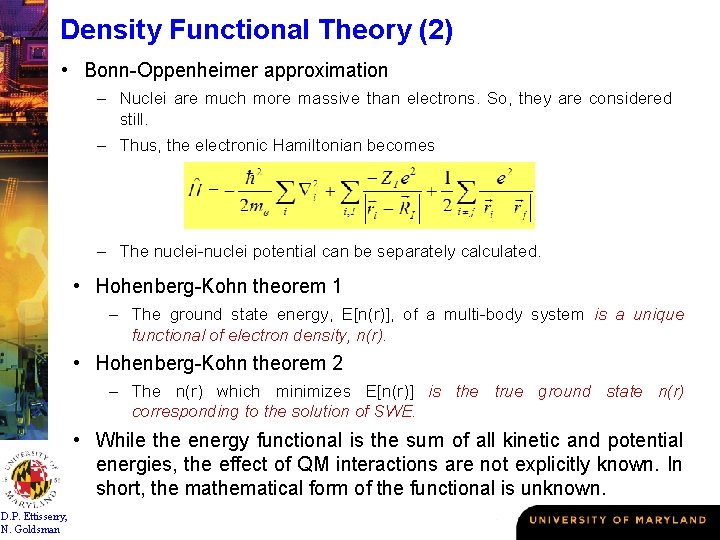
Density Functional Theory (2) • Bonn-Oppenheimer approximation – Nuclei are much more massive than electrons. So, they are considered still. – Thus, the electronic Hamiltonian becomes – The nuclei-nuclei potential can be separately calculated. • Hohenberg-Kohn theorem 1 – The ground state energy, E[n(r)], of a multi-body system is a unique functional of electron density, n(r). • Hohenberg-Kohn theorem 2 – The n(r) which minimizes E[n(r)] is the true ground state n(r) corresponding to the solution of SWE. • While the energy functional is the sum of all kinetic and potential energies, the effect of QM interactions are not explicitly known. In short, the mathematical form of the functional is unknown. D. P. Ettisserry, N. Goldsman
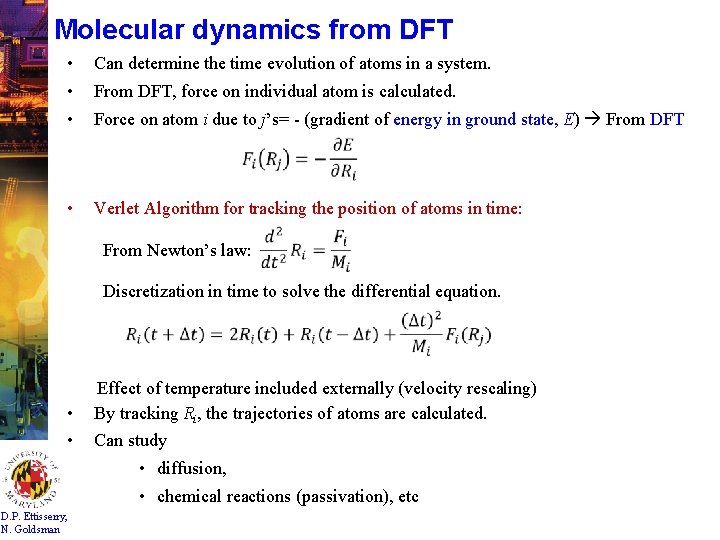
Molecular dynamics from DFT • • • Can determine the time evolution of atoms in a system. From DFT, force on individual atom is calculated. Force on atom i due to j’s= - (gradient of energy in ground state, E) From DFT • Verlet Algorithm for tracking the position of atoms in time: From Newton’s law: Discretization in time to solve the differential equation. • • Effect of temperature included externally (velocity rescaling) By tracking Ri, the trajectories of atoms are calculated. Can study • diffusion, • chemical reactions (passivation), etc D. P. Ettisserry, N. Goldsman
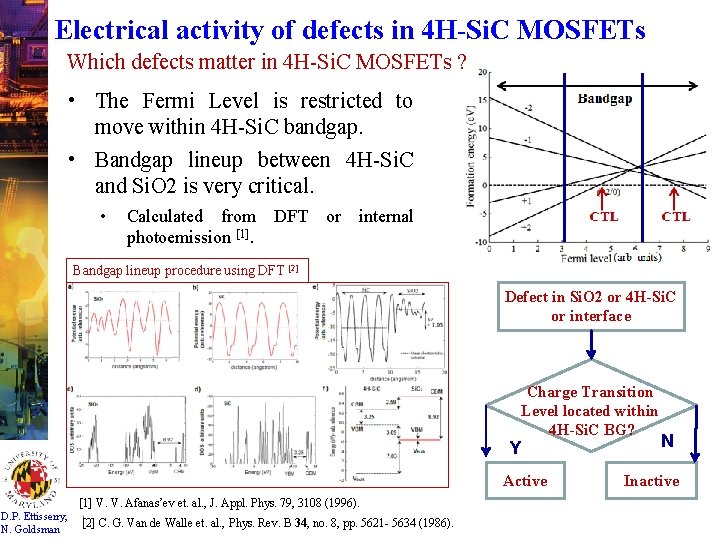
Electrical activity of defects in 4 H-Si. C MOSFETs Which defects matter in 4 H-Si. C MOSFETs ? • The Fermi Level is restricted to move within 4 H-Si. C bandgap. • Bandgap lineup between 4 H-Si. C and Si. O 2 is very critical. • Calculated from DFT or internal photoemission [1]. Bandgap lineup procedure using DFT [2] Defect in Si. O 2 or 4 H-Si. C or interface Y Charge Transition Level located within 4 H-Si. C BG? Active [1] V. V. Afanas’ev et. al. , J. Appl. Phys. 79, 3108 (1996). D. P. Ettisserry, N. Goldsman [2] C. G. Van de Walle et. al. , Phys. Rev. B 34, no. 8, pp. 5621 - 5634 (1986). N Inactive
Density Functional Theory D. P. Ettisserry, N. Goldsman
Density Functional Theory - Flow D. P. Ettisserry, N. Goldsman
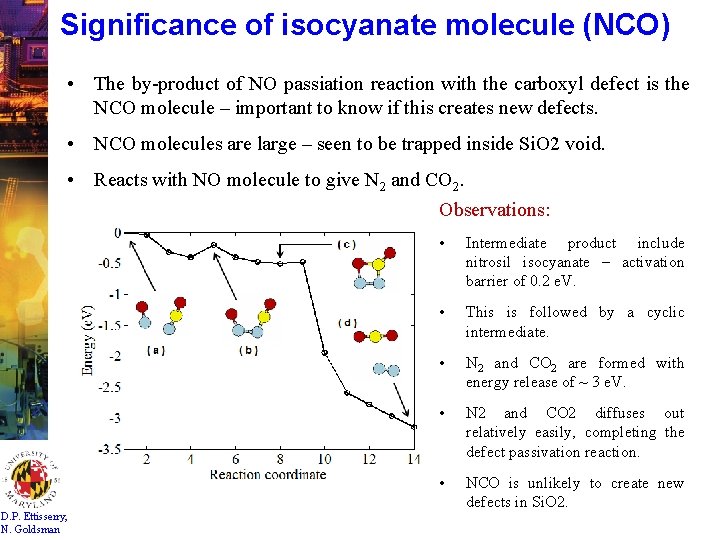
Significance of isocyanate molecule (NCO) • The by-product of NO passiation reaction with the carboxyl defect is the NCO molecule – important to know if this creates new defects. • NCO molecules are large – seen to be trapped inside Si. O 2 void. • Reacts with NO molecule to give N 2 and CO 2. Observations: D. P. Ettisserry, N. Goldsman • Intermediate product include nitrosil isocyanate – activation barrier of 0. 2 e. V. • This is followed by a cyclic intermediate. • N 2 and CO 2 are formed with energy release of ~ 3 e. V. • N 2 and CO 2 diffuses out relatively easily, completing the defect passivation reaction. • NCO is unlikely to create new defects in Si. O 2.
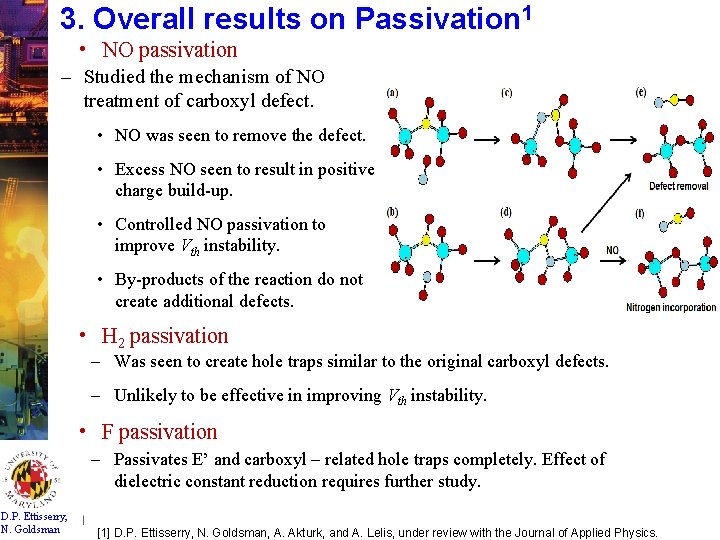
3. Overall results on Passivation 1 • NO passivation – Studied the mechanism of NO treatment of carboxyl defect. • NO was seen to remove the defect. • Excess NO seen to result in positive charge build-up. • Controlled NO passivation to improve Vth instability. • By-products of the reaction do not create additional defects. • H 2 passivation – Was seen to create hole traps similar to the original carboxyl defects. – Unlikely to be effective in improving Vth instability. • F passivation – Passivates E’ and carboxyl – related hole traps completely. Effect of dielectric constant reduction requires further study. D. P. Ettisserry, N. Goldsman [1] D. P. Ettisserry, N. Goldsman, A. Akturk, and A. Lelis, under review with the Journal of Applied Physics.
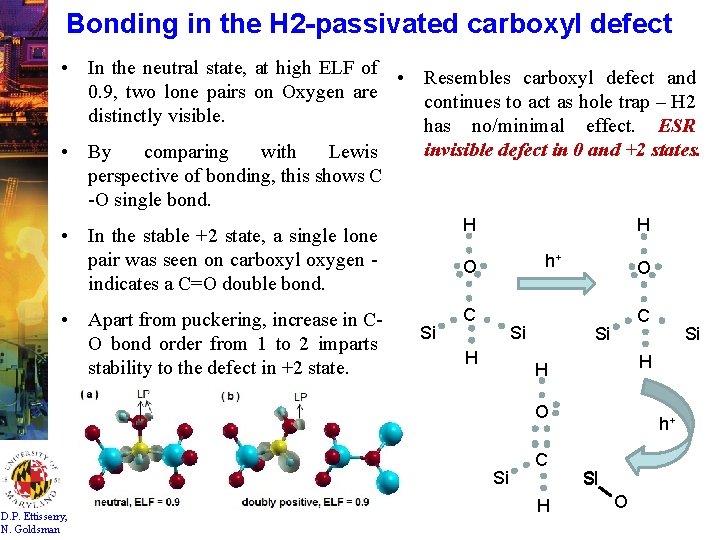
Bonding in the H 2 -passivated carboxyl defect • In the neutral state, at high ELF of • Resembles carboxyl defect and 0. 9, two lone pairs on Oxygen are continues to act as hole trap – H 2 distinctly visible. has no/minimal effect. ESR invisible defect in 0 and +2 states. • By comparing with Lewis perspective of bonding, this shows C -O single bond. • In the stable +2 state, a single lone pair was seen on carboxyl oxygen indicates a C=O double bond. H • Apart from puckering, increase in CO bond order from 1 to 2 imparts stability to the defect in +2 state. C H h+ O Si Si H O C Si H H O Si D. P. Ettisserry, N. Goldsman C H Si h+ Si O
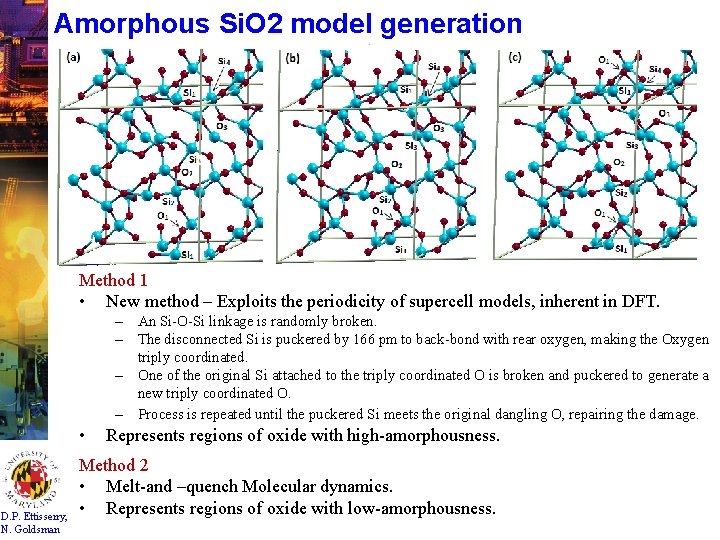
Amorphous Si. O 2 model generation Method 1 • New method – Exploits the periodicity of supercell models, inherent in DFT. – An Si-O-Si linkage is randomly broken. – The disconnected Si is puckered by 166 pm to back-bond with rear oxygen, making the Oxygen triply coordinated. – One of the original Si attached to the triply coordinated O is broken and puckered to generate a new triply coordinated O. – Process is repeated until the puckered Si meets the original dangling O, repairing the damage. • D. P. Ettisserry, N. Goldsman Represents regions of oxide with high-amorphousness. Method 2 • Melt-and –quench Molecular dynamics. • Represents regions of oxide with low-amorphousness.
Important considerations • In theory, one could form infinite number of equations in the overdetermined system – but works only for carefully chosen low voltages. • To minimize errors, the algorithm is applied at low voltages. Ø Voltages at which the equations are formed are chosen in such a way that change in Fermi level is large (or large f(E)). Ø Also, Trap-filling happens at low voltages. • It should be made sure that the Fermi level is such that it falls in the “region of interest” for traps (in case of Si. C, near conduction band). Limitation: • Cannot resolve mid-gap trap energies. Ø All the mid-gap traps are fully occupied even at low gate bias due to large Si. C/Si. O 2 work-function difference.
![Electron Localization Function [1] from DFT • Chemical bonding can be studied using Electron](http://slidetodoc.com/presentation_image_h/0c506899783c1c5cccf0e2b23e41799c/image-59.jpg "Electron Localization Function [1] from DFT • Chemical bonding can be studied using Electron")
Electron Localization Function [1] from DFT • Chemical bonding can be studied using Electron Localization Function (ELF). • ELF is the conditional probability of finding an electron in the vicinity of another electron with the same spin – gives a measure of Pauli’s exclusion. • Defined such that high ELF implies high electron localization – indicates lone pairs, bonding pairs and dangling bonds. • These different electron localizations occur at local maxima in ELF. • Plotted as isosurfaces at different values to distinctly “see” chemical bonding. • ELF used to study bonding transformations in defects during hole capture – help to identify defect stabilizing mechanisms. [1] B. Silvi and A. Savin, Nature 371, 683– 686 (1994). D. P. Ettisserry, N. Goldsman
![BTS measurements [1] B. Silvi and A. Savin, Nature 371, 683– 686 (1994). D.](http://slidetodoc.com/presentation_image_h/0c506899783c1c5cccf0e2b23e41799c/image-60.jpg "BTS measurements [1] B. Silvi and A. Savin, Nature 371, 683– 686 (1994). D.")
BTS measurements [1] B. Silvi and A. Savin, Nature 371, 683– 686 (1994). D. P. Ettisserry, N. Goldsman
- Slides: 60