
Integrated Modeling for the James Webb Space Telescope
Integrated Modeling for the James Webb Space Telescope (JWST) Project: Structural Analysis Activities Presented by: Mark Mc. Ginnis/Swales Johnston, Gary Mosier, Joe Howard, Tupper Hyde, and Keith Parrish (NASA/GSFC) Kong Ha (Jackson and Tull) Frank Liu and Mark Mc. Ginnis (Swales Aerospace) May 6, 2004
Overview l JWST Overview l Observatory Structural Models l Integrated Performance Analysis: n Performance Budget n Linear Optical Analysis n Structural-Thermal-Optical n Optical jitter dynamics l Future Work and Challenges 10/18/2021 2
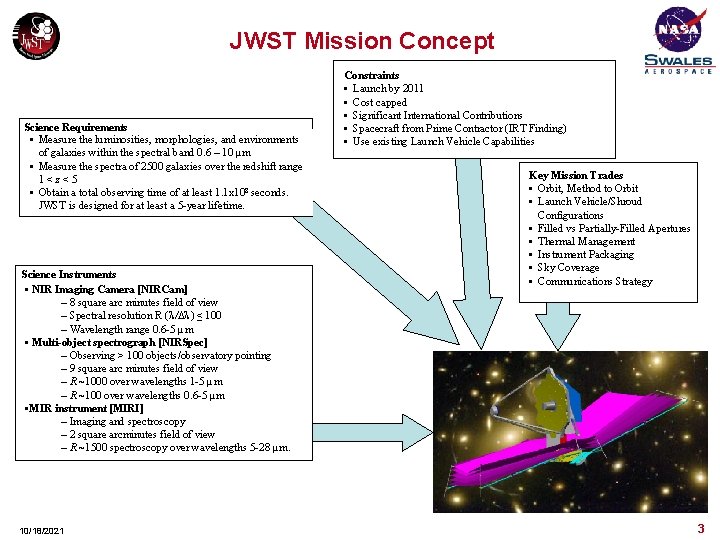
JWST Mission Concept Science Requirements • Measure the luminosities, morphologies, and environments of galaxies within the spectral band 0. 6 – 10 µm • Measure the spectra of 2500 galaxies over the redshift range 1<z<5 • Obtain a total observing time of at least 1. 1 x 10⁸ seconds. JWST is designed for at least a 5 -year lifetime. Science Instruments • NIR Imaging Camera [NIRCam] – 8 square arc minutes field of view – Spectral resolution R (l/Dl) ≤ 100 – Wavelength range 0. 6 -5 µm • Multi-object spectrograph [NIRSpec] – Observing > 100 objects/observatory pointing – 9 square arc minutes field of view – R ~1000 over wavelengths 1 -5 µm – R ~100 over wavelengths 0. 6 -5 µm • MIR instrument [MIRI] – Imaging and spectroscopy – 2 square arcminutes field of view – R ~1500 spectroscopy over wavelengths 5 -28 µm. 10/18/2021 Constraints • Launch by 2011 • Cost capped • Significant International Contributions • Spacecraft from Prime Contractor (IRT Finding) • Use existing Launch Vehicle Capabilities Key Mission Trades • Orbit, Method to Orbit • Launch Vehicle/Shroud Configurations • Filled vs Partially-Filled Apertures • Thermal Management • Instrument Packaging • Sky Coverage • Communications Strategy 3

Observatory Architecture Optical Telescope Element Integrated Science Instrument Module (ISIM) Element Spacecraft Element Sunshield Spacecraft Bus 10/18/2021 4
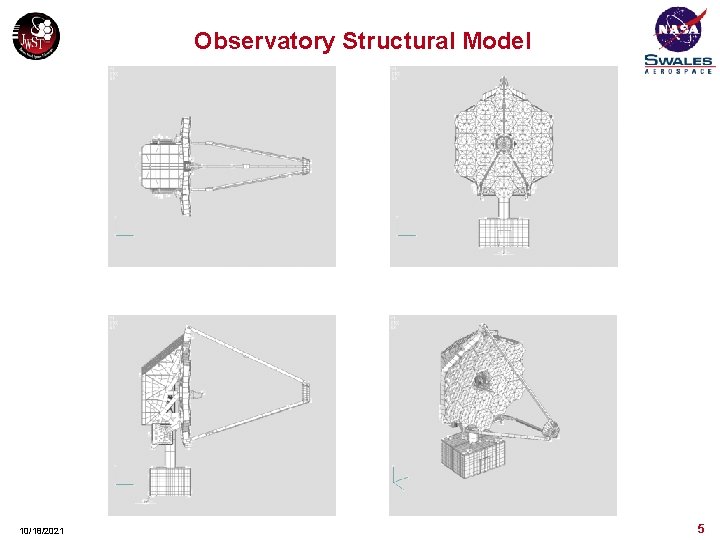
Observatory Structural Model 10/18/2021 5
Integrated Performance Analysis l Overview n Multi-disciplinary analysis • Thermal, Optical, GN&C, and Structural • Tight requirements drive the project toward more integrated analysis n Performance budget • Northrup-Grumman Space Technology (NGST) has adopted a very detailed optical performance budget allocating wavefront error • Seek to place the project in a position to intelligently comment on this budget as the contractors estimate the telescope’s performance n Linear optical model • MATLAB-based tool to allow non-optical engineers to estimate wavefront error l Baseline Analyses: n n 10/18/2021 STOP Jitter 6
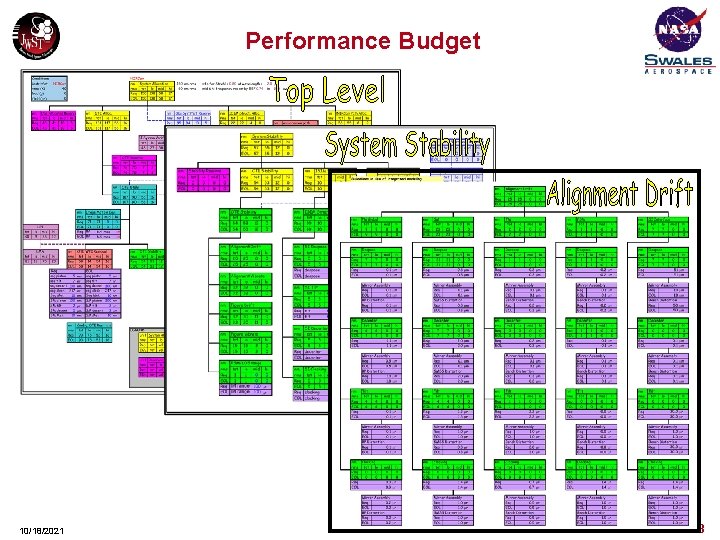
Performance Budget l NGST allocates and tracks optical performance with a spreadsheet l Rooted in project Strehl ratio and Encircled Energy requirements n Calculations translate these into total allowable WFE • Allocated into 3 spatial-frequency bands (cycles/aperture) • Allocations for both beginning and end of life l Two main branches divisions at top level n Active control n Stability l Geometry errors of optics divided into “figure” and “alignment” l Temporal performance is allocated to either “drift” or “vibrate” l Lowest-level requirements often related to equivalent mechanical requirements 10/18/2021 7
Performance Budget 10/18/2021 8
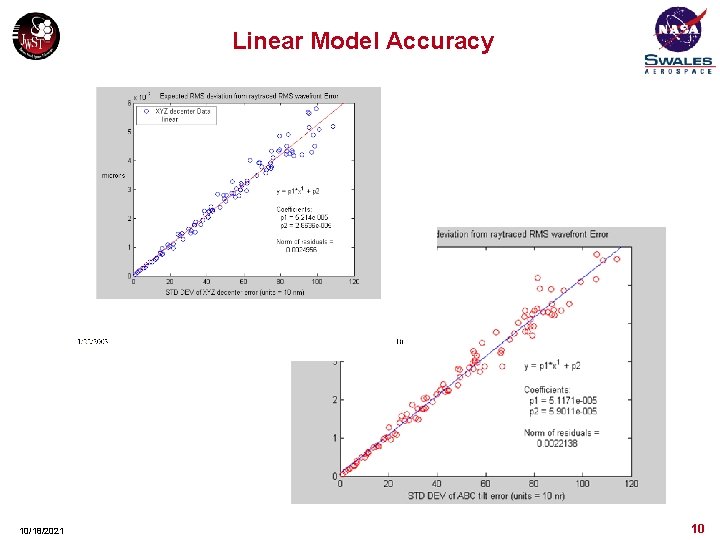
Linear Optical Analysis l Provides accurate estimate of OPD wavefront error for perturbed systems (within the limits of the model) l Coefficients created by ray-tracing runs in OSLO n 10 nm (nrad) motion introduced in each of optical DOF n 100 x 100 array showing OPD at exit pupil generated in MATLAB for each optical perturbation l Arrays scaled and summed in MATLAB based on actual motion in each of the 132 DOF 10/18/2021 n Displacements multiplied by appropriate array n OPD maps summed n FSM manipulated to minimize RMS wavefront error n Results are reported as “Best Fit Plane” with global piston offset removed 9
Linear Model Accuracy 10/18/2021 10
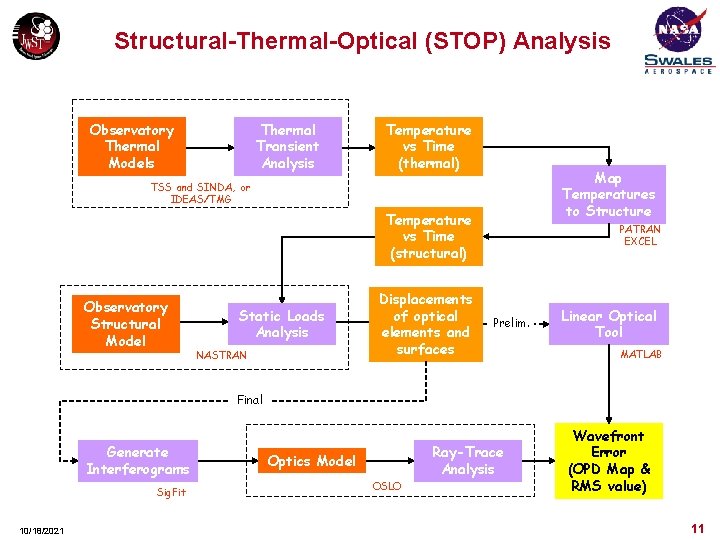
Structural-Thermal-Optical (STOP) Analysis Observatory Thermal Models Thermal Transient Analysis Temperature vs Time (thermal) Map Temperatures to Structure TSS and SINDA, or IDEAS/TMG Temperature vs Time (structural) Observatory Structural Model Static Loads Analysis NASTRAN Displacements of optical elements and surfaces PATRAN EXCEL Prelim. Linear Optical Tool MATLAB Final Generate Interferograms Sig. Fit 10/18/2021 Ray-Trace Analysis Optics Model OSLO Wavefront Error (OPD Map & RMS value) 11
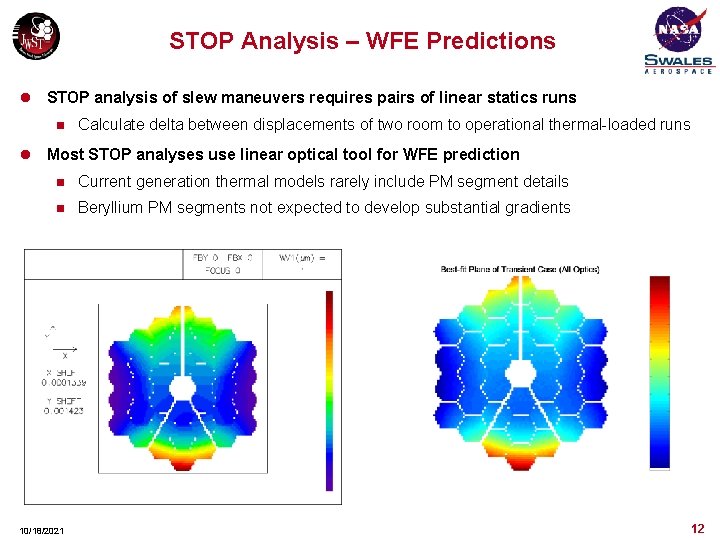
STOP Analysis – WFE Predictions l STOP analysis of slew maneuvers requires pairs of linear statics runs n Calculate delta between displacements of two room to operational thermal-loaded runs l Most STOP analyses use linear optical tool for WFE prediction n Current generation thermal models rarely include PM segment details n Beryllium PM segments not expected to develop substantial gradients 10/18/2021 12
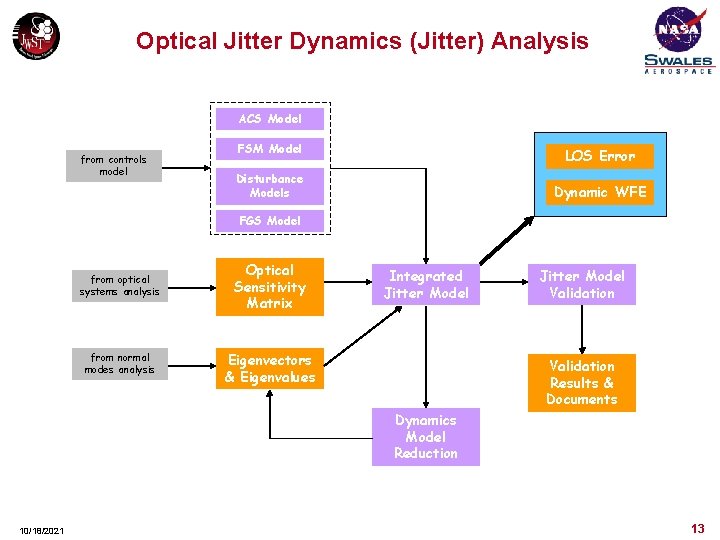
Optical Jitter Dynamics (Jitter) Analysis ACS Model from controls model FSM Model LOS Error Disturbance Models Dynamic WFE FGS Model from optical systems analysis Optical Sensitivity Matrix from normal modes analysis Eigenvectors & Eigenvalues Integrated Jitter Model Validation Results & Documents Dynamics Model Reduction 10/18/2021 13
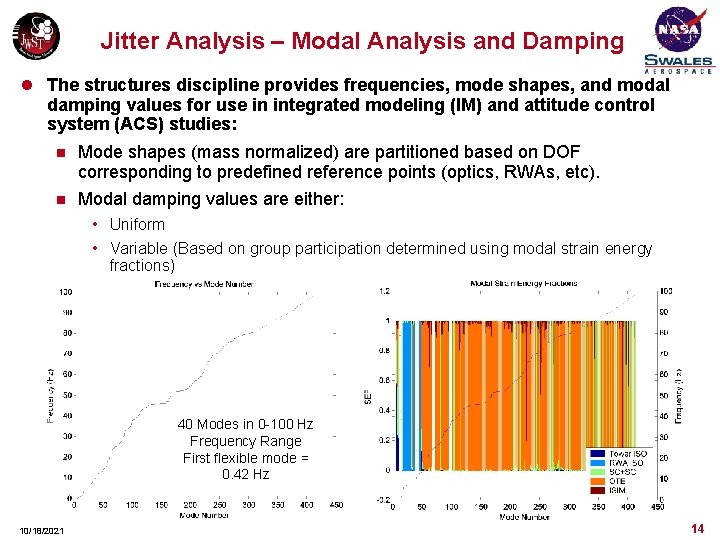
Jitter Analysis – Modal Analysis and Damping l The structures discipline provides frequencies, mode shapes, and modal damping values for use in integrated modeling (IM) and attitude control system (ACS) studies: n Mode shapes (mass normalized) are partitioned based on DOF corresponding to predefined reference points (optics, RWAs, etc). n Modal damping values are either: • Uniform • Variable (Based on group participation determined using modal strain energy fractions) 40 Modes in 0 -100 Hz Frequency Range First flexible mode = 0. 42 Hz 10/18/2021 14
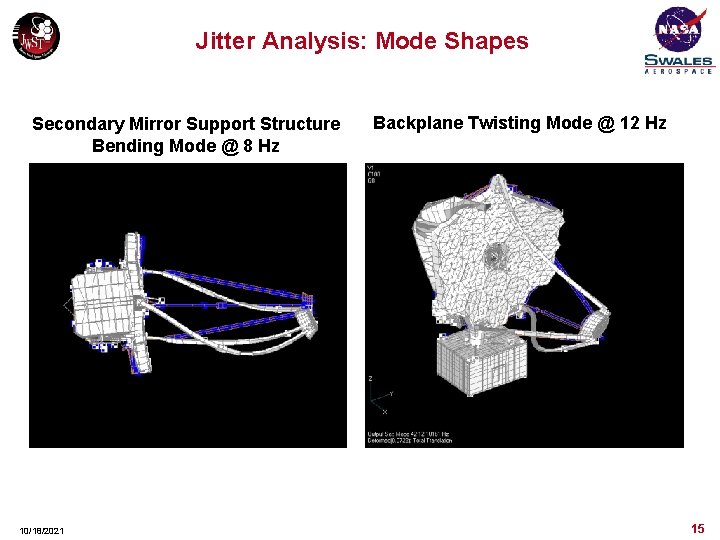
Jitter Analysis: Mode Shapes Secondary Mirror Support Structure Bending Mode @ 8 Hz 10/18/2021 Backplane Twisting Mode @ 12 Hz 15
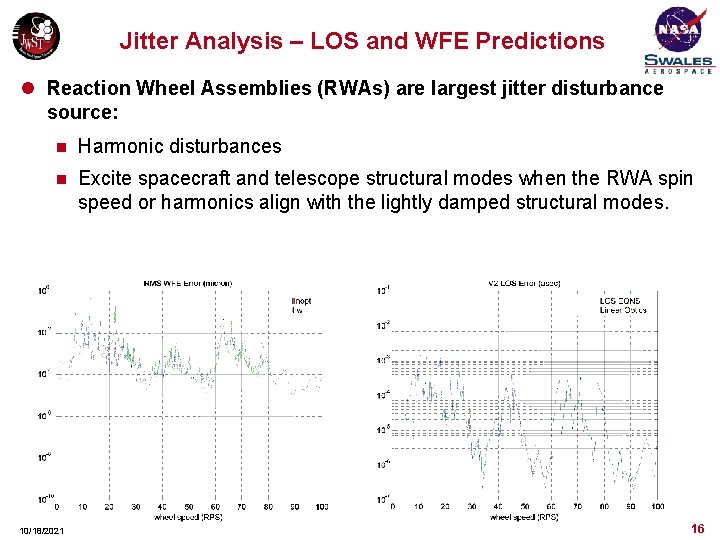
Jitter Analysis – LOS and WFE Predictions l Reaction Wheel Assemblies (RWAs) are largest jitter disturbance source: n Harmonic disturbances n Excite spacecraft and telescope structural modes when the RWA spin speed or harmonics align with the lightly damped structural modes. 10/18/2021 16
Challenges and Future Work l Future Work: n Program plans on following a schedule of analysis cycles: • STOP/Jitter/Launch analyses • First such cycle is underway (6 month duration) n n Need to verify budget allocations by means of integrated modeling Government team performs independent modeling analysis to validate prime contractor • Performance predictions • Requirements placed on subcontractors/partners l Challenges: n Constant pressure exists to create accurate, detailed models while keeping run times tolerable: • Need for high-fidelity (multi-million DOF solid element) structural model anticipated for CDR distortion analysis. • Superelement approaches under investigation n n 10/18/2021 Need to understand sensitivity of results to variations in material properties Need to expand linear optical tool to calculate WFE at multiple field points and FOV locations 17
- Slides: 17