
Integrated Maximum Flow Algorithm for Optimal Response Time
![Parallel Push-relabel Solution: [Hong’ 11]’s Implementation n n Uses the push-relabel technique proposed in](https://slidetodoc.com/presentation_image/2f93189cae50d7b16a5d4c016762455a/image-16.jpg "Parallel Push-relabel Solution: [Hong’ 11]’s Implementation n n Uses the push-relabel technique proposed in")
![References n n n [Altiparmak’ 12] Nihat Altiparmak and A. S¸. Tosun. Generalized optimal](https://slidetodoc.com/presentation_image/2f93189cae50d7b16a5d4c016762455a/image-25.jpg "References n n n [Altiparmak’ 12] Nihat Altiparmak and A. S¸. Tosun. Generalized optimal")

- Slides: 26
Integrated Maximum Flow Algorithm for Optimal Response Time Retrieval of Replicated Data Nihat Altiparmak, Ali Saman Tosun The University of Texas at San Antonio
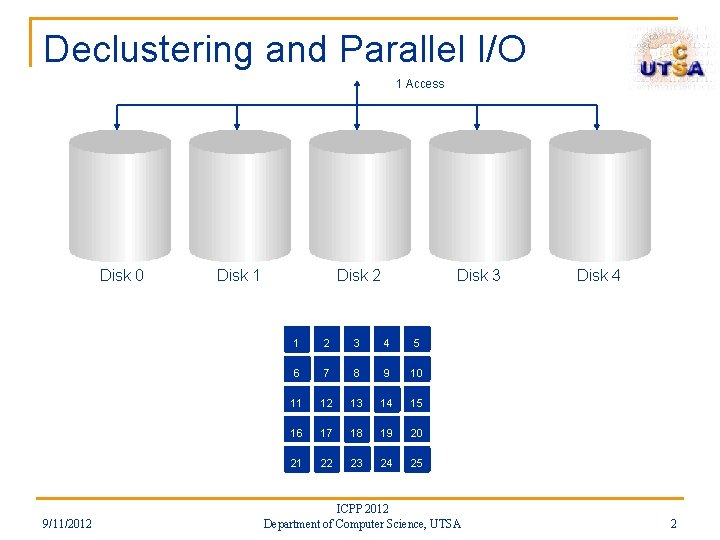
Declustering and Parallel I/O 1 Access Disk 0 Disk 1 Disk 2 01 12 23 34 45 16 27 38 49 10 11 2 12 3 13 4 14 0 15 16 3 17 4 18 0 19 1 20 4 22 0 23 1 24 2 25 21 9/11/2012 Disk 3 Disk 4 0 1 2 3 ICPP 2012 Department of Computer Science, UTSA 2
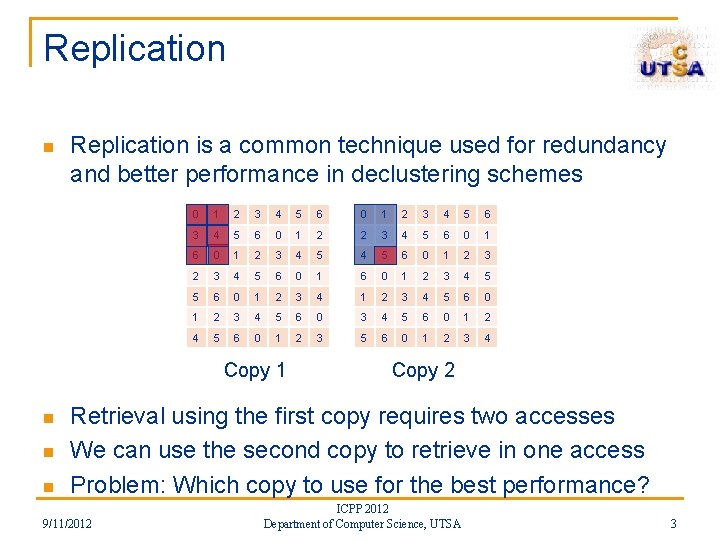
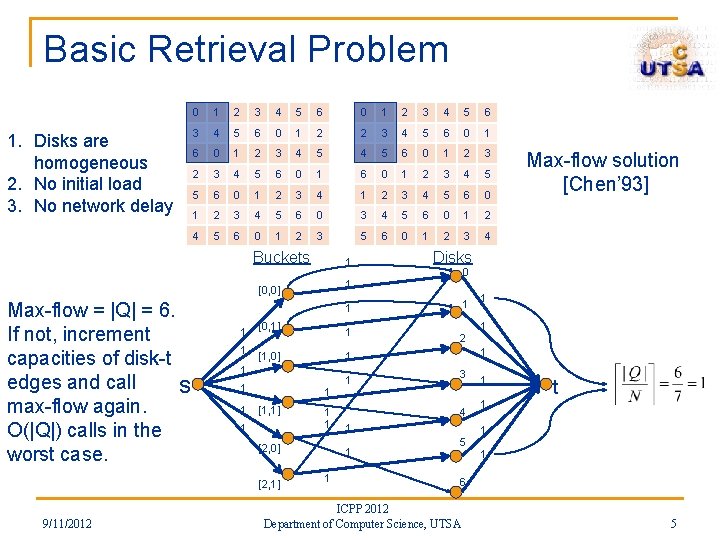
Replication n Replication is a common technique used for redundancy and better performance in declustering schemes 0 1 2 3 4 5 6 0 1 2 2 3 4 5 6 0 1 2 3 4 5 6 0 1 2 3 4 5 6 0 1 2 3 4 5 6 0 1 2 3 4 Copy 1 n n n Copy 2 Retrieval using the first copy requires two accesses We can use the second copy to retrieve in one access Problem: Which copy to use for the best performance? 9/11/2012 ICPP 2012 Department of Computer Science, UTSA 3
Optimal Response Time Retrieval Problem Definition n N disks |Q| buckets Each bucket can be replicated among multiple disks Find a retrieval schedule so that the response time of the query Q is minimized 9/11/2012 ICPP 2012 Department of Computer Science, UTSA 4
Basic Retrieval Problem 1. Disks are homogeneous 2. No initial load 3. No network delay 0 1 2 3 4 5 6 0 1 2 2 3 4 5 6 0 1 2 3 4 5 6 0 1 2 3 4 5 6 0 1 2 3 4 5 6 0 1 2 3 4 Buckets 1 Max-flow = |Q| = 6. If not, increment capacities of disk-t edges and call s max-flow again. O(|Q|) calls in the worst case. 0 1 1 [0, 1] 1 [1, 0] 1 1 1 [1, 1] 1 2 1 1 [2, 0] 1 1 3 4 1 1 1 1 [2, 1] 9/11/2012 Disks 1 [0, 0] Max-flow solution [Chen’ 93] 5 1 1 t 1 1 6 ICPP 2012 Department of Computer Science, UTSA 5
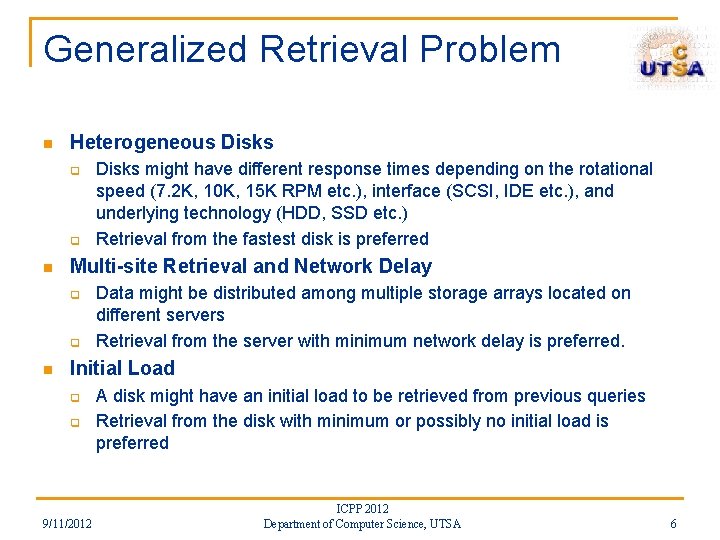
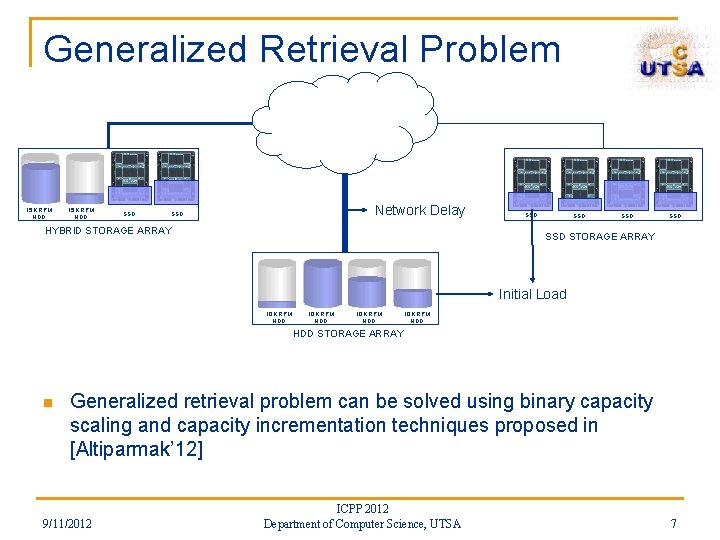
Generalized Retrieval Problem n Heterogeneous Disks q q n Multi-site Retrieval and Network Delay q q n Disks might have different response times depending on the rotational speed (7. 2 K, 10 K, 15 K RPM etc. ), interface (SCSI, IDE etc. ), and underlying technology (HDD, SSD etc. ) Retrieval from the fastest disk is preferred Data might be distributed among multiple storage arrays located on different servers Retrieval from the server with minimum network delay is preferred. Initial Load q q 9/11/2012 A disk might have an initial load to be retrieved from previous queries Retrieval from the disk with minimum or possibly no initial load is preferred ICPP 2012 Department of Computer Science, UTSA 6
Generalized Retrieval Problem 15 K RPM HDD SSD Network Delay SSD HYBRID STORAGE ARRAY SSD SSD SSD STORAGE ARRAY Initial Load 10 K RPM HDD HDD STORAGE ARRAY n Generalized retrieval problem can be solved using binary capacity scaling and capacity incrementation techniques proposed in [Altiparmak’ 12] 9/11/2012 ICPP 2012 Department of Computer Science, UTSA 7
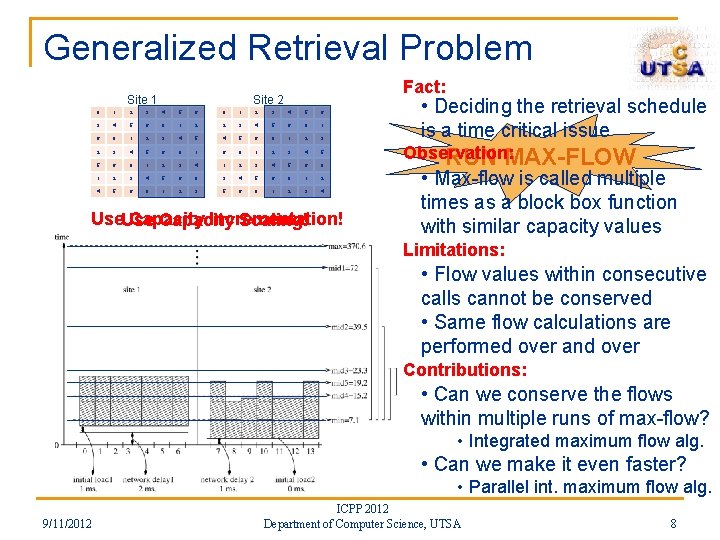
Generalized Retrieval Problem Site 1 Fact: Site 2 0 1 2 3 4 5 6 0 1 2 2 3 4 5 6 0 1 2 3 4 5 6 0 1 2 3 4 5 6 0 1 2 3 4 5 6 0 1 2 3 4 Use Capacity Incrementation! Capacity Scaling! • Deciding the retrieval schedule is a time critical issue Observation: RUN MAX-FLOW • Max-flow is called multiple times as a block box function with similar capacity values Limitations: • Flow values within consecutive calls cannot be conserved • Same flow calculations are performed over and over Contributions: • Can we conserve the flows within multiple runs of max-flow? • Integrated maximum flow alg. • Can we make it even faster? • Parallel int. maximum flow alg. 9/11/2012 ICPP 2012 Department of Computer Science, UTSA 8
Talk Outline n n n Motivation and Background Ford-Fulkerson Based Solution Push-relabel Based Solution Parallel Push-relabel Solution Evaluation Conclusion 9/11/2012 ICPP 2012 Department of Computer Science, UTSA 9
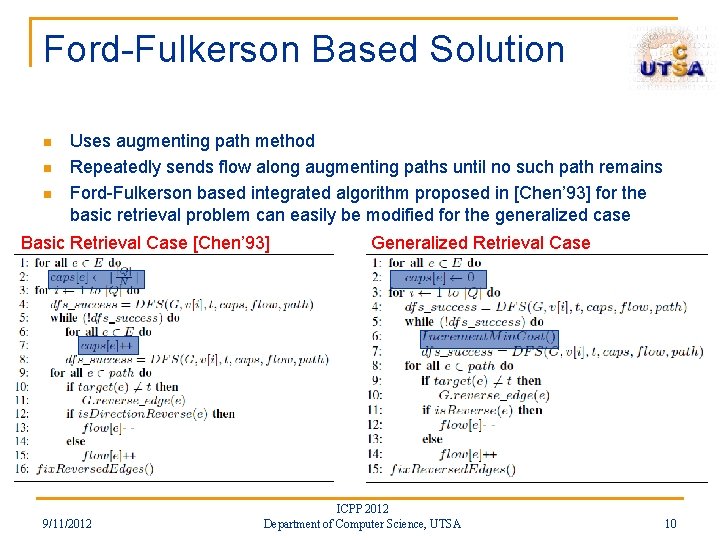
Ford-Fulkerson Based Solution n Uses augmenting path method Repeatedly sends flow along augmenting paths until no such path remains Ford-Fulkerson based integrated algorithm proposed in [Chen’ 93] for the basic retrieval problem can easily be modified for the generalized case Basic Retrieval Case [Chen’ 93] 9/11/2012 Generalized Retrieval Case ICPP 2012 Department of Computer Science, UTSA 10
Talk Outline n n n Motivation and Background Ford-Fulkerson Based Solution Push-relabel Based Solution Parallel Push-relabel Solution Evaluation Conclusion 9/11/2012 ICPP 2012 Department of Computer Science, UTSA 11
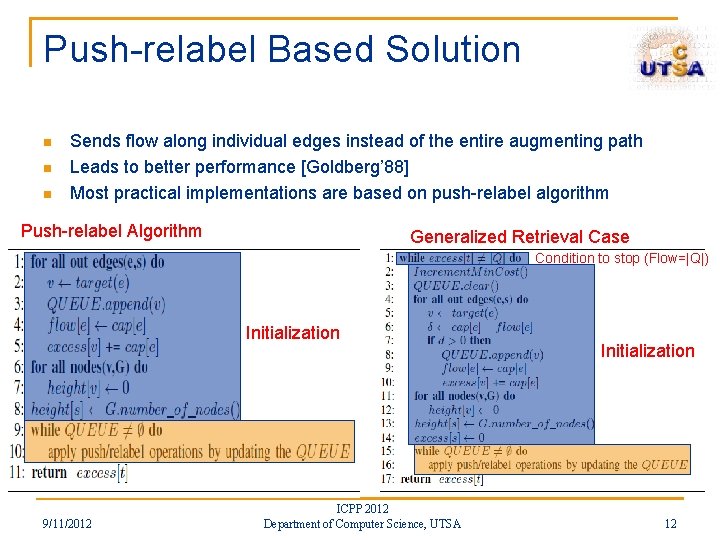
Push-relabel Based Solution n Sends flow along individual edges instead of the entire augmenting path Leads to better performance [Goldberg’ 88] Most practical implementations are based on push-relabel algorithm Push-relabel Algorithm Generalized Retrieval Case Condition to stop (Flow=|Q|) Initialization 9/11/2012 ICPP 2012 Department of Computer Science, UTSA Initialization 12
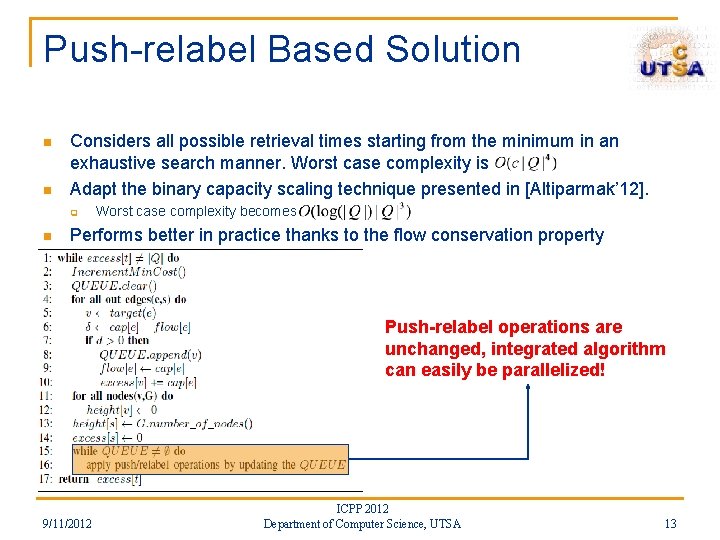
Push-relabel Based Solution n n Considers all possible retrieval times starting from the minimum in an exhaustive search manner. Worst case complexity is Adapt the binary capacity scaling technique presented in [Altiparmak’ 12]. q n Worst case complexity becomes Performs better in practice thanks to the flow conservation property Push-relabel operations are unchanged, integrated algorithm can easily be parallelized! 9/11/2012 ICPP 2012 Department of Computer Science, UTSA 13
Talk Outline n n n Motivation and Background Ford-Fulkerson Based Solution Push-relabel Based Solution Parallel Push-relabel Solution Evaluation Conclusion 9/11/2012 ICPP 2012 Department of Computer Science, UTSA 14
Parallel Push-relabel Solution n Most new generation storage arrays are powered with multi-core processors q n n We can reduce the computation time further by using parallel push-relabel implementation Many parallel push-relabel algorithms are proposed q n EMC Symmetrix VMAX has four Quad-core 2. 33 GHz Intel Xeon Processors [Goldberg’ 88], [Anderson’ 92], [Bader’ 05], [Hong’ 11] Most recent implementation in [Hong’ 11] claims to outperform others. 9/11/2012 ICPP 2012 Department of Computer Science, UTSA 15
Parallel Push-relabel Solution: [Hong’ 11]’s Implementation n n Uses the push-relabel technique proposed in [Goldberg’ 88] Multiple processes/threads do not need any locks or barriers to protect the push and relabel operations Each thread independently determines its own termination without using any locks or barriers Requires atomic read-modify-write instructions q n n Shared flow and excess values are updated by multiple threads using atomic operations Complexity: We use [Hong’ 11]’s implementation for our parallel pushrelabel based solution 9/11/2012 ICPP 2012 Department of Computer Science, UTSA 16
Talk Outline n n n Motivation and Background Ford-Fulkerson Based Solution Push-relabel Based Solution Parallel Push-relabel Solution Evaluation Conclusion 9/11/2012 ICPP 2012 Department of Computer Science, UTSA 17
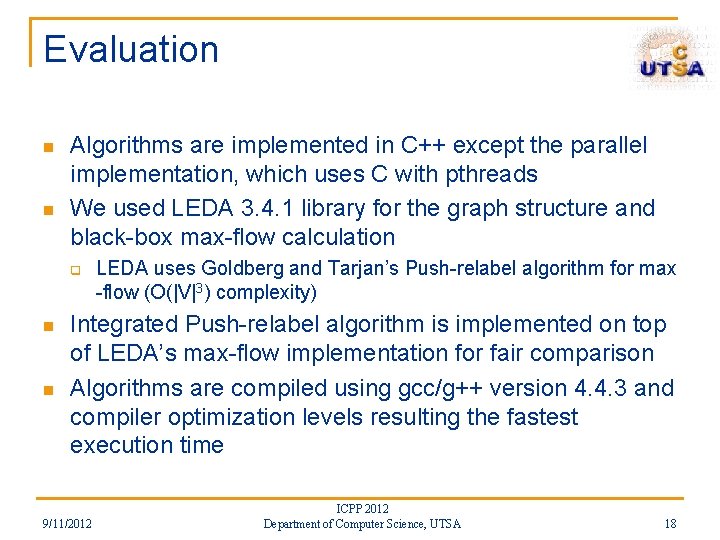
Evaluation n n Algorithms are implemented in C++ except the parallel implementation, which uses C with pthreads We used LEDA 3. 4. 1 library for the graph structure and black-box max-flow calculation q n n LEDA uses Goldberg and Tarjan’s Push-relabel algorithm for max -flow (O(|V|3) complexity) Integrated Push-relabel algorithm is implemented on top of LEDA’s max-flow implementation for fair comparison Algorithms are compiled using gcc/g++ version 4. 4. 3 and compiler optimization levels resulting the fastest execution time 9/11/2012 ICPP 2012 Department of Computer Science, UTSA 18
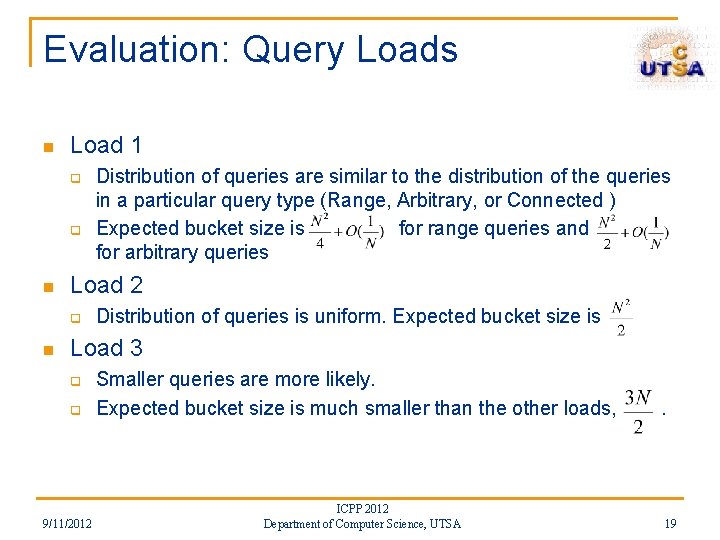
Evaluation: Query Loads n Load 1 q q n Load 2 q n Distribution of queries are similar to the distribution of the queries in a particular query type (Range, Arbitrary, or Connected ) Expected bucket size is for range queries and for arbitrary queries Distribution of queries is uniform. Expected bucket size is Load 3 q q 9/11/2012 Smaller queries are more likely. Expected bucket size is much smaller than the other loads, ICPP 2012 Department of Computer Science, UTSA . 19
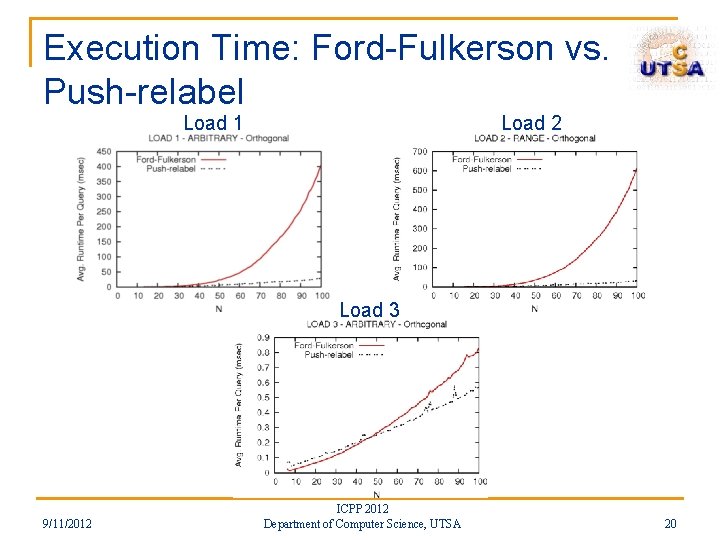
Execution Time: Ford-Fulkerson vs. Push-relabel Load 1 Load 2 Load 3 9/11/2012 ICPP 2012 Department of Computer Science, UTSA 20
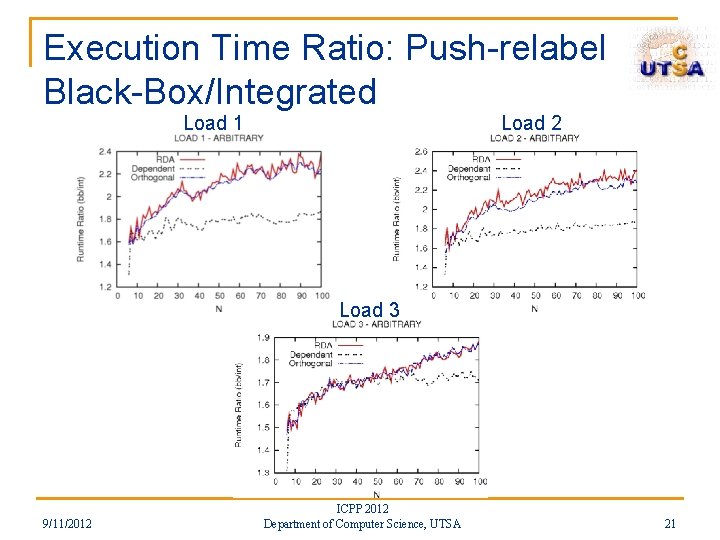
Execution Time Ratio: Push-relabel Black-Box/Integrated Load 1 Load 2 Load 3 9/11/2012 ICPP 2012 Department of Computer Science, UTSA 21
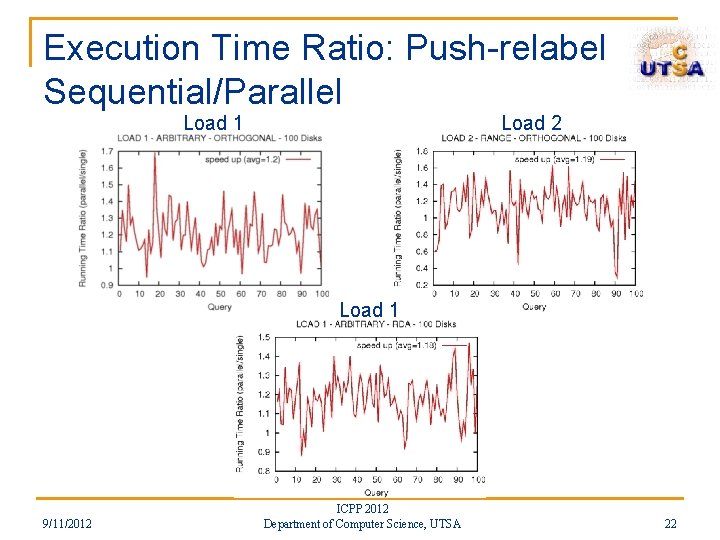
Execution Time Ratio: Push-relabel Sequential/Parallel Load 1 Load 2 Load 1 9/11/2012 ICPP 2012 Department of Computer Science, UTSA 22
Talk Outline n n n Motivation and Background Ford-Fulkerson Based Solution Push-relabel Based Solution Parallel Push-relabel Solution Evaluation Conclusion 9/11/2012 ICPP 2012 Department of Computer Science, UTSA 23
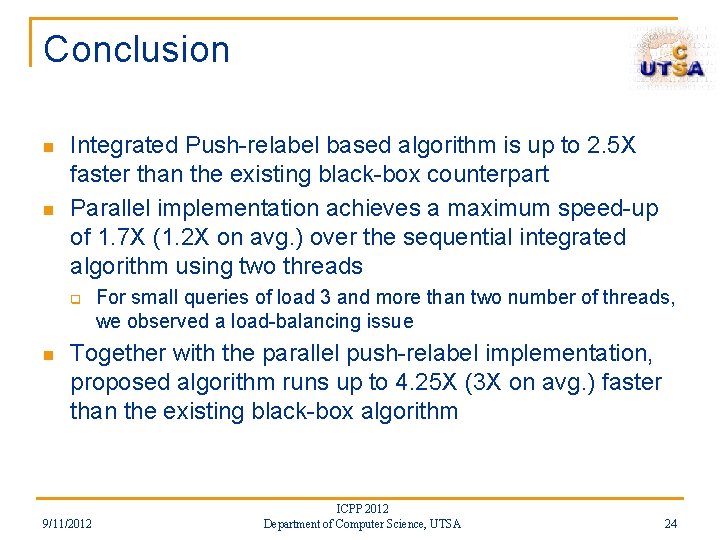
Conclusion n n Integrated Push-relabel based algorithm is up to 2. 5 X faster than the existing black-box counterpart Parallel implementation achieves a maximum speed-up of 1. 7 X (1. 2 X on avg. ) over the sequential integrated algorithm using two threads q n For small queries of load 3 and more than two number of threads, we observed a load-balancing issue Together with the parallel push-relabel implementation, proposed algorithm runs up to 4. 25 X (3 X on avg. ) faster than the existing black-box algorithm 9/11/2012 ICPP 2012 Department of Computer Science, UTSA 24
References n n n [Altiparmak’ 12] Nihat Altiparmak and A. S¸. Tosun. Generalized optimal response time retrieval of replicated data from storage arrays. http: //gozde. cs. utsa. edu/TR 1. pdf, 2012. Technical Report. [Anderson’ 92] Richard J. Anderson and Joao C. Setubal. On the parallel implementation of goldberg’s maximum flow algorithm. In Proceedings of the fourth annual ACM symposium on parallel algorithms and architectures, SPAA’ 92, pages 168– 177, New York, NY, USA, 1992. ACM. [Bader, 05] David A. Bader and Vipin Sachdeva. A cache-aware parallel implementation of the push-relabel network flow algorithm and experimental evaluation of the gap relabeling heuristic. In ISCA PDCS, pages 41– 48, 2005. [31] Bo Hong and Zhengyu He. An asynchronous multithreaded algorithm for the maximum network flow problem with nonblocking global relabeling heuristic. IEEE Transactions on Parallel and Distributed Systems, 22(6): 1025 – 1033, june 2011. [Chen’ 93] L. T. Chen and D. Rotem. Optimal response time retrieval of replicated data. In ACM SIGACT-SIGMOD-SIGART Symposium on Principles of Database Systems, pages 36– 44, 1994. [Goldberg’ 88] Andrew V. Goldberg and Robert E. Tarjan. A new approach to the maximum flow problem. Journal of the ACM, 35: 921– 940, 1988. 9/11/2012 ICPP 2012 Department of Computer Science, UTSA 25
Thank You! Questions? 9/11/2012 ICPP 2012 Department of Computer Science, UTSA 26