
Integrated Management of Whiteflies in Arizona Peter C

- Slides: 30
Integrated Management of Whiteflies in Arizona Peter C. Ellsworth, Ph. D. IPM Specialist, University of Arizona Maricopa, AZ, USA & Steve Naranjo, Ph. D. Research Scientist, USDA-ARS, WCRL Phoenix, AZ, USA Ellsworth/UA
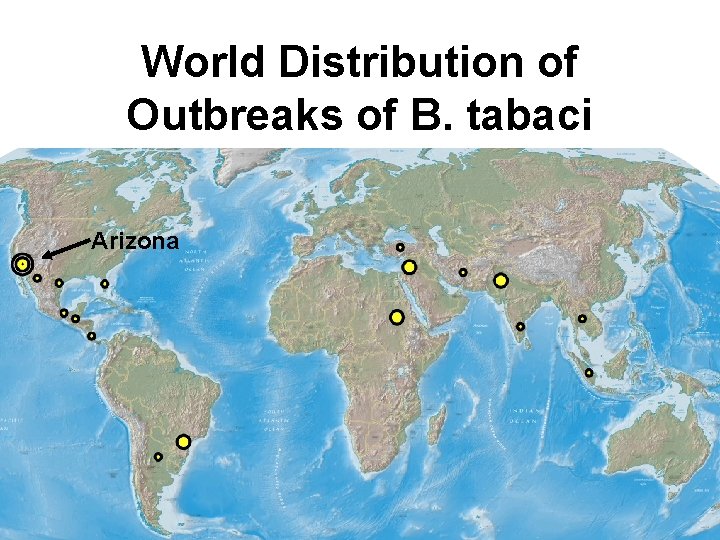
World Distribution of Outbreaks of B. tabaci Arizona Ellsworth/UA
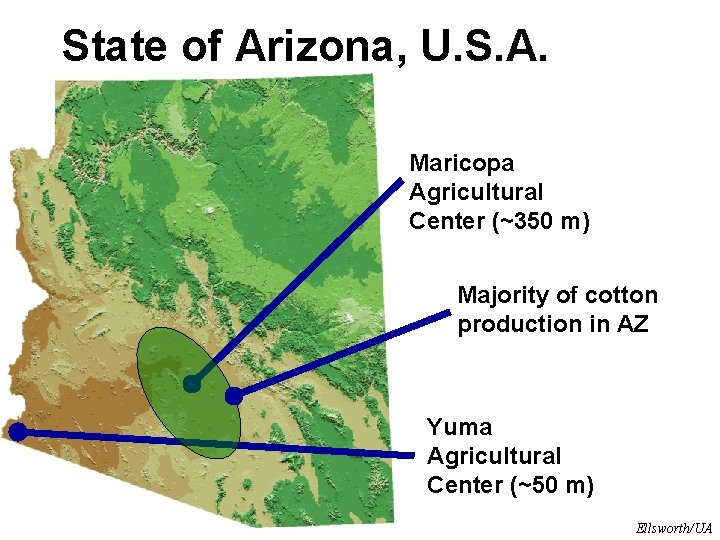
State of Arizona, U. S. A. Maricopa Agricultural Center (~350 m) Majority of cotton production in AZ Yuma Agricultural Center (~50 m) Ellsworth/UA
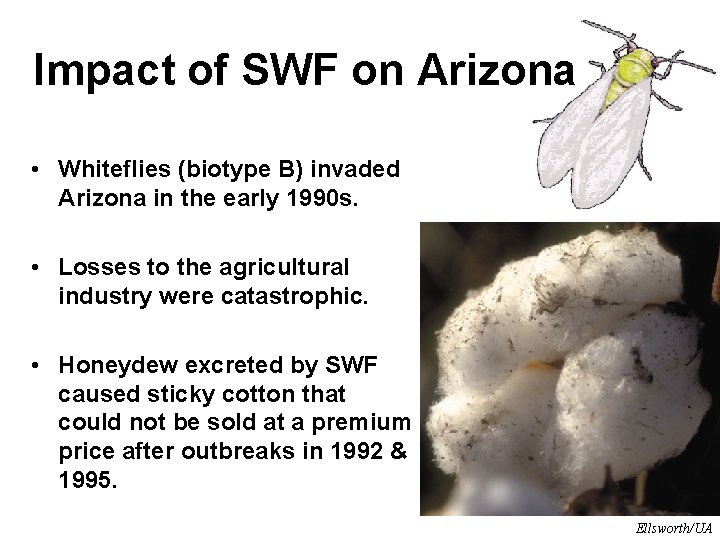
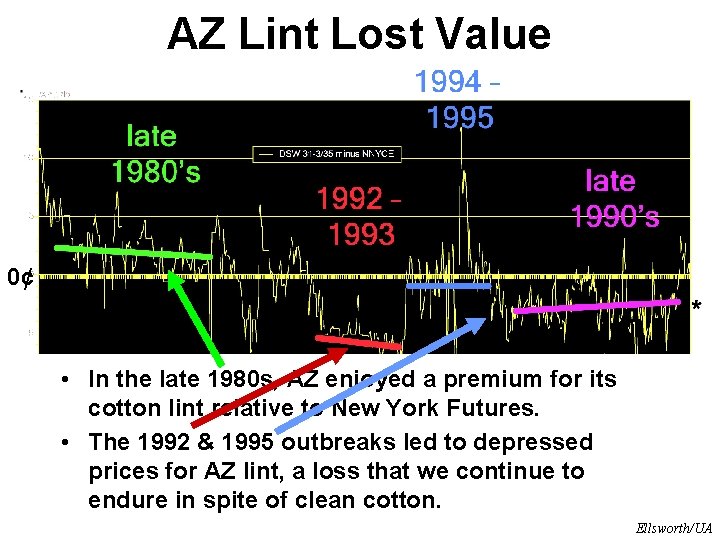
Impact of SWF on Arizona • Whiteflies (biotype B) invaded Arizona in the early 1990 s. • Losses to the agricultural industry were catastrophic. • Honeydew excreted by SWF caused sticky cotton that could not be sold at a premium price after outbreaks in 1992 & 1995. Ellsworth/UA
AZ Lint Lost Value 0¢ • In the late 1980 s, AZ enjoyed a premium for its cotton lint relative to New York Futures. • The 1992 & 1995 outbreaks led to depressed prices for AZ lint, a loss that we continue to endure in spite of clean cotton. Ellsworth/UA
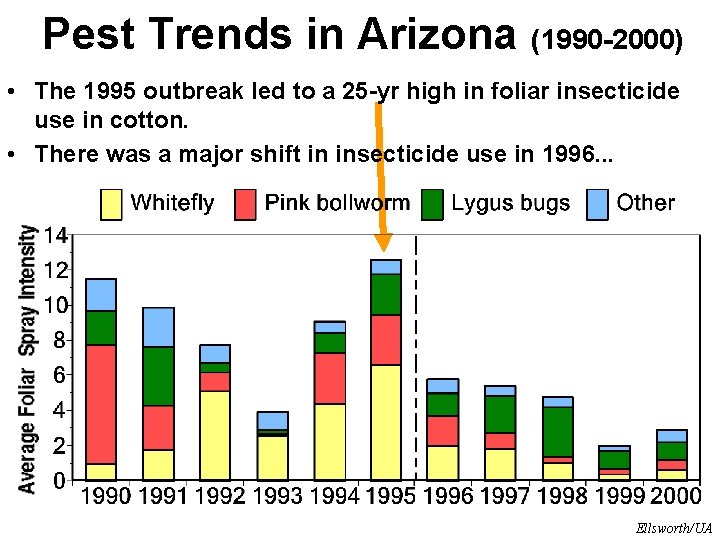
Pest Trends in Arizona (1990 -2000) • The 1995 outbreak led to a 25 -yr high in foliar insecticide use in cotton. • There was a major shift in insecticide use in 1996. . . Ellsworth/UA
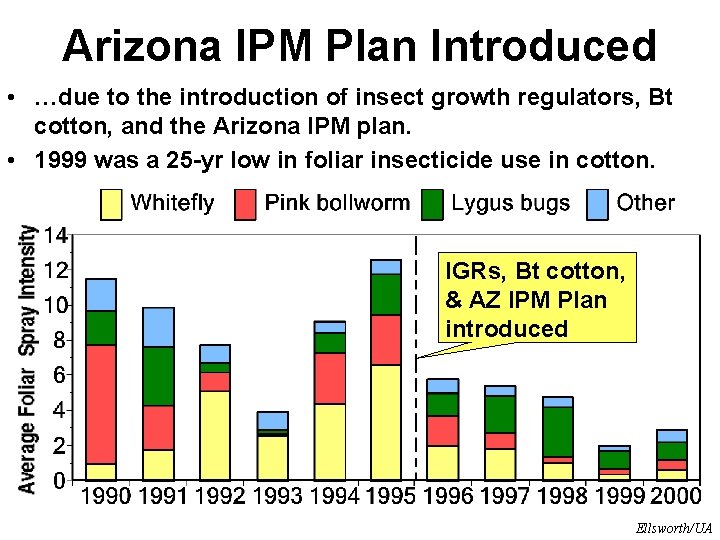
Arizona IPM Plan Introduced • …due to the introduction of insect growth regulators, Bt cotton, and the Arizona IPM plan. • 1999 was a 25 -yr low in foliar insecticide use in cotton. IGRs, Bt cotton, & AZ IPM Plan introduced Ellsworth/UA
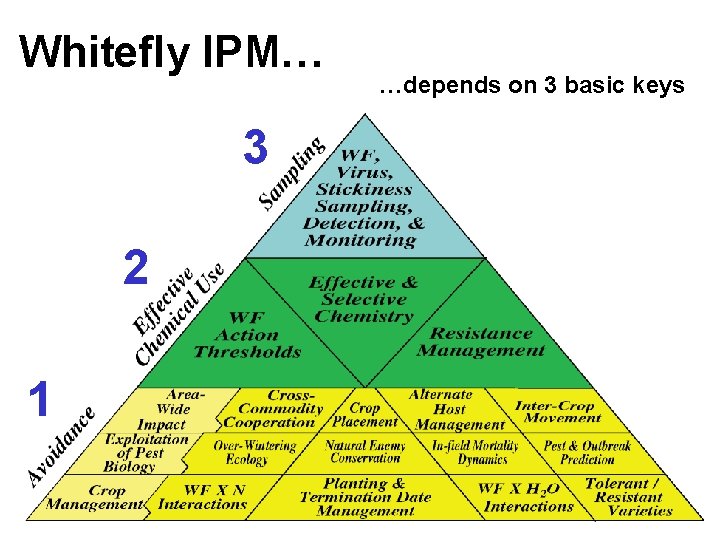
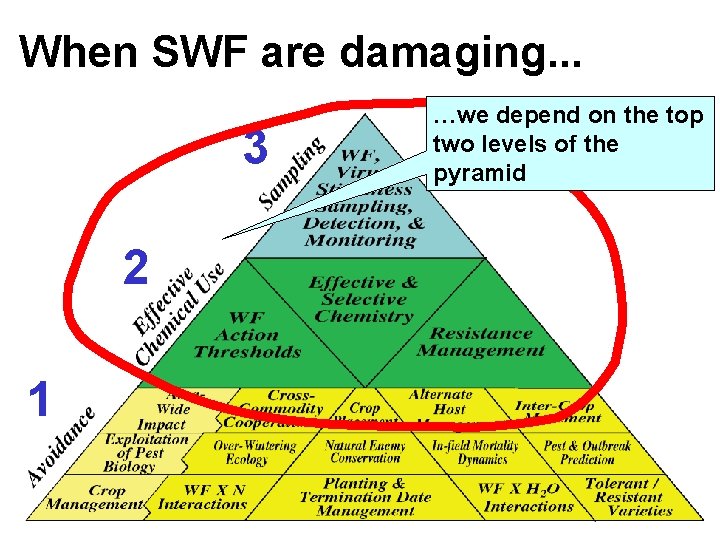
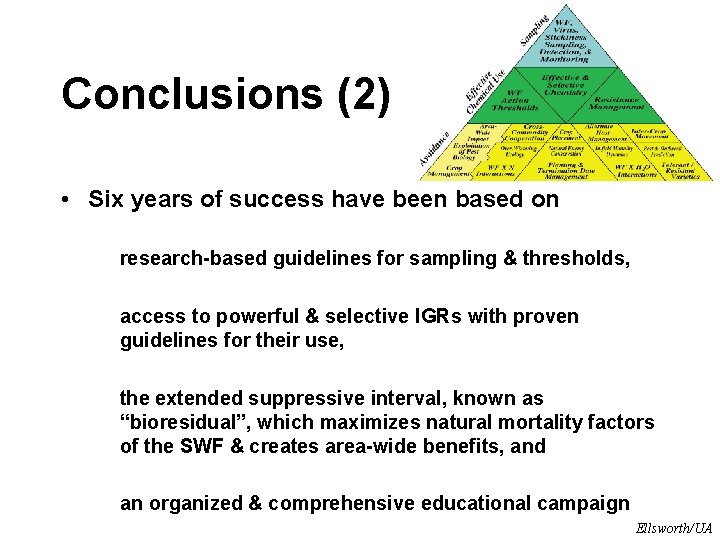
Whitefly IPM… …depends on 3 basic keys 3 2 1 Ellsworth/UA
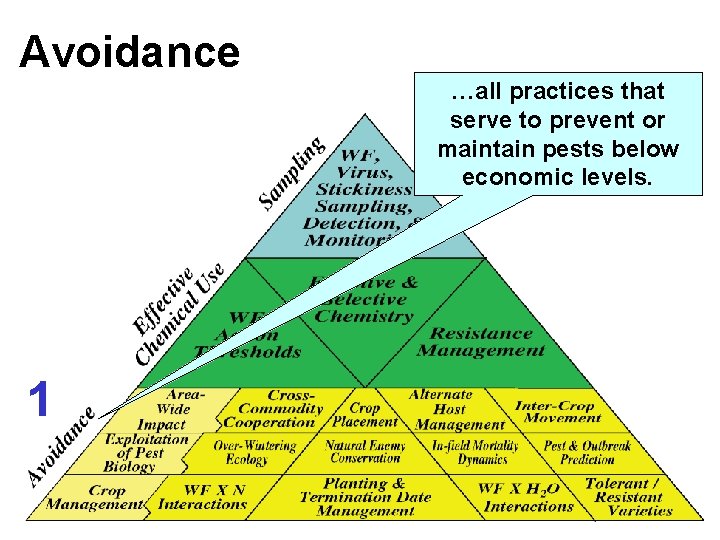
Avoidance …all practices that serve to prevent or maintain pests below economic levels. 1 Ellsworth/UA
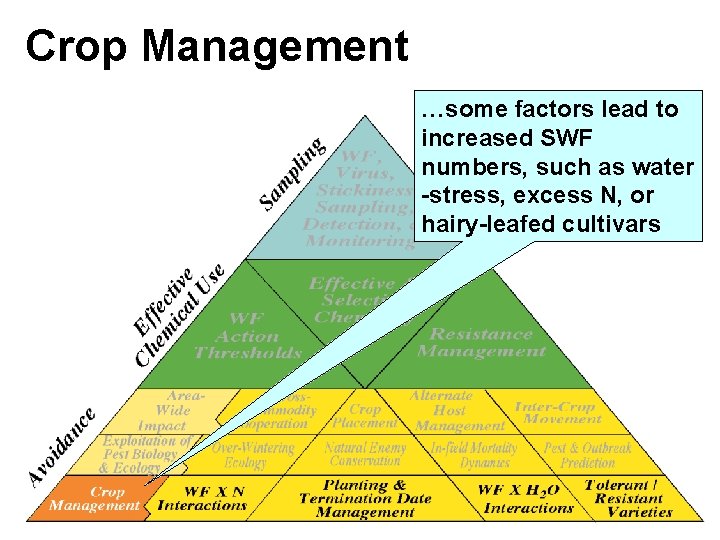
Crop Management …some factors lead to increased SWF numbers, such as water -stress, excess N, or hairy-leafed cultivars Ellsworth/UA
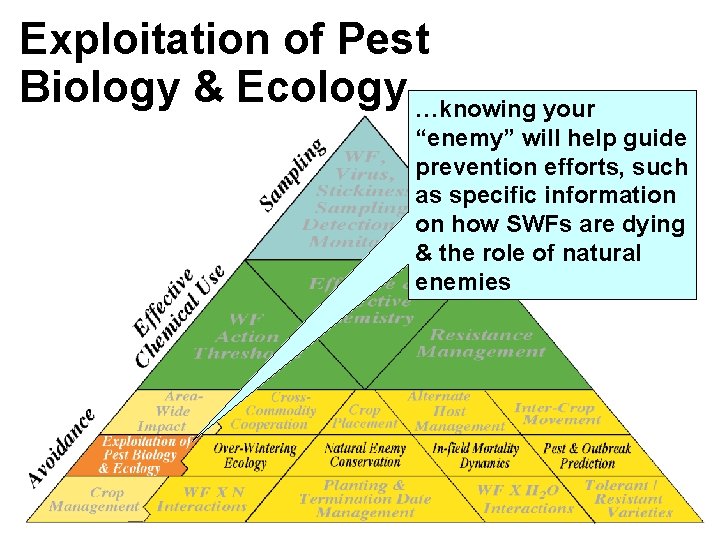
Exploitation of Pest Biology & Ecology …knowing your “enemy” will help guide prevention efforts, such as specific information on how SWFs are dying & the role of natural enemies Ellsworth/UA
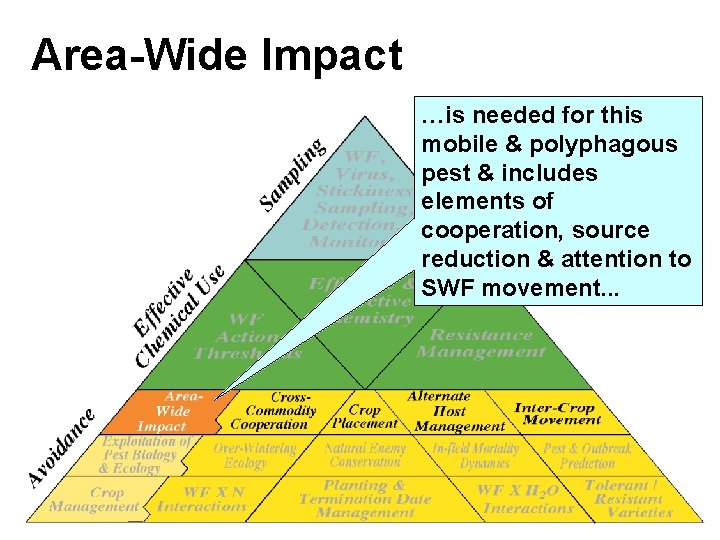
Area-Wide Impact …is needed for this mobile & polyphagous pest & includes elements of cooperation, source reduction & attention to SWF movement. . . Ellsworth/UA
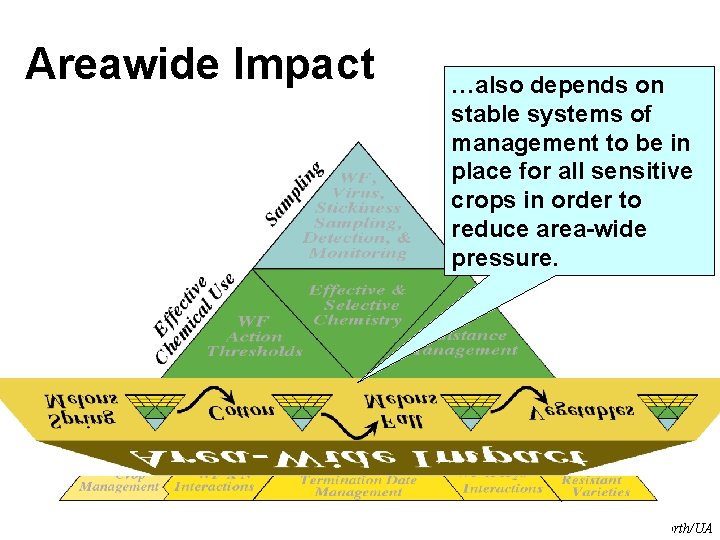
Areawide Impact …also depends on stable systems of management to be in place for all sensitive crops in order to reduce area-wide pressure. Ellsworth/UA
When SWF are damaging. . . 3 …we depend on the top two levels of the pyramid 2 1 Ellsworth/UA
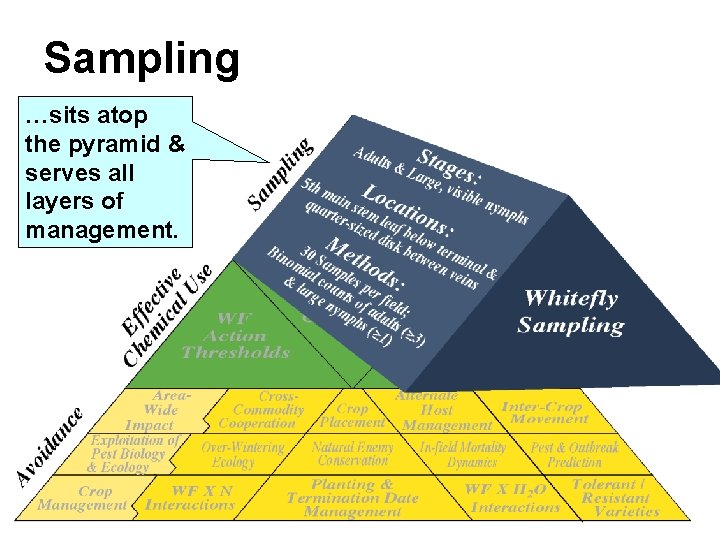
Sampling …sits atop the pyramid & serves all layers of management. Ellsworth/UA
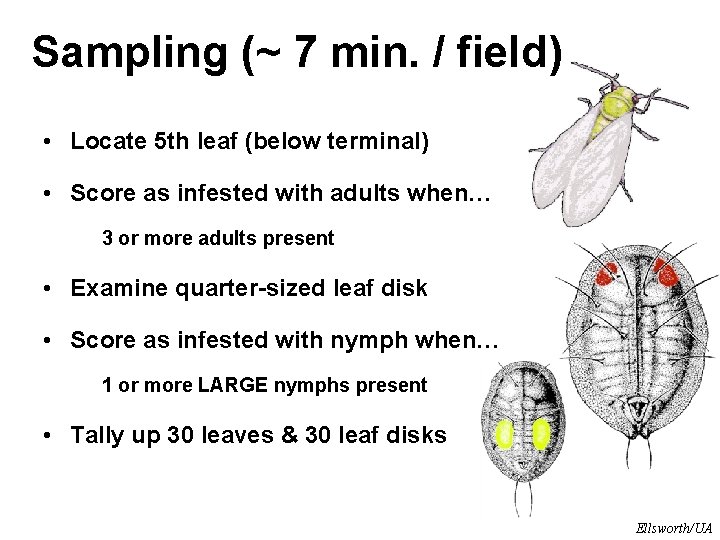
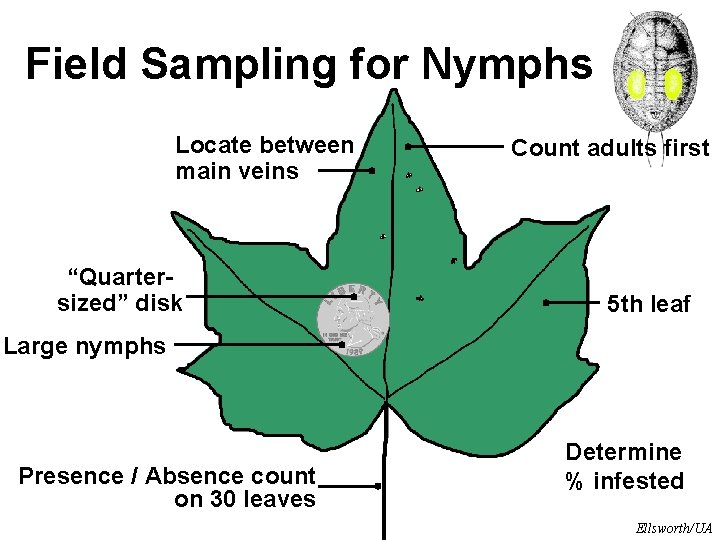
Sampling (~ 7 min. / field) • Locate 5 th leaf (below terminal) • Score as infested with adults when… 3 or more adults present • Examine quarter-sized leaf disk • Score as infested with nymph when… 1 or more LARGE nymphs present • Tally up 30 leaves & 30 leaf disks Ellsworth/UA
Field Sampling for Nymphs Locate between main veins “Quartersized” disk Count adults first 5 th leaf Large nymphs Presence / Absence count on 30 leaves Determine % infested Ellsworth/UA
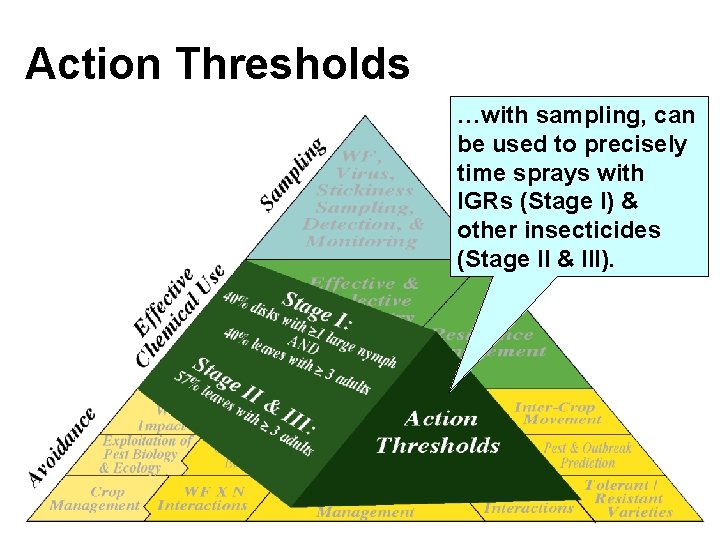
Action Thresholds …with sampling, can be used to precisely time sprays with IGRs (Stage I) & other insecticides (Stage II & III). Ellsworth/UA
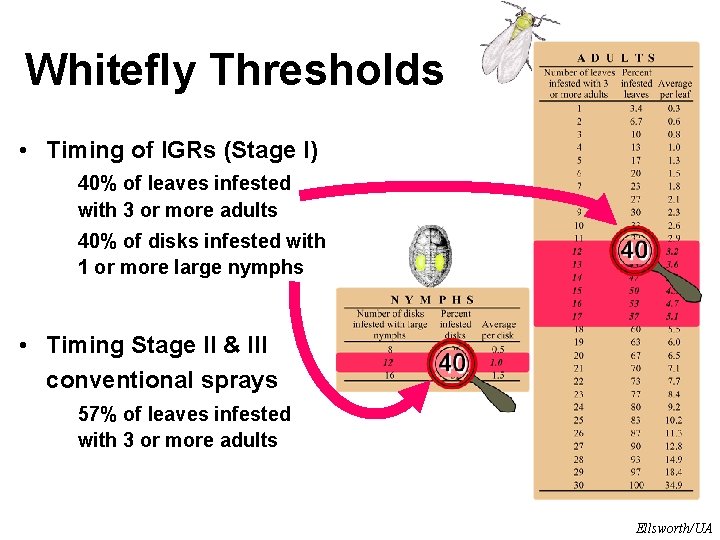
Whitefly Thresholds • Timing of IGRs (Stage I) 40% of leaves infested with 3 or more adults 40% of disks infested with 1 or more large nymphs • Timing Stage II & III conventional sprays 57% of leaves infested with 3 or more adults Ellsworth/UA
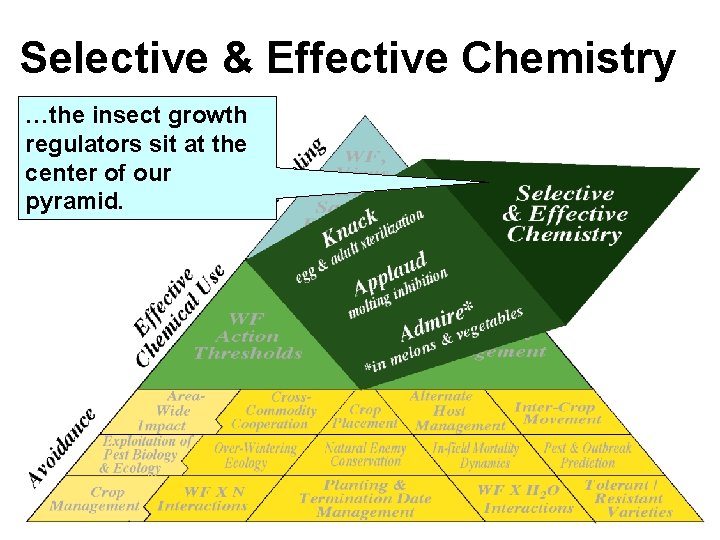
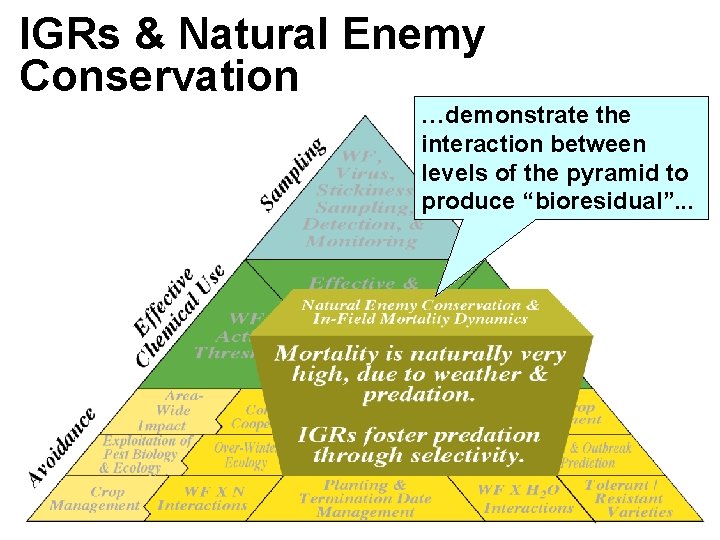
Selective & Effective Chemistry …the insect growth regulators sit at the center of our pyramid. Ellsworth/UA
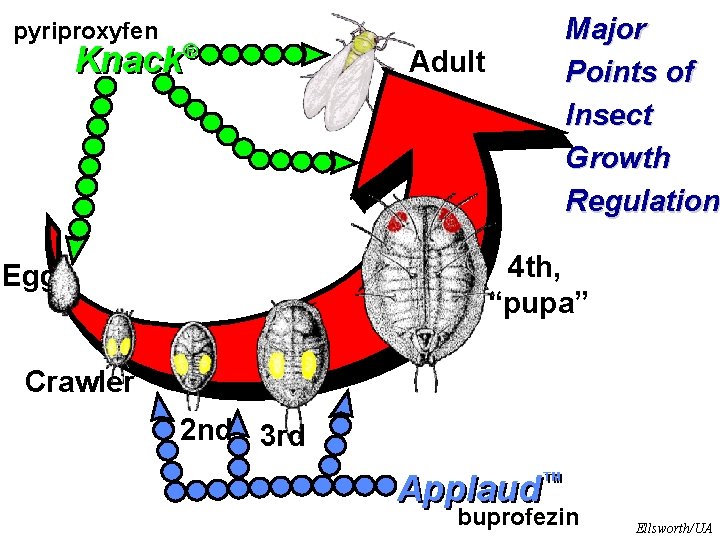
pyriproxyfen ® Knack Major Points of Insect Growth Regulation Adult 4 th, “pupa” Egg Crawler 2 nd 3 rd ™ Applaud buprofezin Ellsworth/UA
IGRs & Natural Enemy Conservation …demonstrate the interaction between levels of the pyramid to produce “bioresidual”. . . Ellsworth/UA
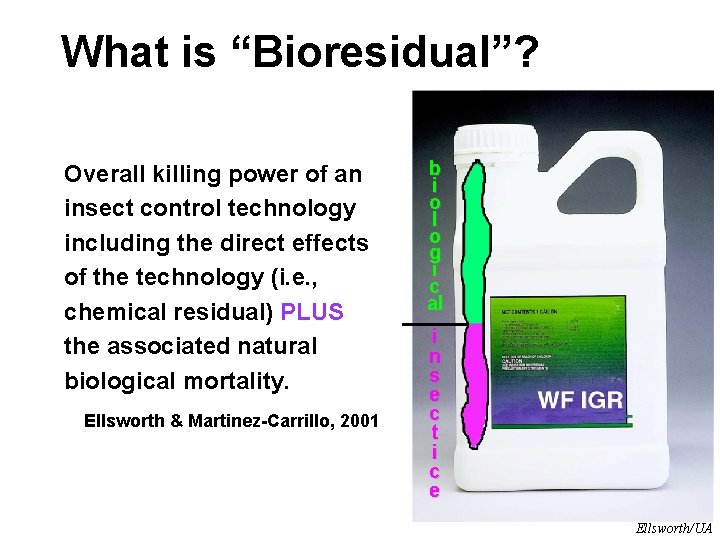
What is “Bioresidual”? Overall killing power of an insect control technology including the direct effects of the technology (i. e. , chemical residual) PLUS the associated natural biological mortality. Ellsworth & Martinez-Carrillo, 2001 b i o l o g i c al i n s e c t i c e Ellsworth/UA
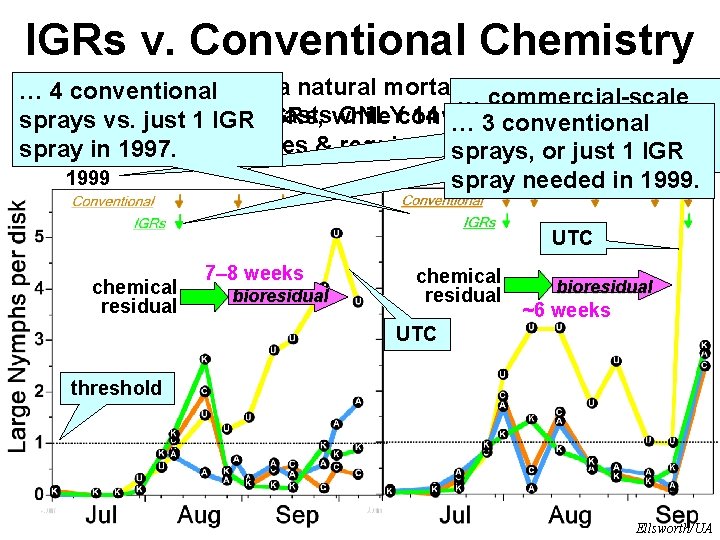
IGRs v. Conventional Chemistry Bioresidual via natural mortality extends the … 4 conventional … commercial-scale Onejust IGR 1 spray lastswhile ONLYconventional 14 days chemically effectiveness of IGRs, sprays kill for sprays vs. IGR … 3 conventional studies are shown natural enemies & require repeated sprays. spray in 1997. sprays, or just 1 IGR two years here. . . 1999 1997 spray needed in 1999. UTC chemical residual 7– 8 weeks bioresidual chemical residual bioresidual ~6 weeks UTC threshold Ellsworth/UA
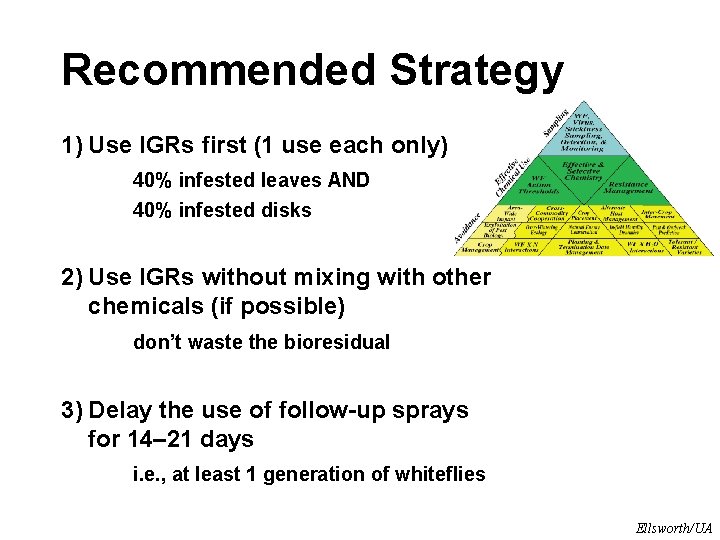
Recommended Strategy 1) Use IGRs first (1 use each only) 40% infested leaves AND 40% infested disks 2) Use IGRs without mixing with other chemicals (if possible) don’t waste the bioresidual 3) Delay the use of follow-up sprays for 14– 21 days i. e. , at least 1 generation of whiteflies Ellsworth/UA
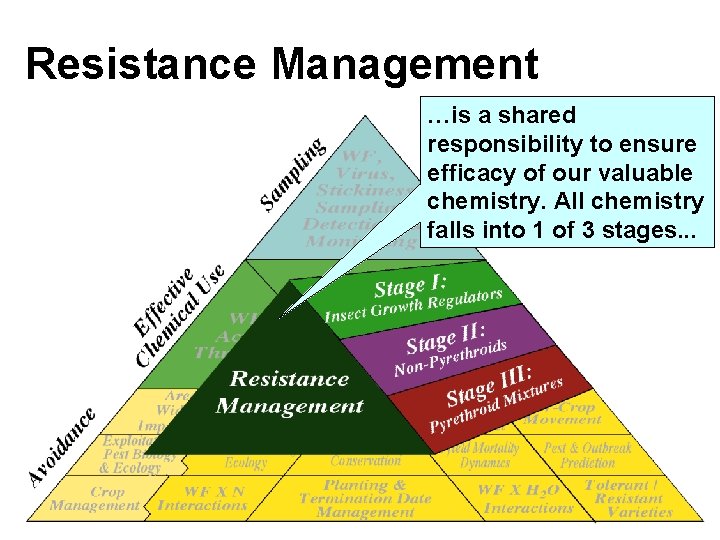
Resistance Management …is a shared responsibility to ensure efficacy of our valuable chemistry. All chemistry falls into 1 of 3 stages. . . Ellsworth/UA
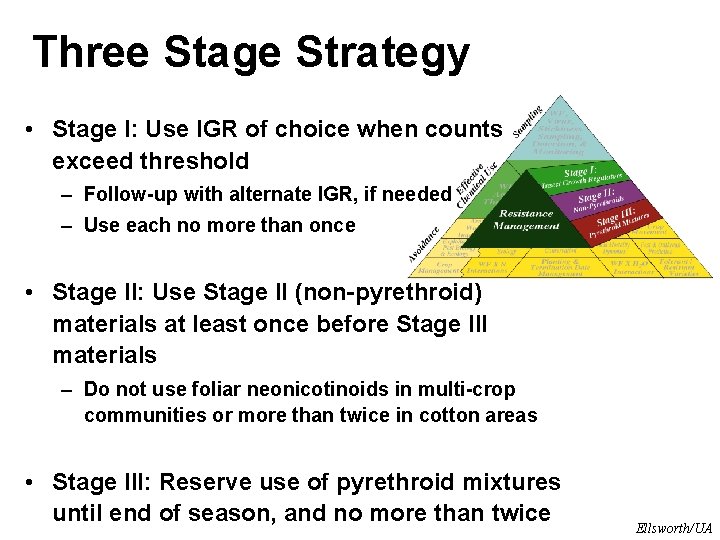
Three Stage Strategy • Stage I: Use IGR of choice when counts exceed threshold – Follow-up with alternate IGR, if needed – Use each no more than once • Stage II: Use Stage II (non-pyrethroid) materials at least once before Stage III materials – Do not use foliar neonicotinoids in multi-crop communities or more than twice in cotton areas • Stage III: Reserve use of pyrethroid mixtures until end of season, and no more than twice Ellsworth/UA
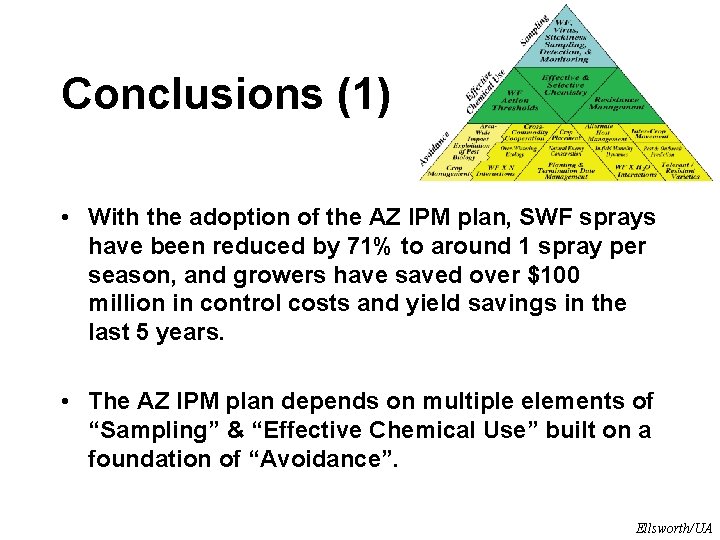
Conclusions (1) • With the adoption of the AZ IPM plan, SWF sprays have been reduced by 71% to around 1 spray per season, and growers have saved over $100 million in control costs and yield savings in the last 5 years. • The AZ IPM plan depends on multiple elements of “Sampling” & “Effective Chemical Use” built on a foundation of “Avoidance”. Ellsworth/UA
Conclusions (2) • Six years of success have been based on research-based guidelines for sampling & thresholds, access to powerful & selective IGRs with proven guidelines for their use, the extended suppressive interval, known as “bioresidual”, which maximizes natural mortality factors of the SWF & creates area-wide benefits, and an organized & comprehensive educational campaign Ellsworth/UA
Information • All University of Arizona crop production & crop protection information is available on our web site, A C I S • Arizona Crop Information Site (ACIS), at • http: //ag. arizona. edu/crops Ellsworth/UA