
Integrated Management Effectiveness Tool IMET Training Kigali Feb
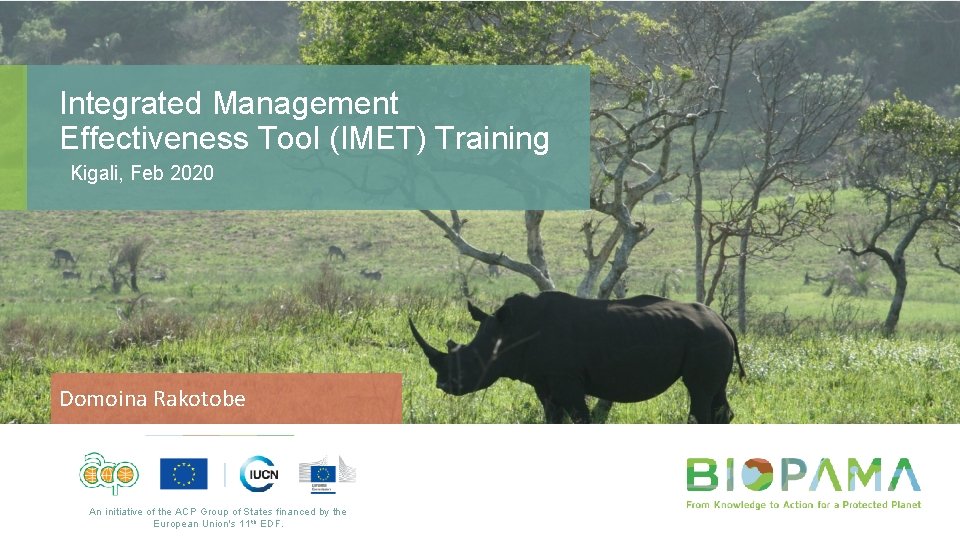
Integrated Management Effectiveness Tool (IMET) Training Kigali, Feb 2020 Domoina Rakotobe An initiative of the ACP Group of States financed by the European Union's 11 th EDF.
SESSION 1 - Protected Area Management Effectiveness (PAME) An initiative of the ACP Group of States financed by the European Union's 11 th EDF.
Objectives of the session At the end of this session, participant will be able to: • Explain why evaluating effectiveness of management is critical • Cite and explain the six elements of the management effectiveness framework
Discuss with your peer (5’) What's the difference between "evaluating management" ? and “evaluating effectiveness of management"
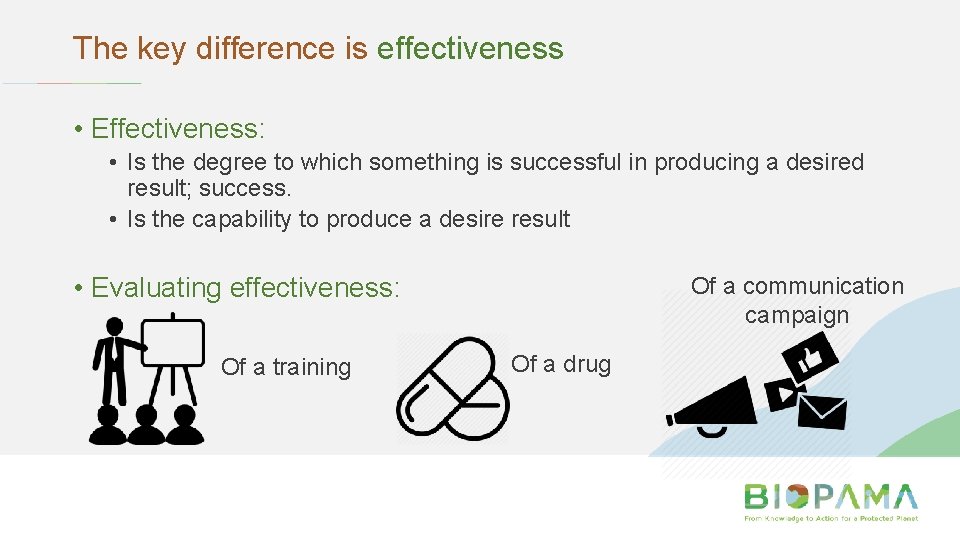
The key difference is effectiveness • Effectiveness: • Is the degree to which something is successful in producing a desired result; success. • Is the capability to produce a desire result • Evaluating effectiveness: Of a training Of a communication campaign Of a drug

Evaluating effectiveness • Evaluating effectiveness = Did we achieve our goals? • Evaluating effectiveness of management is evaluating to what extent management elements (planning, resources, organization…) achieve agreed objectives
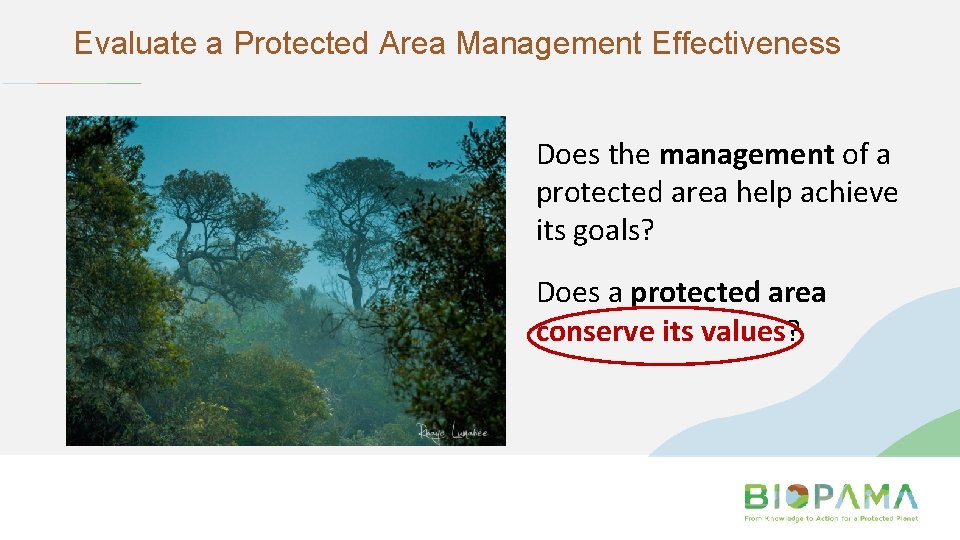
Evaluate a Protected Area Management Effectiveness Does the management of a protected area help achieve its goals? Does a protected area conserve its values?
Evaluate a Protected Area Management Effectiveness • Protected Area Management effectiveness evaluation is defined as the assessment of how well the protected area is being managed – primarily the extent to which it is protecting values and achieving goals and objectives (Hockings et al, 2006)
Why evaluating management effectiveness of a protected area (PA)? • Promote ccountability and transparency • Maintain the value of the PA • Enable support and adaptive management • Better assist in resource allocation • Help involve various stakeholders
Limitations (and risks) in evaluating PAME? • Evaluate management vs. Evaluate managers • Bias of appraiser and PA management staff • Ambiguity in standards • Insufficient evidence • Leniency or Strictness Tenancy • Standards in rating
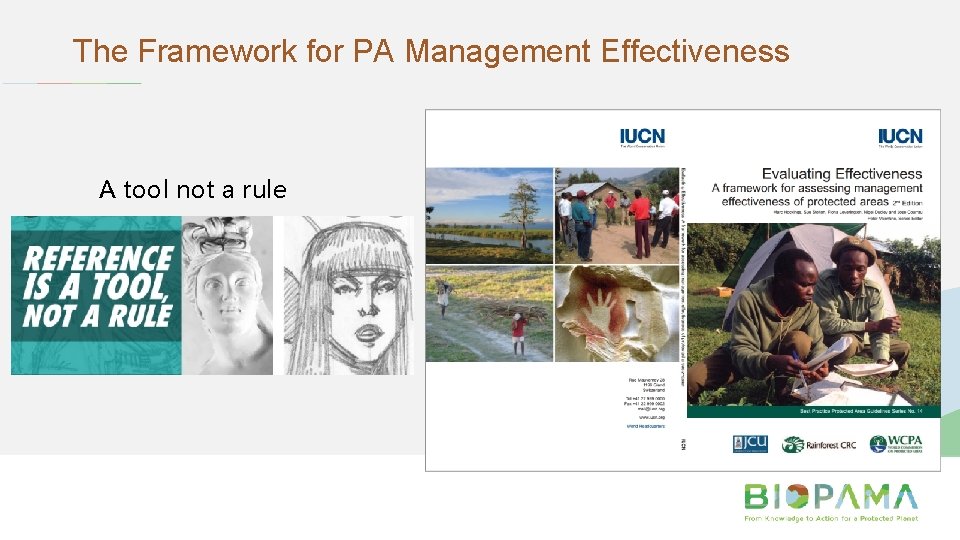
The Framework for PA Management Effectiveness A tool not a rule
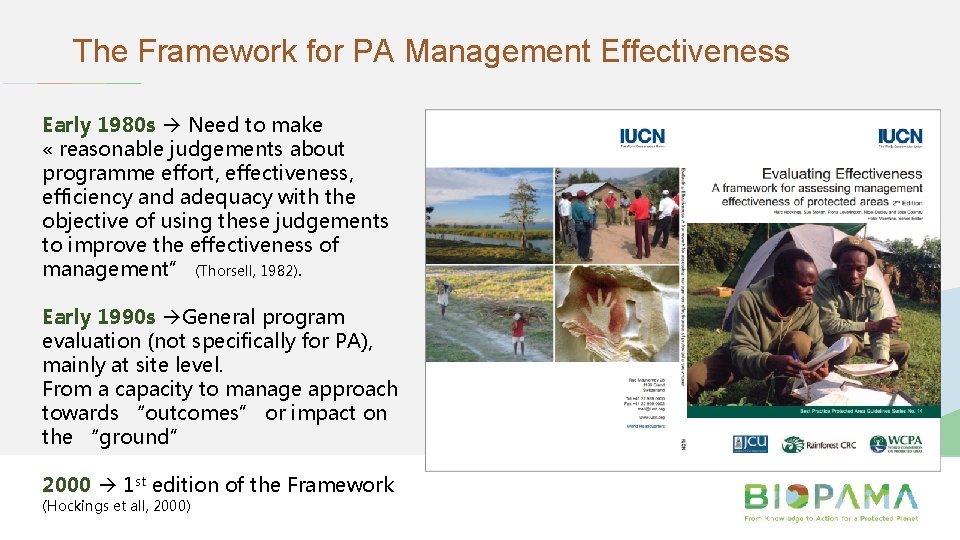
The Framework for PA Management Effectiveness Early 1980 s Need to make « reasonable judgements about programme effort, effectiveness, efficiency and adequacy with the objective of using these judgements to improve the effectiveness of management” (Thorsell, 1982). Early 1990 s General program evaluation (not specifically for PA), mainly at site level. From a capacity to manage approach towards “outcomes” or impact on the “ground” 2000 1 st edition of the Framework (Hockings et all, 2000)
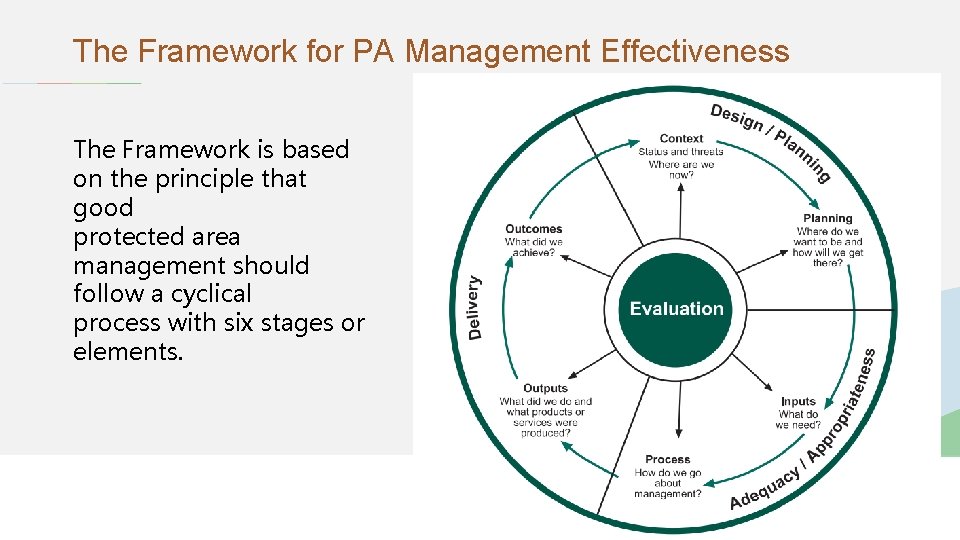
The Framework for PA Management Effectiveness The Framework is based on the principle that good protected area management should follow a cyclical process with six stages or elements.
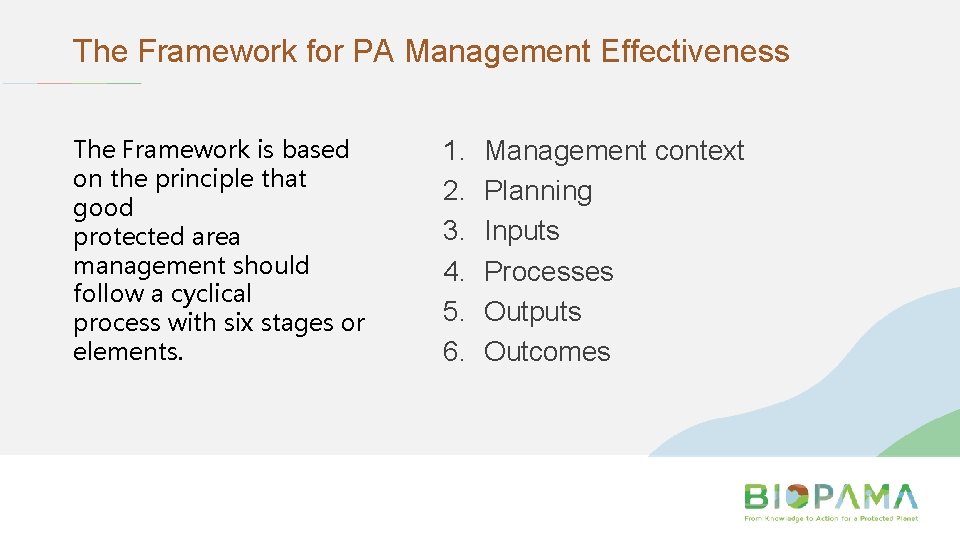
The Framework for PA Management Effectiveness The Framework is based on the principle that good protected area management should follow a cyclical process with six stages or elements. 1. 2. 3. 4. 5. 6. Management context Planning Inputs Processes Outputs Outcomes
Exercise: Jigsaw (75’) Steps: 1. Divide participants into 6 groups according to the 6 elements of the Framework Each group appoints one leader 2. Each group will have time to read and discuss ONE element to be familiar with it. (10’) 3. Form new groups with a representative of the first group. Each member of the groupe will present his/her element to the new group (2 min/ pers) 4. The original groups reconvene and share feedbacks. One representative will prepare a short final presentation based on what they learned from their groups and feedbacks. (15’)
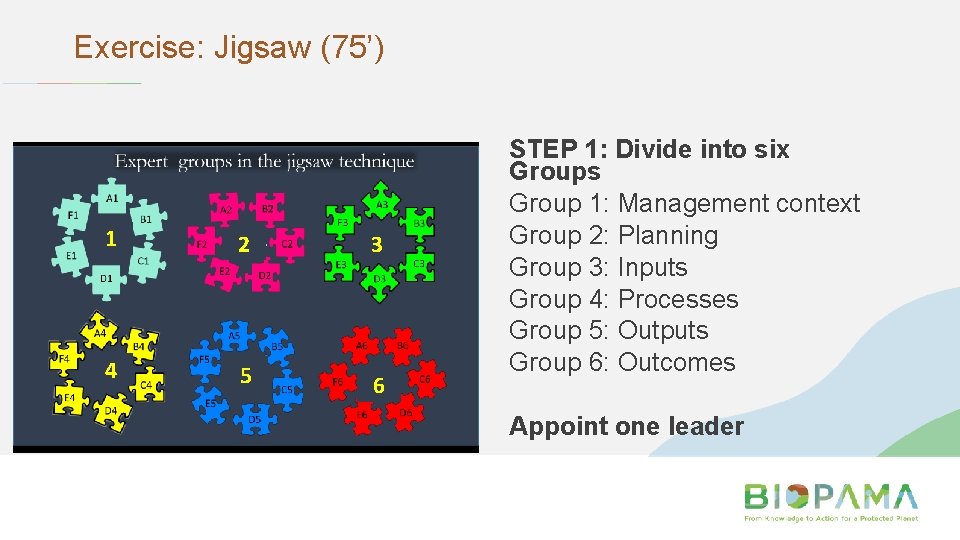
Exercise: Jigsaw (75’) 1 2 4 Grp 1 5 3 Grp 1 6 STEP 1: Divide into six Groups Group 1: Management context Group 2: Planning Group 3: Inputs Group 4: Processes Group 5: Outputs Group 6: Outcomes Grp 1 Appoint one leader
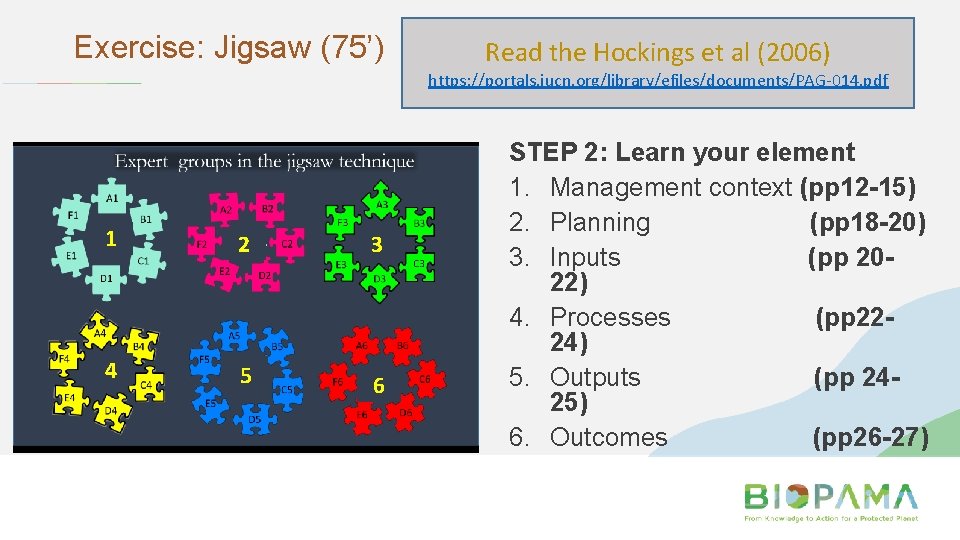
Exercise: Jigsaw (75’) Read the Hockings et al (2006) https: //portals. iucn. org/library/efiles/documents/PAG-014. pdf 1 2 4 Grp 1 5 3 Grp 1 6 Grp 1 STEP 2: Learn your element 1. Management context (pp 12 -15) 2. Planning (pp 18 -20) 3. Inputs (pp 2022) 4. Processes (pp 2224) 5. Outputs (pp 2425) 6. Outcomes (pp 26 -27)
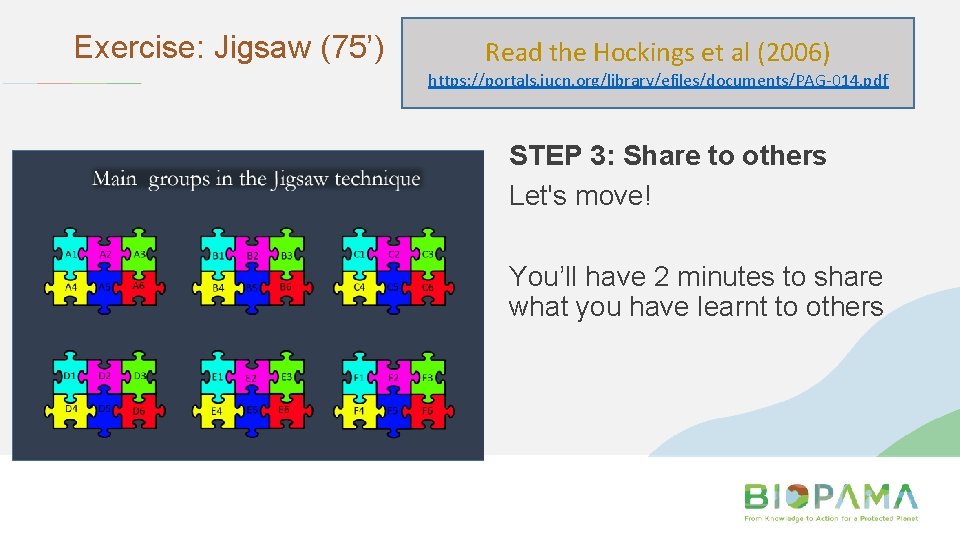
Exercise: Jigsaw (75’) Read the Hockings et al (2006) https: //portals. iucn. org/library/efiles/documents/PAG-014. pdf STEP 3: Share to others Let's move! You’ll have 2 minutes to share what you have learnt to others
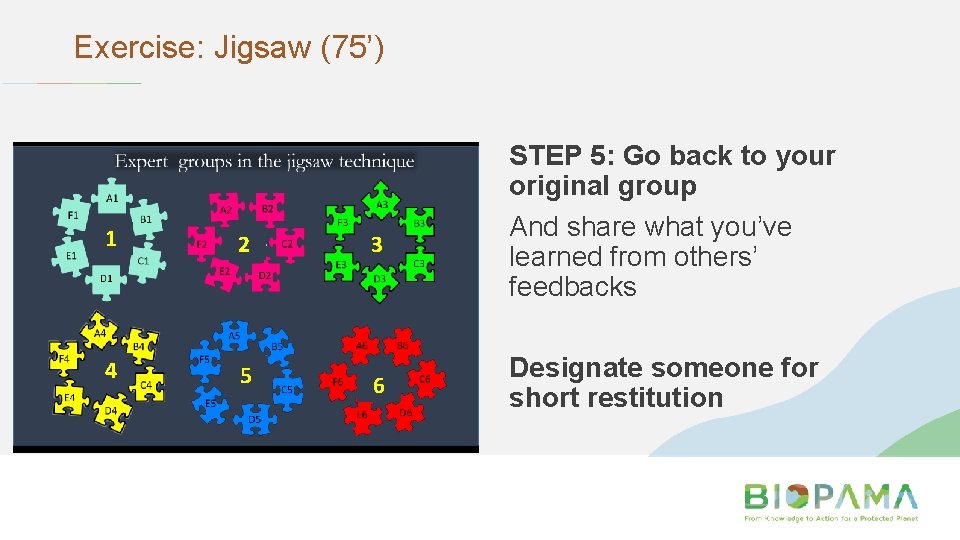
Exercise: Jigsaw (75’) 1 2 4 Grp 1 5 3 Grp 1 6 Grp 1 STEP 5: Go back to your original group And share what you’ve learned from others’ feedbacks Designate someone for short restitution
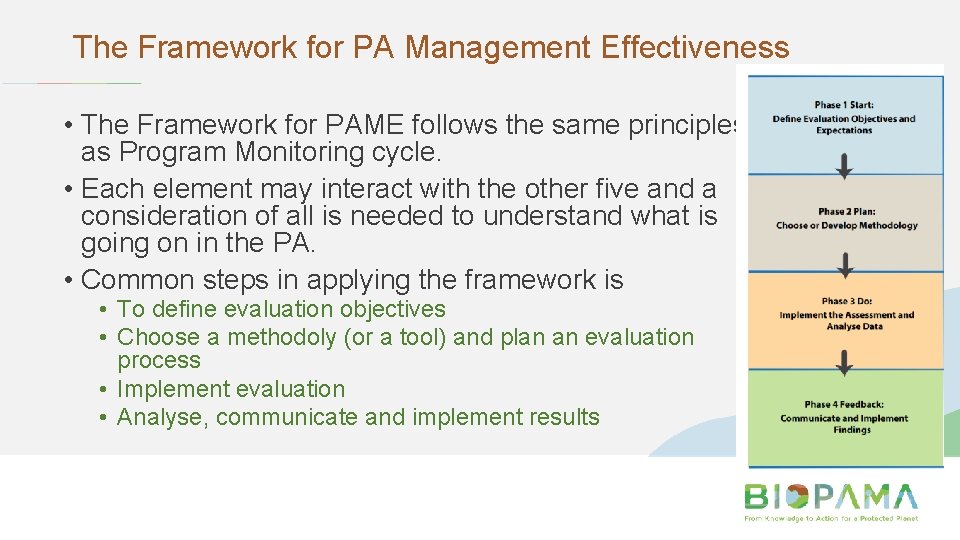
The Framework for PA Management Effectiveness • The Framework for PAME follows the same principles as Program Monitoring cycle. • Each element may interact with the other five and a consideration of all is needed to understand what is going on in the PA. • Common steps in applying the framework is • To define evaluation objectives • Choose a methodoly (or a tool) and plan an evaluation process • Implement evaluation • Analyse, communicate and implement results
Ongoing challenges in doing PAME 1. 2. 3. 4. 5. Other (usual) challenges Ensuring accuracy • Capacity Careful wording of questions • Funds Measuring trends over time • Integration to decision. Descriptive vs. Quantitative scores making Etc.
BIOPAMA PPT Template
BIOPAMA PPT Template
BIOPAMA PPT Template
The Biodiversity and Protected Areas Management Programme (BIOPAMA) is an initiative of the ACP Group of States financed by the European Union's 11 th EDF.
- Slides: 26