
Integrated Financial Management Information Systems IFMIS Integrated or
- Slides: 9
Integrated Financial Management Information Systems - IFMIS Integrated or Interfaced System – Latin American Countries Experience Mario Pessoa Fiscal Affairs Department International Monetary Fund Washington, USA, September 14, 2008
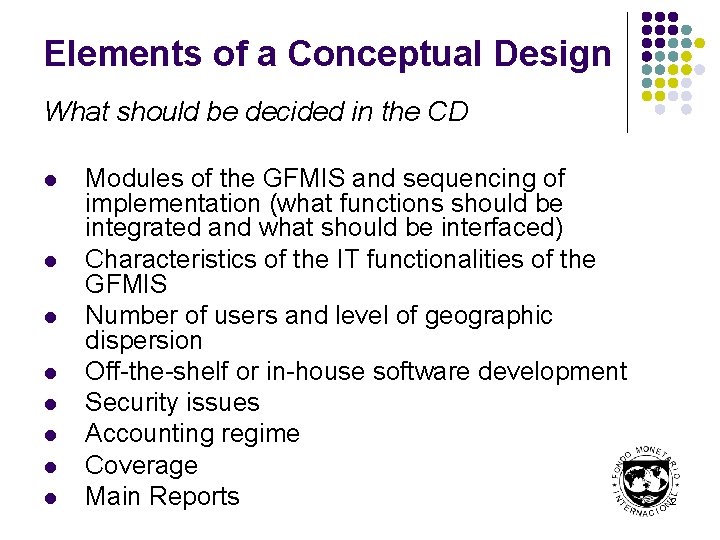
Elements of a Conceptual Design What should be decided in the CD l l l l Modules of the GFMIS and sequencing of implementation (what functions should be integrated and what should be interfaced) Characteristics of the IT functionalities of the GFMIS Number of users and level of geographic dispersion Off-the-shelf or in-house software development Security issues Accounting regime Coverage Main Reports 2
Integrated Financial Management Information Systems - IFMIS Main Functionalities
4
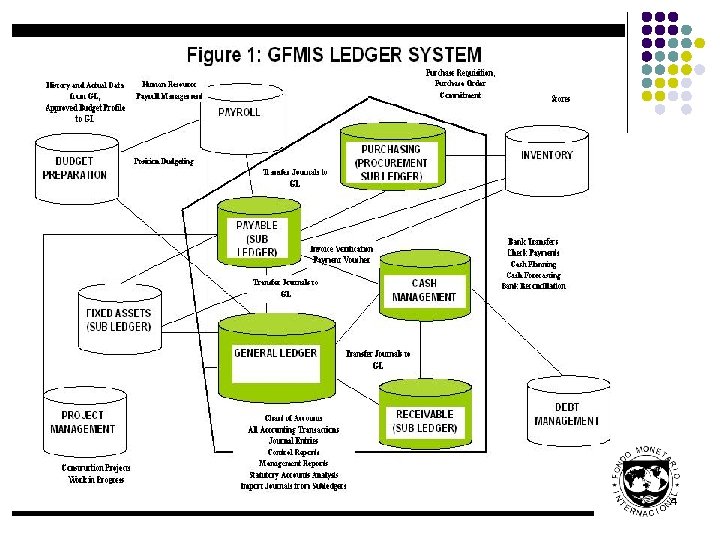
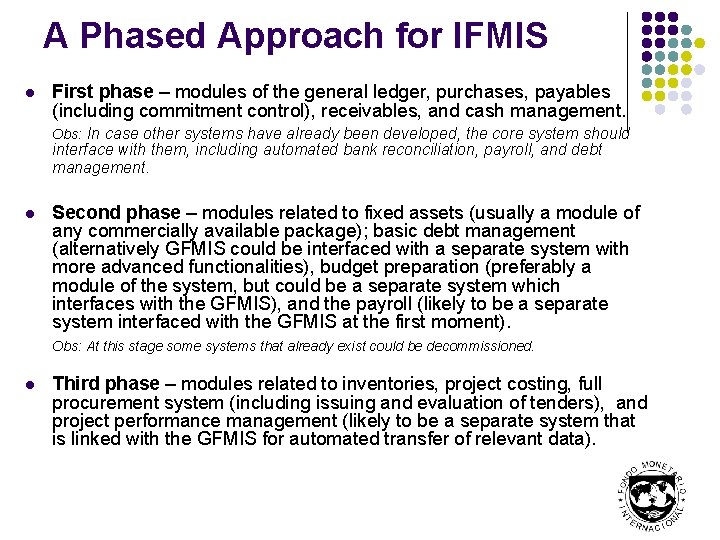
A Phased Approach for IFMIS l First phase – modules of the general ledger, purchases, payables (including commitment control), receivables, and cash management. Obs: In case other systems have already been developed, the core system should interface with them, including automated bank reconciliation, payroll, and debt management. l Second phase – modules related to fixed assets (usually a module of any commercially available package); basic debt management (alternatively GFMIS could be interfaced with a separate system with more advanced functionalities), budget preparation (preferably a module of the system, but could be a separate system which interfaces with the GFMIS), and the payroll (likely to be a separate system interfaced with the GFMIS at the first moment). Obs: At this stage some systems that already exist could be decommissioned. l Third phase – modules related to inventories, project costing, full procurement system (including issuing and evaluation of tenders), and project performance management (likely to be a separate system that is linked with the GFMIS for automated transfer of relevant data). 5
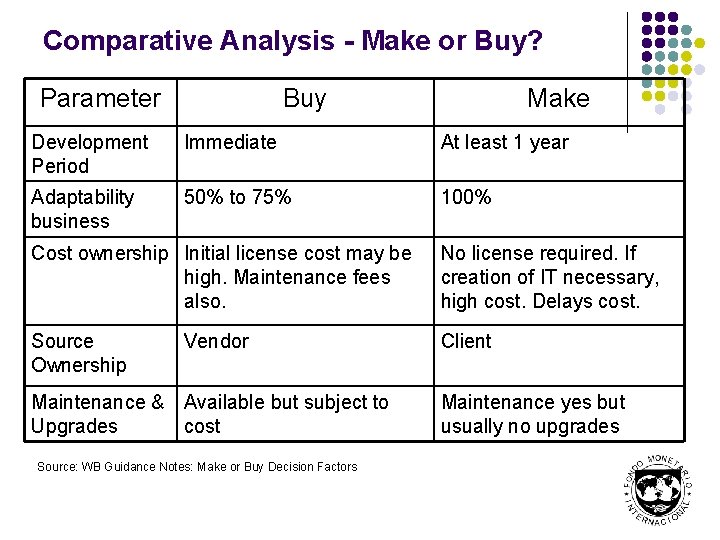
Comparative Analysis - Make or Buy? Parameter Buy Make Development Period Immediate At least 1 year Adaptability business 50% to 75% 100% Cost ownership Initial license cost may be high. Maintenance fees also. No license required. If creation of IT necessary, high cost. Delays cost. Source Ownership Client Vendor Maintenance & Available but subject to Upgrades cost Maintenance yes but usually no upgrades Source: WB Guidance Notes: Make or Buy Decision Factors 6
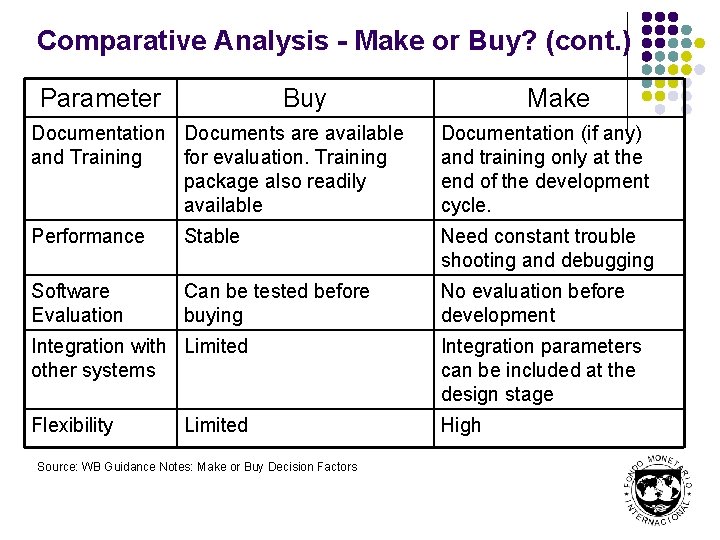
Comparative Analysis - Make or Buy? (cont. ) Parameter Buy Make Documentation Documents are available and Training for evaluation. Training package also readily available Documentation (if any) and training only at the end of the development cycle. Performance Stable Need constant trouble shooting and debugging Software Evaluation Can be tested before buying No evaluation before development Integration with Limited other systems Integration parameters can be included at the design stage Flexibility High Limited Source: WB Guidance Notes: Make or Buy Decision Factors 7
8
9