
Integrated EarthLife Science Life Cycle of Stars How
- Slides: 9
Integrated Earth/Life Science Life Cycle of Stars
How do Stars End Their Lives? Determined by mass of main-sequence star Sun-like stars End up as Black Dwarfs Massive stars End up as Neutron Stars or if large enough End up as Black Holes
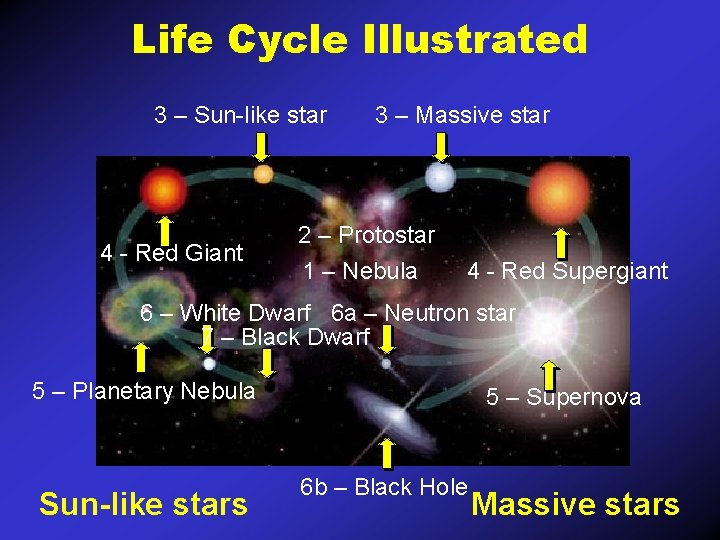
Life Cycle Illustrated 3 – Sun-like star 4 - Red Giant 3 – Massive star 2 – Protostar 1 – Nebula 4 - Red Supergiant 6 – White Dwarf 6 a – Neutron star 7 – Black Dwarf 5 – Planetary Nebula Sun-like stars 5 – Supernova 6 b – Black Hole Massive stars
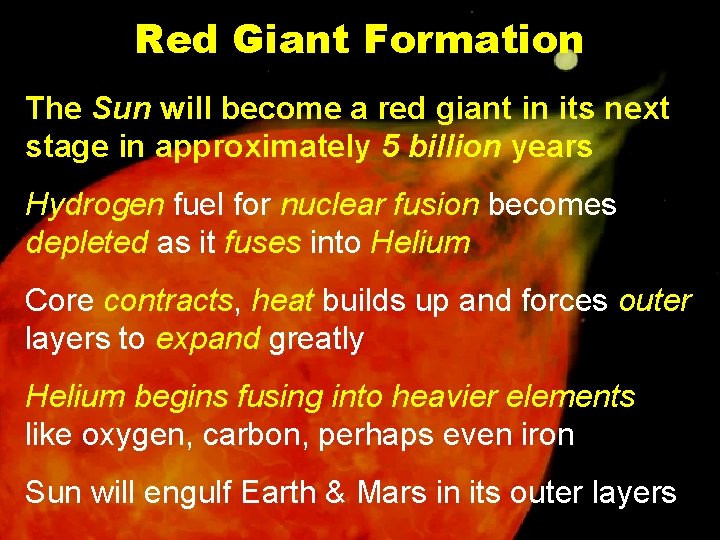
Red Giant Formation The Sun will become a red giant in its next stage in approximately 5 billion years Hydrogen fuel for nuclear fusion becomes depleted as it fuses into Helium Core contracts, heat builds up and forces outer layers to expand greatly Helium begins fusing into heavier elements like oxygen, carbon, perhaps even iron Sun will engulf Earth & Mars in its outer layers
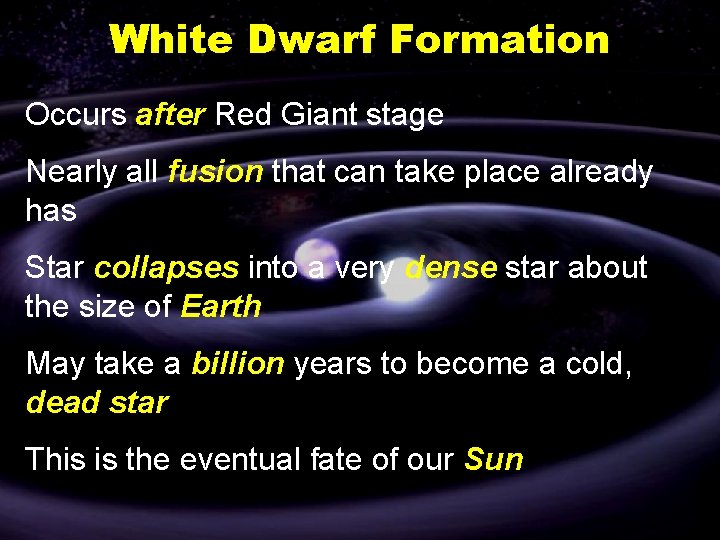
White Dwarf Formation Occurs after Red Giant stage Nearly all fusion that can take place already has Star collapses into a very dense star about the size of Earth May take a billion years to become a cold, dead star This is the eventual fate of our Sun
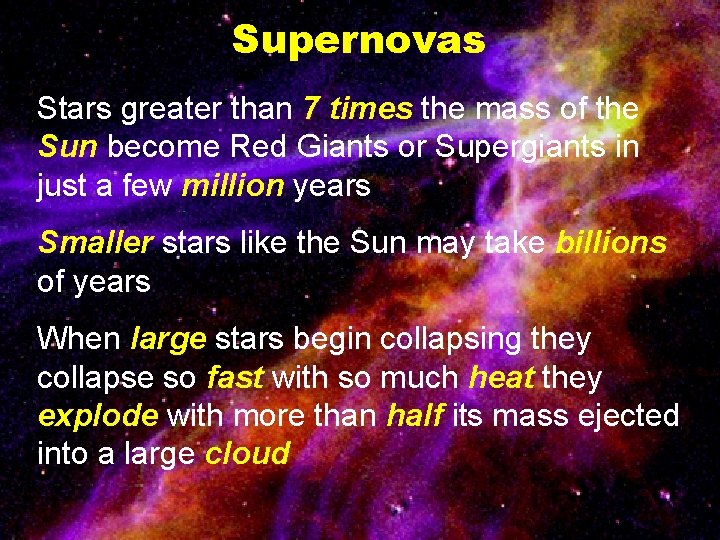
Supernovas Stars greater than 7 times the mass of the Sun become Red Giants or Supergiants in just a few million years Smaller stars like the Sun may take billions of years When large stars begin collapsing they collapse so fast with so much heat they explode with more than half its mass ejected into a large cloud
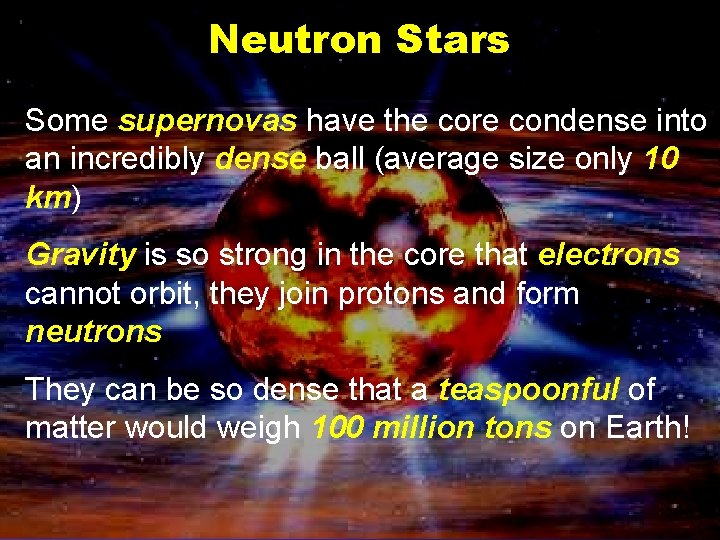
Neutron Stars Some supernovas have the core condense into an incredibly dense ball (average size only 10 km) Gravity is so strong in the core that electrons cannot orbit, they join protons and form neutrons They can be so dense that a teaspoonful of matter would weigh 100 million tons on Earth!
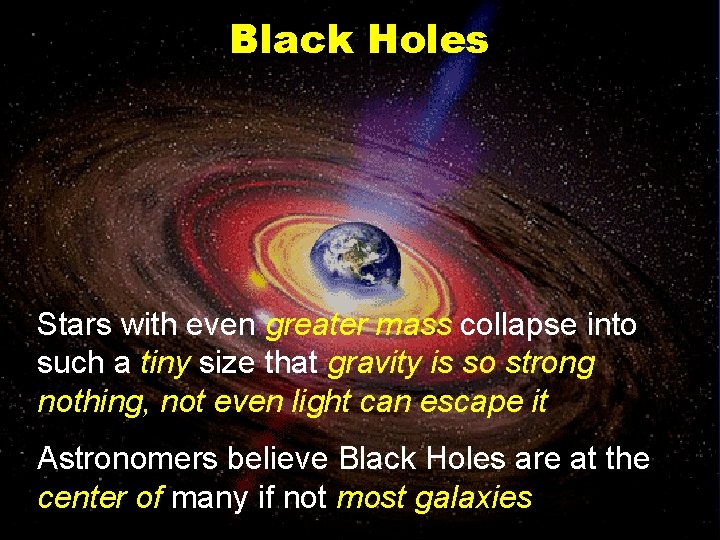
Black Holes Stars with even greater mass collapse into such a tiny size that gravity is so strong nothing, not even light can escape it Astronomers believe Black Holes are at the center of many if not most galaxies
Text Assignment Copy and answer questions 1 – 4 on page 630