
Integrated Early Childhood Development at UNICEF How does


- Slides: 51
Integrated Early Childhood Development at UNICEF: How does breastfeeding fit in? UNICEF Programme Division Nutrition Section
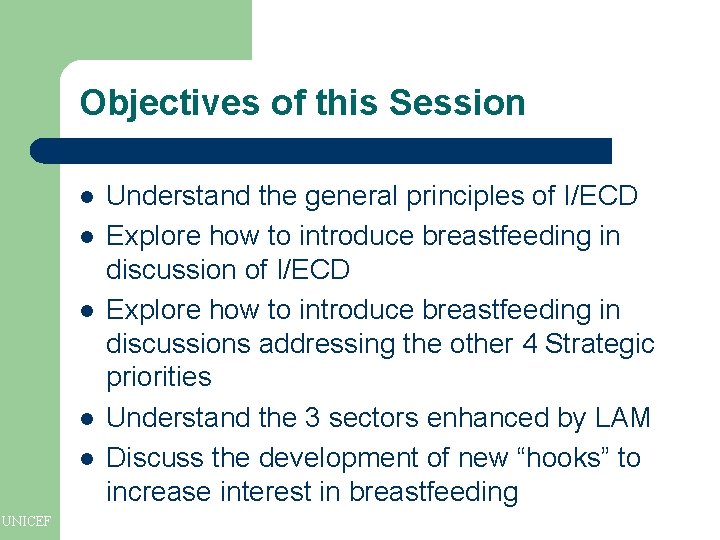
Objectives -The participant will: l l l UNICEF Understand the general principles of I/ECD Explore how to introduce breastfeeding in discussions addressing the other 4 Strategic priorities Understand the 3 sectors enhanced by LAM Discuss the development of new “hooks” to increase interest in breastfeeding
Brainstorm Group 1: Breastfeeding in Other MTSP Strategies l Girl’s Education Cognitive and psycho-social achievement highly associated with breastfeeding UNICEF Educate girls for important role as future mothers: “An educated girl educates her family and society about breastfeeding”
Brainstorm Group 2: Breastfeeding in Other MTSP Strategies l Immunisation Breastfeeding provides first immune protection, and Vitamin A, among Plus UNICEF others, helps fight disease Colostrum is the first immunisation Immediate contact reduces illness by regulating temperature Provides first doses of Vitamin A Disease-free = sanitary, and prevents spread of bacteria Visit is an opportunity to counsel on breastfeeding
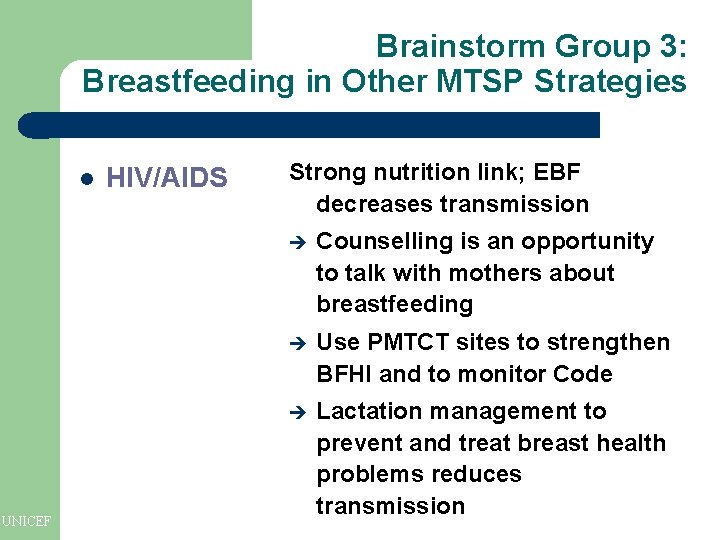
Brainstorm Group 3: Breastfeeding in Other MTSP Strategies l UNICEF HIV/AIDS Strong nutrition link; EBF decreases transmission Counselling is an opportunity to talk with mothers about breastfeeding Use PMTCT sites to strengthen BFHI and to monitor Code Lactation management to prevent and treat breast health problems reduces transmission
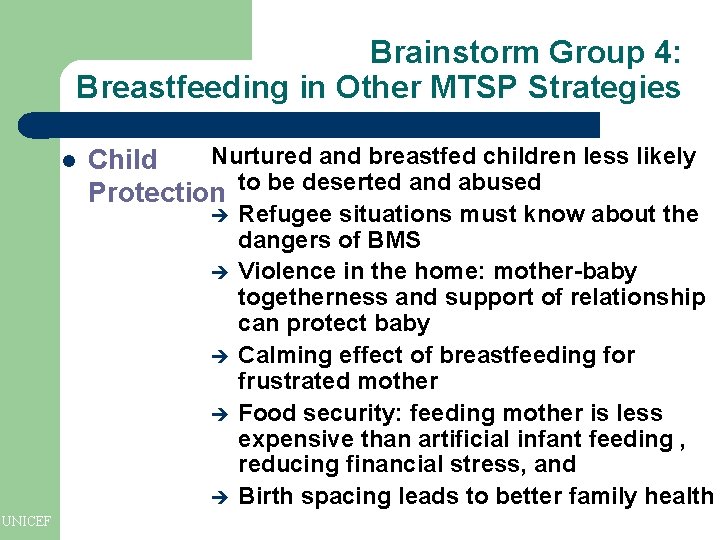
Brainstorm Group 4: Breastfeeding in Other MTSP Strategies l Nurtured and breastfed children less likely Child Protection to be deserted and abused UNICEF Refugee situations must know about the dangers of BMS Violence in the home: mother-baby togetherness and support of relationship can protect baby Calming effect of breastfeeding for frustrated mother Food security: feeding mother is less expensive than artificial infant feeding , reducing financial stress, and Birth spacing leads to better family health
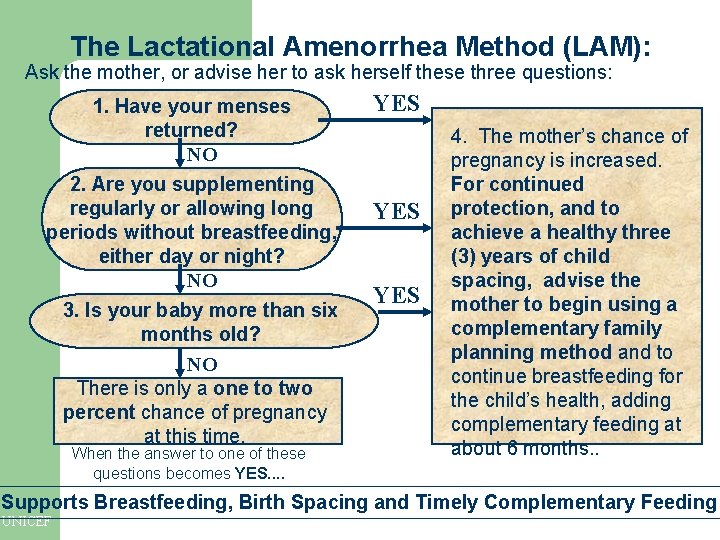
The Lactational Amenorrhea Method (LAM): Ask the mother, or advise her to ask herself these three questions: 1. Have your menses returned? NO 2. Are you supplementing regularly or allowing long periods without breastfeeding, either day or night? NO 3. Is your baby more than six months old? NO There is only a one to two percent chance of pregnancy at this time. When the answer to one of these questions becomes YES. . YES YES 4. The mother’s chance of pregnancy is increased. For continued protection, and to achieve a healthy three (3) years of child spacing, advise the mother to begin using a complementary family planning method and to continue breastfeeding for the child’s health, adding complementary feeding at about 6 months. . Supports Breastfeeding, Birth Spacing and Timely Complementary Feeding UNICEF
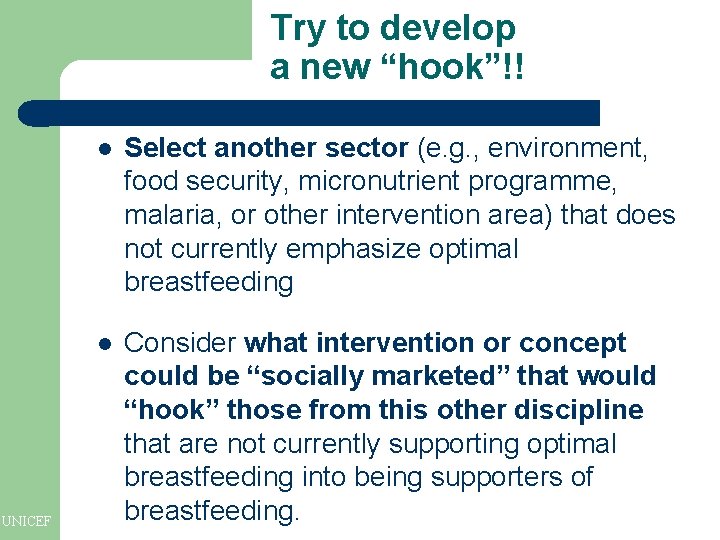
Try to develop a new “hook”!! UNICEF l Select another sector (e. g. , environment, food security, micronutrient programme, malaria, or other intervention area) that does not currently emphasize optimal breastfeeding l Consider what intervention or concept could be “socially marketed” that would “hook” those from this other discipline that are not currently supporting optimal breastfeeding into being supporters of breastfeeding.
Individual Work: Creative New Hooks(1) l l l UNICEF Malaria – Bednet to keep baby safe and breastfed: “safe inside and out” Environment – Breastfeeding has no waste products, no fuel, no commercial waste – Breastfeeding takes less water during shortages Education – Psychosocial interaction that starts with breastfeeding leads to time spent with the child, story-telling and reading
Individual Work: Creative New Hooks(2) l l UNICEF Micro-enterprise – Breastfeeding women are reliable and willing to work from home Credit Banks – Women who breastfeed have a track record of involvement and responsibility, and likely to pay back loan Peacekeeping – Children who are breastfed are more compassionate to others Others – Pharmaceuticals: With the increase in resistant pathogens, breastfeeding is important -- now more than ever.
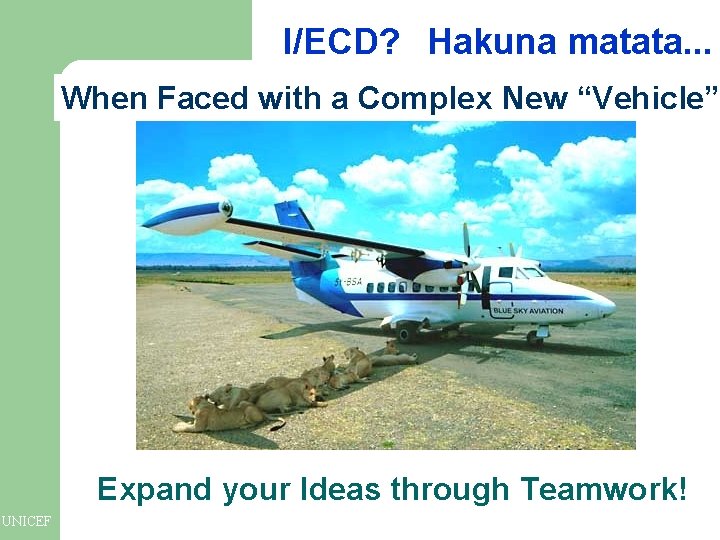
I/ECD? Hakuna matata. . . When Faced with a Complex New “Vehicle” Expand your Ideas through Teamwork! UNICEF
UNICEF
Nutrition related MTSP target indicators l l l UNICEF Reduction in anemia prevalence among women of reproductive age by 15% > 60% of children receive appropriate home care for prevention and treatment of malnutrition > 60% of pregnant women use adequate antenatal services
Focus of I/ECD Integrated ECD is based on child’s rights principles and the life-cycle approach, developed to co-ordinate actions at different levels, aiming to improve: UNICEF – Quality of family care – Family access to good basic services and adequate livelihoods – Community & policy environment needed to support the previous points. General Goals: Child Survival, Growth and Development
What is Integrated Early Childhood Development? The Importance of the Mother-Child Dyad l “A good start on life” à l “Children under 3 y. o. ” à l “Support women’s health, nutrition, and well-being” à l UNICEF “Links to maternal health and survival” à Maternal nutrition for birth weight and maternal survival, early initiation of exclusive breastfeeding (EBF) EBF, appropriate CF which includes responsive feeding, Vit. A, Birth spacing Mother-child vs Child orientation, empowering caretaker to act and interact If mom survives, the child is 3 - 5 times more likely to survive
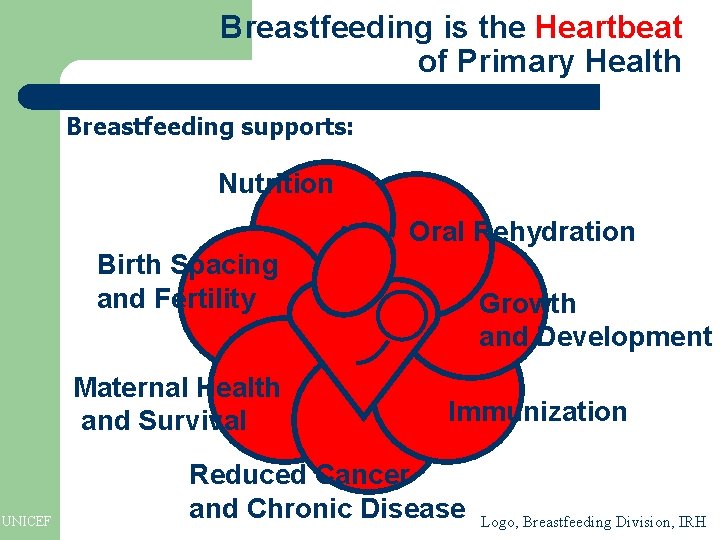
Breastfeeding is the Heartbeat of Primary Health Breastfeeding supports: Nutrition Oral Rehydration Birth Spacing and Fertility Maternal Health and Survival UNICEF Growth and Development Immunization Reduced Cancer and Chronic Disease Logo, Breastfeeding Division, IRH
What is Optimal Breastfeeding? l l UNICEF Six months exclusive breastfeeding Continued breastfeeding with appropriate complementary foods and feeding for 2 years and beyond Related maternal nutrition and care (Birth Interval of 3 years or more)
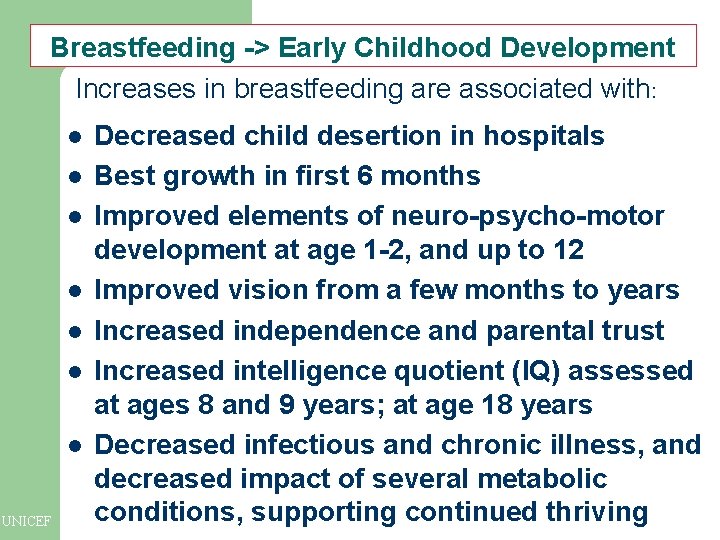
Breastfeeding -> Early Childhood Development Increases in breastfeeding are associated with: l l l l UNICEF Decreased child desertion in hospitals Best growth in first 6 months Improved elements of neuro-psycho-motor development at age 1 -2, and up to 12 Improved vision from a few months to years Increased independence and parental trust Increased intelligence quotient (IQ) assessed at ages 8 and 9 years; at age 18 years Decreased infectious and chronic illness, and decreased impact of several metabolic conditions, supporting continued thriving
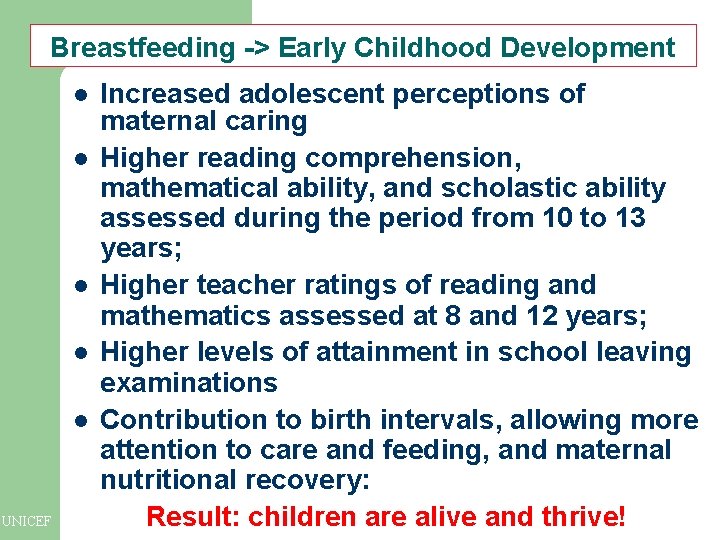
Breastfeeding -> Early Childhood Development l l l UNICEF Increased adolescent perceptions of maternal caring Higher reading comprehension, mathematical ability, and scholastic ability assessed during the period from 10 to 13 years; Higher teacher ratings of reading and mathematics assessed at 8 and 12 years; Higher levels of attainment in school leaving examinations Contribution to birth intervals, allowing more attention to care and feeding, and maternal nutritional recovery: Result: children are alive and thrive!
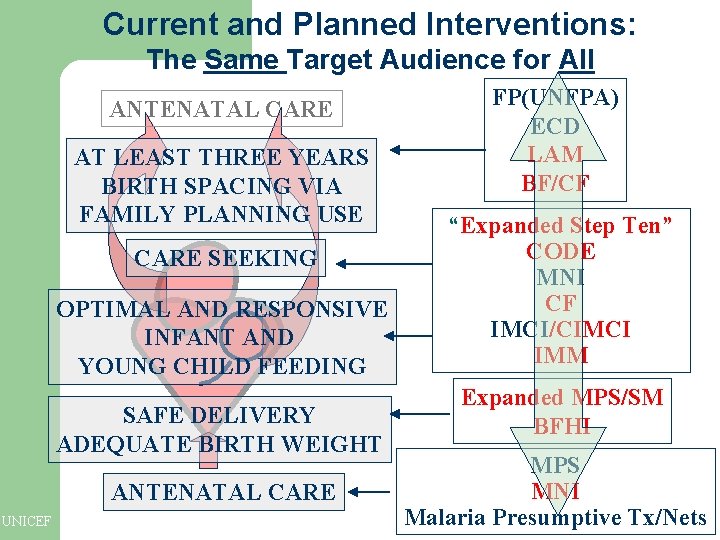
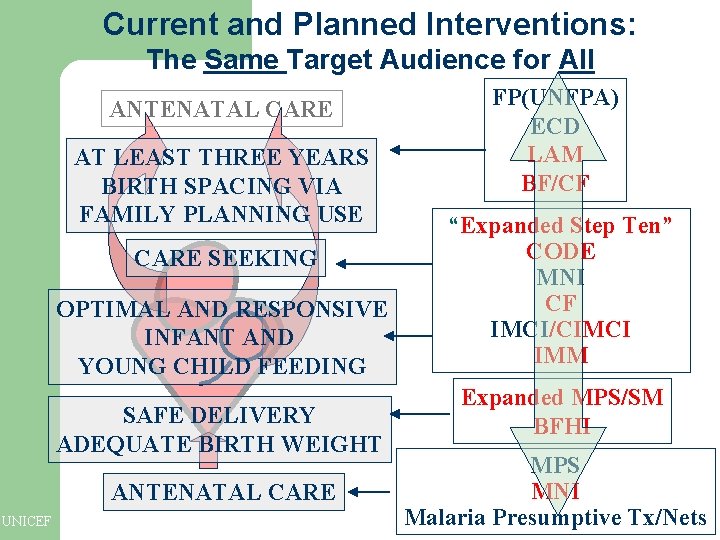
Current and Planned Interventions: The Same Target Audience for All ANTENATAL CARE AT LEAST THREE YEARS BIRTH SPACING VIA FAMILY PLANNING USE CARE SEEKING OPTIMAL AND RESPONSIVE INFANT AND YOUNG CHILD FEEDING SAFE DELIVERY ADEQUATE BIRTH WEIGHT ANTENATAL CARE UNICEF FP(UNFPA) ECD LAM BF/CF “Expanded Step Ten” CODE MNI CF IMCI/CIMCI IMM Expanded MPS/SM BFHI MPS MNI Malaria Presumptive Tx/Nets
Current and Planned Interventions: The Same Target Audience for All ANTENATAL CARE AT LEAST THREE YEARS BIRTH SPACING VIA FAMILY PLANNING USE CARE SEEKING OPTIMAL AND RESPONSIVE INFANT AND YOUNG CHILD FEEDING SAFE DELIVERY ADEQUATE BIRTH WEIGHT ANTENATAL CARE UNICEF FP(UNFPA) ECD LAM BF/CF “Expanded Step Ten” CODE MNI CF IMCI/CIMCI IMM Expanded MPS/SM BFHI MPS MNI Malaria Presumptive Tx/Nets
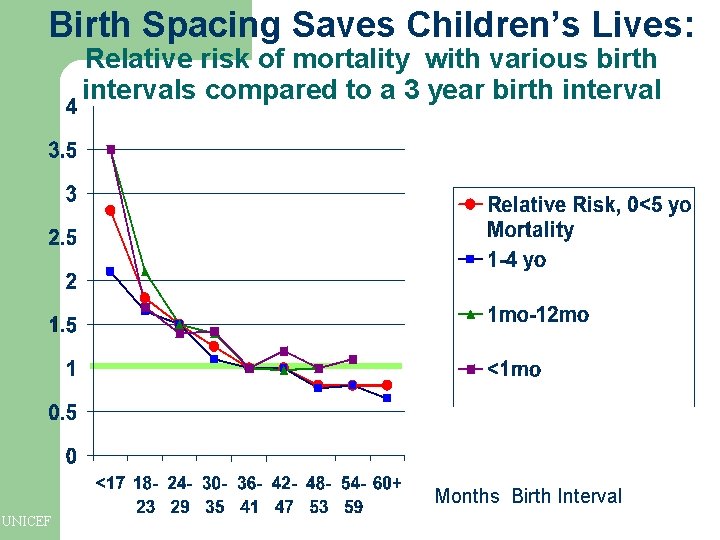
Birth Spacing Saves Children’s Lives: Relative risk of mortality with various birth intervals compared to a 3 year birth interval Months Birth Interval UNICEF
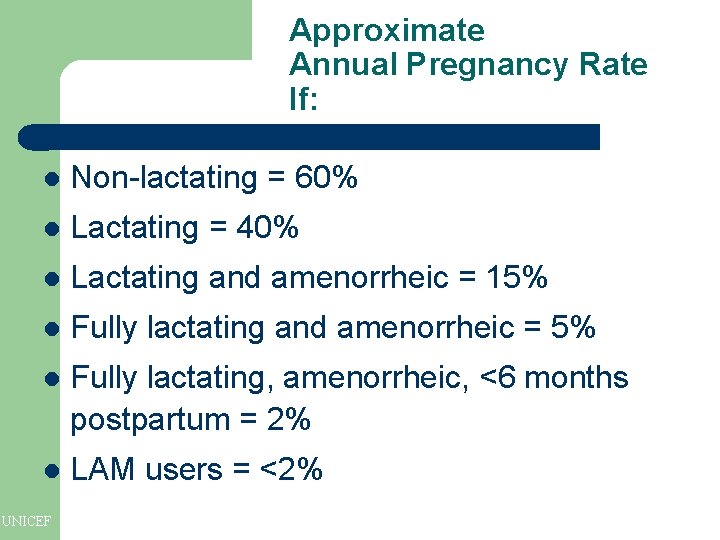
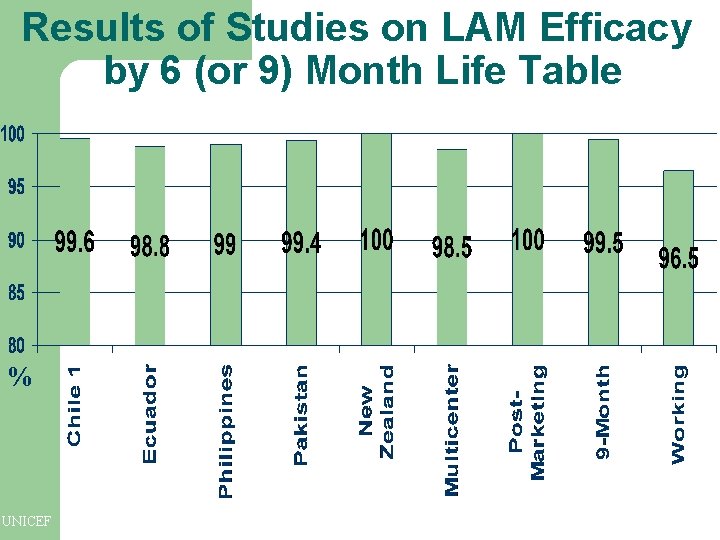
Approximate Annual Pregnancy Rate If: l Non-lactating = 60% l Lactating = 40% l Lactating and amenorrheic = 15% l Fully lactating and amenorrheic = 5% l Fully lactating, amenorrheic, <6 months postpartum = 2% l LAM users = <2% UNICEF
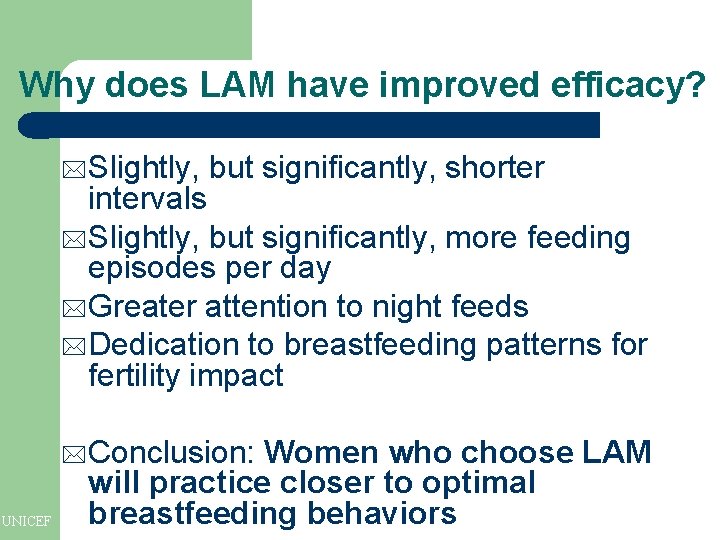
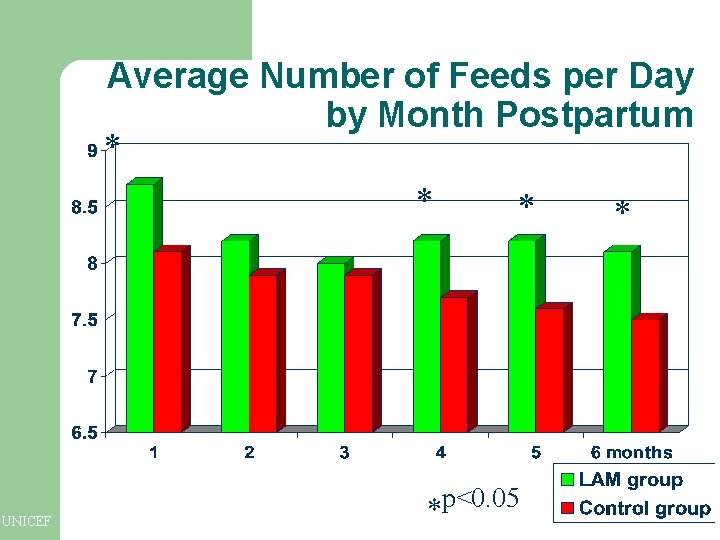
Why does LAM have improved efficacy? * Slightly, but significantly, shorter intervals * Slightly, but significantly, more feeding episodes per day * Greater attention to night feeds * Dedication to breastfeeding patterns for fertility impact * Conclusion: UNICEF Women who choose LAM will practice closer to optimal breastfeeding behaviors
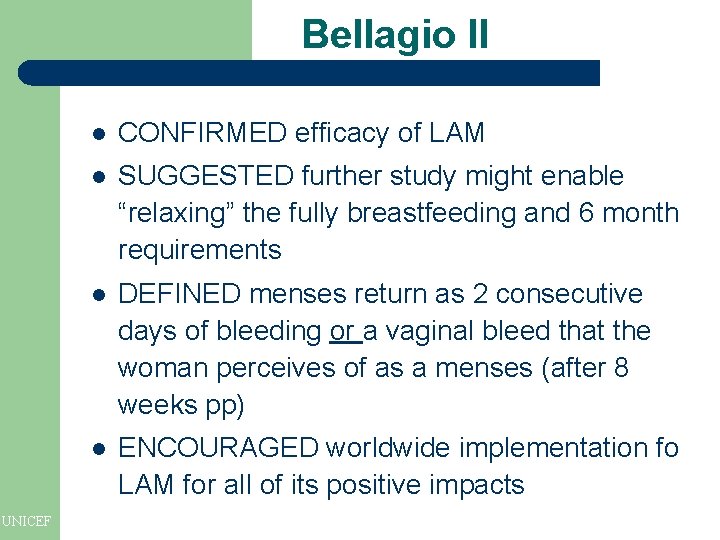
Bellagio II UNICEF l CONFIRMED efficacy of LAM l SUGGESTED further study might enable “relaxing” the fully breastfeeding and 6 month requirements l DEFINED menses return as 2 consecutive days of bleeding or a vaginal bleed that the woman perceives of as a menses (after 8 weeks pp) l ENCOURAGED worldwide implementation fo LAM for all of its positive impacts
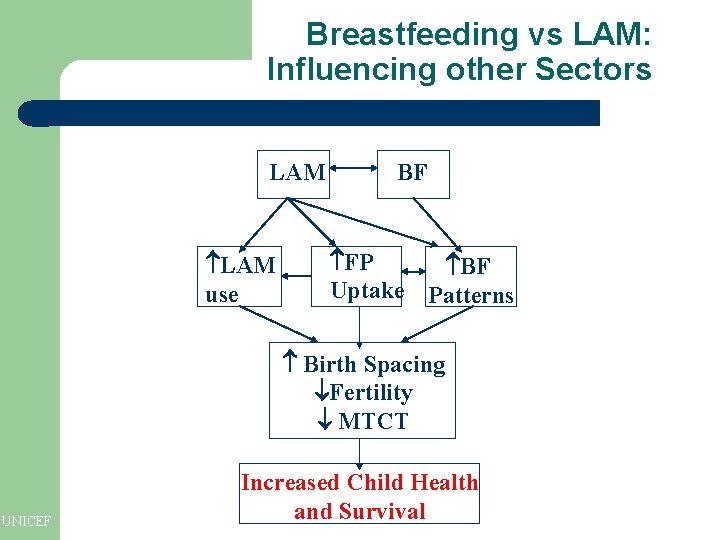
Breastfeeding vs LAM: Influencing other Sectors LAM use BF FP BF Uptake Patterns Birth Spacing Fertility MTCT UNICEF Increased Child Health and Survival
Objectives of this Session l l l UNICEF Understand the general principles of I/ECD Explore how to introduce breastfeeding in discussions addressing the other 4 Strategic priorities Understand the 3 sectors enhanced by LAM Discuss the development of new “hooks” to increase interest in breastfeeding
Thank you Asante-sana Salamat po Merci Gracias Danke Spasibo Abrigato UNICEF Barakallaofik
Infant and Young Child Nutrition and Related Maternal Issues: Targeting the Mother-Child Dyad The Mother-Baby-Friendly Plan of Action UNICEF Programme Division Nutrition Section
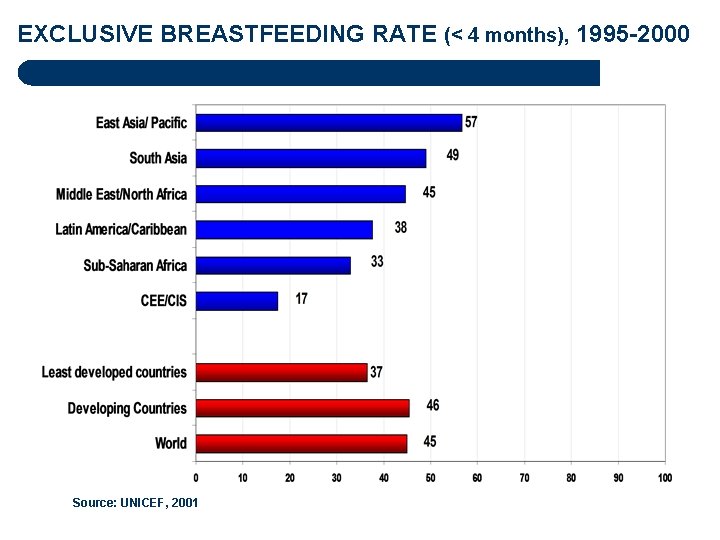
EXCLUSIVE BREASTFEEDING RATE (< 4 months), 1995 -2000 Source: UNICEF, 2001
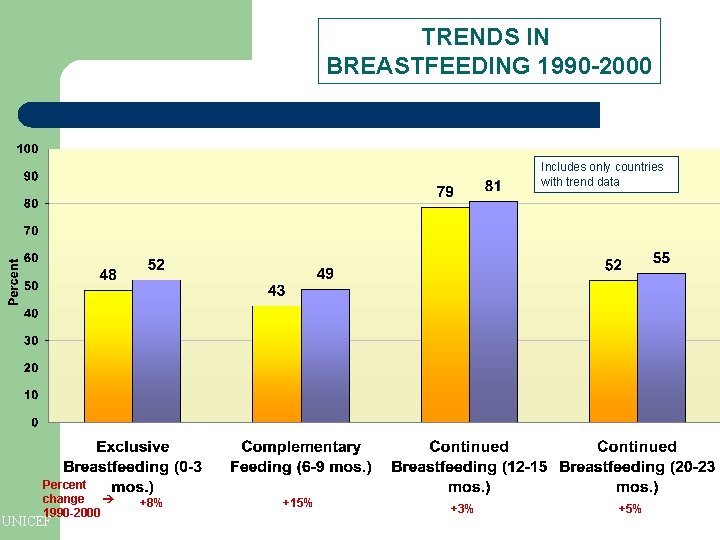
TRENDS IN BREASTFEEDING 1990 -2000 Includes only countries with trend data Percent change 1990 -2000 UNICEF +8% +15% +3% +5%
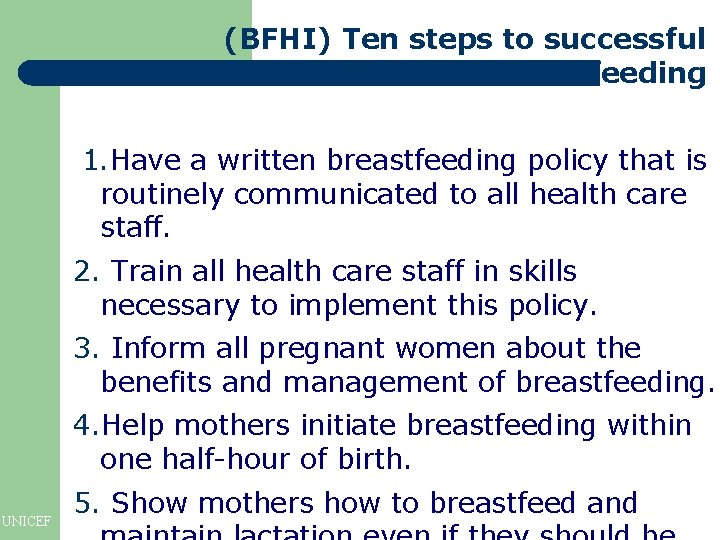
(BFHI) Ten steps to successful breastfeeding 1. Have a written breastfeeding policy that is routinely communicated to all health care staff. 2. Train all health care staff in skills necessary to implement this policy. 3. Inform all pregnant women about the benefits and management of breastfeeding. 4. Help mothers initiate breastfeeding within one half-hour of birth. UNICEF 5. Show mothers how to breastfeed and
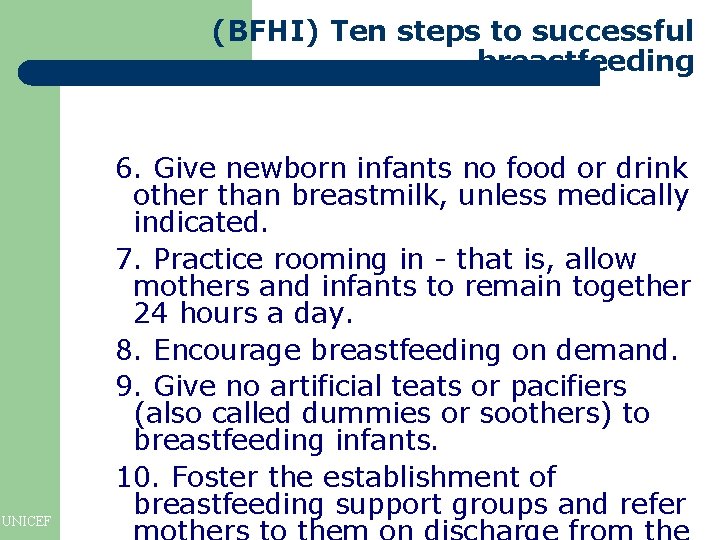
(BFHI) Ten steps to successful breastfeeding UNICEF 6. Give newborn infants no food or drink other than breastmilk, unless medically indicated. 7. Practice rooming in - that is, allow mothers and infants to remain together 24 hours a day. 8. Encourage breastfeeding on demand. 9. Give no artificial teats or pacifiers (also called dummies or soothers) to breastfeeding infants. 10. Foster the establishment of breastfeeding support groups and refer
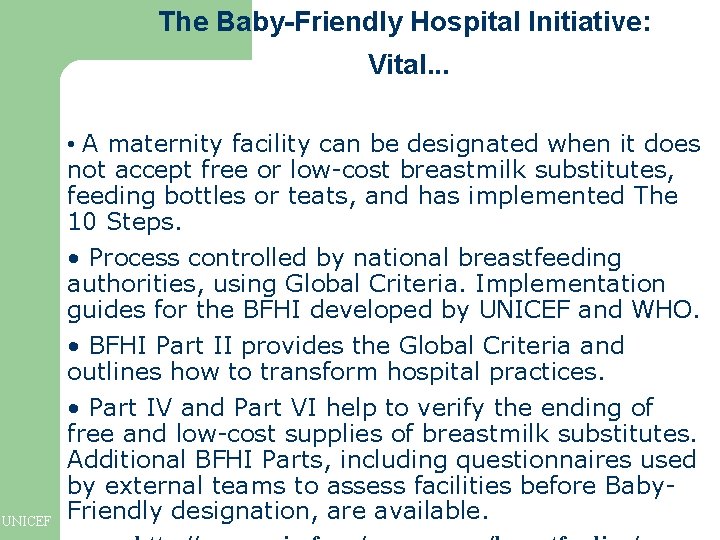
The Baby-Friendly Hospital Initiative: Vital. . . UNICEF • A maternity facility can be designated when it does not accept free or low-cost breastmilk substitutes, feeding bottles or teats, and has implemented The 10 Steps. • Process controlled by national breastfeeding authorities, using Global Criteria. Implementation guides for the BFHI developed by UNICEF and WHO. • BFHI Part II provides the Global Criteria and outlines how to transform hospital practices. • Part IV and Part VI help to verify the ending of free and low-cost supplies of breastmilk substitutes. Additional BFHI Parts, including questionnaires used by external teams to assess facilities before Baby. Friendly designation, are available.
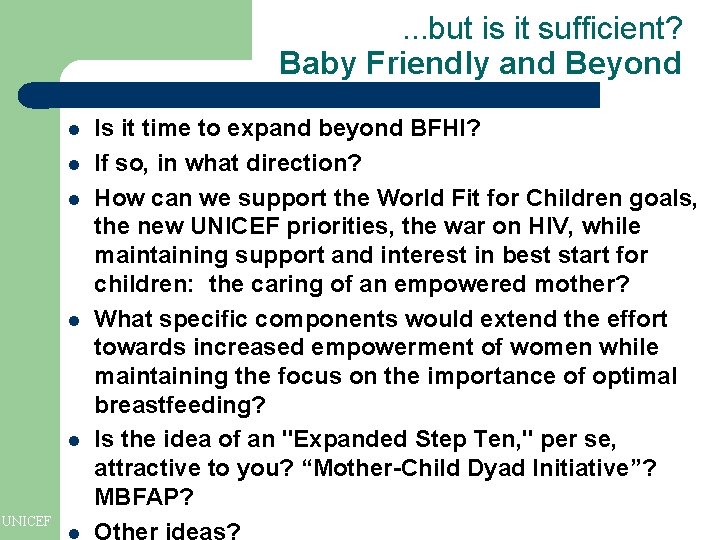
. . . but is it sufficient? Baby Friendly and Beyond l l l UNICEF l Is it time to expand beyond BFHI? If so, in what direction? How can we support the World Fit for Children goals, the new UNICEF priorities, the war on HIV, while maintaining support and interest in best start for children: the caring of an empowered mother? What specific components would extend the effort towards increased empowerment of women while maintaining the focus on the importance of optimal breastfeeding? Is the idea of an "Expanded Step Ten, " per se, attractive to you? “Mother-Child Dyad Initiative”? MBFAP? Other ideas?
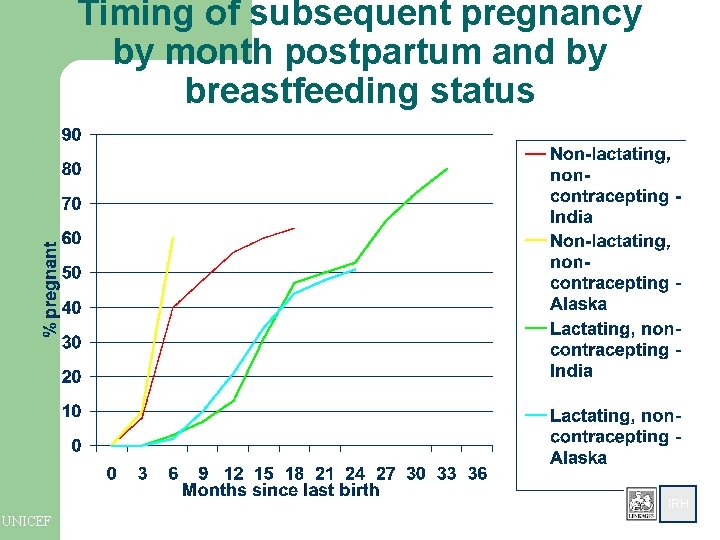
Timing of subsequent pregnancy by month postpartum and by breastfeeding status IRH UNICEF
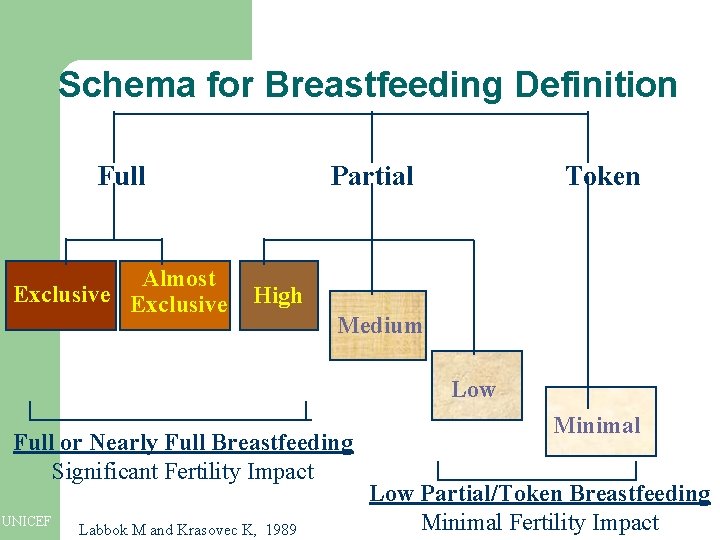
Schema for Breastfeeding Definition Full Almost Exclusive Partial Token High Medium Low Full or Nearly Full Breastfeeding Significant Fertility Impact UNICEF Labbok M and Krasovec K, 1989 Minimal Low Partial/Token Breastfeeding Minimal Fertility Impact
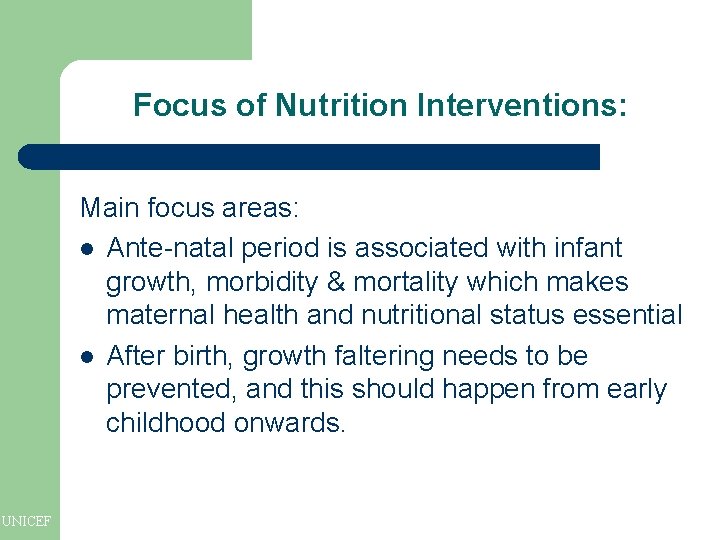
Focus of Nutrition Interventions: Main focus areas: l Ante-natal period is associated with infant growth, morbidity & mortality which makes maternal health and nutritional status essential l After birth, growth faltering needs to be prevented, and this should happen from early childhood onwards. UNICEF
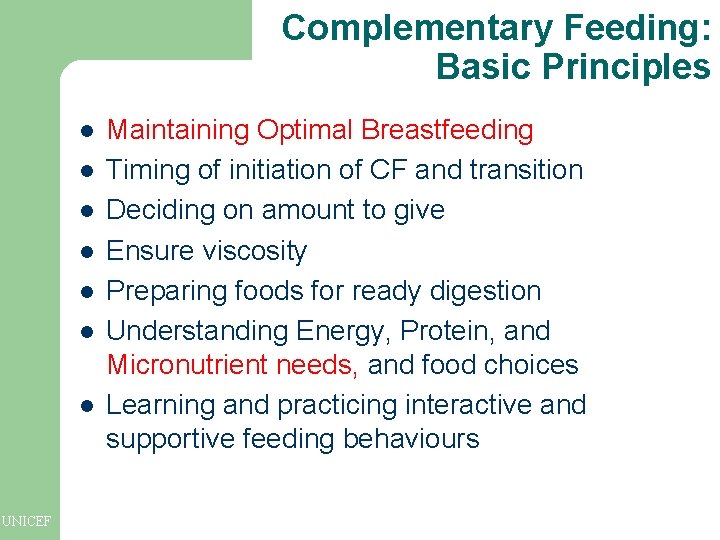
Complementary Feeding: Basic Principles l l l l UNICEF Maintaining Optimal Breastfeeding Timing of initiation of CF and transition Deciding on amount to give Ensure viscosity Preparing foods for ready digestion Understanding Energy, Protein, and Micronutrient needs, and food choices Learning and practicing interactive and supportive feeding behaviours
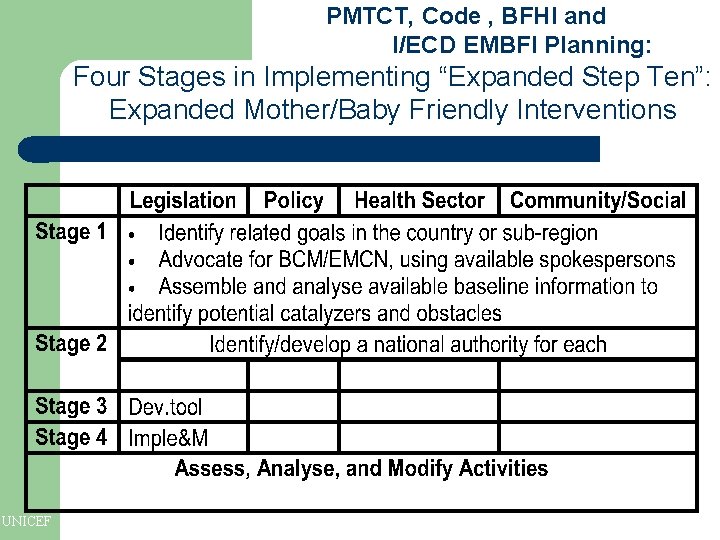
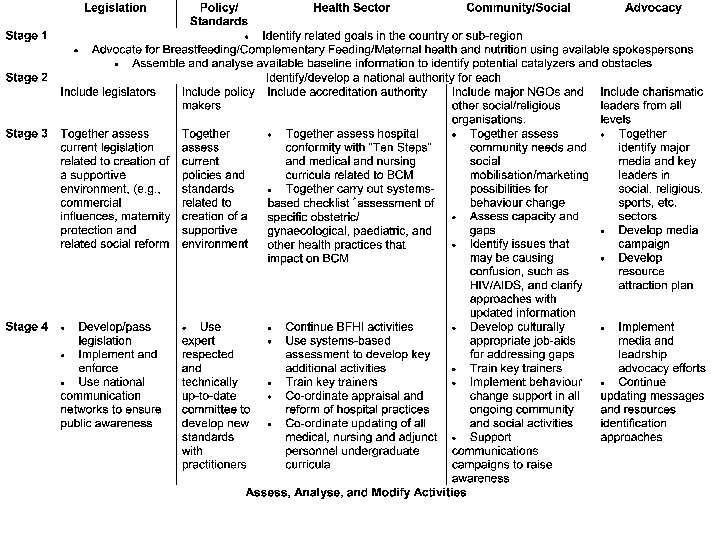
PMTCT, Code , BFHI and I/ECD EMBFI Planning: Four Stages in Implementing “Expanded Step Ten”: Expanded Mother/Baby Friendly Interventions UNICEF
UNICEF
UNICEF
Integrated Early Childhood Development at UNICEF: Targeting the Mother-Child Dyad Vital to MTSP Success UNICEF Programme Division Nutrition Section
Bellagio I -- 1988 l “Women who are not using family planning, but who are fully or nearly fully breastfeeding and amenorrheic, are likely to experience a risk of pregnancy of less than 2% in the first 6 months after delivery” l Developed into LAM algorithm by group of FP and MCH program leaders at Georgetown, IRH Studied in other formats by FHI and others l UNICEF
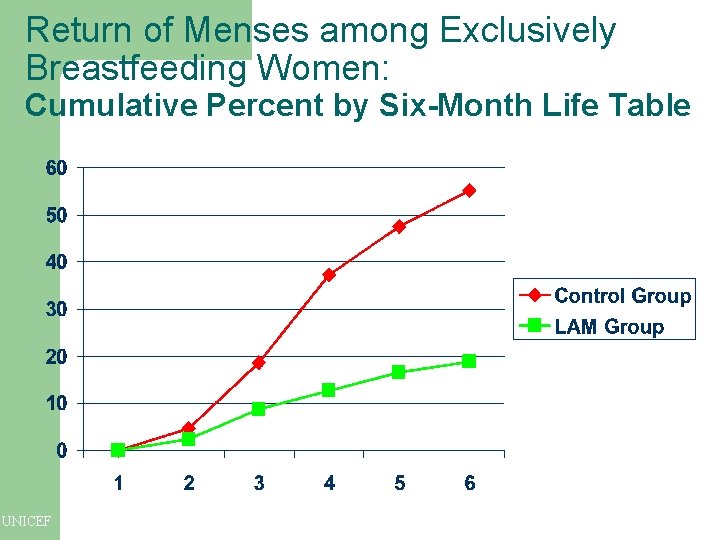
Return of Menses among Exclusively Breastfeeding Women: Cumulative Percent by Six-Month Life Table UNICEF
Average Number of Feeds per Day by Month Postpartum * * UNICEF * *p<0. 05 *
Results of Studies on LAM Efficacy by 6 (or 9) Month Life Table % UNICEF
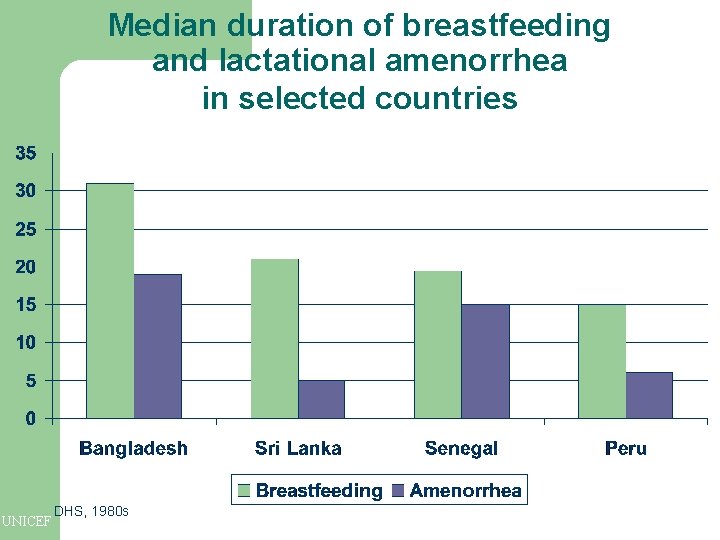
Median duration of breastfeeding and lactational amenorrhea in selected countries UNICEF DHS, 1980 s
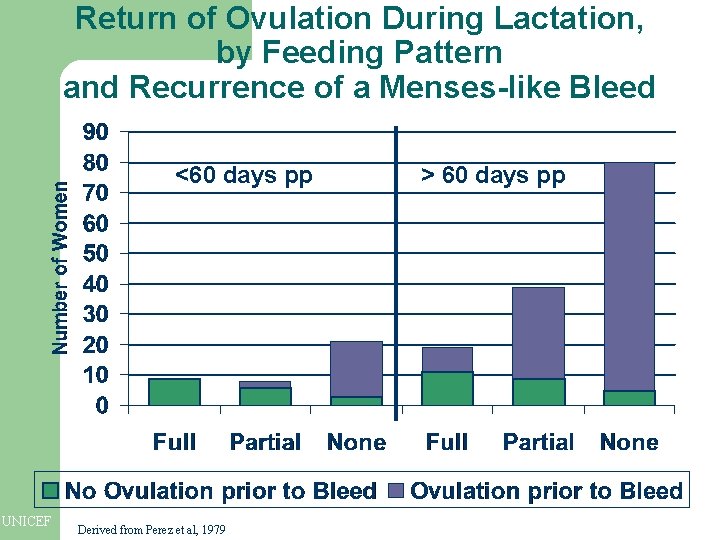
Return of Ovulation During Lactation, by Feeding Pattern and Recurrence of a Menses-like Bleed <60 days pp UNICEF Derived from Perez et al, 1979 > 60 days pp
Conclusions (1 of 2) UNICEF l Interactive Breastfeeding and Responsive feeding are major elements in the life of the 0 -3 year old l Early, Exclusive and Sustained Breastfeeding are shown responsive to intervention programs l ECD benefits inescapably from the presence of a living, health, and well-informed mother who is supported by her community - breastfeeding is empowering l If optimal infant and young child feeding is programmed, nearly all aspects of ECD are addressed and supported.
Conclusions (2 of 2) l We have initiatives in place that support ECD – – – – l l UNICEF BFHI and Expanded BFHI Enforcement of the Code of Marketing New: Complementary Feeding in BF context Nutrition Package of IMCI and Community IMCI Making Pregnancy Safe/Safe Motherhood Micronutrients programs - Vit A, Iodised salt, iron/folate, multi-vitamins Others Integrating their strengths by consistent messages at every contact will be the challenge Targeting the maternal-child dyad may be a key to cross-sectoral integration