
Integrated Drought Management Program IDMP 3 key pillars

- Slides: 6
Integrated Drought Management Program (IDMP): 3 key “pillars” of a National Drought Policy A case of Ethiopia) 1. Monitoring & Early Warning System Existing practices improvements /ongoing efforts Weak EWS in some places & marginalization of the lowlands • Climate Services has to be introduced Single indices Eg. SPI • Multi-Indices SPIE • Vegetation monitoring (GHA) Forecasting is not descriptive (normal, above normal) • Need contextualization to user’s need • Poor station network • Data quality (missing data, • Using of hybrid data downscaled data i. e at Zonal or • IOD phase during seasonal Woreda level) forecast • Variables used (rainfall, Temp. & SST) • Poor forecast skill • Lack of long term and precise data 1
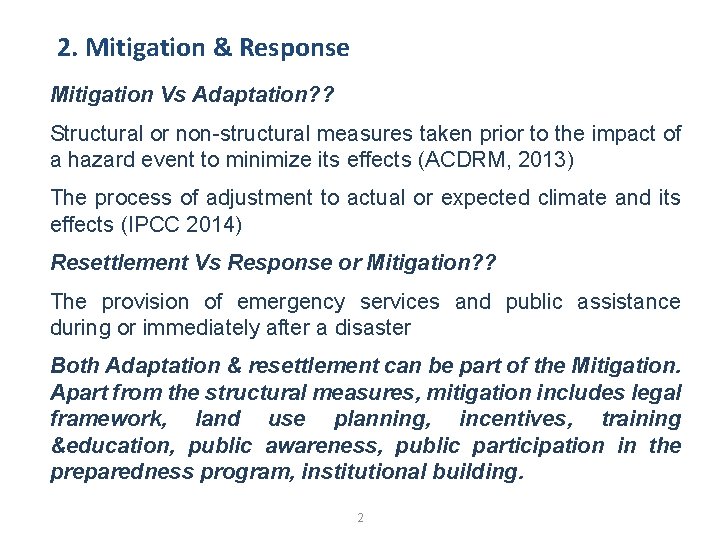
2. Mitigation & Response Mitigation Vs Adaptation? ? Structural or non-structural measures taken prior to the impact of a hazard event to minimize its effects (ACDRM, 2013) The process of adjustment to actual or expected climate and its effects (IPCC 2014) Resettlement Vs Response or Mitigation? ? The provision of emergency services and public assistance during or immediately after a disaster Both Adaptation & resettlement can be part of the Mitigation. Apart from the structural measures, mitigation includes legal framework, land use planning, incentives, training &education, public awareness, public participation in the preparedness program, institutional building. 2
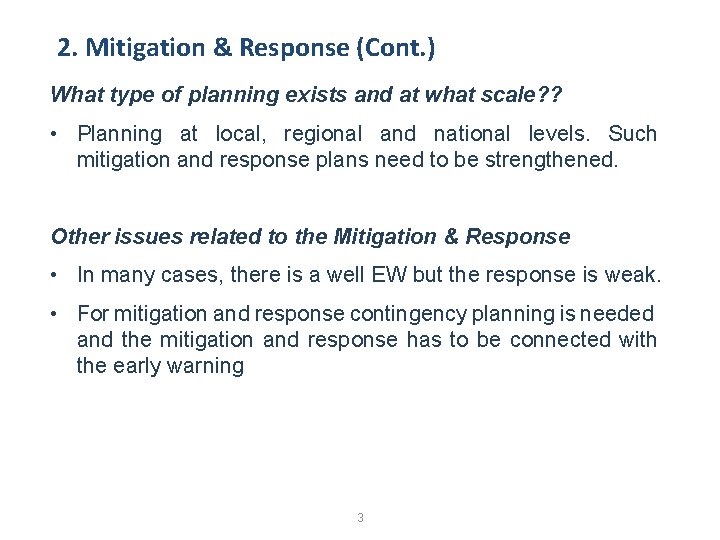
2. Mitigation & Response (Cont. ) What type of planning exists and at what scale? ? • Planning at local, regional and national levels. Such mitigation and response plans need to be strengthened. Other issues related to the Mitigation & Response • In many cases, there is a well EW but the response is weak. • For mitigation and response contingency planning is needed and the mitigation and response has to be connected with the early warning 3
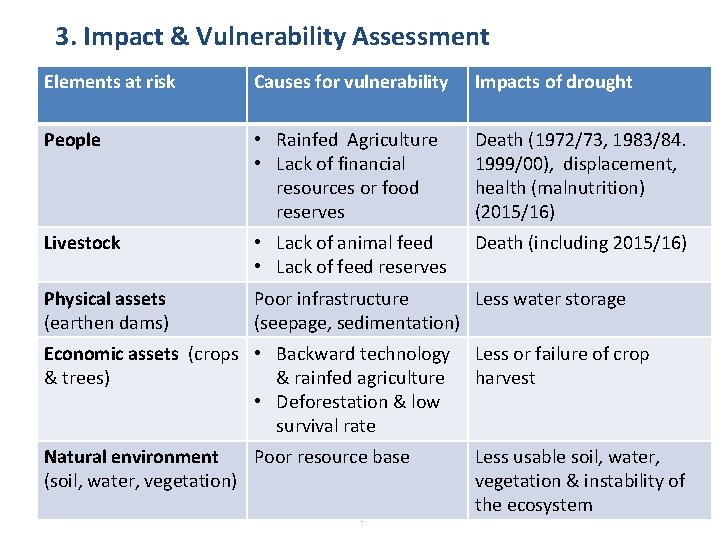
3. Impact & Vulnerability Assessment Elements at risk Causes for vulnerability Impacts of drought People • Rainfed Agriculture • Lack of financial resources or food reserves Death (1972/73, 1983/84. 1999/00), displacement, health (malnutrition) (2015/16) Livestock • Lack of animal feed • Lack of feed reserves Death (including 2015/16) Physical assets (earthen dams) Poor infrastructure Less water storage (seepage, sedimentation) Economic assets (crops • Backward technology & trees) & rainfed agriculture • Deforestation & low survival rate Less or failure of crop harvest Natural environment Poor resource base (soil, water, vegetation) Less usable soil, water, vegetation & instability of the ecosystem 4
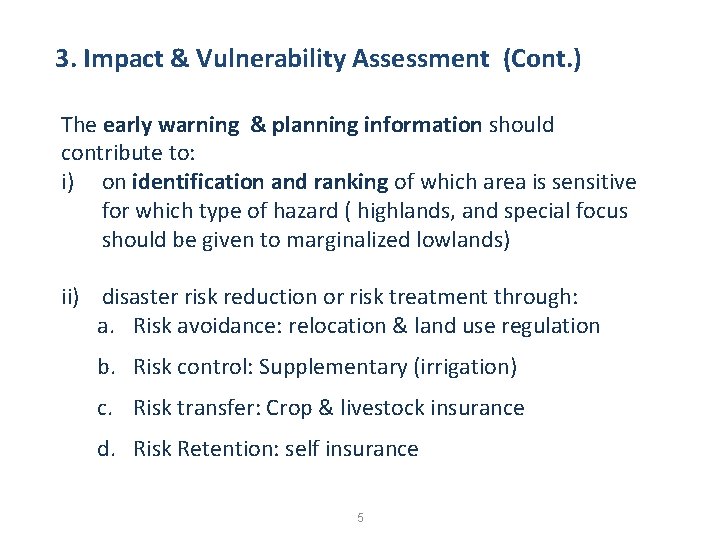
3. Impact & Vulnerability Assessment (Cont. ) The early warning & planning information should contribute to: i) on identification and ranking of which area is sensitive for which type of hazard ( highlands, and special focus should be given to marginalized lowlands) ii) disaster risk reduction or risk treatment through: a. Risk avoidance: relocation & land use regulation b. Risk control: Supplementary (irrigation) c. Risk transfer: Crop & livestock insurance d. Risk Retention: self insurance 5
Challenges: • Mainly top-down information flow • Huge gap on weather and climate information between what is needed at the local level & what is produced at global or regional level Recommendation: The three key pillars to be effective, there should be a coordination of all stakeholders along the climate service value chain, which ranges from climate data acquisition and analysis, interpretation, communication, and use. 6