
INTEGRATED DISASTER RISK MANAGEMENT IN THE PHILIPPINES Rosalia
- Slides: 13
INTEGRATED DISASTER RISK MANAGEMENT IN THE PHILIPPINES Rosalia V. De Leon WBG Alternate Executive Director - Philippines 17 Meeting of the GFDRR Consultative Group April 26, 2016
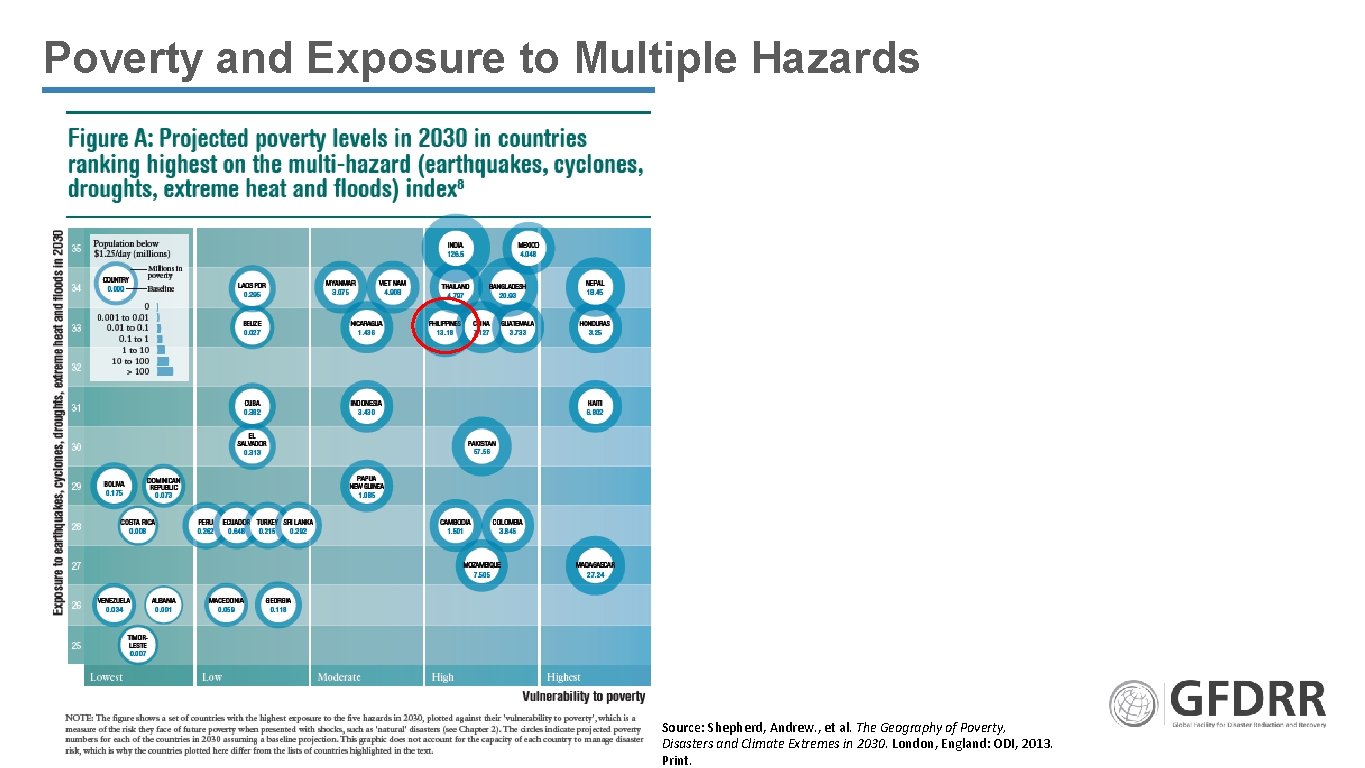
Poverty and Exposure to Multiple Hazards Source: Shepherd, Andrew. , et al. The Geography of Poverty, Disasters and Climate Extremes in 2030. London, England: ODI, 2013. Print.
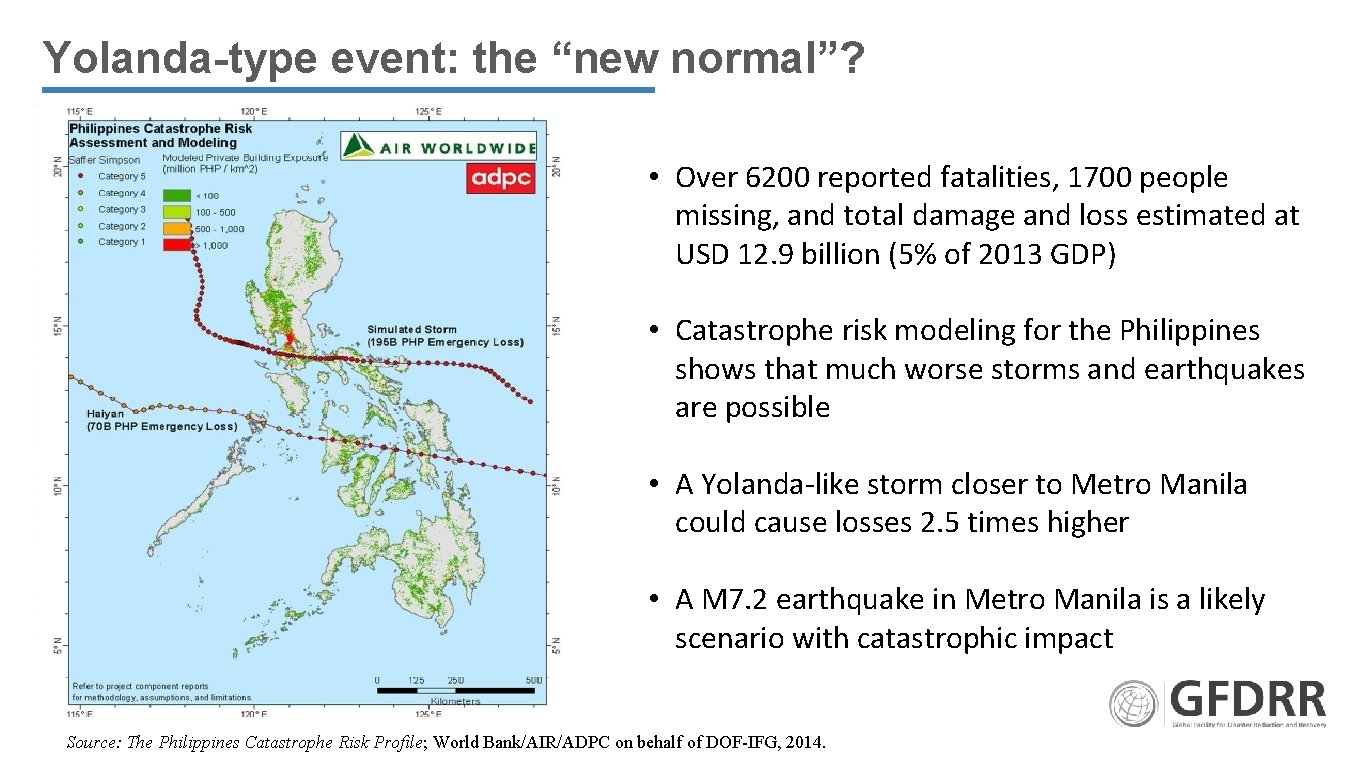
Yolanda-type event: the “new normal”? • Over 6200 reported fatalities, 1700 people missing, and total damage and loss estimated at USD 12. 9 billion (5% of 2013 GDP) • Catastrophe risk modeling for the Philippines shows that much worse storms and earthquakes are possible • A Yolanda-like storm closer to Metro Manila could cause losses 2. 5 times higher • A M 7. 2 earthquake in Metro Manila is a likely scenario with catastrophic impact Source: The Philippines Catastrophe Risk Profile; World Bank/AIR/ADPC on behalf of DOF-IFG, 2014.
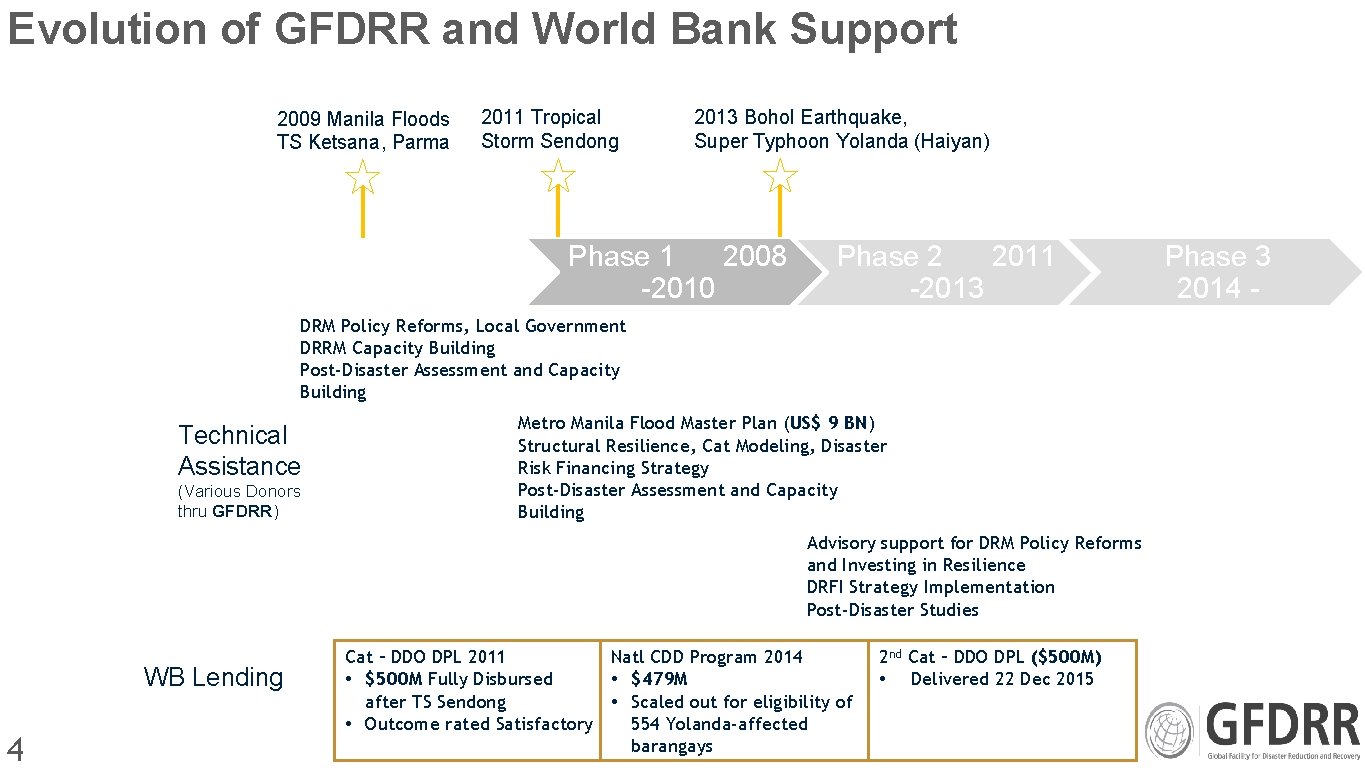
Evolution of GFDRR and World Bank Support 2009 Manila Floods TS Ketsana, Parma 2011 Tropical Storm Sendong 2013 Bohol Earthquake, Super Typhoon Yolanda (Haiyan) Phase 1 2008 -2010 Phase 2 2011 -2013 DRM Policy Reforms, Local Government DRRM Capacity Building Post-Disaster Assessment and Capacity Building Technical Assistance (Various Donors thru GFDRR) Metro Manila Flood Master Plan (US$ 9 BN) Structural Resilience, Cat Modeling, Disaster Risk Financing Strategy Post-Disaster Assessment and Capacity Building Advisory support for DRM Policy Reforms and Investing in Resilience DRFI Strategy Implementation Post-Disaster Studies WB Lending 4 Cat – DDO DPL 2011 Natl CDD Program 2014 • $500 M Fully Disbursed • $479 M after TS Sendong • Scaled out for eligibility of • Outcome rated Satisfactory 554 Yolanda-affected barangays 2 nd Cat – DDO DPL ($500 M) • Delivered 22 Dec 2015 Phase 3 2014 -
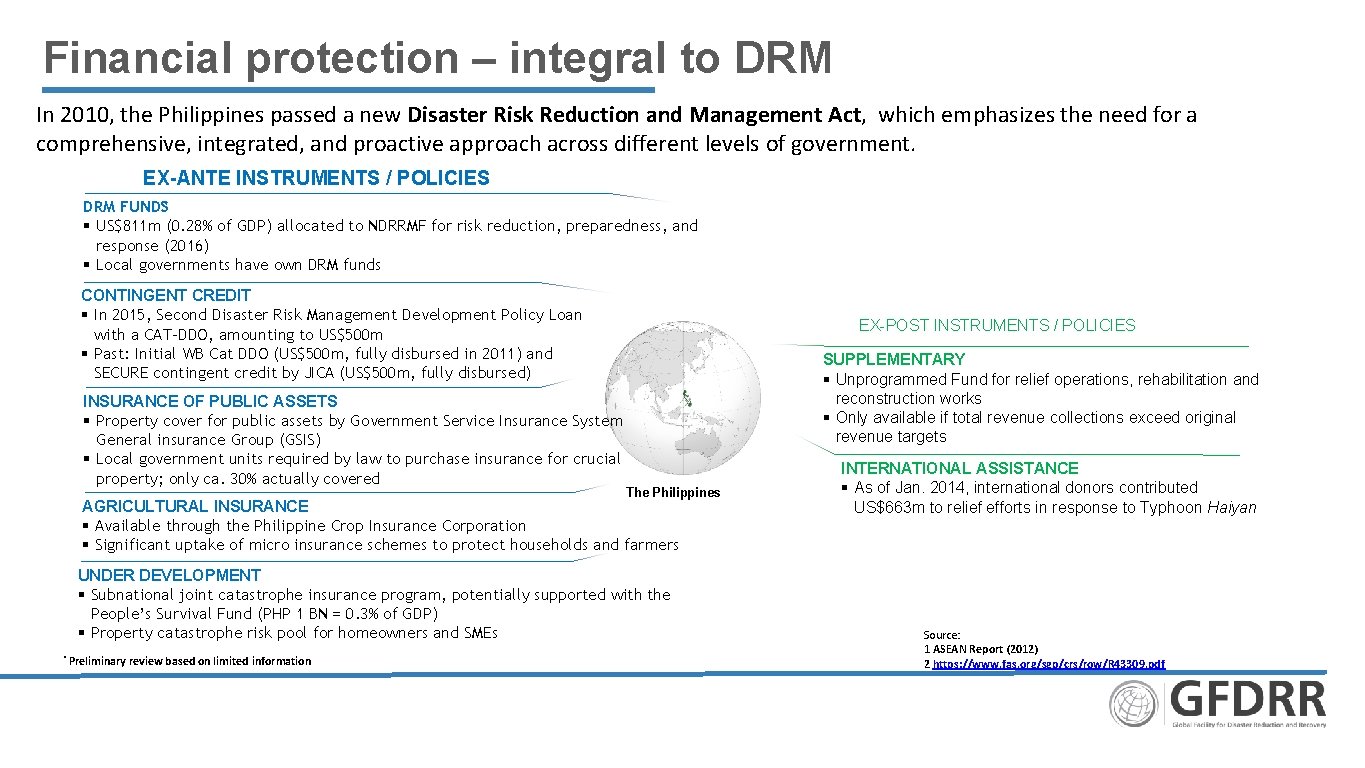
Financial protection – integral to DRM In 2010, the Philippines passed a new Disaster Risk Reduction and Management Act, which emphasizes the need for a comprehensive, integrated, and proactive approach across different levels of government. EX-ANTE INSTRUMENTS / POLICIES DRM FUNDS § US$811 m (0. 28% of GDP) allocated to NDRRMF for risk reduction, preparedness, and response (2016) § Local governments have own DRM funds CONTINGENT CREDIT § In 2015, Second Disaster Risk Management Development Policy Loan with a CAT-DDO, amounting to US$500 m § Past: Initial WB Cat DDO (US$500 m, fully disbursed in 2011) and SECURE contingent credit by JICA (US$500 m, fully disbursed) INSURANCE OF PUBLIC ASSETS § Property cover for public assets by Government Service Insurance System General insurance Group (GSIS) § Local government units required by law to purchase insurance for crucial property; only ca. 30% actually covered EX-POST INSTRUMENTS / POLICIES SUPPLEMENTARY § Unprogrammed Fund for relief operations, rehabilitation and reconstruction works § Only available if total revenue collections exceed original revenue targets The Philippines AGRICULTURAL INSURANCE § Available through the Philippine Crop Insurance Corporation § Significant uptake of micro insurance schemes to protect households and farmers UNDER DEVELOPMENT § Subnational joint catastrophe insurance program, potentially supported with the People’s Survival Fund (PHP 1 BN = 0. 3% of GDP) § Property catastrophe risk pool for homeowners and SMEs * Preliminary review based on limited information INTERNATIONAL ASSISTANCE § As of Jan. 2014, international donors contributed US$663 m to relief efforts in response to Typhoon Haiyan Source: 1 ASEAN Report (2012) 2 https: //www. fas. org/sgp/crs/row/R 43309. pdf
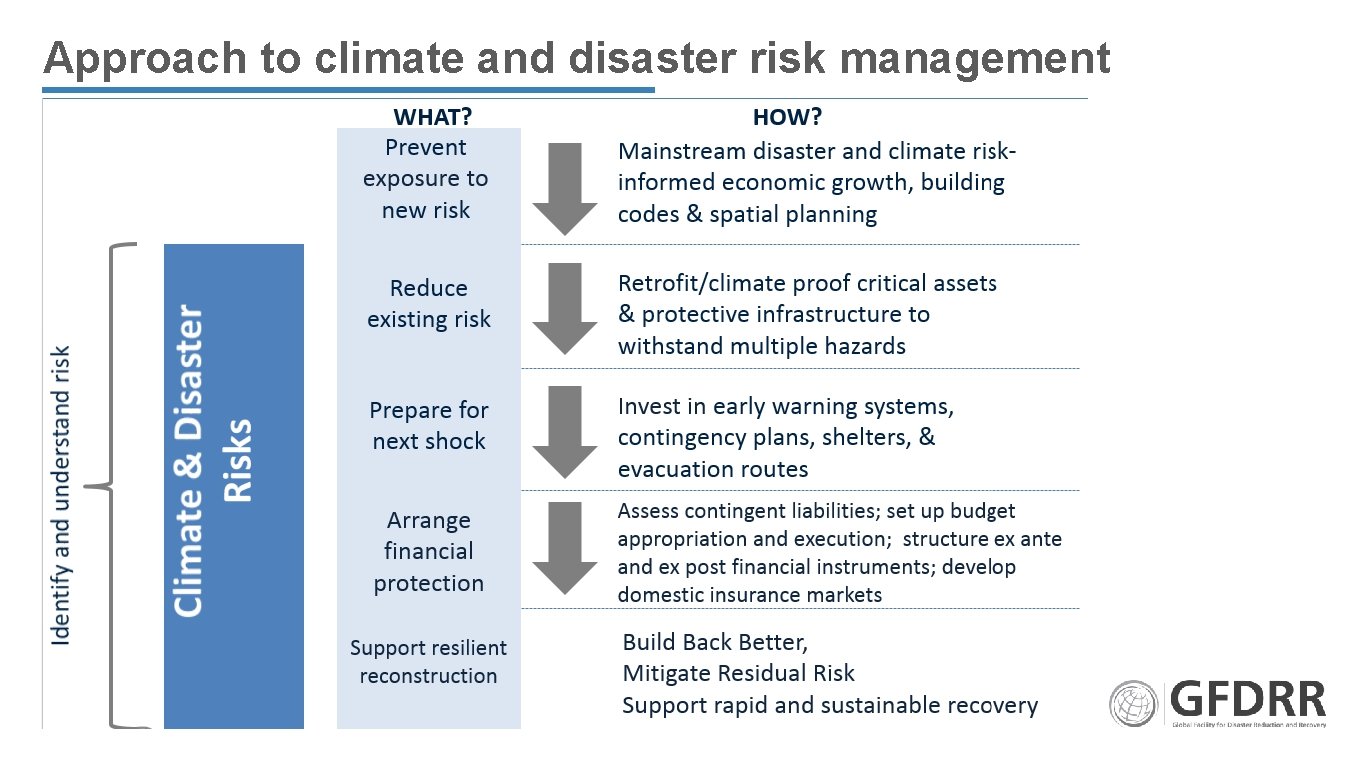
Approach to climate and disaster risk management
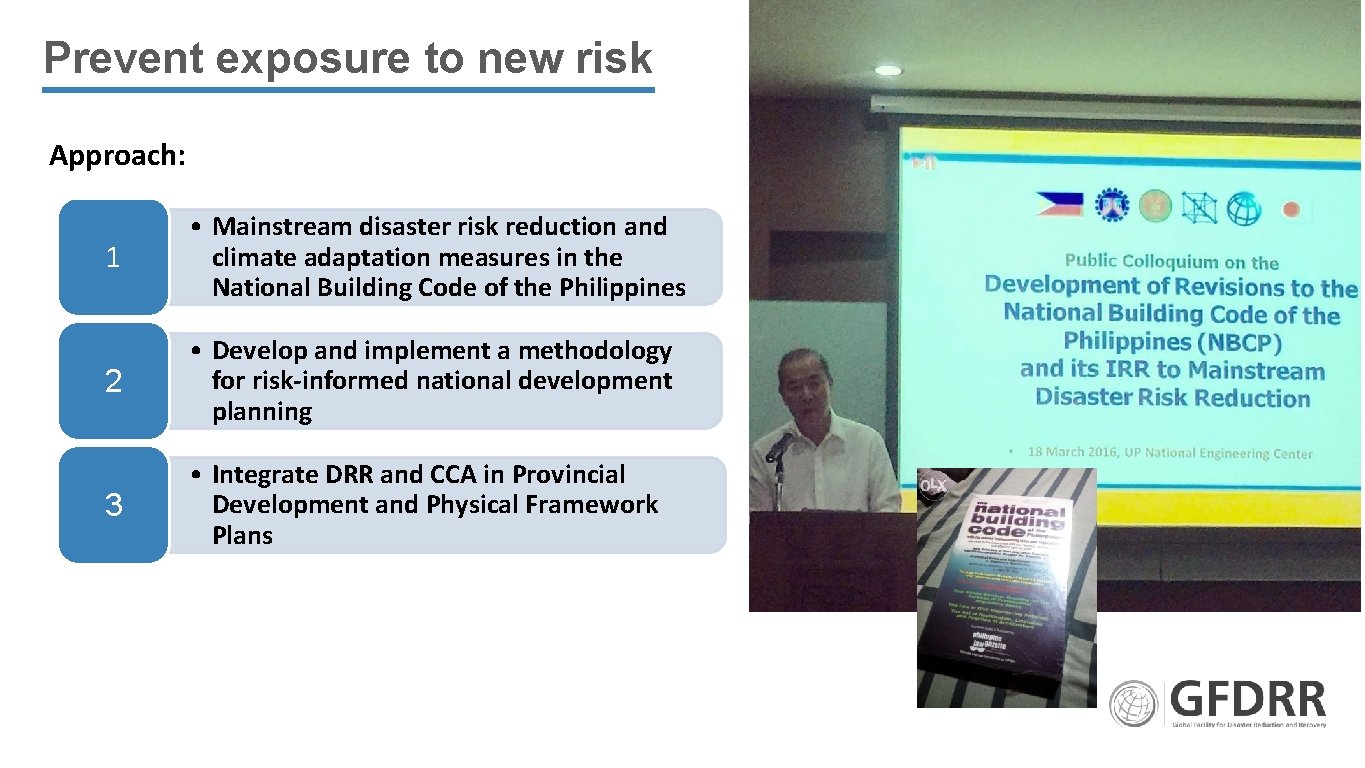
Prevent exposure to new risk Approach: 1 • Mainstream disaster risk reduction and climate adaptation measures in the National Building Code of the Philippines 2 • Develop and implement a methodology for risk-informed national development planning 3 • Integrate DRR and CCA in Provincial Development and Physical Framework Plans
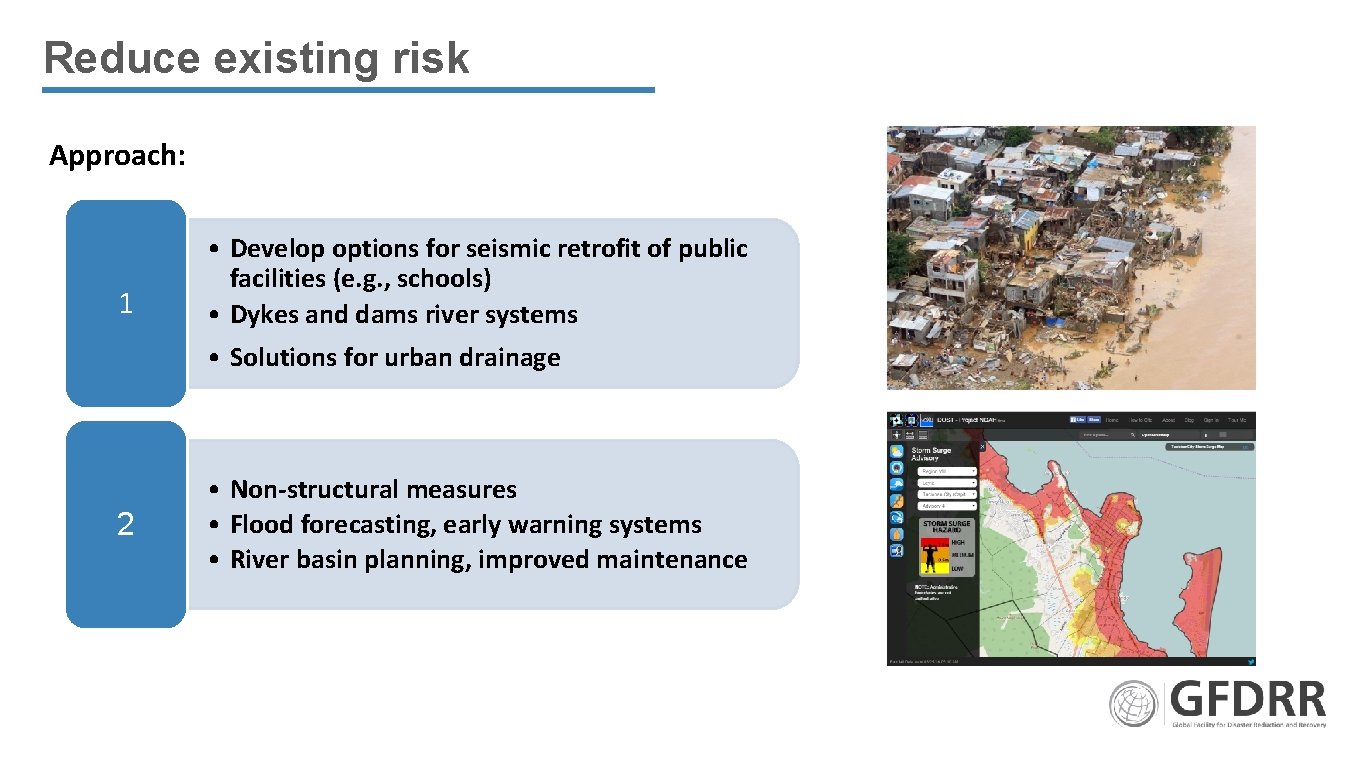
Reduce existing risk Approach: 1 • Develop options for seismic retrofit of public facilities (e. g. , schools) • Dykes and dams river systems • Solutions for urban drainage 2 • Non-structural measures • Flood forecasting, early warning systems • River basin planning, improved maintenance
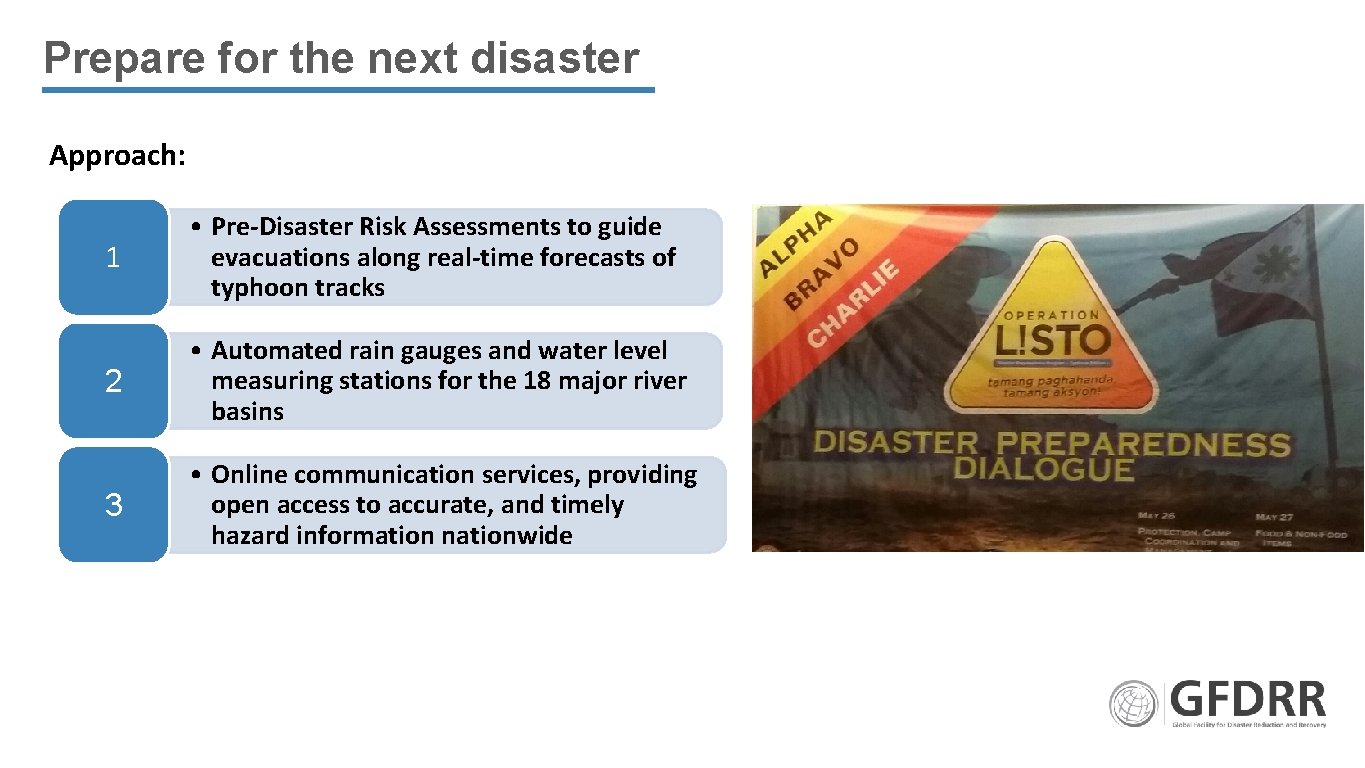
Prepare for the next disaster Approach: 1 • Pre-Disaster Risk Assessments to guide evacuations along real-time forecasts of typhoon tracks 2 • Automated rain gauges and water level measuring stations for the 18 major river basins 3 • Online communication services, providing open access to accurate, and timely hazard information nationwide
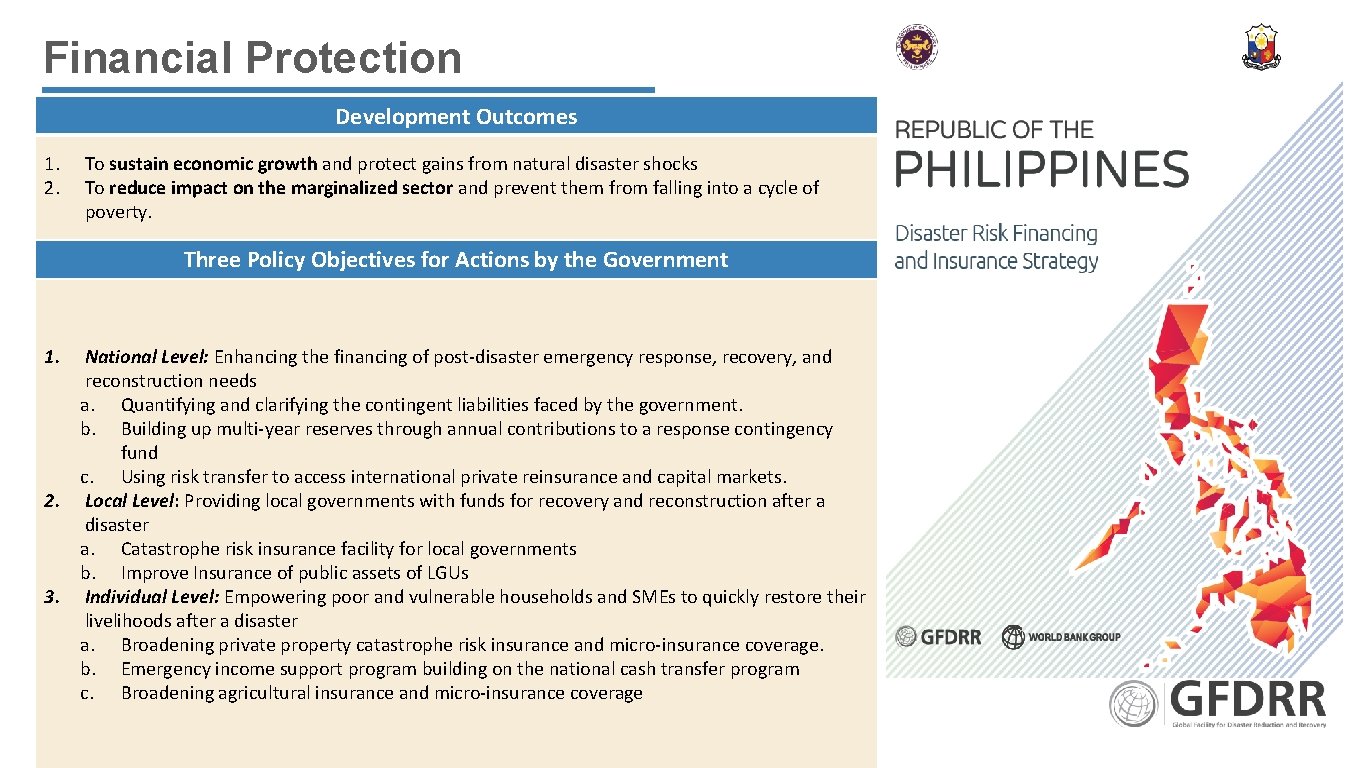
Financial Protection Development Outcomes 1. 2. To sustain economic growth and protect gains from natural disaster shocks To reduce impact on the marginalized sector and prevent them from falling into a cycle of poverty. Three Policy Objectives for Actions by the Government 1. 2. 3. National Level: Enhancing the financing of post-disaster emergency response, recovery, and reconstruction needs a. Quantifying and clarifying the contingent liabilities faced by the government. b. Building up multi-year reserves through annual contributions to a response contingency fund c. Using risk transfer to access international private reinsurance and capital markets. Local Level: Providing local governments with funds for recovery and reconstruction after a disaster a. Catastrophe risk insurance facility for local governments b. Improve Insurance of public assets of LGUs Individual Level: Empowering poor and vulnerable households and SMEs to quickly restore their livelihoods after a disaster a. Broadening private property catastrophe risk insurance and micro-insurance coverage. b. Emergency income support program building on the national cash transfer program c. Broadening agricultural insurance and micro-insurance coverage
Financial Protection – The Vulnerable 20 Group 1. V 20 platform prepares a joint statement on commitment to follow key principles for responsible financial protection against disaster and climate risk (WB/IMF Spring Meetings) 2. V 20 statement at the World Humanitarian Summit - High-Level Roundtable on Natural Disasters and Climate Change (Istanbul, May 2016) 3. V 20 governments (# to be determined) prepare national Financial Protection Strategy that establishes priorities for building financial resilience in line with key principles (by Oct 2016) 4. V 20 platform meets to share national strategies and group countries according to common priorities (WB/IMF Annual Meetings, Oct 2016) 4. V 20 platform presents strategies with associated action/investment plans to international partners for support Sources: GAR 2015, PCRAFI, CCRIF, World Bank, EM-DAT.
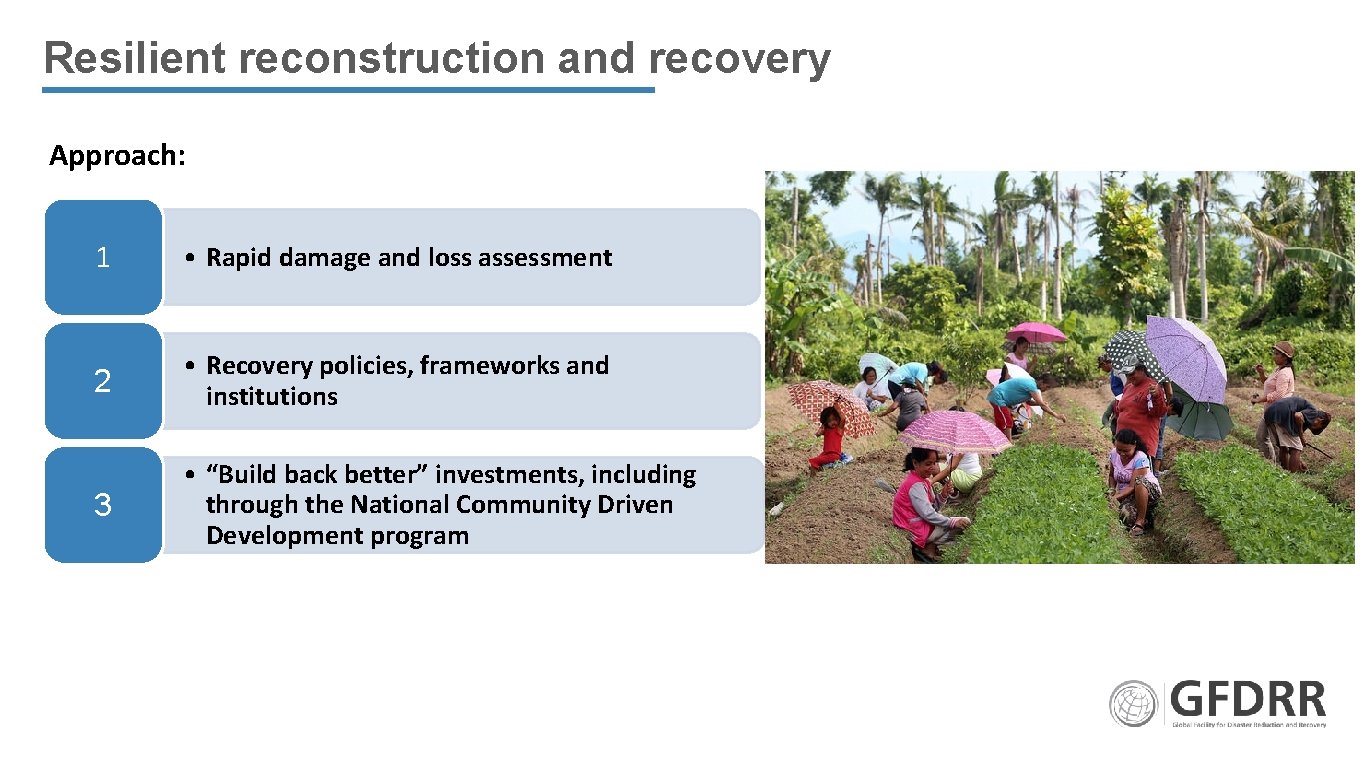
Resilient reconstruction and recovery Approach: 1 • Rapid damage and loss assessment 2 • Recovery policies, frameworks and institutions 3 • “Build back better” investments, including through the National Community Driven Development program
Concluding thoughts • Disaster risk management is a long-term agenda that requires political will, technical expertise, and action across sectors and levels of government. • Finance ministries/departments can take the lead in comprehensive, integrated disaster risk management. • International initiatives can enable vulnerable countries to work together to mobilize resources. • Technical assistance supported by GFDRR underpins achievement of the reforms committed to under development policy lending