
Integrated Digital Electronics David Holburn dmheng cam ac
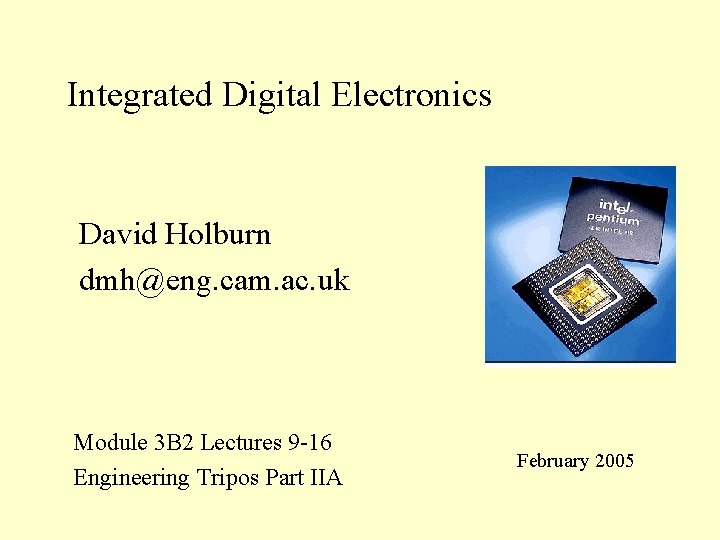
Integrated Digital Electronics David Holburn dmh@eng. cam. ac. uk Module 3 B 2 Lectures 9 -16 Engineering Tripos Part IIA February 2005
3 B 2 Integrated Digital Electronics l 8 lectures in LR 2: u Tuesday l Four handouts (roughly one per two lectures). u u l some gaps to be filled in places where you need to add own notes Two examples sheets: u l at 12, Friday at 9 MOS circuits (lecture 4) Bipolar circuits (lecture 8) Various other notes, graphs and leaflets Material on the WWW
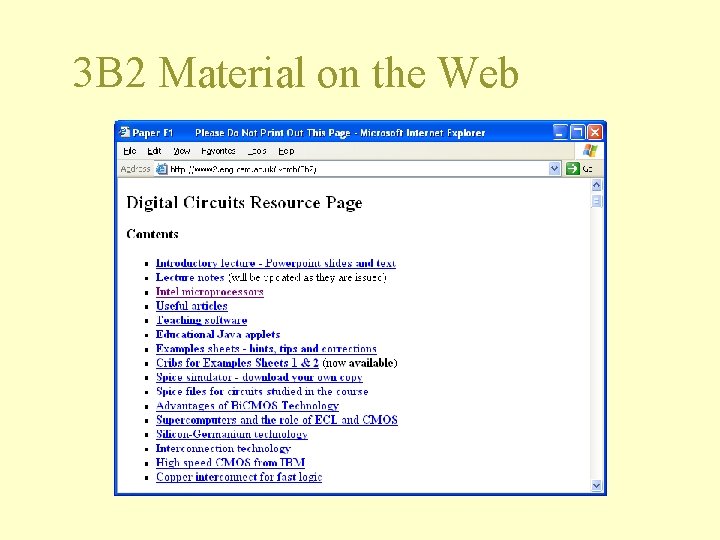
3 B 2 Material on the Web
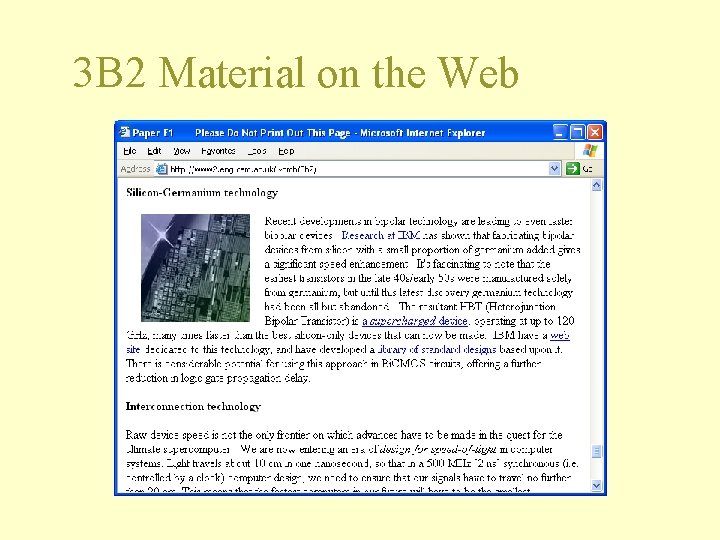
3 B 2 Material on the Web
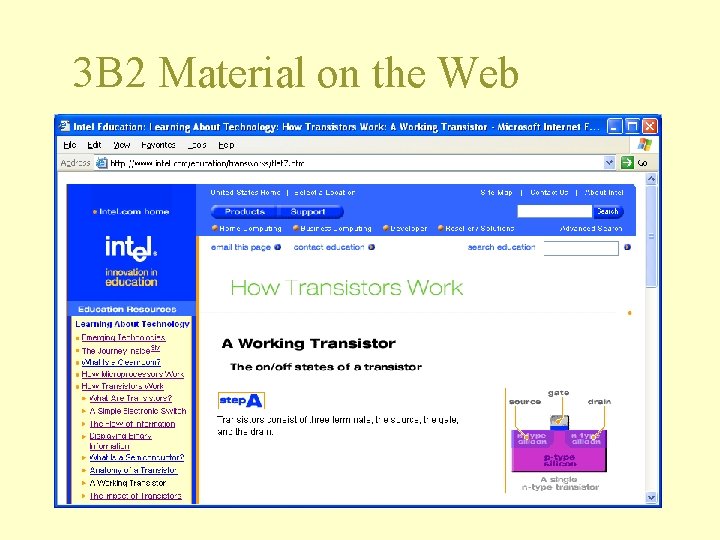
3 B 2 Material on the Web
3 B 2 Material on the Web l l There’s a link to an HTML version of this presentation. Point your browser at: http: //www 2. eng. cam. ac. uk/~dmh/3 b 2
Spice Simulator
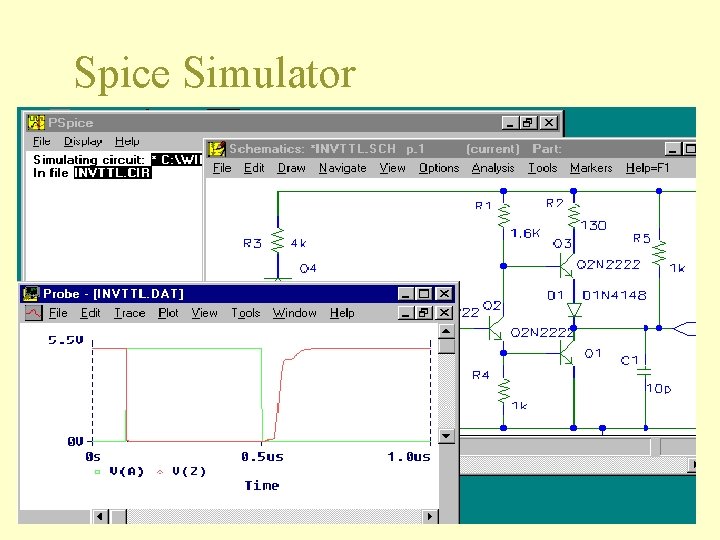
Spice Simulator
Related courses l Related activities in the 3 rd year u l Computer-Based Project C 7 - VLSI design Related modules in the 4 th year Module 4 B 2 - Power Electronics and Applications u Module 4 B 6 - Solid State Devices u Module 4 B 7 - VLSI Design & Technology u Module 4 B 8 - Electronic System Design u
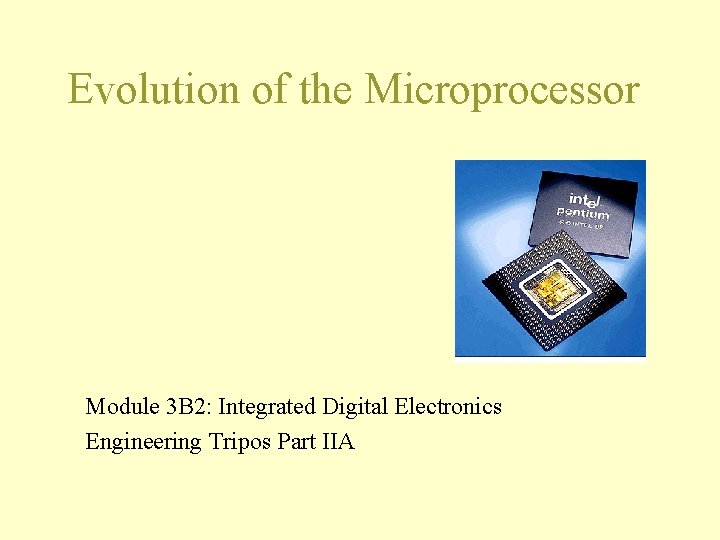
Evolution of the Microprocessor Module 3 B 2: Integrated Digital Electronics Engineering Tripos Part IIA
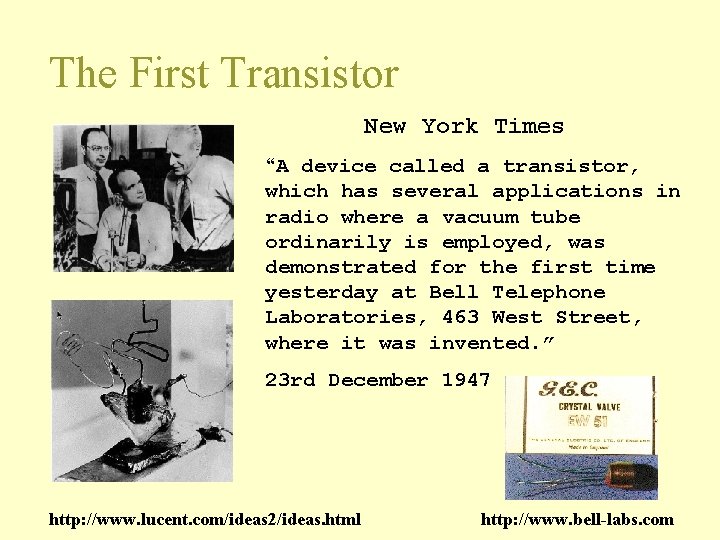
The First Transistor New York Times “A device called a transistor, which has several applications in radio where a vacuum tube ordinarily is employed, was demonstrated for the first time yesterday at Bell Telephone Laboratories, 463 West Street, where it was invented. ” 23 rd December 1947 http: //www. lucent. com/ideas 2/ideas. html http: //www. bell-labs. com

The First Integrated Circuit 1958, Jack Kilby, a young electrical engineer at Texas Instruments, figured out how to put all the circuit elements - transistors, resistors, and capacitors, along with their interconnecting wiring - into a single piece of germanium. His rough prototype was a thin piece of germanium about one-half inch long containing five separate components linked together by tiny wires.

The Microprocessor 4004: Intel’s first microprocessor The 4 -bit 4004 ran at 108 k. Hz & contained 2300 transistors. The speed of this 1971 device is estimated at 0. 06 MIPS. By comparison, Intel's new P 6 runs at 133 MHz, contains 5. 5 million transistors, and executes 300 MIPS (million instructions/s).
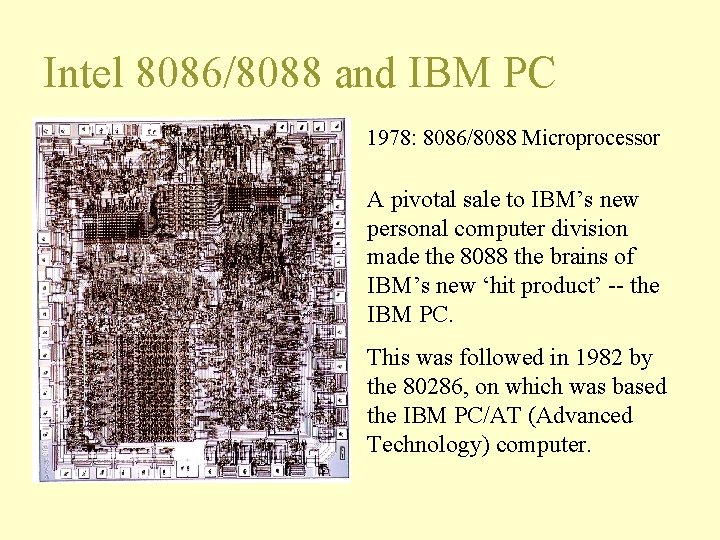
Intel 8086/8088 and IBM PC 1978: 8086/8088 Microprocessor A pivotal sale to IBM’s new personal computer division made the 8088 the brains of IBM’s new ‘hit product’ -- the IBM PC. This was followed in 1982 by the 80286, on which was based the IBM PC/AT (Advanced Technology) computer.
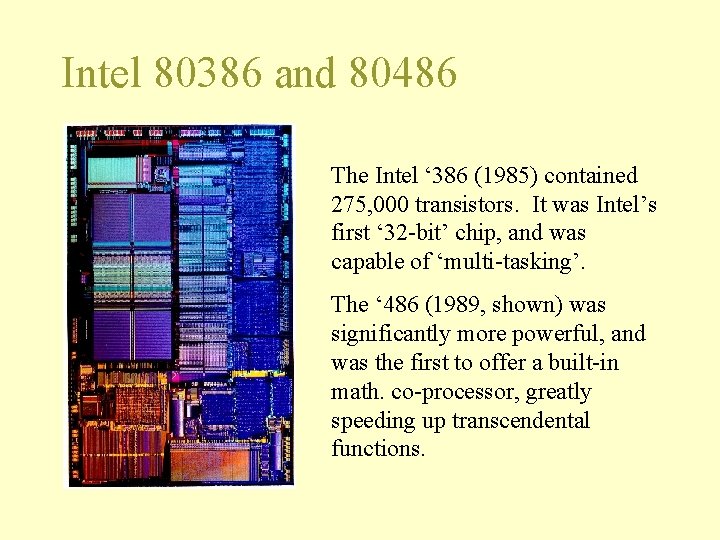
Intel 80386 and 80486 The Intel ‘ 386 (1985) contained 275, 000 transistors. It was Intel’s first ‘ 32 -bit’ chip, and was capable of ‘multi-tasking’. The ‘ 486 (1989, shown) was significantly more powerful, and was the first to offer a built-in math. co-processor, greatly speeding up transcendental functions.
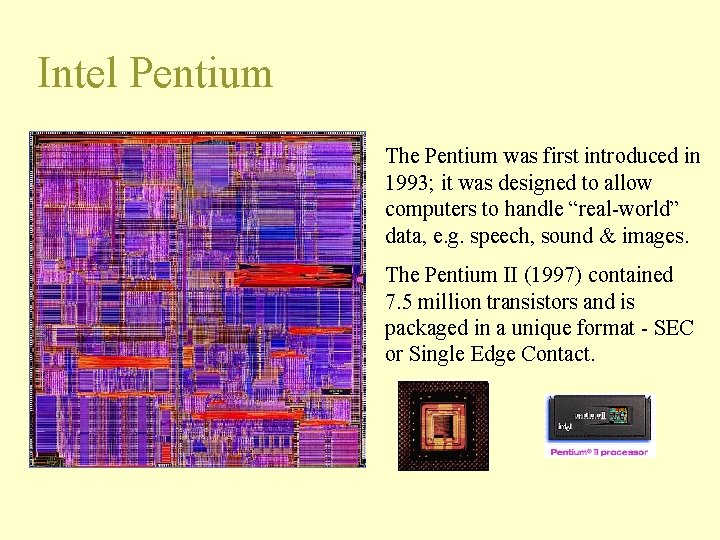
Intel Pentium The Pentium was first introduced in 1993; it was designed to allow computers to handle “real-world” data, e. g. speech, sound & images. The Pentium II (1997) contained 7. 5 million transistors and is packaged in a unique format - SEC or Single Edge Contact.
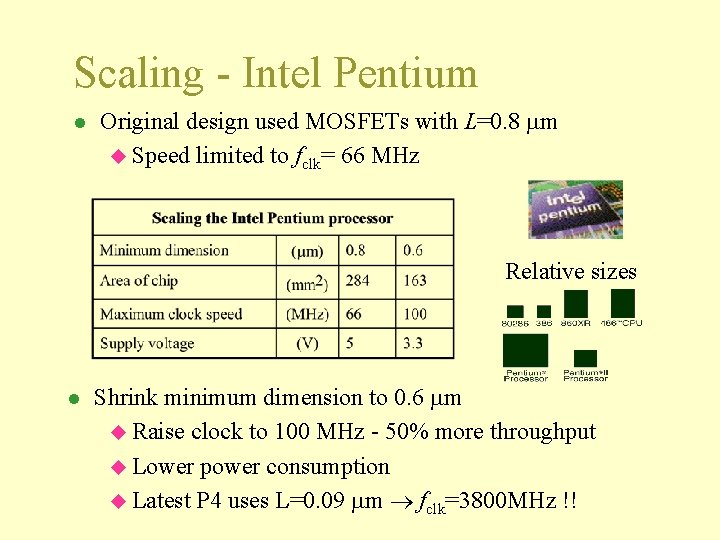
Scaling - Intel Pentium l Original design used MOSFETs with L=0. 8 m u Speed limited to fclk= 66 MHz Relative sizes l Shrink minimum dimension to 0. 6 m u Raise clock to 100 MHz - 50% more throughput u Lower power consumption u Latest P 4 uses L=0. 09 m ® fclk=3800 MHz !!
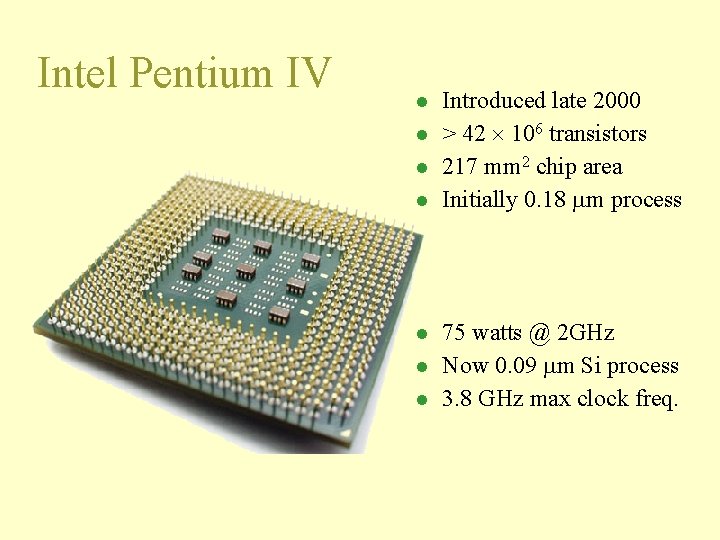
Intel Pentium IV l l l l Introduced late 2000 > 42 106 transistors 217 mm 2 chip area Initially 0. 18 m process 75 watts @ 2 GHz Now 0. 09 m Si process 3. 8 GHz max clock freq.
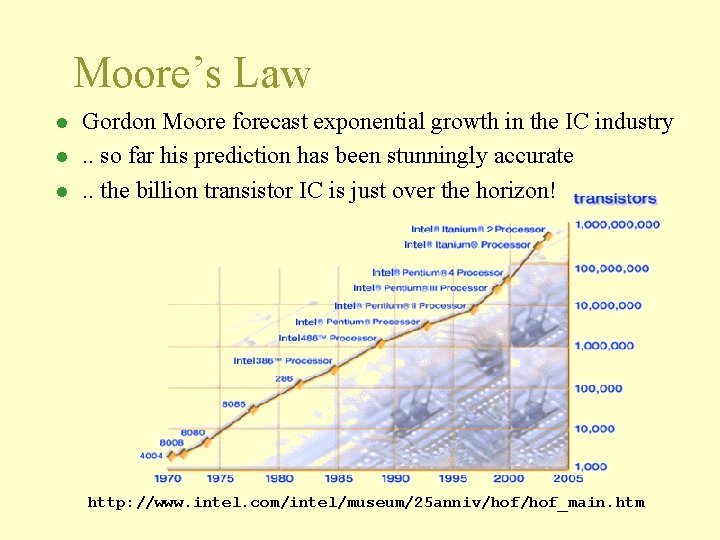
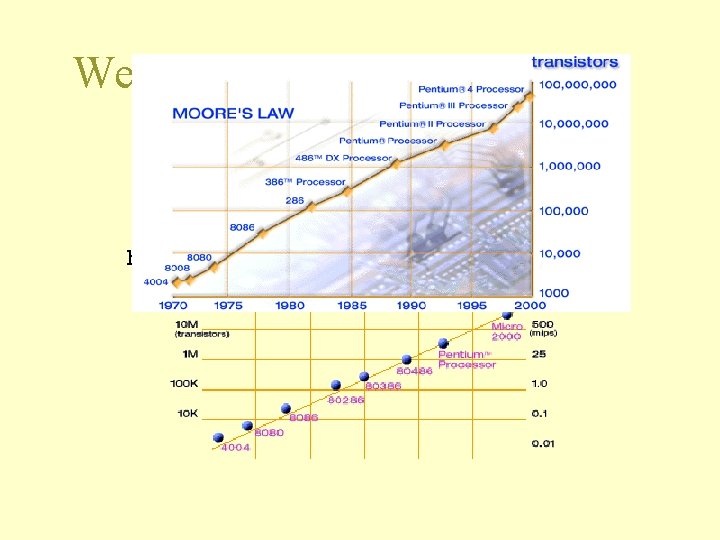
Moore’s Law l l l Gordon Moore forecast exponential growth in the IC industry. . so far his prediction has been stunningly accurate. . the billion transistor IC is just over the horizon! http: //www. intel. com/intel/museum/25 anniv/hof_main. htm
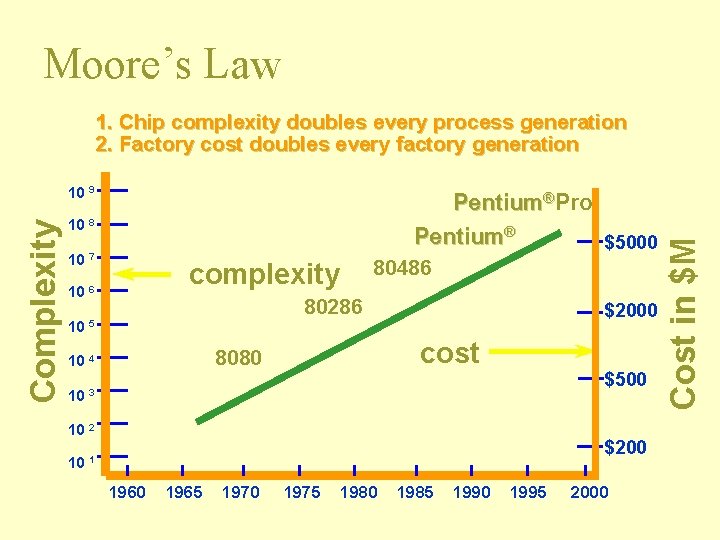
Moore’s Law Complexity 10 9 Pentium®Pro Pentium® $5000 10 8 10 7 10 6 10 80286 $2000 5 cost 8080 10 4 10 80486 complexity $500 3 10 2 $200 10 1 1960 1965 1970 1975 1980 1985 1990 1995 2000 Cost in $M 1. Chip complexity doubles every process generation 2. Factory cost doubles every factory generation
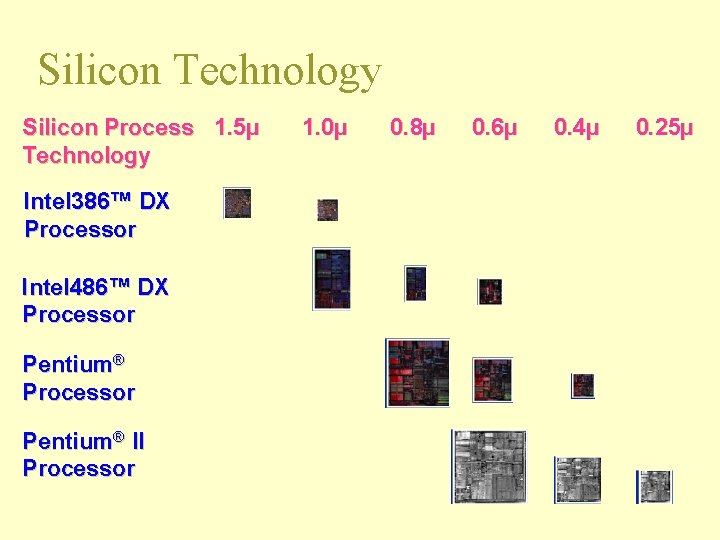
Silicon Technology Silicon Process 1. 5µ Technology Intel 386™ DX Processor Intel 486™ DX Processor Pentium® II Processor 1. 0µ 0. 8µ 0. 6µ 0. 4µ 0. 25µ
Web resource http: //www 2. eng. cam. ac. uk/~dmh/3 b 2
Web resource http: //www 2. eng. cam. ac. uk/~dmh/3 b 2
Web resource http: //www 2. eng. cam. ac. uk/~dmh/3 b 2
- Slides: 24