
Integrated Coordinated Science End of Year Review Part


- Slides: 58
Integrated Coordinated Science End of Year Review
Part 4: Biology / CA Special
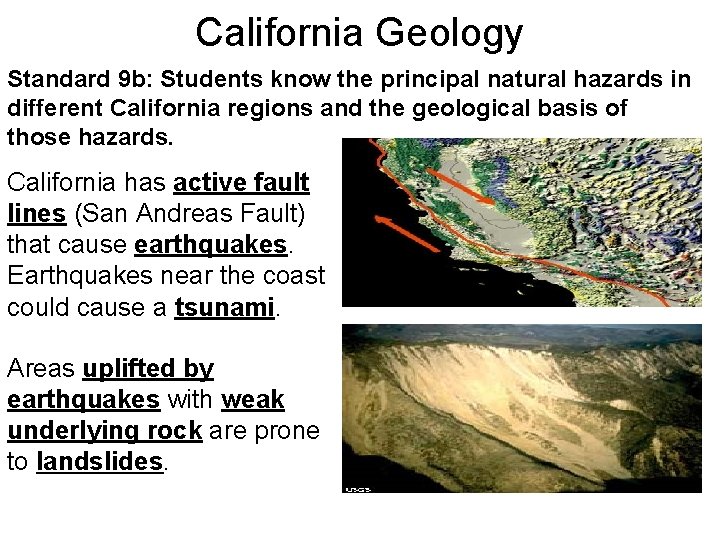
California Geology Standard 9 b: Students know the principal natural hazards in different California regions and the geological basis of those hazards. California has active fault lines (San Andreas Fault) that cause earthquakes. Earthquakes near the coast could cause a tsunami. Areas uplifted by earthquakes with weak underlying rock are prone to landslides.
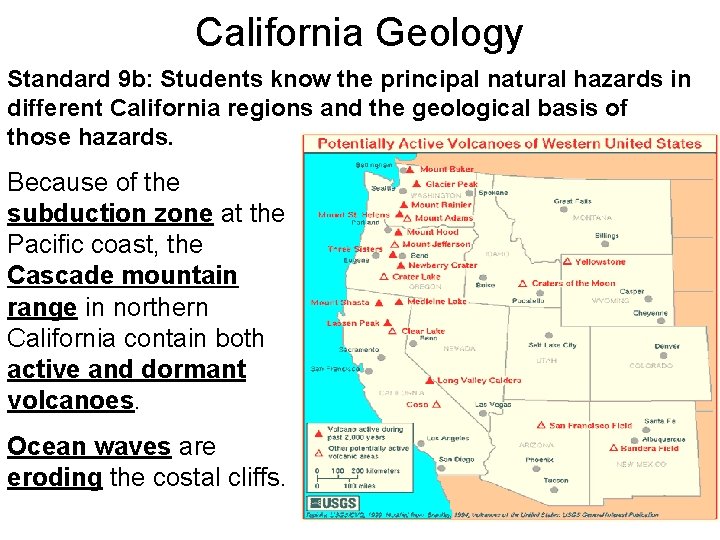
California Geology Standard 9 b: Students know the principal natural hazards in different California regions and the geological basis of those hazards. Because of the subduction zone at the Pacific coast, the Cascade mountain range in northern California contain both active and dormant volcanoes. Ocean waves are eroding the costal cliffs.
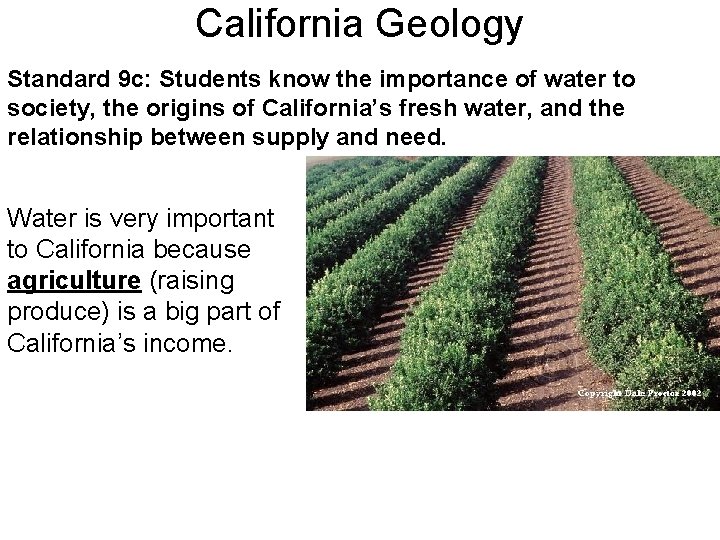
California Geology Standard 9 c: Students know the importance of water to society, the origins of California’s fresh water, and the relationship between supply and need. Water is very important to California because agriculture (raising produce) is a big part of California’s income.
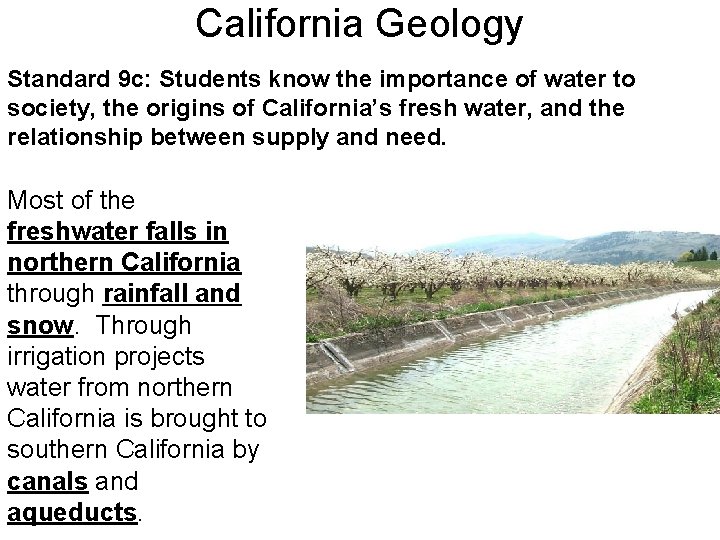
California Geology Standard 9 c: Students know the importance of water to society, the origins of California’s fresh water, and the relationship between supply and need. Most of the freshwater falls in northern California through rainfall and snow. Through irrigation projects water from northern California is brought to southern California by canals and aqueducts.
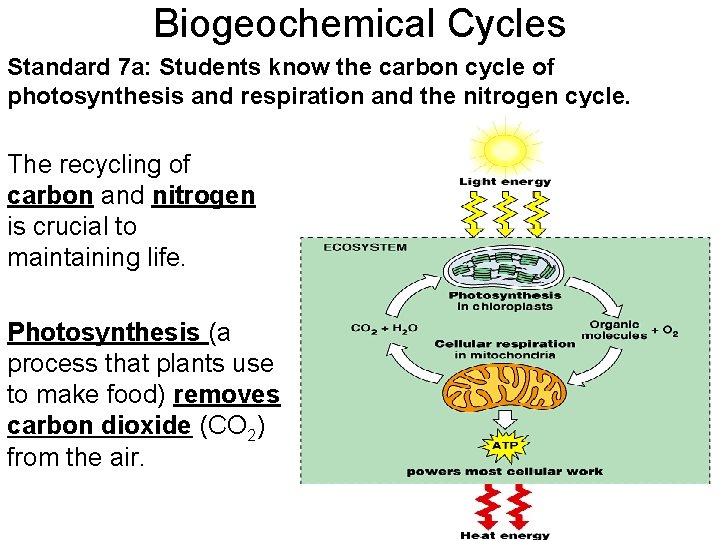
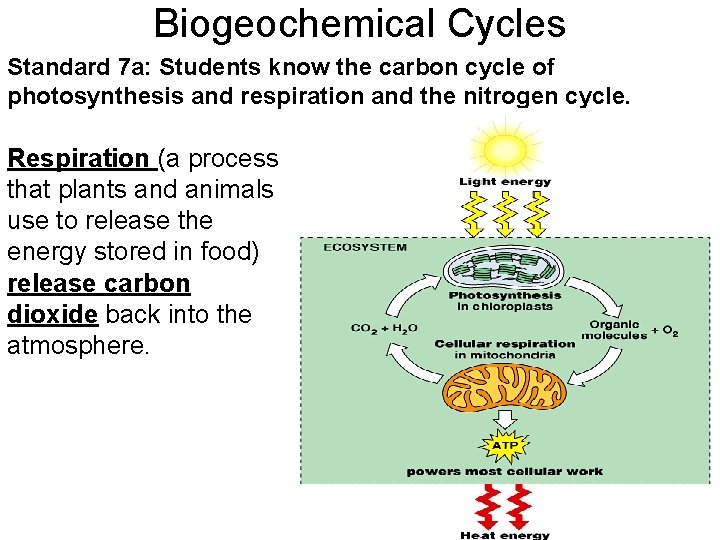
Biogeochemical Cycles Standard 7 a: Students know the carbon cycle of photosynthesis and respiration and the nitrogen cycle. The recycling of carbon and nitrogen is crucial to maintaining life. Photosynthesis (a process that plants use to make food) removes carbon dioxide (CO 2) from the air.
Biogeochemical Cycles Standard 7 a: Students know the carbon cycle of photosynthesis and respiration and the nitrogen cycle. Respiration (a process that plants and animals use to release the energy stored in food) release carbon dioxide back into the atmosphere.
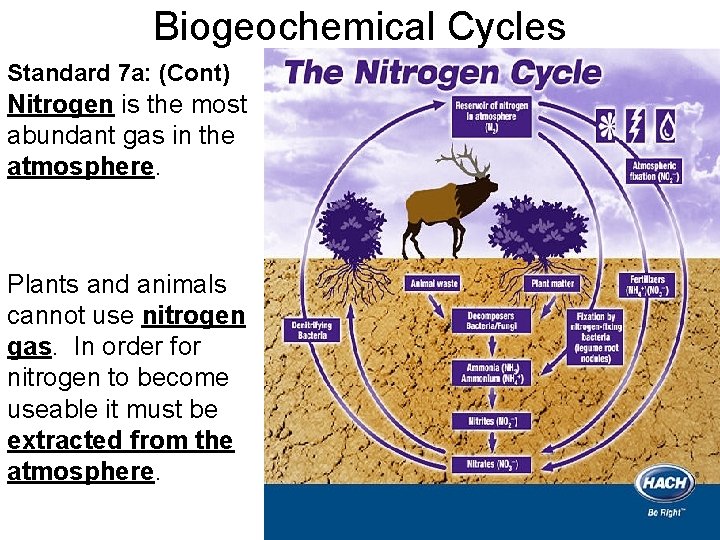
Biogeochemical Cycles Standard 7 a: (Cont) Nitrogen is the most abundant gas in the atmosphere. Plants and animals cannot use nitrogen gas. In order for nitrogen to become useable it must be extracted from the atmosphere.
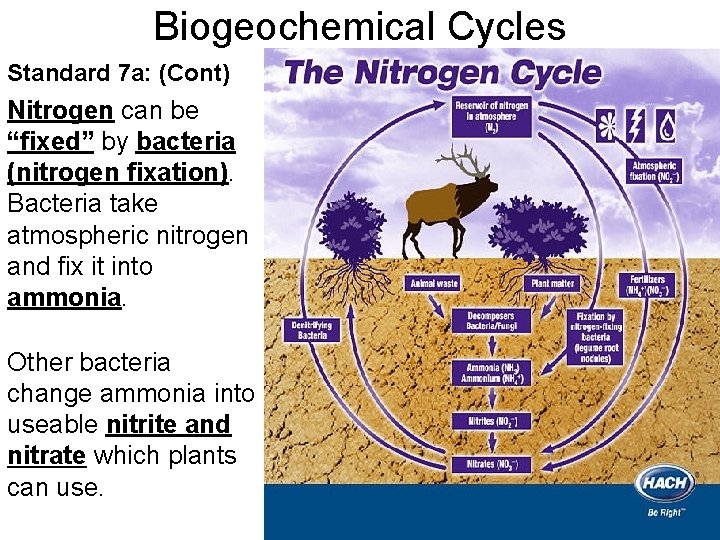
Biogeochemical Cycles Standard 7 a: (Cont) Nitrogen can be “fixed” by bacteria (nitrogen fixation). Bacteria take atmospheric nitrogen and fix it into ammonia. Other bacteria change ammonia into useable nitrite and nitrate which plants can use.
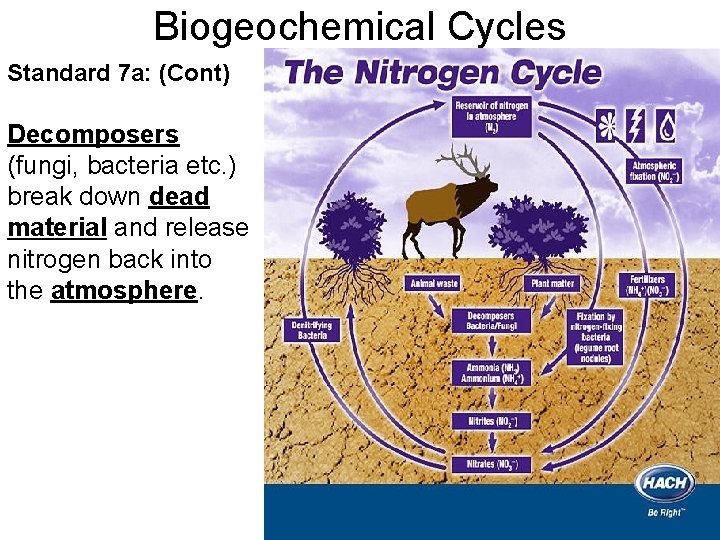
Biogeochemical Cycles Standard 7 a: (Cont) Decomposers (fungi, bacteria etc. ) break down dead material and release nitrogen back into the atmosphere.
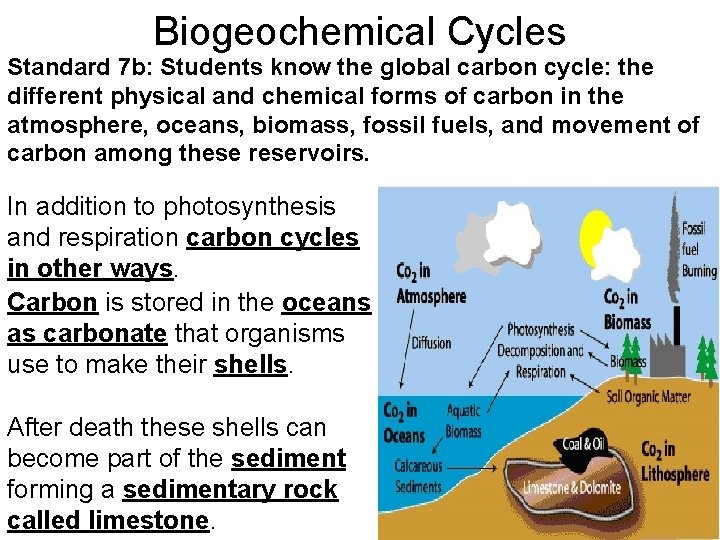
Biogeochemical Cycles Standard 7 b: Students know the global carbon cycle: the different physical and chemical forms of carbon in the atmosphere, oceans, biomass, fossil fuels, and movement of carbon among these reservoirs. In addition to photosynthesis and respiration carbon cycles in other ways. Carbon is stored in the oceans as carbonate that organisms use to make their shells. After death these shells can become part of the sediment forming a sedimentary rock called limestone.
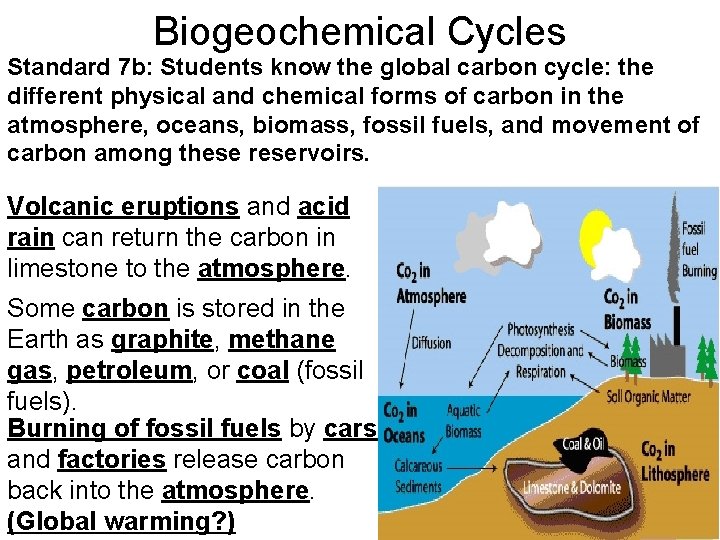
Biogeochemical Cycles Standard 7 b: Students know the global carbon cycle: the different physical and chemical forms of carbon in the atmosphere, oceans, biomass, fossil fuels, and movement of carbon among these reservoirs. Volcanic eruptions and acid rain can return the carbon in limestone to the atmosphere. Some carbon is stored in the Earth as graphite, methane gas, petroleum, or coal (fossil fuels). Burning of fossil fuels by cars and factories release carbon back into the atmosphere. (Global warming? )
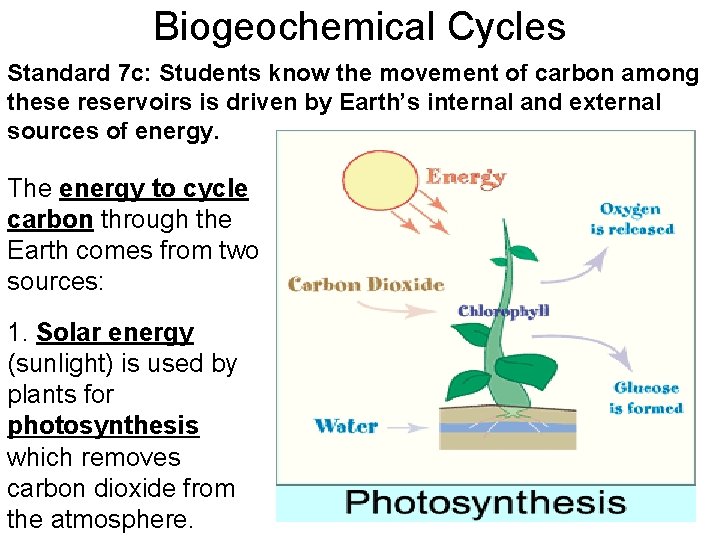
Biogeochemical Cycles Standard 7 c: Students know the movement of carbon among these reservoirs is driven by Earth’s internal and external sources of energy. The energy to cycle carbon through the Earth comes from two sources: 1. Solar energy (sunlight) is used by plants for photosynthesis which removes carbon dioxide from the atmosphere.
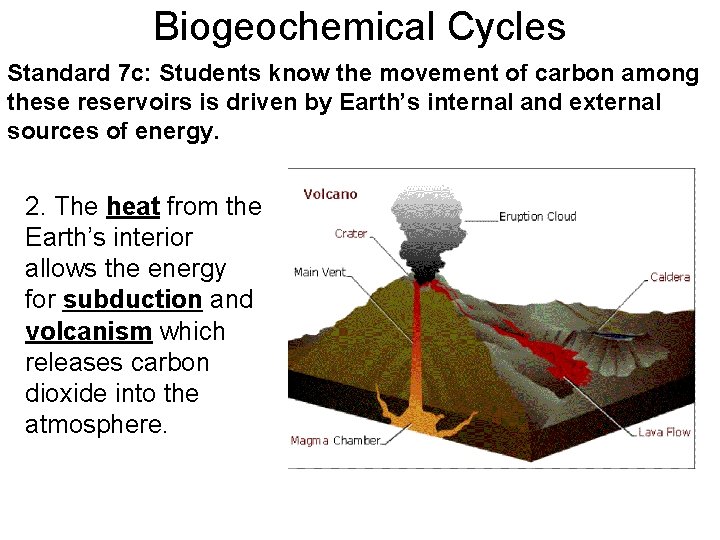
Biogeochemical Cycles Standard 7 c: Students know the movement of carbon among these reservoirs is driven by Earth’s internal and external sources of energy. 2. The heat from the Earth’s interior allows the energy for subduction and volcanism which releases carbon dioxide into the atmosphere.
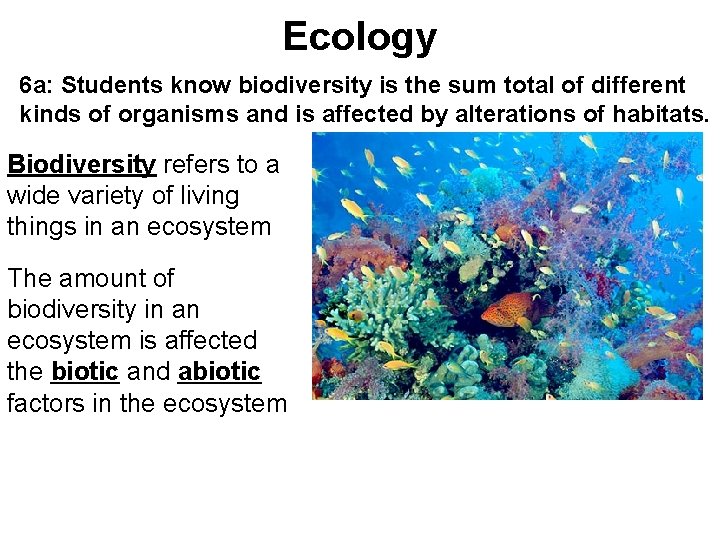
Ecology 6 a: Students know biodiversity is the sum total of different kinds of organisms and is affected by alterations of habitats. Biodiversity refers to a wide variety of living things in an ecosystem The amount of biodiversity in an ecosystem is affected the biotic and abiotic factors in the ecosystem
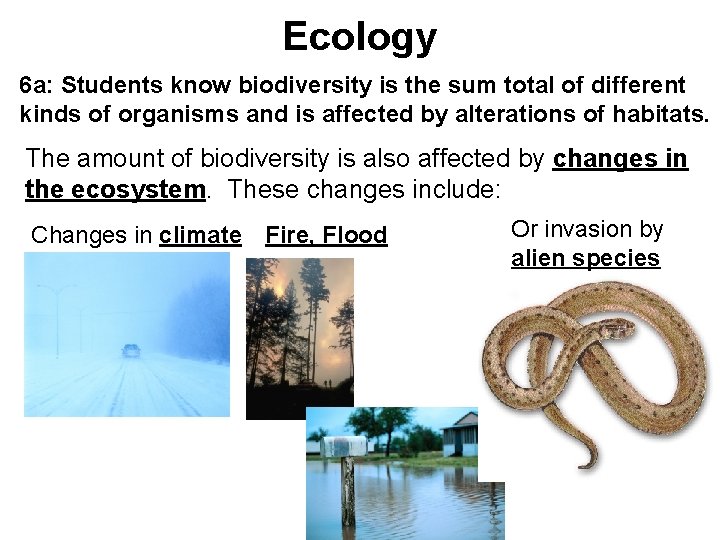
Ecology 6 a: Students know biodiversity is the sum total of different kinds of organisms and is affected by alterations of habitats. The amount of biodiversity is also affected by changes in the ecosystem. These changes include: Changes in climate Fire, Flood Or invasion by alien species
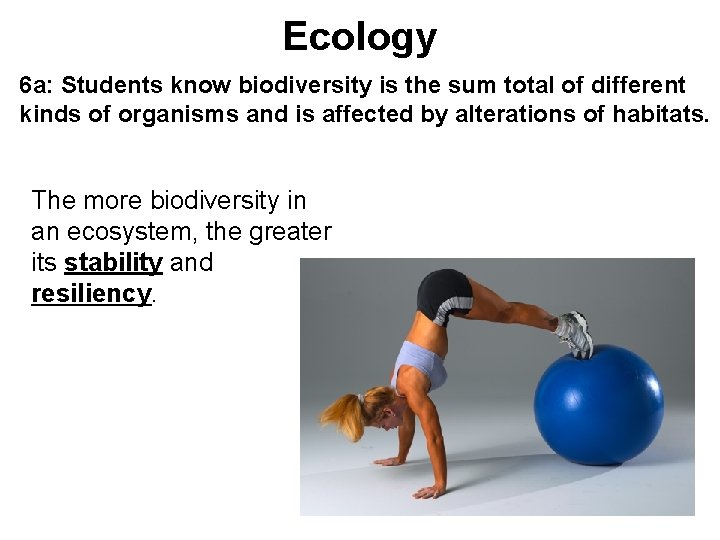
Ecology 6 a: Students know biodiversity is the sum total of different kinds of organisms and is affected by alterations of habitats. The more biodiversity in an ecosystem, the greater its stability and resiliency.
Ecology 6 b: Students know how to analyze changes in an ecosystem resulting from changes in climate, human activity, introduction of nonnative species, or changes in population size. Analysis of change can help people to describe and understand what is happening in a natural system and, to some extent, to control or influence that system
Ecology 6 b: Students know how to analyze changes in an ecosystem resulting from changes in climate, human activity, introduction of nonnative species, or changes in population size. Changes in ecosystems But sometimes there are often manifest themselves in unexpected disturbances predictable patterns
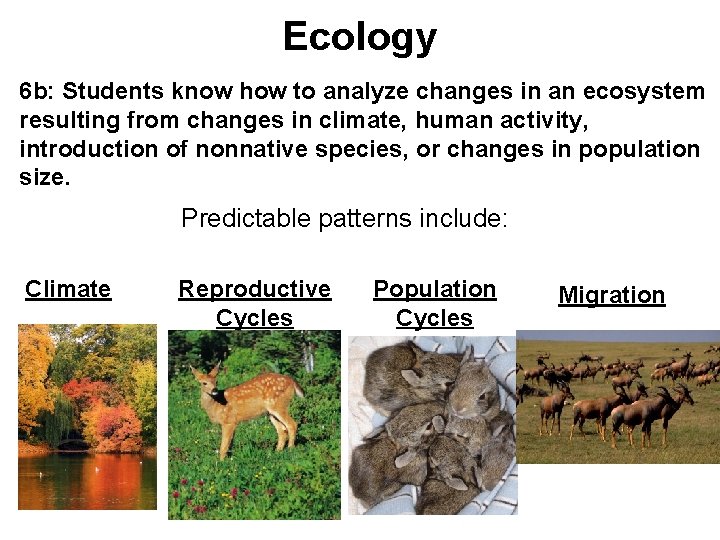
Ecology 6 b: Students know how to analyze changes in an ecosystem resulting from changes in climate, human activity, introduction of nonnative species, or changes in population size. Predictable patterns include: Climate Reproductive Cycles Population Cycles Migration
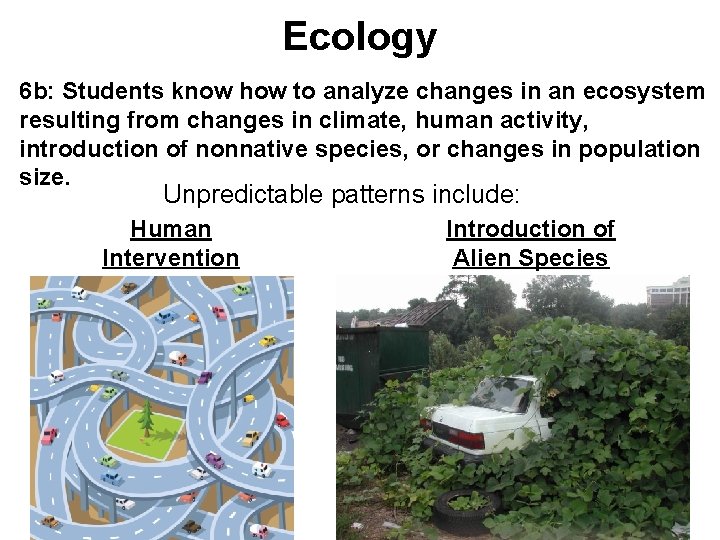
Ecology 6 b: Students know how to analyze changes in an ecosystem resulting from changes in climate, human activity, introduction of nonnative species, or changes in population size. Unpredictable patterns include: Human Intervention Introduction of Alien Species
Ecology 6 b: Students know how to analyze changes in an ecosystem resulting from changes in climate, human activity, introduction of nonnative species, or changes in population size. Analyzing changes in an ecosystem isn’t necessarily simple and may require analysis over a long time This is a process called longitudinal analysis
Ecology 6 c: Students know how fluctuations in population size in an ecosystem are determined by the relative rates of birth, immigration, emigration, and death. Changes in the size of a population are often difficult to measure directly but may be estimated Comparing rates for death and emigration with those for birth and immigration will determine whether the population grows or declines over time
Ecology 6 d: Students know how water, carbon, and nitrogen cycle between abiotic resources and organic matter in the ecosystem and how oxygen cycles through photosynthesis and respiration. We’ve already been over this area earlier, so you can go back and review the earlier information
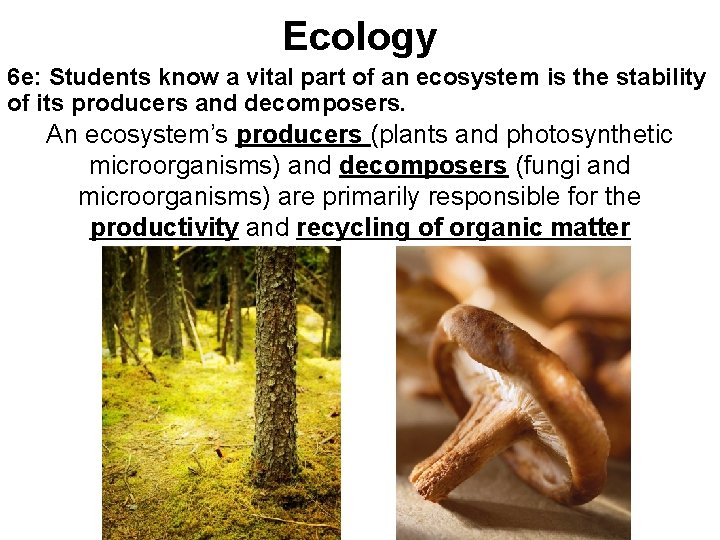
Ecology 6 e: Students know a vital part of an ecosystem is the stability of its producers and decomposers. An ecosystem’s producers (plants and photosynthetic microorganisms) and decomposers (fungi and microorganisms) are primarily responsible for the productivity and recycling of organic matter
Ecology 6 e: Students know a vital part of an ecosystem is the stability of its producers and decomposers. threaten the stability of producers and you jeopardize the availability of energy to the ecosystem
Ecology 6 e: Students know a vital part of an ecosystem is the stability of its producers and decomposers. threaten the stability of decomposers in an ecosystem and you jeopardize the capability of matter to recycle in the rest of the biological community
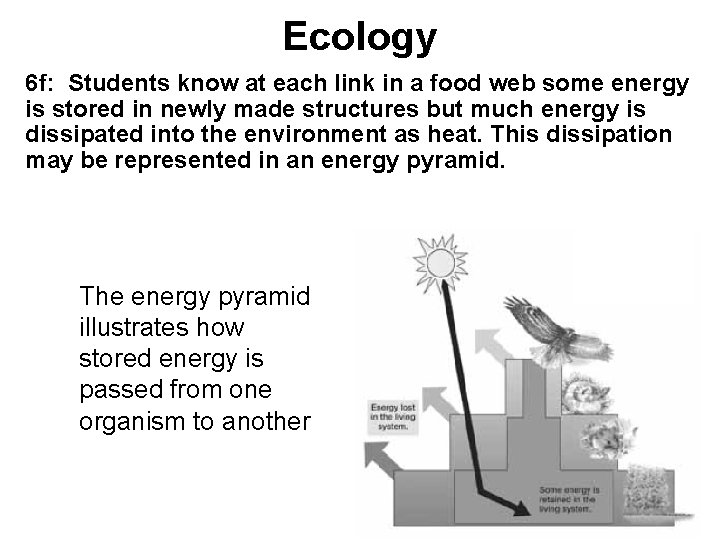
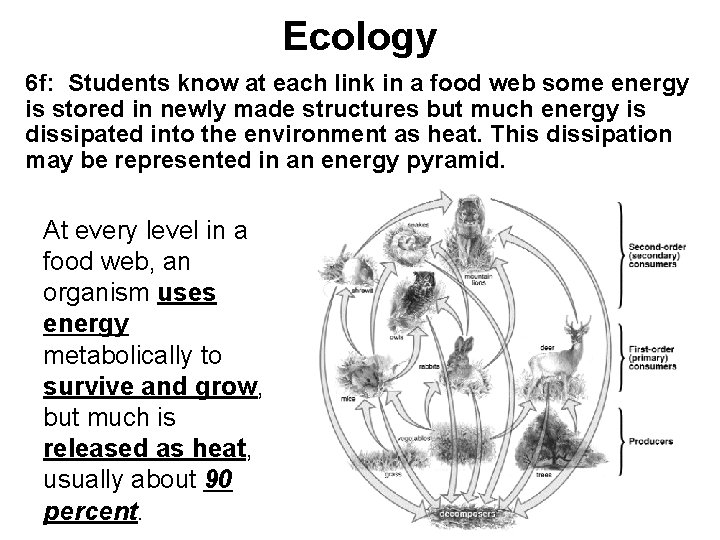
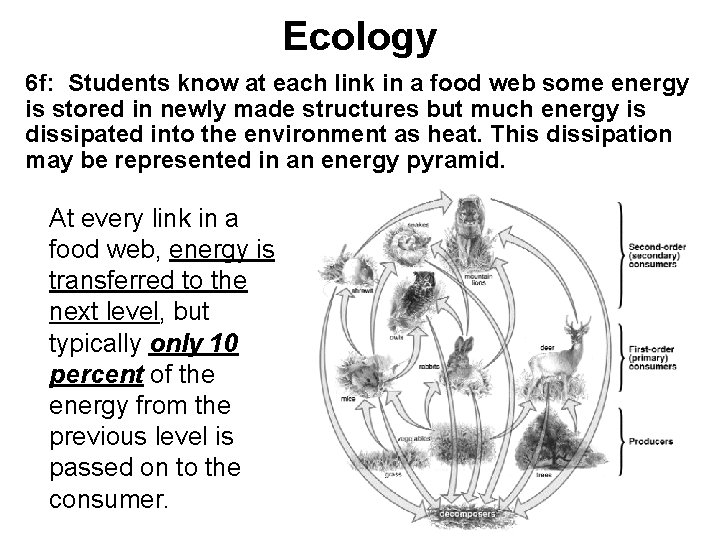
Ecology 6 f: Students know at each link in a food web some energy is stored in newly made structures but much energy is dissipated into the environment as heat. This dissipation may be represented in an energy pyramid. The energy pyramid illustrates how stored energy is passed from one organism to another
Ecology 6 f: Students know at each link in a food web some energy is stored in newly made structures but much energy is dissipated into the environment as heat. This dissipation may be represented in an energy pyramid. At every level in a food web, an organism uses energy metabolically to survive and grow, but much is released as heat, usually about 90 percent.
Ecology 6 f: Students know at each link in a food web some energy is stored in newly made structures but much energy is dissipated into the environment as heat. This dissipation may be represented in an energy pyramid. At every link in a food web, energy is transferred to the next level, but typically only 10 percent of the energy from the previous level is passed on to the consumer.
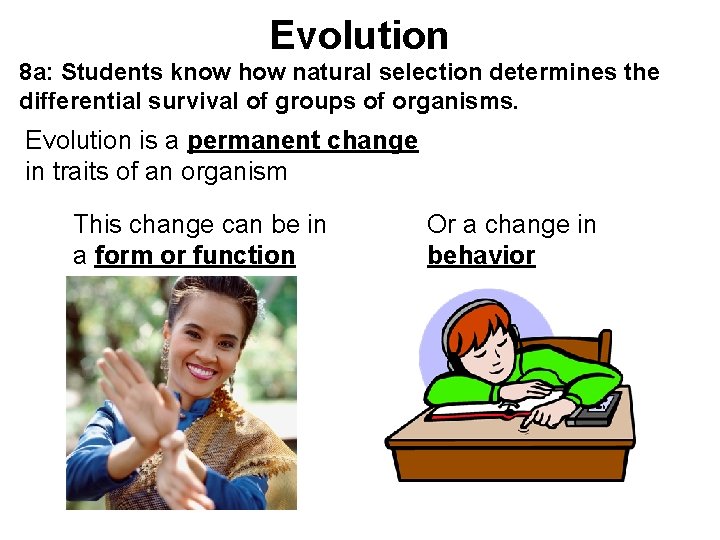
Evolution 8 a: Students know how natural selection determines the differential survival of groups of organisms. Evolution is a permanent change in traits of an organism This change can be in a form or function Or a change in behavior
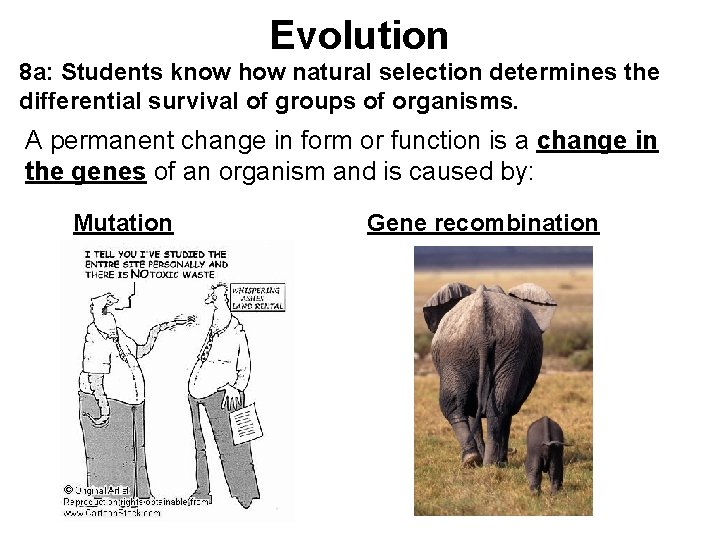
Evolution 8 a: Students know how natural selection determines the differential survival of groups of organisms. A permanent change in form or function is a change in the genes of an organism and is caused by: Mutation Gene recombination
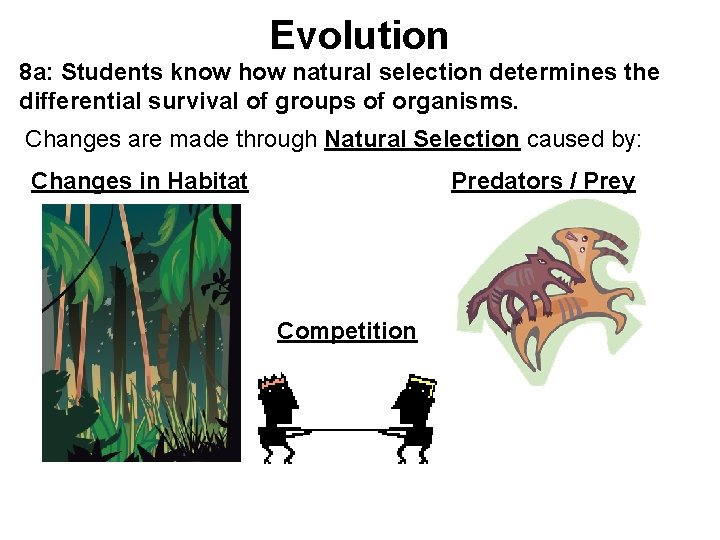
Evolution 8 a: Students know how natural selection determines the differential survival of groups of organisms. Changes are made through Natural Selection caused by: Changes in Habitat Predators / Prey Competition
Evolution 8 a: Students know how natural selection determines the differential survival of groups of organisms. Natural selection favors the organisms that are better suited to survive in a given environment Those not well suited to the environment may die before they can pass on their traits to the next generation
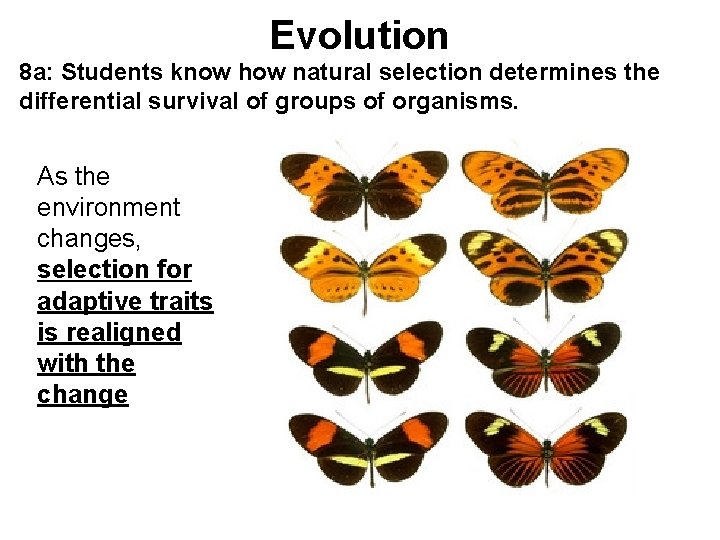
Evolution 8 a: Students know how natural selection determines the differential survival of groups of organisms. As the environment changes, selection for adaptive traits is realigned with the change
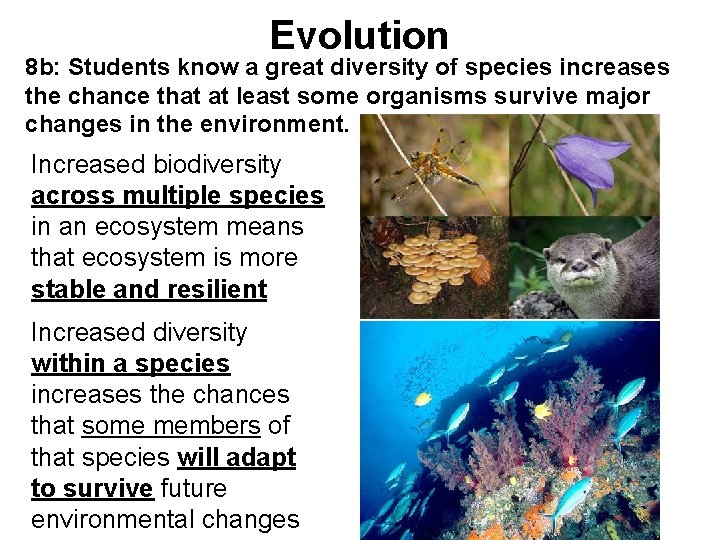
Evolution 8 b: Students know a great diversity of species increases the chance that at least some organisms survive major changes in the environment. Increased biodiversity across multiple species in an ecosystem means that ecosystem is more stable and resilient Increased diversity within a species increases the chances that some members of that species will adapt to survive future environmental changes
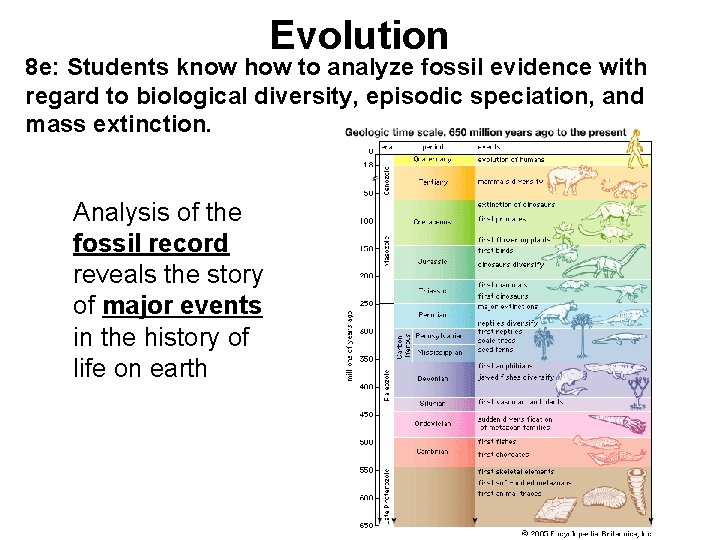
Evolution 8 e: Students know how to analyze fossil evidence with regard to biological diversity, episodic speciation, and mass extinction. Analysis of the fossil record reveals the story of major events in the history of life on earth
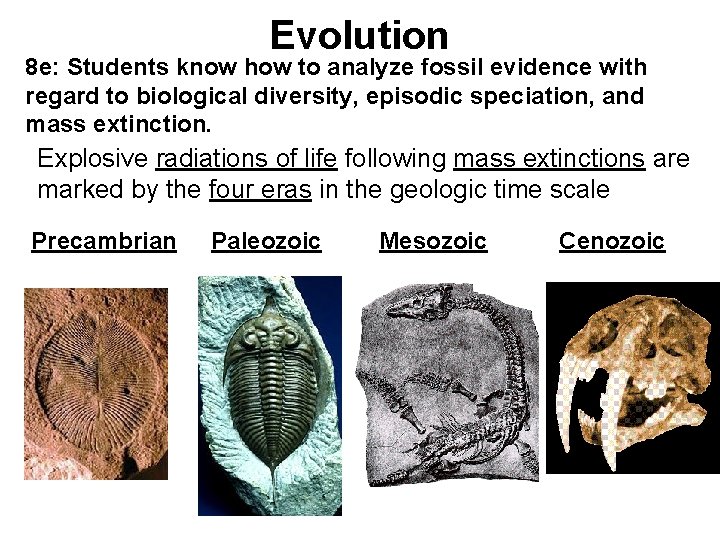
Evolution 8 e: Students know how to analyze fossil evidence with regard to biological diversity, episodic speciation, and mass extinction. Explosive radiations of life following mass extinctions are marked by the four eras in the geologic time scale Precambrian Paleozoic Mesozoic Cenozoic
Evolution 8 e: Students know how to analyze fossil evidence with regard to biological diversity, episodic speciation, and mass extinction. Episodes of speciation are the most dramatic in the aftermath of a mass extinction that has cleared the way for new species to inhabit recently vacated adaptive zones
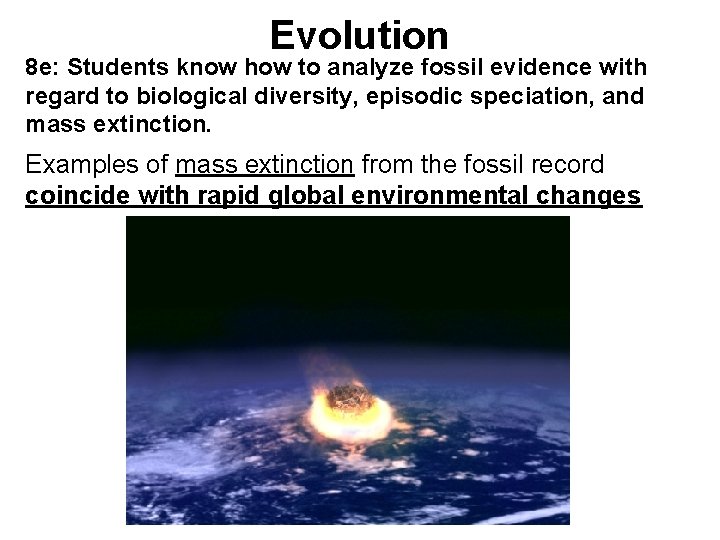
Evolution 8 e: Students know how to analyze fossil evidence with regard to biological diversity, episodic speciation, and mass extinction. Examples of mass extinction from the fossil record coincide with rapid global environmental changes
Congratulations! You have now reviewed all the topics covered by the California Standards Test! Now just sit back and relax and do your best!
California Geology 1. The Long Valley Caldera in east-central California was formed by a massive volcanic eruption about 760, 000 years ago. Since then, it has erupted several times. Of the following, which would be least likely to indicate that another eruption will soon occur? A recurring earthquakes in the vicinity B decreases in precipitation in the area C changes in gas emissions from the caldera D uplifting of the floor of the caldera
California Geology 2. Earthquake activity in California is primarily caused by A the lowering of aquifer levels. B the interaction of tides with the coast. C mining activity during the nineteenth century. D plates grinding past each other along active faults.
California Geology 3. The main purpose of the California aqueduct is to A allow inexpensive water routes for transporting commercial products. B transport fresh water to areas with dense populations. C divert floodwater from populated regions to sparsely populated areas. D provide abundant ocean water to drier regions of California.
Biogeochemical Cycles 1. Carbon in the atmosphere is most often found as which of the following compounds? A stratospheric ozone B fossil fuel C carbon monoxide D carbon dioxide
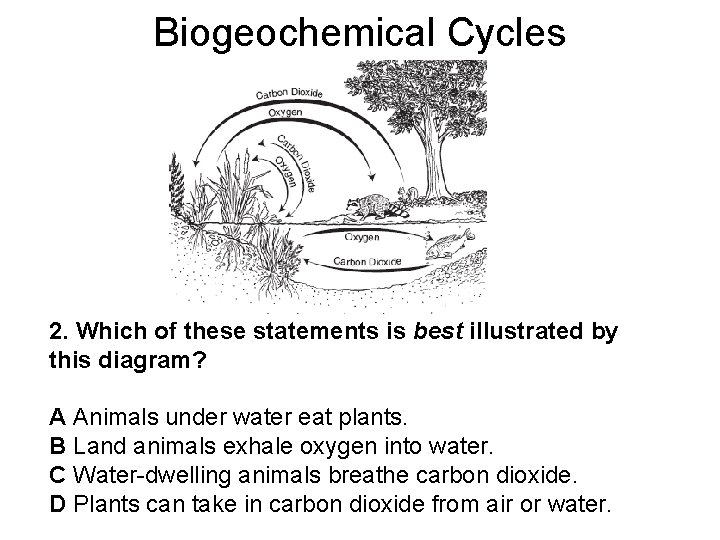
Biogeochemical Cycles 2. Which of these statements is best illustrated by this diagram? A Animals under water eat plants. B Land animals exhale oxygen into water. C Water-dwelling animals breathe carbon dioxide. D Plants can take in carbon dioxide from air or water.
Biogeochemical Cycles 3. From Earth’s atmosphere, carbon dioxide is used by plants, algae, and cyanobacteria during the process of A photosynthesis. B respiration. C decomposition. D nitrogen fixation.
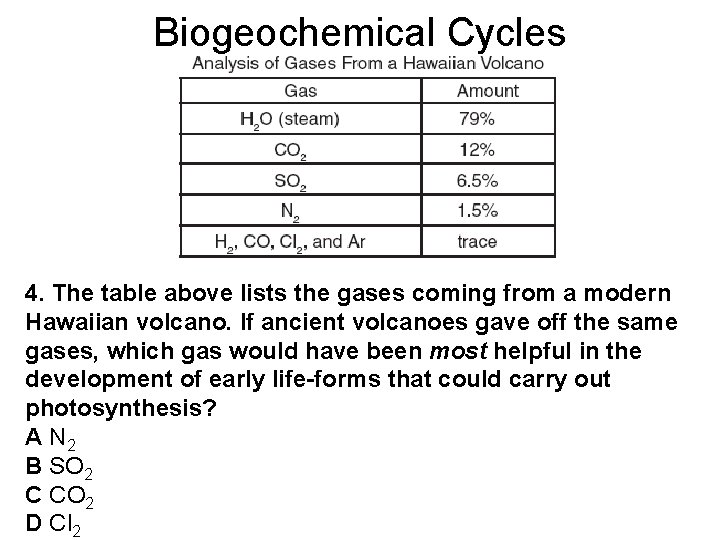
Biogeochemical Cycles 4. The table above lists the gases coming from a modern Hawaiian volcano. If ancient volcanoes gave off the same gases, which gas would have been most helpful in the development of early life-forms that could carry out photosynthesis? A N 2 B SO 2 C CO 2 D Cl 2
Ecology 1. Scientists found that, over a period of 200 years, a mountain pond was transformed into a meadow. During that time, several communities of organisms were replaced by different communities. Which of these best explains why new communities were able to replace older communities? A The original species became extinct. B Species in the older community died from old age. C The abiotic characteristics of the habitat changed. D Diseases that killed the older organisms disappeared.
Ecology 2. In a pond, the primary producer is a green alga, Spirogyra; the primary consumer is the crustacean, Daphnia; the secondary consumer is a small fish, the bluegill; and the tertiary consumer is a larger fish, the smallmouth bass. What changes can be expected in the pond if the Daphnia are killed with pesticides? A The Spirogyra population will probably die. B The bluegill population will probably increase. C The Daphnia population will eat something else. D The smallmouth bass population will die.
Ecology 3. Rabbits introduced into Australia over 100 years ago have become a serious pest to farmers. Rabbit populations increased so much that they displaced many native species of plant eaters. What is the most logical explanation for their increased numbers? A Rabbits have a high death rate. B There are few effective predators. C Additional rabbit species have been introduced. D There is an increase in rabbit competitors.
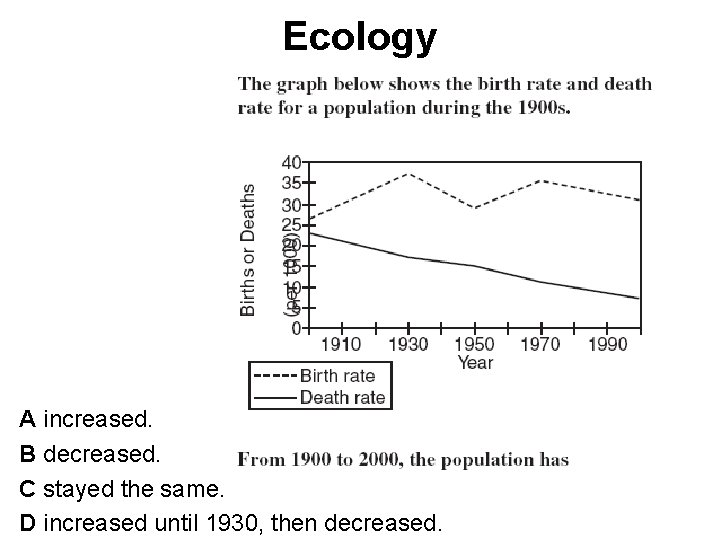
Ecology A increased. B decreased. C stayed the same. D increased until 1930, then decreased.
Ecology 5. Complete burning of plant material returns carbon primarily to the A herbivores. B water. C vegetation. D atmosphere.
Evolution 1. A species of finch has been studied on one of the geographically isolated Galapagos Islands for many years. Since the island is small, the lineage of every bird for several generations is known. This allows a family tree of each bird to be developed. Some family groups have survived and others have died out. The groups that survive probably have A interbred with other species. B inherited some advantageous variations. C found new places on the island to live. D been attacked by more predators.
Evolution 2. Earth has undergone some catastrophic changes from time to time. Which of these most likely explains why life on Earth continued following these catastrophes? A Dominant species had a slow mutation rate. B Many species filled the same niche. C A strong species had many different characteristics. D A wide diversity of species existed.
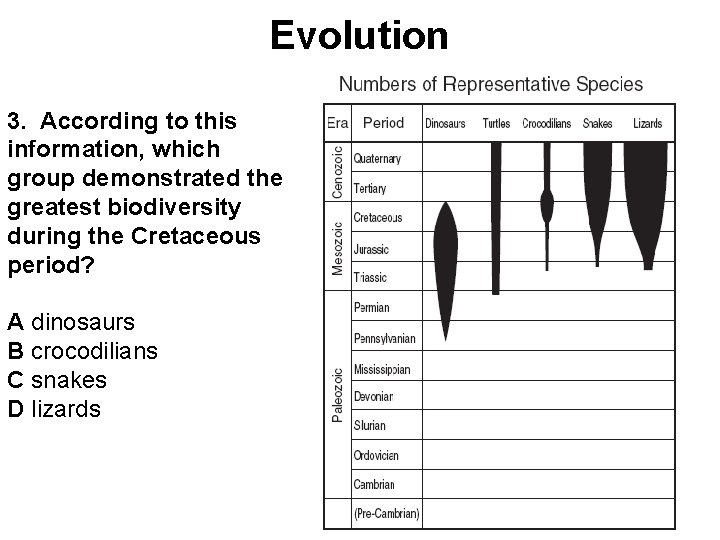
Evolution 3. According to this information, which group demonstrated the greatest biodiversity during the Cretaceous period? A dinosaurs B crocodilians C snakes D lizards
Evolution 4. If a paleontologist finds fossils of many different species existing in the same area at approximately the same time, the paleontologist can conclude that the ecosystem in this area had a high degree of A climatic variation. B episodic speciation. C biological diversity. D geographic isolation.