
Integrated assessment and management of dementia in the

- Slides: 15
Integrated assessment and management of dementia in the community – the Newcastle model John Ward, Hunter New England LHD Sept, 2014,
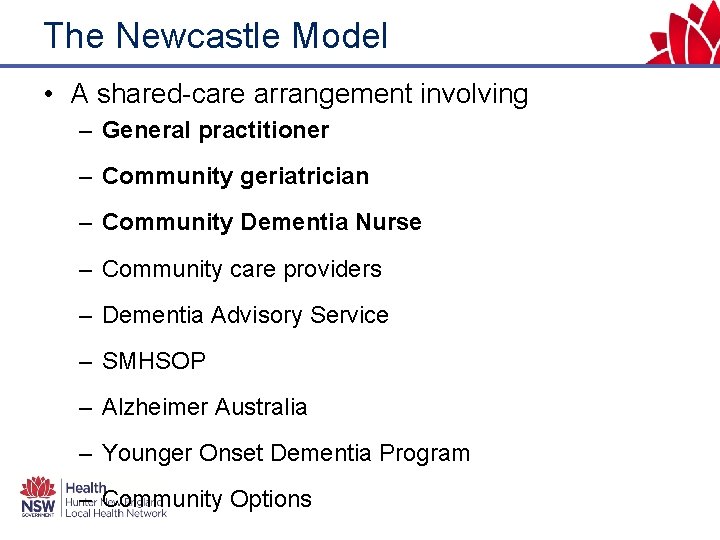
The Newcastle Model • A shared-care arrangement involving – General practitioner – Community geriatrician – Community Dementia Nurse – Community care providers – Dementia Advisory Service – SMHSOP – Alzheimer Australia – Younger Onset Dementia Program – Community Options
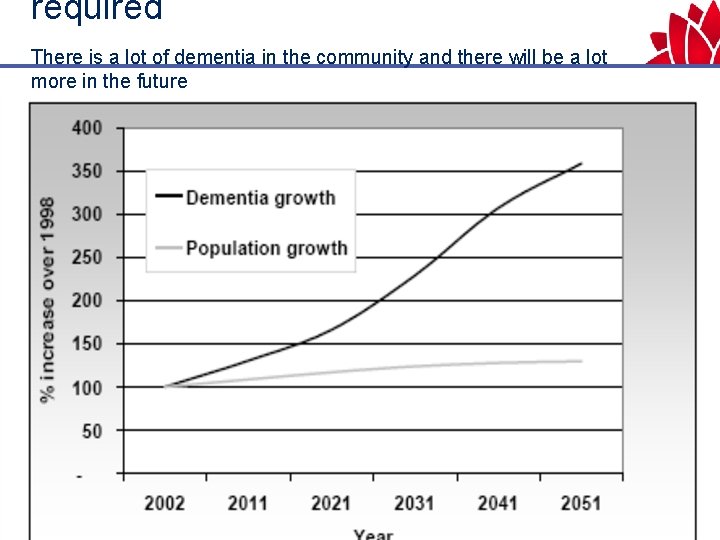
required There is a lot of dementia in the community and there will be a lot more in the future 3
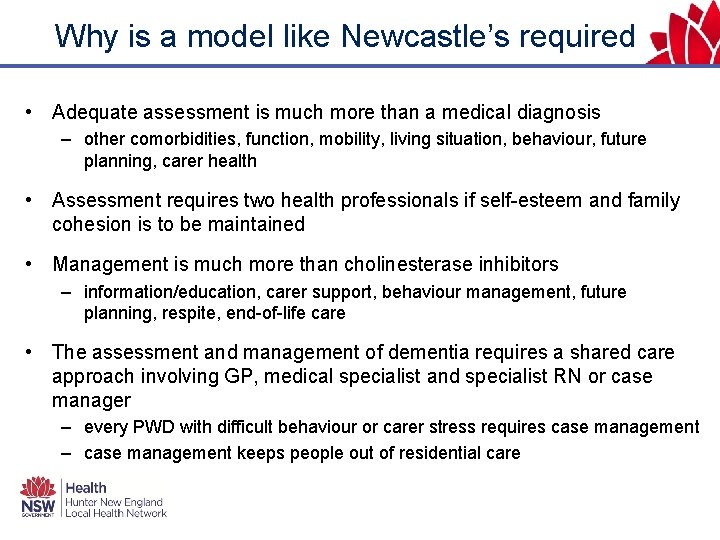
Why is a model like Newcastle’s required • Adequate assessment is much more than a medical diagnosis – other comorbidities, function, mobility, living situation, behaviour, future planning, carer health • Assessment requires two health professionals if self-esteem and family cohesion is to be maintained • Management is much more than cholinesterase inhibitors – information/education, carer support, behaviour management, future planning, respite, end-of-life care • The assessment and management of dementia requires a shared care approach involving GP, medical specialist and specialist RN or case manager – every PWD with difficult behaviour or carer stress requires case management – case management keeps people out of residential care
Role of Community Dementia Nurse – home visit to assess function, mobility, psychosocial supports – assess behaviours – assess carer competency, stress – assists the geriatrician in the clinic – further cognitive testing – Adas-Cog, RUDAS, ACE-R – determine required supports • housework, meals, personal care, respite (in-home, day centre) – provide information, education • written material, Living with Memory Loss, Alzheimers support groups – future planning • POA, Guardianship, ACCR for residential respite, placement, services
Greater Newcastle Dementia Service • 6 Community Dementia Services, embedded in ACAT • 7 Community Dementia Nurses – one per 50, 000 -70, 000 pop. – within ACAT • 6 Community Geriatricians – one (P/T) per 50, 000 -70, 000 pop. • 7 weekly clinics – Toronto, Morisset, Eastlakes, Wallsend, Hunter St, Raymond Tce, Nelson Bay • Supported by Neuropsycholgist, Psychogeriatricians, Neuropsychiatrists, Dementia Advisory Service, Alzheimer Australia, Younger Onset Dementia Program
Geriatrician clinic • history from patient with family in clinic room – don’t ask questions of family that would embarrass • ask family to step outside for examination • CDN interviews family in nearby room • geriatrician joins CDN and family • family returns to clinic room for summary • CDN visits family at home in next few weeks – leaves contact details
Weekly case conferences • Before clinic • Attended by: – ACAT – CDNs – geriatrican – COPS Case Manager – SMHSOP Community Nurse – Package and HACC service providers – Social worker from large ACF
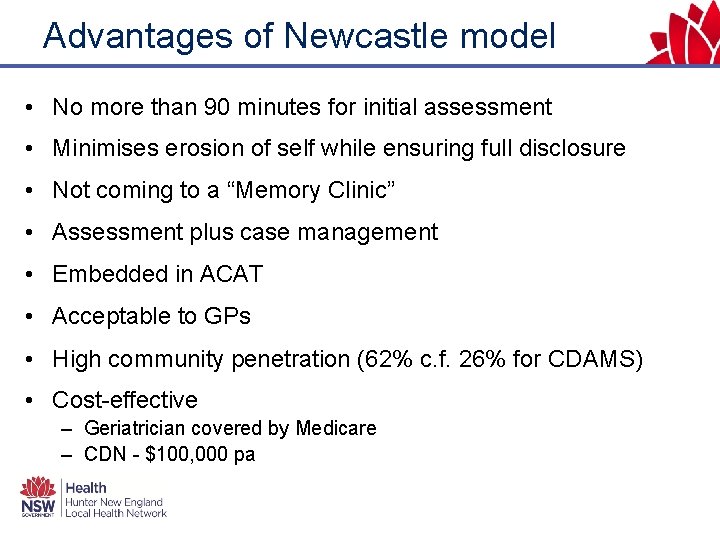
Advantages of Newcastle model • No more than 90 minutes for initial assessment • Minimises erosion of self while ensuring full disclosure • Not coming to a “Memory Clinic” • Assessment plus case management • Embedded in ACAT • Acceptable to GPs • High community penetration (62% c. f. 26% for CDAMS) • Cost-effective – Geriatrician covered by Medicare – CDN - $100, 000 pa
What I believe • It is unacceptable not to have an effective service for the assessment and management of dementia which, I believe, requires a geographical responsibility. . The assessment and management of dementia in the community requires an integrated approach, involving a wide range of service providers. . The essential basis for this integrated approach is the Community Dementia Service comprising a Community Dementia Nurse and a geriatrician.
What I fear • Increasing fragmentation of community aged care • Increasing privatisation of Geriatric Medicine • Loss of geographical responsibility for dementia • Removal of the coordinating role of HNE LHD
What I hope for • Government to accept responsibility for funding assessment and management of dementia • Community Dementia Nurses in all areas of NSW (? Australia) • Role of ACAT to be expanded to comprehensive aged care service to include case management
What are we doing about it • Lobbying governments • Lobbying Alzheimer Australia • Meeting in Newcastle, March, 2015, to establish Network for the Assessment and Case Management of Dementia in the Community
Summary • The prevalence of dementia will increase threefold by 2050 and we need a cost-effective model for assessment and management. • Coordination and integration is essential, not fragmentation • Some variant of the Newcastle model may be the most cost-effective. • We need one CDN per 5000 people over age 70 – 140 for NSW – $14, 000 annually for NSW