
Integrated approaches Piloting a new way to achieve
- Slides: 10
Integrated approaches: Piloting a new way to achieve global environmental benefits Roland Sundstrom Climate Change Specialist May 28, 2015
Why integrated approaches? • address key drivers of environmental degradation at global or regional scales; • tackle most urgent issues that may become too costly to reverse; • enhance synergies across focal areas; • complement country programming with trans-boundary, regional and global action; + stronger partnerships and financial leverage
Three priorities • Taking deforestation out of commodity supply chains; • Sustainable cities; and • Fostering sustainability and resilience for food security in Sub-Saharan Africa $160 M set-aside, of which $50 M and $45 M of the food security and sustainable cities programs, respectively, to be used as incentive for countries to invest their STAR allocations at a 1: 1 ratio
Taking deforestation out of commodity supply chains (1/2) • GEF funding: $45 M; co-financing: $443 M • palm oil, soy and beef are priority commodities • key countries in South East Asia, Latin America and West Africa from the production perspective • domestic, international and global multinational buyers from the demand perspective
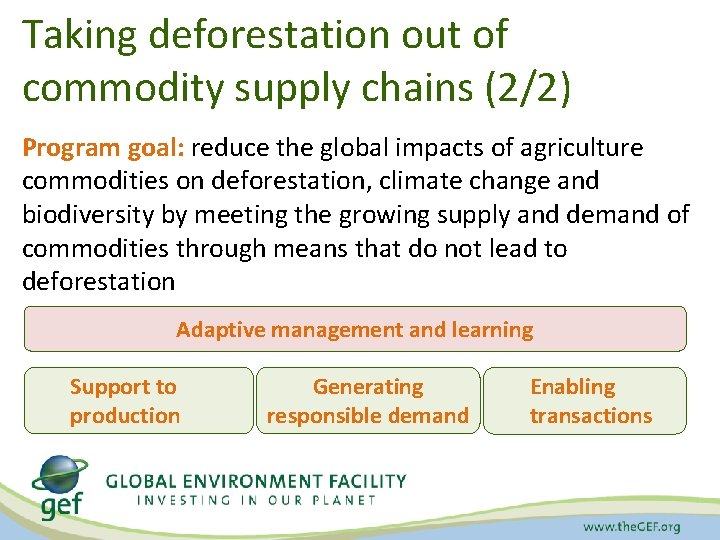
Taking deforestation out of commodity supply chains (2/2) Program goal: reduce the global impacts of agriculture commodities on deforestation, climate change and biodiversity by meeting the growing supply and demand of commodities through means that do not lead to deforestation Adaptive management and learning Support to production Generating responsible demand Enabling transactions
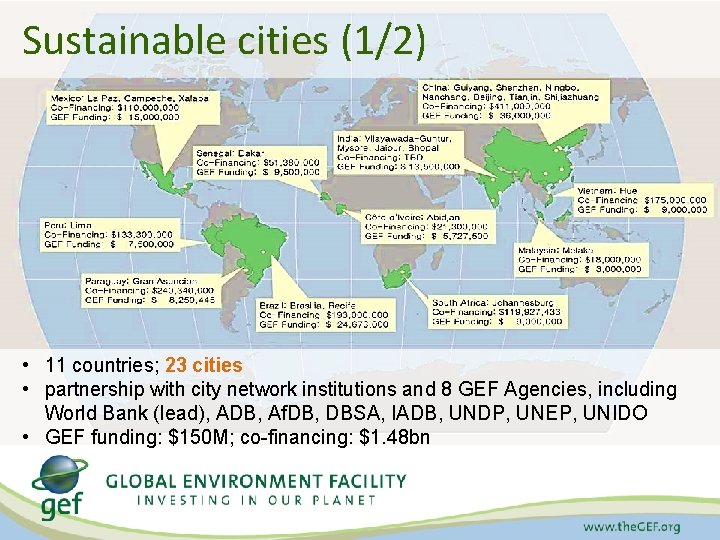
Sustainable cities (1/2) • 11 countries; 23 cities • partnership with city network institutions and 8 GEF Agencies, including World Bank (lead), ADB, Af. DB, DBSA, IADB, UNDP, UNEP, UNIDO • GEF funding: $150 M; co-financing: $1. 48 bn
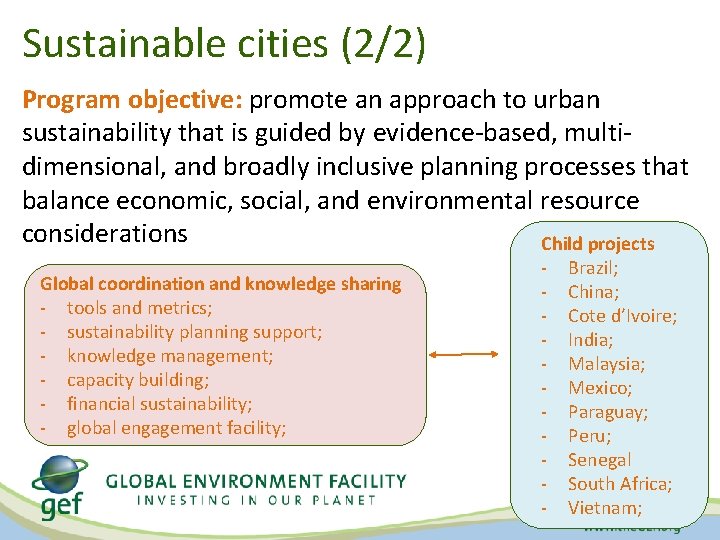
Sustainable cities (2/2) Program objective: promote an approach to urban sustainability that is guided by evidence-based, multidimensional, and broadly inclusive planning processes that balance economic, social, and environmental resource considerations Child projects Global coordination and knowledge sharing - tools and metrics; - sustainability planning support; - knowledge management; - capacity building; - financial sustainability; - global engagement facility; - Brazil; China; Cote d’Ivoire; India; Malaysia; Mexico; Paraguay; Peru; Senegal South Africa; Vietnam;
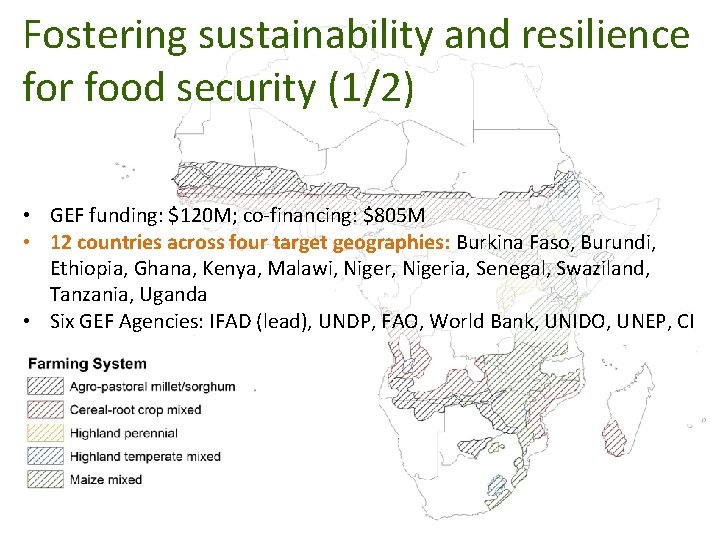
Fostering sustainability and resilience for food security (1/2) • GEF funding: $120 M; co-financing: $805 M • 12 countries across four target geographies: Burkina Faso, Burundi, Ethiopia, Ghana, Kenya, Malawi, Nigeria, Senegal, Swaziland, Tanzania, Uganda • Six GEF Agencies: IFAD (lead), UNDP, FAO, World Bank, UNIDO, UNEP, CI
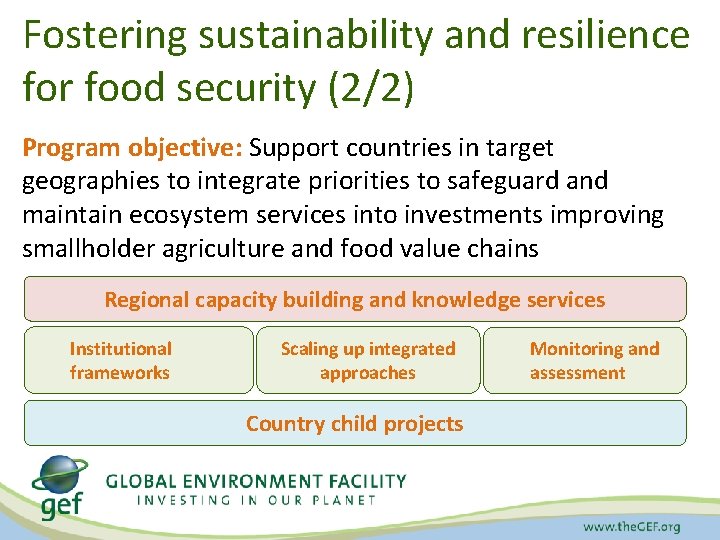
Fostering sustainability and resilience for food security (2/2) Program objective: Support countries in target geographies to integrate priorities to safeguard and maintain ecosystem services into investments improving smallholder agriculture and food value chains Regional capacity building and knowledge services Institutional frameworks Scaling up integrated approaches Country child projects Monitoring and assessment
Thank you mbakarr@thegef. org (food security, IAP coordination) ksundstrom@thegef. org (food security) igray@thegef. org (commodities) caoki@thegef. org; xtan 1@thegef. org (sustainable cities)