
Integral Field Spectroscopy on Gemini GMOS Gemini MultiObject
Integral Field Spectroscopy on Gemini GMOS Gemini Multi-Object Spectrograph, optical IFU (Durham) Andrew Bunker (Io. A, Cambridge) Euro 3 D Meeting July 2002
Gemini Integral Field Spectroscopy · Institute of Astronomy, Cambridge: Andy Bunker, Joanna Smith (Ph. D student), Richard Mc. Mahon, Gerry Gilmore & Ian Parry, Rob Sharp etc (CIRPASS team) · Durham: Richard Bower, Roger Davies etc & GMOS team · Gemini: Kathy Roth, Marianne Takamiya, Inger Jørgensen etc. (Director's discretionary time) · Program with Gemini Observatory to demonstrate the power of IFUs (5+5 nights GMOS+CIRPASS) · Large interntational team (CIRPASS observations involve ~50 scientists) lead by Cambridge/Durham · Aimed at raising profile of IFU science in the Gemini community · Data made public in 2 months
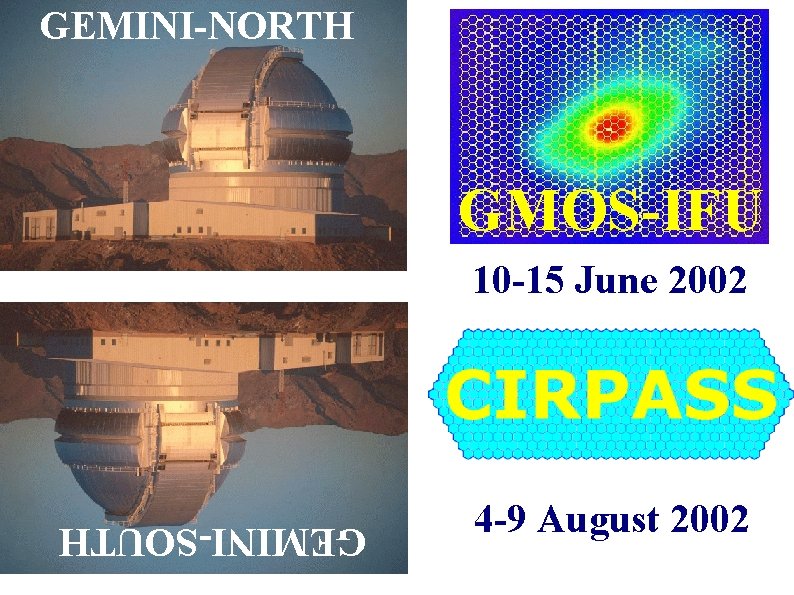
GEMINI-NORTH GMOS-IFU 10 -15 June 2002 4 -9 August 2002 GEMINI-SOUTH
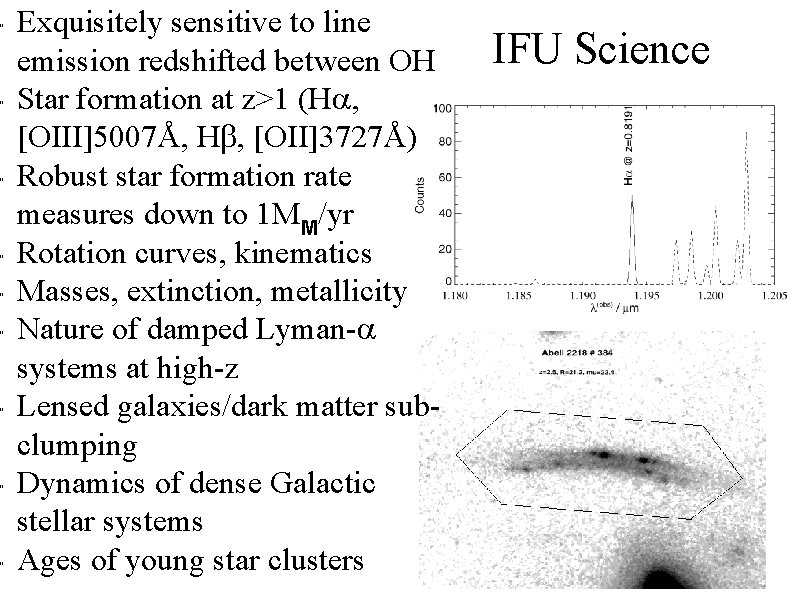
" " " " " Exquisitely sensitive to line emission redshifted between OH Star formation at z>1 (Ha, [OIII]5007Å, Hb, [OII]3727Å) Robust star formation rate measures down to 1 MM/yr Rotation curves, kinematics Masses, extinction, metallicity Nature of damped Lyman-a systems at high-z Lensed galaxies/dark matter subclumping Dynamics of dense Galactic stellar systems Ages of young star clusters IFU Science
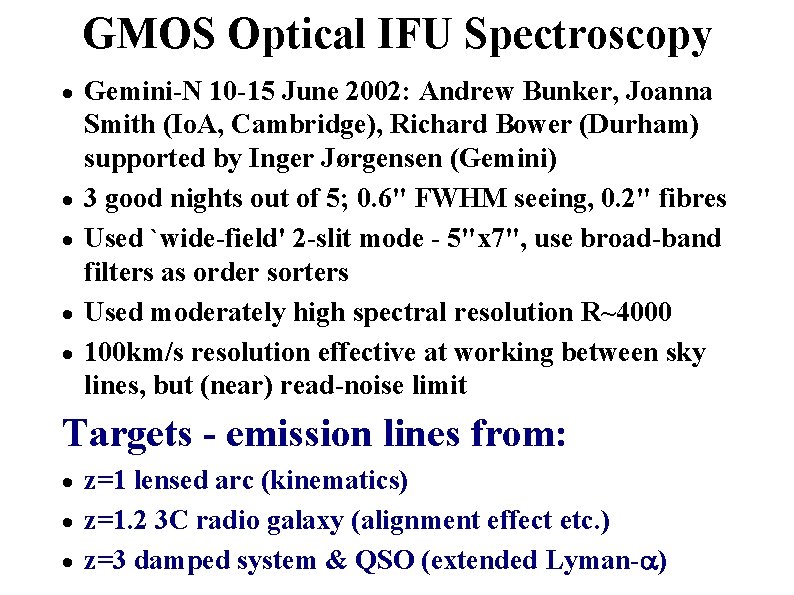
GMOS Optical IFU Spectroscopy · Gemini-N 10 -15 June 2002: Andrew Bunker, Joanna · · Smith (Io. A, Cambridge), Richard Bower (Durham) supported by Inger Jørgensen (Gemini) 3 good nights out of 5; 0. 6" FWHM seeing, 0. 2" fibres Used `wide-field' 2 -slit mode - 5"x 7", use broad-band filters as order sorters Used moderately high spectral resolution R~4000 100 km/s resolution effective at working between sky lines, but (near) read-noise limit Targets - emission lines from: · z=1 lensed arc (kinematics) · z=1. 2 3 C radio galaxy (alignment effect etc. ) · z=3 damped system & QSO (extended Lyman-a)
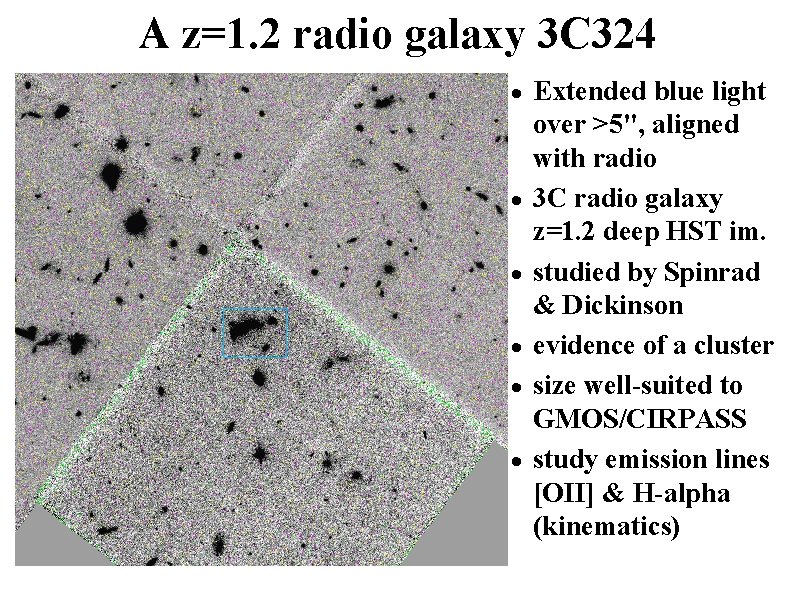
A z=1. 2 radio galaxy 3 C 324 · Extended blue light · · · over >5", aligned with radio 3 C radio galaxy z=1. 2 deep HST im. studied by Spinrad & Dickinson evidence of a cluster size well-suited to GMOS/CIRPASS study emission lines [OII] & H-alpha (kinematics)
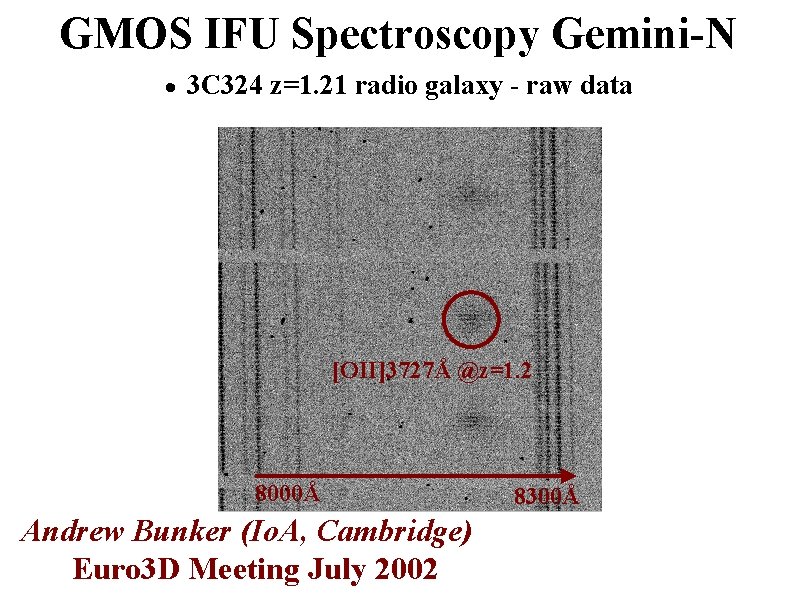
GMOS IFU Spectroscopy Gemini-N · 3 C 324 z=1. 21 radio galaxy - raw data [OII]3727Å @z=1. 2 8000Å Andrew Bunker (Io. A, Cambridge) Euro 3 D Meeting July 2002 8300Å
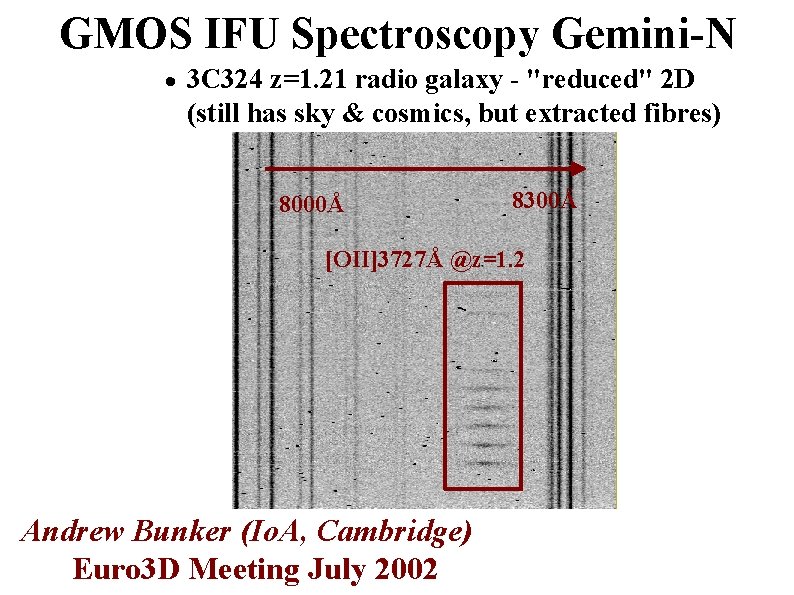
GMOS IFU Spectroscopy Gemini-N · 3 C 324 z=1. 21 radio galaxy - "reduced" 2 D (still has sky & cosmics, but extracted fibres) 8000Å 8300Å [OII]3727Å @z=1. 2 Andrew Bunker (Io. A, Cambridge) Euro 3 D Meeting July 2002
![Wavelength/velocity 3 C 324 3 -D data cube [OII]3727 structure has two velocity components](http://slidetodoc.com/presentation_image_h/363f722b105ac281626f44505f0f4df9/image-9.jpg "Wavelength/velocity 3 C 324 3 -D data cube [OII]3727 structure has two velocity components")
Wavelength/velocity 3 C 324 3 -D data cube [OII]3727 structure has two velocity components at +/-400 km/s
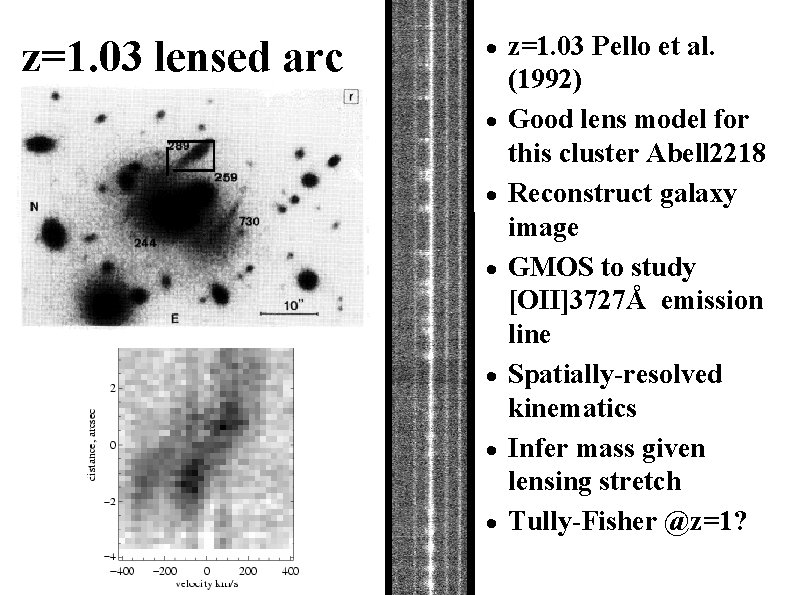
z=1. 03 lensed arc · z=1. 03 Pello et al. · · · (1992) Good lens model for this cluster Abell 2218 Reconstruct galaxy image GMOS to study [OII]3727Å emission line Spatially-resolved kinematics Infer mass given lensing stretch Tully-Fisher @z=1?
![z=1 arc 3 D data cube Wavelength/velocity [OII]3727Å doublet, ~300 km/s velocity shift](http://slidetodoc.com/presentation_image_h/363f722b105ac281626f44505f0f4df9/image-11.jpg "z=1 arc 3 D data cube Wavelength/velocity [OII]3727Å doublet, ~300 km/s velocity shift")
z=1 arc 3 D data cube Wavelength/velocity [OII]3727Å doublet, ~300 km/s velocity shift
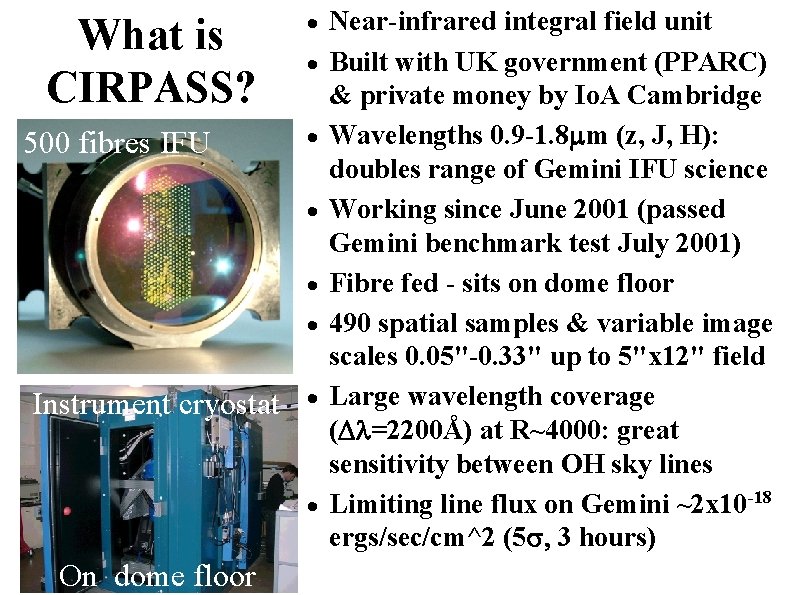
What is CIRPASS? 500 fibres IFU · Near-infrared integral field unit · Built with UK government (PPARC) · · Instrument cryostat · · On dome floor & private money by Io. A Cambridge Wavelengths 0. 9 -1. 8 mm (z, J, H): doubles range of Gemini IFU science Working since June 2001 (passed Gemini benchmark test July 2001) Fibre fed - sits on dome floor 490 spatial samples & variable image scales 0. 05"-0. 33" up to 5"x 12" field Large wavelength coverage (Dl=2200Å) at R~4000: great sensitivity between OH sky lines Limiting line flux on Gemini ~2 x 10 -18 ergs/sec/cm^2 (5 s, 3 hours)
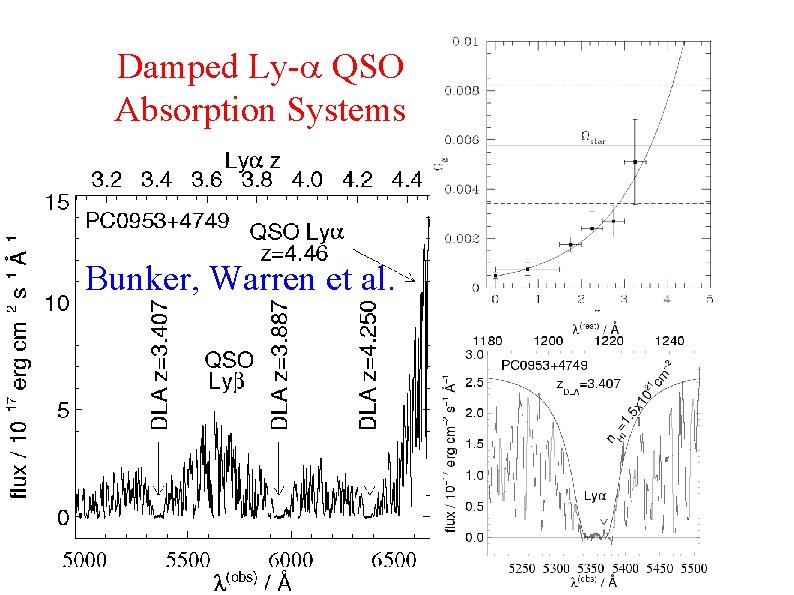
Damped Ly-a QSO Absorption Systems Bunker, Warren et al.
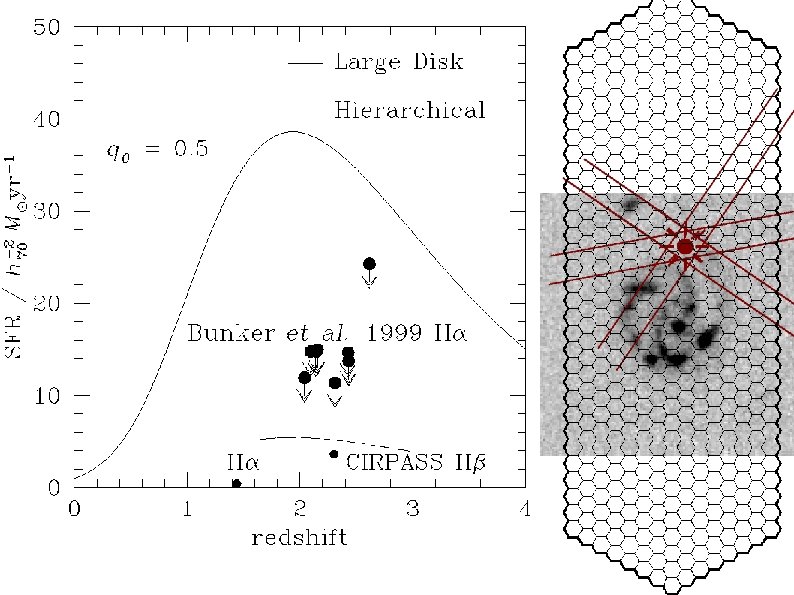
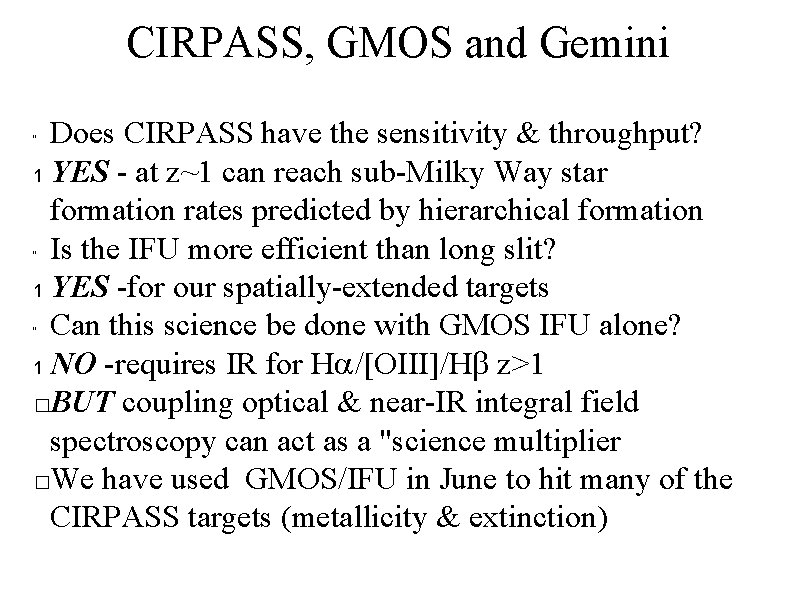
CIRPASS, GMOS and Gemini Does CIRPASS have the sensitivity & throughput? 1 YES - at z~1 can reach sub-Milky Way star formation rates predicted by hierarchical formation Is the IFU more efficient than long slit? 1 YES -for our spatially-extended targets Can this science be done with GMOS IFU alone? 1 NO -requires IR for Ha/[OIII]/Hb z>1 �BUT coupling optical & near-IR integral field spectroscopy can act as a "science multiplier �We have used GMOS/IFU in June to hit many of the CIRPASS targets (metallicity & extinction) " " "
- Slides: 15