
Integer Properties Chapter 10 Preamble Historically number theory
Integer Properties Chapter 10
Preamble Historically, number theory has been a beautiful area of study in pure mathematics. However, in modern times, number theory is very important in the area of security. Encryption algorithms heavily depend on modular arithmetic, and our ability to deal with large integers. We need appropriate techniques to deal with such algorithms.

Divisors • Integer division – In integer division, the input and output values must always be integers. • Let a, b, c are integers such that c = ab. – a and b are called divisors of c – a|c b|c – 105 = 15∙ 7 implies 15|105 and 7|105
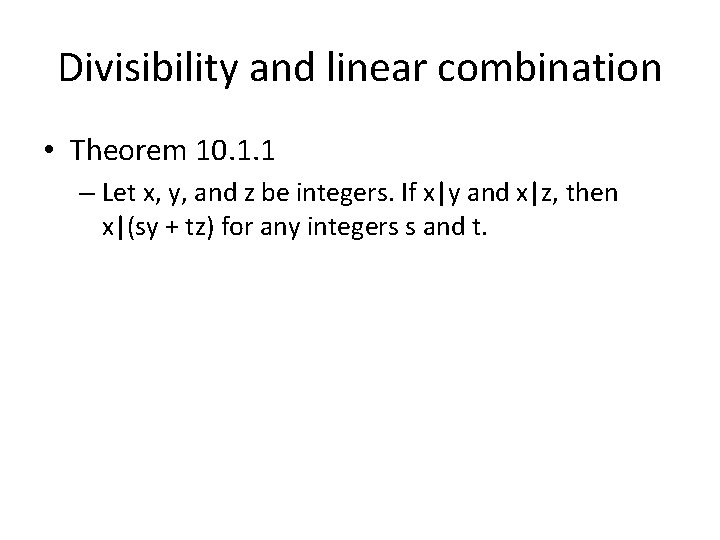
Divisibility and linear combination • Theorem 10. 1. 1 – Let x, y, and z be integers. If x|y and x|z, then x|(sy + tz) for any integers s and t.
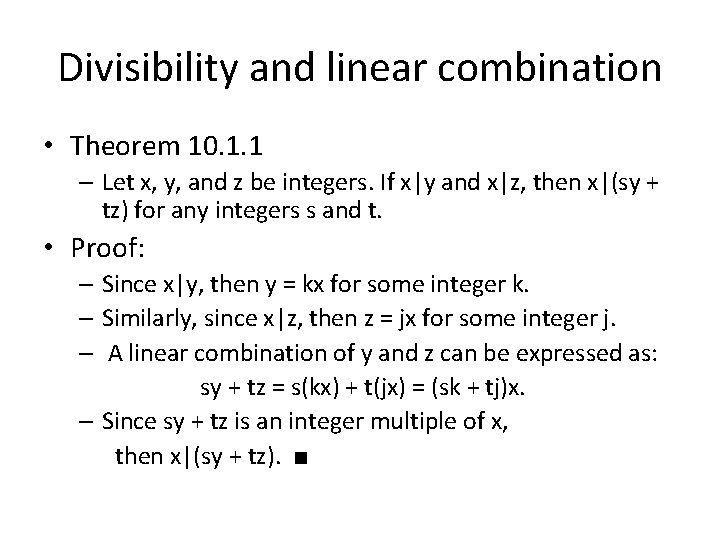
Divisibility and linear combination • Theorem 10. 1. 1 – Let x, y, and z be integers. If x|y and x|z, then x|(sy + tz) for any integers s and t. • Proof: – Since x|y, then y = kx for some integer k. – Similarly, since x|z, then z = jx for some integer j. – A linear combination of y and z can be expressed as: sy + tz = s(kx) + t(jx) = (sk + tj)x. – Since sy + tz is an integer multiple of x, then x|(sy + tz). ■
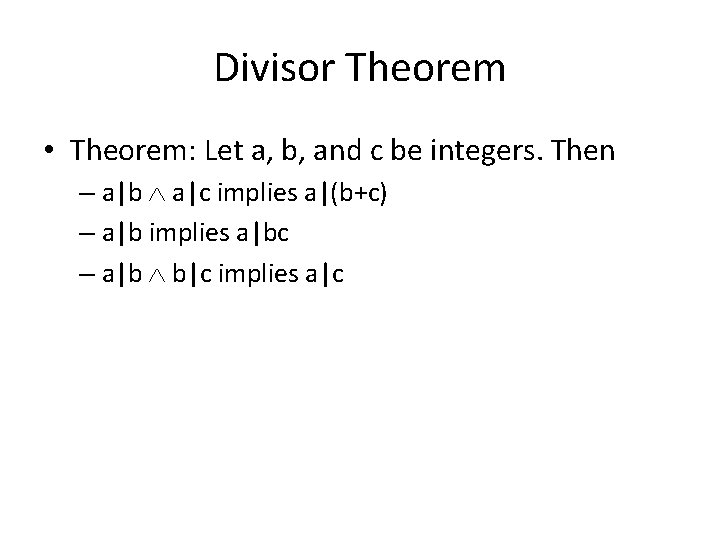
Divisor Theorem • Theorem: Let a, b, and c be integers. Then – a|b a|c implies a|(b+c) – a|b implies a|bc – a|b b|c implies a|c
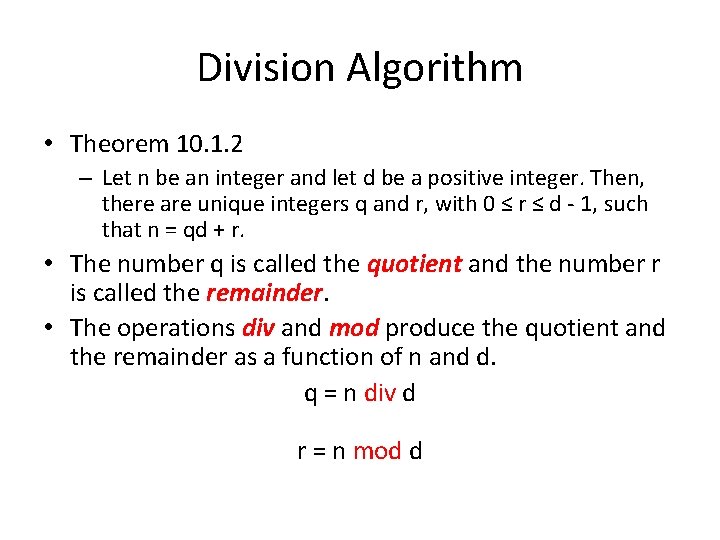
Division Algorithm • Theorem 10. 1. 2 – Let n be an integer and let d be a positive integer. Then, there are unique integers q and r, with 0 ≤ r ≤ d - 1, such that n = qd + r. • The number q is called the quotient and the number r is called the remainder. • The operations div and mod produce the quotient and the remainder as a function of n and d. q = n div d r = n mod d
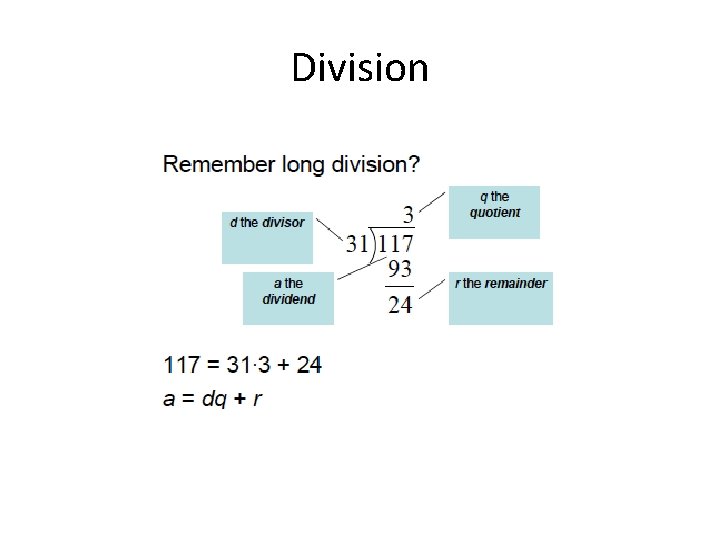
Division
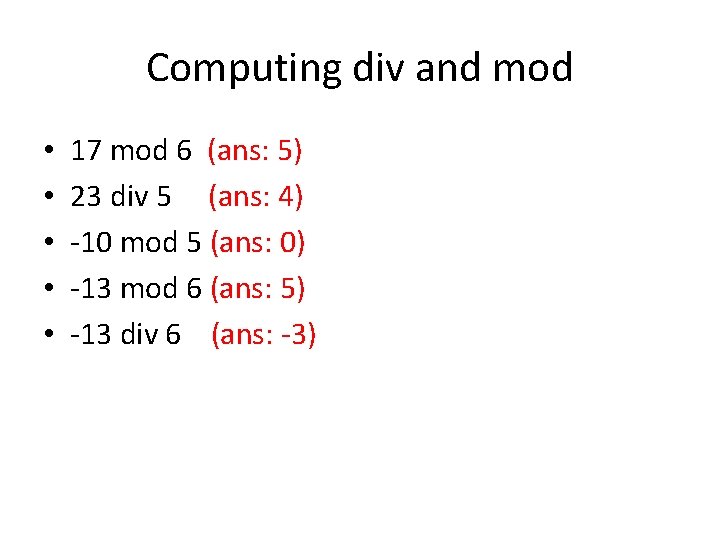
Computing div and mod • • • 17 mod 6 (ans: 5) 23 div 5 (ans: 4) -10 mod 5 (ans: 0) -13 mod 6 (ans: 5) -13 div 6 (ans: -3)
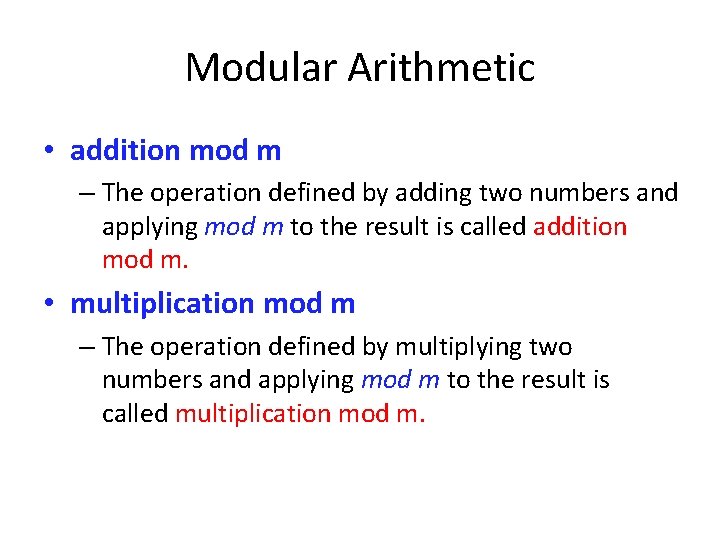
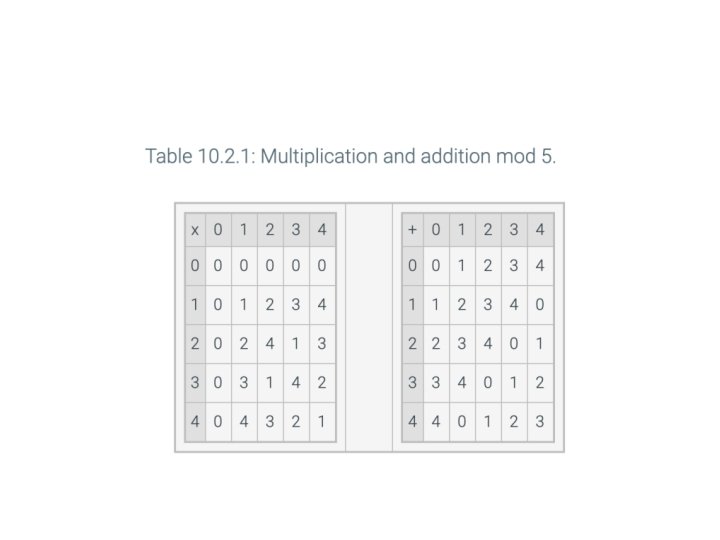
Modular Arithmetic • addition mod m – The operation defined by adding two numbers and applying mod m to the result is called addition mod m. • multiplication mod m – The operation defined by multiplying two numbers and applying mod m to the result is called multiplication mod m.
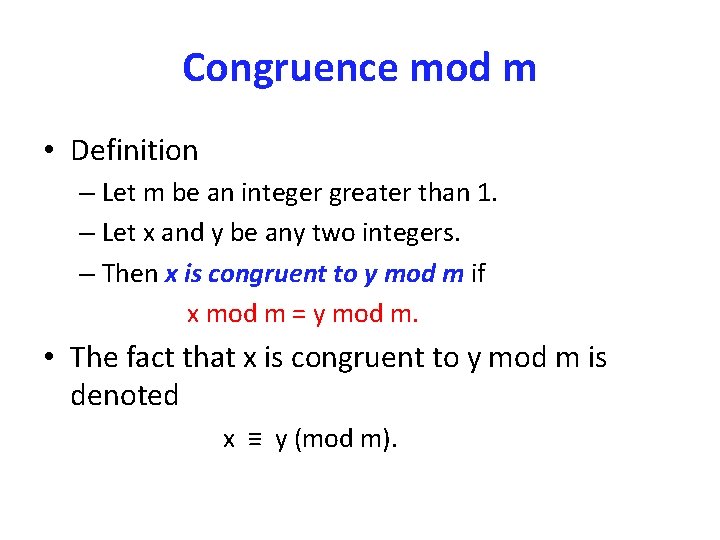
Congruence mod m • Definition – Let m be an integer greater than 1. – Let x and y be any two integers. – Then x is congruent to y mod m if x mod m = y mod m. • The fact that x is congruent to y mod m is denoted x ≡ y (mod m).
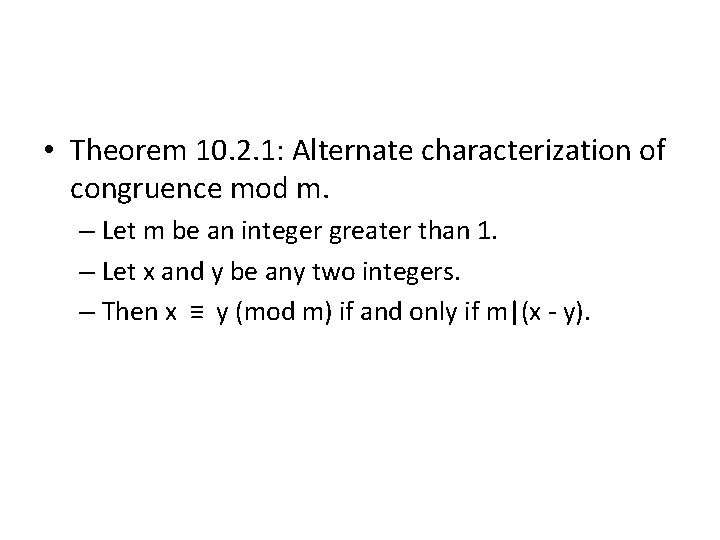
• Theorem 10. 2. 1: Alternate characterization of congruence mod m. – Let m be an integer greater than 1. – Let x and y be any two integers. – Then x ≡ y (mod m) if and only if m|(x - y).
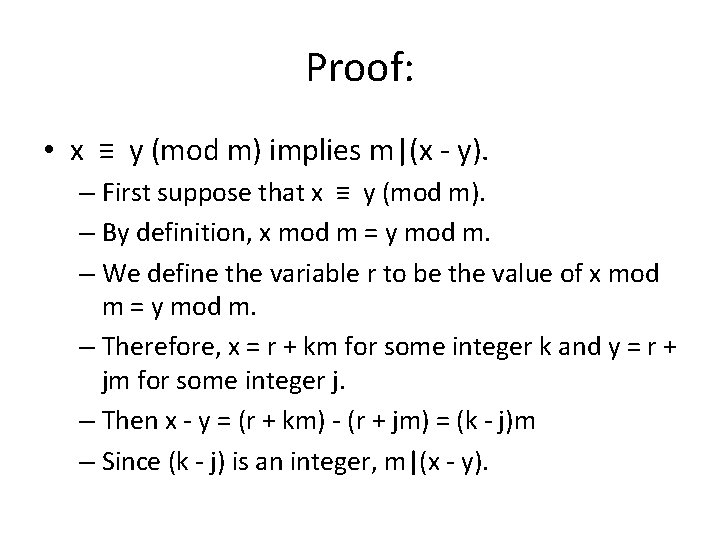
Proof: • x ≡ y (mod m) implies m|(x - y). – First suppose that x ≡ y (mod m). – By definition, x mod m = y mod m. – We define the variable r to be the value of x mod m = y mod m. – Therefore, x = r + km for some integer k and y = r + jm for some integer j. – Then x - y = (r + km) - (r + jm) = (k - j)m – Since (k - j) is an integer, m|(x - y).
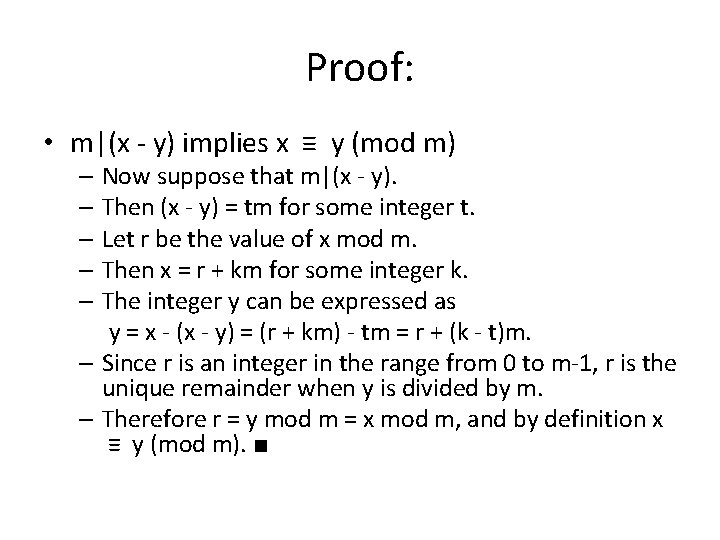
Proof: • m|(x - y) implies x ≡ y (mod m) – Now suppose that m|(x - y). – Then (x - y) = tm for some integer t. – Let r be the value of x mod m. – Then x = r + km for some integer k. – The integer y can be expressed as y = x - (x - y) = (r + km) - tm = r + (k - t)m. – Since r is an integer in the range from 0 to m-1, r is the unique remainder when y is divided by m. – Therefore r = y mod m = x mod m, and by definition x ≡ y (mod m). ■

• Let R be a relation on Z such that (a, b) is in R if a ≡ b (mod n). This relation is an equivalent relation. • When n =3, the equivalent classes of Z are
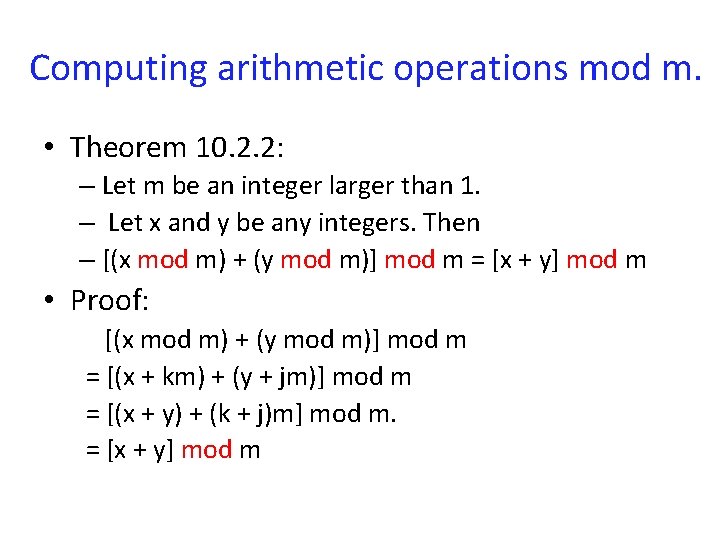
Computing arithmetic operations mod m. • Theorem 10. 2. 2: – Let m be an integer larger than 1. – Let x and y be any integers. Then – [(x mod m) + (y mod m)] mod m = [x + y] mod m • Proof: [(x mod m) + (y mod m)] mod m = [(x + km) + (y + jm)] mod m = [(x + y) + (k + j)m] mod m. = [x + y] mod m

Computing arithmetic operations mod m. • Theorem 10. 2. 2: – Let m be an integer larger than 1. – Let x and y be any integers. Then – [(x mod m)(y mod m)] mod m = [x·y] mod m • Proof: [(x mod m)(y mod m)] mod m = [(x + km)(y + jm)] mod m = [(x·y) + (ky + jx + jkm)m] mod m = [x·y] mod m
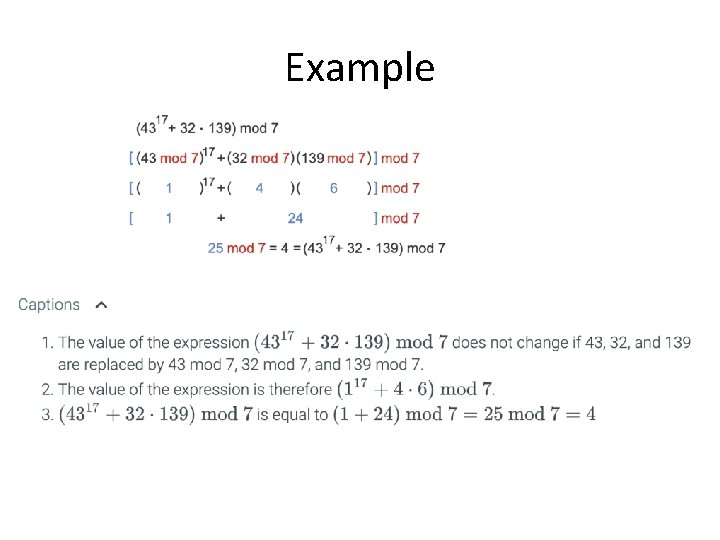
Example
Prime numbers • A number n ≥ 2 is prime if and only if it is divisible by only 1 and itself. • A number which is not a prime is called composite. – 15 is composite – 23 is prime
Fundamental Theorem of Arithmetic • Theorem: Any number n ≥ 2 is expressible as a unique product one or more primes. – 100 = 2∙ 2∙ 5∙ 5 = 22. 52 – 29338848000 = 28355373111
Fundamental Theorem of Arithmetic • Theorem: Any number n ≥ 2 is expressible as a unique product one or more primes. – 100 = 2∙ 2∙ 5∙ 5 = 22. 52 – 29338848000 = 28355373111 • multiplicity – The multiplicity of a prime factor p in a prime factorization is the number of times p appears in the product of primes. – In the previous example, the multiplicity of 3 in the prime factorization of 29338848000 is 3.
How many divisors? • How many positive divisors does n have? – when n= 100, the divisors are 1, 2, 4, 5, 10, 25, 50, 100 – n = 2252 – Divisors are : 2050, 2051, 2052; 2150, 2151, 2152; 2250, 2251, 2252
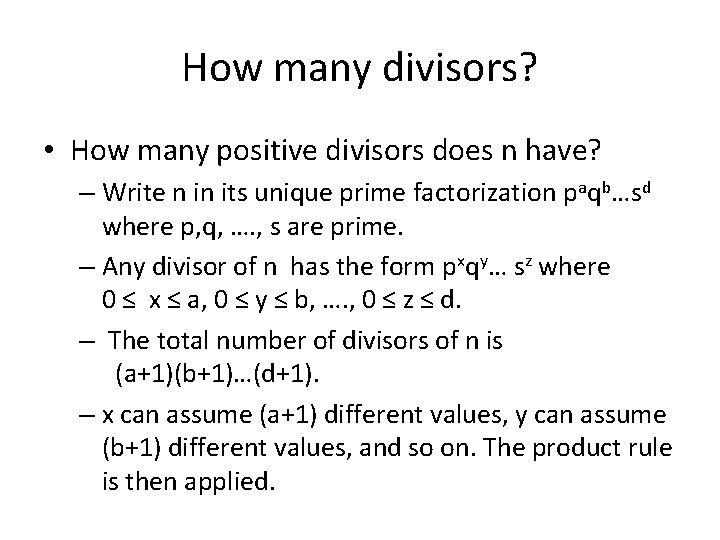
How many divisors? • How many positive divisors does n have? – Write n in its unique prime factorization paqb…sd where p, q, …. , s are prime. – Any divisor of n has the form pxqy… sz where 0 ≤ x ≤ a, 0 ≤ y ≤ b, …. , 0 ≤ z ≤ d. – The total number of divisors of n is (a+1)(b+1)…(d+1). – x can assume (a+1) different values, y can assume (b+1) different values, and so on. The product rule is then applied.
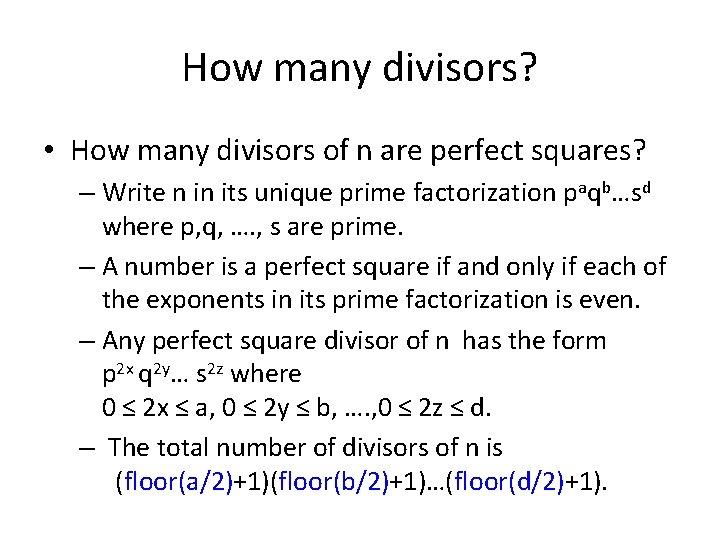
How many divisors? • How many divisors of n are perfect squares? – Write n in its unique prime factorization paqb…sd where p, q, …. , s are prime. – A number is a perfect square if and only if each of the exponents in its prime factorization is even. – Any perfect square divisor of n has the form p 2 x q 2 y… s 2 z where 0 ≤ 2 x ≤ a, 0 ≤ 2 y ≤ b, …. , 0 ≤ 2 z ≤ d. – The total number of divisors of n is (floor(a/2)+1)(floor(b/2)+1)…(floor(d/2)+1).
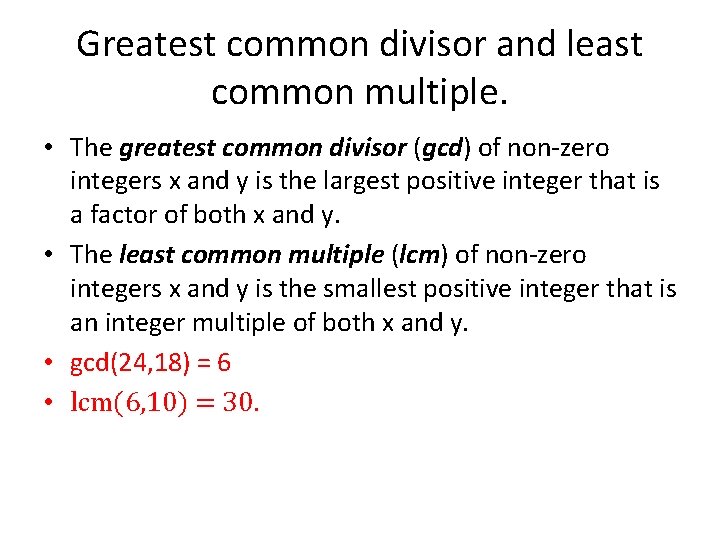
Greatest common divisor and least common multiple. • The greatest common divisor (gcd) of non-zero integers x and y is the largest positive integer that is a factor of both x and y. • The least common multiple (lcm) of non-zero integers x and y is the smallest positive integer that is an integer multiple of both x and y. • gcd(24, 18) = 6 • lcm(6, 10) = 30.
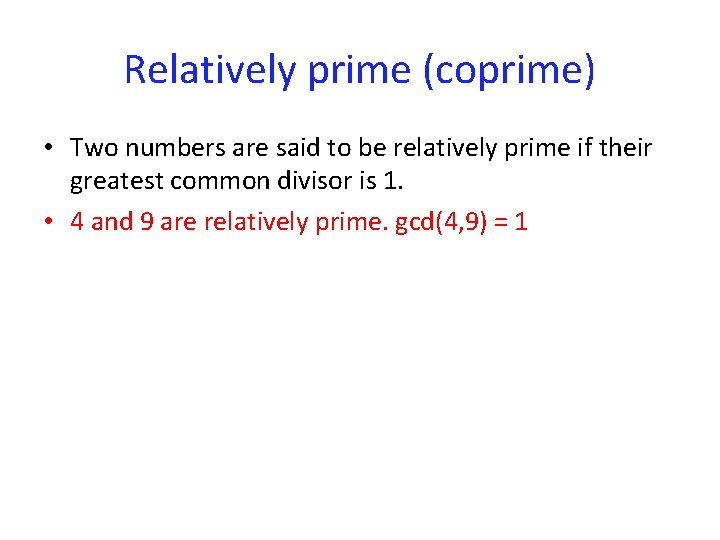
Relatively prime (coprime) • Two numbers are said to be relatively prime if their greatest common divisor is 1. • 4 and 9 are relatively prime. gcd(4, 9) = 1
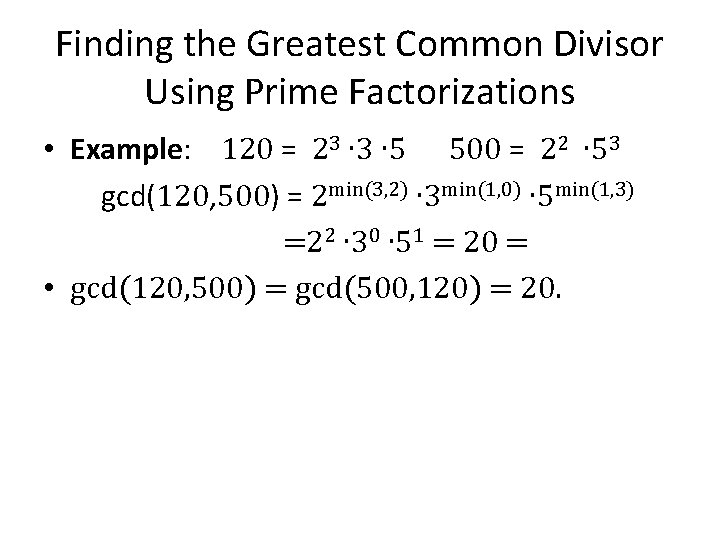
Finding the Greatest Common Divisor Using Prime Factorizations • Example: 120 = 23 ∙ 5 500 = 22 ∙ 53 gcd(120, 500) = 2 min(3, 2) ∙ 3 min(1, 0) ∙ 5 min(1, 3) =22 ∙ 30 ∙ 51 = 20 = • gcd(120, 500) = gcd(500, 120) = 20.
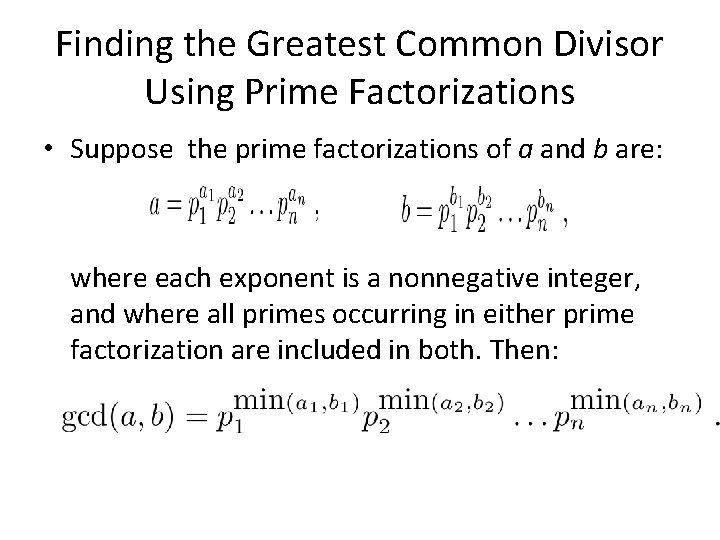
Finding the Greatest Common Divisor Using Prime Factorizations • Suppose the prime factorizations of a and b are: where each exponent is a nonnegative integer, and where all primes occurring in either prime factorization are included in both. Then:
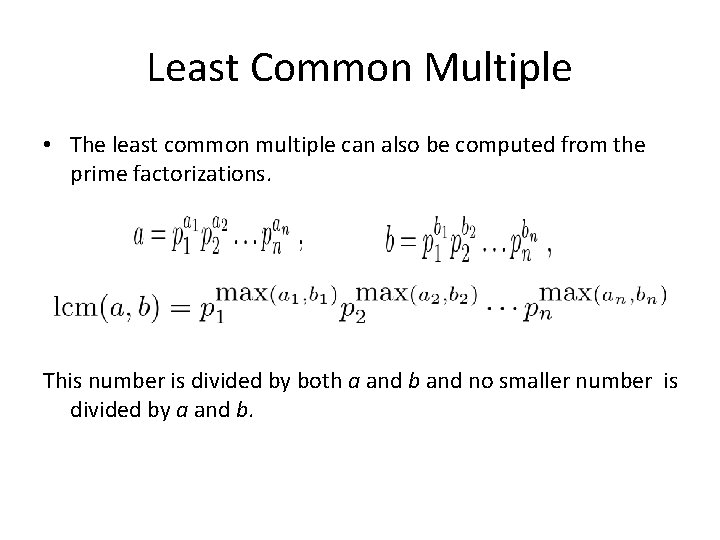
Least Common Multiple • The least common multiple can also be computed from the prime factorizations. This number is divided by both a and b and no smaller number is divided by a and b.
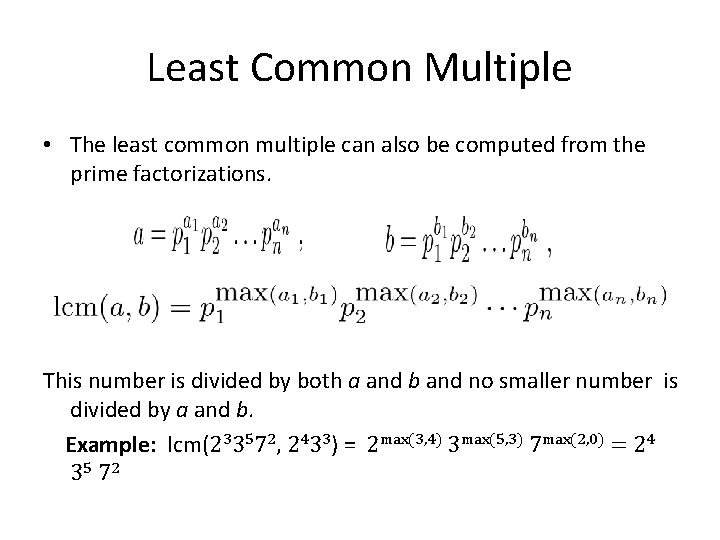
Least Common Multiple • The least common multiple can also be computed from the prime factorizations. This number is divided by both a and b and no smaller number is divided by a and b. Example: lcm(233572, 2433) = 2 max(3, 4) 3 max(5, 3) 7 max(2, 0) = 24 35 7 2
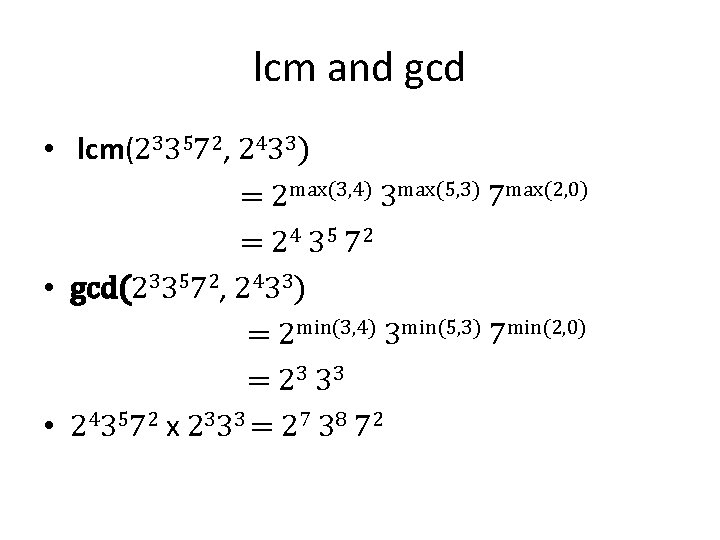
lcm and gcd • lcm(233572, 2433) = 2 max(3, 4) 3 max(5, 3) 7 max(2, 0) = 2 4 35 72 • gcd(233572, 2433) = 2 min(3, 4) 3 min(5, 3) 7 min(2, 0) = 2 3 33 • 243572 x 2333 = 27 38 72
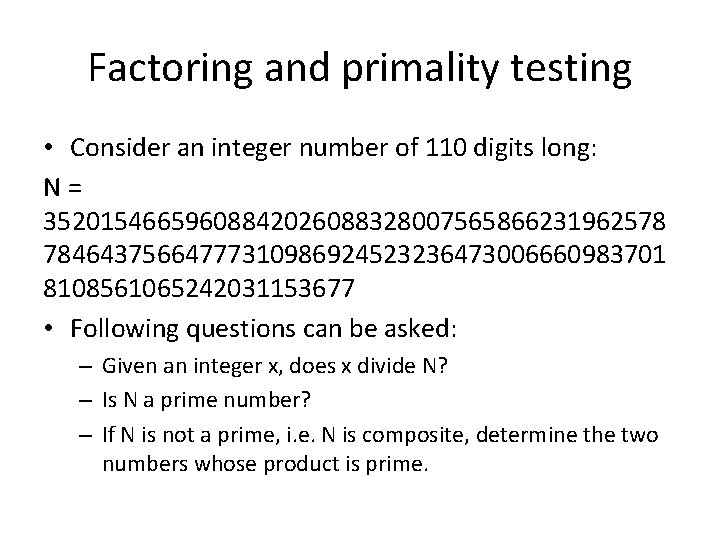
Factoring and primality testing • Consider an integer number of 110 digits long: N = 35201546659608842026088328007565866231962578 78464375664777310986924523236473006660983701 8108561065242031153677 • Following questions can be asked: – Given an integer x, does x divide N? – Is N a prime number? – If N is not a prime, i. e. N is composite, determine the two numbers whose product is prime.
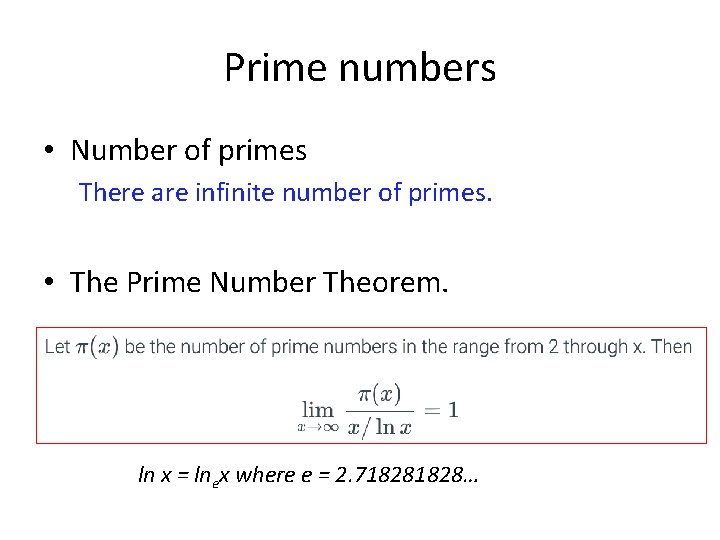
Prime numbers • Number of primes There are infinite number of primes. • The Prime Number Theorem. ln x = lnex where e = 2. 71828…
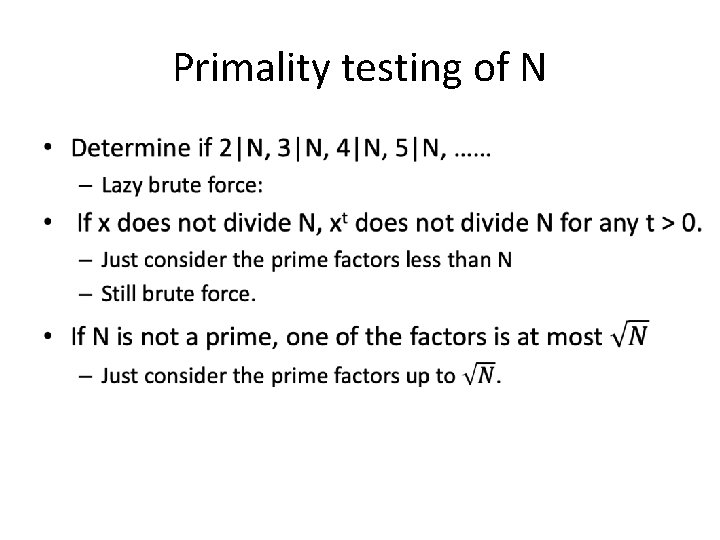
Primality testing of N •
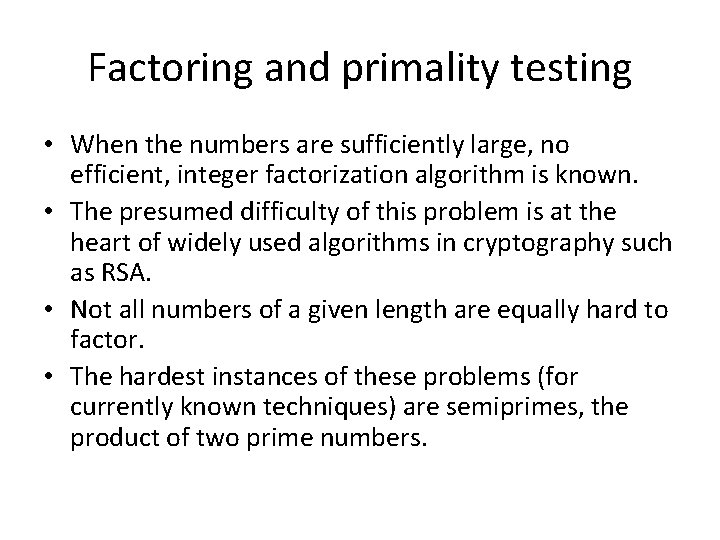
Factoring and primality testing • When the numbers are sufficiently large, no efficient, integer factorization algorithm is known. • The presumed difficulty of this problem is at the heart of widely used algorithms in cryptography such as RSA. • Not all numbers of a given length are equally hard to factor. • The hardest instances of these problems (for currently known techniques) are semiprimes, the product of two prime numbers.


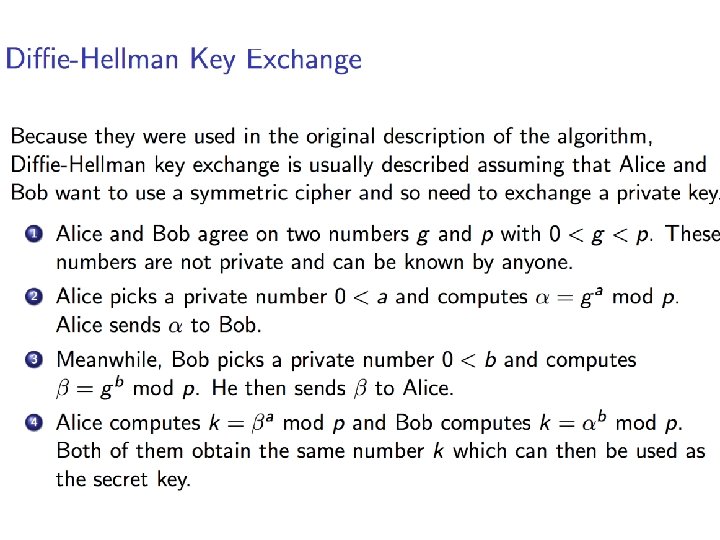
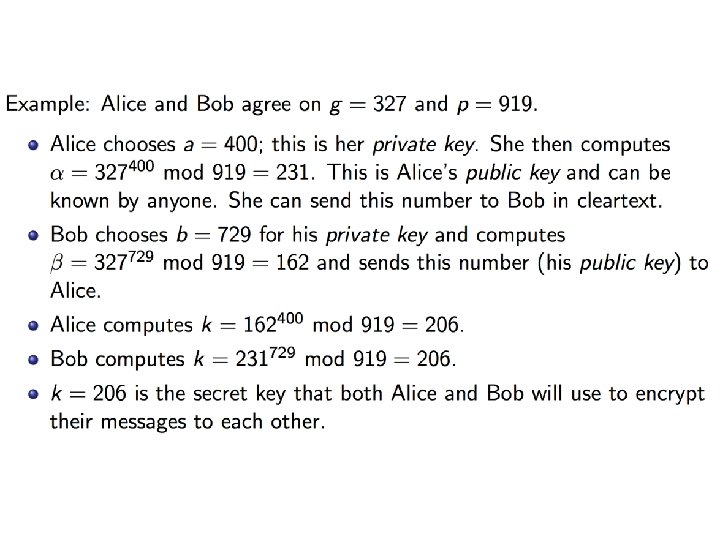
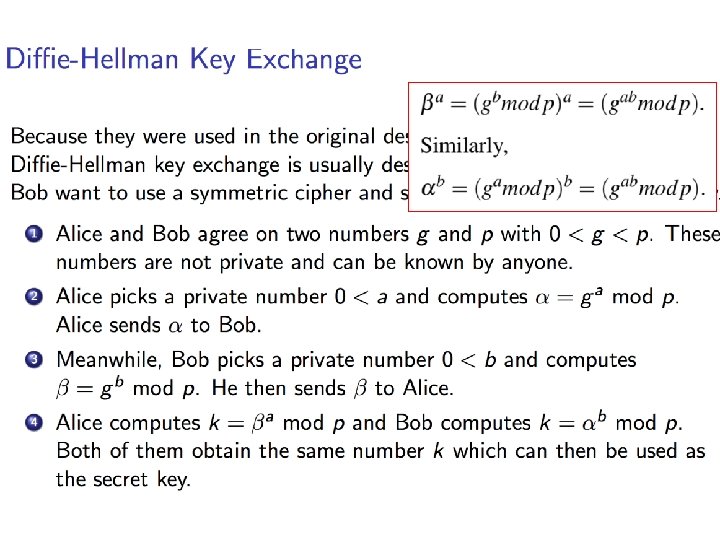
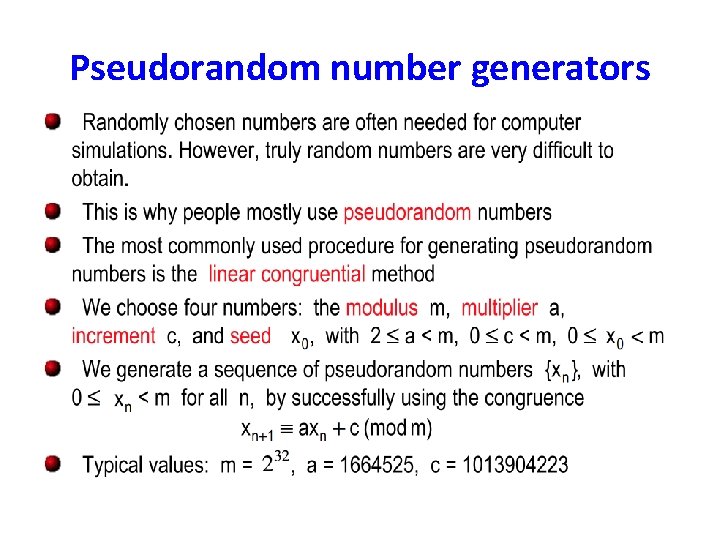
Pseudorandom number generators
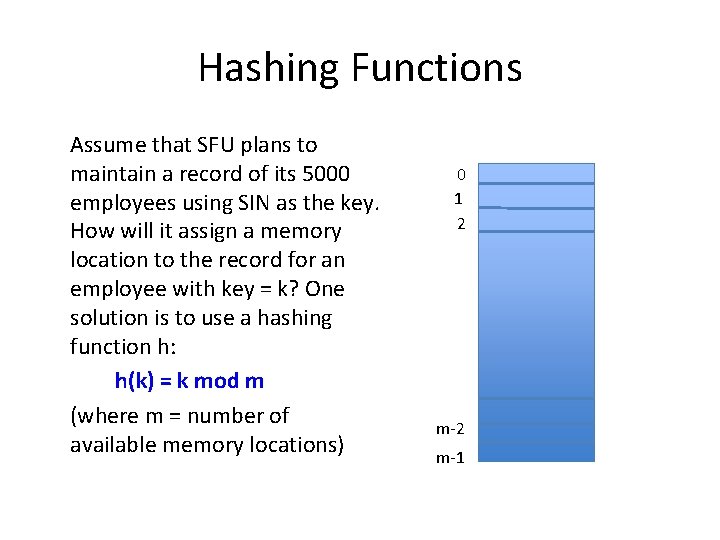
Hashing Functions Assume that SFU plans to maintain a record of its 5000 employees using SIN as the key. How will it assign a memory location to the record for an employee with key = k? One solution is to use a hashing function h: h(k) = k mod m (where m = number of available memory locations) 0 1 2 m-1
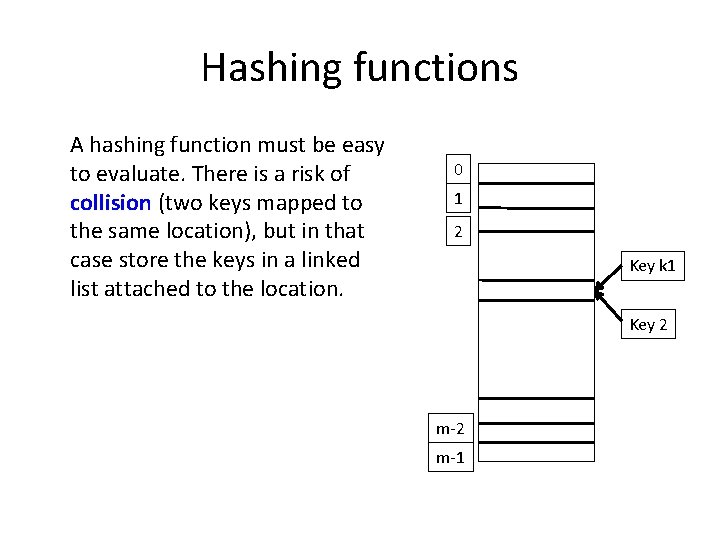
Hashing functions A hashing function must be easy to evaluate. There is a risk of collision (two keys mapped to the same location), but in that case store the keys in a linked list attached to the location. 0 1 2 Key k 1 Key 2 m-2 m-1
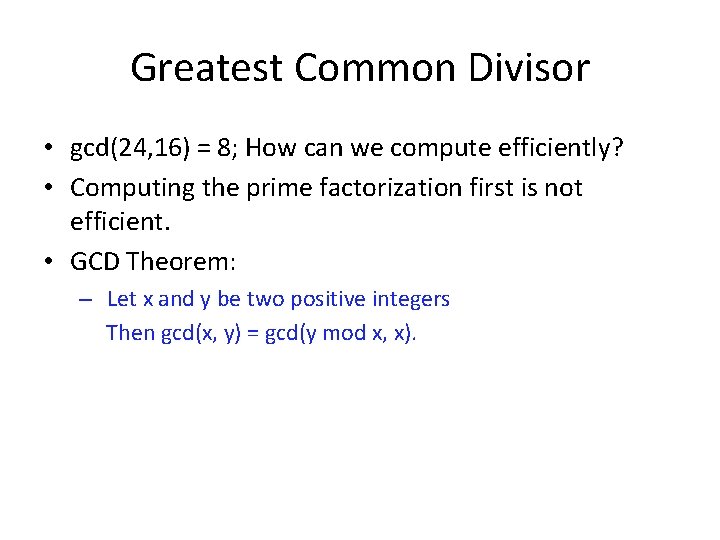
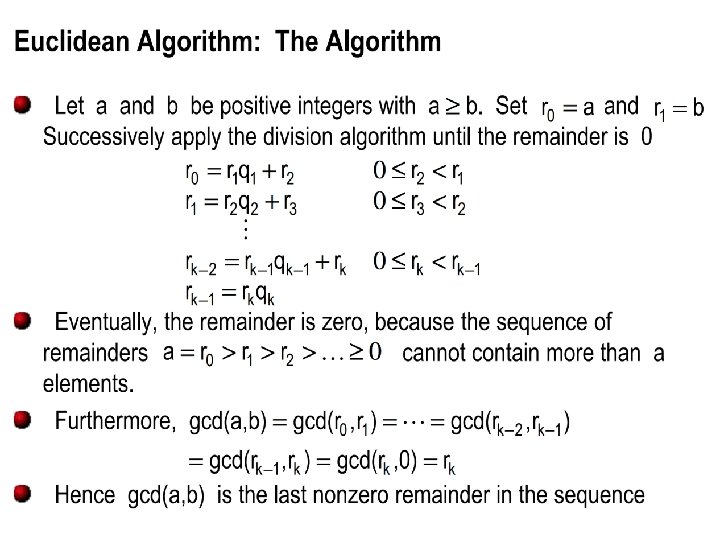
Greatest Common Divisor • gcd(24, 16) = 8; How can we compute efficiently? • Computing the prime factorization first is not efficient. • GCD Theorem: – Let x and y be two positive integers Then gcd(x, y) = gcd(y mod x, x).
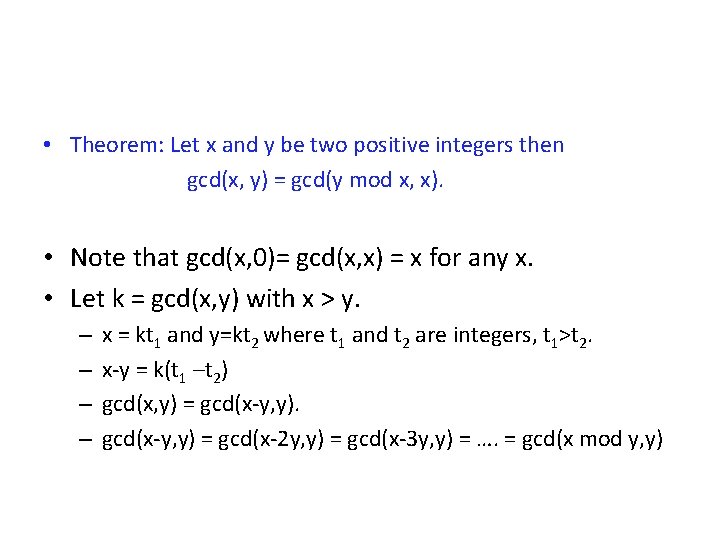
• Theorem: Let x and y be two positive integers then gcd(x, y) = gcd(y mod x, x). • Note that gcd(x, 0)= gcd(x, x) = x for any x. • Let k = gcd(x, y) with x > y. – – x = kt 1 and y=kt 2 where t 1 and t 2 are integers, t 1>t 2. x-y = k(t 1 –t 2) gcd(x, y) = gcd(x-y, y) = gcd(x-2 y, y) = gcd(x-3 y, y) = …. = gcd(x mod y, y)
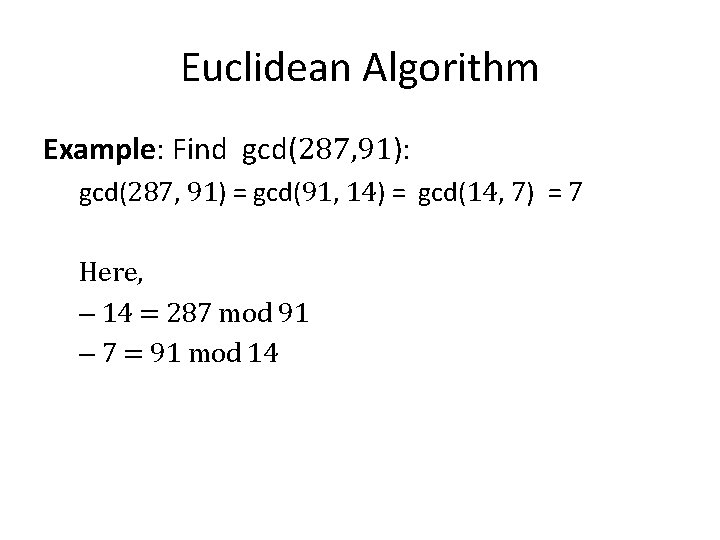
Euclidean Algorithm Example: Find gcd(287, 91): gcd(287, 91) = gcd(91, 14) = gcd(14, 7) = 7 Here, – 14 = 287 mod 91 – 7 = 91 mod 14
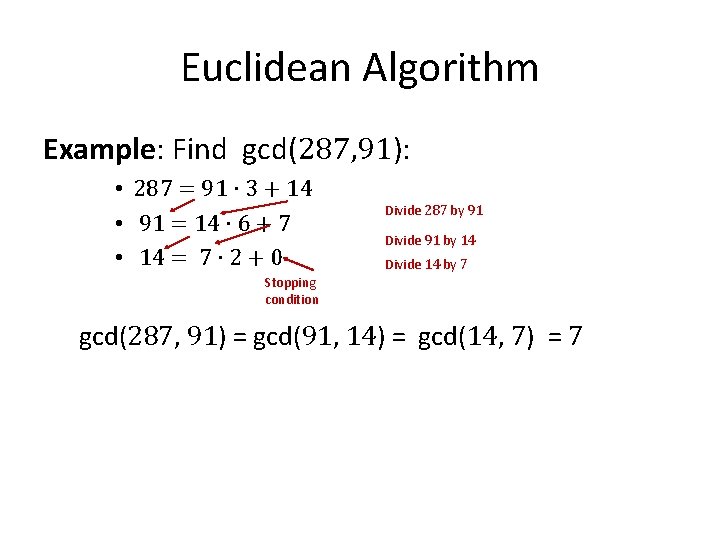
Euclidean Algorithm Example: Find gcd(287, 91): • 287 = 91 ∙ 3 + 14 • 91 = 14 ∙ 6 + 7 • 14 = 7 ∙ 2 + 0 Divide 287 by 91 Divide 91 by 14 Divide 14 by 7 Stopping condition gcd(287, 91) = gcd(91, 14) = gcd(14, 7) = 7

Euclidean Algorithm • The Euclidean algorithm expressed in pseudocode is: procedure gcd(a, b: positive integers) if a < b then swap(a, b) (i. e. c=a, a=b, b=c) x : = a y : = b while y ≠ 0 r : = x mod y x : = y y : = r return x {gcd(a, b) = x}
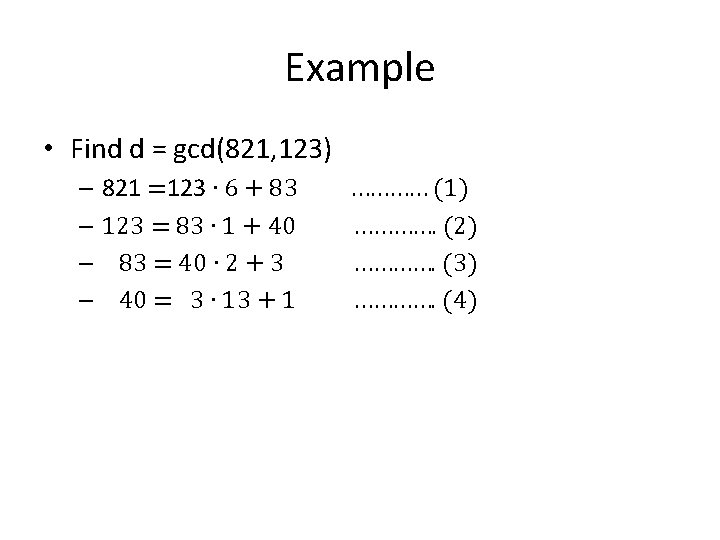
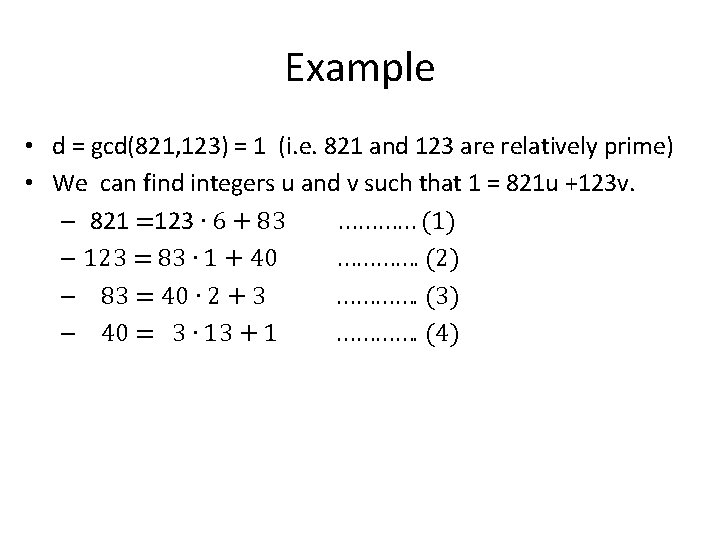
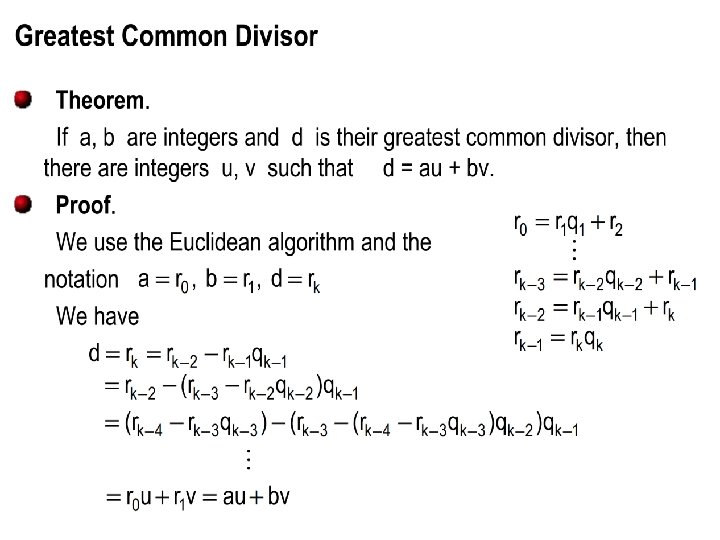
Example • d = gcd(821, 123) = 1 (i. e. 821 and 123 are relatively prime) • We can find integers u and v such that 1 = 821 u +123 v. – 821 =123 ∙ 6 + 83 ………… (1) – 123 = 83 ∙ 1 + 40 …………. (2) – 83 = 40 ∙ 2 + 3 …………. (3) – 40 = 3 ∙ 13 + 1 …………. (4)
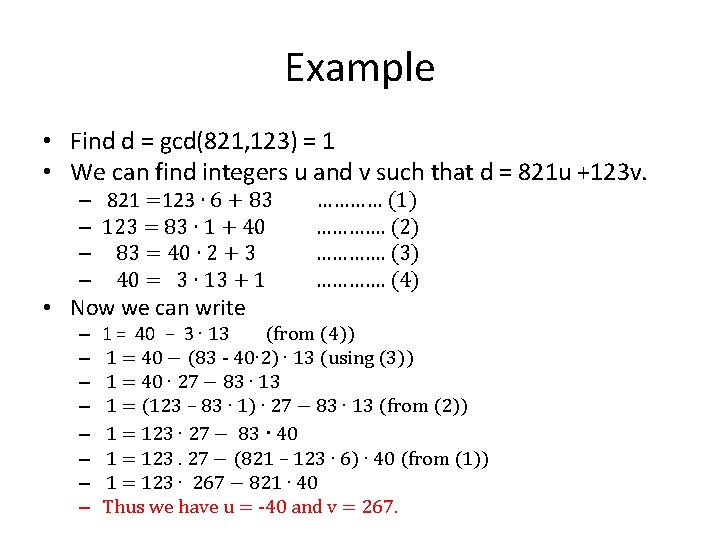
Example • Find d = gcd(821, 123) = 1 • We can find integers u and v such that d = 821 u +123 v. – 821 =123 ∙ 6 + 83 – 123 = 83 ∙ 1 + 40 – 83 = 40 ∙ 2 + 3 – 40 = 3 ∙ 13 + 1 • Now we can write – – – – ………… (1) …………. (2) …………. (3) …………. (4) 1 = 40 − 3 ∙ 13 (from (4)) 1 = 40 − (83 - 40∙ 2) ∙ 13 (using (3)) 1 = 40 ∙ 27 − 83 ∙ 13 1 = (123 – 83 ∙ 1) ∙ 27 − 83 ∙ 13 (from (2)) 1 = 123 ∙ 27 − 83 ∙ 40 1 = 123. 27 − (821 – 123 ∙ 6) ∙ 40 (from (1)) 1 = 123 ∙ 267 − 821 ∙ 40 Thus we have u = -40 and v = 267.
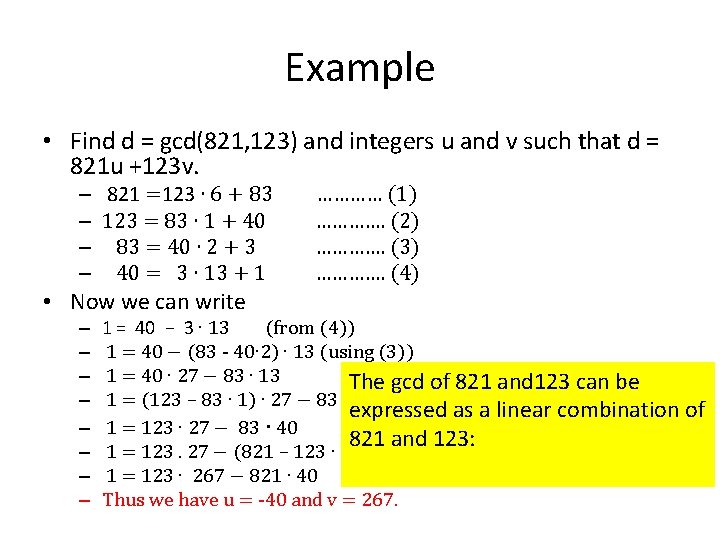
Example • Find d = gcd(821, 123) and integers u and v such that d = 821 u +123 v. – 821 =123 ∙ 6 + 83 – 123 = 83 ∙ 1 + 40 – 83 = 40 ∙ 2 + 3 – 40 = 3 ∙ 13 + 1 • Now we can write – – – – ………… (1) …………. (2) …………. (3) …………. (4) 1 = 40 − 3 ∙ 13 (from (4)) 1 = 40 − (83 - 40∙ 2) ∙ 13 (using (3)) 1 = 40 ∙ 27 − 83 ∙ 13 The gcd of 821 and 123 can be 1 = (123 – 83 ∙ 1) ∙ 27 − 83 ∙ 13 (from (2)) expressed as a linear combination of 1 = 123 ∙ 27 − 83 ∙ 40 821 and 123: 1 = 123. 27 − (821 – 123 ∙ 6) ∙ 40 (from (1)) 1 = 123 ∙ 267 − 821 ∙ 40 Thus we have u = -40 and v = 267.
Example • Griffin has two unmarked containers. One container holds 17 liters and the other holds 55 liters. Explain how Griffin can use his two containers to measure exactly one liter.
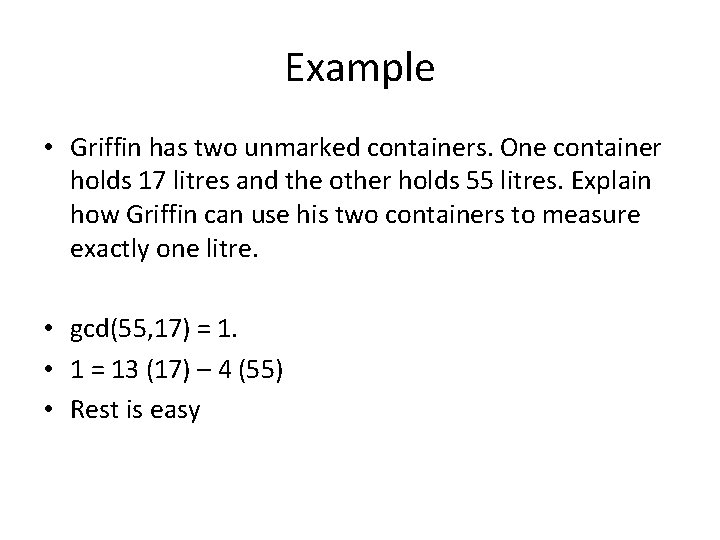
Example • Griffin has two unmarked containers. One container holds 17 litres and the other holds 55 litres. Explain how Griffin can use his two containers to measure exactly one litre. • gcd(55, 17) = 1. • 1 = 13 (17) – 4 (55) • Rest is easy
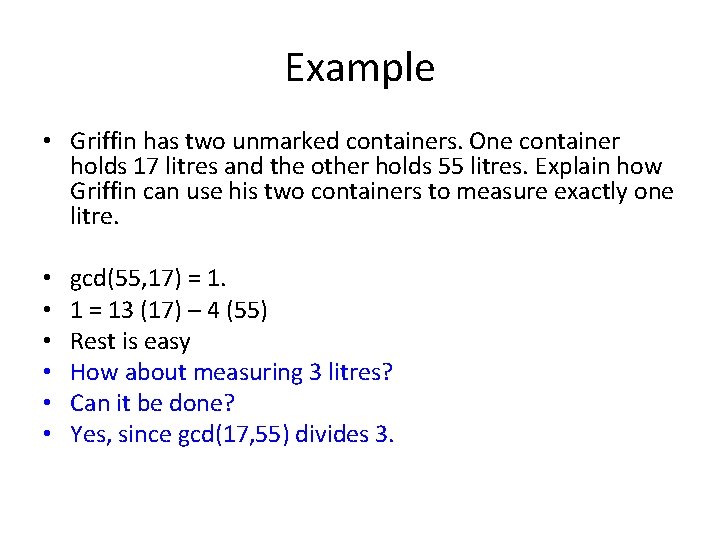
Example • Griffin has two unmarked containers. One container holds 17 litres and the other holds 55 litres. Explain how Griffin can use his two containers to measure exactly one litre. • • • gcd(55, 17) = 1. 1 = 13 (17) – 4 (55) Rest is easy How about measuring 3 litres? Can it be done? Yes, since gcd(17, 55) divides 3.
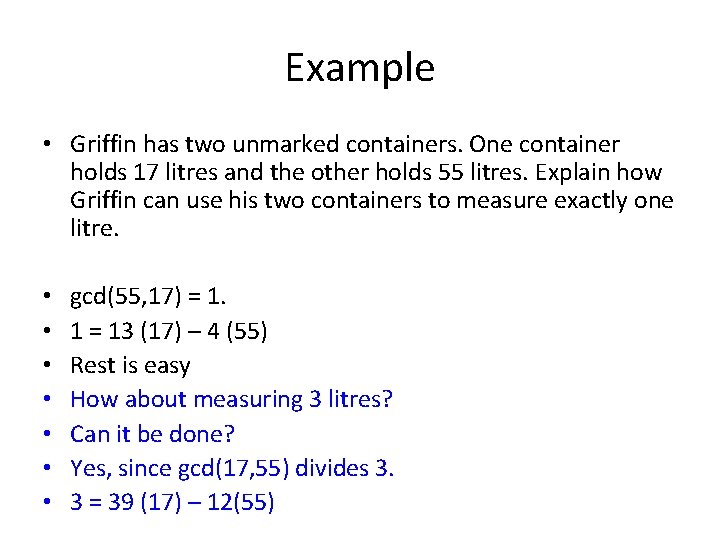
Example • Griffin has two unmarked containers. One container holds 17 litres and the other holds 55 litres. Explain how Griffin can use his two containers to measure exactly one litre. • • gcd(55, 17) = 1. 1 = 13 (17) – 4 (55) Rest is easy How about measuring 3 litres? Can it be done? Yes, since gcd(17, 55) divides 3. 3 = 39 (17) – 12(55)
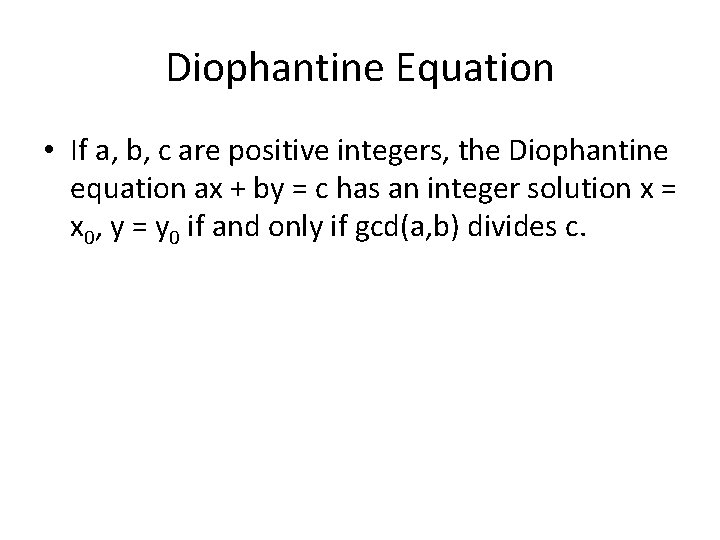
Diophantine Equation • If a, b, c are positive integers, the Diophantine equation ax + by = c has an integer solution x = x 0, y = y 0 if and only if gcd(a, b) divides c.
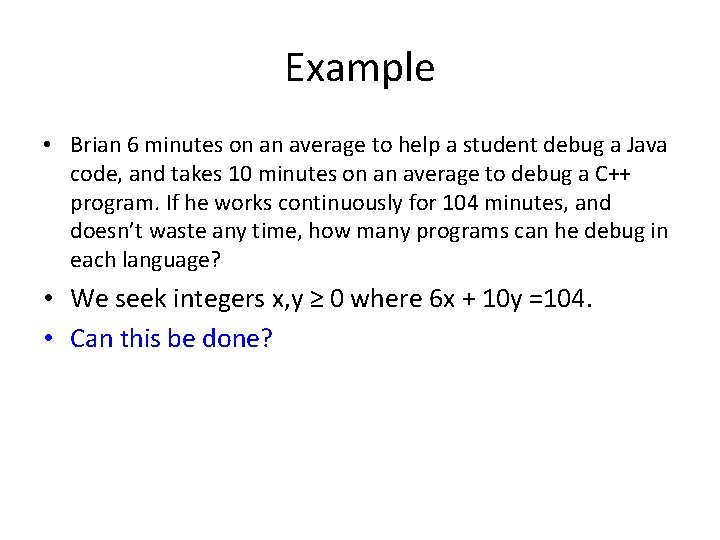
Example • Brian 6 minutes on an average to help a student debug a Java code, and takes 10 minutes on an average to debug a C++ program. If he works continuously for 104 minutes, and doesn’t waste any time, how many programs can he debug in each language? • We seek integers x, y ≥ 0 where 6 x + 10 y =104. • Can this be done?
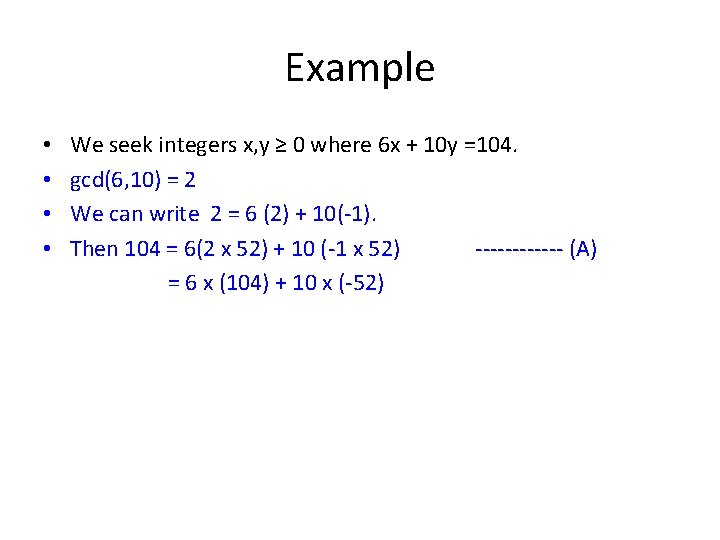
Example • We seek integers x, y ≥ 0 where 6 x + 10 y =104. • gcd(6, 10) = 2 • We can write 2 = 6 (2) + 10(-1). • Then 104 = 6(2 x 52) + 10 (-1 x 52) ------ (A) = 6 x (104) + 10 x (-52)
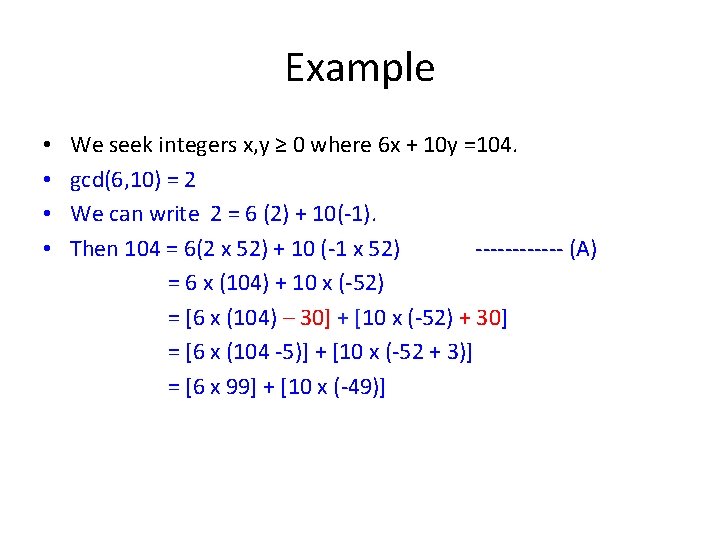
Example • We seek integers x, y ≥ 0 where 6 x + 10 y =104. • gcd(6, 10) = 2 • We can write 2 = 6 (2) + 10(-1). • Then 104 = 6(2 x 52) + 10 (-1 x 52) ------ (A) = 6 x (104) + 10 x (-52) = [6 x (104) – 30] + [10 x (-52) + 30] = [6 x (104 -5)] + [10 x (-52 + 3)] = [6 x 99] + [10 x (-49)]
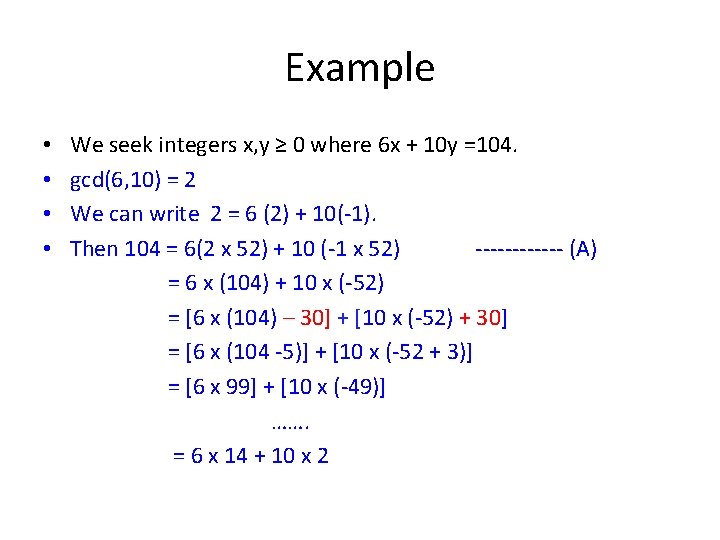
Example • We seek integers x, y ≥ 0 where 6 x + 10 y =104. • gcd(6, 10) = 2 • We can write 2 = 6 (2) + 10(-1). • Then 104 = 6(2 x 52) + 10 (-1 x 52) ------ (A) = 6 x (104) + 10 x (-52) = [6 x (104) – 30] + [10 x (-52) + 30] = [6 x (104 -5)] + [10 x (-52 + 3)] = [6 x 99] + [10 x (-49)] ……. = 6 x 14 + 10 x 2
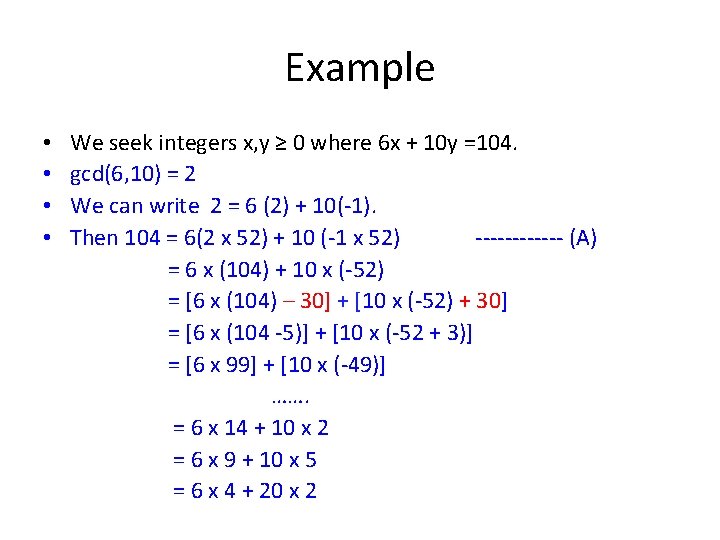
Example • We seek integers x, y ≥ 0 where 6 x + 10 y =104. • gcd(6, 10) = 2 • We can write 2 = 6 (2) + 10(-1). • Then 104 = 6(2 x 52) + 10 (-1 x 52) ------ (A) = 6 x (104) + 10 x (-52) = [6 x (104) – 30] + [10 x (-52) + 30] = [6 x (104 -5)] + [10 x (-52 + 3)] = [6 x 99] + [10 x (-49)] ……. = 6 x 14 + 10 x 2 = 6 x 9 + 10 x 5 = 6 x 4 + 20 x 2
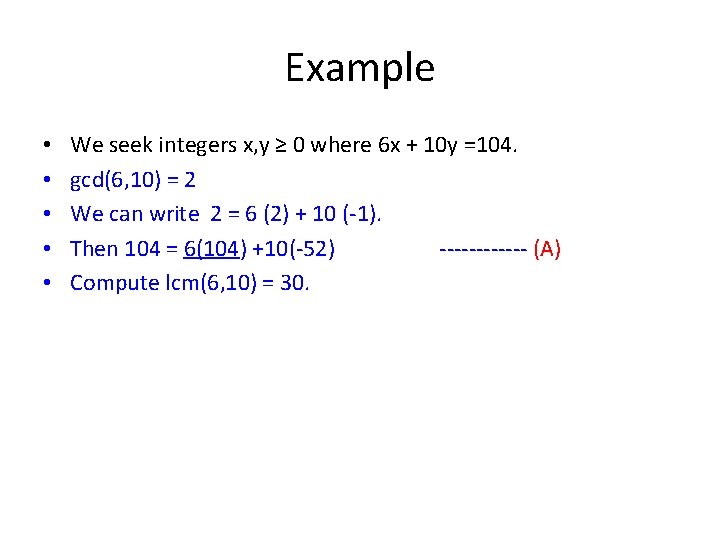
Example • • • We seek integers x, y ≥ 0 where 6 x + 10 y =104. gcd(6, 10) = 2 We can write 2 = 6 (2) + 10 (-1). Then 104 = 6(104) +10(-52) ------ (A) Compute lcm(6, 10) = 30.

Example • • • We seek integers x, y ≥ 0 where 6 x + 10 y =104. gcd(6, 10) = 2 We can write 2 = 6 (2) + 10 (-1). Then 104 = 6(104) +10(-52) ------ (A) Compute lcm(6, 10) = 30. We can write (A) as 104 = 6(104 – 5 k) + 10 (-52 + 3 k) for integer k. --(B)
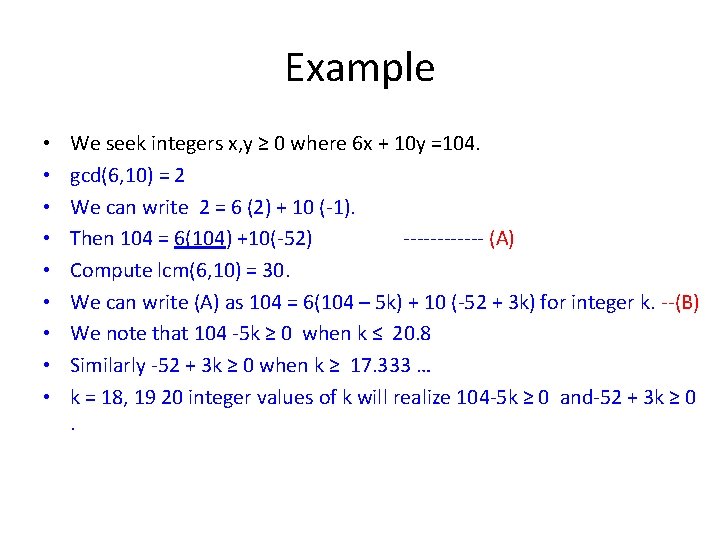
Example • • • We seek integers x, y ≥ 0 where 6 x + 10 y =104. gcd(6, 10) = 2 We can write 2 = 6 (2) + 10 (-1). Then 104 = 6(104) +10(-52) ------ (A) Compute lcm(6, 10) = 30. We can write (A) as 104 = 6(104 – 5 k) + 10 (-52 + 3 k) for integer k. --(B) We note that 104 -5 k ≥ 0 when k ≤ 20. 8 Similarly -52 + 3 k ≥ 0 when k ≥ 17. 333 … k = 18, 19 20 integer values of k will realize 104 -5 k ≥ 0 and-52 + 3 k ≥ 0 .

Example We seek integers x, y ≥ 0 where 6 x + 10 y =104. gcd(6, 10) = 2 We can write 2 = 2 (6) – 2(5) = 6 (2) + 10 (-1). Then 104 = 6(104) +10(-52) ------ (A) Compute lcm(6, 10) = 30. We can write (A) as 104 = 6(104 – 5 k) + 10 (-52 + 3 k) for integer k. --(B) We note that 104 -5 k ≥ 0 when k ≤ 20. 8 Similarly -52 + 3 k ≥ 0 when k ≥ 17. 333 … k = 18, 19 20 integer values of k will realize 104 -5 k ≥ 0 and-52 + 3 k ≥ 0 . • Plugging in k =18, 19 and 20 in (B) we get • • • – 104 = 6. 14 + 10. 2 (k=18) – 104 = 6. 9 + 10. 5 (k=19) – 104 = 6. 4 + 10. 8 (k=20)
- Slides: 69