
Integer Programming Operational Research Level 4 Prepared by
Integer Programming Operational Research -Level 4 Prepared by T. M. J. A. Cooray Department of Mathematics Integer programming, MA-4020 Operational Research 1
Introduction Ø In LP problems , decision variables are non negative values, i. e. they are restricted to be zero or more than zero. Ø It demonstrates one of the properties of LP namely, continuity, which means that fractional values of the decision variables are possible in the solution of a LP model. Ø For some problems like: product mix , balanced diet (nutrition) etc. the assumption of continuity may be valid. Integer programming, MA-4020 Operational Research 2
Ø Ctd. . Ø Further , in some problems such as , production of different fertilizers (in kilograms or tonnages ), usage of different amounts of food items (in grams) etc. may satisfy the continuity assumption. Ø But some items cannot be produced in fractions. Say ship, cranes, tables, chairs etc. Integer programming, MA-4020 Operational Research 3
Ø Ctd. . Ø If we round off the production volume of such products: Ø Corresponding solution may different from the optimal solution. be Ø There would be a significant difference in the total profit, if the profit per unit of each of the products is very high. Integer programming, MA-4020 Operational Research 4
Ø There are problems where it is also necessary to assign people , machines, vehicles to activities in integer quantities. Ø That means these variables should take integer values. Ø Hence there is a need for Integer programming methods. Ø The mathematical model for IP or more precisely ILP is the LP model with one additional restriction/constraint: “variables must have integer values”. Integer programming, MA-4020 Operational Research 5
Ø Ctd. . Ø If only some of the variables of the problem should be integers then they are called “Mixed IP problems” Ø If all the variables should take integer values then we have “Pure IP problems”. Ø There is another area of application, namely problems involving a number of interrelated “yes no decisions”. In such decisions, the only two possible choices are yes or no. Integer programming, MA-4020 Operational Research 6
Ø For example, should we undertake a particular project? Should we make a particular fixed investment? Should we locate a facility in a particular site etc. Ø with just two choices , we can represent such decisions by decision variables that are restricted to just two values. say 0 or 1. Ø Thus xj =1 if decision j is yes =0 if decision j is no Integer programming, MA-4020 Operational Research 7
Ø such variables are binary variables or 0 - 1 variables Ø IP problems that contain only binary variables are called binary integer programming problems. (BIP problems) Integer programming, MA-4020 Operational Research 8
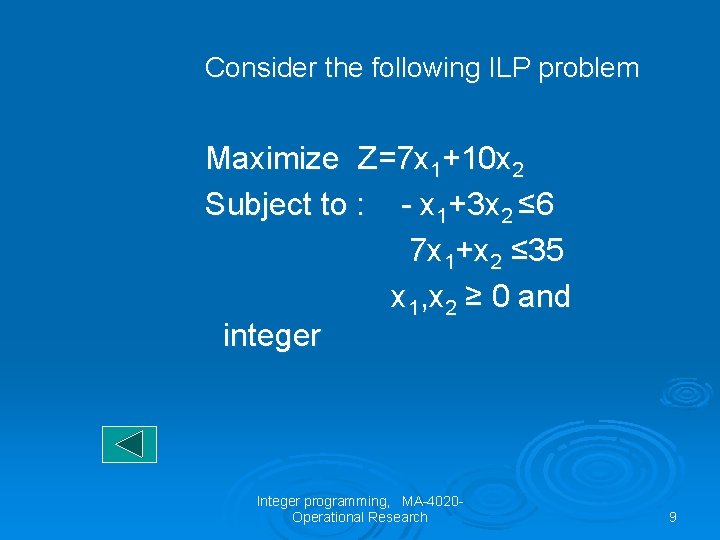
Consider the following ILP problem Maximize Z=7 x 1+10 x 2 Subject to : - x 1+3 x 2 ≤ 6 7 x 1+x 2 ≤ 35 x 1, x 2 ≥ 0 and integer Integer programming, MA-4020 Operational Research 9
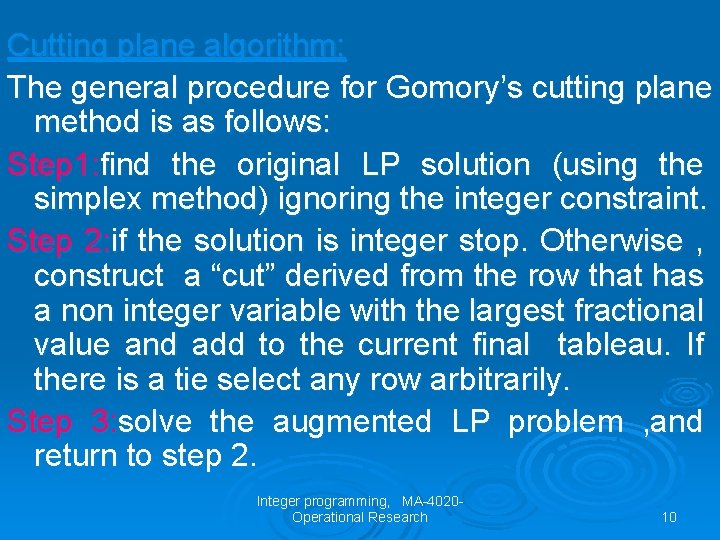
Cutting plane algorithm: The general procedure for Gomory’s cutting plane method is as follows: Step 1: find the original LP solution (using the simplex method) ignoring the integer constraint. Step 2: if the solution is integer stop. Otherwise , construct a “cut” derived from the row that has a non integer variable with the largest fractional value and add to the current final tableau. If there is a tie select any row arbitrarily. Step 3: solve the augmented LP problem , and return to step 2. Integer programming, MA-4020 Operational Research 10
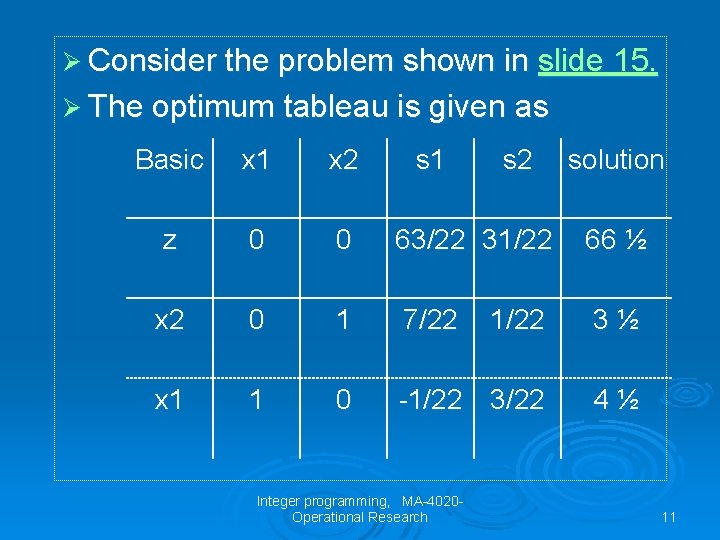
Ø Consider the problem shown in slide 15. Ø The optimum tableau is given as Basic x 1 x 2 s 1 z 0 0 63/22 31/22 66 ½ x 2 0 1 7/22 1/22 3½ x 1 1 0 -1/22 3/22 4½ Integer programming, MA-4020 Operational Research s 2 solution 11
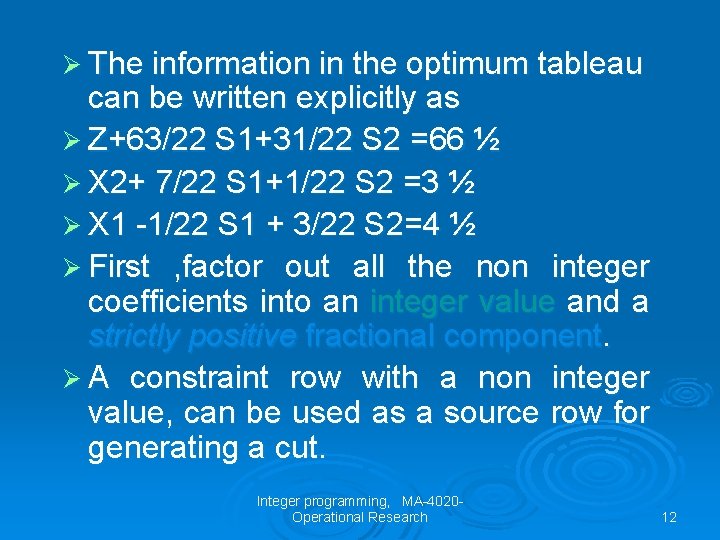
Ø The information in the optimum tableau can be written explicitly as Ø Z+63/22 S 1+31/22 S 2 =66 ½ Ø X 2+ 7/22 S 1+1/22 S 2 =3 ½ Ø X 1 -1/22 S 1 + 3/22 S 2=4 ½ Ø First , factor out all the non integer coefficients into an integer value and a strictly positive fractional component. Ø A constraint row with a non integer value, can be used as a source row for generating a cut. Integer programming, MA-4020 Operational Research 12
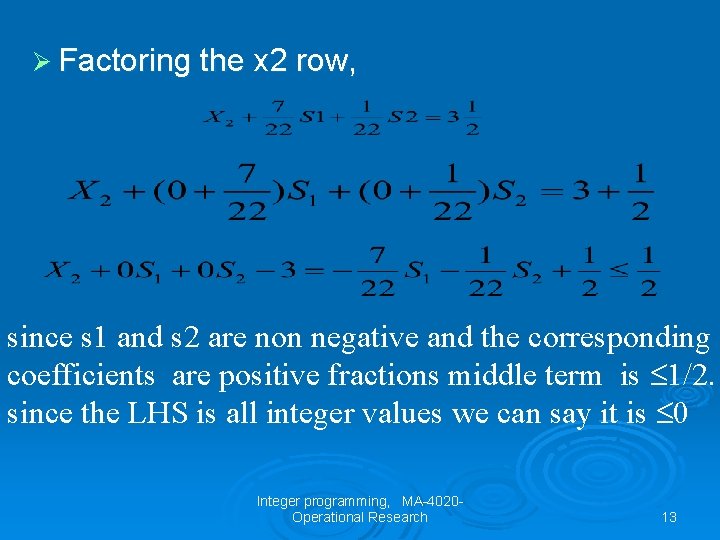
Ø Factoring the x 2 row, since s 1 and s 2 are non negative and the corresponding coefficients are positive fractions middle term is 1/2. since the LHS is all integer values we can say it is 0 Integer programming, MA-4020 Operational Research 13
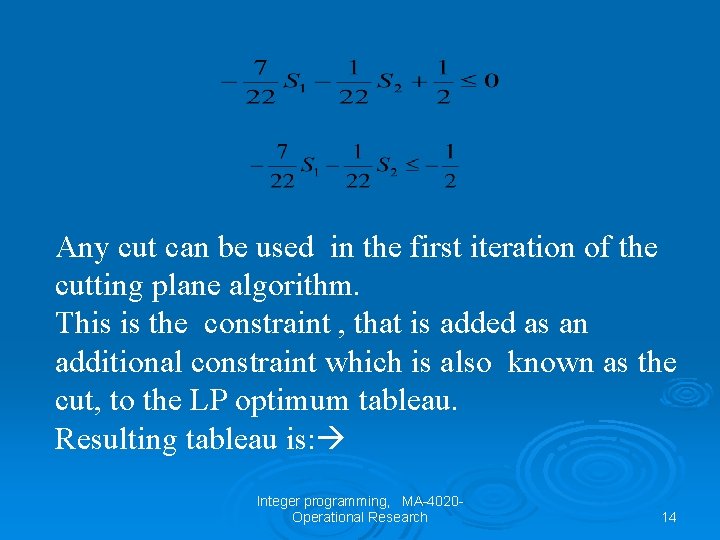
Any cut can be used in the first iteration of the cutting plane algorithm. This is the constraint , that is added as an additional constraint which is also known as the cut, to the LP optimum tableau. Resulting tableau is: Integer programming, MA-4020 Operational Research 14
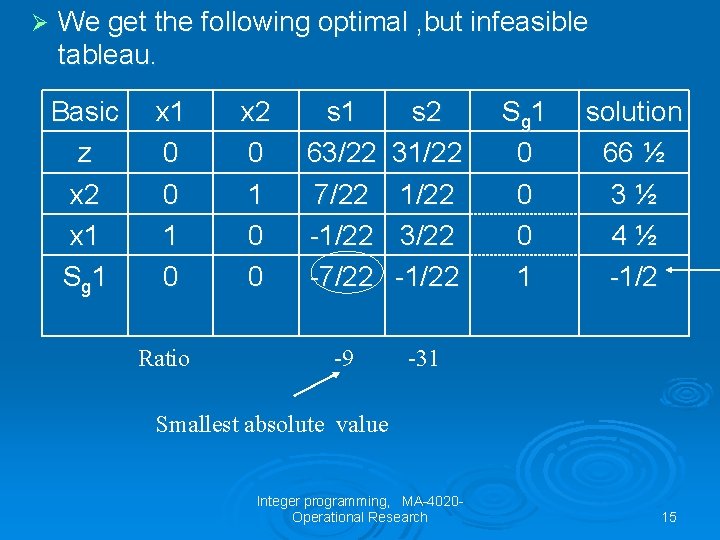
Ø We get the following optimal , but infeasible tableau. Basic z x 2 x 1 S g 1 x 1 0 0 1 0 Ratio x 2 0 1 0 0 s 1 63/22 7/22 -1/22 -7/22 s 2 31/22 3/22 -1/22 -9 -31 S g 1 0 0 0 1 solution 66 ½ 3½ 4½ -1/2 Smallest absolute value Integer programming, MA-4020 Operational Research 15
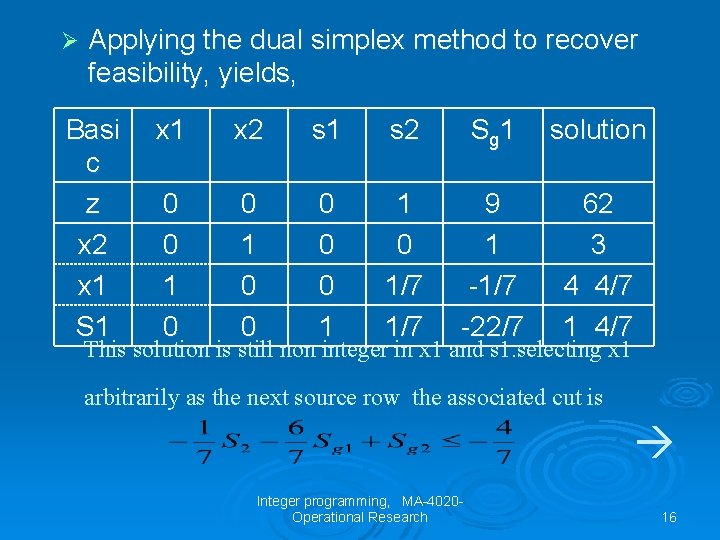
Ø Applying the dual simplex method to recover feasibility, yields, Basi c z x 2 x 1 S 1 x 2 s 1 s 2 S g 1 solution 0 0 1 0 0 0 1 1 0 1/7 9 1 -1/7 -22/7 62 3 4 4/7 1 4/7 This solution is still non integer in x 1 and s 1. selecting x 1 arbitrarily as the next source row the associated cut is Integer programming, MA-4020 Operational Research 16
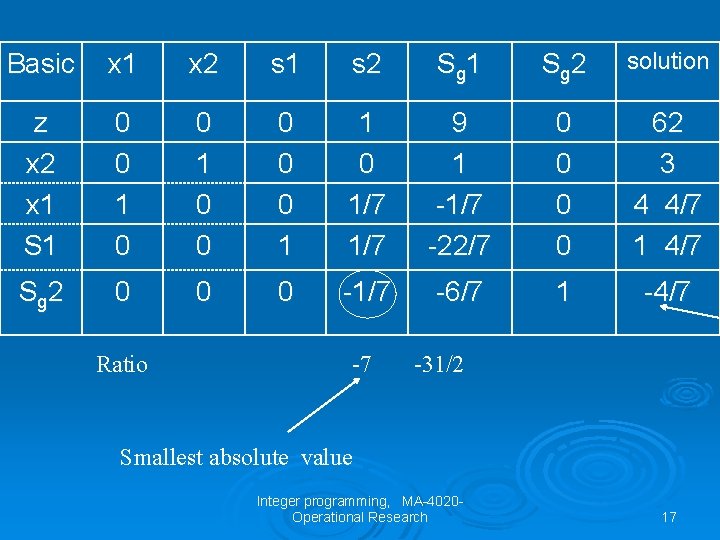
Basic x 1 x 2 s 1 s 2 S g 1 S g 2 solution z x 2 x 1 S 1 0 0 0 1 1 0 1/7 9 1 -1/7 -22/7 0 0 62 3 4 4/7 1 4/7 S g 2 0 0 0 -1/7 -6/7 1 -4/7 Ratio -7 -31/2 Smallest absolute value Integer programming, MA-4020 Operational Research 17
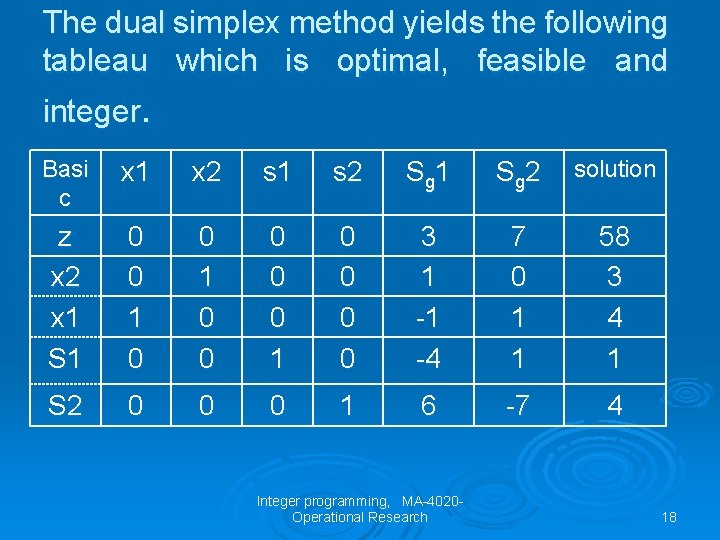
The dual simplex method yields the following tableau which is optimal, feasible and integer. Basi c x 1 x 2 s 1 s 2 S g 1 S g 2 solution z x 2 x 1 S 1 0 0 0 1 0 0 3 1 -1 -4 7 0 1 1 58 3 4 1 S 2 0 0 0 1 6 -7 4 Integer programming, MA-4020 Operational Research 18
Ø It is important to note that the fractional cut assumes that all the variables including the slack and the surplus variables are integer. Ø This means that the cut deals with pure integer problems only. Integer programming, MA-4020 Operational Research 19
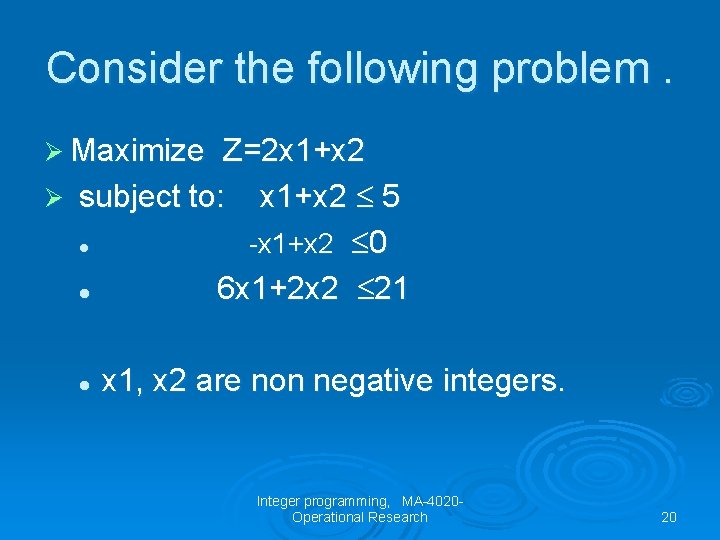
Consider the following problem. Ø Maximize Z=2 x 1+x 2 Ø subject to: x 1+x 2 5 l -x 1+x 2 0 l 6 x 1+2 x 2 21 l x 1, x 2 are non negative integers. Integer programming, MA-4020 Operational Research 20
- Slides: 20