
Integer Programming and Spatial Landscape Planning an example
- Slides: 25
Integer Programming and Spatial Landscape Planning (an example from reserve design) Lecture 15 (6/1/2017)
Spatial Optimization to Aid Reserve Design • Constructing reserve networks with spatial structures that are conducive to the health and integrity of the ecosystem that we wish to preserve
Spatial Attributes • • • Size Connectivity Perimeter-area ratio Proximity Contiguity
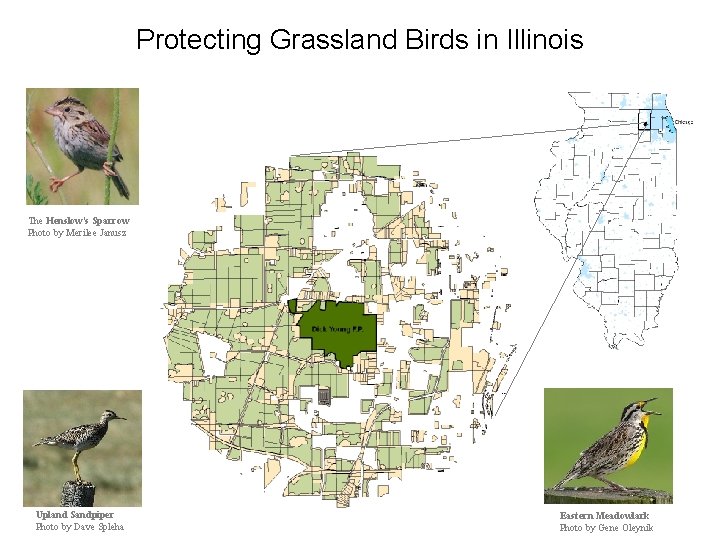
Protecting Grassland Birds in Illinois The Henslow's Sparrow Photo by Merilee Janusz Upland Sandpiper Photo by Dave Spleha http: //www. kaneforest. com/ Eastern Meadowlark Photo by Gene Oleynik
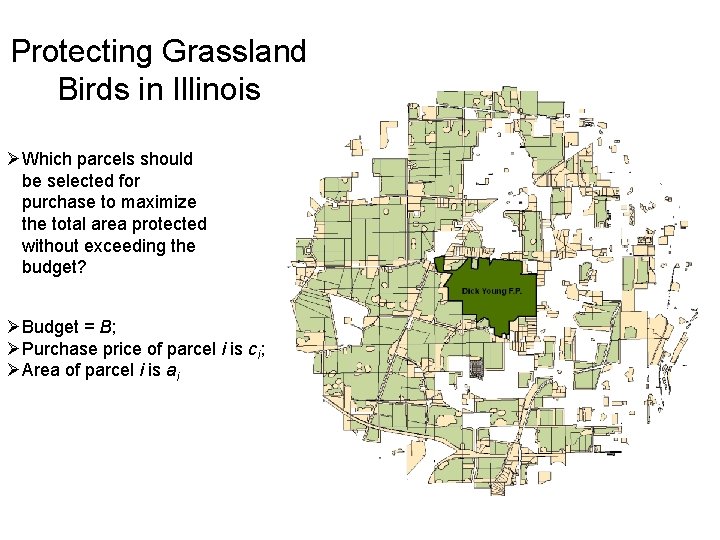
Protecting Grassland Birds in Illinois ØWhich parcels should be selected for purchase to maximize the total area protected without exceeding the budget? ØBudget = B; ØPurchase price of parcel i is ci; ØArea of parcel i is ai
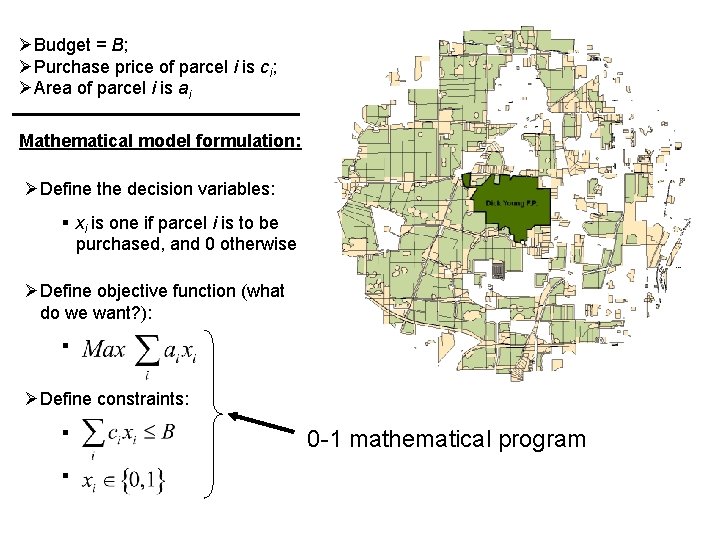
ØBudget = B; ØPurchase price of parcel i is ci; ØArea of parcel i is ai Mathematical model formulation: ØDefine the decision variables: § xi is one if parcel i is to be purchased, and 0 otherwise ØDefine objective function (what do we want? ): § ØDefine constraints: §A § 0 -1 mathematical program
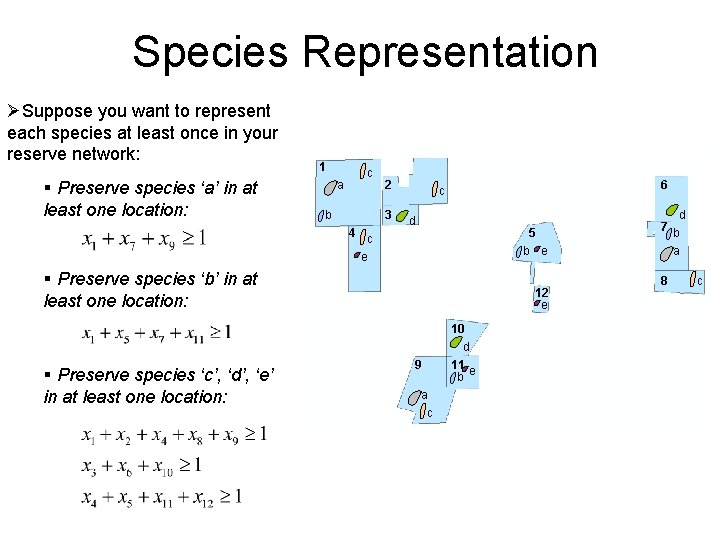
Species Representation ØSuppose you want to represent each species at least once in your reserve network: § Preserve species ‘a’ in at least one location: 1 a c b 2 3 4 c e 6 c d 5 b e § Preserve species ‘b’ in at least one location: § Preserve species ‘c’, ‘d’, ‘e’ in at least one location: 12 e 9 a c 10 d 11 e b d 7 b a 8 c
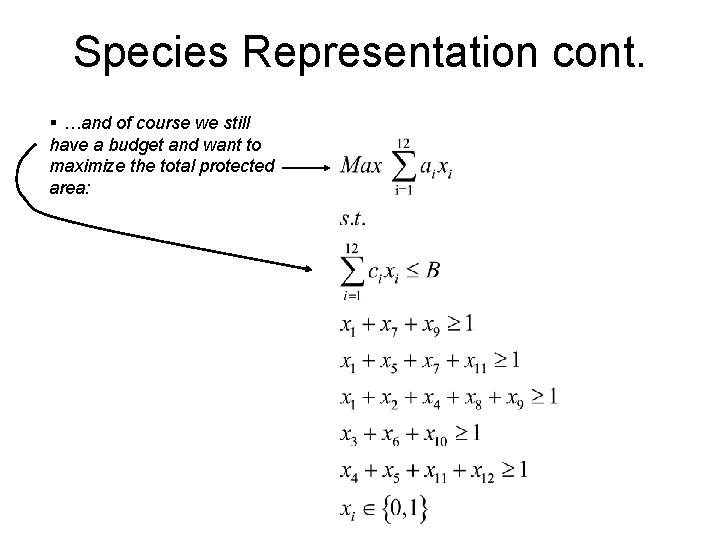
Species Representation cont. § …and of course we still have a budget and want to maximize the total protected area:
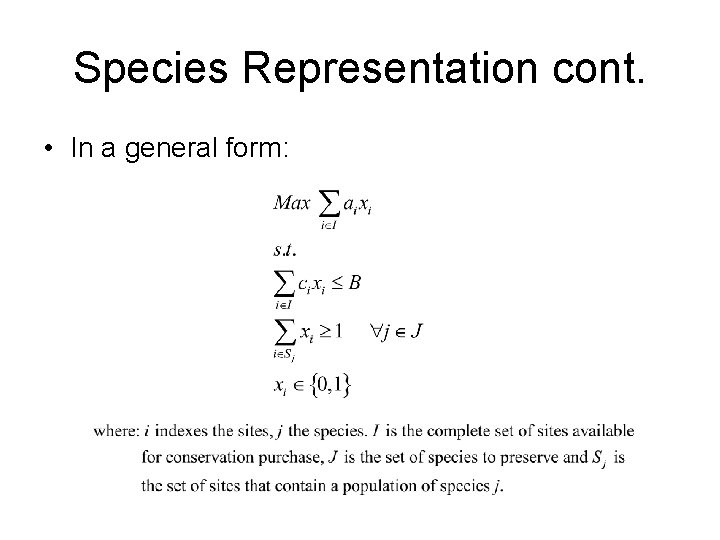
Species Representation cont. • In a general form:
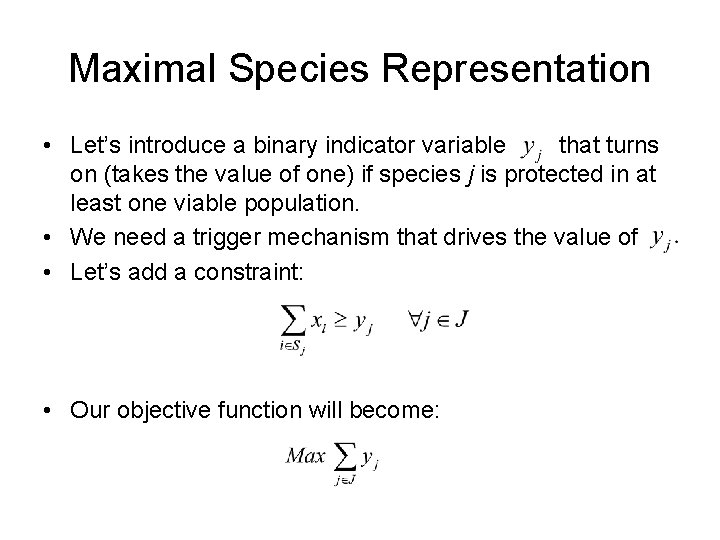
Maximal Species Representation • Let’s introduce a binary indicator variable that turns on (takes the value of one) if species j is protected in at least one viable population. • We need a trigger mechanism that drives the value of • Let’s add a constraint: • Our objective function will become:
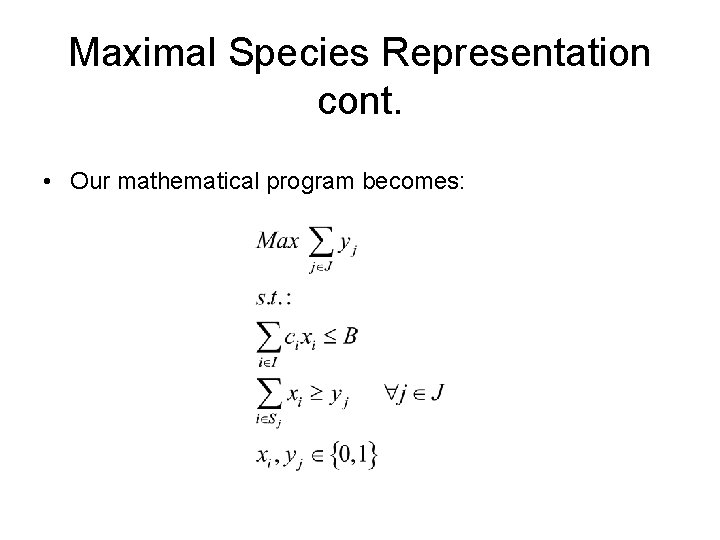
Maximal Species Representation cont. • Our mathematical program becomes:
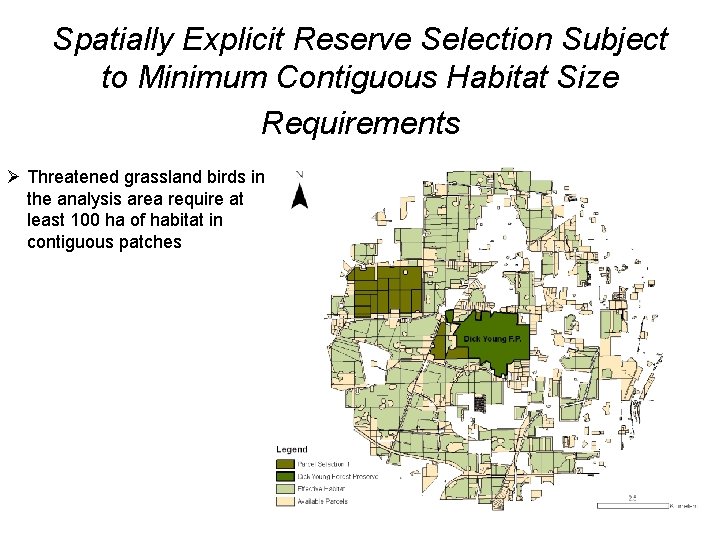
Spatially Explicit Reserve Selection Subject to Minimum Contiguous Habitat Size Requirements Ø Threatened grassland birds in the analysis area require at least 100 ha of habitat in contiguous patches
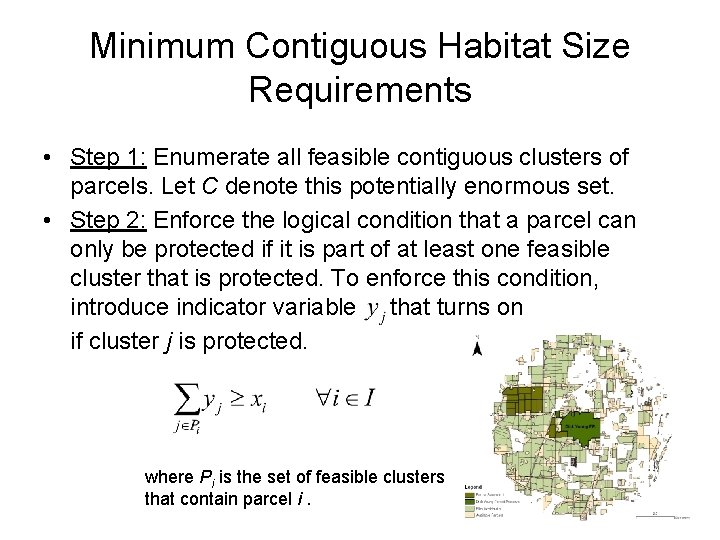
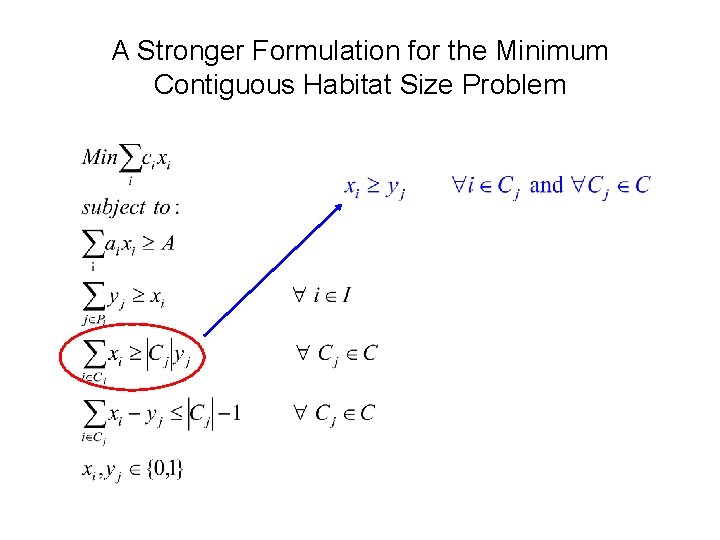
Minimum Contiguous Habitat Size Requirements • Step 1: Enumerate all feasible contiguous clusters of parcels. Let C denote this potentially enormous set. • Step 2: Enforce the logical condition that a parcel can only be protected if it is part of at least one feasible cluster that is protected. To enforce this condition, introduce indicator variable that turns on if cluster j is protected. where Pi is the set of feasible clusters that contain parcel i.
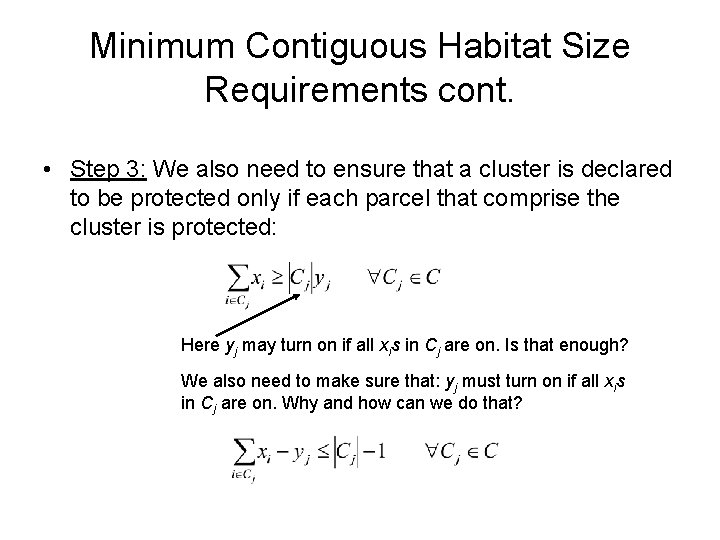
Minimum Contiguous Habitat Size Requirements cont. • Step 3: We also need to ensure that a cluster is declared to be protected only if each parcel that comprise the cluster is protected: Here yj may turn on if all xis in Cj are on. Is that enough? We also need to make sure that: yj must turn on if all xis in Cj are on. Why and how can we do that?
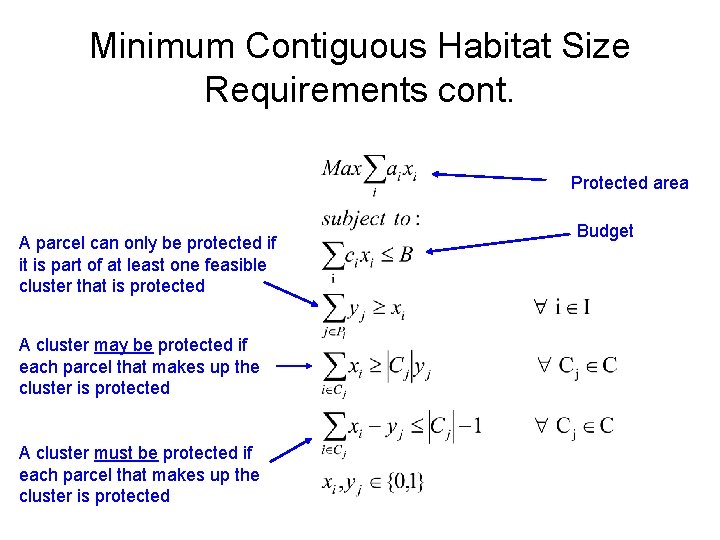
Minimum Contiguous Habitat Size Requirements cont. Protected area A parcel can only be protected if it is part of at least one feasible cluster that is protected A cluster may be protected if each parcel that makes up the cluster is protected A cluster must be protected if each parcel that makes up the cluster is protected Budget
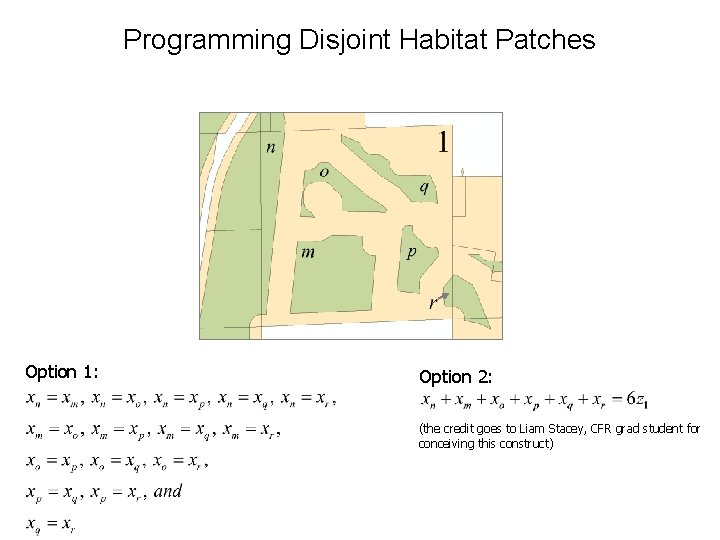
Programming Disjoint Habitat Patches Option 1: Option 2: (the credit goes to Liam Stacey, CFR grad student for conceiving this construct)
A Stronger Formulation for the Minimum Contiguous Habitat Size Problem
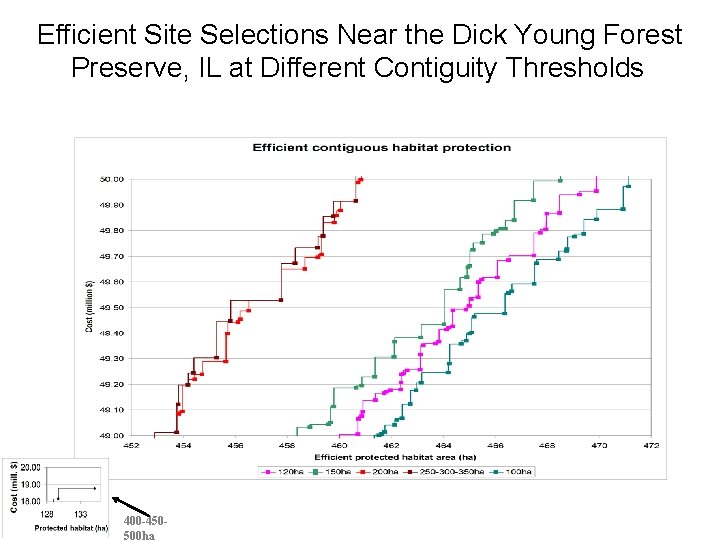
Efficient Site Selections Near the Dick Young Forest Preserve, IL at Different Contiguity Thresholds 400 -450500 ha
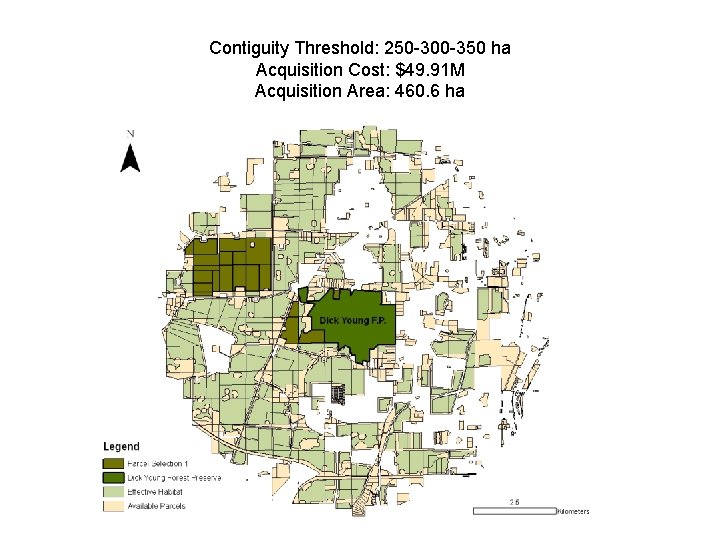
Parcel Selection 1 Contiguity Threshold: 250 -300 -350 ha Acquisition Cost: $49. 91 M Acquisition Area: 460. 6 ha
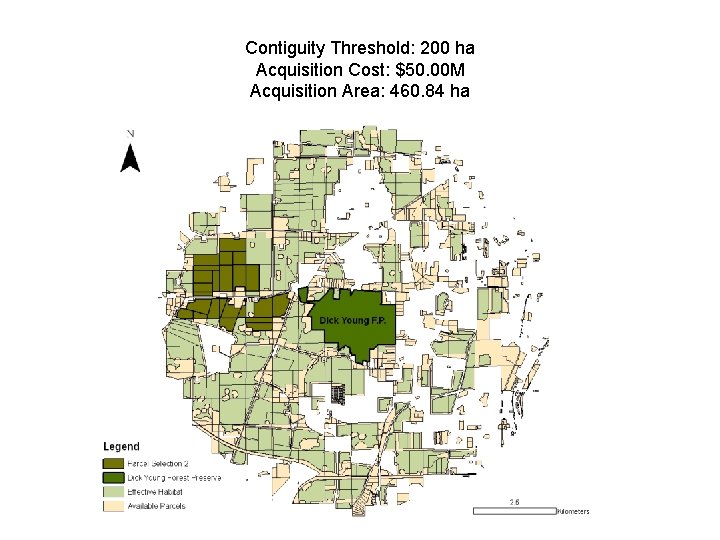
Parcel Selection 2 Contiguity Threshold: 200 ha Acquisition Cost: $50. 00 M Acquisition Area: 460. 84 ha
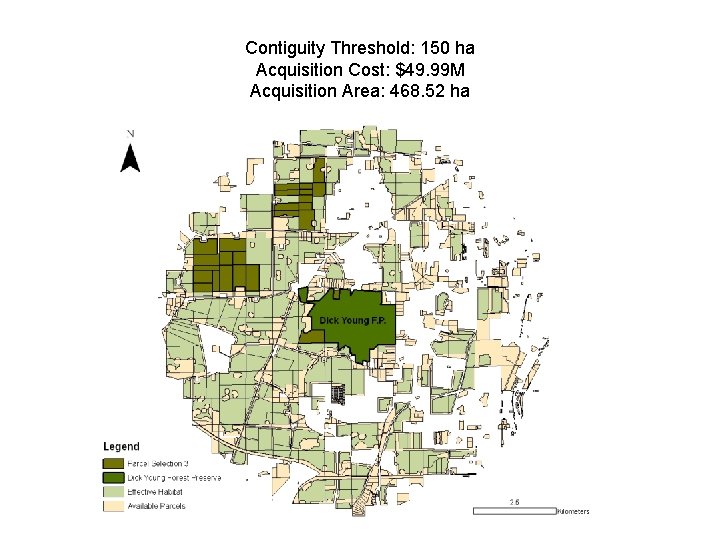
Parcel Selection 3 Contiguity Threshold: 150 ha Acquisition Cost: $49. 99 M Acquisition Area: 468. 52 ha
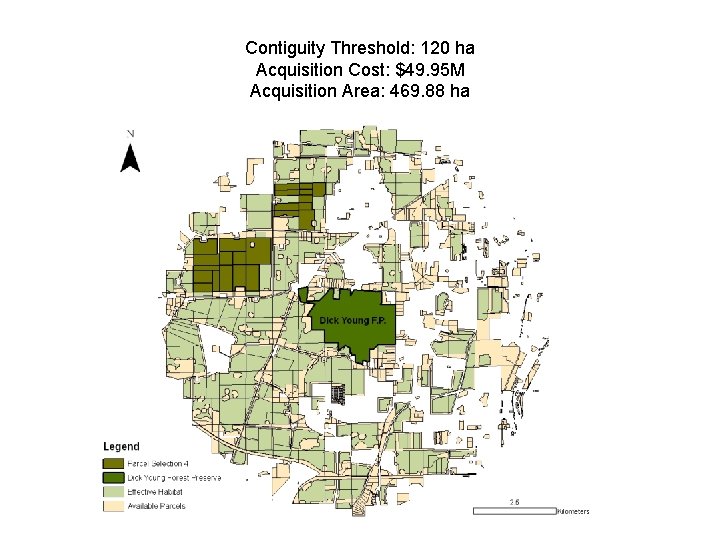
Parcel Selection 4 Contiguity Threshold: 120 ha Acquisition Cost: $49. 95 M Acquisition Area: 469. 88 ha
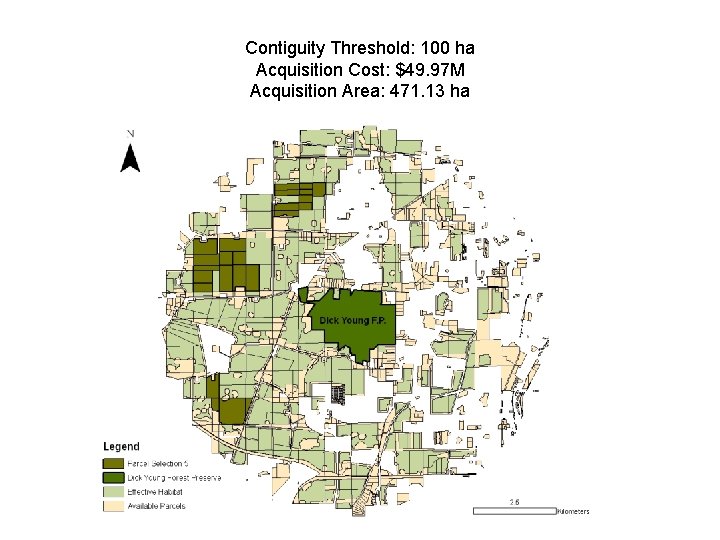
Parcel Selection 5 Contiguity Threshold: 100 ha Acquisition Cost: $49. 97 M Acquisition Area: 471. 13 ha
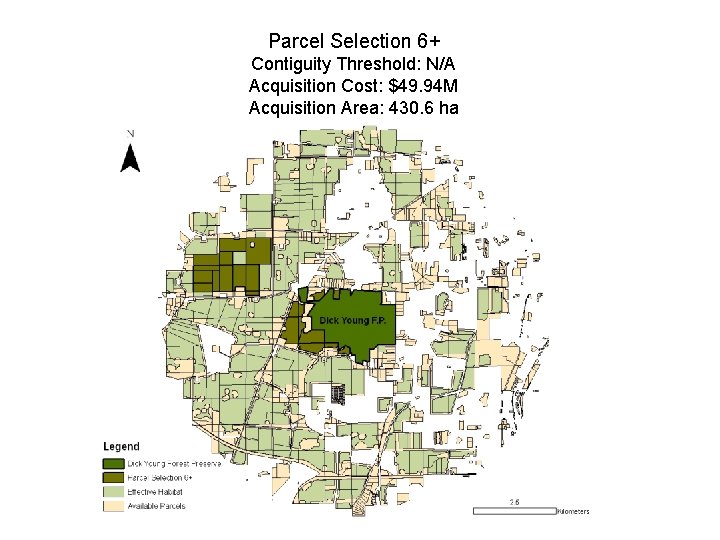
Parcel Selection 6+ Contiguity Threshold: 400 -450 -500 ha Contiguity Threshold: N/A Acquisition Cost: $18. 8 M Acquisition Cost: Area: $49. 94 M 135. 05 ha Acquisition Area: 430. 6 ha
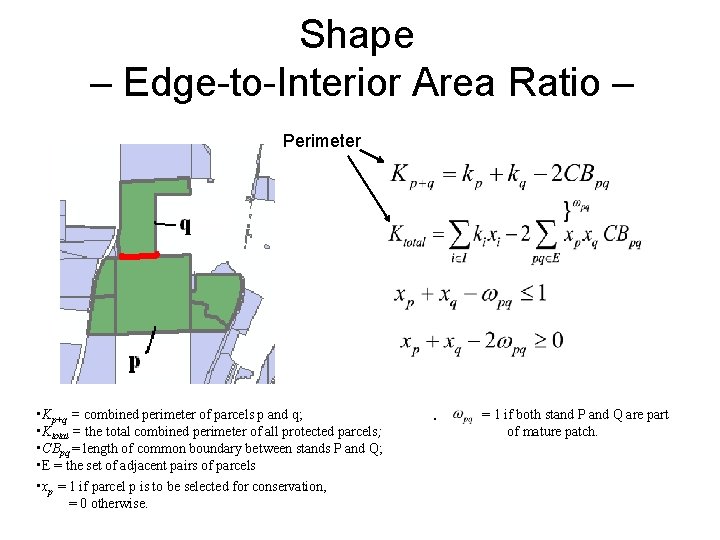
Shape – Edge-to-Interior Area Ratio – Perimeter • Kp+q = combined perimeter of parcels p and q; • Ktotal = the total combined perimeter of all protected parcels; • CBpq = length of common boundary between stands P and Q; • E = the set of adjacent pairs of parcels • xp = 1 if parcel p is to be selected for conservation, = 0 otherwise. • = 1 if both stand P and Q are part of mature patch.