
Integer Multiplication and Division COE 301 Computer Organization
- Slides: 34
Integer Multiplication and Division COE 301 Computer Organization Prof. Muhamed Mudawar College of Computer Sciences and Engineering King Fahd University of Petroleum and Minerals
Presentation Outline v Unsigned Integer Multiplication v Signed Integer Multiplication v Faster Integer Multiplication v Integer Division v Integer Multiplication and Division in MIPS Integer Multiplication and Division COE 301 / ICS 233 Computer Organization – KFUPM © Muhamed Mudawar – slide 2
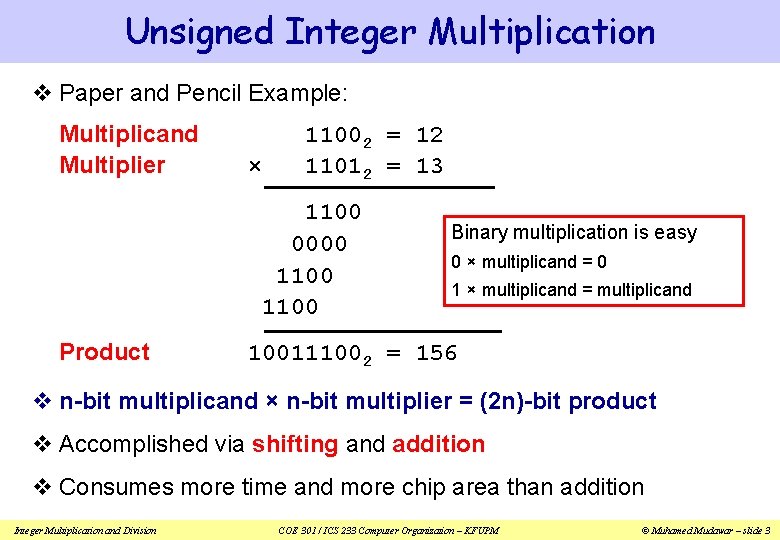
Unsigned Integer Multiplication v Paper and Pencil Example: Multiplicand Multiplier × 11002 = 12 11012 = 13 1100 0000 1100 Product Binary multiplication is easy 0 × multiplicand = 0 1 × multiplicand = multiplicand 100111002 = 156 v n-bit multiplicand × n-bit multiplier = (2 n)-bit product v Accomplished via shifting and addition v Consumes more time and more chip area than addition Integer Multiplication and Division COE 301 / ICS 233 Computer Organization – KFUPM © Muhamed Mudawar – slide 3
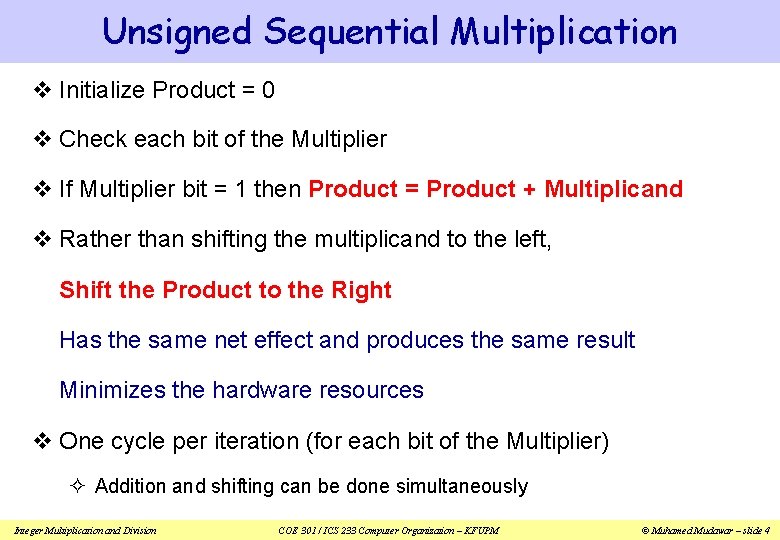
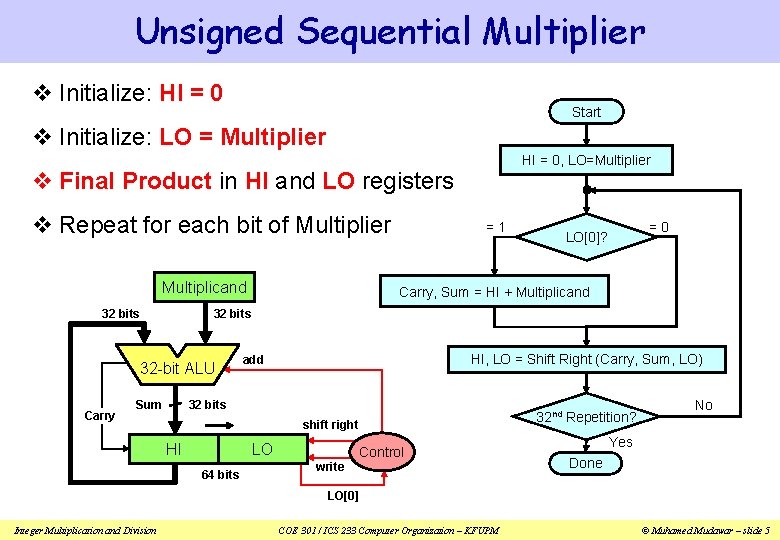
Unsigned Sequential Multiplication v Initialize Product = 0 v Check each bit of the Multiplier v If Multiplier bit = 1 then Product = Product + Multiplicand v Rather than shifting the multiplicand to the left, Shift the Product to the Right Has the same net effect and produces the same result Minimizes the hardware resources v One cycle per iteration (for each bit of the Multiplier) ² Addition and shifting can be done simultaneously Integer Multiplication and Division COE 301 / ICS 233 Computer Organization – KFUPM © Muhamed Mudawar – slide 4
Unsigned Sequential Multiplier v Initialize: HI = 0 Start v Initialize: LO = Multiplier HI = 0, LO=Multiplier v Final Product in HI and LO registers v Repeat for each bit of Multiplier Multiplicand 32 bits =0 LO[0]? Carry, Sum = HI + Multiplicand 32 bits 32 -bit ALU Carry =1 Sum HI, LO = Shift Right (Carry, Sum, LO) add 32 bits 32 nd Repetition? shift right HI LO 64 bits Control write No Yes Done LO[0] Integer Multiplication and Division COE 301 / ICS 233 Computer Organization – KFUPM © Muhamed Mudawar – slide 5
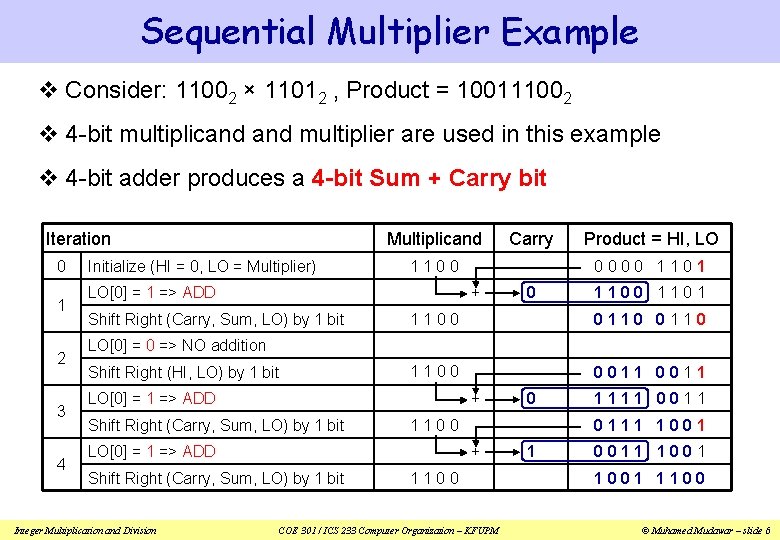
Sequential Multiplier Example v Consider: 11002 × 11012 , Product = 100111002 v 4 -bit multiplicand multiplier are used in this example v 4 -bit adder produces a 4 -bit Sum + Carry bit Iteration 0 1 2 3 4 Multiplicand Initialize (HI = 0, LO = Multiplier) Product = HI, LO 0000 1101 1100 + LO[0] = 1 => ADD Shift Right (Carry, Sum, LO) by 1 bit Carry 0 1101 1100 0110 1100 0011 LO[0] = 0 => NO addition Shift Right (HI, LO) by 1 bit LO[0] = 1 => ADD + Shift Right (Carry, Sum, LO) by 1 bit Integer Multiplication and Division 1111 0011 0111 1001 1100 + LO[0] = 1 => ADD Shift Right (Carry, Sum, LO) by 1 bit 0 1100 COE 301 / ICS 233 Computer Organization – KFUPM 1 0011 1001 1100 © Muhamed Mudawar – slide 6
Next. . . v Unsigned Integer Multiplication v Signed Integer Multiplication v Faster Integer Multiplication v Integer Division v Integer Multiplication and Division in MIPS Integer Multiplication and Division COE 301 / ICS 233 Computer Organization – KFUPM © Muhamed Mudawar – slide 7
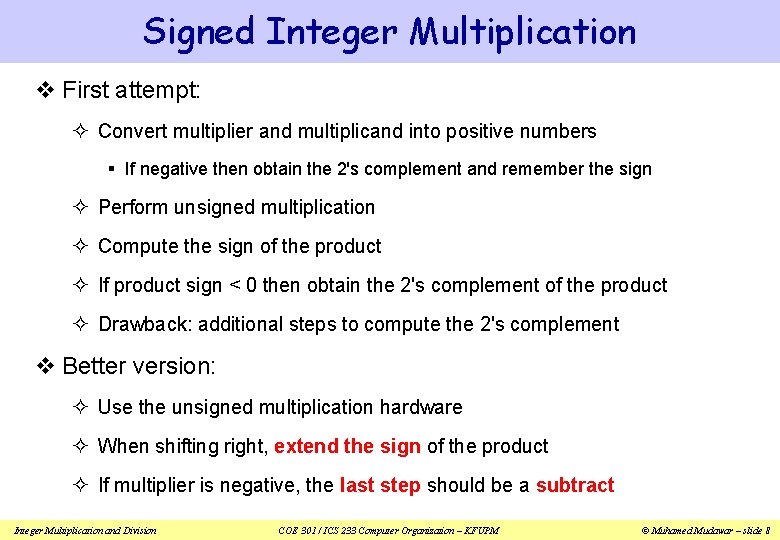
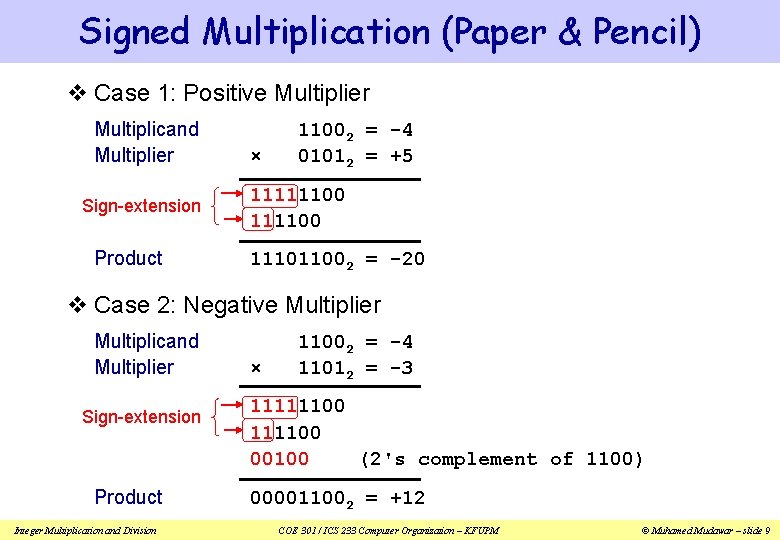
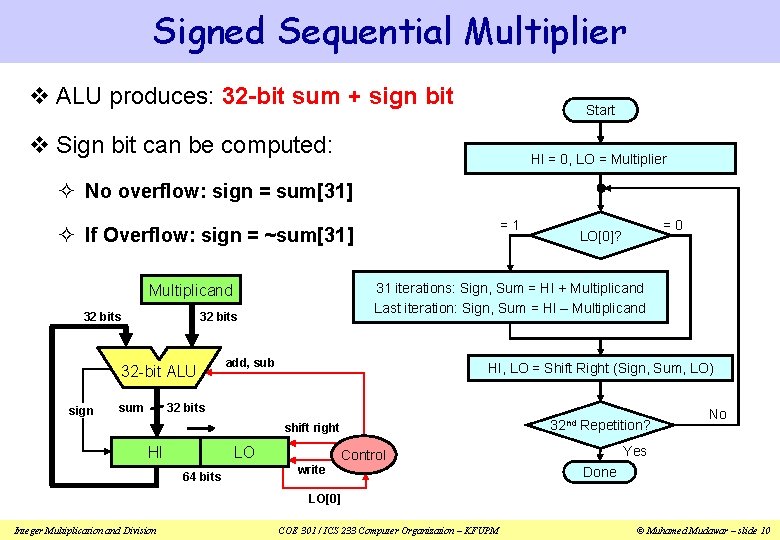
Signed Integer Multiplication v First attempt: ² Convert multiplier and multiplicand into positive numbers § If negative then obtain the 2's complement and remember the sign ² Perform unsigned multiplication ² Compute the sign of the product ² If product sign < 0 then obtain the 2's complement of the product ² Drawback: additional steps to compute the 2's complement v Better version: ² Use the unsigned multiplication hardware ² When shifting right, extend the sign of the product ² If multiplier is negative, the last step should be a subtract Integer Multiplication and Division COE 301 / ICS 233 Computer Organization – KFUPM © Muhamed Mudawar – slide 8
Signed Multiplication (Paper & Pencil) v Case 1: Positive Multiplier Multiplicand Multiplier Sign-extension Product × 11002 = -4 01012 = +5 11111100 111011002 = -20 v Case 2: Negative Multiplier Multiplicand Multiplier Sign-extension Product Integer Multiplication and Division × 11002 = -4 11012 = -3 11111100 00100 (2's complement of 1100) 000011002 = +12 COE 301 / ICS 233 Computer Organization – KFUPM © Muhamed Mudawar – slide 9
Signed Sequential Multiplier v ALU produces: 32 -bit sum + sign bit Start v Sign bit can be computed: HI = 0, LO = Multiplier ² No overflow: sign = sum[31] =1 ² If Overflow: sign = ~sum[31] 31 iterations: Sign, Sum = HI + Multiplicand Last iteration: Sign, Sum = HI – Multiplicand 32 bits 32 -bit ALU sign sum =0 LO[0]? add, sub HI, LO = Shift Right (Sign, Sum, LO) 32 bits 32 nd Repetition? shift right HI LO 64 bits Yes Control write No Done LO[0] Integer Multiplication and Division COE 301 / ICS 233 Computer Organization – KFUPM © Muhamed Mudawar – slide 10
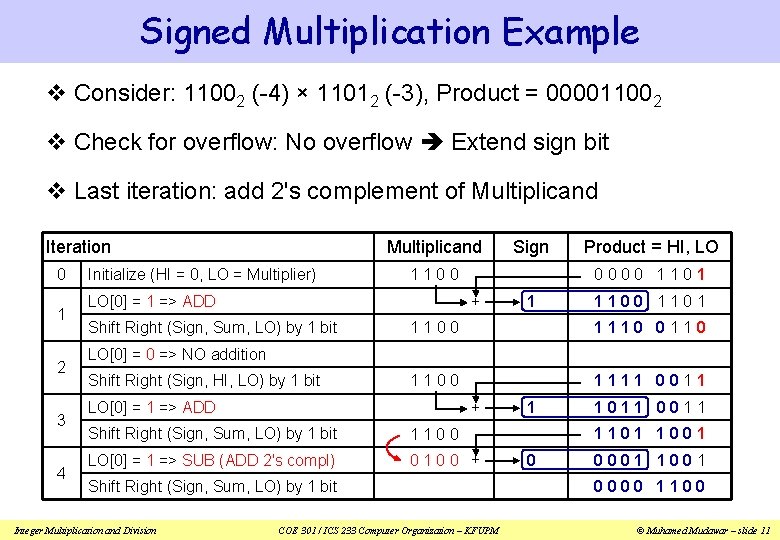
Signed Multiplication Example v Consider: 11002 (-4) × 11012 (-3), Product = 000011002 v Check for overflow: No overflow Extend sign bit v Last iteration: add 2's complement of Multiplicand Iteration 0 1 2 3 4 Multiplicand Initialize (HI = 0, LO = Multiplier) Product = HI, LO 0000 1101 1100 + LO[0] = 1 => ADD Shift Right (Sign, Sum, LO) by 1 bit Sign 1 1100 1101 1100 1110 0110 1100 1111 0011 LO[0] = 0 => NO addition Shift Right (Sign, HI, LO) by 1 bit LO[0] = 1 => ADD + Shift Right (Sign, Sum, LO) by 1 bit 1100 LO[0] = 1 => SUB (ADD 2's compl) 0100 + Shift Right (Sign, Sum, LO) by 1 bit Integer Multiplication and Division COE 301 / ICS 233 Computer Organization – KFUPM 1 1011 0011 1101 1001 0 0001 1001 0000 1100 © Muhamed Mudawar – slide 11
Next. . . v Unsigned Integer Multiplication v Signed Integer Multiplication v Faster Integer Multiplication v Integer Division v Integer Multiplication and Division in MIPS Integer Multiplication and Division COE 301 / ICS 233 Computer Organization – KFUPM © Muhamed Mudawar – slide 12
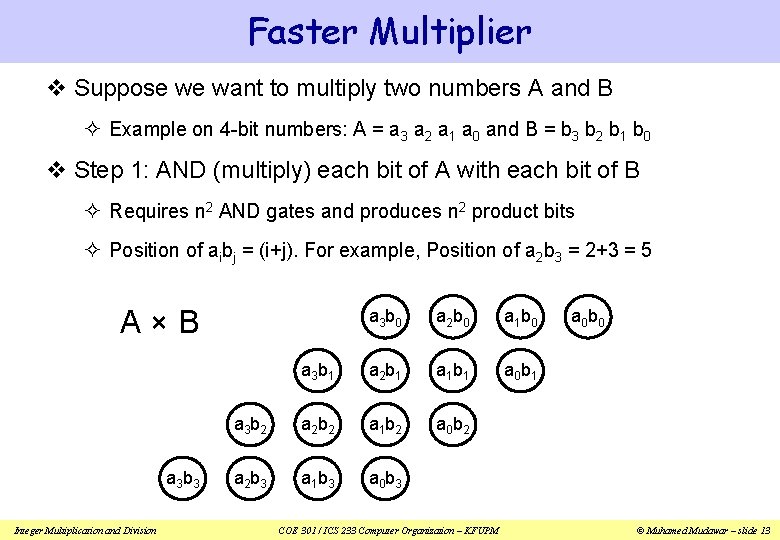
Faster Multiplier v Suppose we want to multiply two numbers A and B ² Example on 4 -bit numbers: A = a 3 a 2 a 1 a 0 and B = b 3 b 2 b 1 b 0 v Step 1: AND (multiply) each bit of A with each bit of B ² Requires n 2 AND gates and produces n 2 product bits ² Position of aibj = (i+j). For example, Position of a 2 b 3 = 2+3 = 5 A×B a 3 b 3 Integer Multiplication and Division a 3 b 0 a 2 b 0 a 1 b 0 a 3 b 1 a 2 b 1 a 1 b 1 a 0 b 1 a 3 b 2 a 2 b 2 a 1 b 2 a 0 b 2 a 2 b 3 a 1 b 3 a 0 b 3 COE 301 / ICS 233 Computer Organization – KFUPM a 0 b 0 © Muhamed Mudawar – slide 13
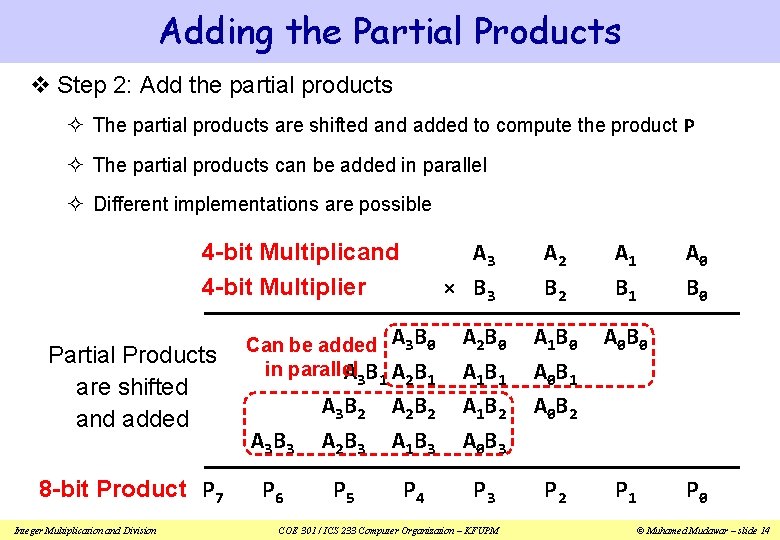
Adding the Partial Products v Step 2: Add the partial products ² The partial products are shifted and added to compute the product P ² The partial products can be added in parallel ² Different implementations are possible A 3 × B 3 4 -bit Multiplicand 4 -bit Multiplier Partial Products are shifted and added 8 -bit Product P 7 Integer Multiplication and Division Can be added A 3 B 0 in parallel A 3 B 1 A 2 B 1 A 3 B 3 A 3 B 2 A 2 B 3 A 2 B 2 A 1 B 3 A 2 B 0 A 1 B 1 A 1 B 2 A 0 B 3 P 6 P 5 P 4 P 3 COE 301 / ICS 233 Computer Organization – KFUPM A 2 B 2 A 1 B 1 A 0 B 0 A 1 B 0 A 0 B 1 A 0 B 2 A 0 B 0 P 2 P 1 P 0 © Muhamed Mudawar – slide 14
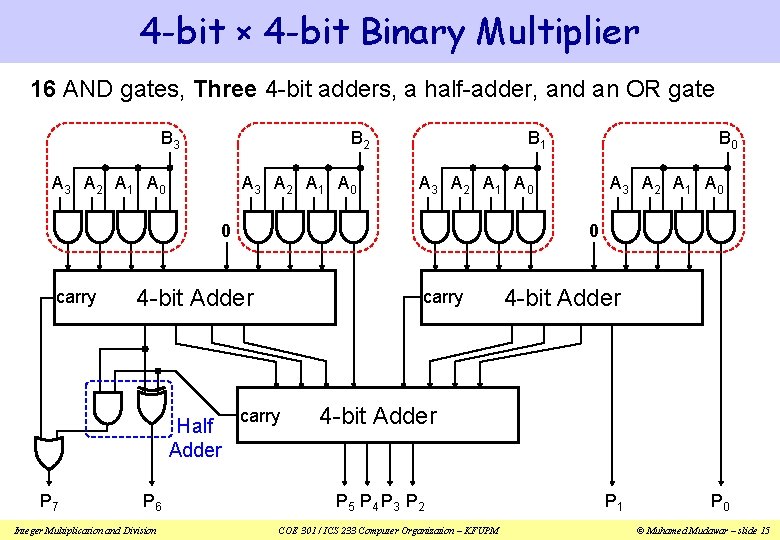
4 -bit × 4 -bit Binary Multiplier 16 AND gates, Three 4 -bit adders, a half-adder, and an OR gate B 3 B 2 A 3 A 2 A 1 A 0 B 1 0 4 -bit Adder Half Adder P 7 P 6 Integer Multiplication and Division A 3 A 2 A 1 A 0 0 carry B 0 carry 4 -bit Adder P 5 P 4 P 3 P 2 COE 301 / ICS 233 Computer Organization – KFUPM P 1 P 0 © Muhamed Mudawar – slide 15
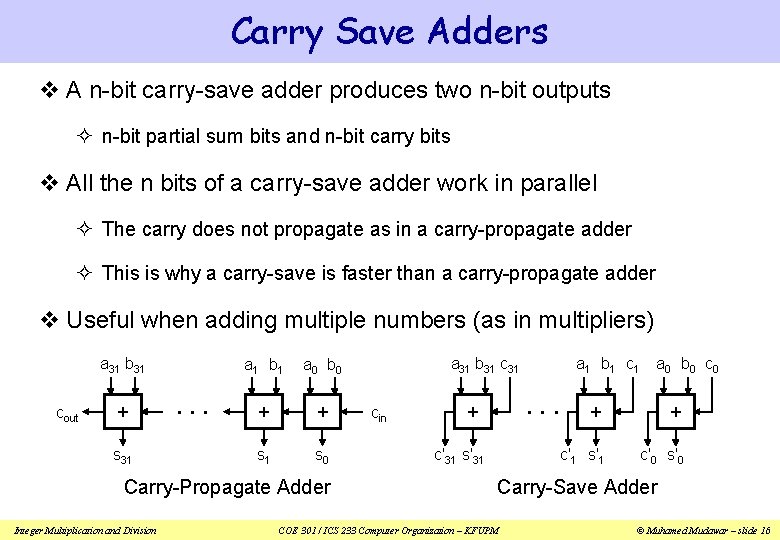
Carry Save Adders v A n-bit carry-save adder produces two n-bit outputs ² n-bit partial sum bits and n-bit carry bits v All the n bits of a carry-save adder work in parallel ² The carry does not propagate as in a carry-propagate adder ² This is why a carry-save is faster than a carry-propagate adder v Useful when adding multiple numbers (as in multipliers) a 31 b 31 cout + s 31 . . . a 1 b 1 a 0 b 0 + + s 1 s 0 Carry-Propagate Adder Integer Multiplication and Division a 31 b 31 cin a 1 b 1 c 1 . . . + c'31 s'31 a 0 b 0 c 0 + + c'1 s'1 c'0 s'0 Carry-Save Adder COE 301 / ICS 233 Computer Organization – KFUPM © Muhamed Mudawar – slide 16
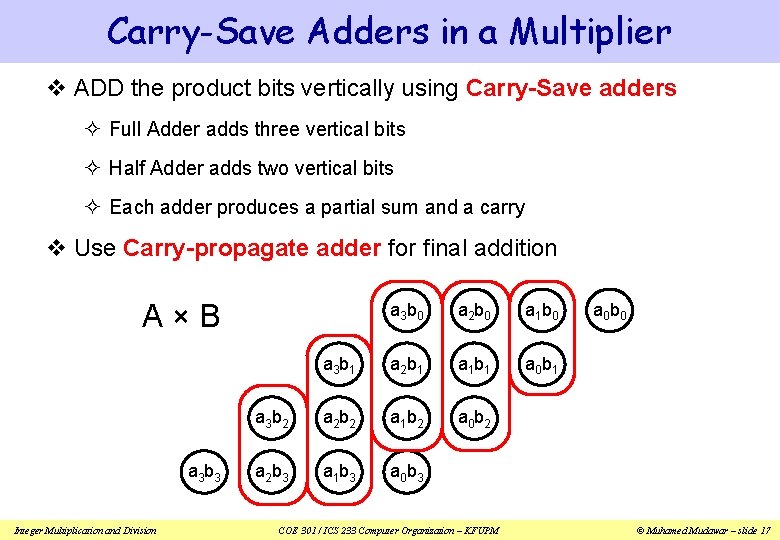
Carry-Save Adders in a Multiplier v ADD the product bits vertically using Carry-Save adders ² Full Adder adds three vertical bits ² Half Adder adds two vertical bits ² Each adder produces a partial sum and a carry v Use Carry-propagate adder for final addition A×B a 3 b 3 Integer Multiplication and Division a 3 b 0 a 2 b 0 a 1 b 0 a 3 b 1 a 2 b 1 a 1 b 1 a 0 b 1 a 3 b 2 a 2 b 2 a 1 b 2 a 0 b 2 a 2 b 3 a 1 b 3 a 0 b 3 COE 301 / ICS 233 Computer Organization – KFUPM a 0 b 0 © Muhamed Mudawar – slide 17
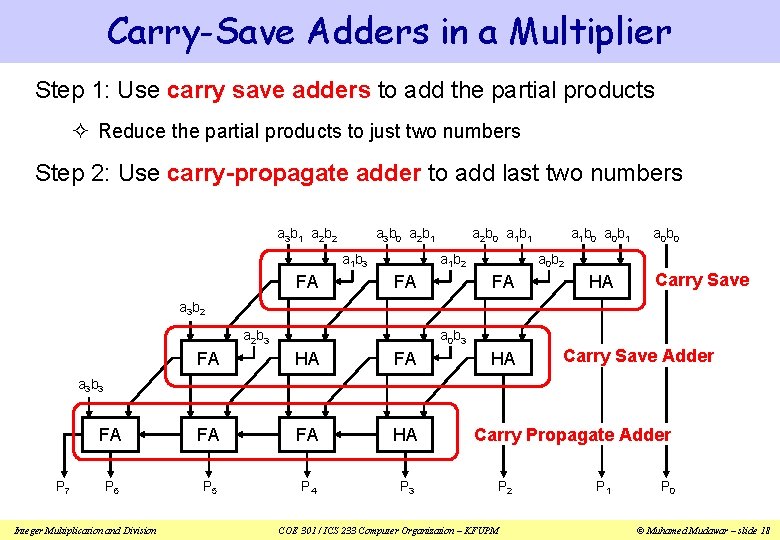
Carry-Save Adders in a Multiplier Step 1: Use carry save adders to add the partial products ² Reduce the partial products to just two numbers Step 2: Use carry-propagate adder to add last two numbers a 3 b 1 a 2 b 2 a 3 b 0 a 2 b 1 a 1 b 3 FA a 2 b 0 a 1 b 1 a 1 b 2 FA a 1 b 0 a 0 b 1 a 0 b 0 a 0 b 2 FA HA Carry Save a 3 b 2 a 2 b 3 a 0 b 3 FA HA FA FA HA P 6 P 5 P 4 P 3 HA Carry Save Adder a 3 b 3 P 7 Integer Multiplication and Division Carry Propagate Adder P 2 COE 301 / ICS 233 Computer Organization – KFUPM P 1 P 0 © Muhamed Mudawar – slide 18
Summary of a Fast Multiplier v A fast n-bit × n-bit multiplier requires: ² n 2 AND gates to produce n 2 product bits in parallel ² Many adders to perform additions in parallel v Uses carry-save adders to reduce delays v Higher cost (more chip area) than sequential multiplier v Higher performance (faster) than sequential multiplier Integer Multiplication and Division COE 301 / ICS 233 Computer Organization – KFUPM © Muhamed Mudawar – slide 19
Next. . . v Unsigned Integer Multiplication v Signed Integer Multiplication v Faster Integer Multiplication v Integer Division v Integer Multiplication and Division in MIPS Integer Multiplication and Division COE 301 / ICS 233 Computer Organization – KFUPM © Muhamed Mudawar – slide 20
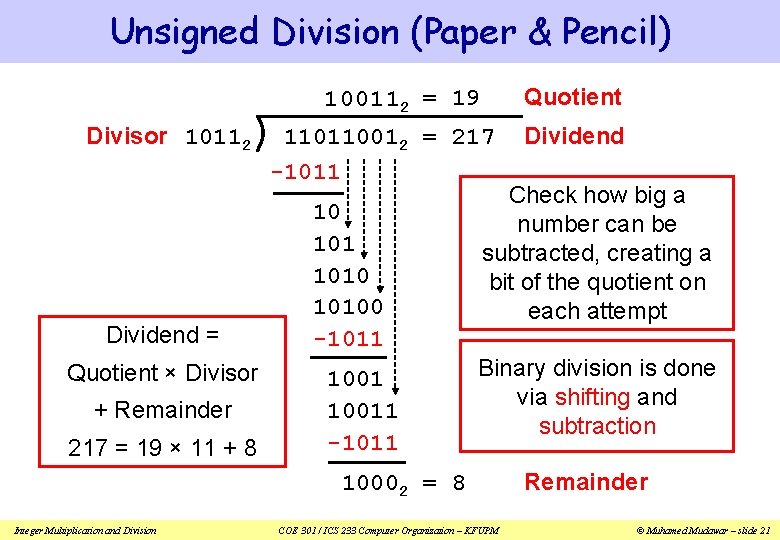
Unsigned Division (Paper & Pencil) Quotient 100112 = 19 Divisor 10112 Dividend = Quotient × Divisor + Remainder 217 = 19 × 11 + 8 110110012 = 217 -1011 10 10100 -1011 10011 -1011 Check how big a number can be subtracted, creating a bit of the quotient on each attempt Binary division is done via shifting and subtraction 10002 = 8 Integer Multiplication and Division Dividend COE 301 / ICS 233 Computer Organization – KFUPM Remainder © Muhamed Mudawar – slide 21
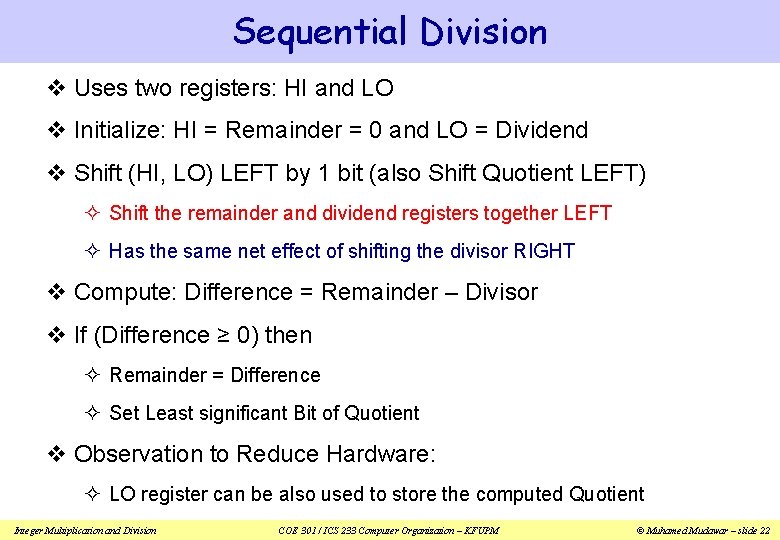
Sequential Division v Uses two registers: HI and LO v Initialize: HI = Remainder = 0 and LO = Dividend v Shift (HI, LO) LEFT by 1 bit (also Shift Quotient LEFT) ² Shift the remainder and dividend registers together LEFT ² Has the same net effect of shifting the divisor RIGHT v Compute: Difference = Remainder – Divisor v If (Difference ≥ 0) then ² Remainder = Difference ² Set Least significant Bit of Quotient v Observation to Reduce Hardware: ² LO register can be also used to store the computed Quotient Integer Multiplication and Division COE 301 / ICS 233 Computer Organization – KFUPM © Muhamed Mudawar – slide 22
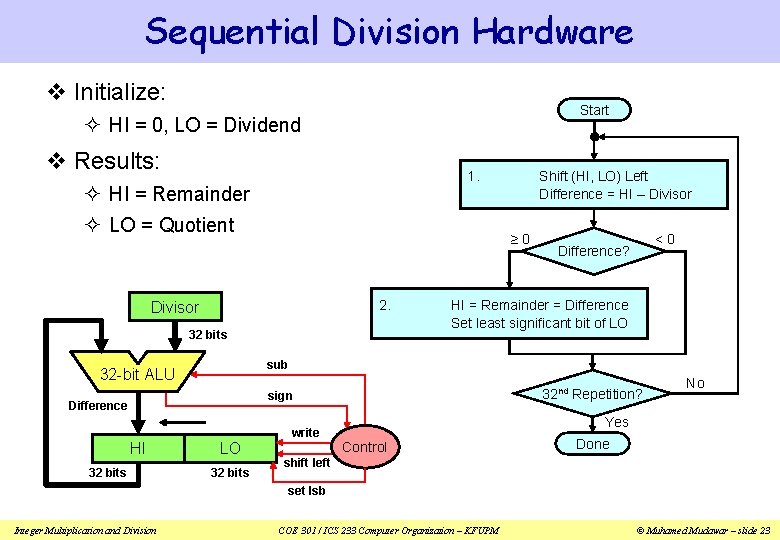
Sequential Division Hardware v Initialize: Start ² HI = 0, LO = Dividend v Results: 1. ² HI = Remainder ² LO = Quotient ≥ 0 2. Divisor 32 bits HI = Remainder = Difference Set least significant bit of LO 32 nd Repetition? sign Difference write 32 bits <0 Difference? sub 32 -bit ALU HI Shift (HI, LO) Left Difference = HI – Divisor LO 32 bits No Yes Control Done shift left set lsb Integer Multiplication and Division COE 301 / ICS 233 Computer Organization – KFUPM © Muhamed Mudawar – slide 23
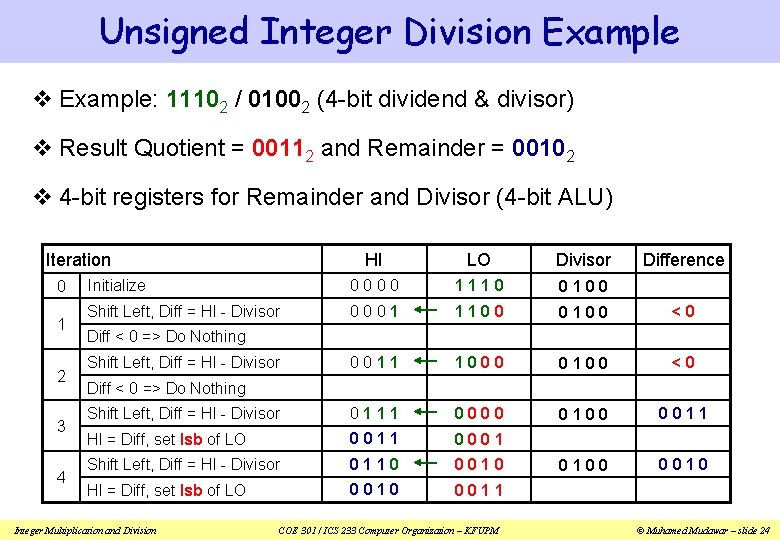
Unsigned Integer Division Example v Example: 11102 / 01002 (4 -bit dividend & divisor) v Result Quotient = 00112 and Remainder = 00102 v 4 -bit registers for Remainder and Divisor (4 -bit ALU) Iteration 0 1 2 3 4 HI LO Divisor Difference Initialize 0000 1110 0100 Shift Left, Diff = HI - Divisor 0001 1100 0100 <0 0011 1000 0100 <0 Shift Left, Diff = HI - Divisor 0111 0000 0100 0011 HI = Diff, set lsb of LO 0011 0001 Shift Left, Diff = HI - Divisor 0110 0010 0100 0010 HI = Diff, set lsb of LO 0010 0011 Diff < 0 => Do Nothing Shift Left, Diff = HI - Divisor Diff < 0 => Do Nothing Integer Multiplication and Division COE 301 / ICS 233 Computer Organization – KFUPM © Muhamed Mudawar – slide 24
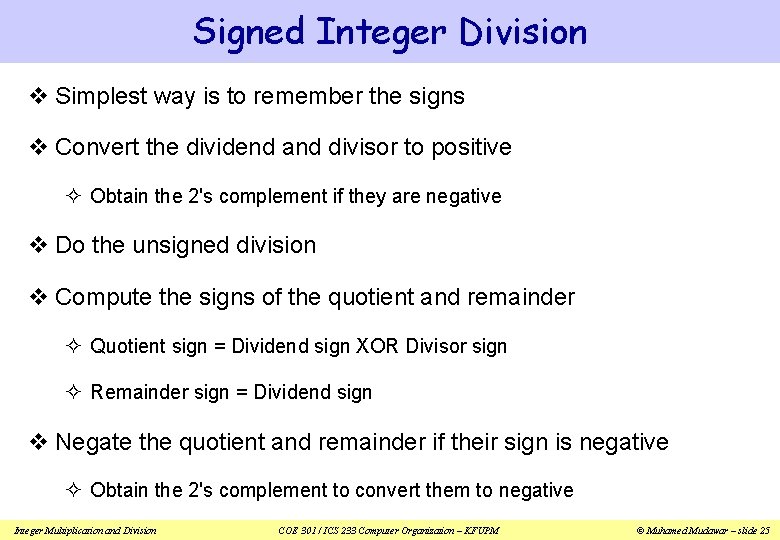
Signed Integer Division v Simplest way is to remember the signs v Convert the dividend and divisor to positive ² Obtain the 2's complement if they are negative v Do the unsigned division v Compute the signs of the quotient and remainder ² Quotient sign = Dividend sign XOR Divisor sign ² Remainder sign = Dividend sign v Negate the quotient and remainder if their sign is negative ² Obtain the 2's complement to convert them to negative Integer Multiplication and Division COE 301 / ICS 233 Computer Organization – KFUPM © Muhamed Mudawar – slide 25
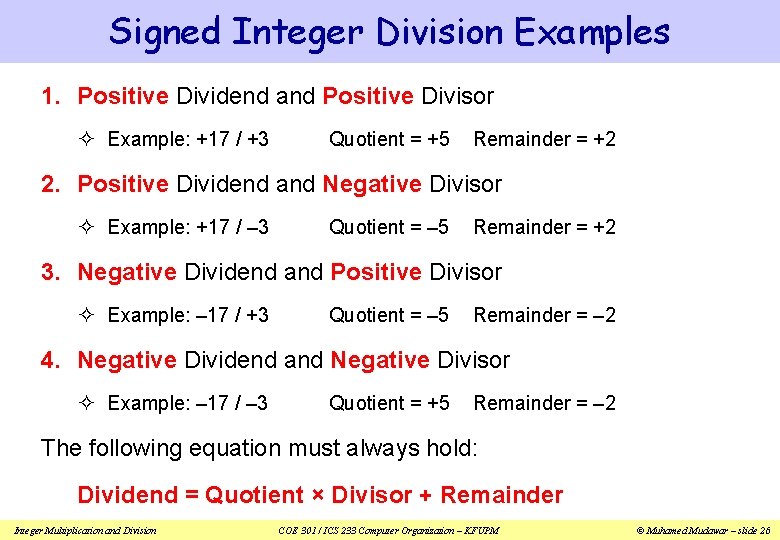
Signed Integer Division Examples 1. Positive Dividend and Positive Divisor ² Example: +17 / +3 Quotient = +5 Remainder = +2 2. Positive Dividend and Negative Divisor ² Example: +17 / – 3 Quotient = – 5 Remainder = +2 3. Negative Dividend and Positive Divisor ² Example: – 17 / +3 Quotient = – 5 Remainder = – 2 4. Negative Dividend and Negative Divisor ² Example: – 17 / – 3 Quotient = +5 Remainder = – 2 The following equation must always hold: Dividend = Quotient × Divisor + Remainder Integer Multiplication and Division COE 301 / ICS 233 Computer Organization – KFUPM © Muhamed Mudawar – slide 26
Next. . . v Unsigned Integer Multiplication v Signed Integer Multiplication v Faster Integer Multiplication v Integer Division v Integer Multiplication and Division in MIPS Integer Multiplication and Division COE 301 / ICS 233 Computer Organization – KFUPM © Muhamed Mudawar – slide 27
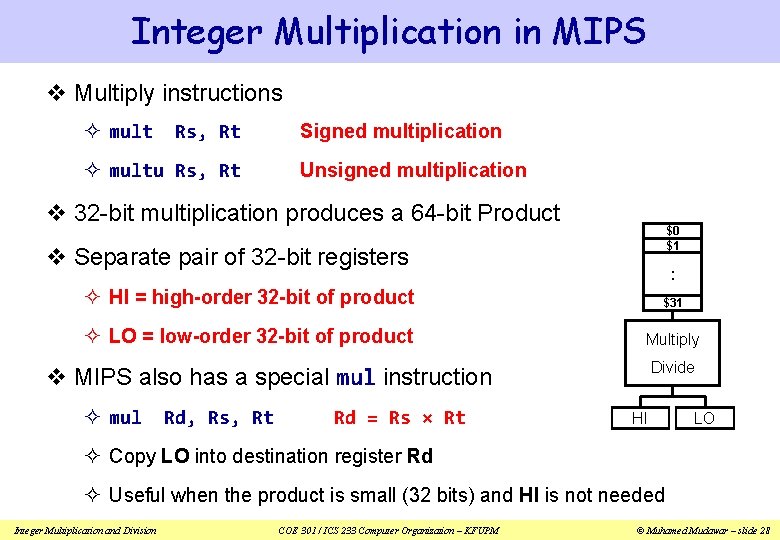
Integer Multiplication in MIPS v Multiply instructions ² mult Rs, Rt ² multu Rs, Rt Signed multiplication Unsigned multiplication v 32 -bit multiplication produces a 64 -bit Product $0 $1 v Separate pair of 32 -bit registers . . ² HI = high-order 32 -bit of product $31 ² LO = low-order 32 -bit of product Multiply Divide v MIPS also has a special mul instruction ² mul Rd, Rs, Rt Rd = Rs × Rt HI LO ² Copy LO into destination register Rd ² Useful when the product is small (32 bits) and HI is not needed Integer Multiplication and Division COE 301 / ICS 233 Computer Organization – KFUPM © Muhamed Mudawar – slide 28
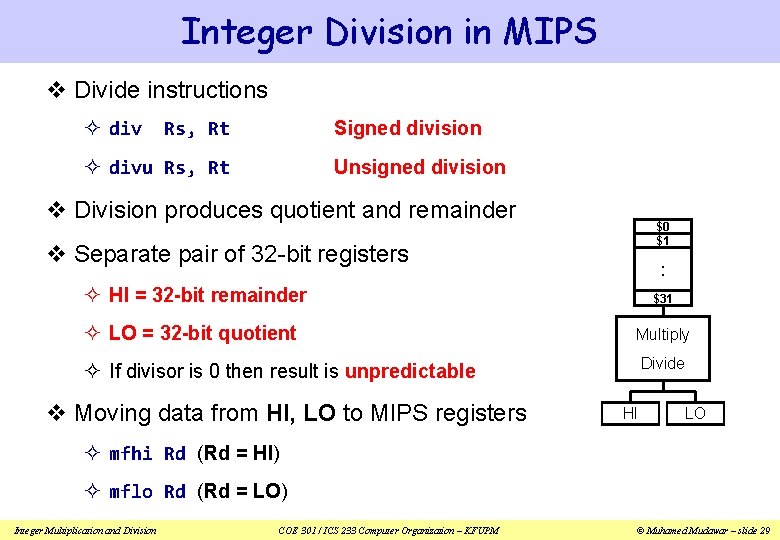
Integer Division in MIPS v Divide instructions ² div Rs, Rt Signed division ² divu Rs, Rt Unsigned division v Division produces quotient and remainder $0 $1 v Separate pair of 32 -bit registers . . ² HI = 32 -bit remainder ² LO = 32 -bit quotient $31 Multiply Divide ² If divisor is 0 then result is unpredictable v Moving data from HI, LO to MIPS registers HI LO ² mfhi Rd (Rd = HI) ² mflo Rd (Rd = LO) Integer Multiplication and Division COE 301 / ICS 233 Computer Organization – KFUPM © Muhamed Mudawar – slide 29
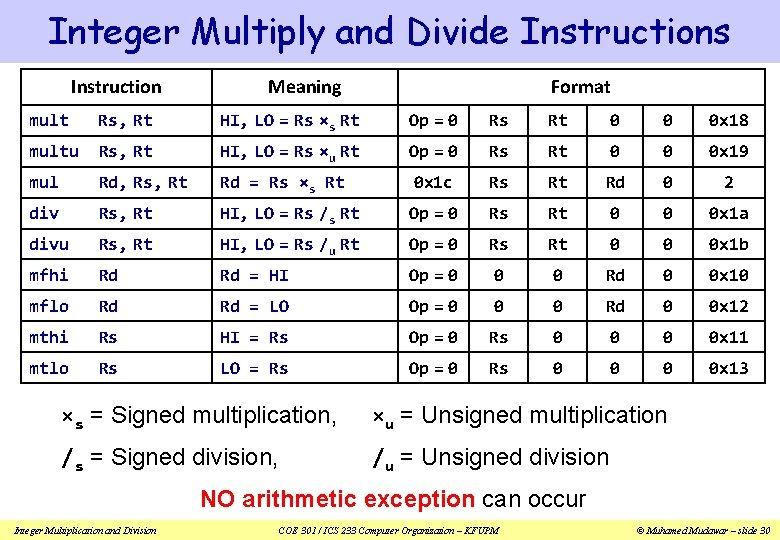
Integer Multiply and Divide Instructions Instruction Meaning Format mult Rs, Rt HI, LO = Rs ×s Rt Op = 0 Rs Rt 0 0 0 x 18 multu Rs, Rt HI, LO = Rs ×u Rt Op = 0 Rs Rt 0 0 0 x 19 mul Rd, Rs, Rt Rd = Rs ×s Rt 0 x 1 c Rs Rt Rd 0 2 div Rs, Rt HI, LO = Rs /s Rt Op = 0 Rs Rt 0 0 0 x 1 a divu Rs, Rt HI, LO = Rs /u Rt Op = 0 Rs Rt 0 0 0 x 1 b mfhi Rd Rd = HI Op = 0 0 0 Rd 0 0 x 10 mflo Rd Rd = LO Op = 0 0 0 Rd 0 0 x 12 mthi Rs HI = Rs Op = 0 Rs 0 0 x 11 mtlo Rs LO = Rs Op = 0 Rs 0 0 x 13 ×s = Signed multiplication, ×u = Unsigned multiplication /s = Signed division, /u = Unsigned division NO arithmetic exception can occur Integer Multiplication and Division COE 301 / ICS 233 Computer Organization – KFUPM © Muhamed Mudawar – slide 30
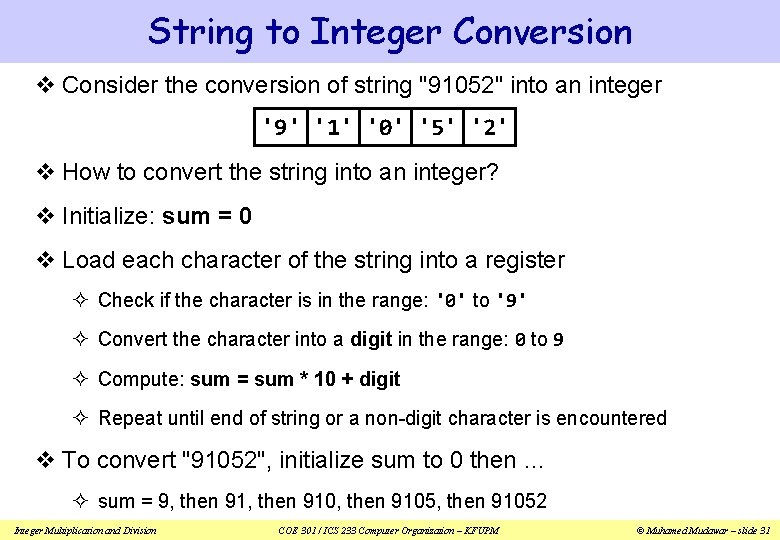
String to Integer Conversion v Consider the conversion of string "91052" into an integer '9' '1' '0' '5' '2' v How to convert the string into an integer? v Initialize: sum = 0 v Load each character of the string into a register ² Check if the character is in the range: '0' to '9' ² Convert the character into a digit in the range: 0 to 9 ² Compute: sum = sum * 10 + digit ² Repeat until end of string or a non-digit character is encountered v To convert "91052", initialize sum to 0 then … ² sum = 9, then 910, then 91052 Integer Multiplication and Division COE 301 / ICS 233 Computer Organization – KFUPM © Muhamed Mudawar – slide 31
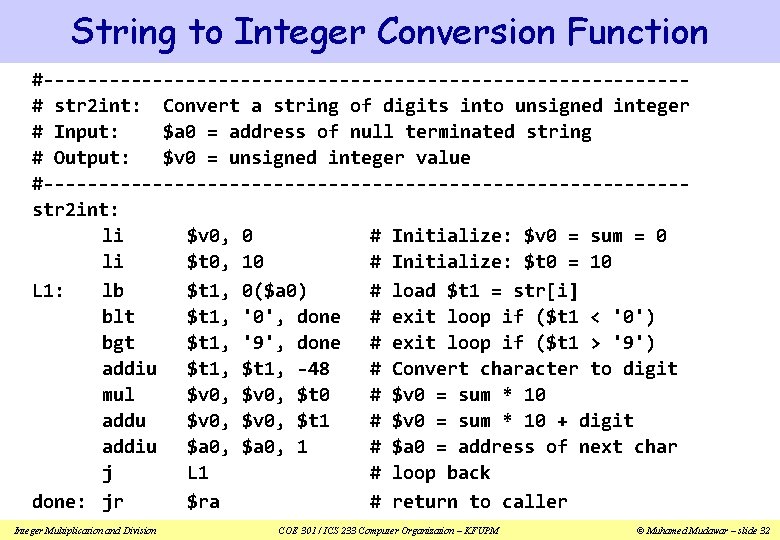
String to Integer Conversion Function #-----------------------------# str 2 int: Convert a string of digits into unsigned integer # Input: $a 0 = address of null terminated string # Output: $v 0 = unsigned integer value #-----------------------------str 2 int: li $v 0, 0 # Initialize: $v 0 = sum = 0 li $t 0, 10 # Initialize: $t 0 = 10 L 1: lb $t 1, 0($a 0) # load $t 1 = str[i] blt $t 1, '0', done # exit loop if ($t 1 < '0') bgt $t 1, '9', done # exit loop if ($t 1 > '9') addiu $t 1, -48 # Convert character to digit mul $v 0, $t 0 # $v 0 = sum * 10 addu $v 0, $t 1 # $v 0 = sum * 10 + digit addiu $a 0, 1 # $a 0 = address of next char j L 1 # loop back done: jr $ra # return to caller Integer Multiplication and Division COE 301 / ICS 233 Computer Organization – KFUPM © Muhamed Mudawar – slide 32
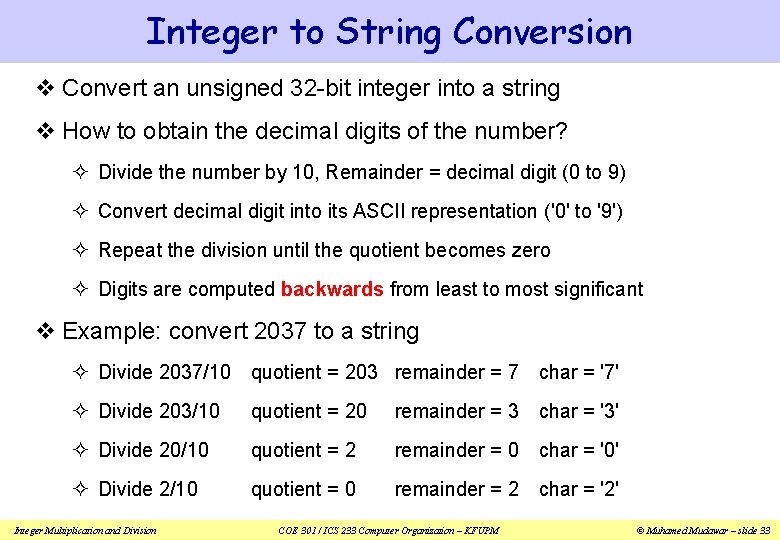
Integer to String Conversion v Convert an unsigned 32 -bit integer into a string v How to obtain the decimal digits of the number? ² Divide the number by 10, Remainder = decimal digit (0 to 9) ² Convert decimal digit into its ASCII representation ('0' to '9') ² Repeat the division until the quotient becomes zero ² Digits are computed backwards from least to most significant v Example: convert 2037 to a string ² Divide 2037/10 quotient = 203 remainder = 7 char = '7' ² Divide 203/10 quotient = 20 remainder = 3 char = '3' ² Divide 20/10 quotient = 2 remainder = 0 char = '0' ² Divide 2/10 quotient = 0 remainder = 2 char = '2' Integer Multiplication and Division COE 301 / ICS 233 Computer Organization – KFUPM © Muhamed Mudawar – slide 33
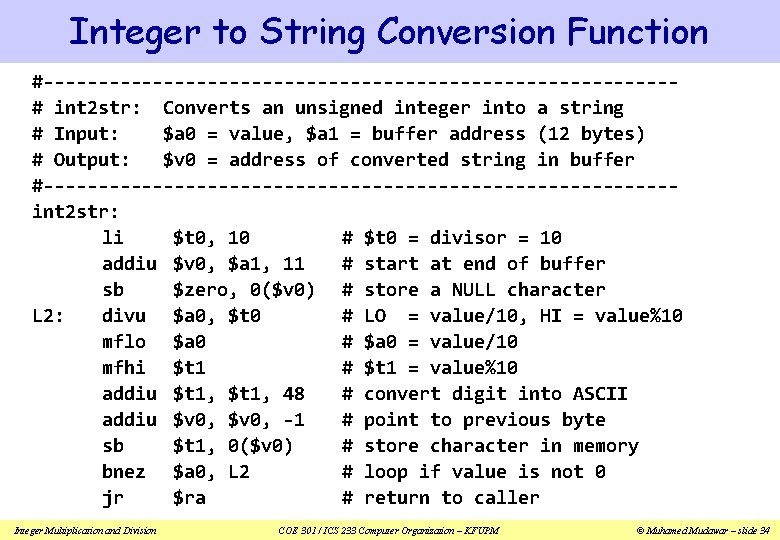
Integer to String Conversion Function #-----------------------------# int 2 str: Converts an unsigned integer into a string # Input: $a 0 = value, $a 1 = buffer address (12 bytes) # Output: $v 0 = address of converted string in buffer #-----------------------------int 2 str: li $t 0, 10 # $t 0 = divisor = 10 addiu $v 0, $a 1, 11 # start at end of buffer sb $zero, 0($v 0) # store a NULL character L 2: divu $a 0, $t 0 # LO = value/10, HI = value%10 mflo $a 0 # $a 0 = value/10 mfhi $t 1 # $t 1 = value%10 addiu $t 1, 48 # convert digit into ASCII addiu $v 0, -1 # point to previous byte sb $t 1, 0($v 0) # store character in memory bnez $a 0, L 2 # loop if value is not 0 jr $ra # return to caller Integer Multiplication and Division COE 301 / ICS 233 Computer Organization – KFUPM © Muhamed Mudawar – slide 34