
Integer Fixed Point Addition and Multiplication CENG 329
- Slides: 31
Integer & Fixed Point Addition and Multiplication CENG 329 Lab Notes By F. Serdar TAŞEL
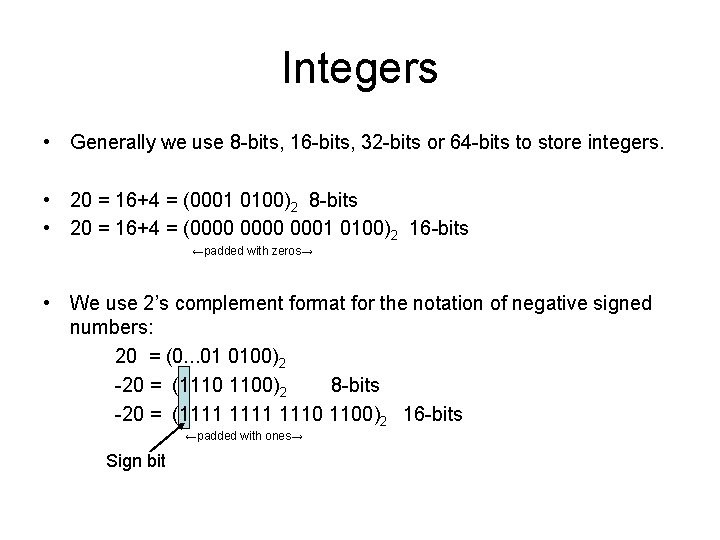
Integers • Generally we use 8 -bits, 16 -bits, 32 -bits or 64 -bits to store integers. • 20 = 16+4 = (0001 0100)2 8 -bits • 20 = 16+4 = (0000 0001 0100)2 16 -bits ←padded with zeros→ • We use 2’s complement format for the notation of negative signed numbers: 20 = (0. . . 01 0100)2 -20 = (1110 1100)2 8 -bits -20 = (1111 1110 1100)2 16 -bits ←padded with ones→ Sign bit
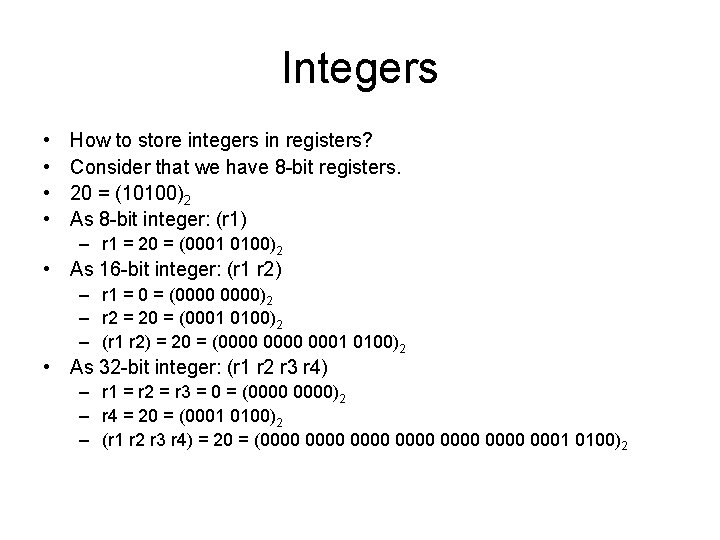
Integers • • How to store integers in registers? Consider that we have 8 -bit registers. 20 = (10100)2 As 8 -bit integer: (r 1) – r 1 = 20 = (0001 0100)2 • As 16 -bit integer: (r 1 r 2) – r 1 = 0 = (0000)2 – r 2 = 20 = (0001 0100)2 – (r 1 r 2) = 20 = (0000 0001 0100)2 • As 32 -bit integer: (r 1 r 2 r 3 r 4) – r 1 = r 2 = r 3 = 0 = (0000)2 – r 4 = 20 = (0001 0100)2 – (r 1 r 2 r 3 r 4) = 20 = (0000 0000 0001 0100)2
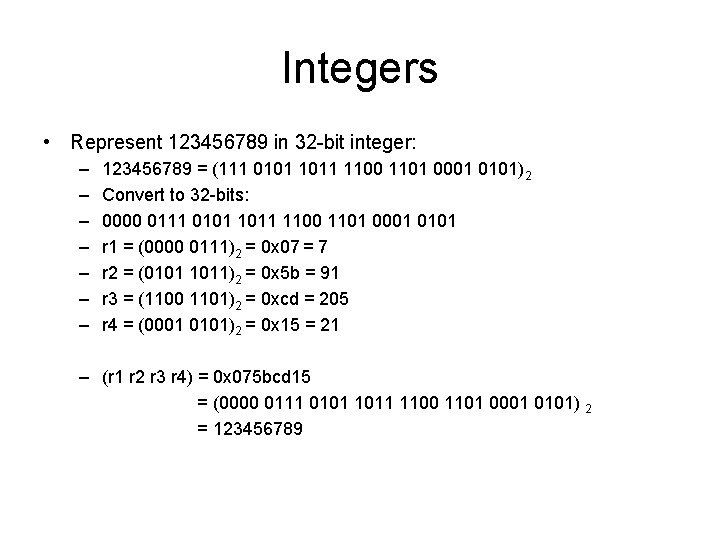
Integers • Represent 123456789 in 32 -bit integer: – – – – 123456789 = (111 0101 1011 1100 1101 0001 0101)2 Convert to 32 -bits: 0000 0111 0101 1011 1100 1101 0001 0101 r 1 = (0000 0111)2 = 0 x 07 = 7 r 2 = (0101 1011)2 = 0 x 5 b = 91 r 3 = (1100 1101)2 = 0 xcd = 205 r 4 = (0001 0101)2 = 0 x 15 = 21 – (r 1 r 2 r 3 r 4) = 0 x 075 bcd 15 = (0000 0111 0101 1011 1100 1101 0001 0101) 2 = 123456789
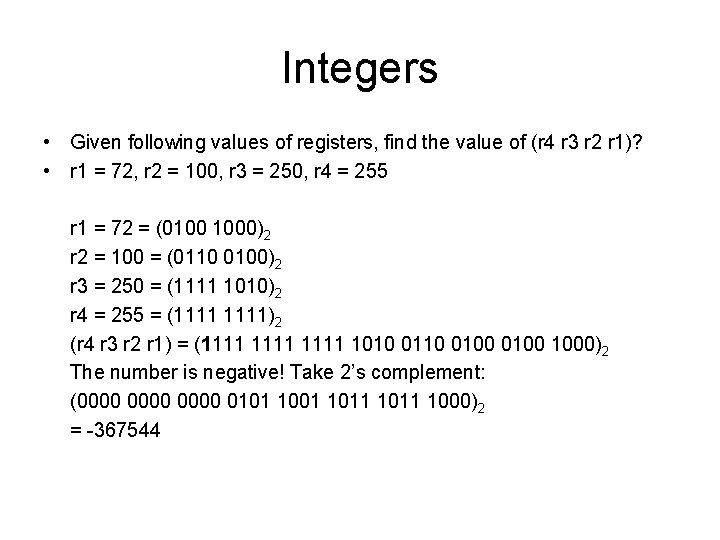
Integers • Given following values of registers, find the value of (r 4 r 3 r 2 r 1)? • r 1 = 72, r 2 = 100, r 3 = 250, r 4 = 255 r 1 = 72 = (0100 1000)2 r 2 = 100 = (0110 0100)2 r 3 = 250 = (1111 1010)2 r 4 = 255 = (1111)2 (r 4 r 3 r 2 r 1) = (1111 1010 0100 1000)2 The number is negative! Take 2’s complement: (0000 0101 1011 1000)2 = -367544
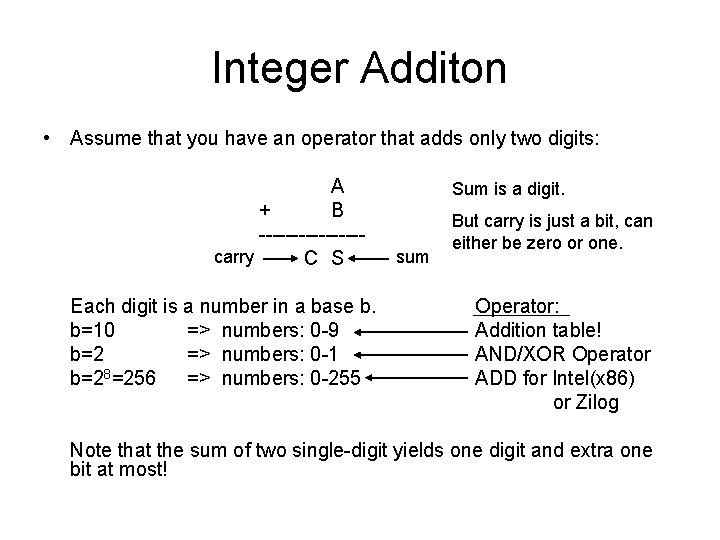
Integer Additon • Assume that you have an operator that adds only two digits: A + B --------carry C S Each digit is a number in a base b. b=10 => numbers: 0 -9 b=2 => numbers: 0 -1 b=28=256 => numbers: 0 -255 Sum is a digit. sum But carry is just a bit, can either be zero or one. Operator: Addition table! AND/XOR Operator ADD for Intel(x 86) or Zilog Note that the sum of two single-digit yields one digit and extra one bit at most!
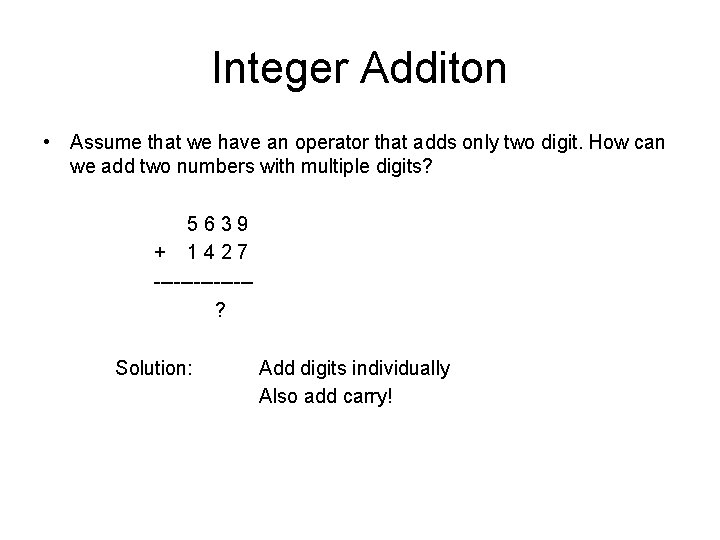
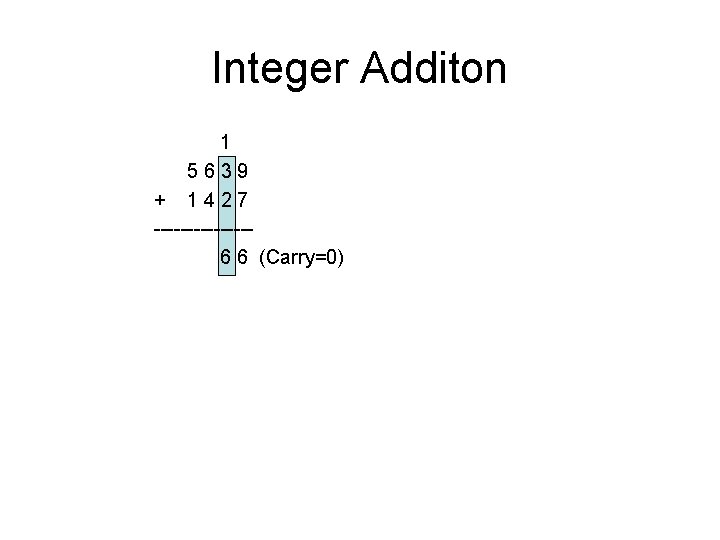
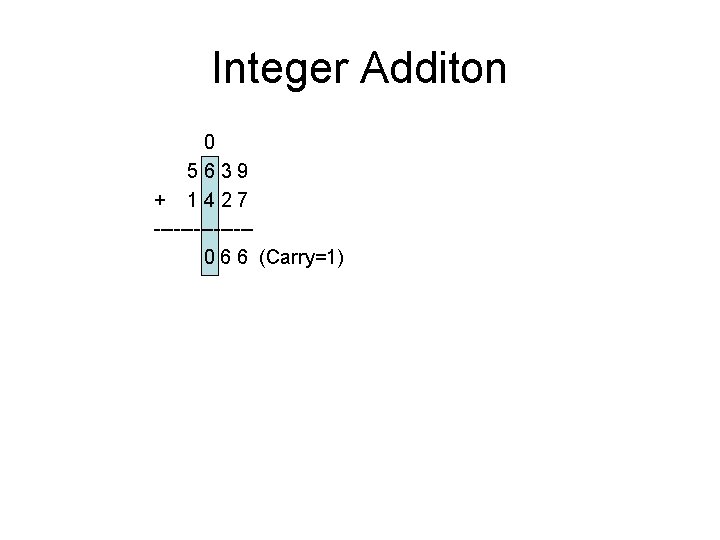
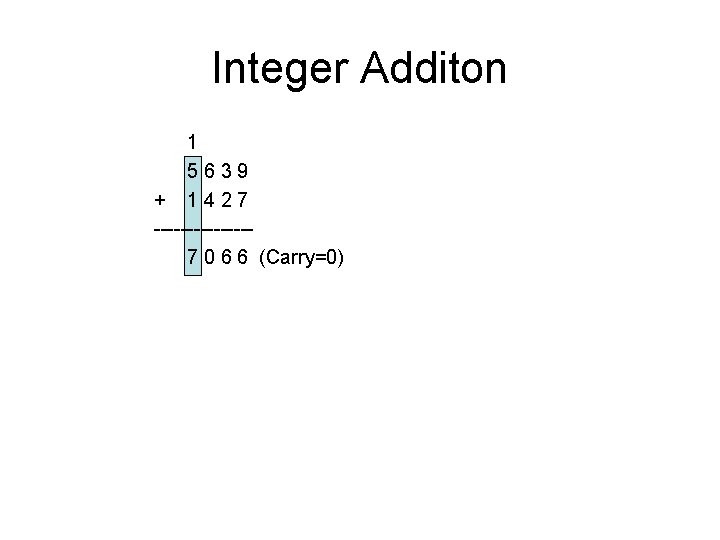
Integer Additon • Assume that we have an operator that adds only two digit. How can we add two numbers with multiple digits? 5639 + 1427 -------? Solution: Add digits individually Also add carry!
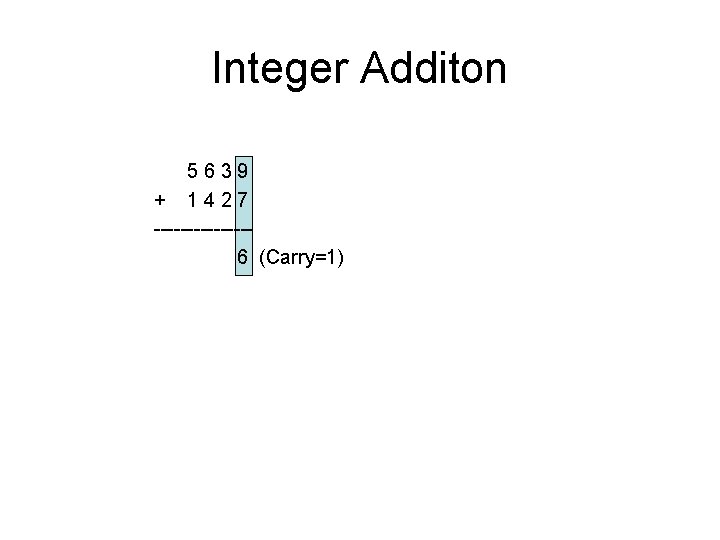
Integer Additon 5639 + 1427 -------6 (Carry=1)
Integer Additon 1 5639 + 1427 -------6 6 (Carry=0)
Integer Additon 0 5639 + 1427 -------0 6 6 (Carry=1)
Integer Additon 1 5639 + 1427 -------7 0 6 6 (Carry=0)
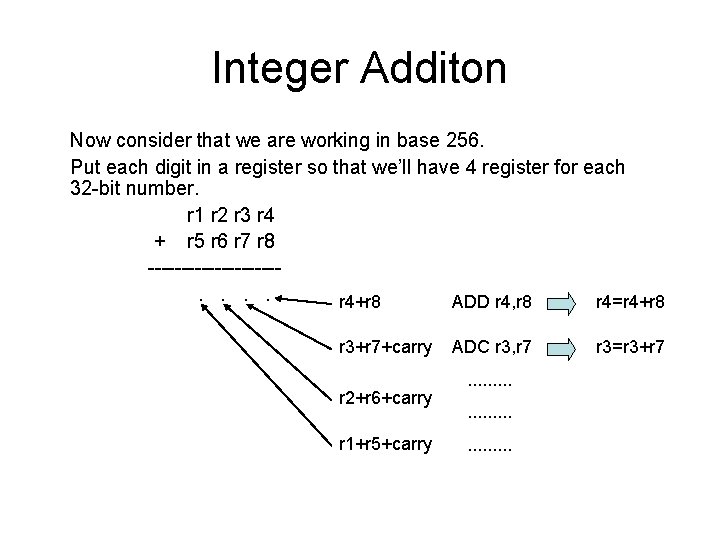
Integer Additon Now consider that we are working in base 256. Put each digit in a register so that we’ll have 4 register for each 32 -bit number. r 1 r 2 r 3 r 4 + r 5 r 6 r 7 r 8 ----------. . r 4+r 8 ADD r 4, r 8 r 4=r 4+r 8 r 3+r 7+carry r 2+r 6+carry r 1+r 5+carry ADC r 3, r 7. . . . r 3=r 3+r 7
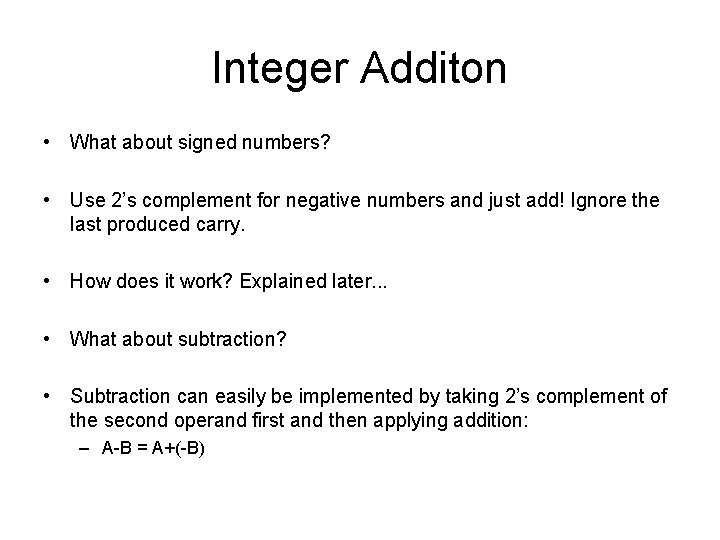
Integer Additon • What about signed numbers? • Use 2’s complement for negative numbers and just add! Ignore the last produced carry. • How does it work? Explained later. . . • What about subtraction? • Subtraction can easily be implemented by taking 2’s complement of the second operand first and then applying addition: – A-B = A+(-B)
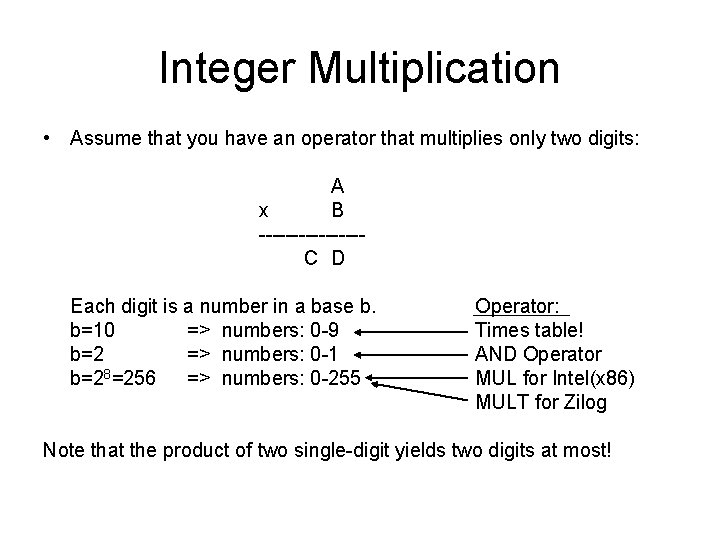
Integer Multiplication • Assume that you have an operator that multiplies only two digits: A x B --------C D Each digit is a number in a base b. b=10 => numbers: 0 -9 b=2 => numbers: 0 -1 b=28=256 => numbers: 0 -255 Operator: Times table! AND Operator MUL for Intel(x 86) MULT for Zilog Note that the product of two single-digit yields two digits at most!
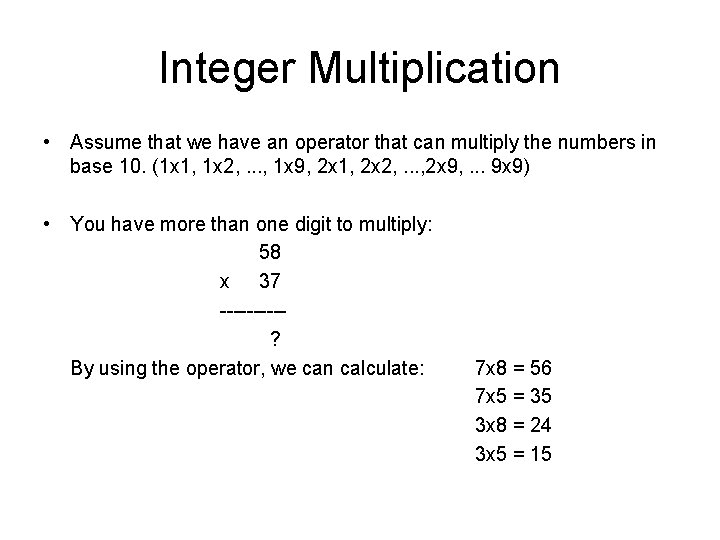
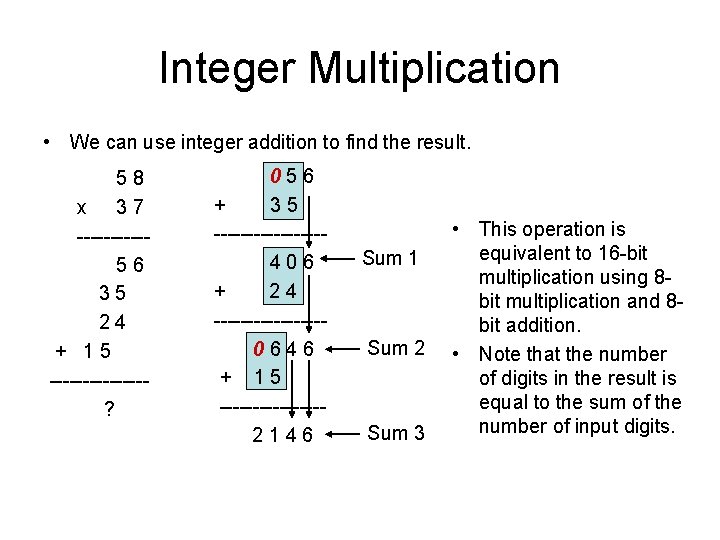
Integer Multiplication • Assume that we have an operator that can multiply the numbers in base 10. (1 x 1, 1 x 2, . . . , 1 x 9, 2 x 1, 2 x 2, . . . , 2 x 9, . . . 9 x 9) • You have more than one digit to multiply: 58 x 37 -----? By using the operator, we can calculate: 7 x 8 = 56 7 x 5 = 35 3 x 8 = 24 3 x 5 = 15
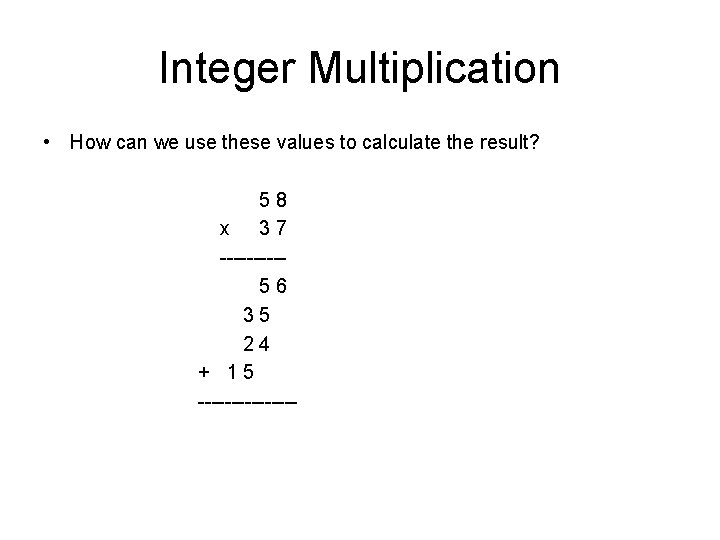
Integer Multiplication • How can we use these values to calculate the result? 58 x 37 -----56 35 24 + 15 --------
Integer Multiplication • We can use integer addition to find the result. 58 x 37 -----56 35 24 + 15 -------? 056 + 35 --------406 + 24 --------0646 + 15 --------2146 Sum 1 Sum 2 Sum 3 • This operation is equivalent to 16 -bit multiplication using 8 bit multiplication and 8 bit addition. • Note that the number of digits in the result is equal to the sum of the number of input digits.
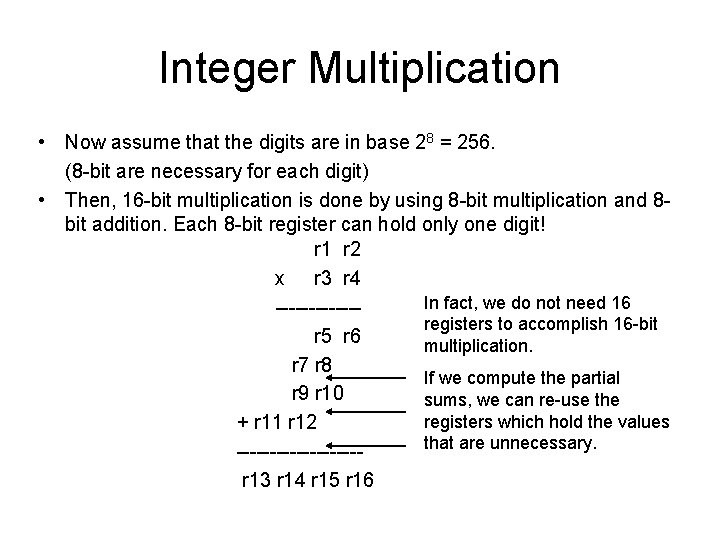
Integer Multiplication • Now assume that the digits are in base 28 = 256. (8 -bit are necessary for each digit) • Then, 16 -bit multiplication is done by using 8 -bit multiplication and 8 bit addition. Each 8 -bit register can hold only one digit! r 1 r 2 x r 3 r 4 In fact, we do not need 16 ------registers to accomplish 16 -bit r 5 r 6 multiplication. r 7 r 8 If we compute the partial r 9 r 10 sums, we can re-use the registers which hold the values + r 11 r 12 that are unnecessary. ---------r 13 r 14 r 15 r 16
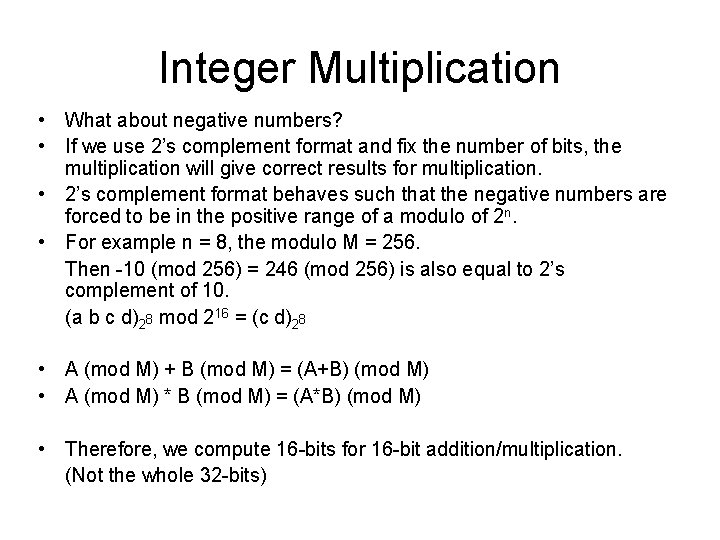
Integer Multiplication • What about negative numbers? • If we use 2’s complement format and fix the number of bits, the multiplication will give correct results for multiplication. • 2’s complement format behaves such that the negative numbers are forced to be in the positive range of a modulo of 2 n. • For example n = 8, the modulo M = 256. Then -10 (mod 256) = 246 (mod 256) is also equal to 2’s complement of 10. (a b c d)28 mod 216 = (c d)28 • A (mod M) + B (mod M) = (A+B) (mod M) • A (mod M) * B (mod M) = (A*B) (mod M) • Therefore, we compute 16 -bits for 16 -bit addition/multiplication. (Not the whole 32 -bits)
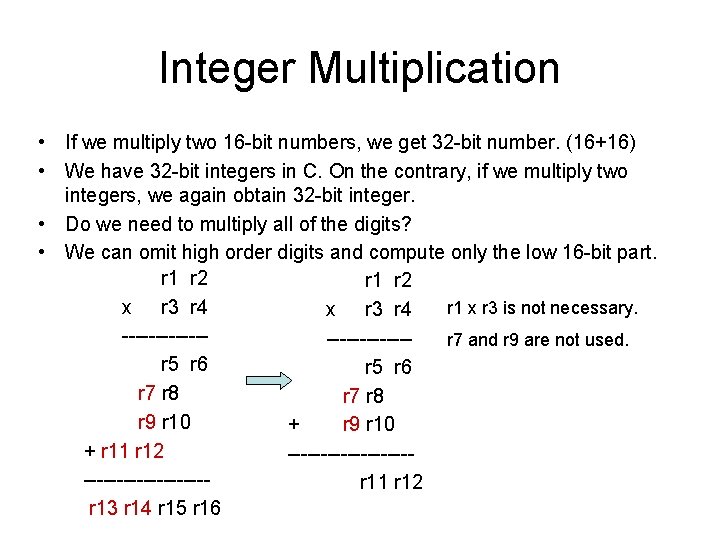
Integer Multiplication • If we multiply two 16 -bit numbers, we get 32 -bit number. (16+16) • We have 32 -bit integers in C. On the contrary, if we multiply two integers, we again obtain 32 -bit integer. • Do we need to multiply all of the digits? • We can omit high order digits and compute only the low 16 -bit part. r 1 r 2 x r 3 r 4 r 1 x r 3 is not necessary. x r 3 r 4 ------------r 7 and r 9 are not used. r 5 r 6 r 7 r 8 r 9 r 10 + r 11 r 12 ------------------r 11 r 12 r 13 r 14 r 15 r 16
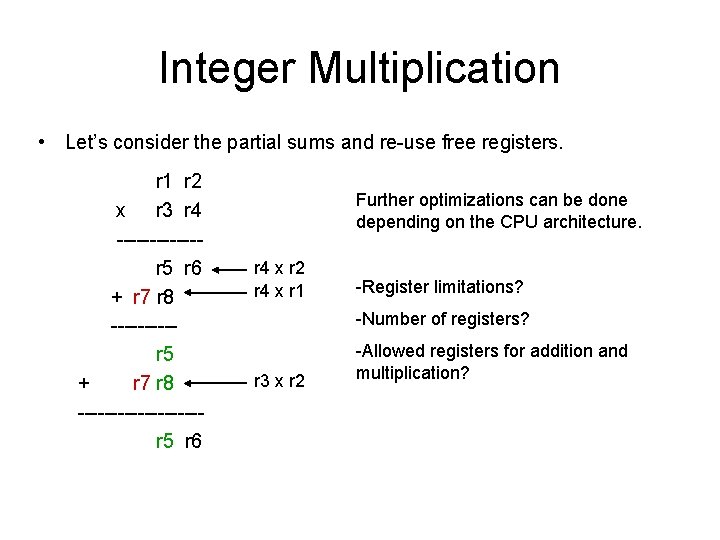
Integer Multiplication • Let’s consider the partial sums and re-use free registers. r 1 r 2 x r 3 r 4 ------r 5 r 6 + r 7 r 8 -----r 5 + r 7 r 8 ---------r 5 r 6 Further optimizations can be done depending on the CPU architecture. r 4 x r 2 r 4 x r 1 -Register limitations? -Number of registers? r 3 x r 2 -Allowed registers for addition and multiplication?
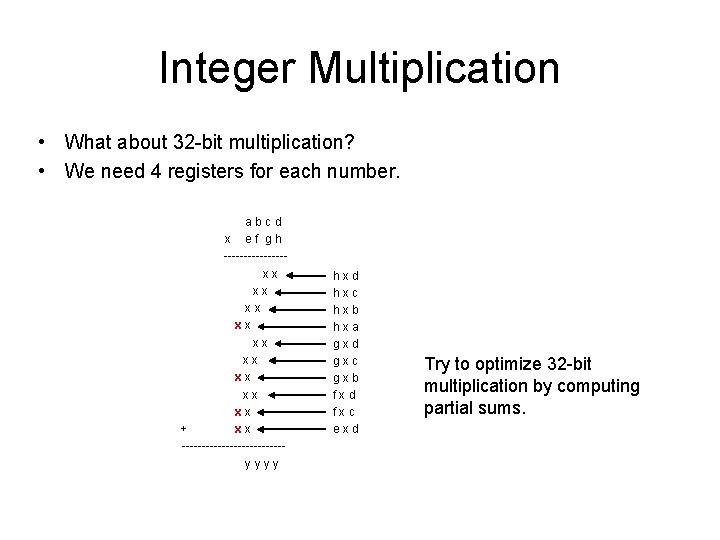
Integer Multiplication • What about 32 -bit multiplication? • We need 4 registers for each number. abcd x ef gh --------xx xx xx + xx -------------yyyy hxd hxc hxb hxa gxd gxc gxb fxd fxc exd Try to optimize 32 -bit multiplication by computing partial sums.
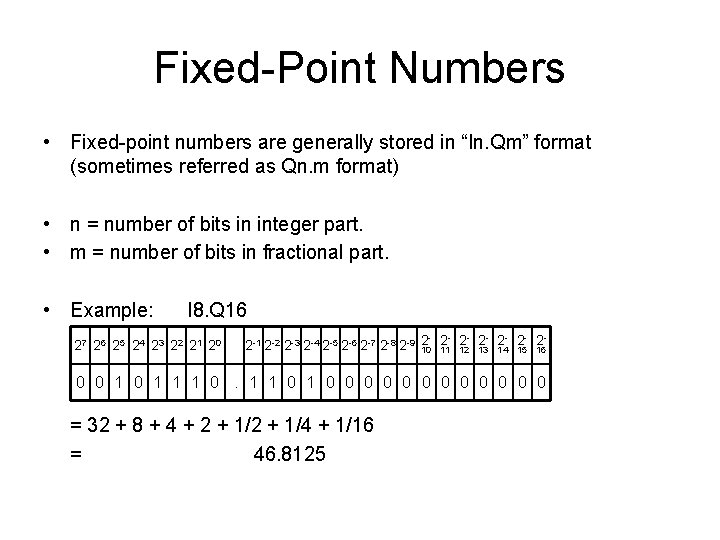
Fixed-Point Numbers • Fixed-point numbers are generally stored in “In. Qm” format (sometimes referred as Qn. m format) • n = number of bits in integer part. • m = number of bits in fractional part. • Example: I 8. Q 16 27 26 25 24 23 22 21 20 - 2 - 2 - 22 -1 2 -2 2 -3 2 -4 2 -5 2 -6 2 -7 2 -8 2 -9 2 10 11 12 13 14 15 16 0 0 1 1 1 0 0 0 0 = 32 + 8 + 4 + 2 + 1/4 + 1/16 = 46. 8125
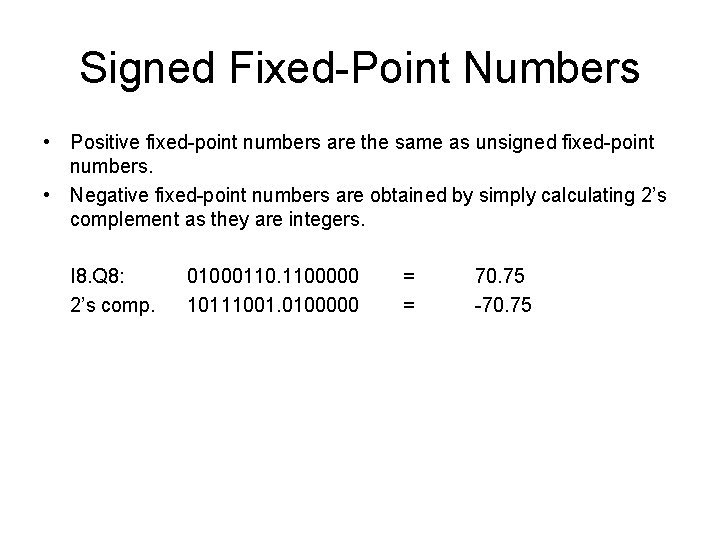
Signed Fixed-Point Numbers • Positive fixed-point numbers are the same as unsigned fixed-point numbers. • Negative fixed-point numbers are obtained by simply calculating 2’s complement as they are integers. I 8. Q 8: 2’s comp. 01000110. 1100000 10111001. 0100000 = = 70. 75 -70. 75
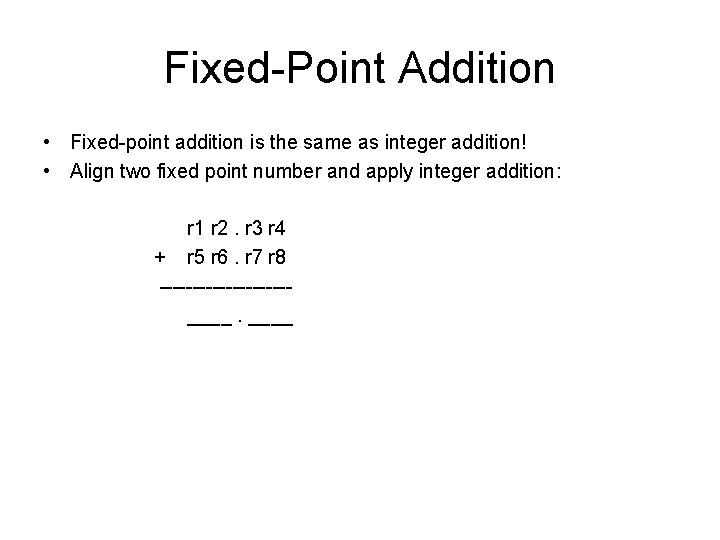
Fixed-Point Addition • Fixed-point addition is the same as integer addition! • Align two fixed point number and apply integer addition: r 1 r 2. r 3 r 4 + r 5 r 6. r 7 r 8 ----------____
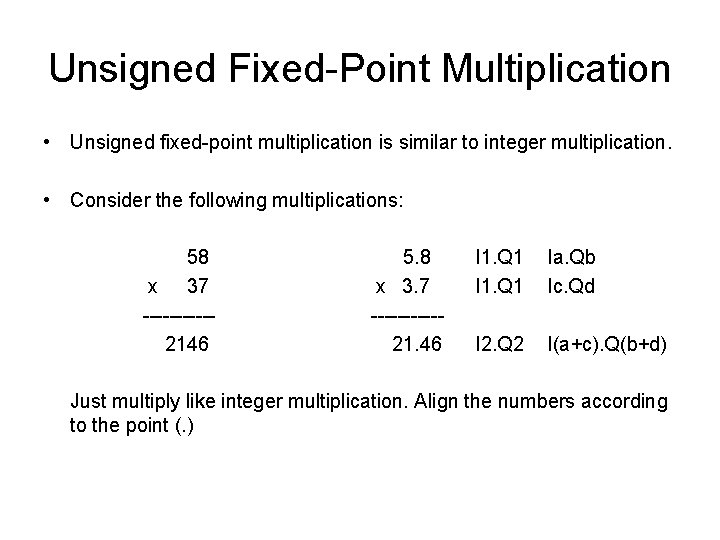
Unsigned Fixed-Point Multiplication • Unsigned fixed-point multiplication is similar to integer multiplication. • Consider the following multiplications: 58 x 37 -----2146 5. 8 x 3. 7 -----21. 46 I 1. Q 1 Ia. Qb Ic. Qd I 2. Q 2 I(a+c). Q(b+d) Just multiply like integer multiplication. Align the numbers according to the point (. )
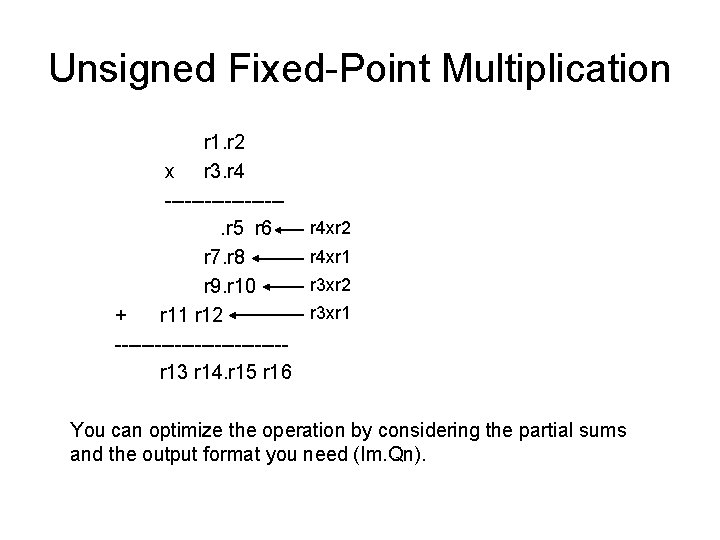
Unsigned Fixed-Point Multiplication r 1. r 2 x r 3. r 4 ---------. r 5 r 6 r 7. r 8 r 9. r 10 + r 11 r 12 -------------r 13 r 14. r 15 r 16 r 4 xr 2 r 4 xr 1 r 3 xr 2 r 3 xr 1 You can optimize the operation by considering the partial sums and the output format you need (Im. Qn).
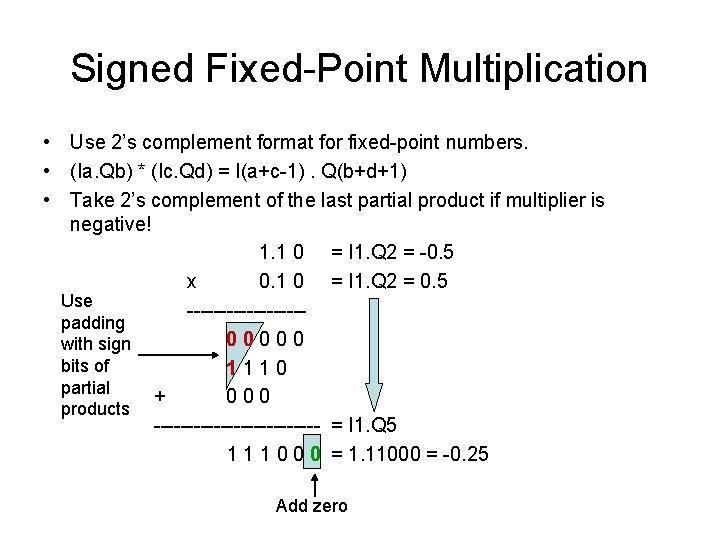
Signed Fixed-Point Multiplication • Use 2’s complement format for fixed-point numbers. • (Ia. Qb) * (Ic. Qd) = I(a+c-1). Q(b+d+1) • Take 2’s complement of the last partial product if multiplier is negative! 1. 1 0 = I 1. Q 2 = -0. 5 x 0. 1 0 = I 1. Q 2 = 0. 5 Use ---------padding 00000 with sign bits of 1110 partial + 000 products ------------- = I 1. Q 5 1 1 1 0 0 0 = 1. 11000 = -0. 25 Add zero
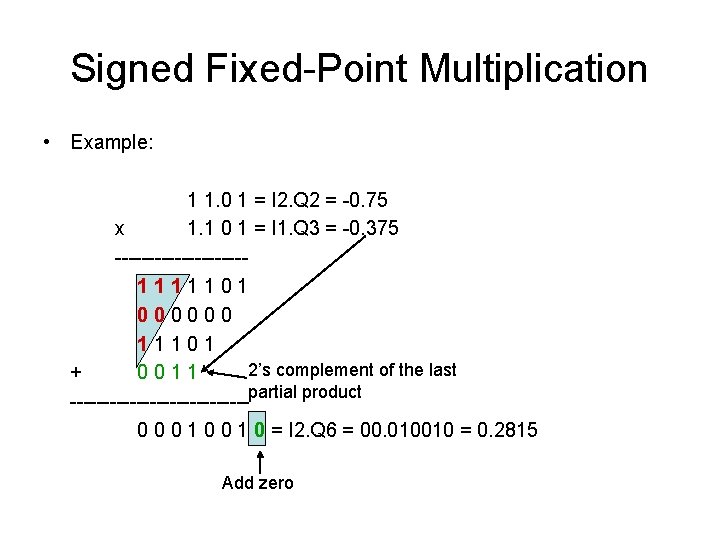
Signed Fixed-Point Multiplication • Example: 1 1. 0 1 = I 2. Q 2 = -0. 75 x 1. 1 0 1 = I 1. Q 3 = -0. 375 ----------1111101 000000 11101 2’s complement of the last + 0011 partial product -------------0 0 0 1 0 = I 2. Q 6 = 00. 010010 = 0. 2815 Add zero
Signed Fixed-Point Multiplication • How can we use registers (e. g. 8 -bit) to accomplish 16 -bit (or more) signed fixed-point multiplication? • Alternative solution 1: – Take 2’s complement of negative numbers. – Apply unsigned fixed-point multiplication. – Finally, Take 2’s complement of the result if necessary. • Alternative solution 2: – 16 -bit signed fixed-point multiplication is equivalent to 32 -bit unsigned fixed-point multiplication (hence similar to 32 -bit integer multiplication).
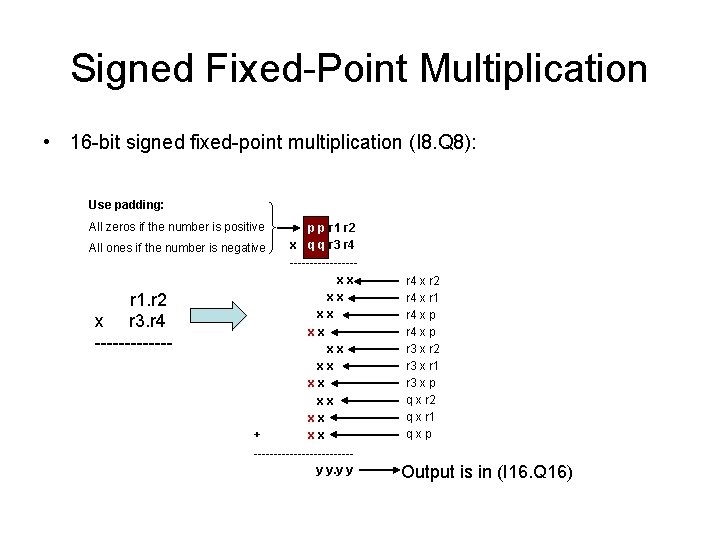
Signed Fixed-Point Multiplication • 16 -bit signed fixed-point multiplication (I 8. Q 8): Use padding: All zeros if the number is positive p p r 1 r 2 x q q r 3 r 4 All ones if the number is negative --------xx xx r 1. r 2 xx x r 3. r 4 xx ------xx xx xx + xx ------------y y. y y r 4 x r 2 r 4 x r 1 r 4 x p r 3 x r 2 r 3 x r 1 r 3 x p q x r 2 q x r 1 qxp Output is in (I 16. Q 16)