
inte RAI Overview Core items assessment Community Health
- Slides: 9
inte. RAI Overview • “Core items” assessment: Community Health Assessment (“CHA”); screening tool – “items” important in all care settings (communication, self-care, behavior, cognition, medical, functional) – have identical definitions, observation time frames, and scoring across environments – a multi-track decision tree: certain answers are called “triggers” that move assessor to supplemental assessment tools
“Triggers” • Numerical values indicate whether a problem exists and the degree of severity; sends the assessor to the next track (efficiencies here) • Next tracks: Other possible Supplement Assessment tools, i. e. : – Functional Supplement – Mental Health Supplement – Assisted Living Supplement – Deaf. Blind Supplement
After Screening with CHA • CHA screening can trigger seventeen inter. RAI Clinical Assessment Protocols (“CAPs”) – Both detailed assessment of area of need and decision support for choosing goals • CHA and the Functional Supplements together trigger the entire set of CAPs – Also trigger a variety of other inter. RAI “scales” and “quality indicators” • i. e. , skin breakdowns
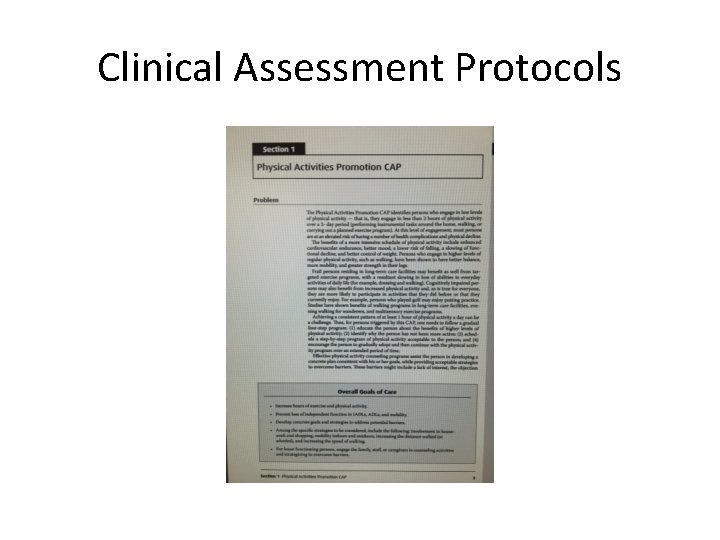
Clinical Assessment Protocols
Assessment Instrumentation Used Across Health Care Sectors • Smoother transitions and greater efficiencies because information derives from a single assessment system – Simultaneously use of varied services, i. e. , use both mental health and personal assistance services – Sequential use of varied services, i. e. , use community supports, then transfer to hospital, then transfer again to a post-acute care setting – Potentially no need to start over with assessing core items; things that don’t change over time are identified
Case Mix Classification • CAPs and Functional Supplements lead to decision support measures (numerical value for type of need and intensity of need) • Algorithms group individuals into “homogenous” categories reflecting the relative costs of services and supports they are likely to use – Used for reimbursement, staffing plans, comparing populations within/across programs • “clinical benefit: provide meaningful clinical descriptions of individuals in a group”
Things We Liked to Hear • Individualized • All inter. RAI instruments use the same methodology same specified observation period focus on observable behaviors use of a few, “powerful questions” to assess areas of need use of professional judgment to integrate multiple sources of information – Good training and support – – • Outcome measurement and continued data collection • Capacity for children to be followed across sectors and systems as they age • Goal is coordinated service planning, seamless transition into other service sectors and systems
Things We Want to Know More About • What does a full inter. RAI assessment "system" actually look like; can we see examples of these things: A data collection form (is online) A user manual Triggers list/information Clinical Assessment Protocols, or CAPs (I actually found these online, later) – Status and outcome measures – – • Case Mix Classifications and Individualization; how it translates to amount and types of services provided to individual
More Information • Instruments overview from inte. RAI: – http: //interrai. org/instruments. html • Review in New Zealand 3/1/2017: – http: //insitemagazine. co. nz/2017/03/01/interraireview-costs-outweigh-the-benefits/ • For the data wonks: – http: //bmchealthservres. biomedcentral. com/artic les/10. 1186/1472 -6963 -8 -277