
Intake Process for Future Release Planning Objectives Introduce
Intake Process for Future Release Planning
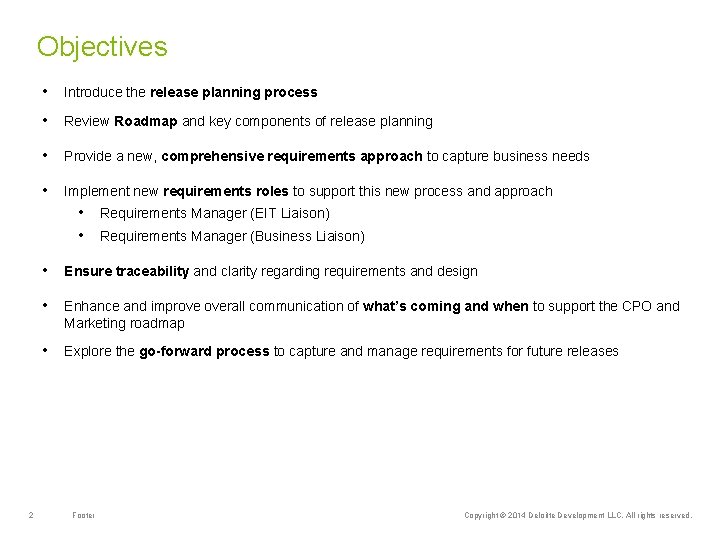
Objectives • Introduce the release planning process • Review Roadmap and key components of release planning • Provide a new, comprehensive requirements approach to capture business needs • Implement new requirements roles to support this new process and approach • Requirements Manager (EIT Liaison) • Requirements Manager (Business Liaison) • Ensure traceability and clarity regarding requirements and design • Enhance and improve overall communication of what’s coming and when to support the CPO and Marketing roadmap • Explore the go-forward process to capture and manage requirements for future releases 2 Footer Copyright © 2014 Deloitte Development LLC. All rights reserved.
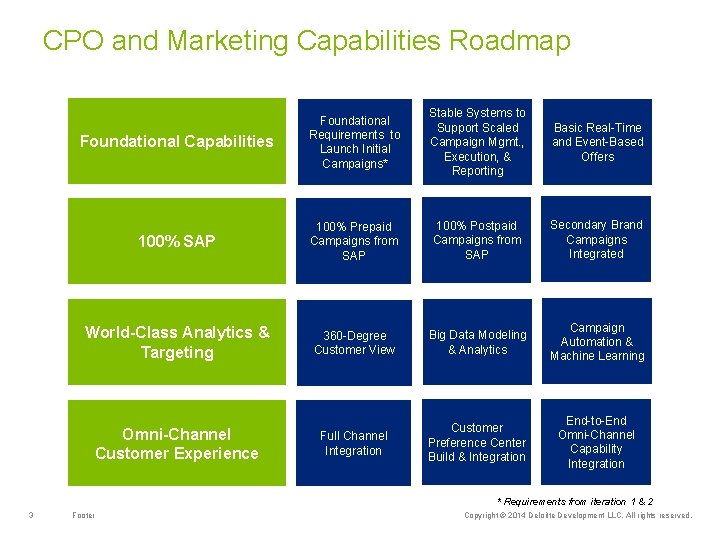
CPO and Marketing Capabilities Roadmap Foundational Capabilities Foundational Requirements to Launch Initial Campaigns* Stable Systems to Support Scaled Campaign Mgmt. , Execution, & Reporting Basic Real-Time and Event-Based Offers 100% SAP 100% Prepaid Campaigns from SAP 100% Postpaid Campaigns from SAP Secondary Brand Campaigns Integrated World-Class Analytics & Targeting 360 -Degree Customer View Big Data Modeling & Analytics Campaign Automation & Machine Learning Full Channel Integration Customer Preference Center Build & Integration End-to-End Omni-Channel Capability Integration Omni-Channel Customer Experience * Requirements from iteration 1 & 2 3 Footer Copyright © 2014 Deloitte Development LLC. All rights reserved.
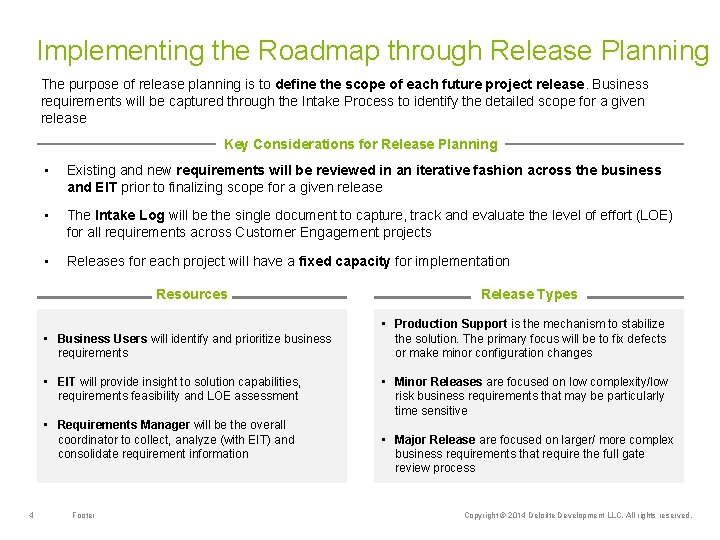
Implementing the Roadmap through Release Planning The purpose of release planning is to define the scope of each future project release. Business requirements will be captured through the Intake Process to identify the detailed scope for a given release Key Considerations for Release Planning • Existing and new requirements will be reviewed in an iterative fashion across the business and EIT prior to finalizing scope for a given release • The Intake Log will be the single document to capture, track and evaluate the level of effort (LOE) for all requirements across Customer Engagement projects • Releases for each project will have a fixed capacity for implementation Resources • Business Users will identify and prioritize business requirements • EIT will provide insight to solution capabilities, requirements feasibility and LOE assessment • Requirements Manager will be the overall coordinator to collect, analyze (with EIT) and consolidate requirement information 4 Footer Release Types • Production Support is the mechanism to stabilize the solution. The primary focus will be to fix defects or make minor configuration changes • Minor Releases are focused on low complexity/low risk business requirements that may be particularly time sensitive • Major Release are focused on larger/ more complex business requirements that require the full gate review process Copyright © 2014 Deloitte Development LLC. All rights reserved.
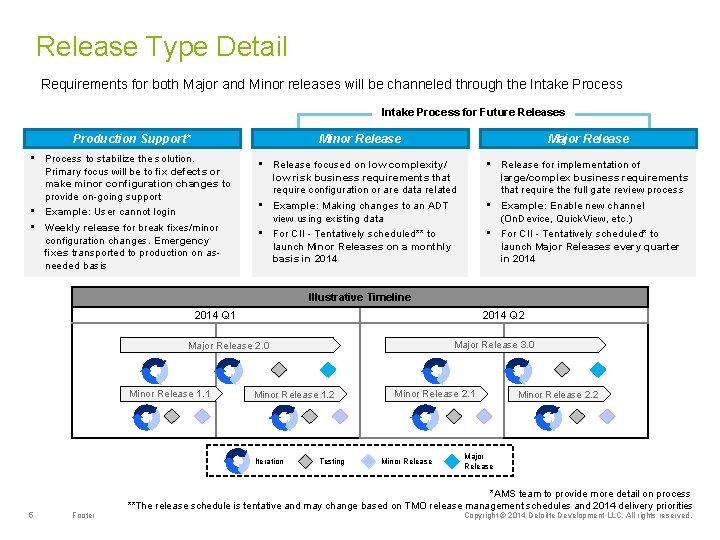
Release Type Detail Requirements for both Major and Minor releases will be channeled through the Intake Process for Future Releases Production Support* Minor Release Major Release • Process to stabilize the solution. Primary focus will be to fix defects or make minor configuration changes to provide on-going support • Example: User cannot login • Weekly release for break fixes/minor configuration changes. Emergency fixes transported to production on asneeded basis • Release focused on low complexity/ low risk business requirements that require configuration or are data related • Example: Making changes to an ADT view using existing data • For CII - Tentatively scheduled** to launch Minor Releases on a monthly basis in 2014 • Release for implementation of large/complex business requirements that require the full gate review process • Example: Enable new channel (On. Device, Quick. View, etc. ) • For CII - Tentatively scheduled* to launch Major Releases every quarter in 2014 Illustrative Timeline 2014 Q 1 2014 Q 2 Major Release 3. 0 Major Release 2. 0 Minor Release 1. 1 Minor Release 1. 2 Iteration 5 Footer Testing Minor Release 2. 1 Minor Release 2. 2 Major Release *AMS team to provide more detail on process **The release schedule is tentative and may change based on TMO release management schedules and 2014 delivery priorities Copyright © 2014 Deloitte Development LLC. All rights reserved.
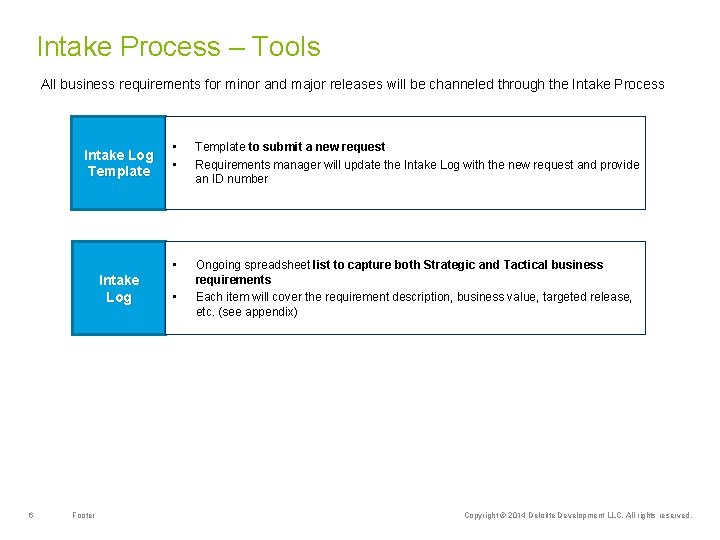
Intake Process – Tools All business requirements for minor and major releases will be channeled through the Intake Process Intake Log Template Intake Log 6 Footer • • Template to submit a new request Requirements manager will update the Intake Log with the new request and provide an ID number • Ongoing spreadsheet list to capture both Strategic and Tactical business requirements Each item will cover the requirement description, business value, targeted release, etc. (see appendix) • Copyright © 2014 Deloitte Development LLC. All rights reserved.
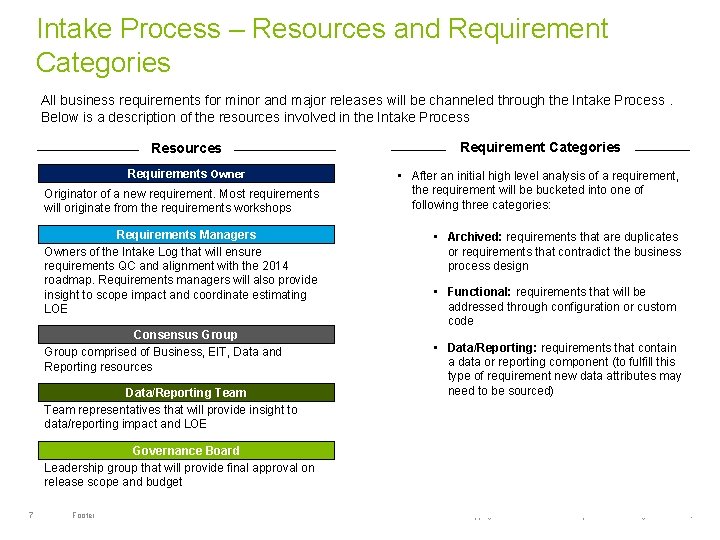
Intake Process – Resources and Requirement Categories All business requirements for minor and major releases will be channeled through the Intake Process. Below is a description of the resources involved in the Intake Process Resources Requirement Categories Requirements Owner • After an initial high level analysis of a requirement, the requirement will be bucketed into one of following three categories: Originator of a new requirement. Most requirements will originate from the requirements workshops Requirements Managers Owners of the Intake Log that will ensure requirements QC and alignment with the 2014 roadmap. Requirements managers will also provide insight to scope impact and coordinate estimating LOE Consensus Group comprised of Business, EIT, Data and Reporting resources Data/Reporting Team representatives that will provide insight to data/reporting impact and LOE • Archived: requirements that are duplicates or requirements that contradict the business process design • Functional: requirements that will be addressed through configuration or custom code • Data/Reporting: requirements that contain a data or reporting component (to fulfill this type of requirement new data attributes may need to be sourced) Governance Board Leadership group that will provide final approval on release scope and budget 7 Footer Copyright © 2014 Deloitte Development LLC. All rights reserved.
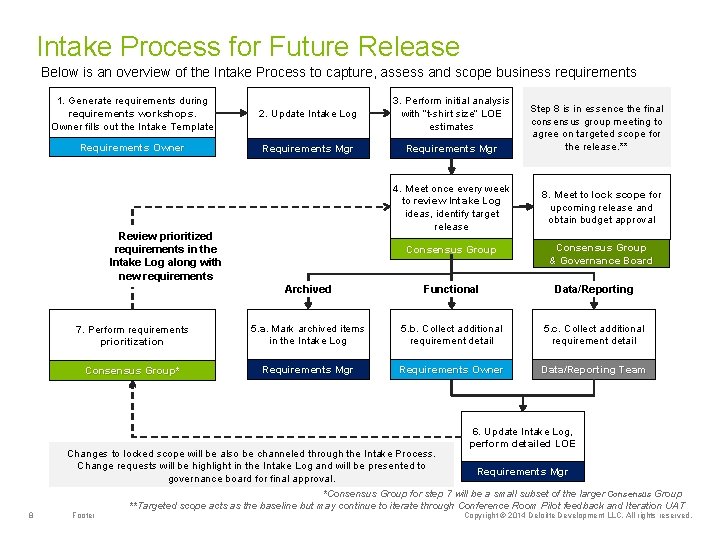
Intake Process for Future Release Below is an overview of the Intake Process to capture, assess and scope business requirements 1. Generate requirements during requirements workshops. Owner fills out the Intake Template 2. Update Intake Log 3. Perform initial analysis with “t-shirt size” LOE estimates Requirements Owner Requirements Mgr Review prioritized requirements in the Intake Log along with new requirements Step 8 is in essence the final consensus group meeting to agree on targeted scope for the release. ** 4. Meet once every week to review Intake Log ideas, identify target release 8. Meet to lock scope for upcoming release and obtain budget approval Consensus Group & Governance Board Archived Functional Data/Reporting 7. Perform requirements prioritization 5. a. Mark archived items in the Intake Log 5. b. Collect additional requirement detail 5. c. Collect additional requirement detail Consensus Group* Requirements Mgr Requirements Owner Data/Reporting Team 6. Update Intake Log, perform detailed LOE 8 Changes to locked scope will be also be channeled through the Intake Process. Change requests will be highlight in the Intake Log and will be presented to Requirements Mgr governance board for final approval. *Consensus Group for step 7 will be a small subset of the larger Consensus Group **Targeted scope acts as the baseline but may continue to iterate through Conference Room Pilot feedback and Iteration UAT Footer Copyright © 2014 Deloitte Development LLC. All rights reserved.
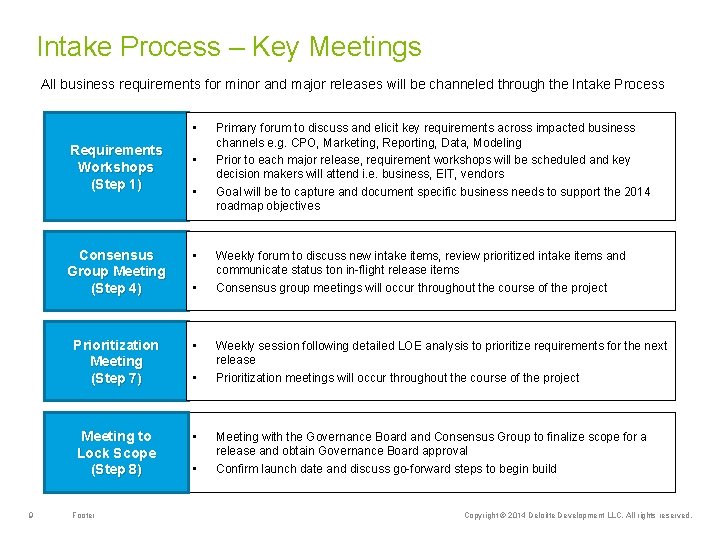
Intake Process – Key Meetings All business requirements for minor and major releases will be channeled through the Intake Process • Requirements Workshops (Step 1) 9 • • Consensus Group Meeting (Step 4) • Prioritization Meeting (Step 7) • Meeting to Lock Scope (Step 8) • Footer • • • Primary forum to discuss and elicit key requirements across impacted business channels e. g. CPO, Marketing, Reporting, Data, Modeling Prior to each major release, requirement workshops will be scheduled and key decision makers will attend i. e. business, EIT, vendors Goal will be to capture and document specific business needs to support the 2014 roadmap objectives Weekly forum to discuss new intake items, review prioritized intake items and communicate status ton in-flight release items Consensus group meetings will occur throughout the course of the project Weekly session following detailed LOE analysis to prioritize requirements for the next release Prioritization meetings will occur throughout the course of the project Meeting with the Governance Board and Consensus Group to finalize scope for a release and obtain Governance Board approval Confirm launch date and discuss go-forward steps to begin build Copyright © 2014 Deloitte Development LLC. All rights reserved.
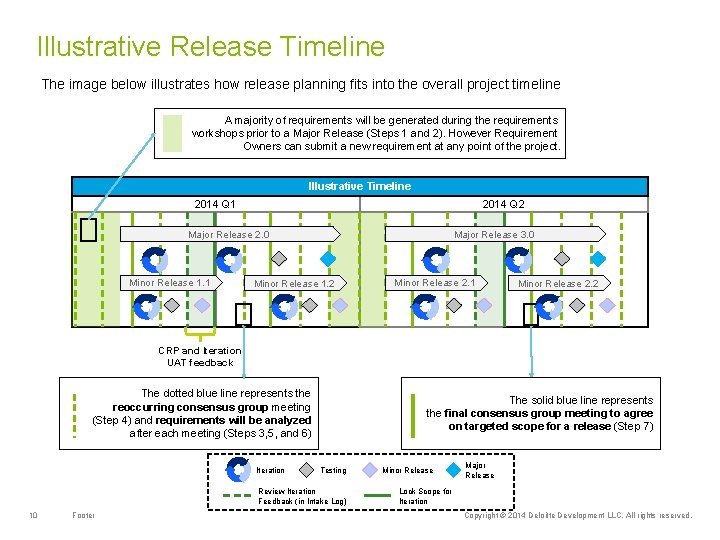
Illustrative Release Timeline The image below illustrates how release planning fits into the overall project timeline A majority of requirements will be generated during the requirements workshops prior to a Major Release (Steps 1 and 2). However Requirement Owners can submit a new requirement at any point of the project. Illustrative Timeline 2014 Q 1 2014 Q 2 Major Release 3. 0 Major Release 2. 0 Minor Release 1. 1 Minor Release 1. 2 Minor Release 2. 1 Minor Release 2. 2 CRP and Iteration UAT feedback The dotted blue line represents the reoccurring consensus group meeting (Step 4) and requirements will be analyzed after each meeting (Steps 3, 5, and 6) Iteration The solid blue line represents the final consensus group meeting to agree on targeted scope for a release (Step 7) Testing Review Iteration Feedback (in Intake Log) 10 Footer Minor Release Major Release Lock Scope for Iteration Copyright © 2014 Deloitte Development LLC. All rights reserved.
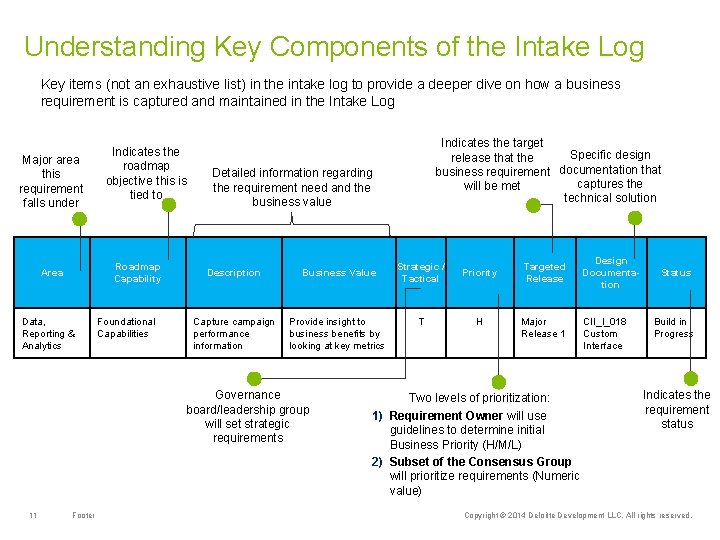
Understanding Key Components of the Intake Log Key items (not an exhaustive list) in the intake log to provide a deeper dive on how a business requirement is captured and maintained in the Intake Log Major area this requirement falls under Indicates the roadmap objective this is tied to Roadmap Capability Area Data, Reporting & Analytics Foundational Capabilities Detailed information regarding the requirement need and the business value Description Business Value Capture campaign performance information Provide insight to business benefits by looking at key metrics Governance board/leadership group will set strategic requirements 11 Footer Indicates the target Specific design release that the business requirement documentation that captures the will be met technical solution Strategic / Tactical Priority T H Targeted Release Major Release 1 Two levels of prioritization: 1) Requirement Owner will use guidelines to determine initial Business Priority (H/M/L) 2) Subset of the Consensus Group will prioritize requirements (Numeric value) Design Documentation CII_I_018 Custom Interface Status Build in Progress Indicates the requirement status Copyright © 2014 Deloitte Development LLC. All rights reserved.
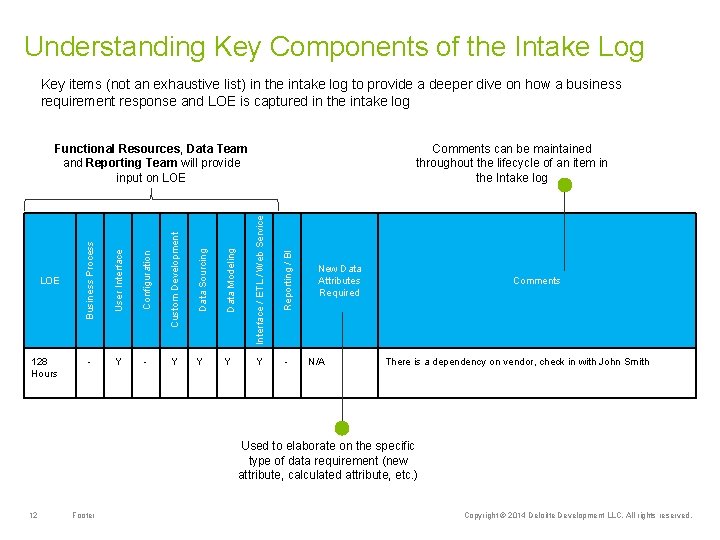
Understanding Key Components of the Intake Log Key items (not an exhaustive list) in the intake log to provide a deeper dive on how a business requirement response and LOE is captured in the intake log Configuration Custom Development Data Sourcing Data Modeling Interface / ETL / Web Service Reporting / BI 128 Hours User Interface LOE Comments can be maintained throughout the lifecycle of an item in the Intake log Business Process Functional Resources, Data Team and Reporting Team will provide input on LOE - Y Y Y Y - New Data Attributes Required N/A Comments There is a dependency on vendor, check in with John Smith Used to elaborate on the specific type of data requirement (new attribute, calculated attribute, etc. ) 12 Footer Copyright © 2014 Deloitte Development LLC. All rights reserved.
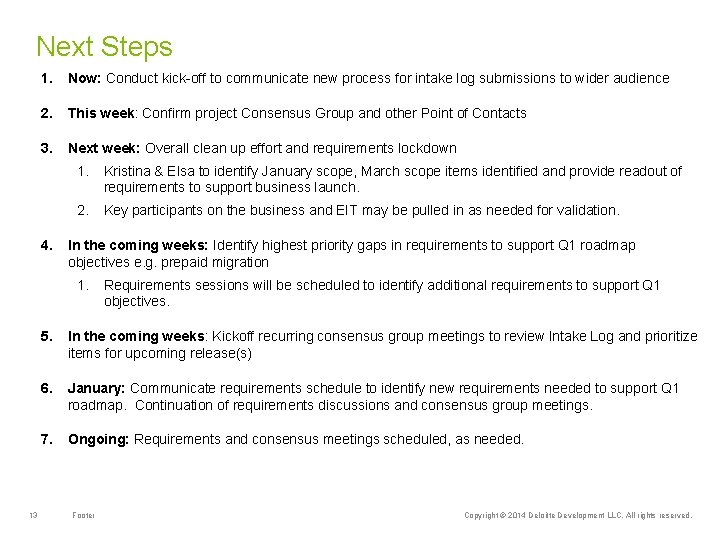
Next Steps 1. Now: Conduct kick-off to communicate new process for intake log submissions to wider audience 2. This week: Confirm project Consensus Group and other Point of Contacts 3. Next week: Overall clean up effort and requirements lockdown 4. 1. Kristina & Elsa to identify January scope, March scope items identified and provide readout of requirements to support business launch. 2. Key participants on the business and EIT may be pulled in as needed for validation. In the coming weeks: Identify highest priority gaps in requirements to support Q 1 roadmap objectives e. g. prepaid migration 1. 13 Requirements sessions will be scheduled to identify additional requirements to support Q 1 objectives. 5. In the coming weeks: Kickoff recurring consensus group meetings to review Intake Log and prioritize items for upcoming release(s) 6. January: Communicate requirements schedule to identify new requirements needed to support Q 1 roadmap. Continuation of requirements discussions and consensus group meetings. 7. Ongoing: Requirements and consensus meetings scheduled, as needed. Footer Copyright © 2014 Deloitte Development LLC. All rights reserved.
Appendix 14 • Detailed description of the different release types • Detailed description of strategic and tactical requirement types • Detailed description of Intake Process steps and point of contacts Footer Copyright © 2014 Deloitte Development LLC. All rights reserved.
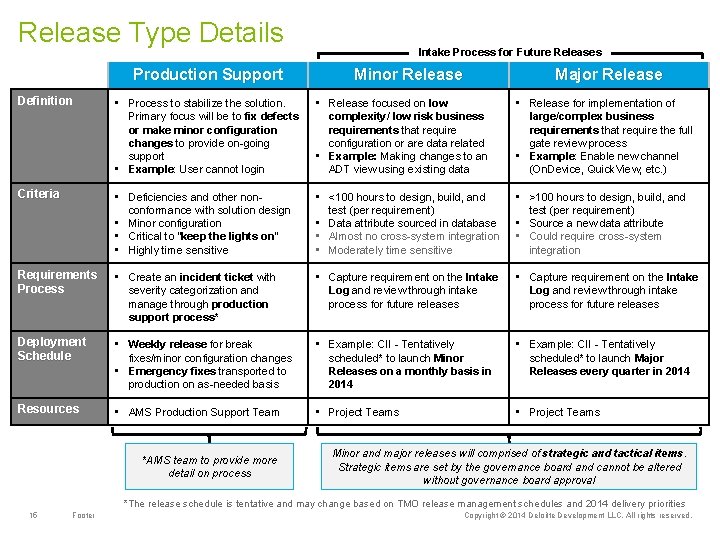
Release Type Details Production Support Intake Process for Future Releases Minor Release Major Release Definition • Process to stabilize the solution. Primary focus will be to fix defects or make minor configuration changes to provide on-going support • Example: User cannot login • Release focused on low complexity/ low risk business requirements that require configuration or are data related • Example: Making changes to an ADT view using existing data • Release for implementation of large/complex business requirements that require the full gate review process • Example: Enable new channel (On. Device, Quick. View, etc. ) Criteria • Deficiencies and other nonconformance with solution design • Minor configuration • Critical to “keep the lights on” • Highly time sensitive • <100 hours to design, build, and test (per requirement) • Data attribute sourced in database • Almost no cross-system integration • Moderately time sensitive • >100 hours to design, build, and test (per requirement) • Source a new data attribute • Could require cross-system integration Requirements Process • Create an incident ticket with severity categorization and manage through production support process* • Capture requirement on the Intake Log and review through intake process for future releases Deployment Schedule • Weekly release for break fixes/minor configuration changes • Emergency fixes transported to production on as-needed basis • Example: CII - Tentatively scheduled* to launch Minor Releases on a monthly basis in 2014 • Example: CII - Tentatively scheduled* to launch Major Releases every quarter in 2014 Resources • AMS Production Support Team • Project Teams *AMS team to provide more detail on process Minor and major releases will comprised of strategic and tactical items. Strategic items are set by the governance board and cannot be altered without governance board approval *The release schedule is tentative and may change based on TMO release management schedules and 2014 delivery priorities 15 Footer Copyright © 2014 Deloitte Development LLC. All rights reserved.
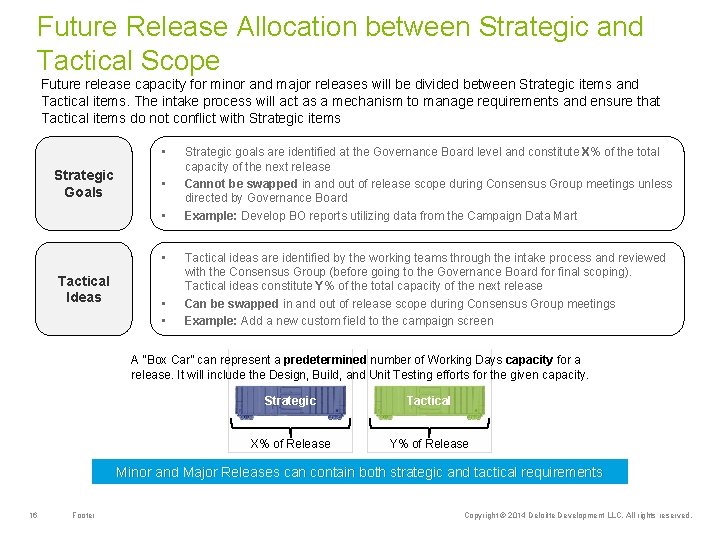
Future Release Allocation between Strategic and Tactical Scope Future release capacity for minor and major releases will be divided between Strategic items and Tactical items. The intake process will act as a mechanism to manage requirements and ensure that Tactical items do not conflict with Strategic items • Strategic Goals • • • Tactical Ideas • • Strategic goals are identified at the Governance Board level and constitute X% of the total capacity of the next release Cannot be swapped in and out of release scope during Consensus Group meetings unless directed by Governance Board Example: Develop BO reports utilizing data from the Campaign Data Mart Tactical ideas are identified by the working teams through the intake process and reviewed with the Consensus Group (before going to the Governance Board for final scoping). Tactical ideas constitute Y% of the total capacity of the next release Can be swapped in and out of release scope during Consensus Group meetings Example: Add a new custom field to the campaign screen A “Box Car” can represent a predetermined number of Working Days capacity for a release. It will include the Design, Build, and Unit Testing efforts for the given capacity. Strategic Tactical X% of Release Y% of Release Minor and Major Releases can contain both strategic and tactical requirements 16 Footer Copyright © 2014 Deloitte Development LLC. All rights reserved.
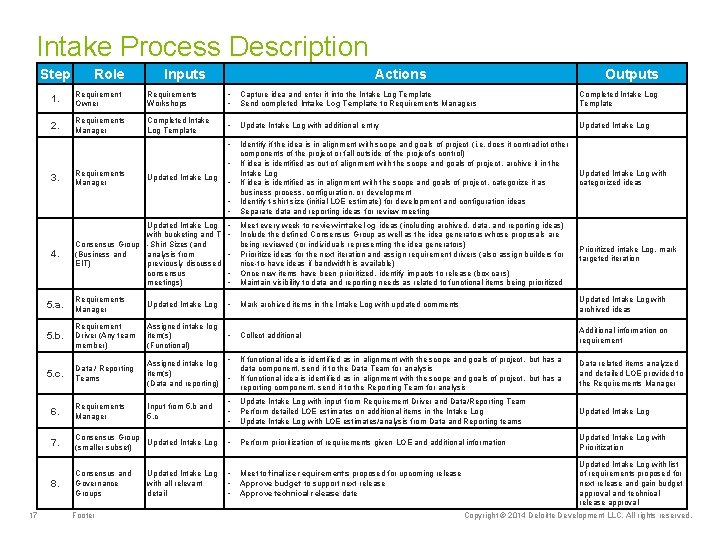
Intake Process Description Step Role Inputs Actions 1. Requirement Owner Requirements Workshops • • Capture idea and enter it into the Intake Log Template Send completed Intake Log Template to Requirements Managers Completed Intake Log Template 2. Requirements Manager Completed Intake Log Template • Update Intake Log with additional entry Updated Intake Log • Identify if the idea is in alignment with scope and goals of project (i. e. does it contradict other components of the project or fall outside of the project’s control) If idea is identified as out of alignment with the scope and goals of project , archive it in the Intake Log If idea is identified as in alignment with the scope and goals of project , categorize it as business process, configuration, or development Identify t-shirt size (initial LOE estimate) for development and configuration ideas Separate data and reporting ideas for review meeting Updated Intake Log with categorized ideas Prioritized intake Log, mark targeted iteration • • Meet every week to review intake log ideas (including archived, data, and reporting ideas) Include the defined Consensus Group as well as the idea generators whose proposals are being reviewed (or individuals representing the idea generators) Prioritize ideas for the next iteration and assign requirement drivers (also assign builders for nice-to-have ideas if bandwidth is available) Once new items have been prioritized, identify impacts to release (box cars) Maintain visibility to data and reporting needs as related to functional items being prioritized • 3. Requirements Manager Updated Intake Log • • • 4. 17 Outputs Updated Intake Log with bucketing and T Consensus Group -Shirt Sizes (and (Business and analysis from EIT) previously discussed consensus meetings) • • • 5. a. Requirements Manager Updated Intake Log • Mark archived items in the Intake Log with updated comments Updated Intake Log with archived ideas 5. b. Requirement Driver (Any team member) Assigned intake log item(s) (Functional) • Collect additional Additional information on requirement • 5. c. Data / Reporting Teams Assigned intake log item(s) • (Data and reporting) If functional idea is identified as in alignment with the scope and goals of project, but has a data component, send it to the Data Team for analysis If functional idea is identified as in alignment with the scope and goals of project, but has a reporting component, send it to the Reporting Team for analysis Data related items analyzed and detailed LOE provided to the Requirements Manager 6. Requirements Manager Input from 5. b and 5. c • • • Update Intake Log with input from Requirement Driver and Data/Reporting Team Perform detailed LOE estimates on additional items in the Intake Log Update Intake Log with LOE estimates/analysis from Data and Reporting teams Updated Intake Log 7. Consensus Group Updated Intake Log (smaller subset) • Perform prioritization of requirements given LOE and additional information Updated Intake Log with Prioritization 8. Consensus and Governance Groups • • • Meet to finalize requirements proposed for upcoming release Approve budget to support next release Approve technical release date Updated Intake Log with list of requirements proposed for next release and gain budget approval and technical release approval Footer Updated Intake Log with all relevant detail Copyright © 2014 Deloitte Development LLC. All rights reserved.
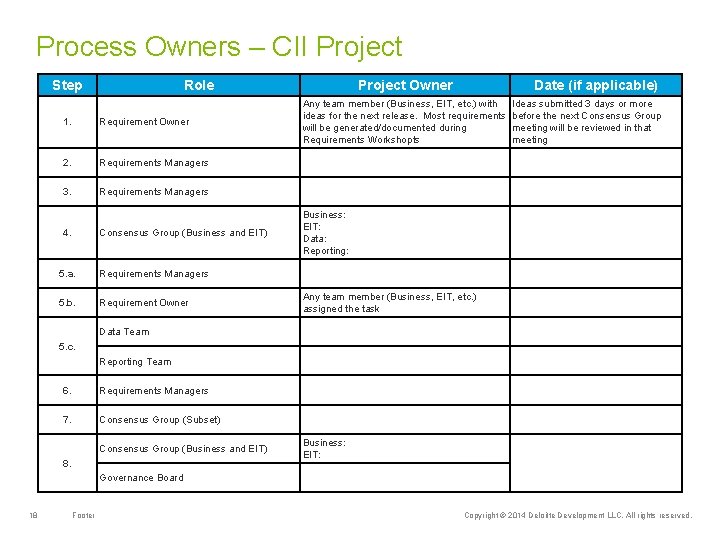
Process Owners – CII Project Step Role 1. Requirement Owner 2. Requirements Managers 3. Requirements Managers 4. Consensus Group (Business and EIT) 5. a. Requirements Managers 5. b. Requirement Owner Project Owner Date (if applicable) Any team member (Business, EIT, etc. ) with ideas for the next release. Most requirements will be generated/documented during Requirements Workshopts Ideas submitted 3 days or more before the next Consensus Group meeting will be reviewed in that meeting Business: EIT: Data: Reporting: Any team member (Business, EIT, etc. ) assigned the task Data Team 5. c. Reporting Team 6. Requirements Managers 7. Consensus Group (Subset) Consensus Group (Business and EIT) 8. Business: EIT: Governance Board 18 Footer Copyright © 2014 Deloitte Development LLC. All rights reserved.
- Slides: 18