
Int ScopeAutomatically Detecting Integer Overflow Vulnerability in X
Int. Scope-Automatically Detecting Integer Overflow Vulnerability in X 86 Binary (http: //www. utdallas. edu/~zxl 111930/file/Int. Scope_NDSS 09. pdf) o o o Tielei Wang†, Tao. Wei†, Zhiqiang Lin‡, Wei Zou†. Purdue University & Peking University Proceedings of NDSS'09: Network and Distributed System Security Symposium Jose Sanchez 1
Acknowledgement � Some materials are taken from: � Authors presentation at NDSS'09 ◦ www. isoc. org/isoc/conferences/ndss/09/pdf/17. pdf 2
Agenda � Problem Description ◦ Integer overflow detection in binary code � Approach ◦ Taint analysis and symbolic execution over an intermediate representation on disassembled code � Contributions � Weaknesses � Improvement 3

What is Integer Overflow? � An integer overflow occurs when an operation results in a value greater than the maximum one of the integral data type. 4
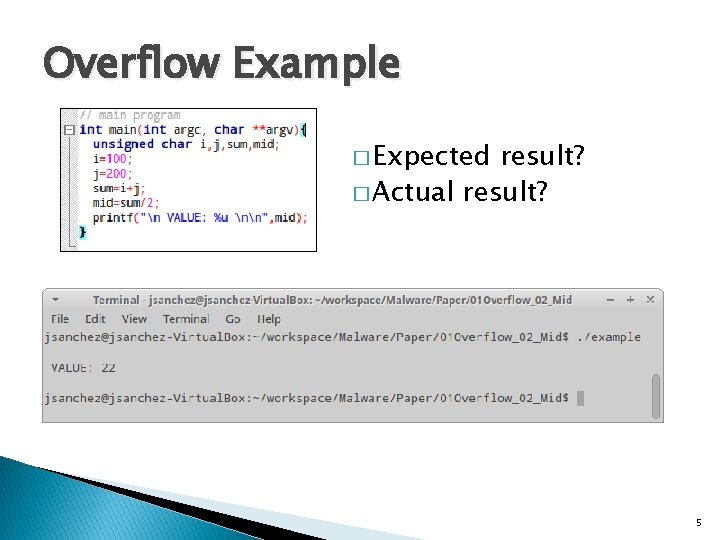
Overflow Example � Expected result? � Actual result? 5
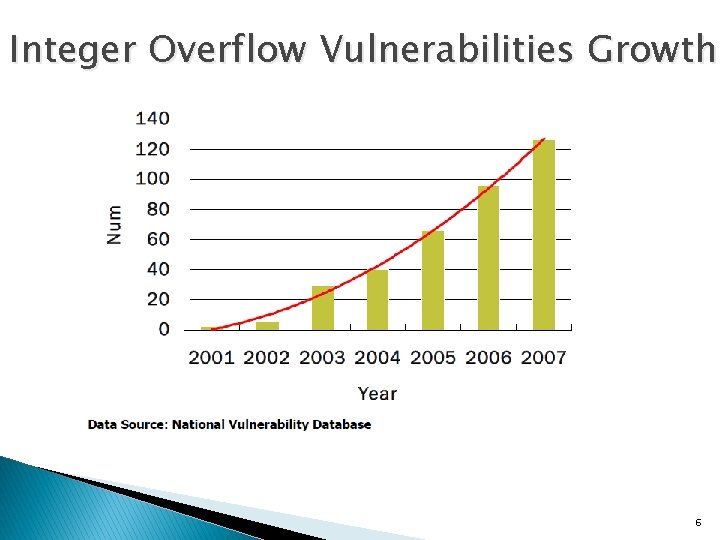
Integer Overflow Vulnerabilities Growth 6
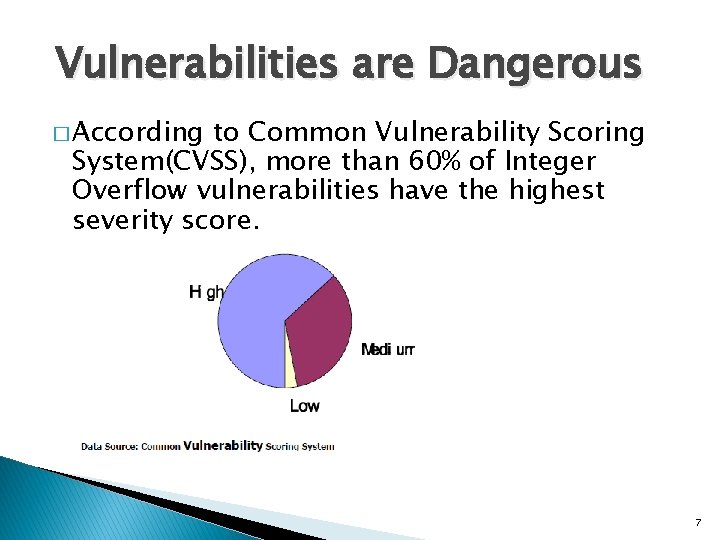
Vulnerabilities are Dangerous � According to Common Vulnerability Scoring System(CVSS), more than 60% of Integer Overflow vulnerabilities have the highest severity score. 7
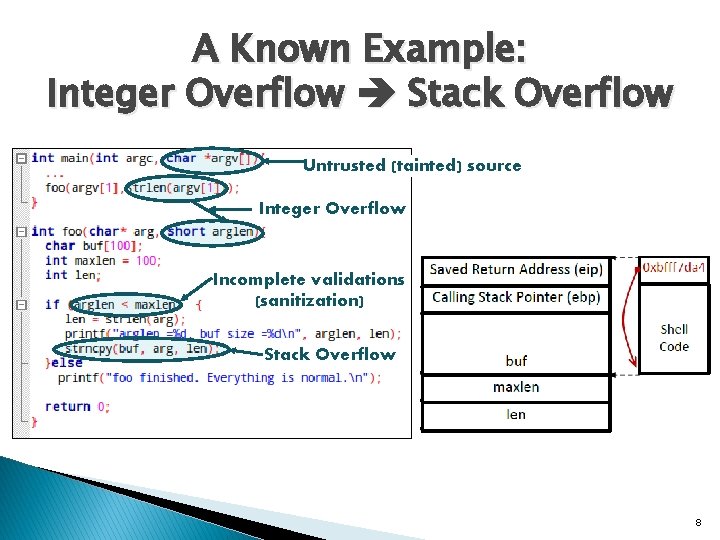
A Known Example: Integer Overflow Stack Overflow Untrusted (tainted) source Integer Overflow Incomplete validations (sanitization) Stack Overflow 8
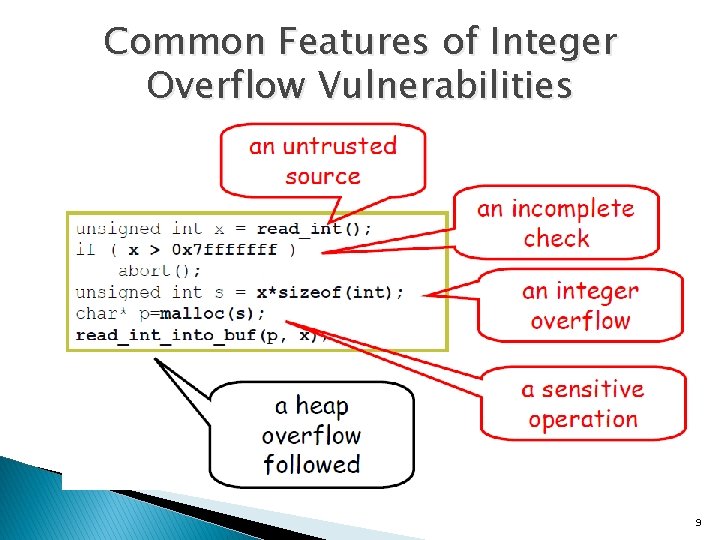
Common Features of Integer Overflow Vulnerabilities 9
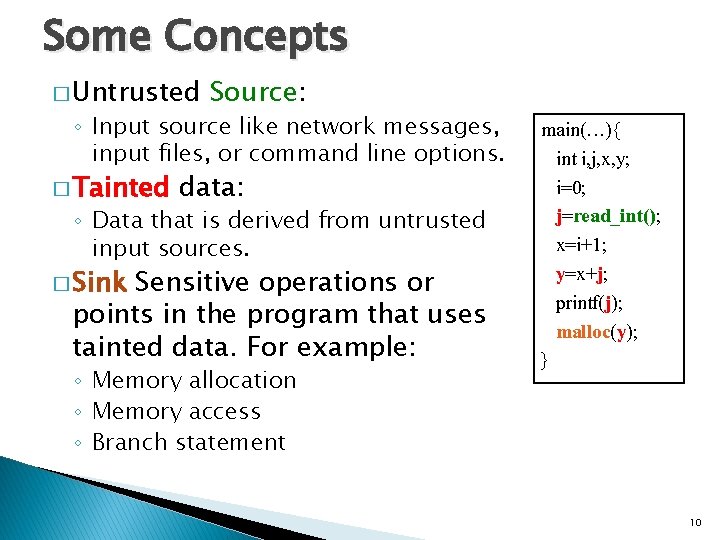
Some Concepts � Untrusted Source: ◦ Input source like network messages, input files, or command line options. � Tainted data: ◦ Data that is derived from untrusted input sources. � Sink Sensitive operations or points in the program that uses tainted data. For example: ◦ Memory allocation ◦ Memory access ◦ Branch statement main(…){ int i, j, x, y; i=0; j=read_int(); x=i+1; y=x+j; printf(j); malloc(y); } 10
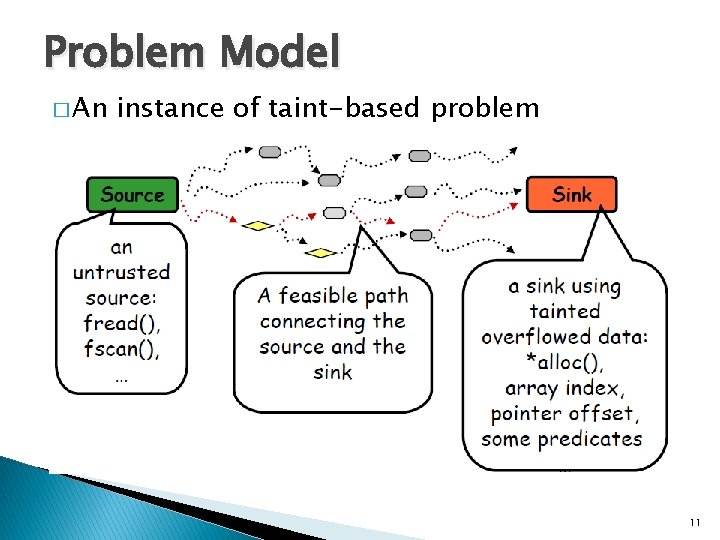
Problem Model � An instance of taint-based problem 11
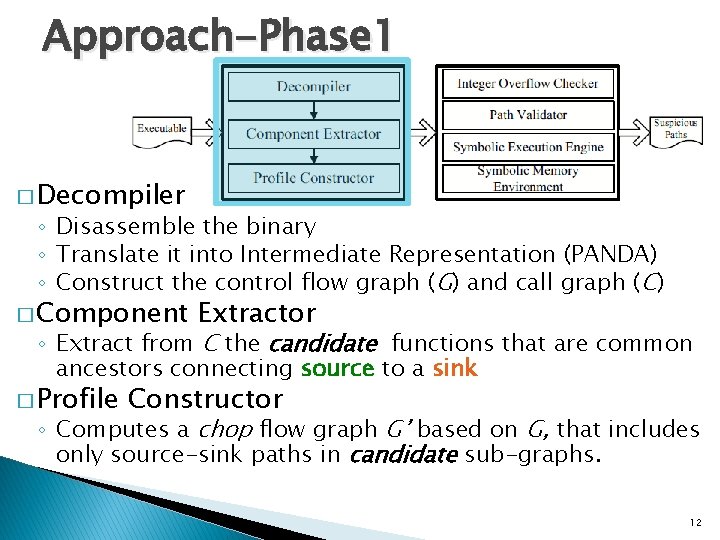
Approach-Phase 1 � Decompiler ◦ Disassemble the binary ◦ Translate it into Intermediate Representation (PANDA) ◦ Construct the control flow graph (G) and call graph (C) � Component Extractor ◦ Extract from C the candidate functions that are common ancestors connecting source to a sink � Profile Constructor ◦ Computes a chop flow graph G’ based on G, that includes only source-sink paths in candidate sub-graphs. 12
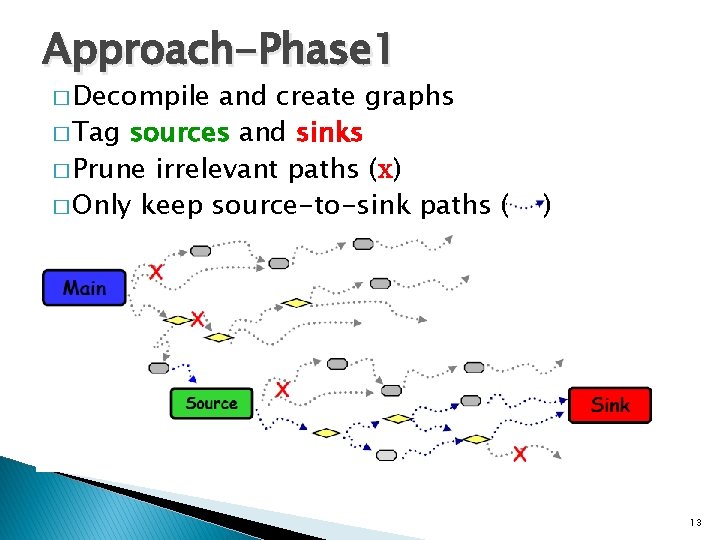
Approach-Phase 1 � Decompile and create graphs � Tag sources and sinks � Prune irrelevant paths (x) � Only keep source-to-sink paths ( ) 13
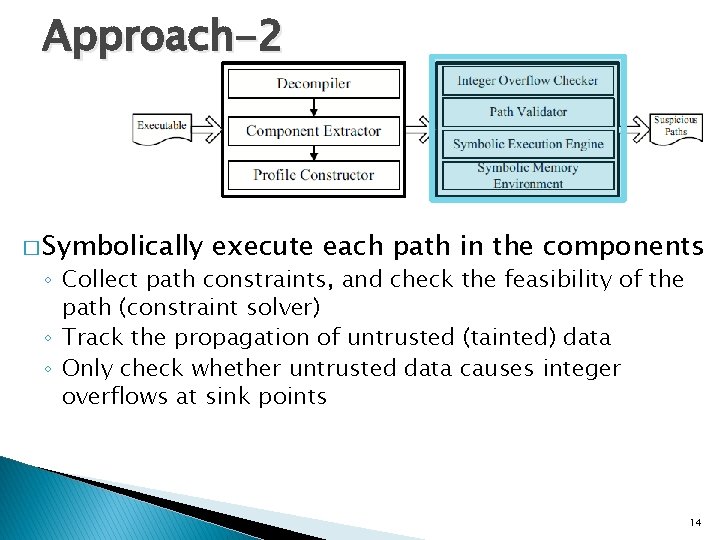
Approach-2 � Symbolically execute each path in the components ◦ Collect path constraints, and check the feasibility of the path (constraint solver) ◦ Track the propagation of untrusted (tainted) data ◦ Only check whether untrusted data causes integer overflows at sink points 14
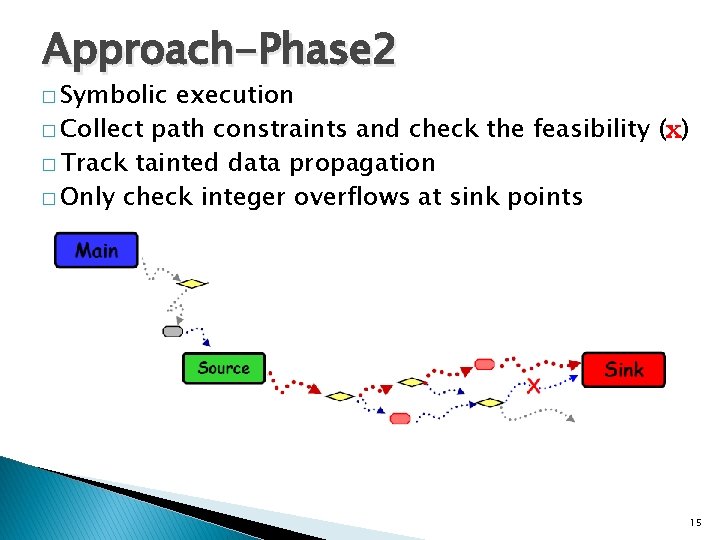
Approach-Phase 2 � Symbolic execution � Collect path constraints and check the feasibility (x) � Track tainted data propagation � Only check integer overflows at sink points 15
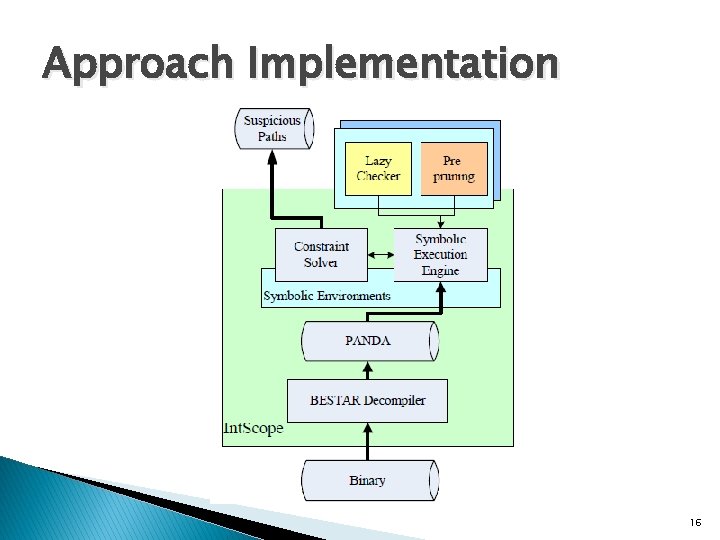
Approach Implementation 16
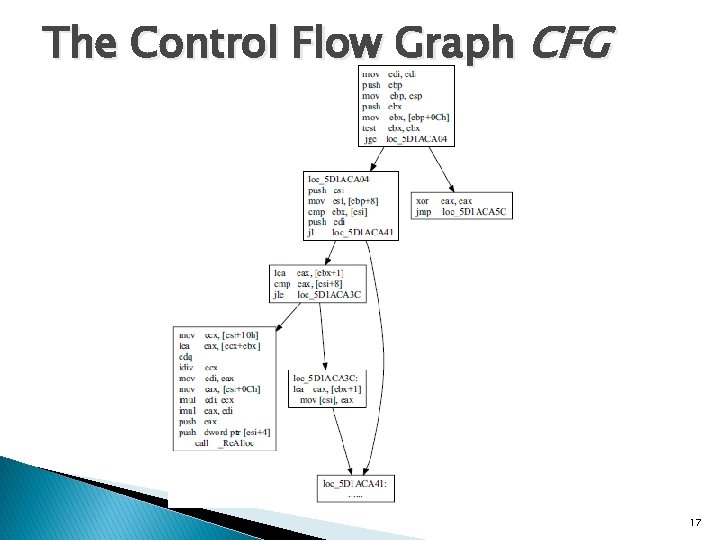
The Control Flow Graph CFG 17
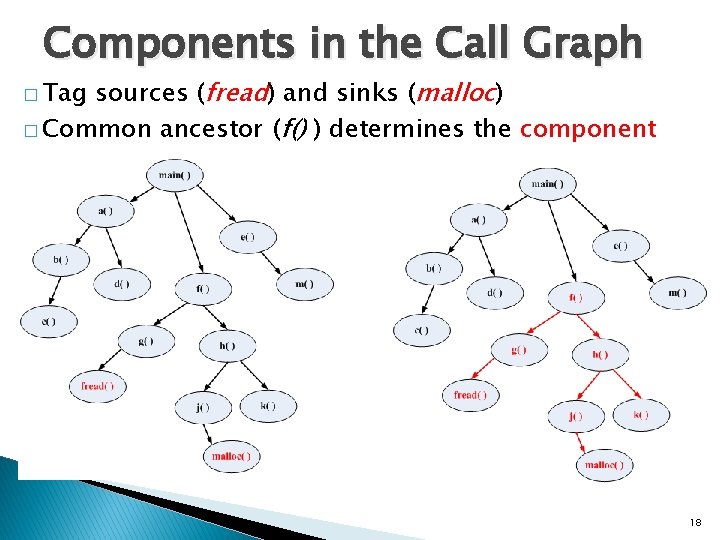
Components in the Call Graph sources (fread) and sinks (malloc) � Common ancestor (f() ) determines the component � Tag 18
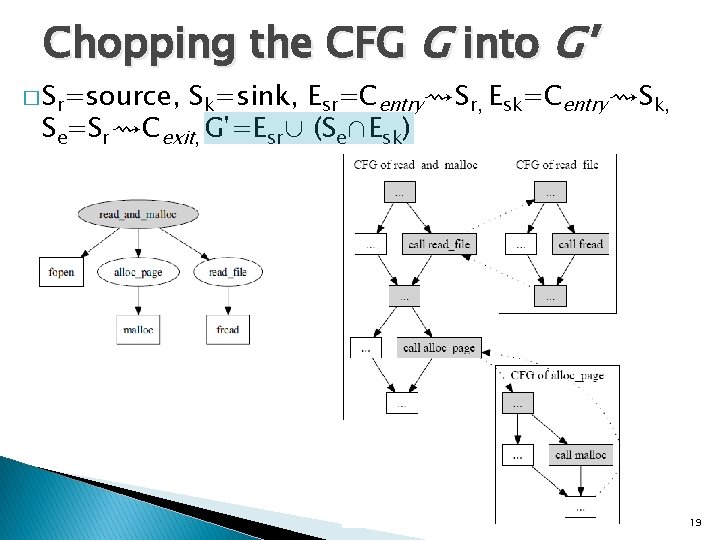
Chopping the CFG G into G' � Sr=source, Sk=sink, Esr=Centry⇝Sr, Esk=Centry⇝Sk, Se=Sr⇝Cexit, G'=Esr∪ (Se∩Esk) 19
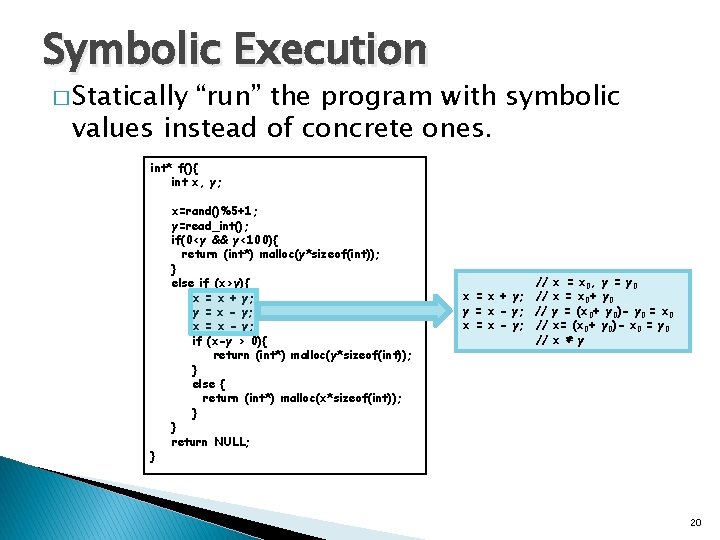
Symbolic Execution � Statically “run” the program with symbolic values instead of concrete ones. int* f(){ int x, y; } x=rand()%5+1; y=read_int(); if(0<y && y<100){ return (int*) malloc(y*sizeof(int)); } else if (x>y){ x = x + y; y = x - y; x = x - y; if (x-y > 0){ return (int*) malloc(y*sizeof(int)); } else { return (int*) malloc(x*sizeof(int)); } } return NULL; // x = x + y; // y = x - y; // x = x - y; // // x = x 0 , y = y 0 x = x 0+ y 0 y = (x 0+ y 0)- y 0 = x 0 x= (x 0+ y 0)- x 0 = y 0 x ⇄ y 20
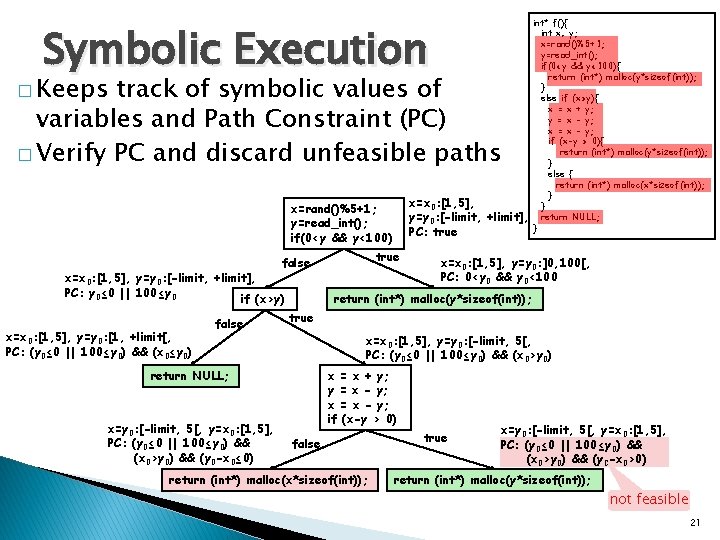
Symbolic Execution � Keeps track of symbolic values of variables and Path Constraint (PC) � Verify PC and discard unfeasible paths x=x 0: [1, 5], y=y 0: [-limit, +limit], PC: true x=rand()%5+1; y=read_int(); if(0<y && y<100) true false x=x 0: [1, 5], y=y 0: [-limit, +limit], PC: y 0≤ 0 || 100≤y 0 if (x>y) x=x 0: [1, 5], y=y 0: [1, +limit[, PC: (y 0≤ 0 || 100≤y 0) && (x 0≤y 0) false x=x 0: [1, 5], y=y 0: ]0, 100[, PC: 0<y 0 && y 0<100 return (int*) malloc(y*sizeof(int)); true x=x 0: [1, 5], y=y 0: [-limit, 5[, PC: (y 0≤ 0 || 100≤y 0) && (x 0>y 0) return NULL; x=y 0: [-limit, 5[, y=x 0: [1, 5], PC: (y 0≤ 0 || 100≤y 0) && (x 0>y 0) && (y 0 -x 0≤ 0) int* f(){ int x, y; x=rand()%5+1; y=read_int(); if(0<y && y<100){ return (int*) malloc(y*sizeof(int)); } else if (x>y){ x = x + y; y = x - y; x = x - y; if (x-y > 0){ return (int*) malloc(y*sizeof(int)); } else { return (int*) malloc(x*sizeof(int)); } } return NULL; } x = x + y; y = x - y; x = x - y; if (x-y > 0) false return (int*) malloc(x*sizeof(int)); true x=y 0: [-limit, 5[, y=x 0: [1, 5], PC: (y 0≤ 0 || 100≤y 0) && (x 0>y 0) && (y 0 -x 0>0) return (int*) malloc(y*sizeof(int)); not feasible 21
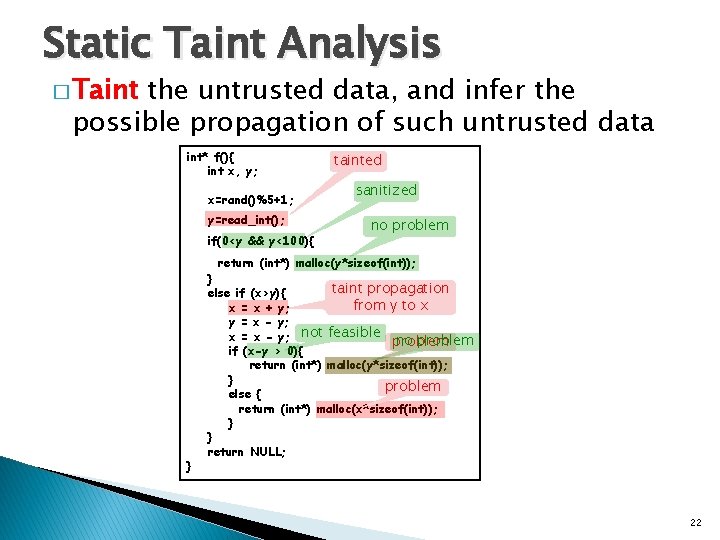
Static Taint Analysis � Taint the untrusted data, and infer the possible propagation of such untrusted data int* f(){ int x, y; x=rand()%5+1; y=read_int(); if(0<y && y<100){ tainted sanitized no problem return (int*) malloc(y*sizeof(int)); } } taint propagation else if (x>y){ from y to x x = x + y; y = x - y; x = x - y; not feasible problem no problem if (x-y > 0){ return (int*) malloc(y*sizeof(int)); } problem else { return (int*) malloc(x*sizeof(int)); } } return NULL; 22
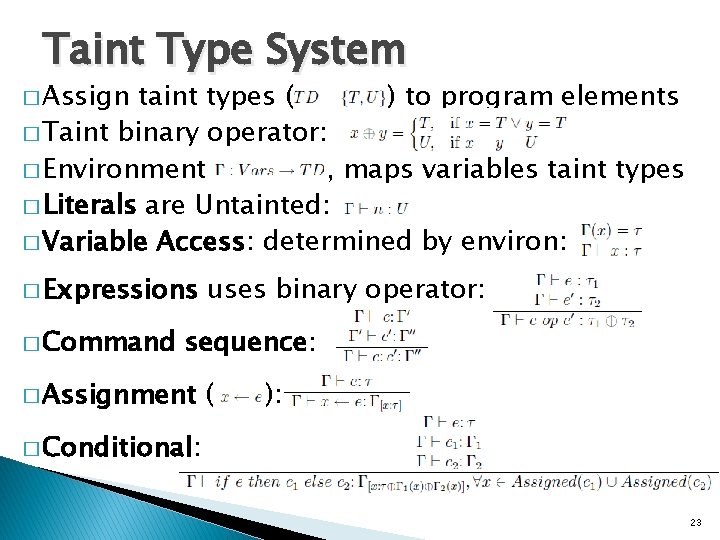
Taint Type System � Assign taint types ( ) to program elements � Taint binary operator: � Environment , maps variables taint types � Literals are Untainted: � Variable Access: determined by environ: � Expressions � Command uses binary operator: sequence: � Assignment ( ): � Conditional: 23
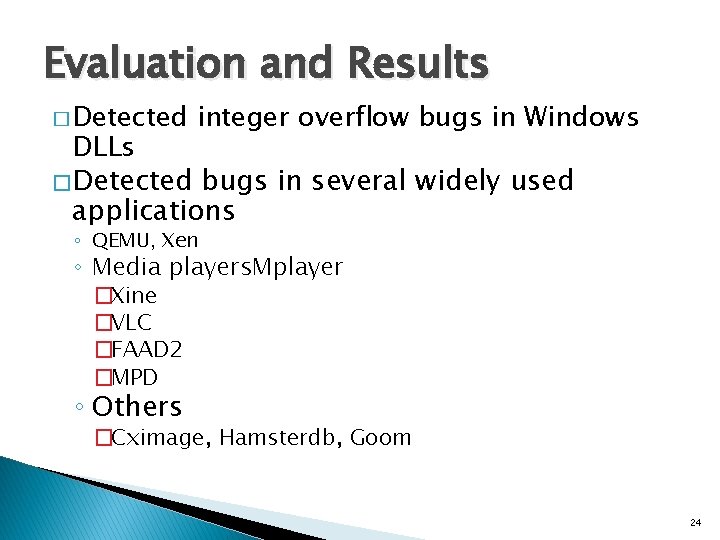
Evaluation and Results � Detected integer overflow bugs in Windows DLLs � Detected bugs in several widely used applications ◦ QEMU, Xen ◦ Media players. Mplayer �Xine �VLC �FAAD 2 �MPD ◦ Others �Cximage, Hamsterdb, Goom 24
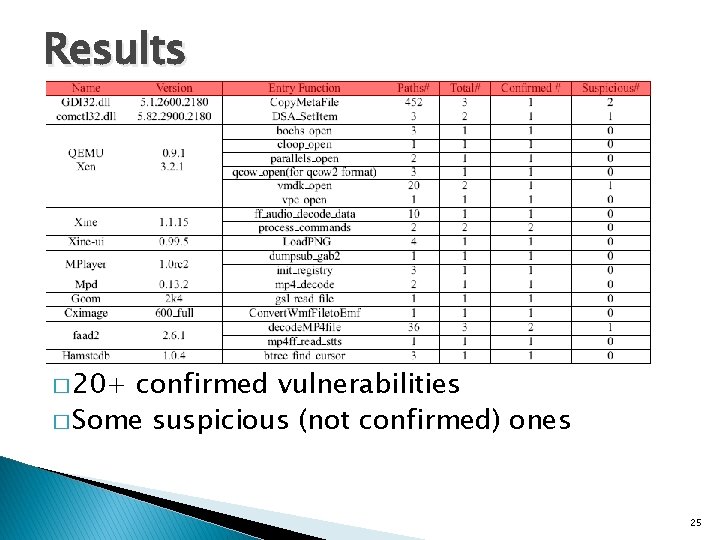
Results � 20+ confirmed vulnerabilities � Some suspicious (not confirmed) ones 25
Tools Used � IDA Pro: A Windows, Linux or Mac OS X hosted multi-processor disassembler and debugger ◦ https: //www. hex-rays. com/products/ida/index. shtml � Gi. Na. C: Symbolic Execution Framework (C++) ◦ http: //www. ginac. de/ � STP: Constraint Solver (automated prover) ◦ https: //sites. google. com/site/stpfastprover/ 26
Contributions üA systematic method of combining taint analysis and path-sensitive symbolic execution to detect integer overflow vulnerabilities in executables. üAn intermediate instruction representation, based on IDA Pro’s disassembled code, and a symbolic execution engine. üA prototype called Int. Scope to analyze realworld binaries, which shows the approach is highly effective. 27
Weaknesses � Incomplete test case generation. ◦ Partial path analysis source⇝sink instead of main⇝sink � Missing of the constraints between inputs. ◦ Lack of information on intrinsic constraints between inputs leads to false positives. � Lack of global information ◦ Lack of information on global variables may lead to false positives. � Imprecise symbolic execution. ◦ Not accurately simulation of block memory functions (memmove, etc. ) and string functions (strncmp, etc. ) may lead to false negatives. 28
Improvements � Produce Path Constraints for suspicious cases. ◦ They could be used in a fuzzing tools. � Improve the precision of the symbolic execution of block memory operations. ◦ Open problem ◦ More precise taint propagation 29
![References � � [1] WANG, T. , WEI, T. , LIN, Z. , AND](http://slidetodoc.com/presentation_image_h2/3d4d731aaff8845e85fd28495303bad4/image-30.jpg "References � � [1] WANG, T. , WEI, T. , LIN, Z. , AND")
References � � [1] WANG, T. , WEI, T. , LIN, Z. , AND ZOU, W. Intscope: Automatically detecting integer overflow vulnerability in x 86 binary using symbolic execution. In Network Distributed Security Symposium (NDSS) (2009). [2] D. Ceara, L. Mounier, and M. -L. Potet, Taint dependency sequences: A characterization of insecure execution paths based on input-sensitive cause sequences, in proceedings of the IEEE Int. workshop MDV'10. IEEE Computer Society, pages 371 -380, 2010 [3] D. Ceara. Detecting Software Vulnerabilities Static Taint Analysis. www. tanalysis. googlecode. com/files/Dumitru. Ceara_BSc. pdf. [4] J. C. King. Symbolic Execution and Program Testing. Communications of the ACM, 19(7): 385– 394, 1976. 30
Thanks! Int. Scope-Automatically Detecting Integer Overflow Vulnerability in X 86 Binary (http: //www. utdallas. edu/~zxl 111930/file/Int. Scope_NDSS 09. pdf) Jose Sanchez 31
- Slides: 31