
INSURANCE REGULATION AND ETHICS Denton Educational Services TEXAS



- Slides: 53
INSURANCE REGULATION AND ETHICS Denton Educational Services
TEXAS INSURANCE CODE T. I. C. is Texas’ code of laws responsible for governing the insurance business Subject to change (amendment) by the State legislature Identified by ARTICLE numbers
TEXAS ADMINISTRATIVE CODE Texas Department of Insurance (T. D. I. ) rules which interpret State laws as written in the insurance code. Exercises T. D. I. ’s authority over the insurance business as conducted in this state - implements/enforces laws Identified by the letters TAC
TEXAS DEPARTMENT OF INSURANCE PURPOSE - to protect citizens of Texas – From illegal, unfair insurance practices – From failure to pay claims – To make sure that insurance is available to meet consumers’ needs at a fair price and sold in a non-discriminatory manner
TEXAS DEPARTMENT OF INSURANCE SCOPE OF AUTHORITY • Set /review pricing for some insurance lines • Determine forms and content of many types of insurance policies • Authorize insurers to operate in Texas - including oversight of financial • solvency License agents Disciplinary actions - cease & desist orders, suspend/revoke licenses, impose fines & administrative penalties up to $25, 000
TEXAS INSURANCE COMMISSIONER Head of T. D. I. who makes policy and renders decisions regarding rules, rates, hearings, appeals, disciplinary actions, formal orders and regulations Appointed by the Governor; approved by the Senate 2 year term
AGENT / COMPANY RELATIONS IN TEXAS DUTIES/OBLIGATIONS OF AGENTS TO COMPANIES • FIDUCIARY RELATIONSHIP - agent owes principal an accounting • for money/property belonging to principal LAW OF AGENCY (Common Law) Agent must not exceed authority granted by principal Agent Informs principal of all material facts Agent must protect principal’s interests
AGENT / COMPANY RELATIONS IN TEXAS h DUTIES/OBLIGATIONS OF COMPANIES TO AGENTS – Enable agent to do business/perform contract - partial termination OK – Protect agent during contract cancellation 46 mos. notice of intent; then 6 mos. renewals 4 No new business/ increased limits without company consent 4 U/W rules or commissions can’t be changed solely because of termination (i. e. for only 1 agent) – Withdrawal plan - file to pull out of markets
LRA LICENSE REQUIREMENTS Be at least 18 and a Texas resident Be appointed by an insurer as an agency owner/principal Obtain a “clearance letter” if any other state licenses held within past 5 years Pass state exam for Emergency or Temp. license Take 80 hours instruction and pass exam for Permanent license within 1 yr.
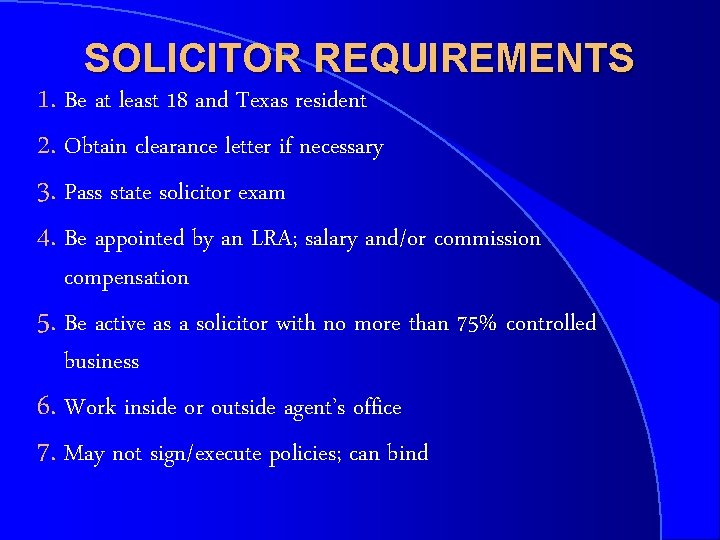
SOLICITOR REQUIREMENTS 1. Be at least 18 and Texas resident 2. Obtain clearance letter if necessary 3. Pass state solicitor exam 4. Be appointed by an LRA; salary and/or commission compensation 5. Be active as a solicitor with no more than 75% controlled business 6. Work inside or outside agent’s office 7. May not sign/execute policies; can bind
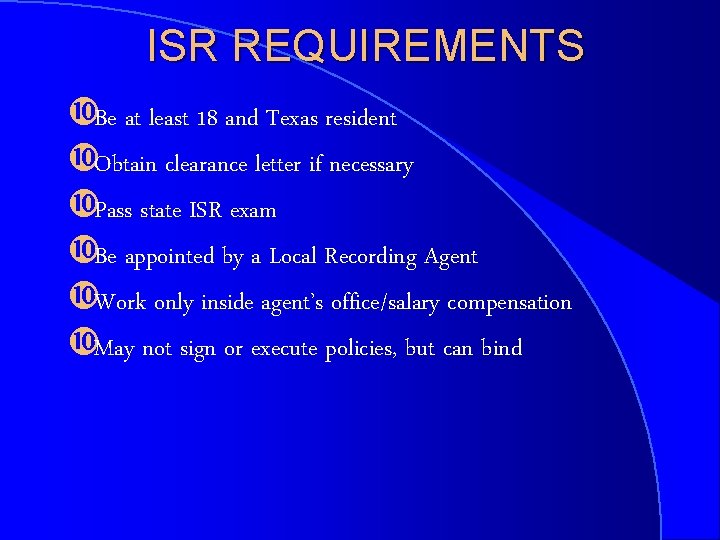
ISR REQUIREMENTS Be at least 18 and Texas resident Obtain clearance letter if necessary Pass state ISR exam Be appointed by a Local Recording Agent Work only inside agent’s office/salary compensation May not sign or execute policies, but can bind
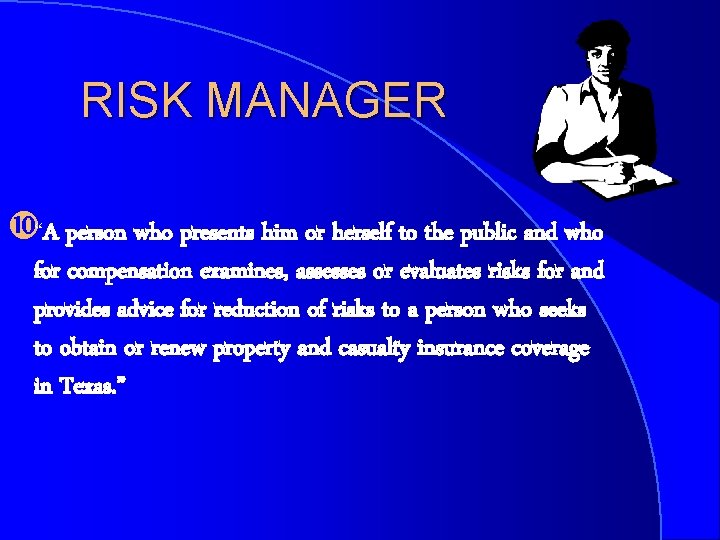
RISK MANAGER “A person who presents him or herself to the public and who for compensation examines, assesses or evaluates risks for and provides advice for reduction of risks to a person who seeks to obtain or renew property and casualty insurance coverage in Texas. ”
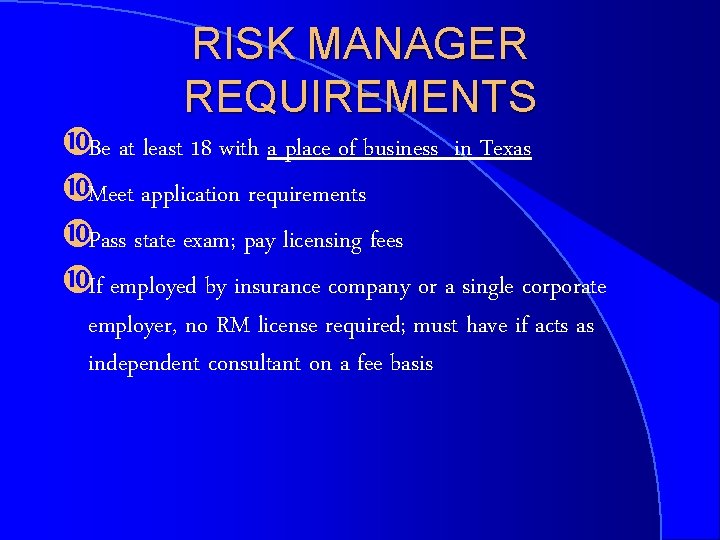
RISK MANAGER REQUIREMENTS Be at least 18 with a place of business in Texas Meet application requirements Pass state exam; pay licensing fees If employed by insurance company or a single corporate employer, no RM license required; must have if acts as independent consultant on a fee basis
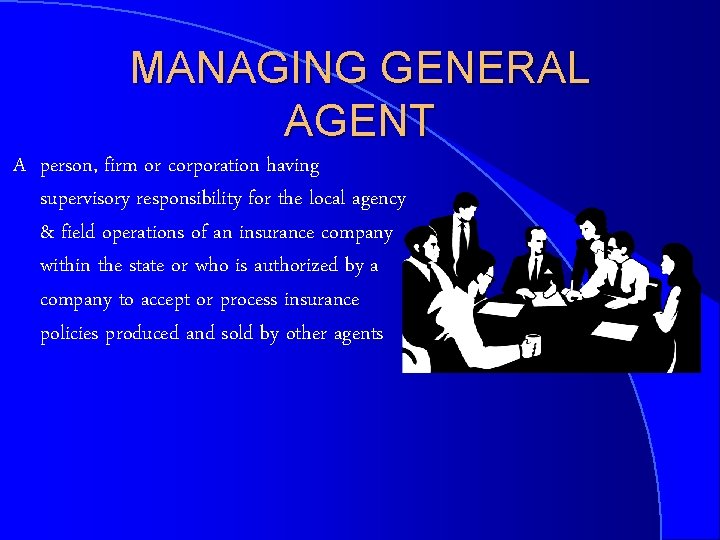
MANAGING GENERAL AGENT A person, firm or corporation having supervisory responsibility for the local agency & field operations of an insurance company within the state or who is authorized by a company to accept or process insurance policies produced and sold by other agents
MGA REQUIREMENTS Have company appointment and accept referral business that equals 50% or more of the agency’s total business or $500, 000 premium. Be at least 18 and a Texas resident Provide $100, 000 proof of financial responsibility Pass state exam Pay licensing fees
SURPLUS LINES AGENT Be a resident of Texas (unless licensed as non-resident acting on behalf of a purchasing group) and office in Texas Hold either an LRA or MGA license Provide $50, 000 proof of financial responsibility Pass licensing exam Pay licensing fees
SURPLUS LINES AGENT Have facilities to accumulate/preserve records Have facilities to collect, maintain, report and remit premium taxes Have knowledge and experience in insurance placement to determine eligibility for surplus lines Have knowledge/experience to collect and analyze financial and other data to determine eligibility (i. e. financial condition) of surplus lines carrier
DUE DILIGENCE Reasonable care owed by LRAs to public when placing standard business Higher standard of care owed by retail and surplus lines agents when placing non-standard business Make reasonable effort to determine financial condition of a non-standard lines insurer – Check the insurer’s financial rating. – If rating is low, advise insured in writing and get a signed authorization
SURPLUS LINES MARKETS h Standard (admitted carriers) authorized by State which has direct financial monitoring responsibility for them (audits every 1 -3 years) h Nonstandard (non-admitted) carriers licensed by State but not audited for financial soundness. h TIC prohibits the “export of coverage to non-admitted market unless a “diligent effort” has been made to locate an admitted carrier to write the coverage”
GROUP I (LIFE & HEALTH) AGENTS h Be at least 18 and a Texas resident h Temporary license - 90 days without exam h Complete 40 hour pre-licensing education program h Pass state exam to get permanent license h Includes those selling HMO related services
OTHER LICENSES h Adjuster - investigates & settles losses on behalf of an insurer or self-insurer h Variable contract agent - sells contracts which pay variable benefits depending on investment experience h Third Party Administrator - provide administrative services or handle funds for insurance companies
OTHER LICENSES CONT’D. h Premium Finance Company - makes loans by entering into finance contracts with insureds h Life Insurance Counselor - charges fee to examine life/annuity contracts; make recommendations to public
CORPORATE & PARTNERSHIP LICENSES h Each principal must hold individual license h Partnership or corporation must also hold same license(s) as principals h Financial responsibility (E & O of at least $100, 000) h Exception is bank agency in a town under 5000 - only 1 officer required to hold license(s)
NON-RESIDENT LICENSES 1. 2. 3. Any agent who sells or services P & C insurance outside residence state must be licensed in other state(s) before company can legally pay commission Each state has different laws, procedures, licenses, restrictions, continuing education requirements, etc. Generally requires letter of good standing from “home” state
EXEMPTIONS FROM LICENSING h Farm Mutual insurance company employees and agents h Salaried clerical employees h Home office solicitors of companies licensed in Texas h Rental car companies and employees (limited license)
CONTINUING EDUCATION 1. 2. 3. 4. LRA, Solicitor, ISR, Group I, Adjuster and MGA all must complete 30 hours approved CE every 2 years (to coincide with license renewals) Certificates must be kept in file for 4 years (agent’s responsibility) Ethics certificates must be kept 6 years Agent licensed continuously 20 years or more is exempt by filing affidavit of history of license(s) held
SUSPENSION/REVOCATION h Willful violation of insurance laws h Intentional material misrepresentation on license application h Misappropriation or conversion of insured’s or insurer’s money h Conviction of fraud or dishonest acts h Felony conviction h Writing more than 75% controlled business
SUSPENSION/REVOCATION h Discrimination between insureds based on race, color, national origin, religion, age, gender, marital status, geographical location, disability or any other criteria not based on sound actuarial principles h Misrepresenting the terms of a contract to induce insured to cancel or surrender the policy and replace it with another
CHARGING FEES h PERMISSIBLE FEES 8 Printing, reproduction, electronic mail or phone 8 Special delivery & other postal 8 Order MVRs 8 Property photos and inspections (reimbursement) 8 Agent fees (in addition to or in lieu of commission) h DISCLOSURE STATEMENT - signed by insured - maintain records for 5 years
FAIR CREDIT REPORTING ACT 1. 2. 3. Protects consumers subject to adverse action based on a credit report Requires permission from consumer prior to obtaining credit information Requires user of adverse credit information to provide 1. written notice of adverse action 2. name, address and phone of agency furnishing report 3. information to obtain free copy of report
TEXAS GUARANTEE FUND h Provides protection in the event that an authorized insurer (standard/admitted company) becomes insolvent h Court places company into liquidation: any claims must be filed with the Fund or appointed receiver h All admitted carriers assessed a pro rata share h $100, 000 cap except workers comp h May NEVER be used as a sales benefit
REFERRAL BUSINESS h “Brokering” between 2 LRAs: agent who has a company appointment accepts business from agent who doesn’t commissions are shared h Producing agent prepares application, collects premium and services policy h Placing agent binds coverage, executes policies and provides evidence that insurance is in force
COMMISSION SHARING h Illegal to share commission with ANY unlicensed person including payment of “bonuses”, “finders fees”, “referral fees” or “incentives” (any valuable consideration) h Solicitor may not “broker” business to or accept commission from any LRA except the appointing agent
CHANGES h All agency names must be registered with TDI (file LDTL certificate) h All changes of ownership/principals must be filed with TDI h Every LRA and Group I appointment by a company must be approved by TDI h TDI must be notified of agency address change h ISR or Solicitor must file agency change with TDI
UNFAIR COMPETITION AND TRADE PRACTICES g MISREPRESENTATION - an untrue statement or omission of a material fact or law or making a statement in a way that would lead a reasonable person to a false conclusion. Also inaccurate or incomplete comparisons of insurance companies or contracts
UNFAIR PRACTICES Cont’d. g FALSE ADVERTISING - printed or published literature intended for public distribution which is untruthful in fact or implication. Includes: – – Print or visual ads and billboards sales and form letters prepared sales presentations/proposals materials included with policy when delivered
UNFAIR PRACTICES Cont’d. g DEFAMATION - false or malicious statement about financial condition of insurer: also distributing false or derogatory information about others in the insurance business g COERCION - forcing someone to do business with you g BOYCOTT - 2 or more agents jointly refusing to place business with a carrier
UNFAIR PRACTICES Cont’d. REDLINING - refusing to write insurance based on location g UNFAIR DISCRIMINATION - refusing to write insurance based on other than underwriting decision g REBATING - providing ANY valuable consideration outside the insurance contract as an inducement to purchase n
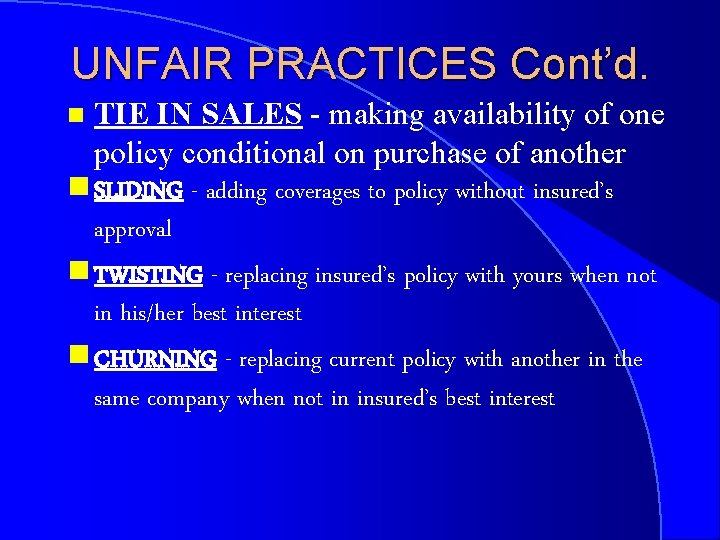
UNFAIR PRACTICES Cont’d. TIE IN SALES - making availability of one policy conditional on purchase of another g SLIDING - adding coverages to policy without insured’s approval g TWISTING - replacing insured’s policy with yours when not in his/her best interest g CHURNING - replacing current policy with another in the same company when not in insured’s best interest n
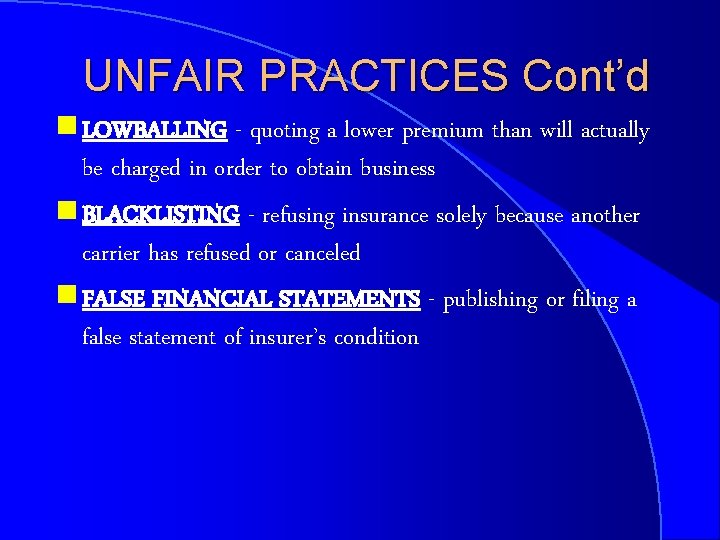
UNFAIR PRACTICES Cont’d g LOWBALLING - quoting a lower premium than will actually be charged in order to obtain business g BLACKLISTING - refusing insurance solely because another carrier has refused or canceled g FALSE FINANCIAL STATEMENTS - publishing or filing a false statement of insurer’s condition
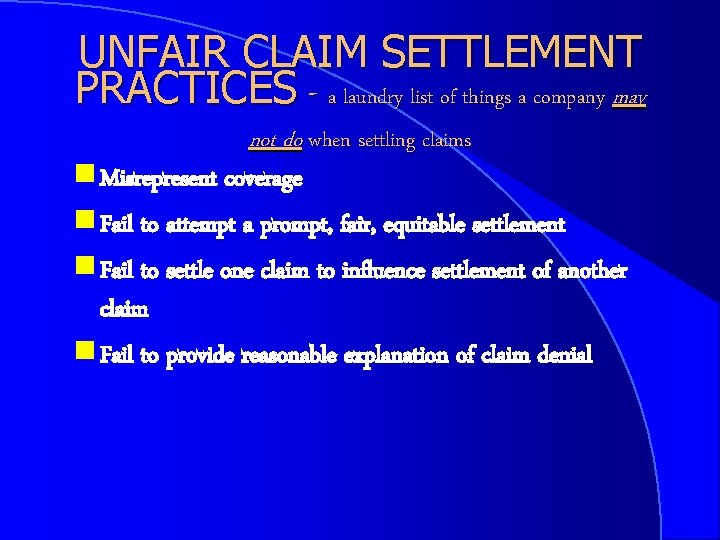
UNFAIR CLAIM SETTLEMENT PRACTICES - a laundry list of things a company may g Misrepresent not do when settling claims coverage g Fail to attempt a prompt, fair, equitable settlement g Fail to settle one claim to influence settlement of another claim g Fail to provide reasonable explanation of claim denial
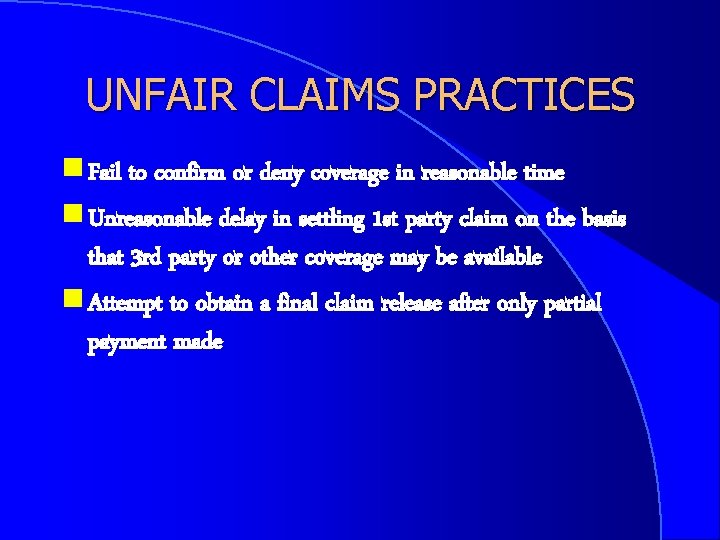
UNFAIR CLAIMS PRACTICES g Fail to confirm or deny coverage in reasonable time g Unreasonable delay in settling 1 st party claim on the basis that 3 rd party or other coverage may be available g Attempt to obtain a final claim release after only partial payment made
UNFAIR CLAIMS PRACTICES n Refuse to pay a claim without reasonable investigation n Delay paying PIP or UM claim because other coverage is available n Require claimant to provide copy of IRS return except in specifically defined cases (EX: loss of income)
ETHICAL PRACTICES h Texas Insurance Code and Texas Administrative Code give us guidelines as to what is legally acceptable/unacceptable in the conduct of insurance business h One goal of agents is to avoid doing what is “wrong” - a legal decision h Another goal should be to try to do what is “right” - this is where ethics applies - a moral decision
Defining Ethical Behavior h Root is Greek “proper modes of conduct” in a culture. Current meaning; “conforming to accepted professional standards of conduct” h Not a response to legal restrictions or threat of punishment h An internal, personal decision implying freedom & authority to make individual judgements h Often defined in relation to what is unethical - no concrete answers
FACTORS AFFECTING ETHICAL DECISIONS 4 Desire to make money 4 Compensation system a person works under 4 Economic forces of competition 4 Moral and religious beliefs 4 Family expectations 4 Emotional problems 4 Expectations of bosses and clients 4 Financial troubles
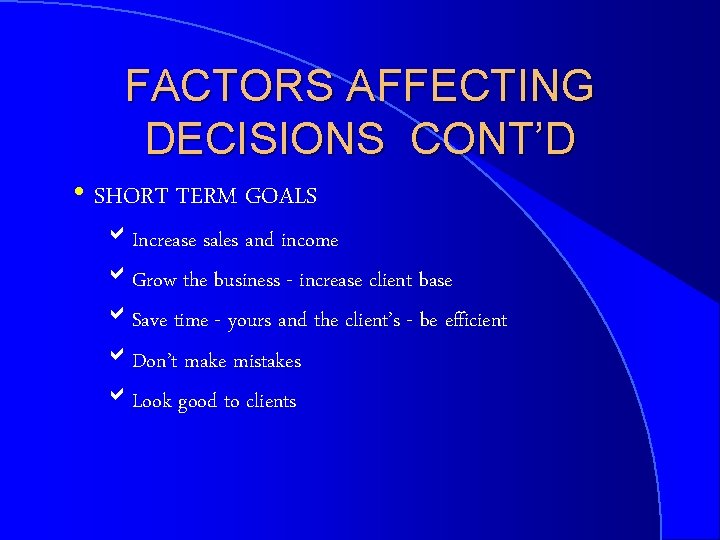
FACTORS AFFECTING DECISIONS CONT’D h SHORT TERM GOALS a. Increase sales and income a. Grow the business - increase client base a. Save time - yours and the client’s - be efficient a. Don’t make mistakes a. Look good to clients
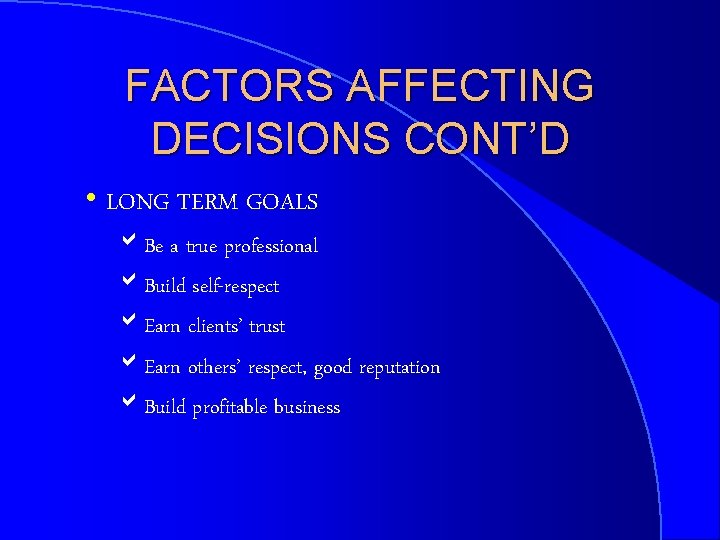
FACTORS AFFECTING DECISIONS CONT’D h LONG TERM GOALS a. Be a true professional a. Build self-respect a. Earn clients’ trust a. Earn others’ respect, good reputation a. Build profitable business
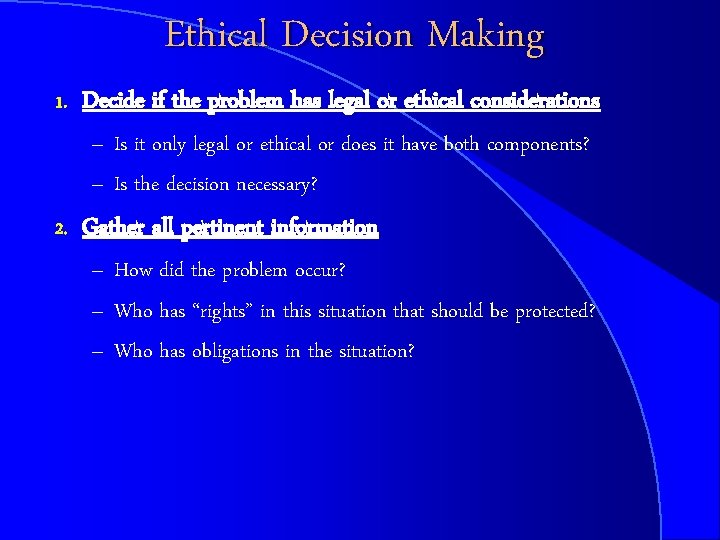
Ethical Decision Making 1. Decide if the problem has legal or ethical considerations – Is it only legal or ethical or does it have both components? – Is the decision necessary? 2. Gather all pertinent information – How did the problem occur? – Who has “rights” in this situation that should be protected? – Who has obligations in the situation?
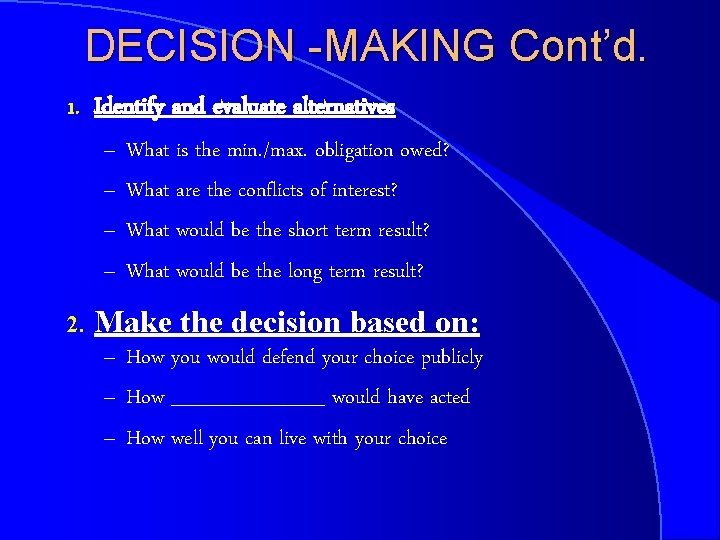
DECISION -MAKING Cont’d. 1. Identify and evaluate alternatives – – 2. What is the min. /max. obligation owed? What are the conflicts of interest? What would be the short term result? What would be the long term result? Make the decision based on: – How you would defend your choice publicly – How ______ would have acted – How well you can live with your choice
CODE OF ETHICS h “Establishes minimum standards of expected behavior for those to whom the code applies. ” h Insurance industry organizations each have own h Some codes are principles only with no penalties for nonadherence h Other codes hold members accountable and may expel or sanction those who do not meet standards
ETHICAL PROBLEMS
A LAST WORD h. PRACTICE WHAT YOU PREACH h. FOLLOW THE GOLDEN RULE