
Insurance Distribution Directive Rebecca Prestage 23 March 2018
Insurance Distribution Directive Rebecca Prestage 23 March 2018
Agenda • IDD purpose and scope • Key changes: • • Training Cross-selling Consumer protection Disclosure requirements Conflicts of interest PII, passporting and client money Product governance • Changes to categories of insurance intermediaries • Insurance based investment products 2 © 2018 Grant Thornton UK LLP. | Public
Purpose and scope of IDD Purpose • To harmonise national provisions concerning insurance and reinsurance distribution. • Consumers should benefit from the same level of protection regardless of distribution channel. • Current and recent financial turbulence has underlined the importance of ensuring effective consumer protection across all financial sectors. 3 © 2018 Grant Thornton UK LLP. | Public Scope • All businesses that sell insurance products, including agents, brokers, insurers and reinsurers. • Market participants that distribute insurance products on an ancillary basis (such as travel agents, mobile phone providers and car rental companies), unless they fall within a limited exemption.
Knowledge, skills & expertise Training • Minimum 15 hours Continuing Professional Development (CPD) for anyone directly involved in insurance distribution activities, their supervisors and relevant management. • Must cover areas such as product coverage, the claims process and insurance regulation. • Start date not specified and training can be pro-rata initially to match accounting reference date. • CPD at new employee’s former workplace can be taken into account if verified. • No prescribed mixture of structured and unstructured CPD. 4 © 2018 Grant Thornton UK LLP. | Public
Cross-selling • Where insurance is the primary product and is sold alongside other products, information must be given on whether the different parts of a package can be bought separately. • The information must provide an adequate description of the products, explain any interaction between them and provide separate information on costs and charges. • Where insurance is ancillary to other goods or services the customer must be able to buy the primary product or service without the insurance. © 2018 Grant Thornton UK LLP. | Public 5

Consumer protection Insurance Product Information Document (IPID) • Standalone document of two sides of A 4 paper and must contain information such as: • a summary of the insurance cover • means of payment of premiums • main exclusions • obligations at the start of the contract, during the contract and means of terminating the contract in the event of a claim. Demands and needs • • Increased personalisation of demands and needs statements. Requirement for a personalised recommendation where advice is given. 6 © 2018 Grant Thornton UK LLP. | Public
Consumer protection Customers’ best interests • A new rule explicitly requiring firms to act always in the best interests of their customers. Complaints • Requirement to have procedures in place to deal with complaints from a person who is not an eligible complainant. Financial promotions • All marketing communications must be clearly identifiable as such. 7 © 2018 Grant Thornton UK LLP. | Public
Disclosure requirements Pre-sale disclosures • Firms must disclose: • whether they are an insurer or intermediary • whether or not they provide advice • (if intermediary) whether they act for the customer or the insurer. Conflicts of interest and transparency • • • Firms should disclose information in a way that shows customers the relationship between firms in the distribution chain, highlighting potential conflicts of interest. Intermediaries must disclose shareholding links between it and any insurers (more than 10% voting rights or capital). Intermediaries must disclose insurers in limited panels. © 2018 Grant Thornton UK LLP. | Public 8
Disclosure requirements Remuneration • Intermediaries must disclose remuneration which has a direct connection to the insurance contract being sold, including: • the nature and basis (ie fee, commission, other type or a combination) of their remuneration • the exact amount of fees payable directly by the customer (or where this is not possible, the method for calculating it). • Insurers must disclose nature of remuneration paid to employees. © 2018 Grant Thornton UK LLP. | Public 9
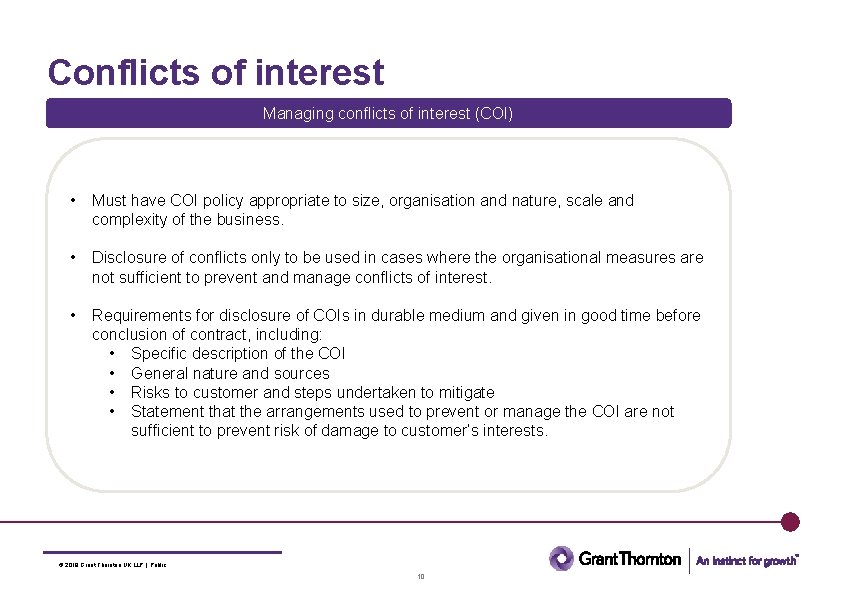
Conflicts of interest Managing conflicts of interest (COI) • Must have COI policy appropriate to size, organisation and nature, scale and complexity of the business. • Disclosure of conflicts only to be used in cases where the organisational measures are not sufficient to prevent and manage conflicts of interest. • Requirements for disclosure of COIs in durable medium and given in good time before conclusion of contract, including: • Specific description of the COI • General nature and sources • Risks to customer and steps undertaken to mitigate • Statement that the arrangements used to prevent or manage the COI are not sufficient to prevent risk of damage to customer’s interests. © 2018 Grant Thornton UK LLP. | Public 10
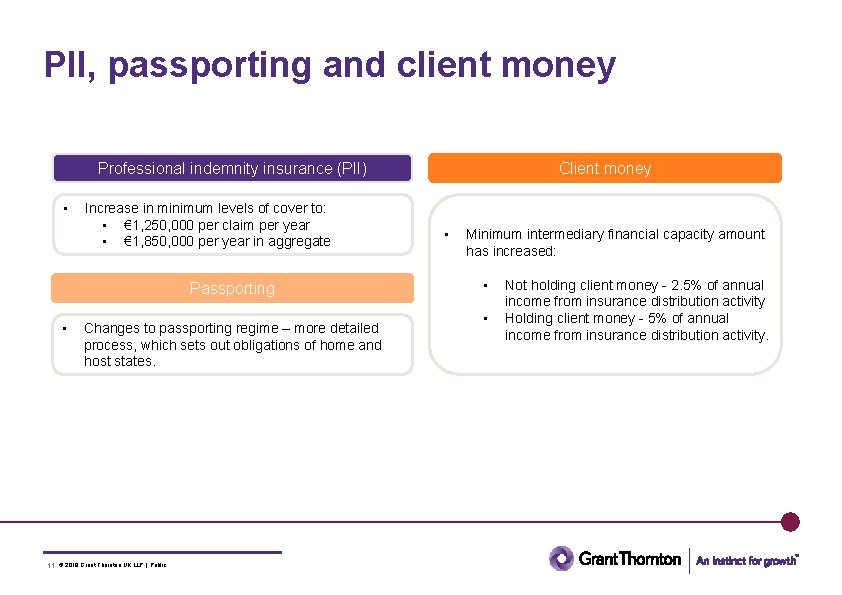
PII, passporting and client money Professional indemnity insurance (PII) • Increase in minimum levels of cover to: • € 1, 250, 000 per claim per year • € 1, 850, 000 per year in aggregate Passporting • Changes to passporting regime – more detailed process, which sets out obligations of home and host states. 11 © 2018 Grant Thornton UK LLP. | Public Client money • Minimum intermediary financial capacity amount has increased: • • Not holding client money - 2. 5% of annual income from insurance distribution activity Holding client money - 5% of annual income from insurance distribution activity.
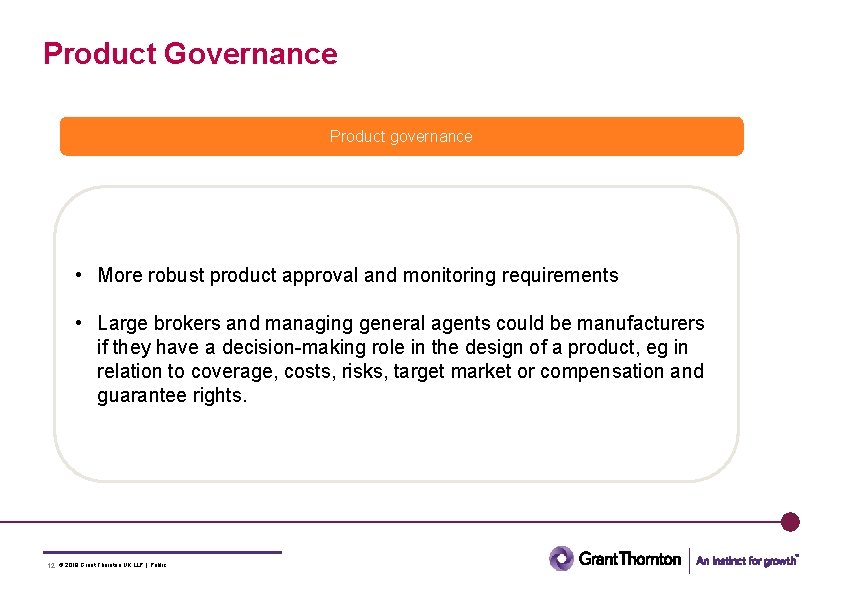
Product Governance Product governance • More robust product approval and monitoring requirements • Large brokers and managing general agents could be manufacturers if they have a decision-making role in the design of a product, eg in relation to coverage, costs, risks, target market or compensation and guarantee rights. 12 © 2018 Grant Thornton UK LLP. | Public
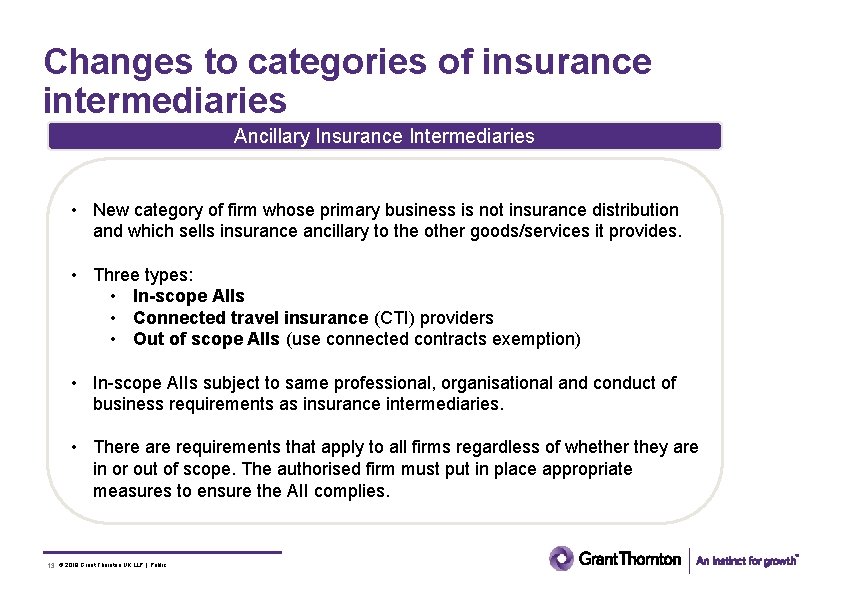
Changes to categories of insurance intermediaries Ancillary Insurance Intermediaries • New category of firm whose primary business is not insurance distribution and which sells insurance ancillary to the other goods/services it provides. • Three types: • In-scope AIIs • Connected travel insurance (CTI) providers • Out of scope AIIs (use connected contracts exemption) • In-scope AIIs subject to same professional, organisational and conduct of business requirements as insurance intermediaries. • There are requirements that apply to all firms regardless of whether they are in or out of scope. The authorised firm must put in place appropriate measures to ensure the AII complies. 13 © 2018 Grant Thornton UK LLP. | Public
Changes to categories of insurance intermediaries What about ARs and IARs? • No link between a firm being an AII and an Appointed Representative (AR). • AII can be an AR or an authorised firm. • The difference is that a principal is strictly liable for acts or omissions by an AR acting on its behalf. For an AII, the principal must have arrangements in place to ensure the AII complies with the relevant IDD requirements. • No changes to Introducer Appointed Representative (IAR) category. An IAR cannot sell, it may only introduce potential customers to their Principal. 14 © 2018 Grant Thornton UK LLP. | Public
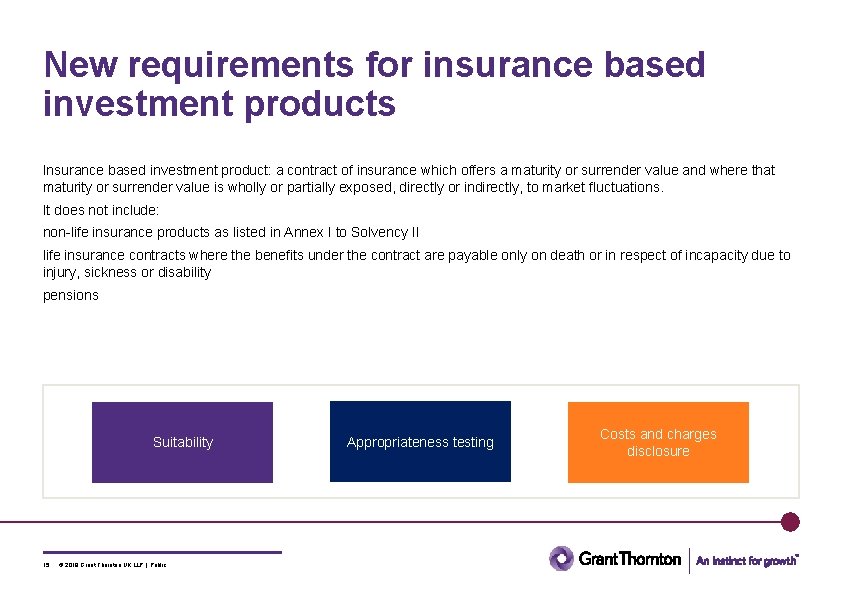
New requirements for insurance based investment products Insurance based investment product: a contract of insurance which offers a maturity or surrender value and where that maturity or surrender value is wholly or partially exposed, directly or indirectly, to market fluctuations. It does not include: non-life insurance products as listed in Annex I to Solvency II life insurance contracts where the benefits under the contract are payable only on death or in respect of incapacity due to injury, sickness or disability pensions Suitability 15 © 2018 Grant Thornton UK LLP. | Public Appropriateness testing Costs and charges disclosure

Thank you © 2018 Grant Thornton UK LLP. | Public ‘Grant Thornton’ refers to the brand under which the Grant Thornton member firms provide assurance, tax and advisory services to their clients and/or refers to one or more member firms, as the context requires. Grant Thornton UK LLP is a member firm of Grant Thornton International Ltd (GTIL). GTIL and the member firms are not a worldwide partnership. GTIL and each member firm is a separate legal entity. Services are delivered by the member firms. GTIL does not provide services to clients. GTIL and its member firms are not agents of, and do not obligate, one another and are not liable for one another’s acts or omissions. grantthornton. co. uk
- Slides: 16