
Insurance Distribution Directive Product Governance Target Markets Richard

Insurance Distribution Directive Product Governance & Target Markets Richard Cockbain, Senior Compliance Manager, Aviva March 2018 Aviva: Public
• Product Governance • Target Markets • Questions Aviva: Public

Product Governance Aviva: Public
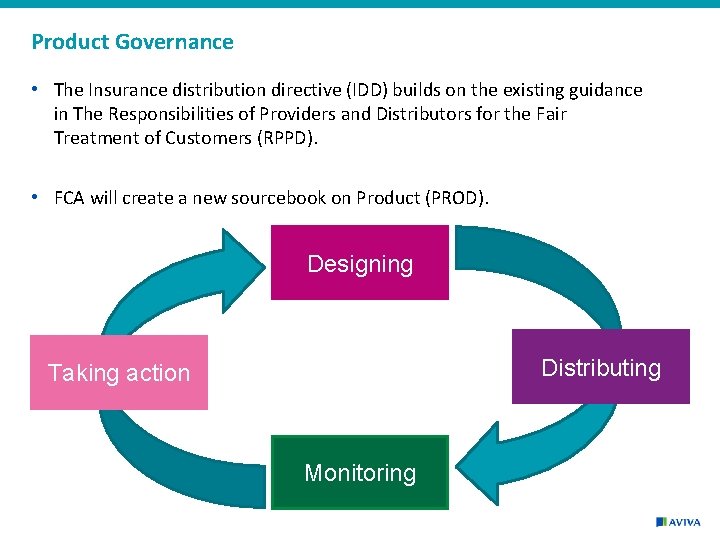
Product Governance • The Insurance distribution directive (IDD) builds on the existing guidance in The Responsibilities of Providers and Distributors for the Fair Treatment of Customers (RPPD). • FCA will create a new sourcebook on Product (PROD). Designing Distributing Taking action Monitoring Aviva: Public
Product Governance Designing: • IDD changes apply to new and significantly adapted products. • Existing products can rely on your current approval process. • Proportionate and appropriate to recognise the complexity of the product. • Stress testing is needed for possible scenarios and performance risks. • Design takes account of: – customers objectives and interests – how to deliver fair outcomes for customers – conflict of interest – potential for detriment Aviva: Public
Product Governance Designing - Considerations/ Oversight: • Does product coverage create any overlap or gaps? • What are the likely needs of the target market? • What is the expected claims ratio? • Is the product offering good value to customers? • What if the market deteriorates? • Is performance reliant on the tax regime? • What is the risk/ reward? Aviva: Public
Product Governance Distributing: • Identify the distribution models which can be used with this product (face-to-face, telephone, internet or mailshot). • If customers’ level of engagement and financial capability could differ between distribution channels then some routes may be unsuitable. • Consider whether the product can be sold without advice. • Distributors need to follow a distribution strategy that is aligned with the manufacturer’s intended approach. • Intermediaries need to be competent to sell the product; as a manufacturer it is important to consider whether training would be helpful, particularly when the product is innovative. Aviva: Public
Product Governance Monitoring: • There is no set percentage of sales that need to be in the target market. However, firms should understand why customers are buying a product which is not designed for them; the greater percentage outside of scope the more thorough the investigation. • Proactive MI depends on the complexity of the product. • Retrospective analysis is acceptable for simpler products (e. g. Household): – actual sales v projections – profiling customers who purchase the product – analysis using Pricing data e. g. age groups of customers – claim acceptance and rejections ratios – complaints volumes – performance; expectations -v- actual Aviva: Public
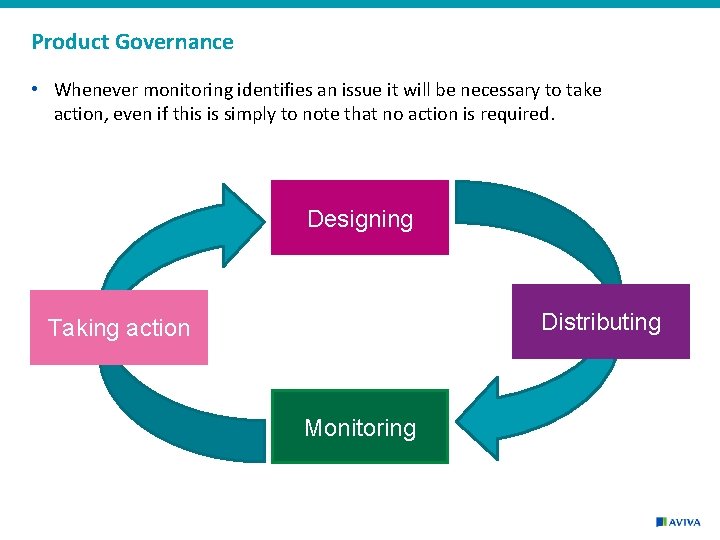
Product Governance • Whenever monitoring identifies an issue it will be necessary to take action, even if this is simply to note that no action is required. Designing Distributing Taking action Monitoring Aviva: Public

Target Markets Aviva: Public
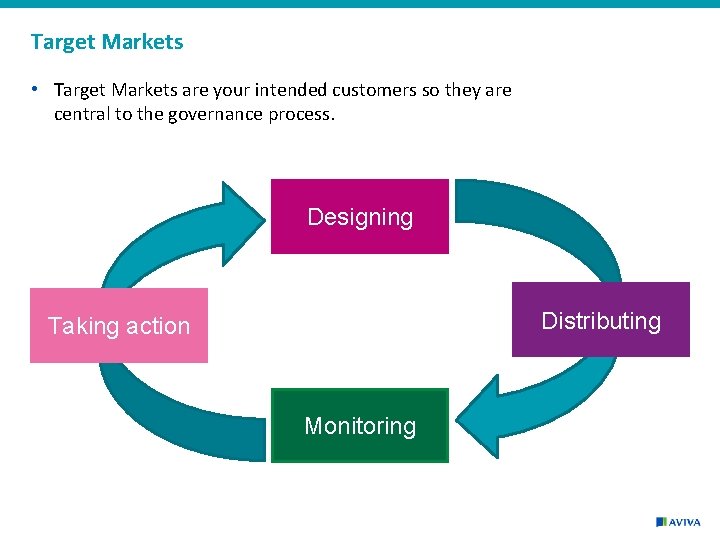
Target Markets • Target Markets are your intended customers so they are central to the governance process. Designing Distributing Taking action Monitoring Aviva: Public
Target Markets Overview: • Provides clarity on who the product is intended for (and who it is not). • Customers who have common characteristics at a generic level. • Need to consider financial capability and level of information available. • Applies to all on-sale products but not closed back-books. • Target markets will be shared with distributors. • Failing to properly consider customer needs or poorly defining the target market could create customer detriment and a mis-selling exposure. Aviva: Public
Target Markets Which customers are in or out of scope: • Firms should not assume that a product is suitable for the mass market. • Where the product is designed for the mass market are there any customers on the margins due to eligibility or exclusions? • What limitations might inhibit a customer from getting full value from the product? Can this be mitigated using underwriting and point of sale questions? • Is the product simple to understand or does it require a level of financial capability? • What are the potential risks from buying the product, do these constrict the Target Market? Aviva: Public
Target Markets Sharing: • Target markets to be shared with distributors: – aid training/ awareness of the manufacturer’s intent for the product – provides a reference point for developing demands and needs – does not inhibit a distributor selling to a customer who is outside of the Target Market where the product meets their demands and needs • The criteria and level of granularity should be proportionate, varying by product and customer types. • If there are multiple customer segments in the Target Market (e. g. vulnerable or different levels of financial capability) they may have different information needs. Aviva: Public
Target Markets Sharing: • Additionally, manufacturers will share information on: – the insurance product, including any risks and costs – product approval process – identified target market – distribution strategy Aviva: Public

A couple of examples Aviva: Public
Target Markets Product Governance Example (Pet) • Where Lifetime Pet Insurance is offered has consideration been given to age thresholds: – premium increases – exclusion of certain types of conditions – higher excess/ co-insurance • If these features are included in the product are these brought to the customer’s attention at point of sale or later on when they are triggered? • What information is in the marketing and policy literature? • How would these limitations affect the customer’s demands and needs? • Does this alter the target market? Aviva: Public
Target Markets Product Governance Example (PPI) • PPI was a mass-market product which was considered simple in design and easy to sell: – protected the customer’s repayment obligations – benefits typically lasted for 12 months – flat rated price Aviva: Public
Target Markets Product Governance Example (PPI) • PPI was a mass-market product which was considered simple in design and easy to sell: – protected the customer’s repayment obligations – benefits typically lasted for 12 months – flat rated price However there were some caveats, for example: – if the customer had a pre-existing condition this was excluded for the first 12 or 24 months (sometimes for the lifetime of the policy). – for self-employed persons they had to wind up their business to make an unemployment claim. • Target Markets might have helped reduce the potential for mis-selling. Aviva: Public
Customers should not regret their purchase Aviva: Public

Any Questions? Aviva: Public

Thank you © Aviva PLC Private and confidential Aviva: Public
- Slides: 22