
Insurance Distribution Directive Alan Chandler Chartered Insurer I
Insurance Distribution Directive
Alan Chandler, Chartered Insurer � � � I have trained more than 1, 000 individuals to become ACII qualified I have trained over 50% of the individuals in the last 8 years that have gone onto achieve the highest ACII pass in the whole of the UK. I train to a pass rate of more than 96% in all CII qualification levels. Certificate , Diploma and Advanced Diploma. I deliver the Allianz scholarship and academy programmes in both the UK and Ireland I have been a Cii examiner. I have trained students who have won national prizes in almost all ACII subjects including Insurance Law (MO 5), Liability (M 96), Commercial Property and BI (M 93), Personal Lines Insurance (P 86), Business and Finance (M 92), Underwriting Practice (M 80), Advanced Underwriting (960), Claims Practice (M 85), Advanced Claims (820), Marketing (945), Advanced Broking (930) and Advanced Risk Management (992).
Objectives � Understand the background and why IDD is being implemented and when � Who it applies to � Describe what the changes are � Explain the impact on general insurance firms and the impact on customers � Describe what firms should be doing in preparation for the changes
To start… � The Insurance Distribution Directive (IDD) is one of the most significant changes in Insurance regulations in 10 years � Firms need to understand the changes and have plans in place to implement the changes � It comes into force on 1 October 2018
It was due on 23 rd Feb but…. � Many � New countries still not prepared and asked for delay date of 1 st July for each country to publish their rules � New date of 1 st October 2018 for implementation
The IDD � It replaces the Insurance Mediation Directive � Mediation becomes Distribution � Its aim is to: ◦ Create a level playing field for insurance intermediaries and the distribution of insurance ◦ Harmonise regulation across the EU ◦ Aim is to improve professional standards in the insurance market across Europe ◦ Raise standards of conduct ◦ Improve competition ◦ Improve customer protection ◦
Background � The Insurance Mediation Directive mainly applied at point of sale, and didn’t cover product design and distribution � Didn’t directly cover Price Comparison Sites (though we did in the UK) � More firms involved in the insurance process rather than just broker/client or policyholder dealing direct with the Insurer
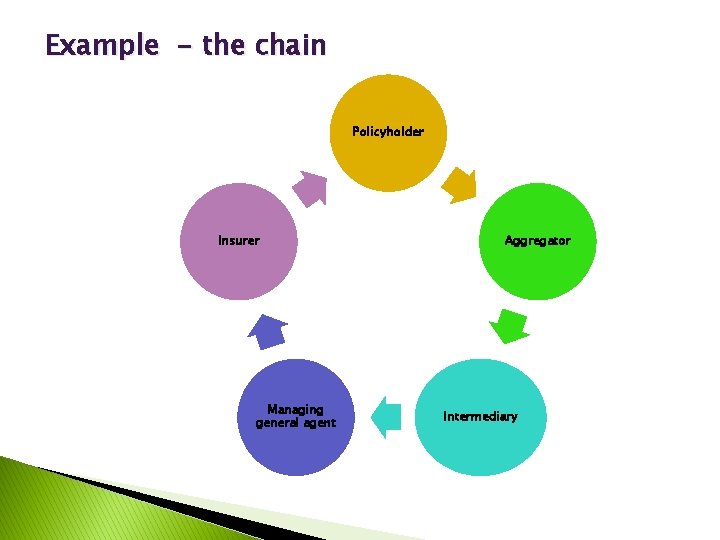
Example - the chain Policyholder Insurer Managing general agent Aggregator Intermediary
Insurance Distribution Directive � Applies to Consumer and Commercial Customers � Applies to Insurers � Applies to Wholesalers � Applies to Garages and Shops that sell Insurance as an ancillary to their main business rather than just pass on leads

Insurance Distribution Directive There is a lot for firms to do
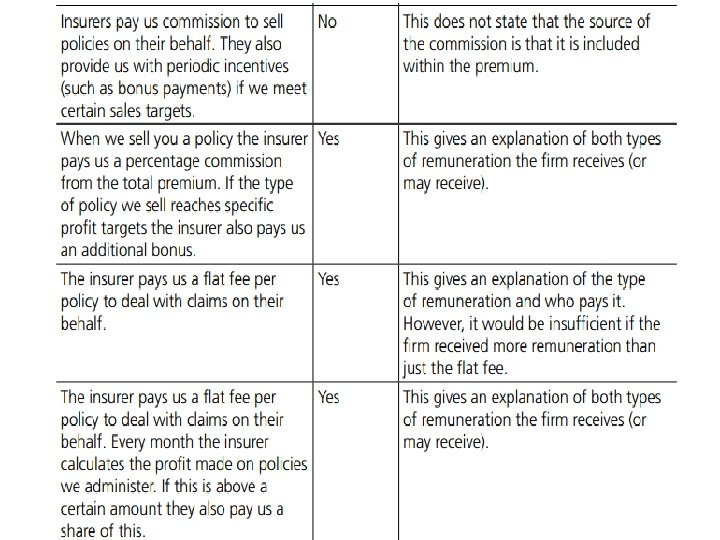
Insurance Distribution Directive Changes to disclosure – Terms of Business and scripts for Commercial AND Consumer Customers � You must disclose the source(s) of your income � You must disclose the type of remuneration
Insurance Distribution Directive Changes to disclosure – Terms of Business and scripts for Commercial AND Consumer Customers � For example you must disclose that any commission you receive from an insurer is taken from the customers’ Premium � You must disclose all other sources of income (Profit Share, Premium Finance, etc. )
Insurance Distribution Directive Changes to disclosure – Terms of Business and scripts for Commercial AND Consumer Customers � Fees must be disclosed in cash terms � Fees of “up to” are not allowed (FCA rule) � Other Fees, for example Mid-Term Adjustments and Cancellation must be disclosed in cash terms (or explain how they will be calculated) � There a number of ways you can do this. For instance in your terms of business you can say “Insurers pay us a commission which is a percentage of your premium and in addition we charge a policy set up fee of £ 30 and mid term adjustment fee of £ 25. We also charge £ 25 if you cancel your policy.

Insurance Distribution Directive Changes to disclosure – Terms of Business and scripts for Commercial AND Consumer Customers � You must disclose whether you are acting for the Insurer or for the Customer � You must disclose whether you are a Broker or an Insurer � In both cases you must act in the customers’ best interest
Insurance Distribution Directive Changes to disclosure – Terms of Business and scripts for Commercial AND Consumer Customers � You must disclose whether or not you provide advice or just information � Insurers must disclose if staff have sales incentive schemes
Insurance Distribution Directive Additional requirements � The Customer must be given a clear choice to receive all documents on paper (and free of charge) or by electronic means (email, PDF etc. )
Insurance Distribution Directive Changes applying to Staff � Al firms must maintain records to demonstrate that those directly involved in Insurance Distribution or its Management: � Have no serious Criminal Convictions relating to property or financial crimes � Are not undischarged Bankrupts � One Senior Member of Staff must take responsibility for maintaining these records (are they going to undertake searches? )
Insurance Distribution Directive Changes applying to Staff � All Insurance Staff must be of good repute (see previous slide) � All Insurance Staff will need 15 hours of CPD, covering specified areas of training and knowledge � The 15 hours is a bare minimum and should of course be exceeded if a firm wishes to be professional � Records must be kept for 3 years � Employees are entitled to a copy
Insurance Distribution Directive Changes applying to Staff � This will require employees to have a minimum necessary knowledge of: � Terms and conditions of policies offered � Applicable laws governing the distribution of insurance products � Claims handling (note claims handlers must be trained on the product not just handling procedures) � Complaints handling
Insurance Distribution Directive Changes applying to Staff � And also: � Assessing customer needs � The Insurance Market � Business Ethics (like unacceptable business practices) � Financial Competence (can you explain percentages can you explain has the parts of the premium fit together) Whilst there is no specific reference to testing the FCA T&C requirements state you must test and define competence
Insurance Distribution Directive Conflicts of Interest � Firms must have a written Conflicts of Interest Policy which contains: � Identification of conflicts from remuneration or other sources � Identification of conflicts from other parties (like brokers receiving hospitality from insurers), related companies or members of the same group (a broker using their own MGA)
Insurance Distribution Directive Conflicts of Interest � Firms must have a written Conflicts of Interest Policy which contains: � Details of procedures to be followed in the event of a COI � A gifts and benefits policy setting out the circumstances that gifts can be offered or accepted � There must also be an annual report to the board
Insurance Distribution Directive Customers’ Best Interests � Obligation on Member States to ensure that, when carrying out distribution, Insurance Intermediaries, Insurance and Reinsurance undertakings always act honestly, fairly and professionally in accordance with the best interests of their Customers (consumer or commercial)
Insurance Distribution Directive Customers’ Best Interests � Rules ensuring that brokers, and insurers do not either pay or assess the performance of employees in a way that conflicts with their duty to act in the best interests of customers
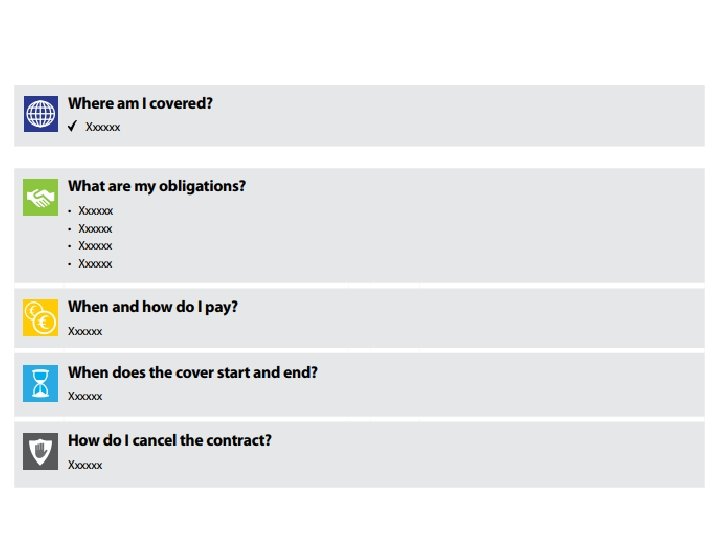
Insurance Distribution Directive Product Information � The new requirements require the Customer to be given a standardised insurance product information document (IPID), summarising the main features of the proposed contract � The responsibility is on the Insurer or product designer(s) to produce this document
Insurance Distribution Directive Product Information � The IPID is a template document � There are very strict rules about how it is presented, which can be followed ( fonts, logos etc)
Insurance Distribution Directive Product Information � The IPID is only required where the Customer is a Consumer � The same product information still needs to be given to Commercial Customers, but there is no requirement to do so in the format of an IPID � It may be more convenient to use an IPID for some Commercial risks
Insurance Distribution Directive Product Information � Currently a Policy Summary is used for most Insurance Products to provide this information, so in effect, this will be replaced by the IPID � Pure Protection Products will still require a Policy Summary (and no IPID)

Insurance Distribution Directive Complaints � Firms should have complaints procedures for all customers (not just eligible complainants)
Insurance Distribution Directive Product Oversight and Governance � New rules covering the design, approval, marketing and management of Insurance products including: � Setting up and maintaining a product approval process so that new products are tested before launch � Ensuring that a target market is identified � The distribution (Intermediary) channels are selected appropriately (e. g. it may be certain complex products should only be sold via a broker not online) � These rules include redesign
Insurance Distribution Directive Product Oversight and Governance � Staff involved in producing new products must demonstrate that they have the necessary expertise for this role � New products (policies) come with appropriate information and details of how they were approved � There must be ongoing Management Information on product performance including for example claims ratio’s
Insurance Distribution Directive Product Oversight and Governance � Intermediaries (if used in the sales process) must have sufficient information about the product, the approval process, and who the product is suitable for � In some cases (for example where an Intermediary negotiates features to be included in a policy), they will share some of the governance responsibility as if they were the Insurer
Insurance Distribution Directive Sales Practices � There are new requirements when Insurance is sold alongside a non-Insurance Product � There are two circumstances to consider: � Where Insurance is the main Product, or � Where a Non-Insurance Product is the main Product
Insurance Distribution Directive Sales Practices � Where Insurance is the main Product: � The Customer must know if the Non-Insurance product(s) can be bought separately � A description of the Non-Insurance Product(s) must be given, including any interactions with the Insurance Product � Information on the costs and charges of the Non-Insurance Product(s) must be explained � Examples: Telematics, Fitness Devices
Insurance Distribution Directive Sales Practices � Where a Non-Insurance Product is the main Product: � The Customer must be able to purchase the primary product or service without the Insurance product (if it is given free the customer can technically refuse the insurance but there would be little point!) � Examples: Insurance with a Car or Mobile Phone
Insurance Distribution Directive Introducer Appointed Representatives � Introducing is exempt from regulation if all the Introducer does is pass on information to a Broker, where that information is already held on the introducers own records (for example customers Name & Address) � This area is complex, and you may need advice
Recap … � Understand the background and why IDD is being implemented and when? � Who is applies to? � Describe what the changes are � Explain what the impact is on general insurance firms, the impact on customers � Describe what firms should be doing in preparation for the changes


Create Solutions Ltd The specialist training and compliance company for the general insurance industry Tel 0161 870 6637 www. createsolutions. co. uk
- Slides: 43