
Insurance Careers Insurance Appraisers Overview Among the career
- Slides: 5
Insurance Careers
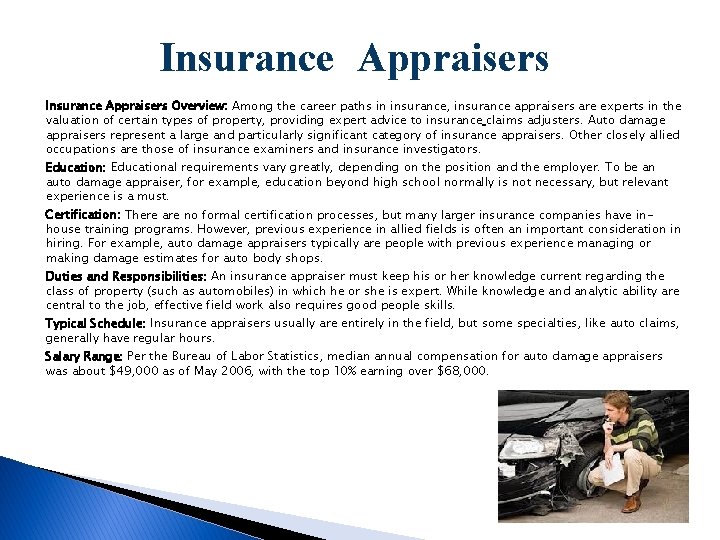
Insurance Appraisers Overview: Among the career paths in insurance, insurance appraisers are experts in the valuation of certain types of property, providing expert advice to insurance claims adjusters. Auto damage appraisers represent a large and particularly significant category of insurance appraisers. Other closely allied occupations are those of insurance examiners and insurance investigators. Education: Educational requirements vary greatly, depending on the position and the employer. To be an auto damage appraiser, for example, education beyond high school normally is not necessary, but relevant experience is a must. Certification: There are no formal certification processes, but many larger insurance companies have inhouse training programs. However, previous experience in allied fields is often an important consideration in hiring. For example, auto damage appraisers typically are people with previous experience managing or making damage estimates for auto body shops. Duties and Responsibilities: An insurance appraiser must keep his or her knowledge current regarding the class of property (such as automobiles) in which he or she is expert. While knowledge and analytic ability are central to the job, effective field work also requires good people skills. Typical Schedule: Insurance appraisers usually are entirely in the field, but some specialties, like auto claims, generally have regular hours. Salary Range: Per the Bureau of Labor Statistics, median annual compensation for auto damage appraisers was about $49, 000 as of May 2006, with the top 10% earning over $68, 000.
Insurance Claims Adjusters Overview: Among career paths in insurance, insurance claims adjusters determine whether a party claiming loss due to property damage, bodily injury, etc. , is owed a payment under an insurance policy, and in what amount. Most insurance claims adjusters are employees of insurance companies, but some are independent consultants who represent claimants. Closely allied occupations are insurance claims examiners, insurance appraisers and insurance investigators. Education: Educational requirements vary greatly, depending on the position and the employer. Normally, a bachelor's degree is sufficient. Certification: There are no formal certification processes, but many larger insurance companies have inhouse training programs. However, previous experience in allied fields is often an important consideration in hiring. For example, insurance companies look to hire people with legal experience to be adjusters for liability claims, people with engineering or architectural backgrounds to be adjusters for industrial claims, etc. Duties and Responsibilities: Insurance claims adjusters require a mix of analytic and people skills. To evaluate a claim, an adjuster may have to interview numerous people (such as the claimant, witnesses, law enforcement, expert consultants, etc. ) and examine numerous documents (such as police reports, court records, medical records, etc. ). Coming to a settlement with the claimant may require negotiation or even legal action, in which the insurance claims adjuster must work with lawyers on behalf of the insurance company. Typical Schedule: Insurance claims adjusters have a mixture of office and field work, sometimes requiring out of town travel. Workweeks can be highly variable, based on the need to meet clients in evenings and on weekends, or to handle a rash of claims pursuant to a natural disaster or severe weather event. Weeks of 5060 hours are not unusual. Salary Range: Per the Bureau of Labor Statistics, median annual compensation was about $51, 000 as of May 2006, with the top 10% earning over $79, 000.
Insurance Claims Examiners Overview: Among the career paths in insurance, insurance claims examiners do work similar to that of insurance claims adjusters. Examiner, rather than adjuster, is the usual title in life and health insurance. However, in property and casualty insurance, the title of examiner often designates a senior adjuster who handles the most costly or difficult claims. Other closely allied occupations are those of insurance appraisers and insurance investigators. Education: Educational requirements vary greatly, depending on the position and the employer. Normally, a bachelor's degree is sufficient. Certification: There are no formal certification processes, but many larger insurance companies have in-house training programs. However, previous experience in allied fields is often an important consideration in hiring. For example, insurance companies look to hire people with legal experience to be examiners for liability claims, people with medical experience to be examiners for health claims, people with engineering or architectural backgrounds to be examiners for industrial claims, etc. Duties and Responsibilities: Insurance claims examiners require a mix of analytic and people skills. To evaluate a health insurance claim, an examiner may have to consult with medical experts and study medical records. In life insurance, claims examiners may need to establish the cause of death, especially if the policy offers extra payment in case of death in an accident. In some cases, reaching a settlement with the claimant may require negotiation or even legal action, in which the insurance claims examiner must work with lawyers on behalf of the insurance company. Typical Schedule: Insurance claims examiners in life and health insurance tend to work a regular 40 hour week from fixed office locations. Those in property and casualty insurance will have longer hours and more travel requirements, similar to insurance claims adjusters. Salary Range: Per the Bureau of Labor Statistics, median annual compensation was about $51, 000 as of May 2006, with the top 10% earning over $79, 000.
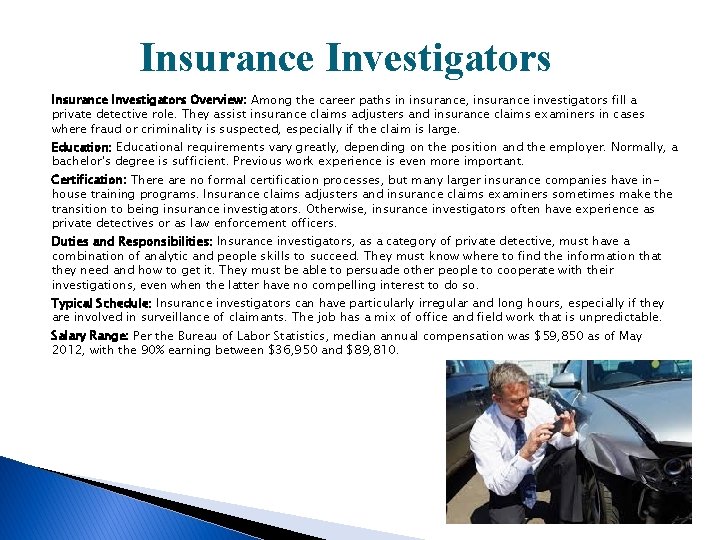
Insurance Investigators Overview: Among the career paths in insurance, insurance investigators fill a private detective role. They assist insurance claims adjusters and insurance claims examiners in cases where fraud or criminality is suspected, especially if the claim is large. Education: Educational requirements vary greatly, depending on the position and the employer. Normally, a bachelor's degree is sufficient. Previous work experience is even more important. Certification: There are no formal certification processes, but many larger insurance companies have inhouse training programs. Insurance claims adjusters and insurance claims examiners sometimes make the transition to being insurance investigators. Otherwise, insurance investigators often have experience as private detectives or as law enforcement officers. Duties and Responsibilities: Insurance investigators, as a category of private detective, must have a combination of analytic and people skills to succeed. They must know where to find the information that they need and how to get it. They must be able to persuade other people to cooperate with their investigations, even when the latter have no compelling interest to do so. Typical Schedule: Insurance investigators can have particularly irregular and long hours, especially if they are involved in surveillance of claimants. The job has a mix of office and field work that is unpredictable. Salary Range: Per the Bureau of Labor Statistics, median annual compensation was $59, 850 as of May 2012, with the 90% earning between $36, 950 and $89, 810.