
Insulin Pumps and Continuous Glucose Monitoring in Type
- Slides: 1
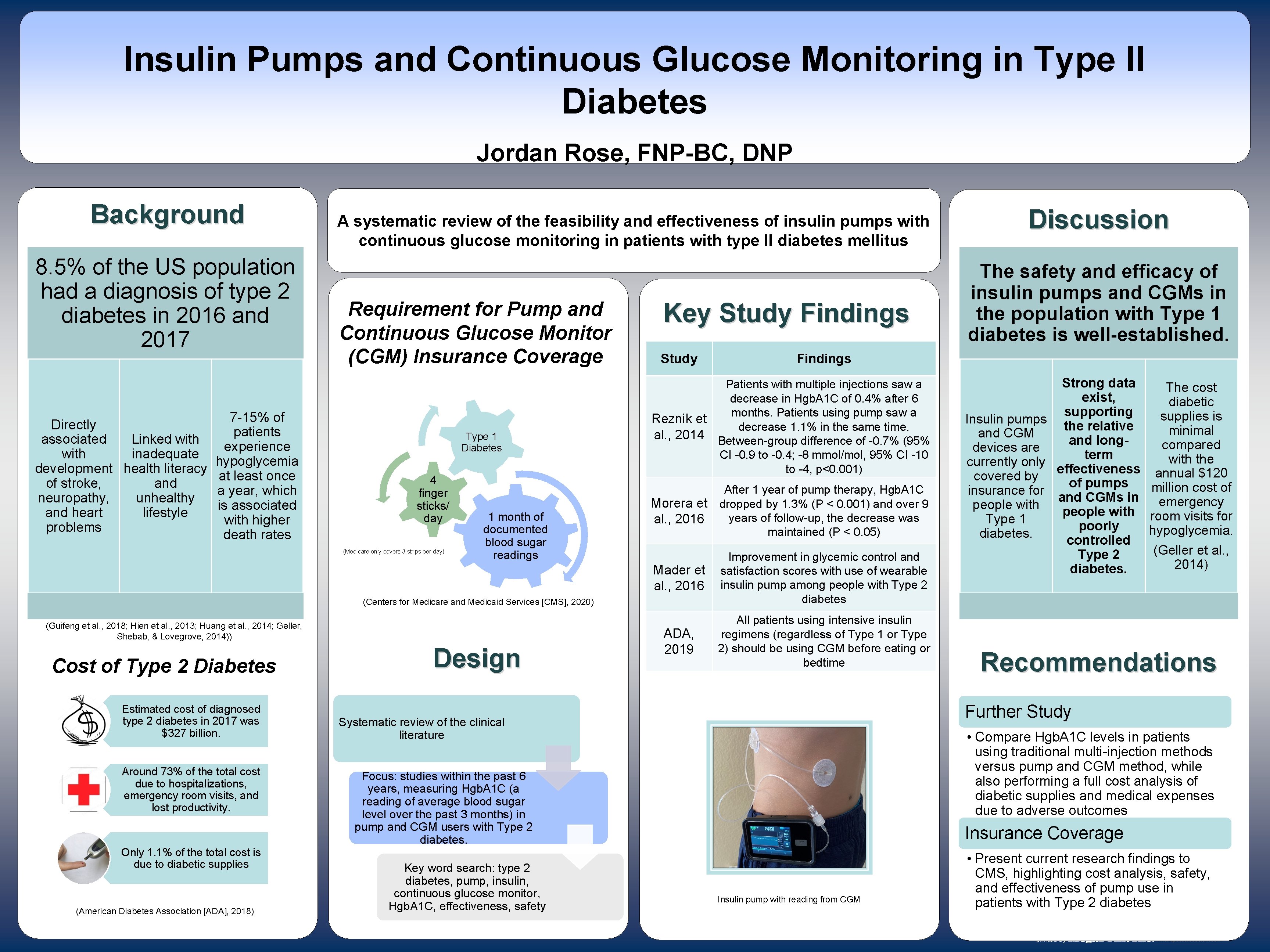
Insulin Pumps and Continuous Glucose Monitoring in Type II Diabetes Jordan Rose, FNP-BC, DNP Background 8. 5% of the US population had a diagnosis of type 2 diabetes in 2016 and 2017 7 -15% of Directly patients associated Linked with experience with inadequate hypoglycemia development health literacy at least once of stroke, and a year, which neuropathy, unhealthy is associated and heart lifestyle with higher problems death rates A systematic review of the feasibility and effectiveness of insulin pumps with continuous glucose monitoring in patients with type II diabetes mellitus Requirement for Pump and Continuous Glucose Monitor (CGM) Insurance Coverage Type 1 Diabetes 4 finger sticks/ day (Medicare only covers 3 strips per day) 1 month of documented blood sugar readings Key Study Findings Study (Guifeng et al. , 2018; Hien et al. , 2013; Huang et al. , 2014; Geller, Shebab, & Lovegrove, 2014)) Cost of Type 2 Diabetes Estimated cost of diagnosed type 2 diabetes in 2017 was $327 billion. Around 73% of the total cost due to hospitalizations, emergency room visits, and lost productivity. Only 1. 1% of the total cost is due to diabetic supplies (American Diabetes Association [ADA], 2018) Design Morera et al. , 2016 After 1 year of pump therapy, Hgb. A 1 C dropped by 1. 3% (P < 0. 001) and over 9 years of follow-up, the decrease was maintained (P < 0. 05) Mader et al. , 2016 Improvement in glycemic control and satisfaction scores with use of wearable insulin pump among people with Type 2 diabetes ADA, 2019 All patients using intensive insulin regimens (regardless of Type 1 or Type 2) should be using CGM before eating or bedtime Strong data exist, supporting Insulin pumps the relative and CGM and longdevices are term currently only effectiveness covered by of pumps insurance for and CGMs in people with Type 1 poorly diabetes. controlled Type 2 diabetes. The cost diabetic supplies is minimal compared with the annual $120 million cost of emergency room visits for hypoglycemia. (Geller et al. , 2014) Recommendations Further Study Systematic review of the clinical literature • Compare Hgb. A 1 C levels in patients using traditional multi-injection methods versus pump and CGM method, while also performing a full cost analysis of diabetic supplies and medical expenses due to adverse outcomes Focus: studies within the past 6 years, measuring Hgb. A 1 C (a reading of average blood sugar level over the past 3 months) in pump and CGM users with Type 2 diabetes. Key word search: type 2 diabetes, pump, insulin, continuous glucose monitor, Hgb. A 1 C, effectiveness, safety The safety and efficacy of insulin pumps and CGMs in the population with Type 1 diabetes is well-established. Findings Patients with multiple injections saw a decrease in Hgb. A 1 C of 0. 4% after 6 months. Patients using pump saw a Reznik et decrease 1. 1% in the same time. al. , 2014 Between-group difference of -0. 7% (95% CI -0. 9 to -0. 4; -8 mmol/mol, 95% CI -10 to -4, p<0. 001) (Centers for Medicare and Medicaid Services [CMS], 2020) Discussion Insurance Coverage Insulin pump with reading from CGM • Present current research findings to CMS, highlighting cost analysis, safety, and effectiveness of pump use in patients with Type 2 diabetes www. postersession. com