
Insulin Lispro Drugbank ID DB 00046 Protein chemical
Insulin Lispro Drugbank ID: DB 00046 Protein chemical formula : C 257 H 387 N 65 O 76 S 6 Protein average weight : 5808. 0000 Half-life : Sub. Q administration = 1 hour
Description Insulin lispro is a recombinant human insulin analogue produced in a specialized laboratory strain of Escherischia coli. Plasmid DNA transfected into the bacteria encodes for an analogue of human insulin that has a lysine at residuce B 28 and proline at B 29; these residues are reversed in endogenous human insulin. Reversal of these amino acid residues produces a rapid-acting insulin analogue. FDA approved on 1996. Indication For the treatment of Type 1 or 2 diabetes mellitus. To be used in conjunction with an intermediate or long-acting insulin except when used in a continuous insulin infusion pump.
Pharmacodynamics Insulin is a natural hormone produced by beta cells of the pancreas. In nondiabetic individuals, a basal level of insulin is supplemented with insulin spikes following meals. Increased insulin secretion following meals is responsible for the metabolic changes that occur as the body transitions from a postabsorptive to absorptive state. Insulin promotes cellular uptake of glucose, particularly in muscle and adipose tissues, promotes energy storage via glycogenesis, opposes catabolism of energy stores, increases DNA replication and protein synthesis by stimulating amino acid uptake by liver, muscle and adipose tissue, and modifies the activity of numerous enzymes involved in glycogen synthesis and glycolysis. Insulin also promotes growth and is required for the actions of growth hormone (e. g. protein synthesis, cell division, DNA synthesis). Insulin lispro is a rapid-acting insulin analogue used to mimic postprandial insulin spikes in diabetic individuals. The onset of action of insulin lispro is 10 -15 minutes. Its activity peaks 60 minutes following subcutaneous injection and its duration of action is 4 -5 hours. Compared to regular human insulin, insulin lispro has a more rapid onset of action and a shorter duration of action. Insulin lispro is also shown to be equipotent to human insulin on a molar basis.
Mechanism Of Action Insulin lispro binds to the insulin receptor (IR), a heterotetrameric protein consisting of two extracellular alpha units and two transmembrane beta units. The binding of insulin to the alpha subunit of IR stimulates the tyrosine kinase activity intrinsic to the beta subunit of the receptor. The bound receptor autophosphorylates and phosphorylates numerous intracellular substrates such as insulin receptor substrates (IRS) proteins, Cbl, APS, Shc and Gab 1. Activation of these proteins leads to the activation of downstream signaling molecules including PI 3 kinase and Akt regulates the activity of glucose transporter 4 (GLUT 4) and protein kinase C (PKC), both of which play critical roles in metabolism and catabolism. In humans, insulin is stored in the form of hexamers; however, only insulin monomers are able to interact with IR. Reversal of the proline and lysine residues at positions B 28 and B 29 of native insulin eliminates hydrophobic interactions and weakens some of the hydrogen bonds that contribute to the stability of the insulin dimers that comprise insulin hexamers. Hexamers of insulin lispro are produced in the presence of zinc and < i> m< /i> -cresol. These weakly associated hexamers quickly dissociate upon subcutaneous injection and are absorbed as monomers through vascular endothelial cells. These properties give insulin lispro its fast-acting properties.
Toxicity Inappropriately high dosages relative to food intake and/or energy expenditure may result in severe and sometimes prolonged and life-threatening hypoglycemia. Neurogenic (autonomic) signs and symptoms of hypoglycemia include trembling, palpitations, sweating, anxiety, hunger, nausea and tingling. Neuroglycopenic signs and symptoms of hypoglycemia include difficulty concentrating, lethargy/weakness, confusion, drowsiness, vision changes, difficulty speaking, headache, and dizziness. Mild hypoglycemia is characterized by the presence of autonomic symptoms. Moderate hypoglycemia is characterized by the presence of autonomic and neuroglycopenic symptoms. Individuals may become unconscious in severe cases of hypoglycemia. Rare cases of lipoatrophy or lipohypertrophy reactions have been observed. Metabolism Insulin is predominantly cleared by metabolic degradation via a receptormediated process.
Absorption Rapidly absorbed following subcutaneous administration. It is also absorbed more quickly than regular human insulin. Peak serum levels occur 30 -90 minutes after injection in healthy subjects. Absorption also differs depending on the site of injection. After insulin lispro was administered in the abdomen, serum drug levels were higher and the duration of action was slightly shorter than after deltoid or thigh administration. Bioavailability, 0. 1 - 0. 2 unit/kg = 55% - 77%. Volume of Distribution : When administered intravenously as bolus injections of 0. 1 and 0. 2 U/kg dose in two separate groups of healthy subjects, the mean volume of distribution of insulin lispro appeared to decrease with increase in dose (1. 55 and 0. 72 L/kg, respectively). Clearance is dose dependent. When a dose of 0. 1 unit/kg and 0. 2 unit/kg were administered intravenously, the mean clearance was 21. 0 m. L/min/kg and 9. 6 m. L/min/kg respectively. Categories Hypoglycemic Agents and Antidiabetic Agents
Affected Organism Humans and other mammals Patents : Country Canada United States Patent Number 2151564 2151560 5474978 5514646 Approved 2003 -02 -11 2000 -05 -09 1994 -06 -16 1993 -05 -07 Expires (estimated) 2015 -06 -12 2014 -06 -16 2013 -05 -07 Food interaction Inject subcutaneuosly 15 minutes before meal Drug interaction Acebutolol : The beta-blocker, acebutolol, may decrease symptoms of hypoglycemia. Atenolol : The beta-blocker, atenolol, may decrease symptoms of hypoglycemia. Bisoprolol : The beta-blocker, bisoprolol, may decrease symptoms of hypoglycemia. Carvedilol : The beta-blocker, carvedilol, may decrease symptoms of hypoglycemia. Dextropropoxyphene : Concomitant therapy with drugs that may increase the bloodglucose-lowering effect of insulin lispro and thus the chance of hypoglycemia should be monitored closely.
Disopyramide : Concomitant therapy with drugs that may increase the blood-glucose-lowering effect of insulin lispro and thus the chance of hypoglycemia should be monitored closely. Enalapril : Concomitant therapy with ACE inhibitors may increase the blood-glucose-lowering effect of insulin lispro and thus the chance of hypoglycemia should be monitored closely. Epinephrine : Concomitant therapy with sympathomimetic agents may reduce the blood-glucoselowering effect of insulin lispro. Esmolol : The beta-blocker, esmolol, may decrease symptoms of hypoglycemia. Nofibrate : Concomitant therapy with drugs that may increase the blood-glucose-lowering effect of insulin lispro and thus the chance of hypoglycemia should be monitored closely. Fluoxetine : Concomitant therapy with drugs that may increase the blood-glucose-lowering effect of insulin lispro and thus the chance of hypoglycemia should be monitored closely. Hydrochlorothiazide : Concomitant therapy with diuretics may reduce the blood-glucose-lowering effect of insulin lispro. Losartan : Concomitant therapy with angiotensin II receptor blockers may increase the blood-glucoselowering effect of insulin lispro and thus the chance of hypoglycemia should be monitored closely. Octreotide : Concomitant therapy with somatostatin analogs may increase the blood-glucose-lowering effect of insulin lispro and thus the chance of hypoglycemia should be monitored closely. Pentoxifylline : Concomitant therapy with drugs that may increase the blood-glucose-lowering effect of insulin lispro and thus the chance of hypoglycemia should be monitored closely. Pramlintide : Concomitant therapy with drugs that may increase the blood-glucose-lowering effect of insulin lispro and thus the chance of hypoglycemia should be monitored closely. Prednisone : Concomitant therapy with corticosteriods may reduce the blood-glucose-lowering effect of insulin lispro. Ramipril : Concomitant therapy with ACE inhibitors may increase the blood-glucose-lowering effect of insulin lispro and thus the chance of hypoglycemia should be monitored closely.
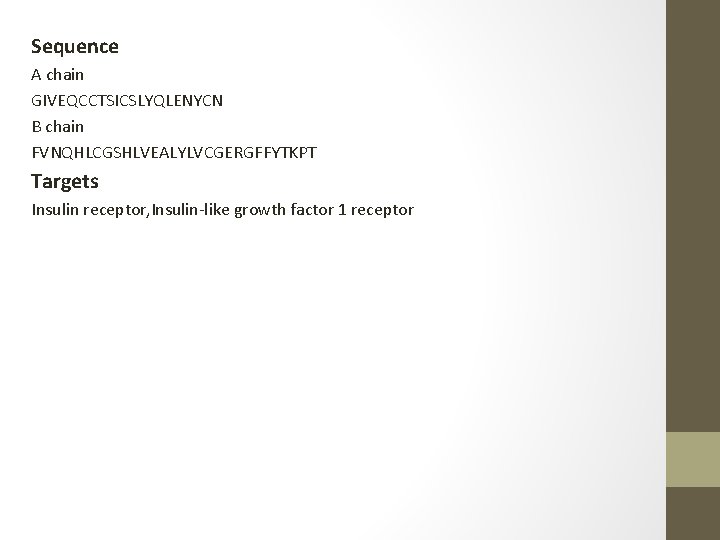
Sequence A chain GIVEQCCTSICSLYQLENYCN B chain FVNQHLCGSHLVEALYLVCGERGFFYTKPT Targets Insulin receptor, Insulin-like growth factor 1 receptor
Brands : Humalog , Humalog Kwik. Pen , Humalog Pen Company : Eli Lilly Description : HUMALOG® (insulin lispro injection, USP [r. DNA origin]) is a rapid -acting human insulin analog used to lower blood glucose. Insulin lispro is produced by recombinant DNA technology utilizing a non-pathogenic laboratory strain of Escherichia coli. Insulin lispro differs from human insulin in that the amino acid proline at position B 28 is replaced by lysine and the lysine in position B 29 is replaced by proline. Chemically, it is Lys(B 28), Pro(B 29) human insulin analog and has the empirical formula C 257 H 383 N 65 O 77 S 6 and a molecular weight of 5808, both identical to that of human insulin. Used For/Prescribed for : Humalog is used to treat type 1 (insulin- dependent) diabetes in adults. It is usually given together with another longacting insulin. Humalog is also used together with oral (taken by mouth) medications to treat type 2 (non insulin-dependent) diabetes in adults. Form : sterile, aqueous, clear, and colorless solution Route of administration : subcutaneous and intravenous injection
Formulation : Each milliliter of HUMALOG contains insulin lispro 100 units, 16 mg glycerin, 1. 88 mg dibasic sodium phosphate, 3. 15 mg Metacresol, zinc oxide content adjusted to provide 0. 0197 mg zinc ion, trace amounts of phenol, and Water for Injection. Insulin lispro has a p. H of 7. 0 to 7. 8. The p. H is adjusted by addition of aqueous solutions of hydrochloric acid 10% and/or sodium hydroxide 10%. Dosage : The total daily insulin requirement may vary and is usually between 0. 5 to 1 unit/kg/day. Insulin requirements may be altered during stress, major illness, or with changes in exercise, meal patterns, or coadministered drugs. HUMALOG should be given within 15 minutes before a meal or immediately after a meal. Contraindication : HUMALOG is contraindicated: during episodes of hypoglycemia in patients who are hypersensitive to HUMALOG or to any of its excipients. Side effects : Common Humalog side effects may include: low blood sugar--headache, hunger, weakness, sweating, confusion, irritability, dizziness, fast heart rate, or feeling jittery. Drug Interaction : total of 800 drugs (5324 brand generic names) are known to interact with Humalog (insulin lispro). 1 major drug interactions (3 brand generic names) 710 moderate drug interactions (4727 brand generic names) 89 minor drug interactions (594 brand generic names)
Genral References # Miles HL, Acerini CL: Insulin analog preparations and their use in children and adolescents with type 1 diabetes mellitus. Paediatr Drugs. 2008; 10(3): 163 -76. "Pubmed": http: //www. ncbi. nlm. nih. gov/pubmed/18454569 # Zib I, Raskin P: Novel insulin analogues and its mitogenic potential. Diabetes Obes Metab. 2006 Nov; 8(6): 611 -20. "Pubmed": http: //www. ncbi. nlm. nih. gov/pubmed/17026485
Refrence http: //pi. lilly. com/us/humalog-pen-pi. pdf http: //www. drugs. com/humalog. html http: //www. rxlist. com/humalog-drug. htm
- Slides: 13