
Insulin Aspart Approved drug Chemical formula C 256
- Slides: 8
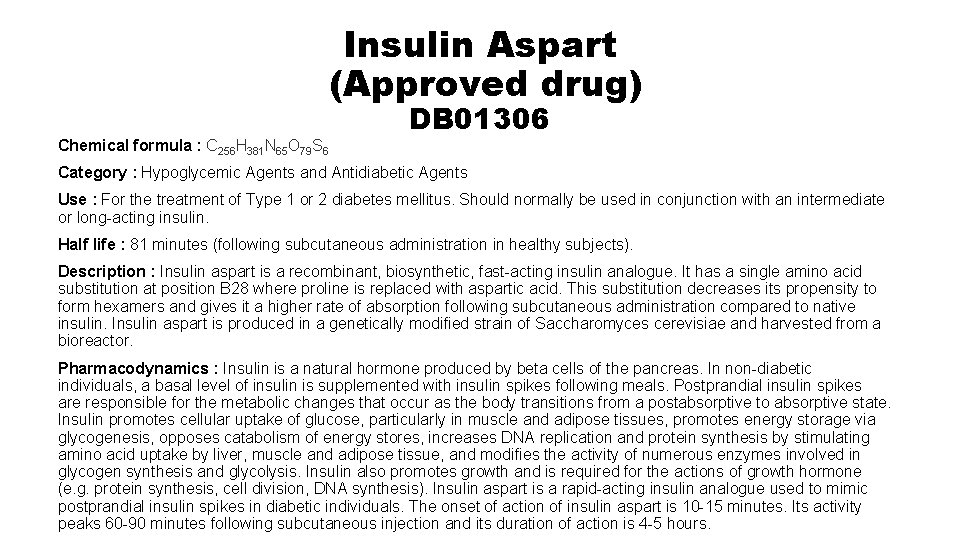
Insulin Aspart (Approved drug) Chemical formula : C 256 H 381 N 65 O 79 S 6 DB 01306 Category : Hypoglycemic Agents and Antidiabetic Agents Use : For the treatment of Type 1 or 2 diabetes mellitus. Should normally be used in conjunction with an intermediate or long-acting insulin. Half life : 81 minutes (following subcutaneous administration in healthy subjects). Description : Insulin aspart is a recombinant, biosynthetic, fast-acting insulin analogue. It has a single amino acid substitution at position B 28 where proline is replaced with aspartic acid. This substitution decreases its propensity to form hexamers and gives it a higher rate of absorption following subcutaneous administration compared to native insulin. Insulin aspart is produced in a genetically modified strain of Saccharomyces cerevisiae and harvested from a bioreactor. Pharmacodynamics : Insulin is a natural hormone produced by beta cells of the pancreas. In non-diabetic individuals, a basal level of insulin is supplemented with insulin spikes following meals. Postprandial insulin spikes are responsible for the metabolic changes that occur as the body transitions from a postabsorptive to absorptive state. Insulin promotes cellular uptake of glucose, particularly in muscle and adipose tissues, promotes energy storage via glycogenesis, opposes catabolism of energy stores, increases DNA replication and protein synthesis by stimulating amino acid uptake by liver, muscle and adipose tissue, and modifies the activity of numerous enzymes involved in glycogen synthesis and glycolysis. Insulin also promotes growth and is required for the actions of growth hormone (e. g. protein synthesis, cell division, DNA synthesis). Insulin aspart is a rapid-acting insulin analogue used to mimic postprandial insulin spikes in diabetic individuals. The onset of action of insulin aspart is 10 -15 minutes. Its activity peaks 60 -90 minutes following subcutaneous injection and its duration of action is 4 -5 hours.
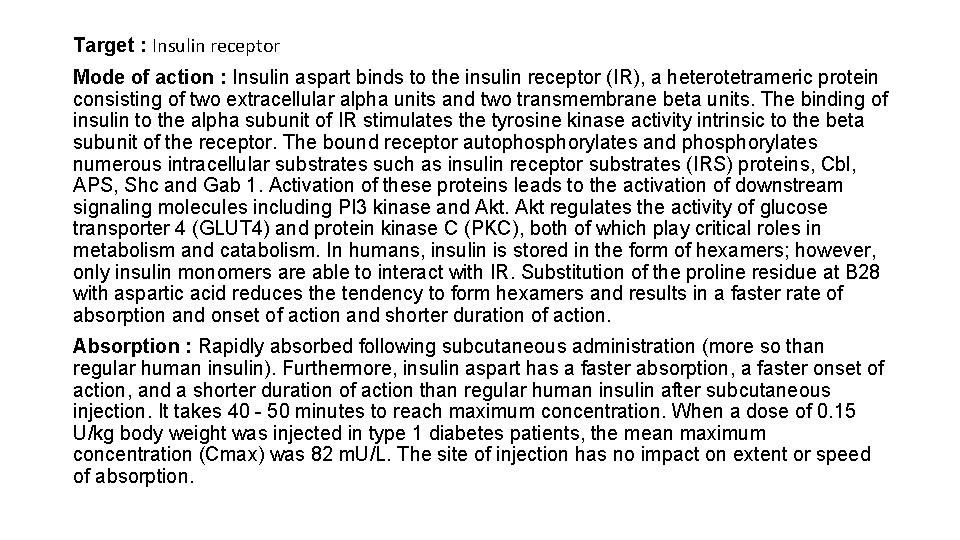
Target : Insulin receptor Mode of action : Insulin aspart binds to the insulin receptor (IR), a heterotetrameric protein consisting of two extracellular alpha units and two transmembrane beta units. The binding of insulin to the alpha subunit of IR stimulates the tyrosine kinase activity intrinsic to the beta subunit of the receptor. The bound receptor autophosphorylates and phosphorylates numerous intracellular substrates such as insulin receptor substrates (IRS) proteins, Cbl, APS, Shc and Gab 1. Activation of these proteins leads to the activation of downstream signaling molecules including PI 3 kinase and Akt regulates the activity of glucose transporter 4 (GLUT 4) and protein kinase C (PKC), both of which play critical roles in metabolism and catabolism. In humans, insulin is stored in the form of hexamers; however, only insulin monomers are able to interact with IR. Substitution of the proline residue at B 28 with aspartic acid reduces the tendency to form hexamers and results in a faster rate of absorption and onset of action and shorter duration of action. Absorption : Rapidly absorbed following subcutaneous administration (more so than regular human insulin). Furthermore, insulin aspart has a faster absorption, a faster onset of action, and a shorter duration of action than regular human insulin after subcutaneous injection. It takes 40 - 50 minutes to reach maximum concentration. When a dose of 0. 15 U/kg body weight was injected in type 1 diabetes patients, the mean maximum concentration (Cmax) was 82 m. U/L. The site of injection has no impact on extent or speed of absorption.
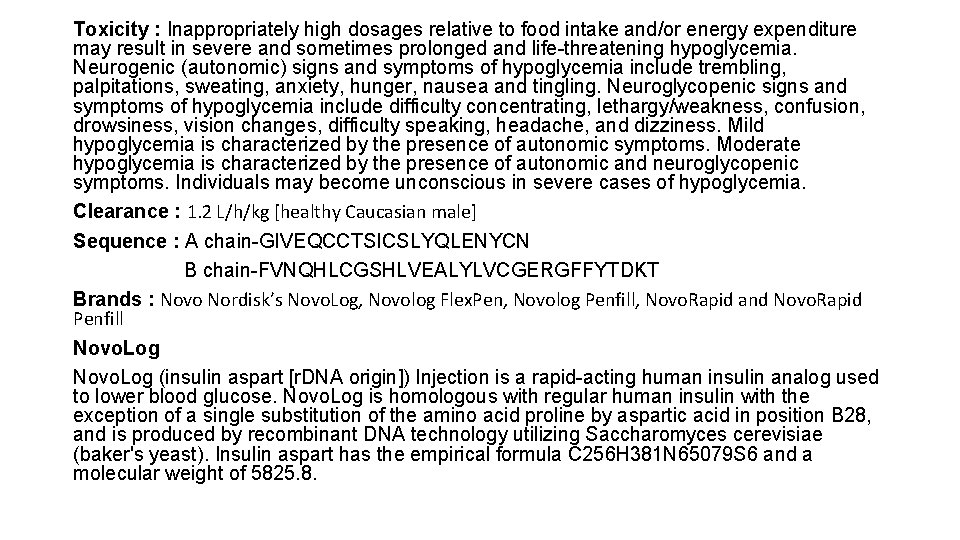
Toxicity : Inappropriately high dosages relative to food intake and/or energy expenditure may result in severe and sometimes prolonged and life-threatening hypoglycemia. Neurogenic (autonomic) signs and symptoms of hypoglycemia include trembling, palpitations, sweating, anxiety, hunger, nausea and tingling. Neuroglycopenic signs and symptoms of hypoglycemia include difficulty concentrating, lethargy/weakness, confusion, drowsiness, vision changes, difficulty speaking, headache, and dizziness. Mild hypoglycemia is characterized by the presence of autonomic symptoms. Moderate hypoglycemia is characterized by the presence of autonomic and neuroglycopenic symptoms. Individuals may become unconscious in severe cases of hypoglycemia. Clearance : 1. 2 L/h/kg [healthy Caucasian male] Sequence : A chain-GIVEQCCTSICSLYQLENYCN B chain-FVNQHLCGSHLVEALYLVCGERGFFYTDKT Brands : Novo Nordisk’s Novo. Log, Novolog Flex. Pen, Novolog Penfill, Novo. Rapid and Novo. Rapid Penfill Novo. Log (insulin aspart [r. DNA origin]) Injection is a rapid-acting human insulin analog used to lower blood glucose. Novo. Log is homologous with regular human insulin with the exception of a single substitution of the amino acid proline by aspartic acid in position B 28, and is produced by recombinant DNA technology utilizing Saccharomyces cerevisiae (baker's yeast). Insulin aspart has the empirical formula C 256 H 381 N 65079 S 6 and a molecular weight of 5825. 8.
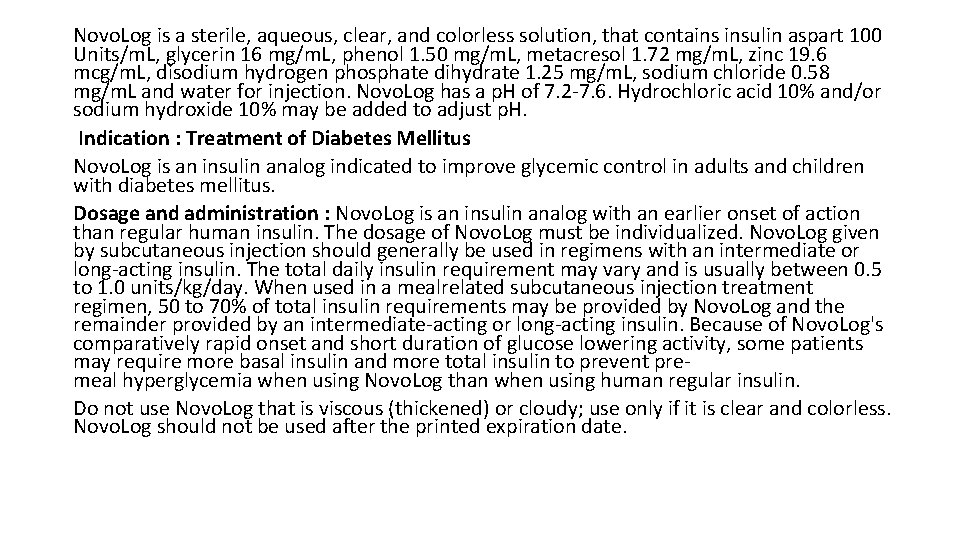
Novo. Log is a sterile, aqueous, clear, and colorless solution, that contains insulin aspart 100 Units/m. L, glycerin 16 mg/m. L, phenol 1. 50 mg/m. L, metacresol 1. 72 mg/m. L, zinc 19. 6 mcg/m. L, disodium hydrogen phosphate dihydrate 1. 25 mg/m. L, sodium chloride 0. 58 mg/m. L and water for injection. Novo. Log has a p. H of 7. 2 -7. 6. Hydrochloric acid 10% and/or sodium hydroxide 10% may be added to adjust p. H. Indication : Treatment of Diabetes Mellitus Novo. Log is an insulin analog indicated to improve glycemic control in adults and children with diabetes mellitus. Dosage and administration : Novo. Log is an insulin analog with an earlier onset of action than regular human insulin. The dosage of Novo. Log must be individualized. Novo. Log given by subcutaneous injection should generally be used in regimens with an intermediate or long-acting insulin. The total daily insulin requirement may vary and is usually between 0. 5 to 1. 0 units/kg/day. When used in a mealrelated subcutaneous injection treatment regimen, 50 to 70% of total insulin requirements may be provided by Novo. Log and the remainder provided by an intermediate-acting or long-acting insulin. Because of Novo. Log's comparatively rapid onset and short duration of glucose lowering activity, some patients may require more basal insulin and more total insulin to prevent premeal hyperglycemia when using Novo. Log than when using human regular insulin. Do not use Novo. Log that is viscous (thickened) or cloudy; use only if it is clear and colorless. Novo. Log should not be used after the printed expiration date.
Subcutaneous Injection Novo. Log should be administered by subcutaneous injection in the abdominal region, buttocks, thigh, or upper arm. Because Novo. Log has a more rapid onset and a shorter duration of activity than human regular insulin, it should be injected immediately (within 5 -10 minutes) before a meal. Injection sites should be rotated within the same region to reduce the risk of lipodystrophy. As with all insulins, the duration of action of Novo. Log will vary according to the dose, injection site, blood flow, temperature, and level of physical activity. Novo. Log may be diluted with Insulin Diluting Medium for Novo. Log for subcutaneous injection. Diluting one part Novo. Log to nine parts diluent will yield a concentration onetenth that of Novo. Log (equivalent to U-10). Diluting one part Novo. Log to one part diluent will yield a concentration one-half that of Novo. Log (equivalent to U-50). Intravenous Use Novo. Log can be administered intravenously under medical supervision for glycemic control with close monitoring of blood glucose and potassium levels to avoid hypoglycemia and hypokalemia. For intravenous use, Novo. Log should be used at concentrations from 0. 05 U/m. L to 1. 0 U/m. L insulin aspart in infusion systems using polypropylene infusion bags. Novo. Log has been shown to be stable in infusion fluids such as 0. 9% sodium chloride. Inspect Novo. Log for particulate matter and discoloration prior to parenteral administration.
Drug interactions : A number of substances affect glucose metabolism and may require insulin dose adjustment and particularly close monitoring. The following are examples of substances that may increase the blood-glucoselowering effect and susceptibility to hypoglycemia: oral antidiabetic products, pramlintide, ACE inhibitors, disopyramide, fibrates, fluoxetine, monoamine oxidase (MAO) inhibitors, propoxyphene, salicylates, somatostatin analog (e. g. , octreotide), sulfonamide antibiotics. The following are examples of substances that may reduce the blood-glucoselowering effect: corticosteroids, niacin, danazol, diuretics, sympathomimetic agents (e. g. , epinephrine, salbutamol, terbutaline), isoniazid, phenothiazine derivatives, somatropin, thyroid hormones, estrogens, progestogens (e. g. , in oral contraceptives), atypical antipsychotics. Beta-blockers, clonidine, lithium salts, and alcohol may either potentiate or weaken the blood-glucoselowering effect of insulin. Pentamidine may cause hypoglycemia, which may sometimes be followed by hyperglycemia. The signs of hypoglycemia may be reduced or absent in patients taking sympatholytic products such as beta-blockers, clonidine, guanethidine, and reserpine. Overdose : Excess insulin administration may cause hypoglycemia and, particularly when given intravenously, hypokalemia. Mild episodes of hypoglycemia usually can be treated with oral glucose. Adjustments in drug dosage, meal patterns, or exercise, may be needed. More severe episodes with coma, seizure, or neurologic impairment may be treated with intramuscular/subcutaneous glucagon or concentrated intravenous glucose. Sustained carbohydrate intake and observation may be necessary because hypoglycemia may recur after apparent clinical recovery. Hypokalemia must be corrected appropriately.
Contraindication : Novo. Log is contraindicated • during episodes of hypoglycemia • in patients with hypersensitivity to Novo. Log or one of its excipients.
General reference : www. rxlist. com www. drugbank. com Heller S, Kurtzhals P, Verge D, Lindholm A: Insulin aspart: promising early results borne out in clinical practice. Expert Opin Pharmacother. 2002 Feb; 3(2): 183 -95. "Pubmed": http: //www. ncbi. nlm. nih. gov/pubmed/11829732# Sciacca L, Cassarino MF, Genua M, Pandini G, Le Moli R, Squatrito S, Vigneri R: Insulin analogues differently activate insulin receptor isoforms and postreceptor signalling. Diabetologia. 2010 Apr 28. "Pubmed": http: //www. ncbi. nlm. nih. gov/pubmed/20424816