
INSULIN ANALOGS WITH EXTENDED TIMEACTION AND HIGH SELECTIVITY
- Slides: 15
INSULIN ANALOGS WITH EXTENDED TIME-ACTION AND HIGH SELECTIVITY FOR INSULIN vs IGF-1 RECEPTOR Wayne Kohn, Radmila Micanovic, Sharon Myers, Andrew Vick, Steven Kahl, Lianshan Zhang, Beth Strifler, Shun Li, Jing Shang, John Beals, John Mayer and Richard Di. Marchi, from Lilly Research Laboratories, Eli Lilly and Company, Indianapolis, IN, 46285
ABSTRACT Attempts to identify a basal insulin product with a peakless profile and 24 hr duration have resulted in little success prior to discovery of insulin glargine, which represents a pharmacokinetic improvement, but with potential limitations such as increased mitogenicity. We conducted a structure-function analysis to identify a superior p. I-shifted basal insulin with a receptor affinity profile more comparable to native human insulin. In particular, we have compared the functional effects of basic residues added selectively and combinatorially to the N-terminus of the A- and B-chains and to the C-terminus of the B -chain. IGF-1 receptor affinity was significantly enhanced by addition of basic residues at the Cterminus of the B-chain. Arginine additions at the N-terminus of the A-chain appreciably decreased IGF-1 receptor affinity when incorporated concomitantly with arginines at the C-terminus of the Bchain. Substitutions at position A 21 also affected receptor selectivity. Analogs were functionally tested for glucose uptake in 3 T 3 -L 1 adipocytes and stimulation of proliferation of human mammary epithelial cells. A strong positive correlation between receptor affinities and respective metabolic and mitogenic potencies was observed. An in vitro assay that estimated solubility of the insulin analogs under physiological conditions was predictive of the time-action in an SRIF dog model. Relative to glargine, two analogs LY 2116419 and LY 2109967 possessed five and fifteen fold greater insulin receptor selectivity, respectively, with correspondingly five and ten fold lower in vitro mitogenic potency, respectively. In the dog model, both analogs displayed a peakless PK/PD profile, which was similar to that of glargine in duration. INTRODUCTION An insulin formulation with a peakless activity profile and 24 hr duration has been long recognized as an important objective for optimizing glucose control in diabetes. The advent of rapid-acting insulins to cover mealtime glucose excursions has intensified the requirement for such a basal insulin , as slow-release formulations of wild-type insulins have been found inadequate. A recently introduced basal insulin, insulin glargine (1) contains one amino acid
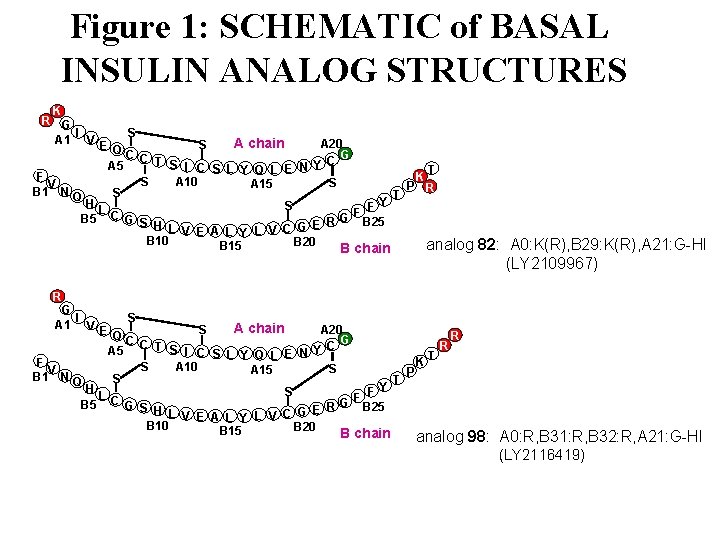
substitution relative to human insulin and two additional Arg residues which extend the duration of action via an increased isoelectric point (p. I-shift approach) from 5. 6 to 7. 0. The peptide is formulated at p. H 4 and precipitates upon subcutaneous injection. The precipitated peptide acts as a depot that is redissolved and absorbed over an extended period. While glargine possesses an attractive pharmacokinetic profile, it also demonstrates significantly increased mitogenic potential relative to human insulin and appreciable intra- and inter-patient variability. We have performed an extensive structure-function analysis to identify additional basal insulin analogs, which utilize the p. I-shift approach to achieve a protracted time action yet maintain a receptor affinity profile that compares more favorably with native insulin. Through this investigation, we intended to identify the ideal number of basic amino acids and their optimal placement in the molecule in order to obtain the desirable pharmacological and physical properties. Effects of basic residues added at the N-terminus of the A-chain, and/or the N-terminus of the B-chain and/or the C-terminus of the Bchain were measured in terms of insulin and IGF-1 receptor binding, stimulation of glucose uptake in differentiated mouse 3 T 3 -L 1 adipocytes and stimulation of cell proliferation in human mammary epithelial cells. To identify analogs that may have a protracted time-action profile in vivo, solubility of the insulin analogs was measured in p. H 7 PBS buffer. Four objectives of our basal insulin design include: (1) extended peakless PK/PD profile; (2) IR vs. IGF-1 R selectivity close to that of human insulin; (3) adequate biopotency; and (4) chemical stability in p. H 4 formulation. ABBREVIATIONS IR, insulin receptor; IGF-1 R, insulin-like growth factor 1 receptor; HI, human insulin; rp-HPLC, reversed-phase high performance liquid chromatography; p. I, isoelectric point; PBS, phosphate-buffered saline NOMENCLATURE Human insulin is a 51 aa protein composed of a 21 aa A chain and a 30 aa B chain held together by two disulfide bonds. The positions within the chains are designated A 1 to A 21 and B 1 to B 30, respectively. Addition of an extra amino acid(s) at either N terminus are given the notation of position 0, -1, etc. For example, addition of an Arg-Arg dipeptide sequence to the N terminus of the A chain would give the analog A 0: R, A(-1): R-HI. Similarly, additional amino acids at the C termini are denoted A 22, A 23, etc.
and B 31, B 32, etc. Addition of amino acid or other acylating agent to Lys e-amine is indicated in brackets after the position of the amino acid. For example, acylation of the B 29: Lys with Arg yields the analog B 29: K(R)-HI. METHODS Insulin analogs were prepared by acylation of one or more of the three amino groups (the two N-terminal amines and the side chain amine of Lysine at position B 29) of an insulin “template” with protected amino acids or dipeptides activated as N-hydroxysuccinimide (NHS) esters with diisopropylcarbodiimide. Agents used were Boc-Arg(Pbf)-NHS; Boc-Arg(Pbf)-NHS, and Boc-Lys(Boc-Arg(Pbf))-NHS. Insulin templates HI; A 21: G-HI; A 21: Xaa-HI; A 21: G, B 31: R-HI, and A 21: G, B 31: R; B 32: R-HI were obtained from expression in E. coli via recombinant DNA technology. Singlechain precursors were solublized from inclusion bodies and refolded under redox conditions. Trypsin treatment cleaved the leader sequence, which ends with an Arg, and excised the C peptide. Carboxypeptidase B was used to trim Arg residues from the B chain C terminus as appropriate. Acylation reactions were performed in water/ACN or water/DMF mixtures at room temperature. The product distribution was modulated via adjustment of the p. H, the equivalents of reagent added, and the length of reaction time. Purification was performed in one of two ways: (1) purification of the reaction mixture by rp. HPLC followed by protecting-group removal and final rp-HPLC purification, or (2) the reaction mixture was diluted with water and lyophilized, followed by protecting group removal, purification by cation exchange chromatography and final purification/desalting by rp-HPLC. Product identity was confirmed by a combination of LC-MS (verification of purity and molecular weight), N-terminal protein sequencing, and LC-MS analysis of Staph. Aureus V 8 protease digest, which yields characteristic fragments via specific cleavage on the carboxyl side of Glu residues (2). Receptor binding assays were performed on P 1 membrane preparations from stably transfected 293 EBNA cells overexpressing the HI or h. IGF-1 receptor. Binding affinities were determined from a competitive binding assay using the respective native ligand, radiolabeled with 125 I. The assay was performed in 96 well plates using scintillation proximity assay mode. Metabolic potency was determined by measurement of uptake of 14 C-deoxyglucose by differentiated mouse 3 T 3 -L 1 adipocytes over 1 hr at 37 o. C. Mitogenic potency was determined by the incorporation of 14 C-thymidine in human mammary epithelial cells over a 48 hr incubation time. In all assays, the activity relative to HI control was determined within each experiment and then averaged over the number of experiments. Therefore comparison of the average EC 50 or IC 50 for an analog with the average value for HI will not generate the same relative activity value.
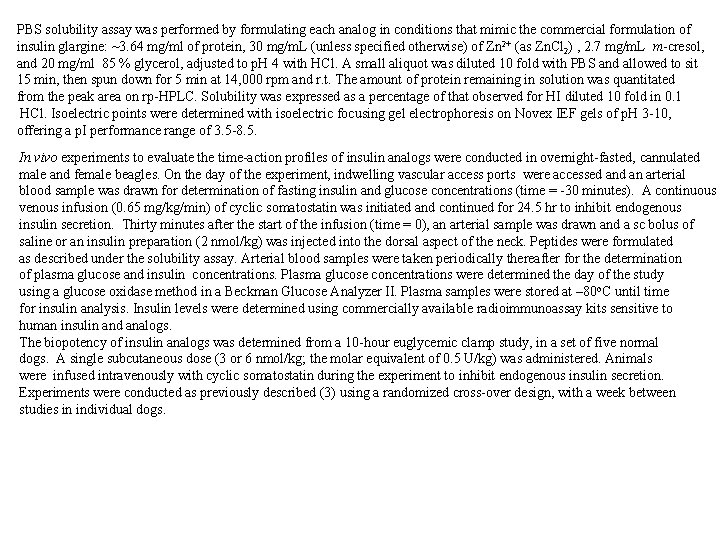
PBS solubility assay was performed by formulating each analog in conditions that mimic the commercial formulation of insulin glargine: ~3. 64 mg/ml of protein, 30 mg/m. L (unless specified otherwise) of Zn 2+ (as Zn. Cl 2) , 2. 7 mg/m. L m-cresol, and 20 mg/ml 85 % glycerol, adjusted to p. H 4 with HCl. A small aliquot was diluted 10 fold with PBS and allowed to sit 15 min, then spun down for 5 min at 14, 000 rpm and r. t. The amount of protein remaining in solution was quantitated from the peak area on rp-HPLC. Solubility was expressed as a percentage of that observed for HI diluted 10 fold in 0. 1 HCl. Isoelectric points were determined with isoelectric focusing gel electrophoresis on Novex IEF gels of p. H 3 -10, offering a p. I performance range of 3. 5 -8. 5. In vivo experiments to evaluate the time-action profiles of insulin analogs were conducted in overnight-fasted, cannulated male and female beagles. On the day of the experiment, indwelling vascular access ports were accessed an arterial blood sample was drawn for determination of fasting insulin and glucose concentrations (time = -30 minutes). A continuous venous infusion (0. 65 mg/kg/min) of cyclic somatostatin was initiated and continued for 24. 5 hr to inhibit endogenous insulin secretion. Thirty minutes after the start of the infusion (time = 0), an arterial sample was drawn and a sc bolus of saline or an insulin preparation (2 nmol/kg) was injected into the dorsal aspect of the neck. Peptides were formulated as described under the solubility assay. Arterial blood samples were taken periodically thereafter for the determination of plasma glucose and insulin concentrations. Plasma glucose concentrations were determined the day of the study using a glucose oxidase method in a Beckman Glucose Analyzer II. Plasma samples were stored at – 80 o. C until time for insulin analysis. Insulin levels were determined using commercially available radioimmunoassay kits sensitive to human insulin and analogs. The biopotency of insulin analogs was determined from a 10 -hour euglycemic clamp study, in a set of five normal dogs. A single subcutaneous dose (3 or 6 nmol/kg; the molar equivalent of 0. 5 U/kg) was administered. Animals were infused intravenously with cyclic somatostatin during the experiment to inhibit endogenous insulin secretion. Experiments were conducted as previously described (3) using a randomized cross-over design, with a week between studies in individual dogs.
Figure 1: SCHEMATIC of BASAL INSULIN ANALOG STRUCTURES K R G S I A 1 V A chain A 20 S E Q G C C C T S I C Y A 5 R N S L Y Q L E T K F A 10 S S V A 15 P R B 1 N Q S T H S F Y L C F B 5 G S H R G B 25 L V E A L Y L V C G E B 10 B 20 analog B 15 B chain 82: A 0: K(R), B 29: K(R), A 21: G-HI (LY 2109967) R G S I A 1 V A chain A 20 S E Q R G C C C R T S I C S L Y Q L E N Y A 5 R T K F A 10 S S V A 15 P B 1 N Q S T H S F Y L C F B 5 G S H R G B 25 L V E A L Y L V C G E B 10 B 20 B 15 B chain analog 98: A 0: R, B 31: R, B 32: R, A 21: G-HI (LY 2116419)
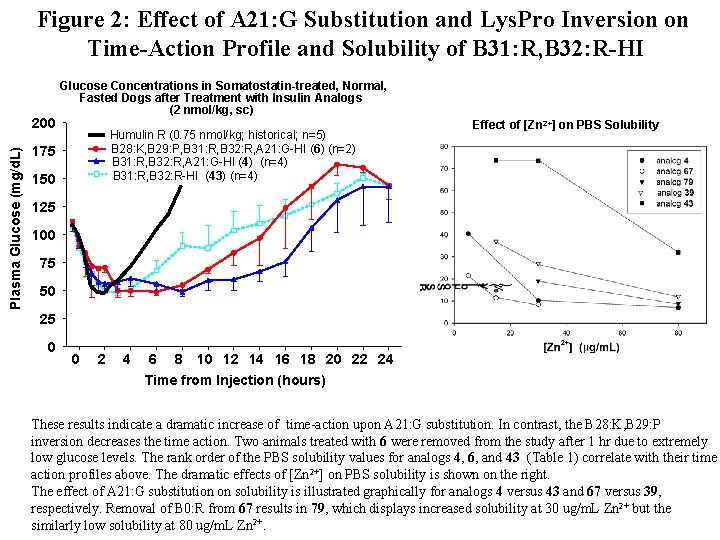
Figure 2: Effect of A 21: G Substitution and Lys. Pro Inversion on Time-Action Profile and Solubility of B 31: R, B 32: R-HI Plasma Glucose (mg/d. L) 200 Glucose Concentrations in Somatostatin-treated, Normal, Fasted Dogs after Treatment with Insulin Analogs (2 nmol/kg, sc) Humulin R (0. 75 nmol/kg; historical; n=5) B 28: K, B 29: P, B 31: R, B 32: R, A 21: G-HI (6) (n=2) B 31: R, B 32: R, A 21: G-HI (4) (n=4) B 31: R, B 32: R-HI (43) (n=4) 175 150 Effect of [Zn 2+] on PBS Solubility 125 100 75 50 25 0 0 2 4 6 8 10 12 14 16 18 20 22 24 Time from Injection (hours) These results indicate a dramatic increase of time-action upon A 21: G substitution. In contrast, the B 28: K, B 29: P inversion decreases the time action. Two animals treated with 6 were removed from the study after 1 hr due to extremely low glucose levels. The rank order of the PBS solubility values for analogs 4, 6, and 43 (Table 1) correlate with their time action profiles above. The dramatic effects of [Zn 2+] on PBS solubility is shown on the right. The effect of A 21: G substitution on solubility is illustrated graphically for analogs 4 versus 43 and 67 versus 39, respectively. Removal of B 0: R from 67 results in 79, which displays increased solubility at 30 ug/m. L Zn 2+ but the similarly low solubility at 80 ug/m. L Zn 2+.
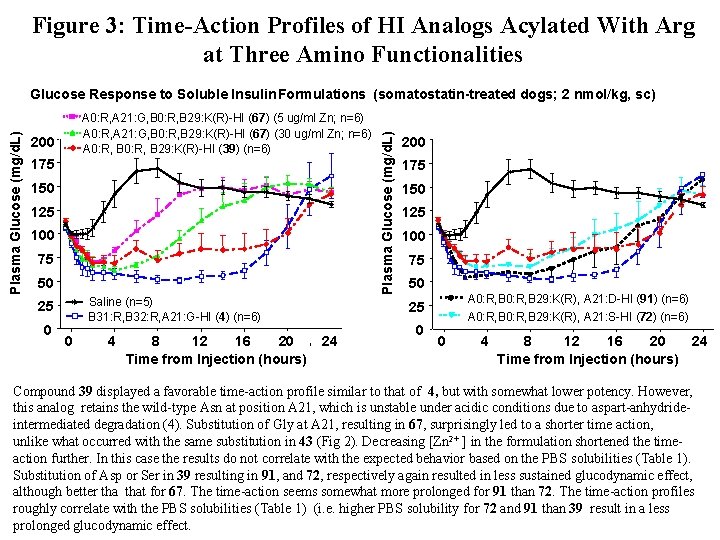
Figure 3: Time-Action Profiles of HI Analogs Acylated With Arg at Three Amino Functionalities A 0: R, A 21: G, B 0: R, B 29: K(R)-HI (67) (5 ug/ml Zn; n=6) A 0: R, A 21: G, B 0: R, B 29: K(R)-HI (67) (30 ug/ml Zn; n=6) A 0: R, B 29: K(R)-HI (39) (n=6) 200 175 150 125 100 75 50 Saline (n=5) B 31: R, B 32: R, A 21: G-HI (4) (n=6) 25 0 0 4 8 12 16 20 Time from Injection (hours) Plasma Glucose (mg/d. L) Glucose Response to Soluble Insulin. Formulations (somatostatin-treated dogs; 2 nmol/kg, sc) 200 175 150 125 100 75 50 A 0: R, B 29: K(R), A 21: D-HI (91) (n=6) A 0: R, B 29: K(R), A 21: S-HI (72) (n=6) 25 24 0 0 4 24 8 12 16 20 Time from Injection (hours) Compound 39 displayed a favorable time-action profile similar to that of 4, but with somewhat lower potency. However, this analog retains the wild-type Asn at position A 21, which is unstable under acidic conditions due to aspart-anhydrideintermediated degradation (4). Substitution of Gly at A 21, resulting in 67, surprisingly led to a shorter time action, unlike what occurred with the same substitution in 43 (Fig 2). Decreasing [Zn 2+ ] in the formulation shortened the timeaction further. In this case the results do not correlate with the expected behavior based on the PBS solubilities (Table 1). Substitution of Asp or Ser in 39 resulting in 91, and 72, respectively again resulted in less sustained glucodynamic effect, although better that for 67. The time-action seems somewhat more prolonged for 91 than 72. The time-action profiles roughly correlate with the PBS solubilities (Table 1) (i. e. higher PBS solubility for 72 and 91 than 39 result in a less prolonged glucodynamic effect.
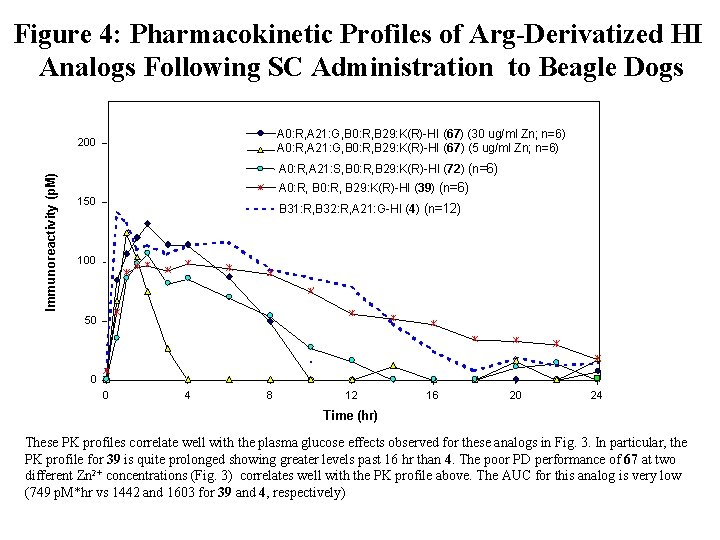
Figure 4: Pharmacokinetic Profiles of Arg-Derivatized HI Analogs Following SC Administration to Beagle Dogs A 0: R, A 21: G, B 0: R, B 29: K(R)-HI (67) (30 ug/ml Zn; n=6) A 0: R, A 21: G, B 0: R, B 29: K(R)-HI (67) (5 ug/ml Zn; n=6) Immunoreactivity (p. M) 200 A 0: R, A 21: S, B 0: R, B 29: K(R)-HI (72) (n=6) A 0: R, B 29: K(R)-HI (39) (n=6) 150 B 31: R, B 32: R, A 21: G-HI (4) (n=12) 100 50 0 0 4 8 12 16 20 24 Time (hr) These PK profiles correlate well with the plasma glucose effects observed for these analogs in Fig. 3. In particular, the PK profile for 39 is quite prolonged showing greater levels past 16 hr than 4. The poor PD performance of 67 at two different Zn 2+ concentrations (Fig. 3) correlates well with the PK profile above. The AUC for this analog is very low (749 p. M*hr vs 1442 and 1603 for 39 and 4, respectively)
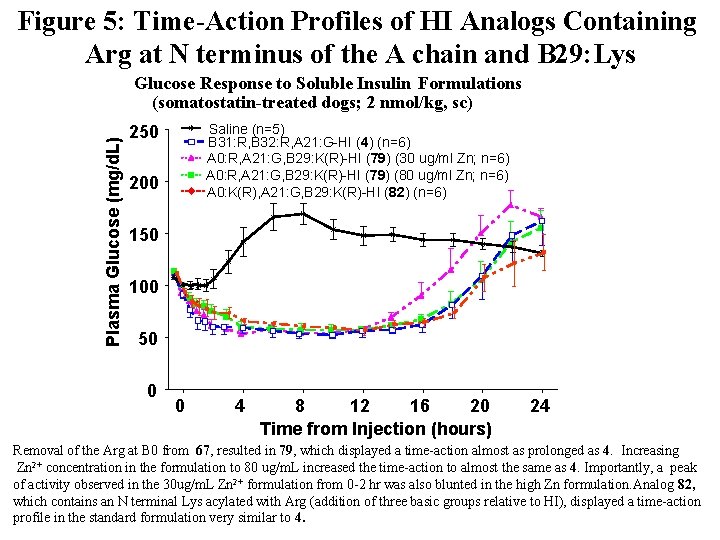
Figure 5: Time-Action Profiles of HI Analogs Containing Arg at N terminus of the A chain and B 29: Lys Plasma Glucose (mg/d. L) Glucose Response to Soluble Insulin Formulations (somatostatin-treated dogs; 2 nmol/kg, sc) Saline (n=5) B 31: R, B 32: R, A 21: G-HI (4) (n=6) A 0: R, A 21: G, B 29: K(R)-HI (79) (30 ug/ml Zn; n=6) A 0: R, A 21: G, B 29: K(R)-HI (79) (80 ug/ml Zn; n=6) A 0: K(R), A 21: G, B 29: K(R)-HI (82) (n=6) 250 200 150 100 50 0 0 4 8 12 16 20 Time from Injection (hours) 24 Removal of the Arg at B 0 from 67, resulted in 79, which displayed a time-action almost as prolonged as 4. Increasing Zn 2+ concentration in the formulation to 80 ug/m. L increased the time-action to almost the same as 4. Importantly, a peak of activity observed in the 30 ug/m. L Zn 2+ formulation from 0 -2 hr was also blunted in the high Zn formulation. Analog 82, which contains an N terminal Lys acylated with Arg (addition of three basic groups relative to HI), displayed a time-action profile in the standard formulation very similar to 4.
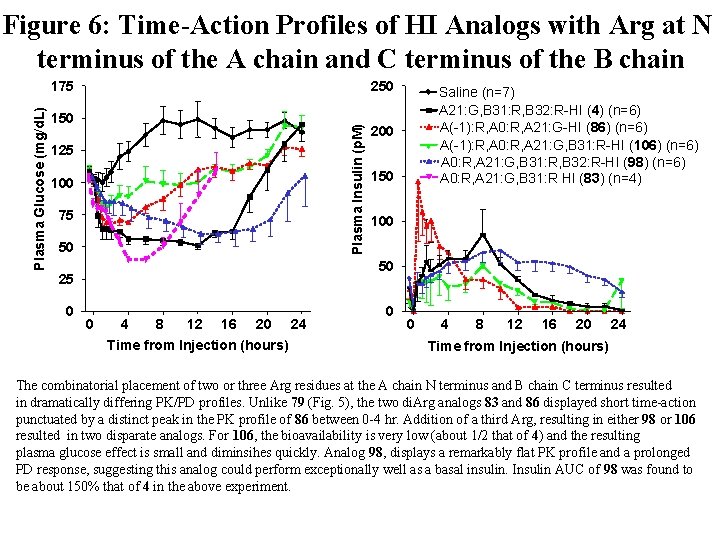
Figure 6: Time-Action Profiles of HI Analogs with Arg at N terminus of the A chain and C terminus of the B chain 250 150 Plasma Insulin (p. M) Plasma Glucose (mg/d. L) 175 125 100 75 50 200 150 100 50 25 0 Saline (n=7) A 21: G, B 31: R, B 32: R-HI (4) (n=6) A(-1): R, A 0: R, A 21: G-HI (86) (n=6) A(-1): R, A 0: R, A 21: G, B 31: R-HI (106) (n=6) A 0: R, A 21: G, B 31: R, B 32: R-HI (98) (n=6) A 0: R, A 21: G, B 31: R HI (83) (n=4) 0 4 8 12 16 20 Time from Injection (hours) 24 0 0 4 8 12 16 20 24 Time from Injection (hours) The combinatorial placement of two or three Arg residues at the A chain N terminus and B chain C terminus resulted in dramatically differing PK/PD profiles. Unlike 79 (Fig. 5), the two di. Arg analogs 83 and 86 displayed short time-action punctuated by a distinct peak in the PK profile of 86 between 0 -4 hr. Addition of a third Arg, resulting in either 98 or 106 resulted in two disparate analogs. For 106, the bioavailability is very low (about 1/2 that of 4) and the resulting plasma glucose effect is small and diminsihes quickly. Analog 98, displays a remarkably flat PK profile and a prolonged PD response, suggesting this analog could perform exceptionally well as a basal insulin. Insulin AUC of 98 was found to be about 150% that of 4 in the above experiment.
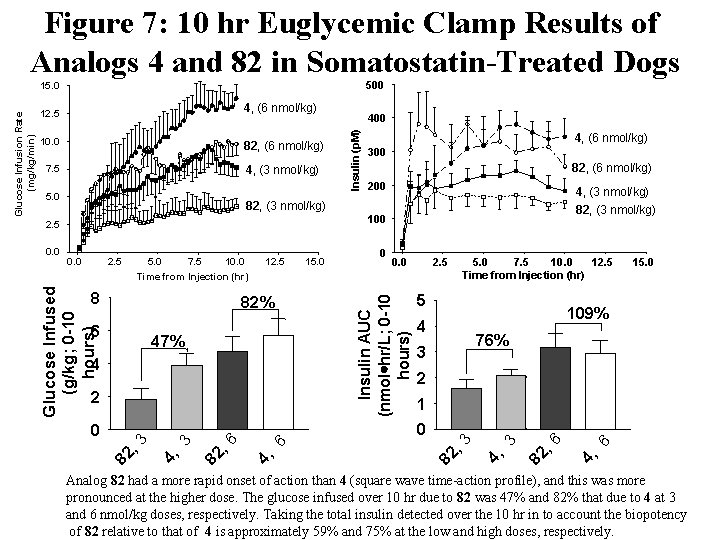
Figure 7: 10 hr Euglycemic Clamp Results of Analogs 4 and 82 in Somatostatin-Treated Dogs 500 4, (6 nmol/kg) 10. 0 82, (6 nmol/kg) 4, (3 nmol/kg) 7. 5 5. 0 4, (6 nmol/kg) 300 82, (6 nmol/kg) 200 4, (3 nmol/kg) 82, (3 nmol/kg) 100 2. 5 5. 0 7. 5 10. 0 Time from Injection (hr) 8 12. 5 82% 6 47% 4 2 0 0. 0 2. 5 5. 0 7. 5 10. 0 12. 5 Time from Injection (hr) 5 15. 0 109% 4 76% 3 2 1 6 4, , 6 82 3 4, , 3 0 82 0 15. 0 82 0. 0 Insulin AUC (nmol ·hr/L; 0 -10 hours) 2. 5 0. 0 400 Insulin (p. M) 12. 5 Glucose Infused (g/kg; 0 -10 hours) Glucose Infusion Rate (mg/kg/min) 15. 0 Analog 82 had a more rapid onset of action than 4 (square wave time-action profile), and this was more pronounced at the higher dose. The glucose infused over 10 hr due to 82 was 47% and 82% that due to 4 at 3 and 6 nmol/kg doses, respectively. Taking the total insulin detected over the 10 hr in to account the biopotency of 82 relative to that of 4 is approximately 59% and 75% at the low and high doses, respectively.
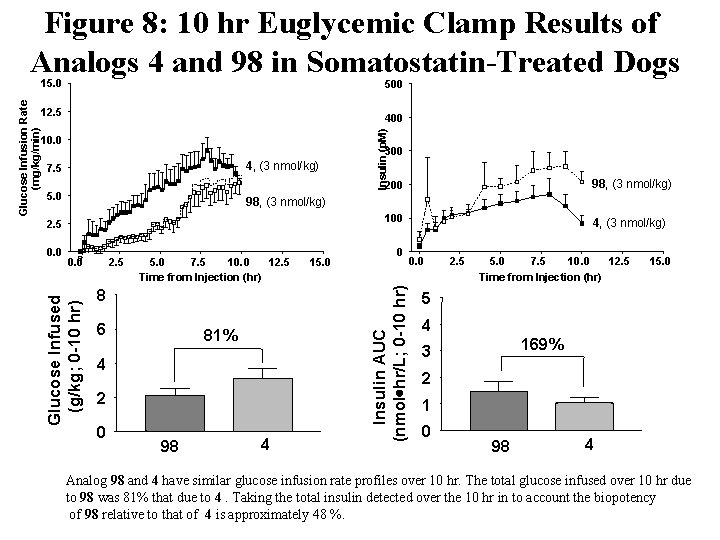
Figure 8: 10 hr Euglycemic Clamp Results of Analogs 4 and 98 in Somatostatin-Treated Dogs 500 12. 5 10. 0 300 4, (3 nmol/kg) 7. 5 5. 0 200 98, (3 nmol/kg) 100 4, (3 nmol/kg) 98, (3 nmol/kg) 2. 5 0. 0 Glucose Infused (g/kg; 0 -10 hr) 0. 0 Insulin (p. M) 400 2. 5 5. 0 7. 5 10. 0 12. 5 Time from Injection (hr) 8 6 81% 4 2 0 98 4 15. 0 0 Insulin AUC (nmol· hr/L; 0 -10 hr) Glucose Infusion Rate (mg/kg/min) 15. 0 0. 0 2. 5 5. 0 7. 5 10. 0 12. 5 Time from Injection (hr) 15. 0 5 4 169% 3 2 1 0 98 4 Analog 98 and 4 have similar glucose infusion rate profiles over 10 hr. The total glucose infused over 10 hr due to 98 was 81% that due to 4. Taking the total insulin detected over the 10 hr in to account the biopotency of 98 relative to that of 4 is approximately 48 %.
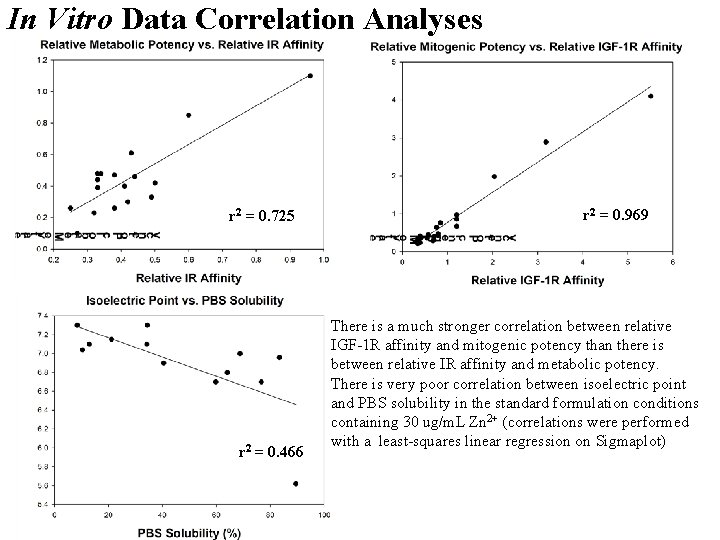
In Vitro Data Correlation Analyses r 2 = 0. 725 r 2 = 0. 466 r 2 = 0. 969 There is a much stronger correlation between relative IGF-1 R affinity and mitogenic potency than there is between relative IR affinity and metabolic potency. There is very poor correlation between isoelectric point and PBS solubility in the standard formulation conditions containing 30 ug/m. L Zn 2+ (correlations were performed with a least-squares linear regression on Sigmaplot)
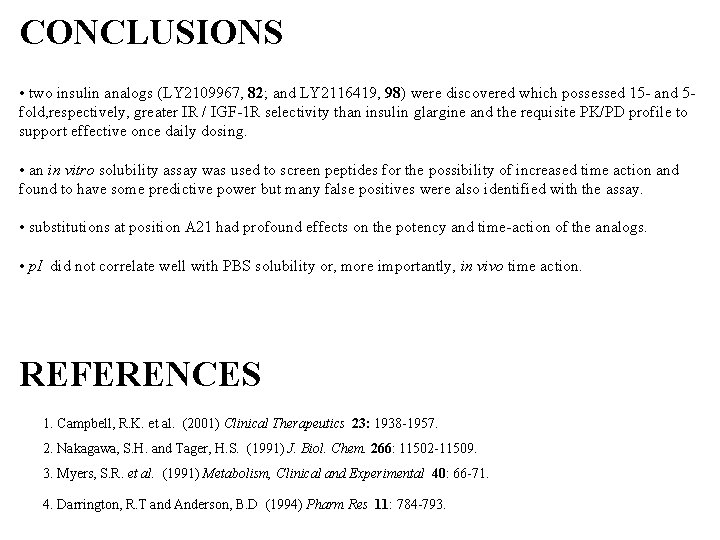
CONCLUSIONS • two insulin analogs (LY 2109967, 82; and LY 2116419, 98) were discovered which possessed 15 - and 5 fold, respectively, greater IR / IGF-1 R selectivity than insulin glargine and the requisite PK/PD profile to support effective once daily dosing. • an in vitro solubility assay was used to screen peptides for the possibility of increased time action and found to have some predictive power but many false positives were also identified with the assay. • substitutions at position A 21 had profound effects on the potency and time-action of the analogs. • p. I did not correlate well with PBS solubility or, more importantly, in vivo time action. REFERENCES 1. Campbell, R. K. et al. (2001) Clinical Therapeutics 23: 1938 -1957. 2. Nakagawa, S. H. and Tager, H. S. (1991) J. Biol. Chem. 266: 11502 -11509. 3. Myers, S. R. et al. (1991) Metabolism, Clinical and Experimental 40: 66 -71. 4. Darrington, R. T and Anderson, B. D (1994) Pharm Res 11: 784 -793.