
Insufflator q principles of operation function use scientific

- Slides: 14
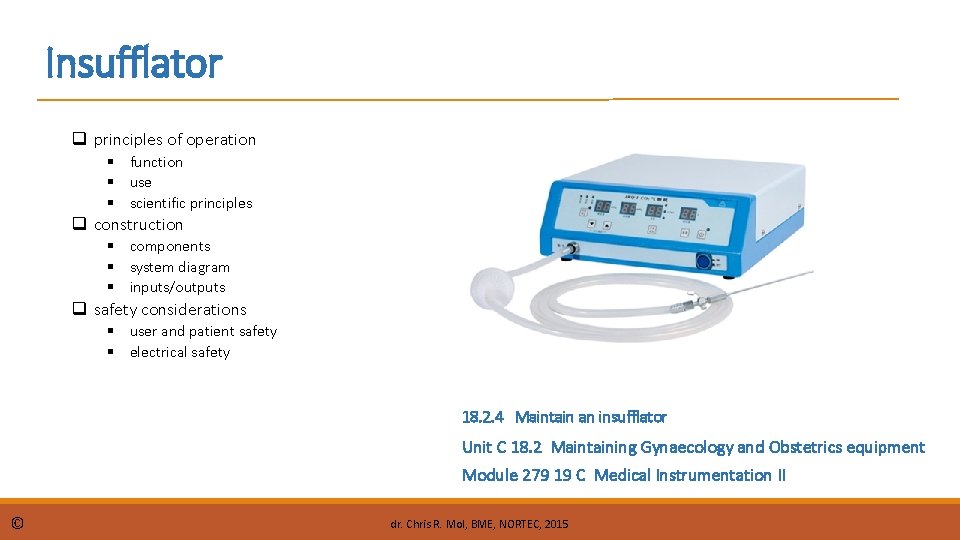
Insufflator q principles of operation § function § use § scientific principles q construction § components § system diagram § inputs/outputs q safety considerations § user and patient safety § electrical safety 18. 2. 4 Maintain an insufflator Unit C 18. 2 Maintaining Gynaecology and Obstetrics equipment Module 279 19 C Medical Instrumentation II © dr. Chris R. Mol, BME, NORTEC, 2015
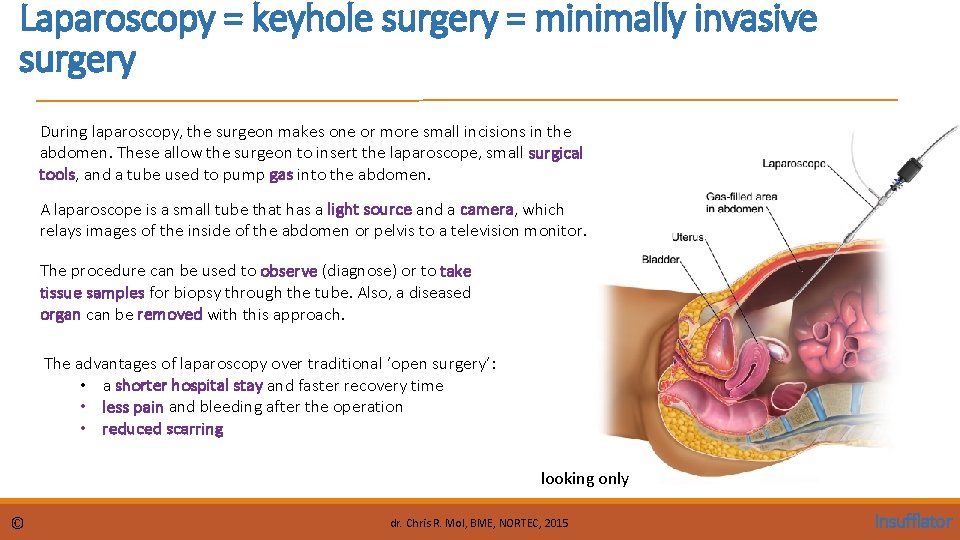
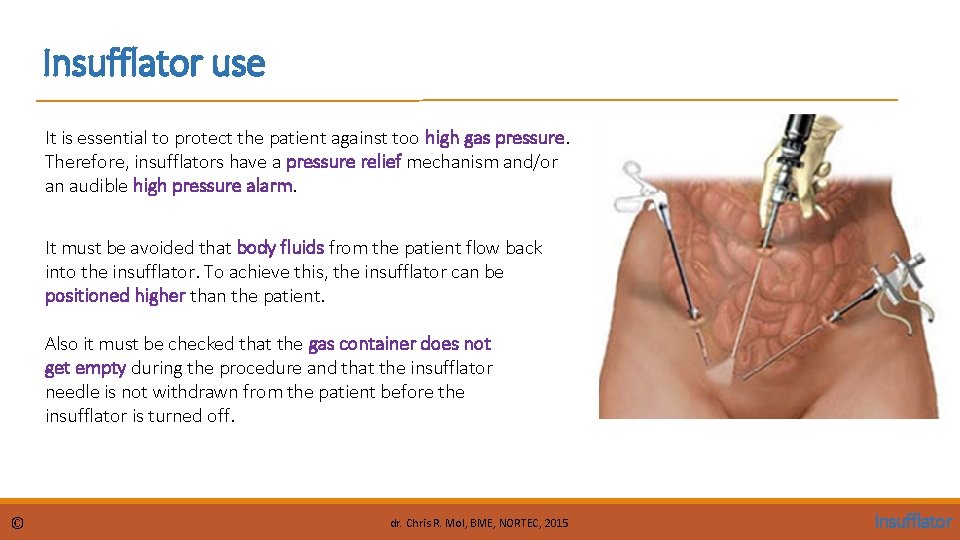
Laparoscopy = keyhole surgery = minimally invasive surgery During laparoscopy, the surgeon makes one or more small incisions in the abdomen. These allow the surgeon to insert the laparoscope, small surgical tools, and a tube used to pump gas into the abdomen. A laparoscope is a small tube that has a light source and a camera, which relays images of the inside of the abdomen or pelvis to a television monitor. The procedure can be used to observe (diagnose) or to take tissue samples for biopsy through the tube. Also, a diseased organ can be removed with this approach. The advantages of laparoscopy over traditional ‘open surgery’: • a shorter hospital stay and faster recovery time • less pain and bleeding after the operation • reduced scarring looking only © dr. Chris R. Mol, BME, NORTEC, 2015 Insufflator
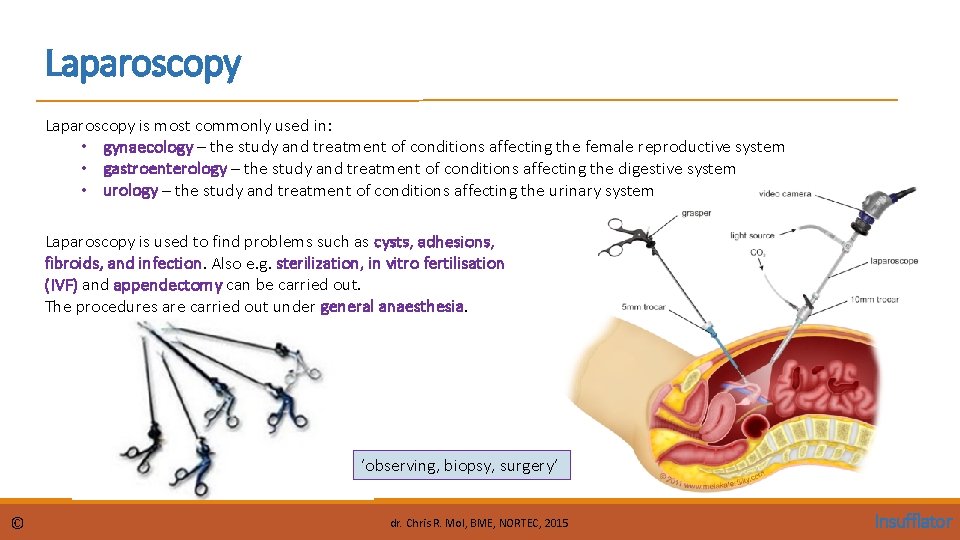
Laparoscopy is most commonly used in: • gynaecology – the study and treatment of conditions affecting the female reproductive system • gastroenterology – the study and treatment of conditions affecting the digestive system • urology – the study and treatment of conditions affecting the urinary system Laparoscopy is used to find problems such as cysts, adhesions, fibroids, and infection. Also e. g. sterilization, in vitro fertilisation (IVF) and appendectomy can be carried out. The procedures are carried out under general anaesthesia. ‘observing, biopsy, surgery’ © dr. Chris R. Mol, BME, NORTEC, 2015 Insufflator
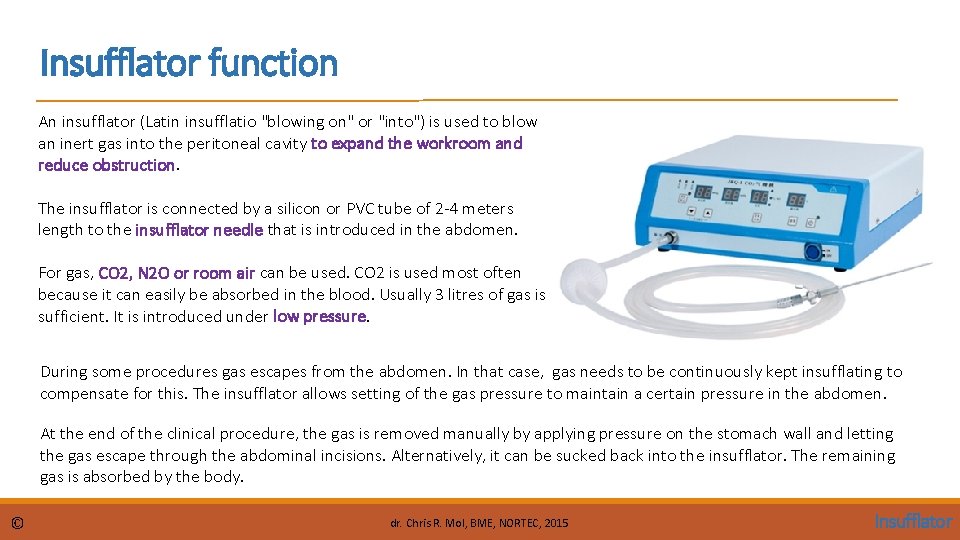
Insufflator function An insufflator (Latin insufflatio "blowing on" or "into") is used to blow an inert gas into the peritoneal cavity to expand the workroom and reduce obstruction. The insufflator is connected by a silicon or PVC tube of 2 -4 meters length to the insufflator needle that is introduced in the abdomen. For gas, CO 2, N 2 O or room air can be used. CO 2 is used most often because it can easily be absorbed in the blood. Usually 3 litres of gas is sufficient. It is introduced under low pressure. During some procedures gas escapes from the abdomen. In that case, gas needs to be continuously kept insufflating to compensate for this. The insufflator allows setting of the gas pressure to maintain a certain pressure in the abdomen. At the end of the clinical procedure, the gas is removed manually by applying pressure on the stomach wall and letting the gas escape through the abdominal incisions. Alternatively, it can be sucked back into the insufflator. The remaining gas is absorbed by the body. © dr. Chris R. Mol, BME, NORTEC, 2015 Insufflator
Insufflator use It is essential to protect the patient against too high gas pressure. Therefore, insufflators have a pressure relief mechanism and/or an audible high pressure alarm. It must be avoided that body fluids from the patient flow back into the insufflator. To achieve this, the insufflator can be positioned higher than the patient. Also it must be checked that the gas container does not get empty during the procedure and that the insufflator needle is not withdrawn from the patient before the insufflator is turned off. © dr. Chris R. Mol, BME, NORTEC, 2015 Insufflator
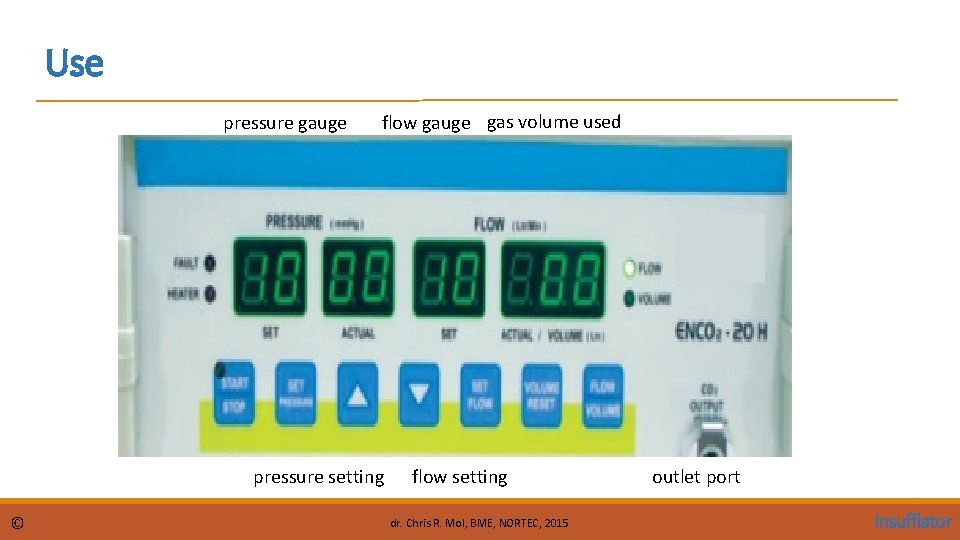
Use pressure gauge flow gauge gas volume used pressure setting © flow setting dr. Chris R. Mol, BME, NORTEC, 2015 outlet port Insufflator
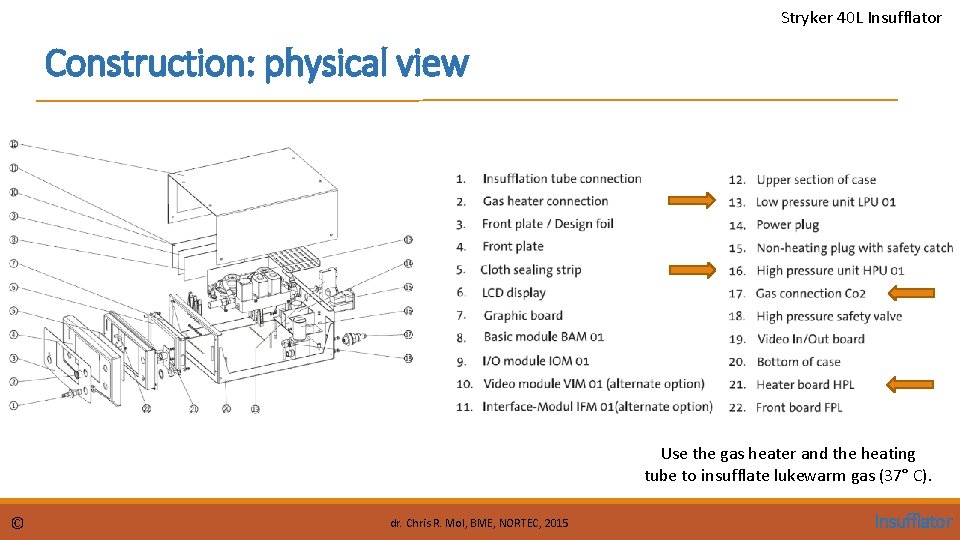
Stryker 40 L Insufflator Construction: physical view Use the gas heater and the heating tube to insufflate lukewarm gas (37° C). © dr. Chris R. Mol, BME, NORTEC, 2015 Insufflator
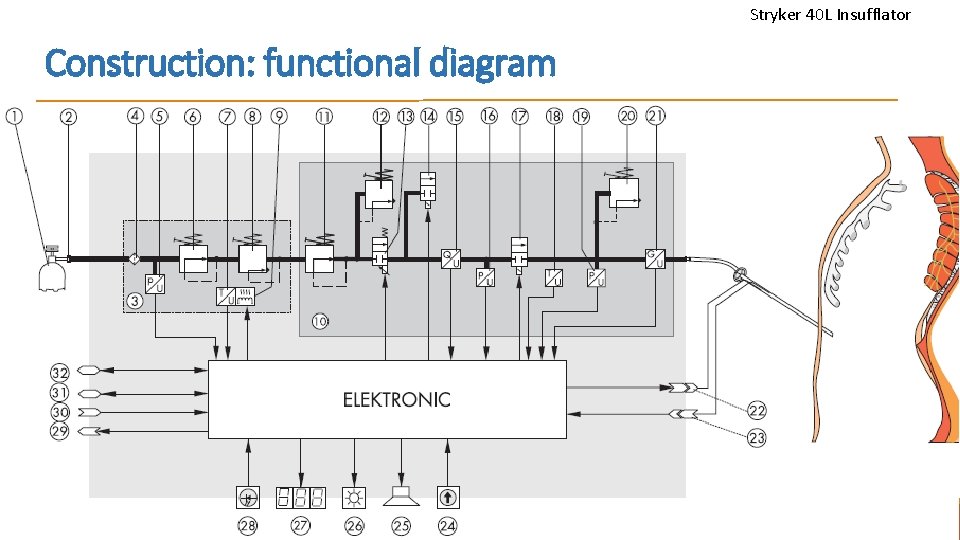
Stryker 40 L Insufflator Construction: functional diagram Stryker 40 L Insufflator © dr. Chris R. Mol, BME, NORTEC, 2015 Insufflator
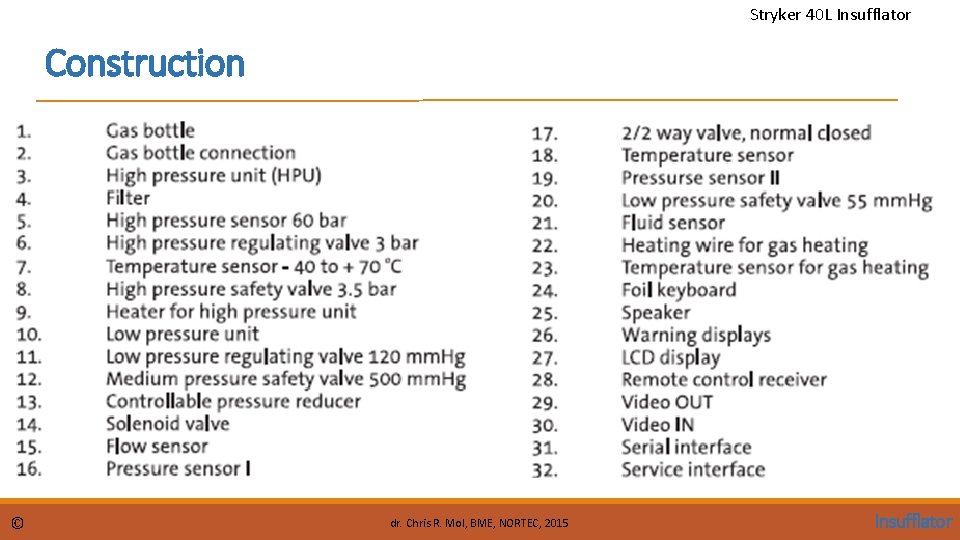
Stryker 40 L Insufflator Construction © dr. Chris R. Mol, BME, NORTEC, 2015 Insufflator
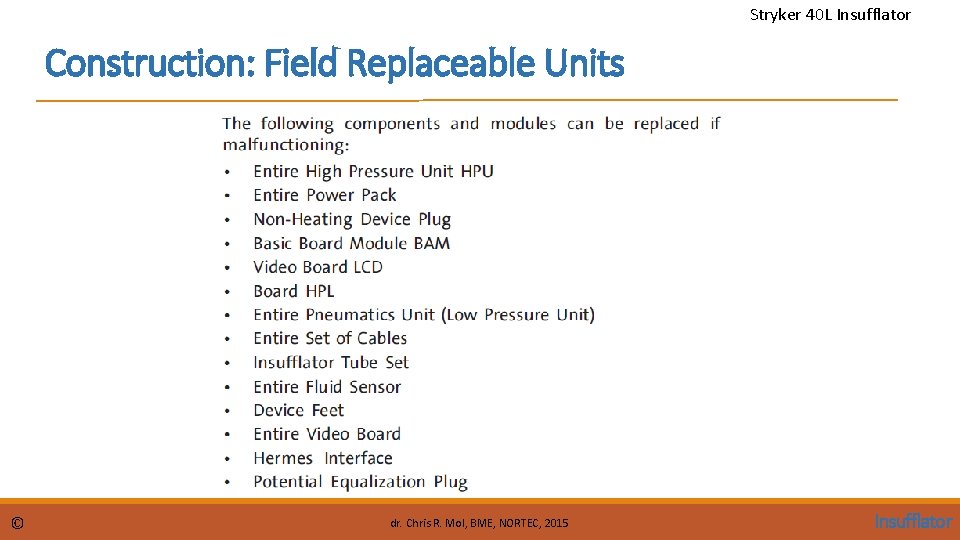
Stryker 40 L Insufflator Construction: Field Replaceable Units © dr. Chris R. Mol, BME, NORTEC, 2015 Insufflator
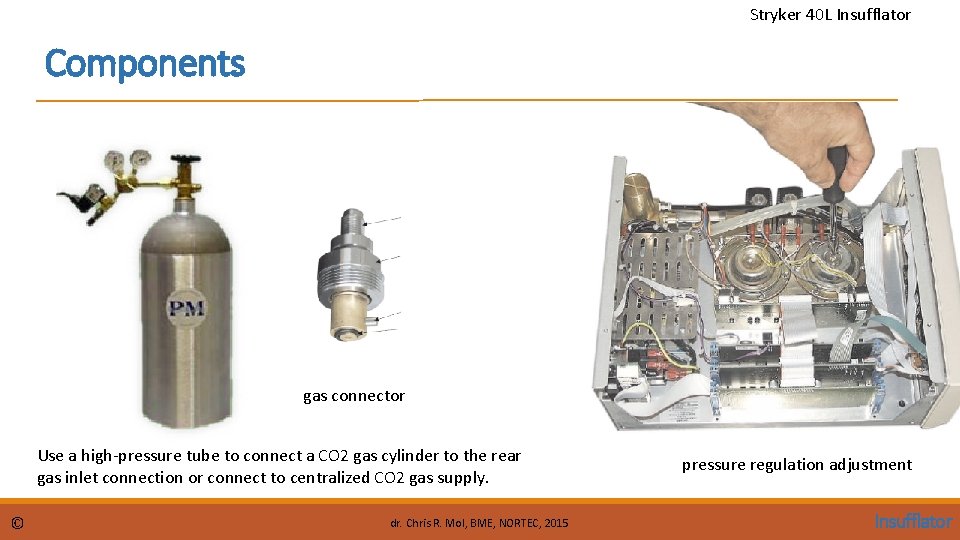
Stryker 40 L Insufflator Components gas connector Use a high-pressure tube to connect a CO 2 gas cylinder to the rear gas inlet connection or connect to centralized CO 2 gas supply. © dr. Chris R. Mol, BME, NORTEC, 2015 pressure regulation adjustment Insufflator
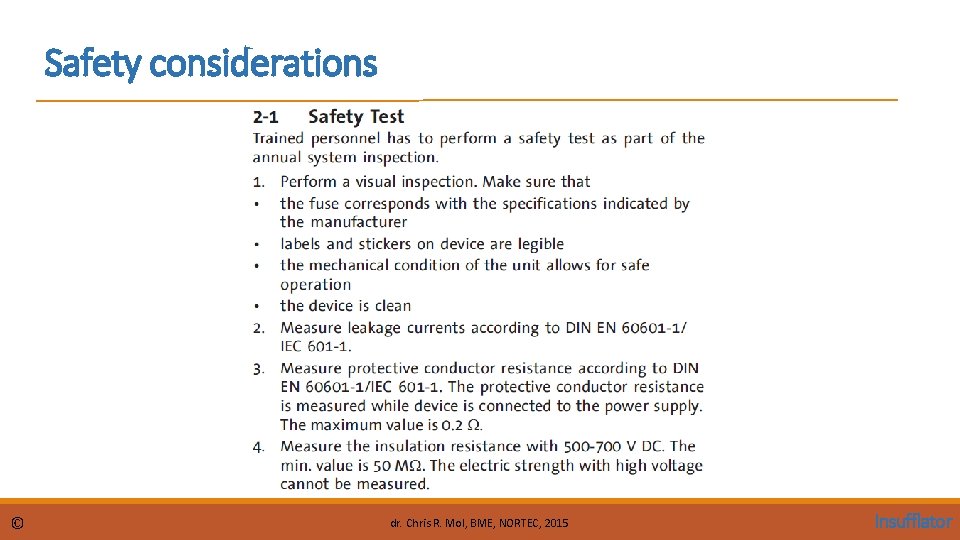
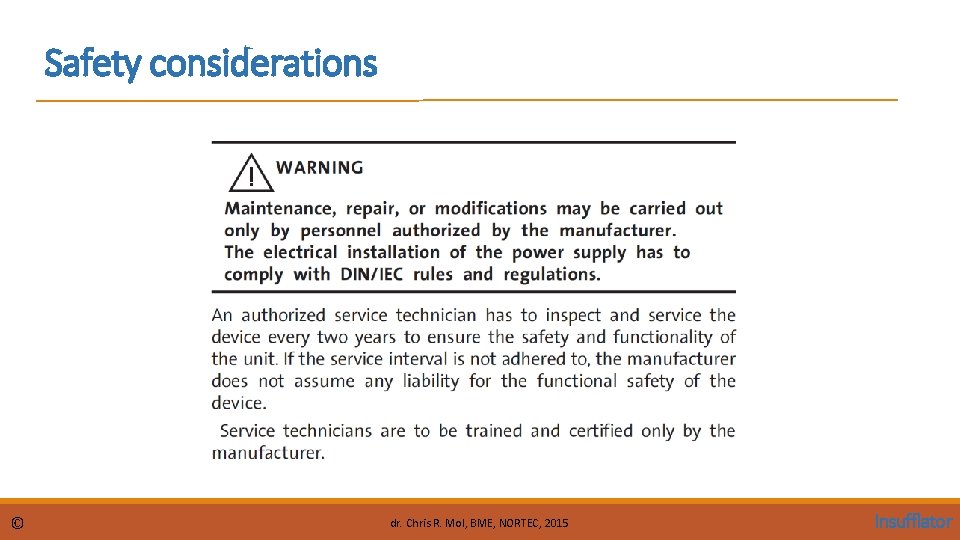
Safety considerations © dr. Chris R. Mol, BME, NORTEC, 2015 Insufflator
Safety considerations © dr. Chris R. Mol, BME, NORTEC, 2015 Insufflator
END The creation of this presentation was supported by a grant from THET: see https: //www. thet. org/